Review: Political Influence on Economic Growth in India (Course Name)
VerifiedAdded on 2023/01/11
|9
|2805
|37
Report
AI Summary
This report provides a critical review of a research paper by Asher and Novosad, investigating the correlation between political partisanship and economic growth in India. The paper employs a regression discontinuity model to analyze how the allocation of government resources by politicians influences private sector employment, stock prices, and overall output. The authors highlight the impact of electoral cycles and political favoritism on economic distortions. The review discusses the paper's methodology, including the use of census data and night light analysis, while also critiquing certain aspects, such as the data's age and the logic behind using night lights as an economic indicator. The review further compares the research with existing literature, like the works of Przeworski and Limongi, and Jong-aPin, and concludes that the authors successfully demonstrate the significant influence of political leaders on both public and private sectors through their control over credit, public goods, and regulations, while acknowledging that the study was unable to determine any link between politically influenced credit and political favoritism on employment growth, or public goods and employment rates. The review offers suggestions for potential extensions and highlights the implications of the findings, particularly regarding the impact of elections and political instability on economic outcomes.
1
Critical Review
Research question
In this paper, economists Sam Asher and Paul Novosad have shed some light on the
correlation between politics and growth in the context of India. The authors have pointed out that
political partisanship can influence the provision of government resources. Disproportionate
distribution of government inputs by predisposed politicians can affect the growth the country in
the long term. It can lead to higher private sector employment, rise in stock prices of firms and
increase in overall output. The elected politicians often talk into the firms by using the
regulations for their own benefits. There are also certain aspects of business where the firms have
to depend on the government, for example, the allocation of land to set up manufacturing unit. It
is only up to the government to allocate such resources. The existing literature base of the
research explains the magnitude of regulatory favors tendered to the firms. Due to its effective
regulation mechanism, access to banking loans and public infrastructure, a democratic system is
ideal to improve such allocation from government end. The authors have also attempted to
determine the factor that is most likely to be used by the ruling dispensation. In order to fill the
existing literature gap, the authors have presented a detailed analysis of the economic distortion
due political favouritism and its long-term effects on the economy.
Context of the paper
The paper shows a model of political decision making, where the ruling dispensation try
influence the allocation of government resources for their electoral benefits. The authors have
presented a detailed overview of the Indian electoral system. The constitution bestows the Indian
states with significant power and authority. After the election, the winning candidates form the
State Legislative Assembly with a single member representing each constituency. The party with
Critical Review
Research question
In this paper, economists Sam Asher and Paul Novosad have shed some light on the
correlation between politics and growth in the context of India. The authors have pointed out that
political partisanship can influence the provision of government resources. Disproportionate
distribution of government inputs by predisposed politicians can affect the growth the country in
the long term. It can lead to higher private sector employment, rise in stock prices of firms and
increase in overall output. The elected politicians often talk into the firms by using the
regulations for their own benefits. There are also certain aspects of business where the firms have
to depend on the government, for example, the allocation of land to set up manufacturing unit. It
is only up to the government to allocate such resources. The existing literature base of the
research explains the magnitude of regulatory favors tendered to the firms. Due to its effective
regulation mechanism, access to banking loans and public infrastructure, a democratic system is
ideal to improve such allocation from government end. The authors have also attempted to
determine the factor that is most likely to be used by the ruling dispensation. In order to fill the
existing literature gap, the authors have presented a detailed analysis of the economic distortion
due political favouritism and its long-term effects on the economy.
Context of the paper
The paper shows a model of political decision making, where the ruling dispensation try
influence the allocation of government resources for their electoral benefits. The authors have
presented a detailed overview of the Indian electoral system. The constitution bestows the Indian
states with significant power and authority. After the election, the winning candidates form the
State Legislative Assembly with a single member representing each constituency. The party with

Paraphrase This Document
Need a fresh take? Get an instant paraphrase of this document with our AI Paraphraser
2
the maximum number of seats is invited by the governor (appointed by the President) to form the
government with or without the support of allies. The local development funds are distributed
amongst the Members of Legislative Assembly or MLAs. An MLA must co-operate and
maintain good relationship with the center to get the development acts sanctioned. It is up to the
government to allocate development funds and sanction infrastructure projects. So, in a way,
politicians can make it easier for the businessmen to set up their factory units. The companies
also heavily rely on government officials for inputs. The government owned public sector
companies are also important part of the state economy. Although, researchers like Przeworski
and Limongi (1993)have denied any connection between politics and economic growth.
According to their research, economical growth has more to do with the nature of politics
practiced. It is evident in South America. The countries with a democratic system of
administration enjoyed a higher growth rate than countries with autocratic administration. The
transformation of political scenarios is related to the growth spurts. This article suggests
bureaucratic involvement reflecting the Weberian in economic growth facilitation (Evans and
Kauch, 1999).
Method and Model
In this paper, the authors have used a regression discontinuity model. There is no spatial
co-relation between the ruling and opposition as they often share borders. The two political
parties are represented as A and B. A follows a policy of XA and B follows a policy of XB in a
one-dimensional continuum. An amount of K is distributed amongst the elected representatives
to be spent in the constituencies. The model assumes that every constituency have two politicians
who are able to accommodate the government resources efficiently. The central government
decides on input allocation. Politicians with low capacity are unable to bring in necessary
the maximum number of seats is invited by the governor (appointed by the President) to form the
government with or without the support of allies. The local development funds are distributed
amongst the Members of Legislative Assembly or MLAs. An MLA must co-operate and
maintain good relationship with the center to get the development acts sanctioned. It is up to the
government to allocate development funds and sanction infrastructure projects. So, in a way,
politicians can make it easier for the businessmen to set up their factory units. The companies
also heavily rely on government officials for inputs. The government owned public sector
companies are also important part of the state economy. Although, researchers like Przeworski
and Limongi (1993)have denied any connection between politics and economic growth.
According to their research, economical growth has more to do with the nature of politics
practiced. It is evident in South America. The countries with a democratic system of
administration enjoyed a higher growth rate than countries with autocratic administration. The
transformation of political scenarios is related to the growth spurts. This article suggests
bureaucratic involvement reflecting the Weberian in economic growth facilitation (Evans and
Kauch, 1999).
Method and Model
In this paper, the authors have used a regression discontinuity model. There is no spatial
co-relation between the ruling and opposition as they often share borders. The two political
parties are represented as A and B. A follows a policy of XA and B follows a policy of XB in a
one-dimensional continuum. An amount of K is distributed amongst the elected representatives
to be spent in the constituencies. The model assumes that every constituency have two politicians
who are able to accommodate the government resources efficiently. The central government
decides on input allocation. Politicians with low capacity are unable to bring in necessary
3
developmental resources to his reign or some may let his existing resources be stolen through
corruption or misallocation. A voter votes on the ability of the candidate to bring in these utilities
from the central government. The voter’s understanding of the candidate’s policy is another key
factor. Although the voter may not have an in-person interaction with the candidate, yet his
perception is based on popular opinion and feedbacks from the government. Voters may also
take into account that amount of benefits the ruling party can bring into their area. The ruling
party also want to increase their chance of coming back to power.
All these parameters indicate that the ruling party is more likely to favour candidates who
are able to win trust of their voters. Candidates from the ruling disposition are more likely to be
allocated with greater number of resources if he or she have high chances of re-election. An
average voter is heavily influenced by the government policies and the ability of the respective
candidates. This model assumes that every voter is rational. It recognizes the fact that all political
parties try their best to shape voter opinion on their candidates. When elections are close the
differential seems maximum. Also, voters may think that the election result will affect the
development projects. They can shape their opinion from the resources allocated in the opposite
constituencies. Finally, the result is derived from the
Data and Empirical Strategy
Most of the data used for this research have been sourced from Census reports. The most
recent one is from 2005. While the data that has been used may be old, the research is quite
authentic since only the highest rated data sources were used for research. Here, night lights have
been used to judge the growth of economy. Some areas also fall under tourist spots as well as
children’s play areas where bigger lights may be used. These areas may not necessarily be
industrial areas but there is a definitive association between the two which makes for good
developmental resources to his reign or some may let his existing resources be stolen through
corruption or misallocation. A voter votes on the ability of the candidate to bring in these utilities
from the central government. The voter’s understanding of the candidate’s policy is another key
factor. Although the voter may not have an in-person interaction with the candidate, yet his
perception is based on popular opinion and feedbacks from the government. Voters may also
take into account that amount of benefits the ruling party can bring into their area. The ruling
party also want to increase their chance of coming back to power.
All these parameters indicate that the ruling party is more likely to favour candidates who
are able to win trust of their voters. Candidates from the ruling disposition are more likely to be
allocated with greater number of resources if he or she have high chances of re-election. An
average voter is heavily influenced by the government policies and the ability of the respective
candidates. This model assumes that every voter is rational. It recognizes the fact that all political
parties try their best to shape voter opinion on their candidates. When elections are close the
differential seems maximum. Also, voters may think that the election result will affect the
development projects. They can shape their opinion from the resources allocated in the opposite
constituencies. Finally, the result is derived from the
Data and Empirical Strategy
Most of the data used for this research have been sourced from Census reports. The most
recent one is from 2005. While the data that has been used may be old, the research is quite
authentic since only the highest rated data sources were used for research. Here, night lights have
been used to judge the growth of economy. Some areas also fall under tourist spots as well as
children’s play areas where bigger lights may be used. These areas may not necessarily be
industrial areas but there is a definitive association between the two which makes for good
⊘ This is a preview!⊘
Do you want full access?
Subscribe today to unlock all pages.

Trusted by 1+ million students worldwide
4
research. The night lights may be present sometimes but they might not be operative at night.
This may depend upon the continuity of electricity in the area. Therefore, I found this
relationship of the lights and the growth of the economy of the region somewhat illogical. I may
have thought of considering the area’s per capita income in order to measure the overall
economic growth. There was one more aspect which I found dubious and that was the Census
data were up to 2005 but the results of elections were only available up to the year 2012. The
manner in which the organization of these datasets was done was indeed a humongous analytical
job for those who were working upon this project.
Results
The linear-regression method was used to study the general impact of the ruling party. It
was found that the ruling party is most impactful whenever the elections are near. Additionally,
the effect of the election is mostly localized which may be because of the politicians investing
largely in constituencies that are competitive as these are the ones which apparently have the
most electoral potential. To conclude we can say that in private sectors, employment growth is
influenced mainly by the growth rate of constituencies that are in opposition than the growth rate
in constituencies that are dominating. Even the traders of local markets now have knowledge
regarding these factors which directly reflects in the pricing of stocks of the products. The
fluctuation in these stock prices is also dependent upon the date of elections. These findings
resemble the results from Economic Census and night lights. The authors have further
emphasized here that the workings of public sector firms are entirely different from that of
private sector firms. India’s economy is largely constituted of public sector firms and according
to Economic Census, the mean employee count is 2.4. Although the multi-angular impact and
influence of politics on private as well as public firms is evident from the research, this article
research. The night lights may be present sometimes but they might not be operative at night.
This may depend upon the continuity of electricity in the area. Therefore, I found this
relationship of the lights and the growth of the economy of the region somewhat illogical. I may
have thought of considering the area’s per capita income in order to measure the overall
economic growth. There was one more aspect which I found dubious and that was the Census
data were up to 2005 but the results of elections were only available up to the year 2012. The
manner in which the organization of these datasets was done was indeed a humongous analytical
job for those who were working upon this project.
Results
The linear-regression method was used to study the general impact of the ruling party. It
was found that the ruling party is most impactful whenever the elections are near. Additionally,
the effect of the election is mostly localized which may be because of the politicians investing
largely in constituencies that are competitive as these are the ones which apparently have the
most electoral potential. To conclude we can say that in private sectors, employment growth is
influenced mainly by the growth rate of constituencies that are in opposition than the growth rate
in constituencies that are dominating. Even the traders of local markets now have knowledge
regarding these factors which directly reflects in the pricing of stocks of the products. The
fluctuation in these stock prices is also dependent upon the date of elections. These findings
resemble the results from Economic Census and night lights. The authors have further
emphasized here that the workings of public sector firms are entirely different from that of
private sector firms. India’s economy is largely constituted of public sector firms and according
to Economic Census, the mean employee count is 2.4. Although the multi-angular impact and
influence of politics on private as well as public firms is evident from the research, this article
Paraphrase This Document
Need a fresh take? Get an instant paraphrase of this document with our AI Paraphraser
5
has proved beyond doubt that the attitude of leaders in political parties impacts both these
sectors.
The authors have touched upon the effect of credit, public goods and regulations on the
economic growth here. If we consider a single item of regulation like the permission for mining,
the authors have observed that the ruling party has permitted areas that can be used for mining.
However, a direct link cannot be established between the easier permissions and economic
growth but the authors have also argued thatregulations by political parties do have an influence
over the economic growth of the area concerned. However, the authors have not beenable to
determine any link between politically influenced credit and political favoritism on employment
growth. As for public goods like infrastructure, the current article also could not examine the link
between political favoritism and public infrastructure on the overall increase in employment rates
of the region.
Literature - comparison
When political instability increases, economic growth shows a lower performance. This
has been reflected in the research of Jong-aPin (2009) and Klomp and de Haan (2009).
Considering the association between politics and a growth of regional economy, Rogoff (1990)
observed that the way economic situation changes can affect or determine the pattern of votes
obtained in elections. When the economic conditions are adverse, the disappointment of the
people would come upon the governing part. In the subsequent election that party is likely to be
voted out from the governing position. Thus, the association of growth in votes and the local
economy is determined indirectly. This is because the ability of the governing party can be
reflected in terms of the economic set up which can determine the results of elections. For this
same reason, a political person would attempt to continue his service in office. This can have a
has proved beyond doubt that the attitude of leaders in political parties impacts both these
sectors.
The authors have touched upon the effect of credit, public goods and regulations on the
economic growth here. If we consider a single item of regulation like the permission for mining,
the authors have observed that the ruling party has permitted areas that can be used for mining.
However, a direct link cannot be established between the easier permissions and economic
growth but the authors have also argued thatregulations by political parties do have an influence
over the economic growth of the area concerned. However, the authors have not beenable to
determine any link between politically influenced credit and political favoritism on employment
growth. As for public goods like infrastructure, the current article also could not examine the link
between political favoritism and public infrastructure on the overall increase in employment rates
of the region.
Literature - comparison
When political instability increases, economic growth shows a lower performance. This
has been reflected in the research of Jong-aPin (2009) and Klomp and de Haan (2009).
Considering the association between politics and a growth of regional economy, Rogoff (1990)
observed that the way economic situation changes can affect or determine the pattern of votes
obtained in elections. When the economic conditions are adverse, the disappointment of the
people would come upon the governing part. In the subsequent election that party is likely to be
voted out from the governing position. Thus, the association of growth in votes and the local
economy is determined indirectly. This is because the ability of the governing party can be
reflected in terms of the economic set up which can determine the results of elections. For this
same reason, a political person would attempt to continue his service in office. This can have a
6
positive impact on the economic status of nation to enhance the opportunities of being elected to
power again. Often a politician uses propaganda before election in order to announce his or her
capabilities which can even be quite farfetched or away from the truth. Now, Keynes suggests
that such an approach can affect the economic conditions of a nation for a short time. The present
politician raises supply of money when the election closes. This builds a platform which helps
increase rates of employment and level of output. These conditions are favorable for voters such
that the present leader can be voted again to power. Many voters are not treated right because
they often do not understand that when elections are over and complete, the levels of
employment and output are likely to go back to previous levels. According to Rogoff(1990)
election is carried out on previously decided date and hence the consequences of pre-election
cannot have any real effect on elections. Also due to political manipulations which are quite
frequent nowadays, the voters’ decisions will depend rather on the bigger promises for returns
made by the candidates. Irrespective of the fact that a nation is democratic or autocratic, the
economic conditions can fall below the international benchmark in terms of quality. According
to the Great Man Theory mentioned by Zolcsac (2015) the actions of a leader can determine the
economic status of a nation. As per Levine, a rise in investments can bring about more capital
accumulation which will take forward to higher economic developments in a certain area.
Foreign investments can have long term effect on the Indian economy. This is because it brings
on capital as foreign investments within the national boundaries. During last two decades,
several politicians of India and economic leaders were fostering such investments. This capital
could be provided towards the waning industries in order to regenerate them such that
employment in the country can grow (Duhan, 2014). When foreign money flows into the
economy, the growth can be rapid between 2001 and 2010. This high growth rate can be
positive impact on the economic status of nation to enhance the opportunities of being elected to
power again. Often a politician uses propaganda before election in order to announce his or her
capabilities which can even be quite farfetched or away from the truth. Now, Keynes suggests
that such an approach can affect the economic conditions of a nation for a short time. The present
politician raises supply of money when the election closes. This builds a platform which helps
increase rates of employment and level of output. These conditions are favorable for voters such
that the present leader can be voted again to power. Many voters are not treated right because
they often do not understand that when elections are over and complete, the levels of
employment and output are likely to go back to previous levels. According to Rogoff(1990)
election is carried out on previously decided date and hence the consequences of pre-election
cannot have any real effect on elections. Also due to political manipulations which are quite
frequent nowadays, the voters’ decisions will depend rather on the bigger promises for returns
made by the candidates. Irrespective of the fact that a nation is democratic or autocratic, the
economic conditions can fall below the international benchmark in terms of quality. According
to the Great Man Theory mentioned by Zolcsac (2015) the actions of a leader can determine the
economic status of a nation. As per Levine, a rise in investments can bring about more capital
accumulation which will take forward to higher economic developments in a certain area.
Foreign investments can have long term effect on the Indian economy. This is because it brings
on capital as foreign investments within the national boundaries. During last two decades,
several politicians of India and economic leaders were fostering such investments. This capital
could be provided towards the waning industries in order to regenerate them such that
employment in the country can grow (Duhan, 2014). When foreign money flows into the
economy, the growth can be rapid between 2001 and 2010. This high growth rate can be
⊘ This is a preview!⊘
Do you want full access?
Subscribe today to unlock all pages.
Trusted by 1+ million students worldwide
7
expressed in form of 8.5 to 9 percent growth rate of GDP, huge savings and levels of
investments. Finally, the political leaders can significantly influence economic progress in the
country via fostering foreign investments.
Discussions and conclusions
The association between local economic activities and political scenario is reflected in the
article. This is a reflection of literature review where previous instances of the License Rule
mechanism were studied. Political influence has been defended on grounds of promoting
economic growth. The heavy control of the government’s regulation on industries was tracked
properly I think. Political influence was justified to be an important consideration for economic
growth. Decisions related to expansion of output, imports etc are determined via government
regulations earlier to 1990. After liberalizations, the burdens could be lowered. When there are
no official regulations the political parties will try to control the resources existing. When
resources are allocated they are also based on individual preferences. One needs to choose the
government such that the same is cordial towards promoting businesses. In a global economy
this is most important. For a developing nation like India, economic strength is often decided by
its industrial growth. This leads to better rates of production and employment. If the economy is
strong, it can attract investors. If the reader is not much expert in statistics, he would find it
complicated. The linear model is concerned with some vector based parameters. The
assumptions are simplistic in nature. It might be difficult to replicate the research unless a
different approach is used for choosing parameters. The strength of the paper lies in its findings
section.
Recommendations
expressed in form of 8.5 to 9 percent growth rate of GDP, huge savings and levels of
investments. Finally, the political leaders can significantly influence economic progress in the
country via fostering foreign investments.
Discussions and conclusions
The association between local economic activities and political scenario is reflected in the
article. This is a reflection of literature review where previous instances of the License Rule
mechanism were studied. Political influence has been defended on grounds of promoting
economic growth. The heavy control of the government’s regulation on industries was tracked
properly I think. Political influence was justified to be an important consideration for economic
growth. Decisions related to expansion of output, imports etc are determined via government
regulations earlier to 1990. After liberalizations, the burdens could be lowered. When there are
no official regulations the political parties will try to control the resources existing. When
resources are allocated they are also based on individual preferences. One needs to choose the
government such that the same is cordial towards promoting businesses. In a global economy
this is most important. For a developing nation like India, economic strength is often decided by
its industrial growth. This leads to better rates of production and employment. If the economy is
strong, it can attract investors. If the reader is not much expert in statistics, he would find it
complicated. The linear model is concerned with some vector based parameters. The
assumptions are simplistic in nature. It might be difficult to replicate the research unless a
different approach is used for choosing parameters. The strength of the paper lies in its findings
section.
Recommendations
Paraphrase This Document
Need a fresh take? Get an instant paraphrase of this document with our AI Paraphraser
8
The period for economic outcome covered around seven to eight years. Every politician
can have certain opposition period as well. For avoiding the complications and ensuring the
article to be an easy read, qualitative research can also be used. This can be based on surveys and
case studies. Primary surveys have the advantage of providing first hand data sets. Interviews
prove to be cost effective way of processing and collecting data (Egan, 2007). Unique datasets
can be generated. One can ensure reliability by being cautious about the formats of questions
used and choices of samples. One can also quantify the qualified data collected through
interviews. Researchers have revealed they are well acquainted with quantitative methods and
reasoning.
References
Asher, S., & Novosad, P. (2017). Politics and local economic growth: Evidence from
india. American Economic Journal: Applied Economics, 9(1), 229-73.
The period for economic outcome covered around seven to eight years. Every politician
can have certain opposition period as well. For avoiding the complications and ensuring the
article to be an easy read, qualitative research can also be used. This can be based on surveys and
case studies. Primary surveys have the advantage of providing first hand data sets. Interviews
prove to be cost effective way of processing and collecting data (Egan, 2007). Unique datasets
can be generated. One can ensure reliability by being cautious about the formats of questions
used and choices of samples. One can also quantify the qualified data collected through
interviews. Researchers have revealed they are well acquainted with quantitative methods and
reasoning.
References
Asher, S., & Novosad, P. (2017). Politics and local economic growth: Evidence from
india. American Economic Journal: Applied Economics, 9(1), 229-73.
9
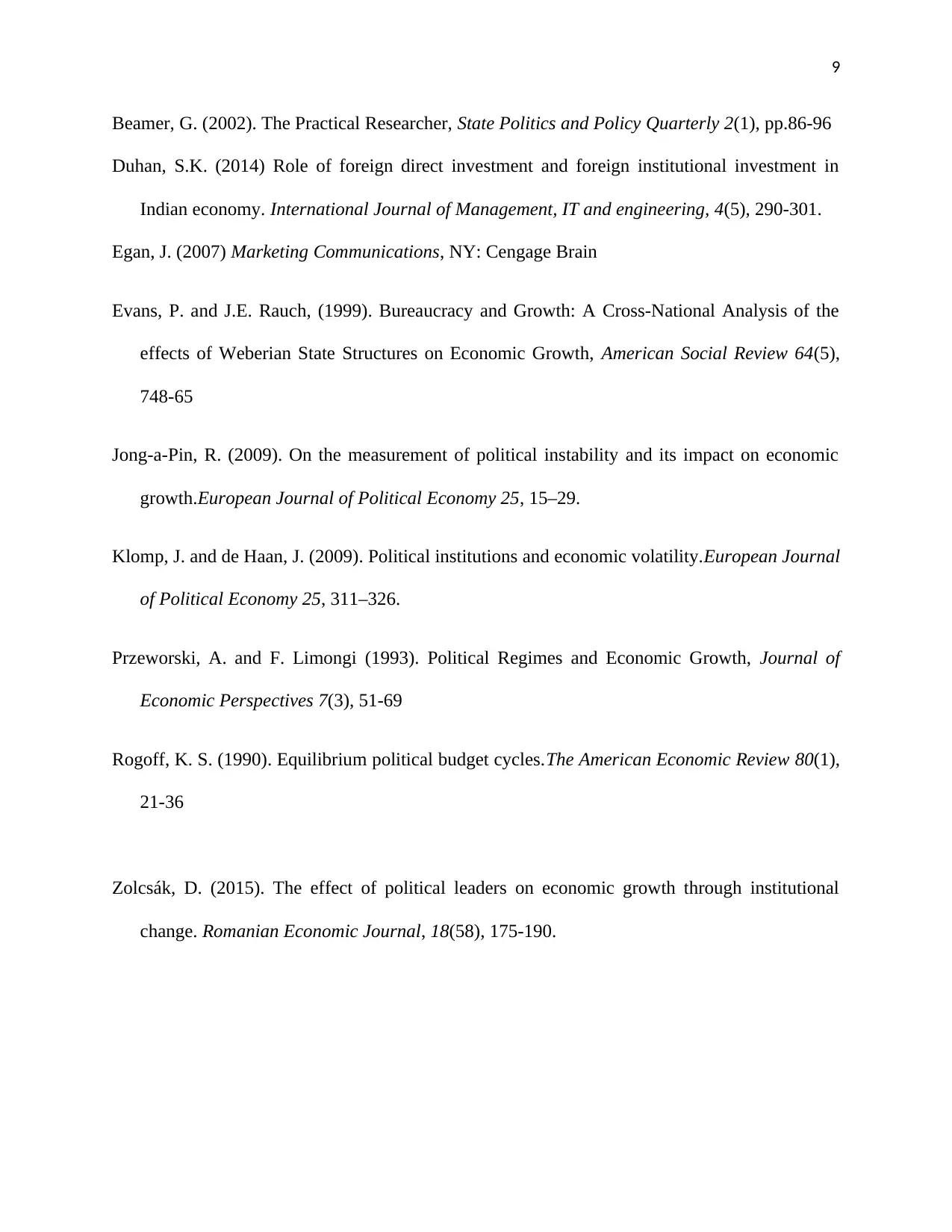
Beamer, G. (2002). The Practical Researcher, State Politics and Policy Quarterly 2(1), pp.86-96
Duhan, S.K. (2014) Role of foreign direct investment and foreign institutional investment in
Indian economy. International Journal of Management, IT and engineering, 4(5), 290-301.
Egan, J. (2007) Marketing Communications, NY: Cengage Brain
Evans, P. and J.E. Rauch, (1999). Bureaucracy and Growth: A Cross-National Analysis of the
effects of Weberian State Structures on Economic Growth, American Social Review 64(5),
748-65
Jong-a-Pin, R. (2009). On the measurement of political instability and its impact on economic
growth.European Journal of Political Economy 25, 15–29.
Klomp, J. and de Haan, J. (2009). Political institutions and economic volatility.European Journal
of Political Economy 25, 311–326.
Przeworski, A. and F. Limongi (1993). Political Regimes and Economic Growth, Journal of
Economic Perspectives 7(3), 51-69
Rogoff, K. S. (1990). Equilibrium political budget cycles.The American Economic Review 80(1),
21-36
Zolcsák, D. (2015). The effect of political leaders on economic growth through institutional
change. Romanian Economic Journal, 18(58), 175-190.
Beamer, G. (2002). The Practical Researcher, State Politics and Policy Quarterly 2(1), pp.86-96
Duhan, S.K. (2014) Role of foreign direct investment and foreign institutional investment in
Indian economy. International Journal of Management, IT and engineering, 4(5), 290-301.
Egan, J. (2007) Marketing Communications, NY: Cengage Brain
Evans, P. and J.E. Rauch, (1999). Bureaucracy and Growth: A Cross-National Analysis of the
effects of Weberian State Structures on Economic Growth, American Social Review 64(5),
748-65
Jong-a-Pin, R. (2009). On the measurement of political instability and its impact on economic
growth.European Journal of Political Economy 25, 15–29.
Klomp, J. and de Haan, J. (2009). Political institutions and economic volatility.European Journal
of Political Economy 25, 311–326.
Przeworski, A. and F. Limongi (1993). Political Regimes and Economic Growth, Journal of
Economic Perspectives 7(3), 51-69
Rogoff, K. S. (1990). Equilibrium political budget cycles.The American Economic Review 80(1),
21-36
Zolcsák, D. (2015). The effect of political leaders on economic growth through institutional
change. Romanian Economic Journal, 18(58), 175-190.
⊘ This is a preview!⊘
Do you want full access?
Subscribe today to unlock all pages.
Trusted by 1+ million students worldwide

1 out of 9


Related Documents


Your All-in-One AI-Powered Toolkit for Academic Success.
+13062052269
info@desklib.com
Available 24*7 on WhatsApp / Email
![[object Object]](/_next/static/media/star-bottom.7253800d.svg)
Unlock your academic potential
Copyright © 2020–2026 A2Z Services. All Rights Reserved. Developed and managed by ZUCOL.