A Critical Examination of Sexual Health Challenges in Young Adults
VerifiedAdded on 2021/10/08
|29
|8470
|59
Report
AI Summary
This report critically examines the sexual health challenges faced by young adults, using the case of Fred, a homeless nineteen-year-old engaging in risky sexual behavior. It explores the complexities of the situation, considering socioeconomic factors and the need for multidisciplinary healthcare approaches. The report discusses the importance of professional ethics, theoretical principles, and moral reasoning in addressing these challenges. It highlights the prevalence of unhealthy sexual behaviors, the risk of STDs and unintended pregnancies, and the impact of homelessness. The report emphasizes the need for healthcare professionals to provide comprehensive, tailored care, considering the emotional and social needs of adolescents. It also addresses the importance of open communication, privacy, and awareness of the stigma surrounding sexual health issues.
Running head: CRITICAL EXAMINATION OF SEXUAL HEALTH CHALLENGES
CRITICAL EXAMINATION OF SEXUAL HEALTH CHALLENGES
Name of the Student:
Name of the University:
Author note:
CRITICAL EXAMINATION OF SEXUAL HEALTH CHALLENGES
Name of the Student:
Name of the University:
Author note:

Paraphrase This Document
Need a fresh take? Get an instant paraphrase of this document with our AI Paraphraser
1CRITIAL EXAMINATION OF SEXUAL HEALTH CHALLENGES
Executive Summary
Despite the adequate public educational dissemination of information and policies
pertaining to the need for maintaining healthy and appropriate sexual health practices, there still
lies considerable prevalence of unhealthy, risky sexual behavior amongst adolescents.
Considering the complex social, developmental and functional needs of adolescents,
maintenance of adequate sexual health often becomes a contentious issue. The following report
discusses the complex case scenario of Fred, a young adult who is homeless and is actively
involved in undertaking unhealthy sexual behaviors for the purpose of living. For the
management of this case, healthcare professionals must critically consider moral and ethical
principles along with a variety of theoretical principles. Likewise, the need of the hour is the
adoption of multidisciplinary approach for the treatment of adolescent sexual problems, along
with the appropriate dissemination of information concerning the associated health outcomes,
with due consideration of unprotected sexual engagement amongst the youth.
Executive Summary
Despite the adequate public educational dissemination of information and policies
pertaining to the need for maintaining healthy and appropriate sexual health practices, there still
lies considerable prevalence of unhealthy, risky sexual behavior amongst adolescents.
Considering the complex social, developmental and functional needs of adolescents,
maintenance of adequate sexual health often becomes a contentious issue. The following report
discusses the complex case scenario of Fred, a young adult who is homeless and is actively
involved in undertaking unhealthy sexual behaviors for the purpose of living. For the
management of this case, healthcare professionals must critically consider moral and ethical
principles along with a variety of theoretical principles. Likewise, the need of the hour is the
adoption of multidisciplinary approach for the treatment of adolescent sexual problems, along
with the appropriate dissemination of information concerning the associated health outcomes,
with due consideration of unprotected sexual engagement amongst the youth.
2CRITIAL EXAMINATION OF SEXUAL HEALTH CHALLENGES
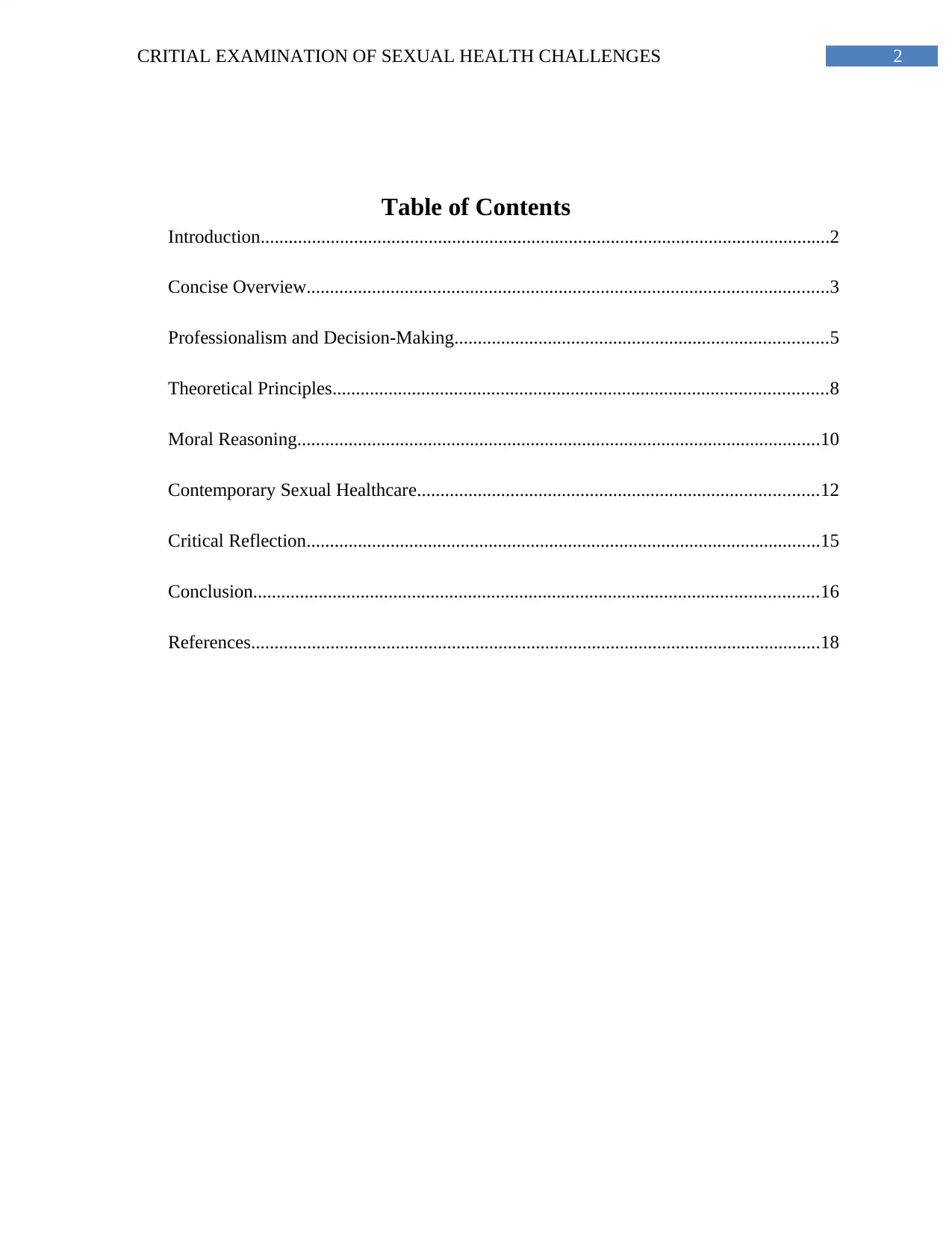
Table of Contents
Introduction..........................................................................................................................2
Concise Overview................................................................................................................3
Professionalism and Decision-Making................................................................................5
Theoretical Principles..........................................................................................................8
Moral Reasoning................................................................................................................10
Contemporary Sexual Healthcare......................................................................................12
Critical Reflection..............................................................................................................15
Conclusion.........................................................................................................................16
References..........................................................................................................................18
Table of Contents
Introduction..........................................................................................................................2
Concise Overview................................................................................................................3
Professionalism and Decision-Making................................................................................5
Theoretical Principles..........................................................................................................8
Moral Reasoning................................................................................................................10
Contemporary Sexual Healthcare......................................................................................12
Critical Reflection..............................................................................................................15
Conclusion.........................................................................................................................16
References..........................................................................................................................18
⊘ This is a preview!⊘
Do you want full access?
Subscribe today to unlock all pages.

Trusted by 1+ million students worldwide
3CRITIAL EXAMINATION OF SEXUAL HEALTH CHALLENGES
Introduction
According to Edelman et al., (2015), optimum sexual healthcare services imply the
provision of a range of professional and quality services which aid an individual to embrace their
sexuality with enjoyment and liberty. ‘Sexual health’ also refers to a collection of treatment
principles and procedures which aid in the prevention of sexually transmitted diseases (Meyrick
& Gray, 2018). As stated by Epstein and Mamo (2017), optimum sexual health encompasses the
freedom of all individuals to practice their varied sexual needs with ease, along with providing
everyone the right to access all health services concerned with the optimum maintenance and
treatment of the same. In accordance to the World Health Organization, optimum sexual health
refers to the state of wellness and wellbeing, at the social, physical as well as mental platforms. It
also implies the requirement of individuals to approach their own as well other’s sexual needs
with respect and consent for the purpose of engagement in sexual relationships which are safe
and devoid of violence, disparities and force (Costello et al., 2016).
According to Sarver et al., (2014), despite the increased awareness and dissemination of
public education on maintenance and practice of appropriate sexual health, there still lies and
increased prevalence and tendencies of adolescents and youngsters to engage in sexual behaviors
which are risky, resulting in an increase in their susceptibility to affliction of additional harmful
disorders and associated negative health outcomes. Hence, according to DiClemente (2016), the
need of the hour is to undertake a critical examination of the concerned professionalism and
decision-making associated with the same, for the purpose of prevention of undertaking specific,
uninformed sexual health activities amongst the youth, which will yield harmful consequences
on the health of the individual as well as others.
Introduction
According to Edelman et al., (2015), optimum sexual healthcare services imply the
provision of a range of professional and quality services which aid an individual to embrace their
sexuality with enjoyment and liberty. ‘Sexual health’ also refers to a collection of treatment
principles and procedures which aid in the prevention of sexually transmitted diseases (Meyrick
& Gray, 2018). As stated by Epstein and Mamo (2017), optimum sexual health encompasses the
freedom of all individuals to practice their varied sexual needs with ease, along with providing
everyone the right to access all health services concerned with the optimum maintenance and
treatment of the same. In accordance to the World Health Organization, optimum sexual health
refers to the state of wellness and wellbeing, at the social, physical as well as mental platforms. It
also implies the requirement of individuals to approach their own as well other’s sexual needs
with respect and consent for the purpose of engagement in sexual relationships which are safe
and devoid of violence, disparities and force (Costello et al., 2016).
According to Sarver et al., (2014), despite the increased awareness and dissemination of
public education on maintenance and practice of appropriate sexual health, there still lies and
increased prevalence and tendencies of adolescents and youngsters to engage in sexual behaviors
which are risky, resulting in an increase in their susceptibility to affliction of additional harmful
disorders and associated negative health outcomes. Hence, according to DiClemente (2016), the
need of the hour is to undertake a critical examination of the concerned professionalism and
decision-making associated with the same, for the purpose of prevention of undertaking specific,
uninformed sexual health activities amongst the youth, which will yield harmful consequences
on the health of the individual as well as others.
Paraphrase This Document
Need a fresh take? Get an instant paraphrase of this document with our AI Paraphraser
4CRITIAL EXAMINATION OF SEXUAL HEALTH CHALLENGES
The following paragraphs of the report aim to critically examine a sexual health scenario,
along with the deconstructed and critical examination of the professionals involved in the
situation, a range of theoretical principles involved for further understanding, the principles of
morality involved along with a critical overview of treatment principles associated with sexual
healthcare services at contemporary platforms.
Concise Overview
We shall be critically considering the scenario of Fred. Fred, who is aged nineteen years
old, is engaged in the conductance of unhealthy and risky sexual health behaviors. Considering
his critical situation of homelessness, he takes part in the engagement of sexual practices with a
female friend, as a result of which, the concerned female friend in question returns the favor by
allowing Fred to reside in her house, for free of cost. Despite adequate knowledge and awareness
concerning his wrong doing, Fred is unable to break free from the act since he will be at a loss of
his basic living standards.
Hence, as observed from the above scenario, along with the engagement in risky and
unhealthy sexual behavior, a number of factors are to be taken into concern, due to multi-faceted
nature of the above, encompassing compromised sexual health, along with detrimental
socioeconomic standards leading to homelessness.
The rationale behind this scenario is the prevalence of adolescents undertaking risky
sexual behavior leading to their increased susceptibility and infliction to a variety of diseases and
co-morbidities (Simons et al., 2016). According to Kerpelman et al., (2016), the practice of
adolescents undertaking unhealthy sexual behaviors is emerging as a major population
shortcoming and critical health scenario on a global platform. The engagement of young adults
The following paragraphs of the report aim to critically examine a sexual health scenario,
along with the deconstructed and critical examination of the professionals involved in the
situation, a range of theoretical principles involved for further understanding, the principles of
morality involved along with a critical overview of treatment principles associated with sexual
healthcare services at contemporary platforms.
Concise Overview
We shall be critically considering the scenario of Fred. Fred, who is aged nineteen years
old, is engaged in the conductance of unhealthy and risky sexual health behaviors. Considering
his critical situation of homelessness, he takes part in the engagement of sexual practices with a
female friend, as a result of which, the concerned female friend in question returns the favor by
allowing Fred to reside in her house, for free of cost. Despite adequate knowledge and awareness
concerning his wrong doing, Fred is unable to break free from the act since he will be at a loss of
his basic living standards.
Hence, as observed from the above scenario, along with the engagement in risky and
unhealthy sexual behavior, a number of factors are to be taken into concern, due to multi-faceted
nature of the above, encompassing compromised sexual health, along with detrimental
socioeconomic standards leading to homelessness.
The rationale behind this scenario is the prevalence of adolescents undertaking risky
sexual behavior leading to their increased susceptibility and infliction to a variety of diseases and
co-morbidities (Simons et al., 2016). According to Kerpelman et al., (2016), the practice of
adolescents undertaking unhealthy sexual behaviors is emerging as a major population
shortcoming and critical health scenario on a global platform. The engagement of young adults
5CRITIAL EXAMINATION OF SEXUAL HEALTH CHALLENGES
in harmful sexual practices amongst multiple partners or the like results in higher susceptibility
to the acquisition of sexually transmitted diseases. As stated by Ritchwood et al, (2016), the
critical and highly receptive age of adolescent is characterized by tendencies in the engagement
of experimentation which puts them at a greater vulnerability towards harmful health outcomes.
A majority of adolescents who have underwent risk taking ventures associated with sexual
intercourse, present a wide range of complications in addition to sexually transmitted diseases.
These include: hepatitis, arthritis of infectious skin rashes (Boyer et al., 2017). A stated by
Sedgh et al., (2015), in the United Kingdom, one of the salient national objectives requiring
fulfillment, for the purpose of maintenance of optimum health amongst the population is the
implementation of efforts aimed at decreasing the adolescent infliction of premature teenage
pregnancies, untimely and inappropriate abortions and most importantly, sexually transmitted
diseases and HIV. In accordance to the data published by the Family Planning Association and
Brook Sexual Health Charity, titled as the ‘Unprotected Nation’ report, if the prevalent trends
outlining engagement in unhealthy sexual health amongst adolescents remained untreated for
prolonged periods, the estimated financial consequences associated with untimed pregnancies,
abortions and sexually transmitted diseases will amount to 130 million Euros (Marcell et al.,
2018).
The additional rationale outlining the selection of the above case scenario of Fred, is the
prevalent situation of homelessness amongst the youth of the United Kingdom. In accordance to
‘Center Point’ – an organization in the United Kingdom, dedicated for the provision of help and
services to the youngsters devoid of appropriate residential and occupational surroundings, there
is an annual reporting of homelessness amongst almonds 103, 000 youngsters (Montgomerie &
Büdenbender, 2015). As opined by Watson, Crawley & Kane (2016), along with the prevalence
in harmful sexual practices amongst multiple partners or the like results in higher susceptibility
to the acquisition of sexually transmitted diseases. As stated by Ritchwood et al, (2016), the
critical and highly receptive age of adolescent is characterized by tendencies in the engagement
of experimentation which puts them at a greater vulnerability towards harmful health outcomes.
A majority of adolescents who have underwent risk taking ventures associated with sexual
intercourse, present a wide range of complications in addition to sexually transmitted diseases.
These include: hepatitis, arthritis of infectious skin rashes (Boyer et al., 2017). A stated by
Sedgh et al., (2015), in the United Kingdom, one of the salient national objectives requiring
fulfillment, for the purpose of maintenance of optimum health amongst the population is the
implementation of efforts aimed at decreasing the adolescent infliction of premature teenage
pregnancies, untimely and inappropriate abortions and most importantly, sexually transmitted
diseases and HIV. In accordance to the data published by the Family Planning Association and
Brook Sexual Health Charity, titled as the ‘Unprotected Nation’ report, if the prevalent trends
outlining engagement in unhealthy sexual health amongst adolescents remained untreated for
prolonged periods, the estimated financial consequences associated with untimed pregnancies,
abortions and sexually transmitted diseases will amount to 130 million Euros (Marcell et al.,
2018).
The additional rationale outlining the selection of the above case scenario of Fred, is the
prevalent situation of homelessness amongst the youth of the United Kingdom. In accordance to
‘Center Point’ – an organization in the United Kingdom, dedicated for the provision of help and
services to the youngsters devoid of appropriate residential and occupational surroundings, there
is an annual reporting of homelessness amongst almonds 103, 000 youngsters (Montgomerie &
Büdenbender, 2015). As opined by Watson, Crawley & Kane (2016), along with the prevalence
⊘ This is a preview!⊘
Do you want full access?
Subscribe today to unlock all pages.
Trusted by 1+ million students worldwide
6CRITIAL EXAMINATION OF SEXUAL HEALTH CHALLENGES
of homelessness amongst youth who are inflicted with critical family or domestic issues, the
additional scenario of ‘hidden homelessness’ is often associated with greater and far more
dangerous health and lifestyle consequences. The situation of homelessness can be observed
amongst youngsters spending days and nights with strangers, at bus or subway stops or sofas and
floors of unsafe and unknown environments. As evident in the case study, the situation of Fred
clearly outlines similarities of hidden homelessness. According to Hada et al., (2017), the
prevalence of homelessness is associated with a number of physiological and psychological
negative health outcomes along with presence of barriers in occupational and educational
environments.
Professionalism and Decision-Making
According to Slater and Robinson (2014), the developmental stage of adolescence
encompasses a wide range of functional, developmental and emotional alterations in their
physiological as well as psychological health, resulting in an increased receptivity to their
surroundings. Hence, as stated by Lundgren and Amin (2015), the stage of development amongst
young individuals are outlined by the necessity to engage and acquire security, acceptance,
confidence and most importantly respect, amongst a wide range of social relationships and
platforms, further resulting in a increased to their self confidence and self-esteem. Hence, in
accordance to Guilamo-Ramos et al., (2015), considering the emerging social needs of
adolescents along with a lack of control on the strong impulse to engage in novel, risk-taking and
experimental behavior, the sexual health of adolescents continue to reach a platform of
compromise which professionals must consider in the decision-making process of dissemination
of sexual health education and treatment procedures.
of homelessness amongst youth who are inflicted with critical family or domestic issues, the
additional scenario of ‘hidden homelessness’ is often associated with greater and far more
dangerous health and lifestyle consequences. The situation of homelessness can be observed
amongst youngsters spending days and nights with strangers, at bus or subway stops or sofas and
floors of unsafe and unknown environments. As evident in the case study, the situation of Fred
clearly outlines similarities of hidden homelessness. According to Hada et al., (2017), the
prevalence of homelessness is associated with a number of physiological and psychological
negative health outcomes along with presence of barriers in occupational and educational
environments.
Professionalism and Decision-Making
According to Slater and Robinson (2014), the developmental stage of adolescence
encompasses a wide range of functional, developmental and emotional alterations in their
physiological as well as psychological health, resulting in an increased receptivity to their
surroundings. Hence, as stated by Lundgren and Amin (2015), the stage of development amongst
young individuals are outlined by the necessity to engage and acquire security, acceptance,
confidence and most importantly respect, amongst a wide range of social relationships and
platforms, further resulting in a increased to their self confidence and self-esteem. Hence, in
accordance to Guilamo-Ramos et al., (2015), considering the emerging social needs of
adolescents along with a lack of control on the strong impulse to engage in novel, risk-taking and
experimental behavior, the sexual health of adolescents continue to reach a platform of
compromise which professionals must consider in the decision-making process of dissemination
of sexual health education and treatment procedures.
Paraphrase This Document
Need a fresh take? Get an instant paraphrase of this document with our AI Paraphraser
7CRITIAL EXAMINATION OF SEXUAL HEALTH CHALLENGES
According to Macintyre, Vega and Sagbakken (2015), considering the compromised
sexual health scenario of Fred outlined in the above case study, the concerned professional or
clinician must engage in theoretical principles of adequate interpersonal communication which
includes imparting education on the negative health consequences associated with Fred’s
engagement in unhealthy sexual practices with his female friend, questioning directly concerning
the details of complexities of the case as well as engaging in adequate inquiry of the conductance
of medical examinations of sexually transmitted diseases (STDs) and Human Immunodeficiency
Virus (HIV). Further appropriate professionalism, as stated by Sandberg Thoma and Kamp Dush
(2014), required in the mitigation of Fred’s complex sexual health scenario would require
obtaining detailed information about previous medical history as well as sexual history of past
engagement in sexual health practices. Such information is crucial for the implementation of
decision-making further resulting in provision of appropriate sexual health education and
services for Fred.
However, critical examination can uncover crucial loopholes in the professionalism
associated with decision-making for appropriate sexual health services. As stated by Liu et al.,
(2015), despite the prevalence of adequate public policies and sexual health education, there
continues to remain a strong taboo, discrimination and emotional suppression associated with the
direct and open discussion of sexual behaviors. Further, as stated by Jackson et al., (2015), the
prevalence of fear of being stigmatized, ridiculed and the possibilities of acquisition of alarming
and critical reactions from elders, continue to traumatize adolescents in the discussion of sexual
practices. Also, as stated by Johns, Jayne and Steiner (2016), in addition to the above stigma
which professionals must consider, the lack of privacy in primary healthcare surroundings aim to
be an added burden in the transmission of sexual health services to the youth by professionals.
According to Macintyre, Vega and Sagbakken (2015), considering the compromised
sexual health scenario of Fred outlined in the above case study, the concerned professional or
clinician must engage in theoretical principles of adequate interpersonal communication which
includes imparting education on the negative health consequences associated with Fred’s
engagement in unhealthy sexual practices with his female friend, questioning directly concerning
the details of complexities of the case as well as engaging in adequate inquiry of the conductance
of medical examinations of sexually transmitted diseases (STDs) and Human Immunodeficiency
Virus (HIV). Further appropriate professionalism, as stated by Sandberg Thoma and Kamp Dush
(2014), required in the mitigation of Fred’s complex sexual health scenario would require
obtaining detailed information about previous medical history as well as sexual history of past
engagement in sexual health practices. Such information is crucial for the implementation of
decision-making further resulting in provision of appropriate sexual health education and
services for Fred.
However, critical examination can uncover crucial loopholes in the professionalism
associated with decision-making for appropriate sexual health services. As stated by Liu et al.,
(2015), despite the prevalence of adequate public policies and sexual health education, there
continues to remain a strong taboo, discrimination and emotional suppression associated with the
direct and open discussion of sexual behaviors. Further, as stated by Jackson et al., (2015), the
prevalence of fear of being stigmatized, ridiculed and the possibilities of acquisition of alarming
and critical reactions from elders, continue to traumatize adolescents in the discussion of sexual
practices. Also, as stated by Johns, Jayne and Steiner (2016), in addition to the above stigma
which professionals must consider, the lack of privacy in primary healthcare surroundings aim to
be an added burden in the transmission of sexual health services to the youth by professionals.
8CRITIAL EXAMINATION OF SEXUAL HEALTH CHALLENGES
Likewise, as opined by Svanemyr et al., (2015), the engagement in unhealthy sexual health
practices is often associated with a plethora of negative social and emotional histories of abuse
and emotional trauma, which often adolescents avoid discussion due to the absence of
professional privacy along with a shortcoming amongst professionals to adhere to the multiple
emotional and physical needs of the youth, in additional to just dealing with their sexual
counterparts.
Hence, the need of the hour, for the management of Fred’s scenario, is the deliverance of
multidisciplinary care by professionals in the dissemination of sexual health services,
considering the various socioeconomic factors associated with the Fred (Stenström et al., 2014).
According to Mustanski et al., (2015), despite the relative open-mindedness exhibited by a
majority of professionals engaged in sexual healthcare professionals, youngsters at present seek
additional healthcare benefits beyond the mere provision of supportive environments in sexual
health education and discussion. As stated by Denno, Hoopes and Chandra-Mouli (2015),
majority of adolescents and youngsters feel the lack of acceptance or openness to information or
situational details by the professionals, along with the exhibition of excessive assumptions
concerning the situation with due ignorance of additional salient details and causative factors.
Hence, with respect to Fred, the concerned professional must take into consideration the
prevalence of additional associating factors, such as homelessness, which act as key determining
constructs to the situation.
Hence, according to Widman et al., (2014), for the optimum maintenance as well as
treatment of sexual health amongst adolescents like Fred who are undertaking risky sexual
behavior, the concerned health professional must engage actively in safeguarding the health of
Fred, since he may present additional symptoms of self harm, abuse, sexually transmitted
Likewise, as opined by Svanemyr et al., (2015), the engagement in unhealthy sexual health
practices is often associated with a plethora of negative social and emotional histories of abuse
and emotional trauma, which often adolescents avoid discussion due to the absence of
professional privacy along with a shortcoming amongst professionals to adhere to the multiple
emotional and physical needs of the youth, in additional to just dealing with their sexual
counterparts.
Hence, the need of the hour, for the management of Fred’s scenario, is the deliverance of
multidisciplinary care by professionals in the dissemination of sexual health services,
considering the various socioeconomic factors associated with the Fred (Stenström et al., 2014).
According to Mustanski et al., (2015), despite the relative open-mindedness exhibited by a
majority of professionals engaged in sexual healthcare professionals, youngsters at present seek
additional healthcare benefits beyond the mere provision of supportive environments in sexual
health education and discussion. As stated by Denno, Hoopes and Chandra-Mouli (2015),
majority of adolescents and youngsters feel the lack of acceptance or openness to information or
situational details by the professionals, along with the exhibition of excessive assumptions
concerning the situation with due ignorance of additional salient details and causative factors.
Hence, with respect to Fred, the concerned professional must take into consideration the
prevalence of additional associating factors, such as homelessness, which act as key determining
constructs to the situation.
Hence, according to Widman et al., (2014), for the optimum maintenance as well as
treatment of sexual health amongst adolescents like Fred who are undertaking risky sexual
behavior, the concerned health professional must engage actively in safeguarding the health of
Fred, since he may present additional symptoms of self harm, abuse, sexually transmitted
⊘ This is a preview!⊘
Do you want full access?
Subscribe today to unlock all pages.
Trusted by 1+ million students worldwide
9CRITIAL EXAMINATION OF SEXUAL HEALTH CHALLENGES
diseases or physiological complications like abdominal pain. Further, as stated by Mustanski et
al., (2014), considering the complexities of the situation, adolescents like Fred will require
treatment services and information which goes beyond generalized sexual health matters and
which are customized to their complex needs. According to Chandra-Mouli, Lane and Wong
(2015), youth at present, expect a range of professional information such as technical statistics,
contraceptive use and the like. The sensitive receptiveness of adolescent cognition may lead to
them finding difficulty in understanding and retention in a situation of excessive information
dissemination and hence, professionals must consider imparting specific information in a step-
by-step process for ease in perception, in the decision-making process.
Likewise, as stated by Cima and Parker (2017), the professional concerned with the
management of Fred’s case must also consider his state of homelessness for which an inter-
professional approach may be required due to the various social, psychological and health
complications associated with the situation, as observed in the case scenario.
Theoretical Principles
For the provision of adequate sexual health treatment services considering the complex
case scenario of Fred, professionals and nurses involved in clinical practices must consider the
principles of various theories associated with sexual behavior amongst individuals as well as the
treatment concerning Fred (Alessi, 2014).
In accordance to some of the earliest theories of sexual behavior as stated by Aristotle,
Plato and even Sigmund Freud, sexuality amongst humans have been described as an intrinsic
and innate need, required for the channeling of energies, directed towards release (Maxwell et
al., 2017). However, as discussed by Muise and Impett (2016), despite the existence of this
diseases or physiological complications like abdominal pain. Further, as stated by Mustanski et
al., (2014), considering the complexities of the situation, adolescents like Fred will require
treatment services and information which goes beyond generalized sexual health matters and
which are customized to their complex needs. According to Chandra-Mouli, Lane and Wong
(2015), youth at present, expect a range of professional information such as technical statistics,
contraceptive use and the like. The sensitive receptiveness of adolescent cognition may lead to
them finding difficulty in understanding and retention in a situation of excessive information
dissemination and hence, professionals must consider imparting specific information in a step-
by-step process for ease in perception, in the decision-making process.
Likewise, as stated by Cima and Parker (2017), the professional concerned with the
management of Fred’s case must also consider his state of homelessness for which an inter-
professional approach may be required due to the various social, psychological and health
complications associated with the situation, as observed in the case scenario.
Theoretical Principles
For the provision of adequate sexual health treatment services considering the complex
case scenario of Fred, professionals and nurses involved in clinical practices must consider the
principles of various theories associated with sexual behavior amongst individuals as well as the
treatment concerning Fred (Alessi, 2014).
In accordance to some of the earliest theories of sexual behavior as stated by Aristotle,
Plato and even Sigmund Freud, sexuality amongst humans have been described as an intrinsic
and innate need, required for the channeling of energies, directed towards release (Maxwell et
al., 2017). However, as discussed by Muise and Impett (2016), despite the existence of this
Paraphrase This Document
Need a fresh take? Get an instant paraphrase of this document with our AI Paraphraser
10CRITIAL EXAMINATION OF SEXUAL HEALTH CHALLENGES
innate need, individual sexual needs must be adequate directed and channeled, for the ordered
functioning of the community. Hence, the professionals and nurses involved in the treatment and
educational dissemination of Fred must consider the natural need for adolescents like Fred to
engage in sexual practices, with however, the requirement for controlling these practices, for the
purpose of regulating his health.
An additional theory outlining sexuality in individuals emphasizes on the principles of
social constructivism, by notable psychologists and sociologists such as Freud, Frank Beach and
Clellan Ford. Hence, as stated by Carlson (2016), the exhibition of sexual behaviors by
individuals, especially adolescents are often the results of social expectations further resulting in
either openness or the prevalence of taboo leading to suppression of expression. Hence, in the
situation of Fred, he may find difficulties in the discussion of the complex nature of
homelessness and unhealthy sexual practices, due to societal taboo and misunderstanding which
the concerned professionals must take into consideration and engage in the provision of a
clinically and socially acceptable, safe, supportive and empathetic environment for enhanced
decision-making further resulting high quality mitigation.
In addition to the above theoretical perspectives, the professional must consider
additional theoretical aspects associated with nursing practice and provision of optimum health
and treatment care. A key nursing and treatment theory which may be considered here is the
theory of ‘Unitary Human Beings’ by Martha Rogers. This theory as discussed by Phillips
(2016), emphasizes active interaction between a patient and their environment which is required
for the holistic treatment of the individual. Hence, health professionals must consider this theory
at the forefront since Fred’s compromised and risky sexual health situation is highly associated
with this environment of homelessness and hence the need of the hour is the provision of an
innate need, individual sexual needs must be adequate directed and channeled, for the ordered
functioning of the community. Hence, the professionals and nurses involved in the treatment and
educational dissemination of Fred must consider the natural need for adolescents like Fred to
engage in sexual practices, with however, the requirement for controlling these practices, for the
purpose of regulating his health.
An additional theory outlining sexuality in individuals emphasizes on the principles of
social constructivism, by notable psychologists and sociologists such as Freud, Frank Beach and
Clellan Ford. Hence, as stated by Carlson (2016), the exhibition of sexual behaviors by
individuals, especially adolescents are often the results of social expectations further resulting in
either openness or the prevalence of taboo leading to suppression of expression. Hence, in the
situation of Fred, he may find difficulties in the discussion of the complex nature of
homelessness and unhealthy sexual practices, due to societal taboo and misunderstanding which
the concerned professionals must take into consideration and engage in the provision of a
clinically and socially acceptable, safe, supportive and empathetic environment for enhanced
decision-making further resulting high quality mitigation.
In addition to the above theoretical perspectives, the professional must consider
additional theoretical aspects associated with nursing practice and provision of optimum health
and treatment care. A key nursing and treatment theory which may be considered here is the
theory of ‘Unitary Human Beings’ by Martha Rogers. This theory as discussed by Phillips
(2016), emphasizes active interaction between a patient and their environment which is required
for the holistic treatment of the individual. Hence, health professionals must consider this theory
at the forefront since Fred’s compromised and risky sexual health situation is highly associated
with this environment of homelessness and hence the need of the hour is the provision of an
11CRITIAL EXAMINATION OF SEXUAL HEALTH CHALLENGES
acceptable and conducive environment required for holistic recovery. Additional professional
treatment and care theories which the professional must consider is the ‘Need Theory’ by
Virginia Henderson, which emphasizes the role of professionals in empowering and inspiring
individuals to take control of their lives and associated health through undertaking appropriate
health promotion activities. Hence, the professional must seek to educate Fred adequately on
sexual health and required practices for optimum health, which he may implement successfully
in the future, as in the present scenario, Fred clearly lacks direction and confidence in
undertaking healthy sexual behaviors on his own (Ahtisham & Jacoline, 2015).
Moral Reasoning
According to Chávez et al., (2016), the topic of sexual health has always been met with
increased ethical and moral conflict due to the sensitive and complex nature of sexual health
preferences and involved, along with the ever prevailing issue of consent. Thus, in a complex
scenario of compromise sexual health, where an adolescent may not agree to the usage of
condoms despite the associated lack of safety involved, the professional must engage in adequate
moral reasoning to result in healthy sexual practices with due consideration of ethical issues.
In accordance to the data published by United Nation’s Population Fund, the youth and
young adult population posses the fundamental right to engage in healthy sexual practices, along
with being granted adequate access to optimum sexual health services (Chandra-Mouli et al.,
2015). According to Knight et al., (2014), achievement of optimum sexual health is considered
as a major developmental milestone during the growing sensitive phase encompassing
adolescents and hence, societal and clinical settings are obliged to provide adequate support,
freedom and access to sexual health services without taboo or judgment. Likewise, as stated by
acceptable and conducive environment required for holistic recovery. Additional professional
treatment and care theories which the professional must consider is the ‘Need Theory’ by
Virginia Henderson, which emphasizes the role of professionals in empowering and inspiring
individuals to take control of their lives and associated health through undertaking appropriate
health promotion activities. Hence, the professional must seek to educate Fred adequately on
sexual health and required practices for optimum health, which he may implement successfully
in the future, as in the present scenario, Fred clearly lacks direction and confidence in
undertaking healthy sexual behaviors on his own (Ahtisham & Jacoline, 2015).
Moral Reasoning
According to Chávez et al., (2016), the topic of sexual health has always been met with
increased ethical and moral conflict due to the sensitive and complex nature of sexual health
preferences and involved, along with the ever prevailing issue of consent. Thus, in a complex
scenario of compromise sexual health, where an adolescent may not agree to the usage of
condoms despite the associated lack of safety involved, the professional must engage in adequate
moral reasoning to result in healthy sexual practices with due consideration of ethical issues.
In accordance to the data published by United Nation’s Population Fund, the youth and
young adult population posses the fundamental right to engage in healthy sexual practices, along
with being granted adequate access to optimum sexual health services (Chandra-Mouli et al.,
2015). According to Knight et al., (2014), achievement of optimum sexual health is considered
as a major developmental milestone during the growing sensitive phase encompassing
adolescents and hence, societal and clinical settings are obliged to provide adequate support,
freedom and access to sexual health services without taboo or judgment. Likewise, as stated by
⊘ This is a preview!⊘
Do you want full access?
Subscribe today to unlock all pages.
Trusted by 1+ million students worldwide

1 out of 29


Your All-in-One AI-Powered Toolkit for Academic Success.
+13062052269
info@desklib.com
Available 24*7 on WhatsApp / Email
![[object Object]](/_next/static/media/star-bottom.7253800d.svg)
Unlock your academic potential
Copyright © 2020–2026 A2Z Services. All Rights Reserved. Developed and managed by ZUCOL.