University Report: Critical Evaluation of Sleep Disorders in Infants
VerifiedAdded on 2020/04/07
|23
|4546
|229
Report
AI Summary
This report presents a critical evaluation of sleep disorders in infants, focusing on the effectiveness of various interventions. The study examines the use of scheduled awakenings and systematic ignoring as treatment methods for infants experiencing nocturnal awakening and crying episodes. The research involved dividing infants into three groups: scheduled awakenings, systematic ignoring, and a control group. The scheduled awakenings procedure involved parents arousing and consoling infants before spontaneous awakenings, while systematic ignoring involved allowing infants to "cry it out" with limited parental intervention. The results indicated that both scheduled awakenings and systematic ignoring were more effective than the control group in reducing awakenings and crying over an eight-week period, with systematic ignoring showing quicker initial results. The report also discusses the implications of these treatment processes and includes a review of relevant literature, search protocols, inclusion/exclusion criteria, and a critical appraisal of the studies using the CASP tool. The report concludes with a summary of findings and references supporting the research.
Running head: CRITICAL EVALUATION OF SLEEP DISORDERS IN INFANTS
Critical evaluation of sleep disorders in infants
Name of the Student
Name of the University
Author Note
Critical evaluation of sleep disorders in infants
Name of the Student
Name of the University
Author Note

Paraphrase This Document
Need a fresh take? Get an instant paraphrase of this document with our AI Paraphraser
1
CRITICAL EVALUATION OF SLEEP DISORDERS IN INFANTS
Executive Summary
The infants showing spontaneous awakening and crying phases in the night time were
randomly included in three groups dividing equally such as scheduled awakenings,
systematic ignoring or control. Scheduled awakenings procedure had parent arousing and
consoling or feeding the infant 15-60 minutes prior to spontaneous awakenings. Once
precluded, parents with scheduled awakenings were systematically eliminated. Systematic
ignoring comprised of letting the infant to “cry it out” lacking parental attention except at
times to ensure the safety of the infant. Infants included in the groups of scheduled
awakening and systematic ignoring was found to awoke and cry less than compared with the
infants in the controlled group in the treatment duration of 8 weeks and follow-ups after
treatment for 3 and 6 weeks. Systematic ignoring was recorded to show more effective results
than scheduled awakenings in the first week of treatment or else the efficacy of both the
treatments were found to be same. The different implications of the treatment processes were
also discussed.
CRITICAL EVALUATION OF SLEEP DISORDERS IN INFANTS
Executive Summary
The infants showing spontaneous awakening and crying phases in the night time were
randomly included in three groups dividing equally such as scheduled awakenings,
systematic ignoring or control. Scheduled awakenings procedure had parent arousing and
consoling or feeding the infant 15-60 minutes prior to spontaneous awakenings. Once
precluded, parents with scheduled awakenings were systematically eliminated. Systematic
ignoring comprised of letting the infant to “cry it out” lacking parental attention except at
times to ensure the safety of the infant. Infants included in the groups of scheduled
awakening and systematic ignoring was found to awoke and cry less than compared with the
infants in the controlled group in the treatment duration of 8 weeks and follow-ups after
treatment for 3 and 6 weeks. Systematic ignoring was recorded to show more effective results
than scheduled awakenings in the first week of treatment or else the efficacy of both the
treatments were found to be same. The different implications of the treatment processes were
also discussed.
2
CRITICAL EVALUATION OF SLEEP DISORDERS IN INFANTS
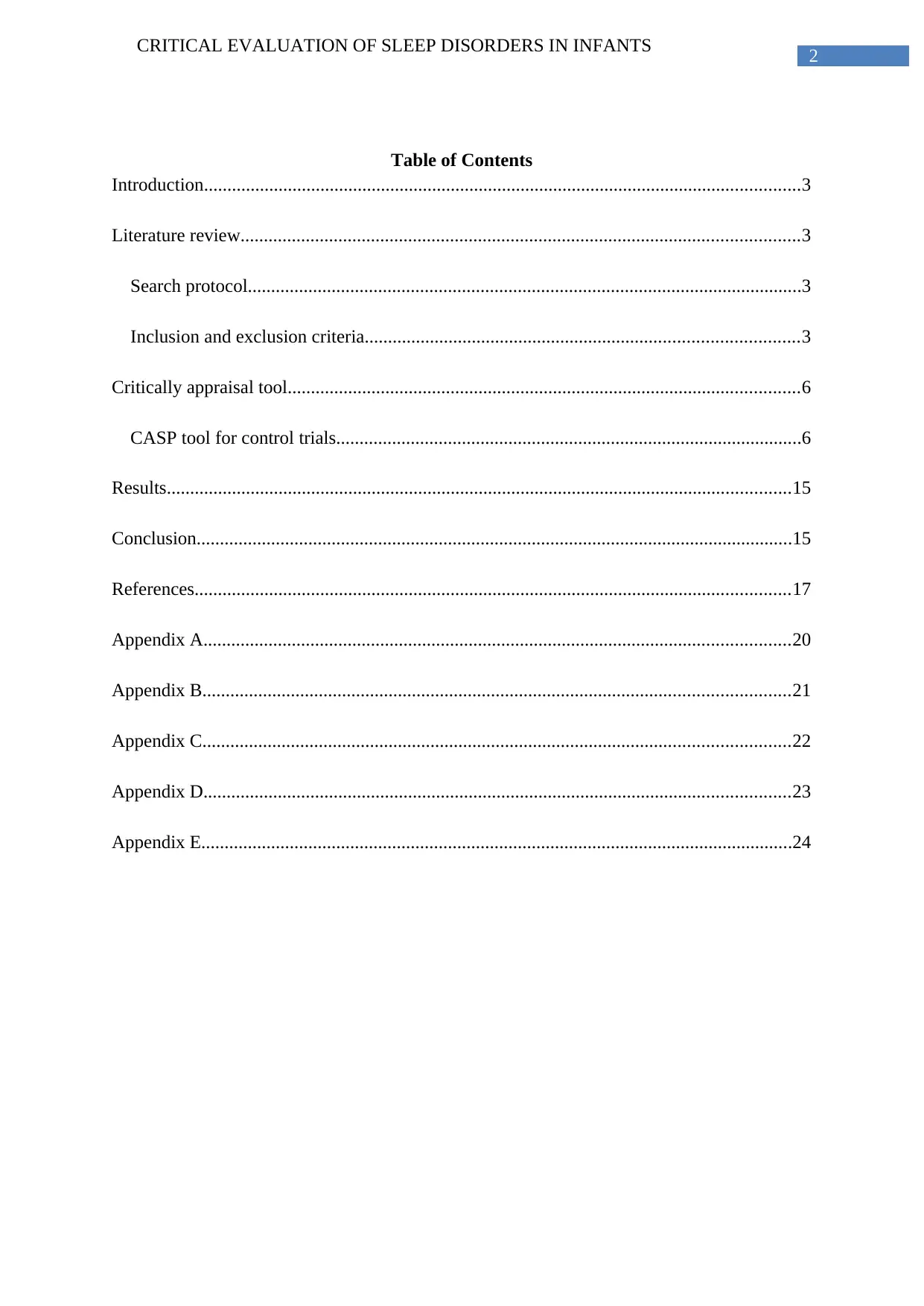
Table of Contents
Introduction................................................................................................................................3
Literature review........................................................................................................................3
Search protocol.......................................................................................................................3
Inclusion and exclusion criteria.............................................................................................3
Critically appraisal tool..............................................................................................................6
CASP tool for control trials....................................................................................................6
Results......................................................................................................................................15
Conclusion................................................................................................................................15
References................................................................................................................................17
Appendix A..............................................................................................................................20
Appendix B..............................................................................................................................21
Appendix C..............................................................................................................................22
Appendix D..............................................................................................................................23
Appendix E...............................................................................................................................24
CRITICAL EVALUATION OF SLEEP DISORDERS IN INFANTS
Table of Contents
Introduction................................................................................................................................3
Literature review........................................................................................................................3
Search protocol.......................................................................................................................3
Inclusion and exclusion criteria.............................................................................................3
Critically appraisal tool..............................................................................................................6
CASP tool for control trials....................................................................................................6
Results......................................................................................................................................15
Conclusion................................................................................................................................15
References................................................................................................................................17
Appendix A..............................................................................................................................20
Appendix B..............................................................................................................................21
Appendix C..............................................................................................................................22
Appendix D..............................................................................................................................23
Appendix E...............................................................................................................................24
⊘ This is a preview!⊘
Do you want full access?
Subscribe today to unlock all pages.

Trusted by 1+ million students worldwide
3
CRITICAL EVALUATION OF SLEEP DISORDERS IN INFANTS
Introduction
One of the common and significant issues faced by the parents are the not sleeping
behaviour throughout the night and thereby restricting from going to sleep by their children
(Sivertsen et al., 2015). The persistence of the sleep disruptions with crying episodes led to
negative impacts on the parents such as distress, fatigue and decrease in the tolerance towards
the night time problems (O’Neill & Gilea, 2017). The other part of concern was that some of
the parents who faced the issues regarding episodes of crying in night by infants did not
consult any professionals to solve the problem (Bell, 2014). The difficulties faced in the
bedtime sleep led to child abuse, maternal ambivalence and maternal depression towards their
child (Weinraub et al., 2012). Keeping this issue into consideration, professional support
played major role in solving the spontaneous awakening and crying phases in night further
preventing the conflict of parent-child (Mindell & Owens, 2015).
Literature review
Search protocol
In this review, different databases were considered such as MEDLINE, SCOPUS,
EMBASE, CINAHL and Cochrane Library. The search terms were “child,” “toddler,”
“infant,” “sleep,” “settling,” “wake,” “treatment,” “medication,” “therapy,” and
“intervention”. The searching pattern was supplemented through tracking all the articles and
cited reviews, bibliography, books as well as hand searching the journals based on the topic
for the last 5 years.
Inclusion and exclusion criteria
The studies that were included in this review were centred within young children aged
5 or younger, who represented nocturnal awakening at night time, with established sleep
CRITICAL EVALUATION OF SLEEP DISORDERS IN INFANTS
Introduction
One of the common and significant issues faced by the parents are the not sleeping
behaviour throughout the night and thereby restricting from going to sleep by their children
(Sivertsen et al., 2015). The persistence of the sleep disruptions with crying episodes led to
negative impacts on the parents such as distress, fatigue and decrease in the tolerance towards
the night time problems (O’Neill & Gilea, 2017). The other part of concern was that some of
the parents who faced the issues regarding episodes of crying in night by infants did not
consult any professionals to solve the problem (Bell, 2014). The difficulties faced in the
bedtime sleep led to child abuse, maternal ambivalence and maternal depression towards their
child (Weinraub et al., 2012). Keeping this issue into consideration, professional support
played major role in solving the spontaneous awakening and crying phases in night further
preventing the conflict of parent-child (Mindell & Owens, 2015).
Literature review
Search protocol
In this review, different databases were considered such as MEDLINE, SCOPUS,
EMBASE, CINAHL and Cochrane Library. The search terms were “child,” “toddler,”
“infant,” “sleep,” “settling,” “wake,” “treatment,” “medication,” “therapy,” and
“intervention”. The searching pattern was supplemented through tracking all the articles and
cited reviews, bibliography, books as well as hand searching the journals based on the topic
for the last 5 years.
Inclusion and exclusion criteria
The studies that were included in this review were centred within young children aged
5 or younger, who represented nocturnal awakening at night time, with established sleep
Paraphrase This Document
Need a fresh take? Get an instant paraphrase of this document with our AI Paraphraser
4
CRITICAL EVALUATION OF SLEEP DISORDERS IN INFANTS
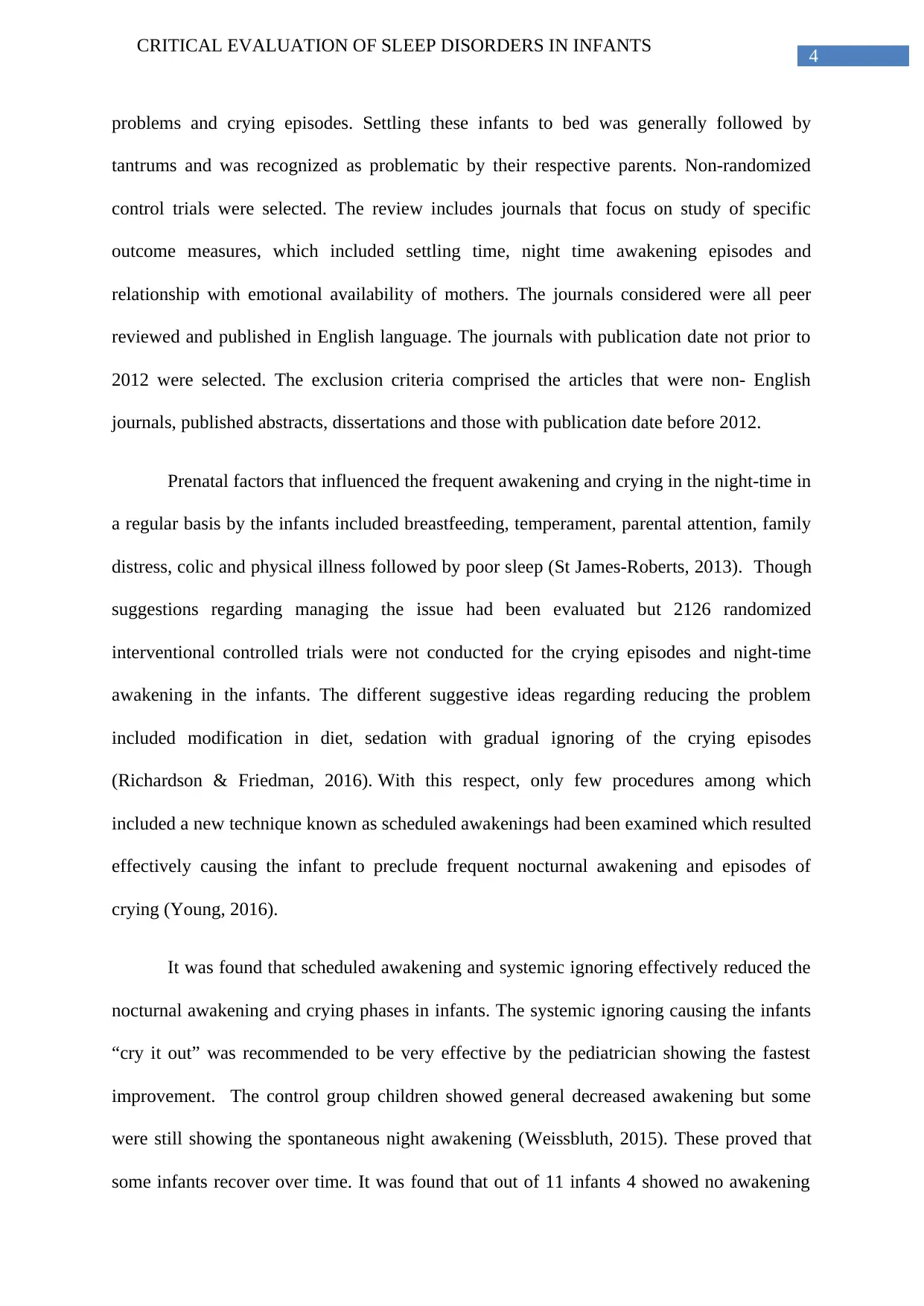
problems and crying episodes. Settling these infants to bed was generally followed by
tantrums and was recognized as problematic by their respective parents. Non-randomized
control trials were selected. The review includes journals that focus on study of specific
outcome measures, which included settling time, night time awakening episodes and
relationship with emotional availability of mothers. The journals considered were all peer
reviewed and published in English language. The journals with publication date not prior to
2012 were selected. The exclusion criteria comprised the articles that were non- English
journals, published abstracts, dissertations and those with publication date before 2012.
Prenatal factors that influenced the frequent awakening and crying in the night-time in
a regular basis by the infants included breastfeeding, temperament, parental attention, family
distress, colic and physical illness followed by poor sleep (St James-Roberts, 2013). Though
suggestions regarding managing the issue had been evaluated but 2126 randomized
interventional controlled trials were not conducted for the crying episodes and night-time
awakening in the infants. The different suggestive ideas regarding reducing the problem
included modification in diet, sedation with gradual ignoring of the crying episodes
(Richardson & Friedman, 2016). With this respect, only few procedures among which
included a new technique known as scheduled awakenings had been examined which resulted
effectively causing the infant to preclude frequent nocturnal awakening and episodes of
crying (Young, 2016).
It was found that scheduled awakening and systemic ignoring effectively reduced the
nocturnal awakening and crying phases in infants. The systemic ignoring causing the infants
“cry it out” was recommended to be very effective by the pediatrician showing the fastest
improvement. The control group children showed general decreased awakening but some
were still showing the spontaneous night awakening (Weissbluth, 2015). These proved that
some infants recover over time. It was found that out of 11 infants 4 showed no awakening
CRITICAL EVALUATION OF SLEEP DISORDERS IN INFANTS
problems and crying episodes. Settling these infants to bed was generally followed by
tantrums and was recognized as problematic by their respective parents. Non-randomized
control trials were selected. The review includes journals that focus on study of specific
outcome measures, which included settling time, night time awakening episodes and
relationship with emotional availability of mothers. The journals considered were all peer
reviewed and published in English language. The journals with publication date not prior to
2012 were selected. The exclusion criteria comprised the articles that were non- English
journals, published abstracts, dissertations and those with publication date before 2012.
Prenatal factors that influenced the frequent awakening and crying in the night-time in
a regular basis by the infants included breastfeeding, temperament, parental attention, family
distress, colic and physical illness followed by poor sleep (St James-Roberts, 2013). Though
suggestions regarding managing the issue had been evaluated but 2126 randomized
interventional controlled trials were not conducted for the crying episodes and night-time
awakening in the infants. The different suggestive ideas regarding reducing the problem
included modification in diet, sedation with gradual ignoring of the crying episodes
(Richardson & Friedman, 2016). With this respect, only few procedures among which
included a new technique known as scheduled awakenings had been examined which resulted
effectively causing the infant to preclude frequent nocturnal awakening and episodes of
crying (Young, 2016).
It was found that scheduled awakening and systemic ignoring effectively reduced the
nocturnal awakening and crying phases in infants. The systemic ignoring causing the infants
“cry it out” was recommended to be very effective by the pediatrician showing the fastest
improvement. The control group children showed general decreased awakening but some
were still showing the spontaneous night awakening (Weissbluth, 2015). These proved that
some infants recover over time. It was found that out of 11 infants 4 showed no awakening
5
CRITICAL EVALUATION OF SLEEP DISORDERS IN INFANTS
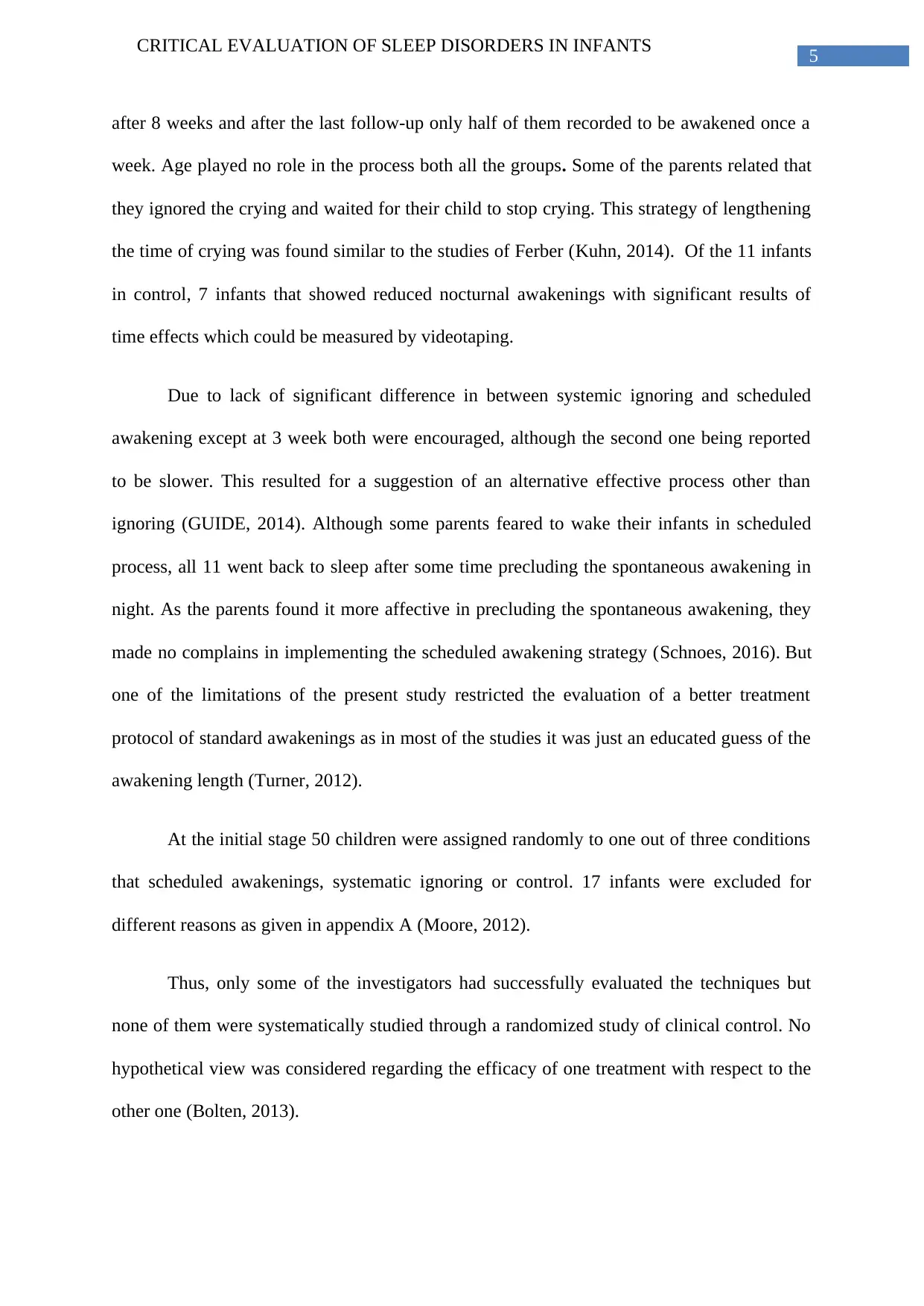
after 8 weeks and after the last follow-up only half of them recorded to be awakened once a
week. Age played no role in the process both all the groups. Some of the parents related that
they ignored the crying and waited for their child to stop crying. This strategy of lengthening
the time of crying was found similar to the studies of Ferber (Kuhn, 2014). Of the 11 infants
in control, 7 infants that showed reduced nocturnal awakenings with significant results of
time effects which could be measured by videotaping.
Due to lack of significant difference in between systemic ignoring and scheduled
awakening except at 3 week both were encouraged, although the second one being reported
to be slower. This resulted for a suggestion of an alternative effective process other than
ignoring (GUIDE, 2014). Although some parents feared to wake their infants in scheduled
process, all 11 went back to sleep after some time precluding the spontaneous awakening in
night. As the parents found it more affective in precluding the spontaneous awakening, they
made no complains in implementing the scheduled awakening strategy (Schnoes, 2016). But
one of the limitations of the present study restricted the evaluation of a better treatment
protocol of standard awakenings as in most of the studies it was just an educated guess of the
awakening length (Turner, 2012).
At the initial stage 50 children were assigned randomly to one out of three conditions
that scheduled awakenings, systematic ignoring or control. 17 infants were excluded for
different reasons as given in appendix A (Moore, 2012).
Thus, only some of the investigators had successfully evaluated the techniques but
none of them were systematically studied through a randomized study of clinical control. No
hypothetical view was considered regarding the efficacy of one treatment with respect to the
other one (Bolten, 2013).
CRITICAL EVALUATION OF SLEEP DISORDERS IN INFANTS
after 8 weeks and after the last follow-up only half of them recorded to be awakened once a
week. Age played no role in the process both all the groups. Some of the parents related that
they ignored the crying and waited for their child to stop crying. This strategy of lengthening
the time of crying was found similar to the studies of Ferber (Kuhn, 2014). Of the 11 infants
in control, 7 infants that showed reduced nocturnal awakenings with significant results of
time effects which could be measured by videotaping.
Due to lack of significant difference in between systemic ignoring and scheduled
awakening except at 3 week both were encouraged, although the second one being reported
to be slower. This resulted for a suggestion of an alternative effective process other than
ignoring (GUIDE, 2014). Although some parents feared to wake their infants in scheduled
process, all 11 went back to sleep after some time precluding the spontaneous awakening in
night. As the parents found it more affective in precluding the spontaneous awakening, they
made no complains in implementing the scheduled awakening strategy (Schnoes, 2016). But
one of the limitations of the present study restricted the evaluation of a better treatment
protocol of standard awakenings as in most of the studies it was just an educated guess of the
awakening length (Turner, 2012).
At the initial stage 50 children were assigned randomly to one out of three conditions
that scheduled awakenings, systematic ignoring or control. 17 infants were excluded for
different reasons as given in appendix A (Moore, 2012).
Thus, only some of the investigators had successfully evaluated the techniques but
none of them were systematically studied through a randomized study of clinical control. No
hypothetical view was considered regarding the efficacy of one treatment with respect to the
other one (Bolten, 2013).
⊘ This is a preview!⊘
Do you want full access?
Subscribe today to unlock all pages.
Trusted by 1+ million students worldwide
6
CRITICAL EVALUATION OF SLEEP DISORDERS IN INFANTS
Critically appraisal tool
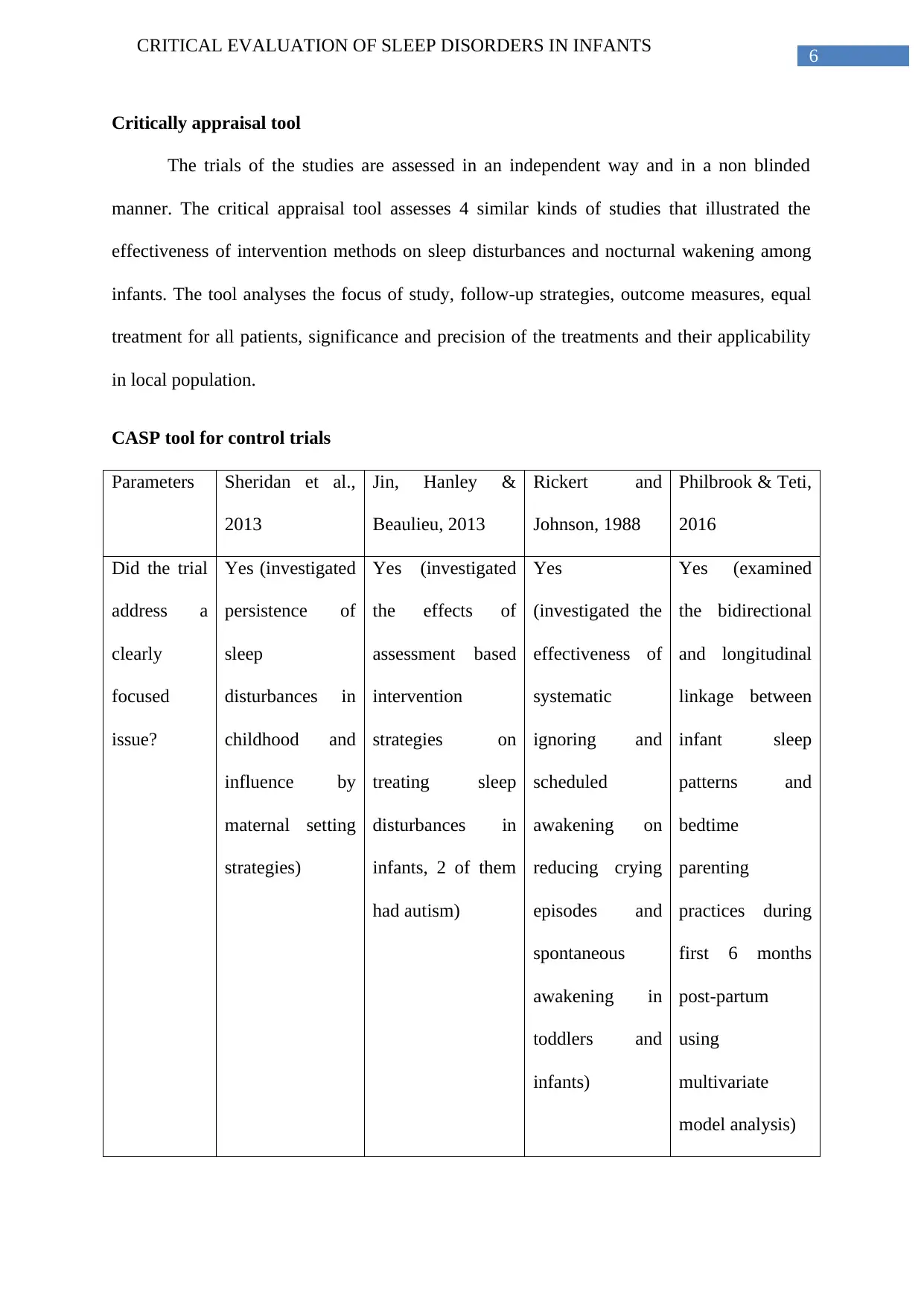
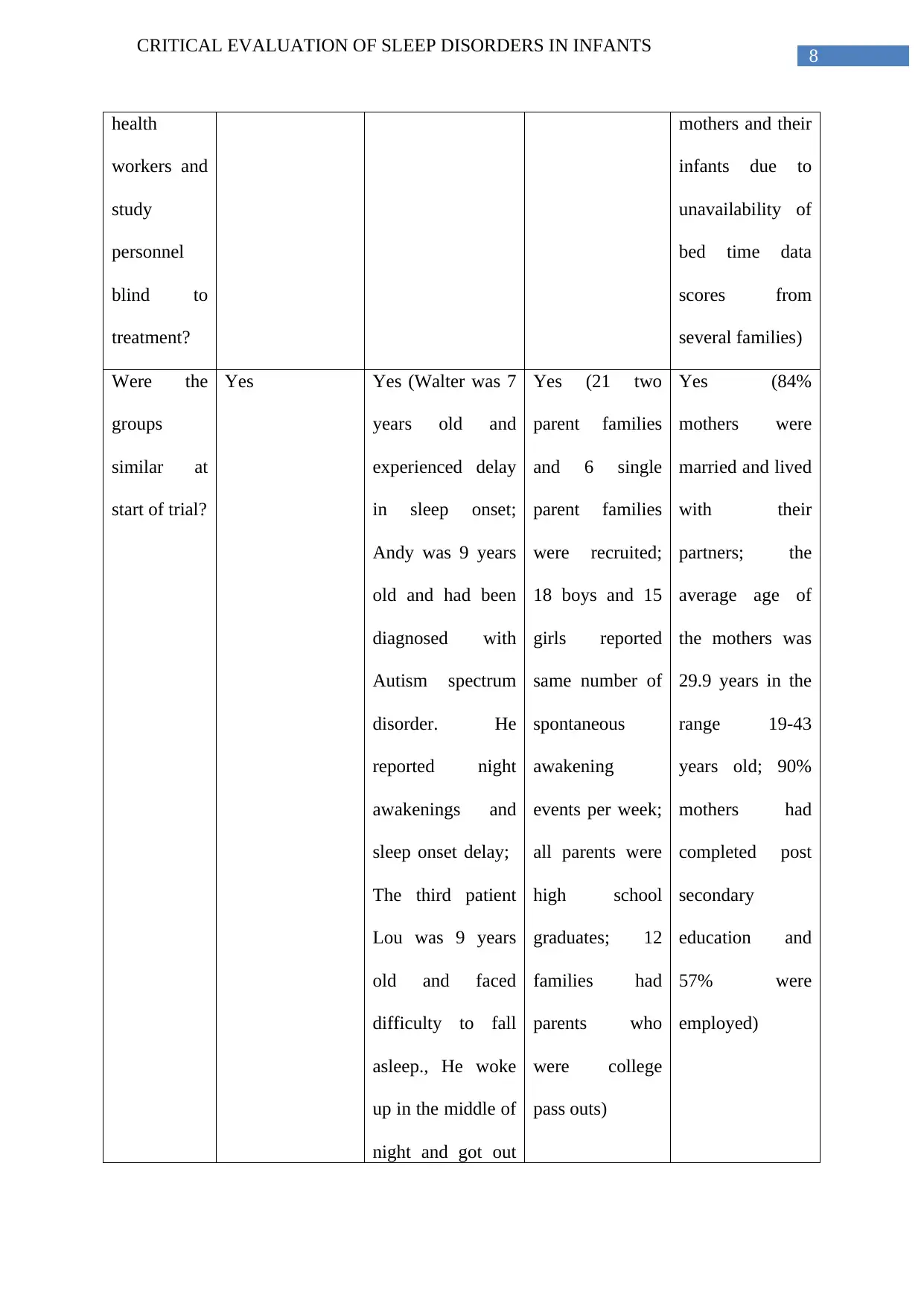
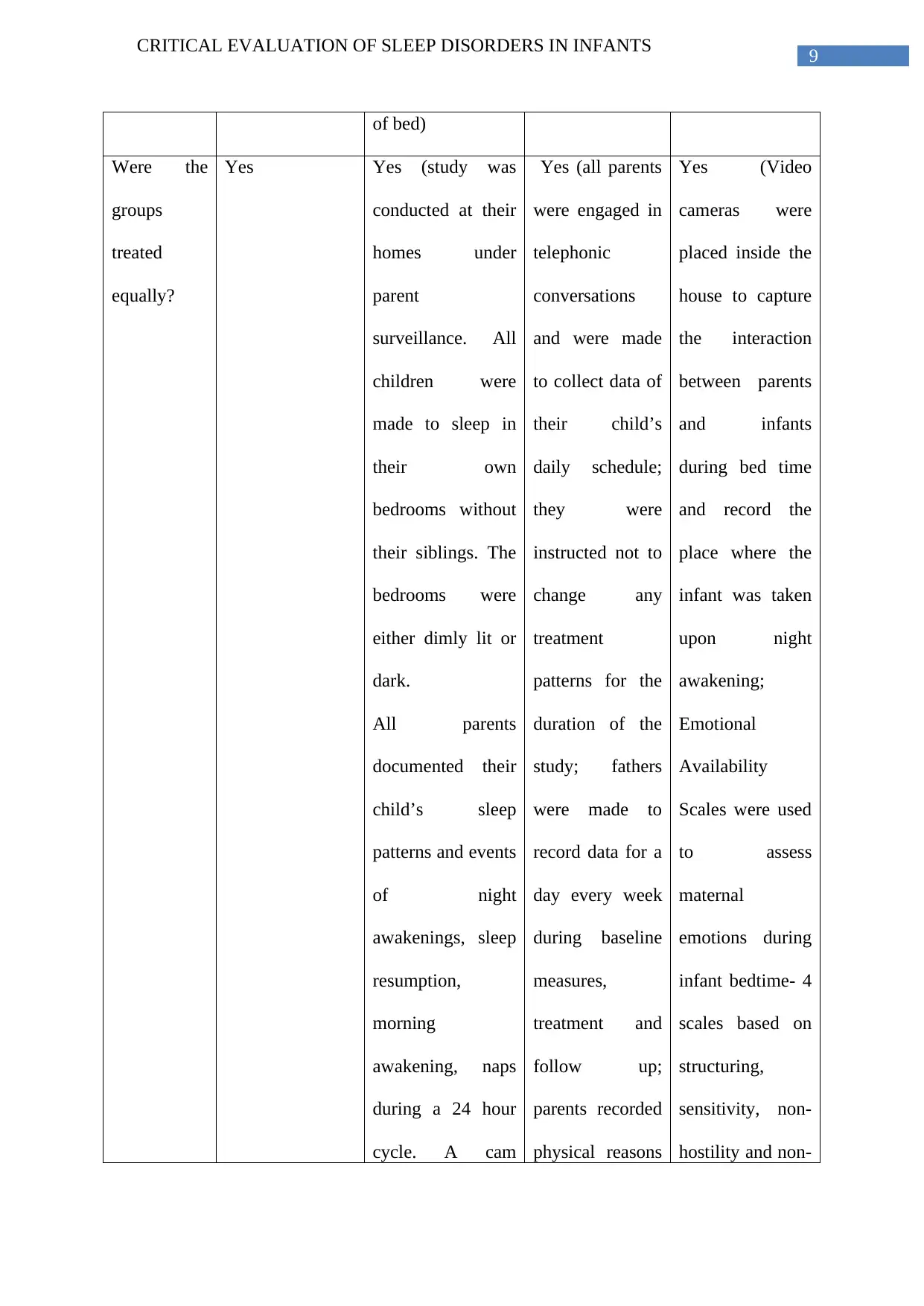
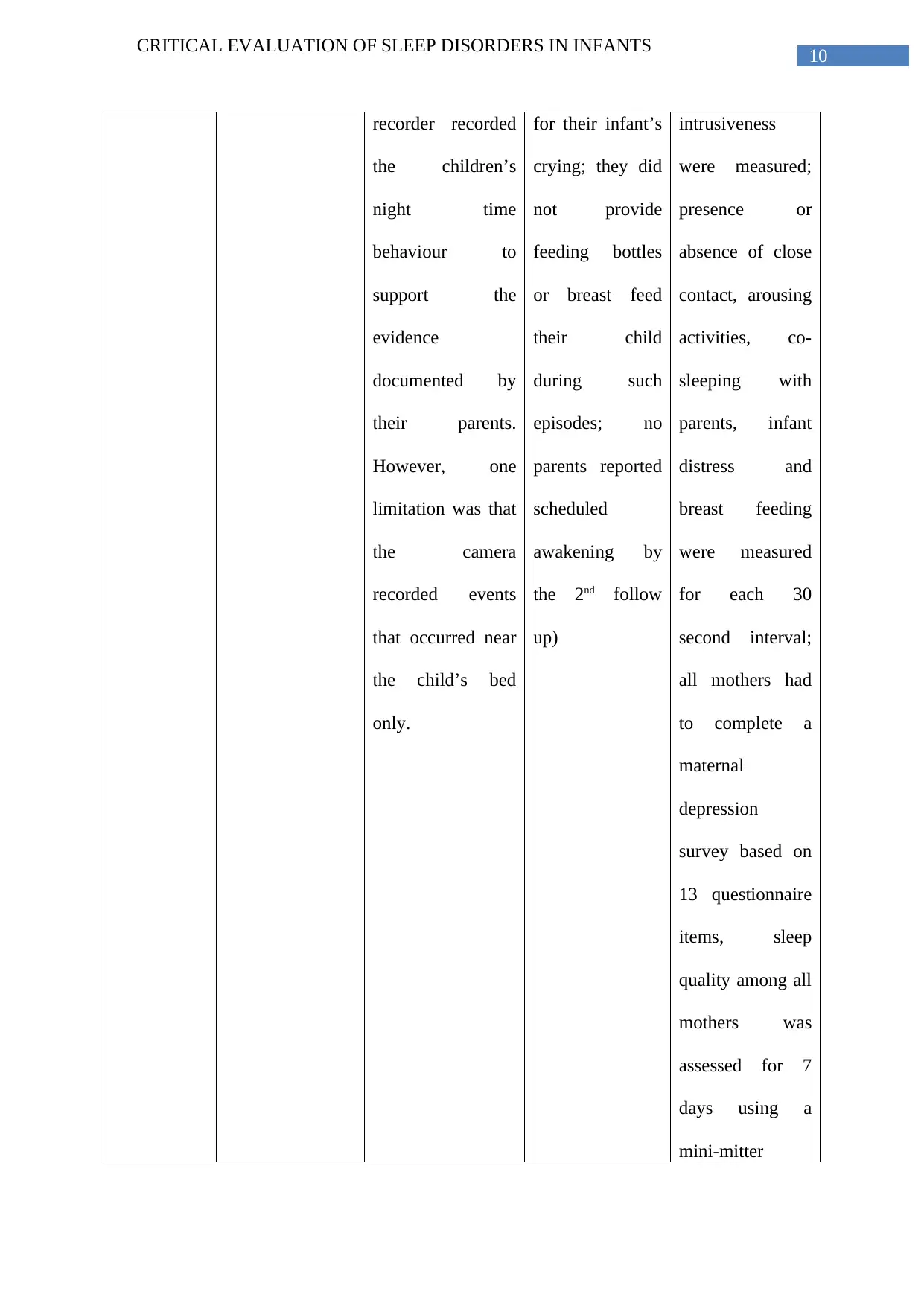
The trials of the studies are assessed in an independent way and in a non blinded
manner. The critical appraisal tool assesses 4 similar kinds of studies that illustrated the
effectiveness of intervention methods on sleep disturbances and nocturnal wakening among
infants. The tool analyses the focus of study, follow-up strategies, outcome measures, equal
treatment for all patients, significance and precision of the treatments and their applicability
in local population.
CASP tool for control trials
Parameters Sheridan et al.,
2013
Jin, Hanley &
Beaulieu, 2013
Rickert and
Johnson, 1988
Philbrook & Teti,
2016
Did the trial
address a
clearly
focused
issue?
Yes (investigated
persistence of
sleep
disturbances in
childhood and
influence by
maternal setting
strategies)
Yes (investigated
the effects of
assessment based
intervention
strategies on
treating sleep
disturbances in
infants, 2 of them
had autism)
Yes
(investigated the
effectiveness of
systematic
ignoring and
scheduled
awakening on
reducing crying
episodes and
spontaneous
awakening in
toddlers and
infants)
Yes (examined
the bidirectional
and longitudinal
linkage between
infant sleep
patterns and
bedtime
parenting
practices during
first 6 months
post-partum
using
multivariate
model analysis)
CRITICAL EVALUATION OF SLEEP DISORDERS IN INFANTS
Critically appraisal tool
The trials of the studies are assessed in an independent way and in a non blinded
manner. The critical appraisal tool assesses 4 similar kinds of studies that illustrated the
effectiveness of intervention methods on sleep disturbances and nocturnal wakening among
infants. The tool analyses the focus of study, follow-up strategies, outcome measures, equal
treatment for all patients, significance and precision of the treatments and their applicability
in local population.
CASP tool for control trials
Parameters Sheridan et al.,
2013
Jin, Hanley &
Beaulieu, 2013
Rickert and
Johnson, 1988
Philbrook & Teti,
2016
Did the trial
address a
clearly
focused
issue?
Yes (investigated
persistence of
sleep
disturbances in
childhood and
influence by
maternal setting
strategies)
Yes (investigated
the effects of
assessment based
intervention
strategies on
treating sleep
disturbances in
infants, 2 of them
had autism)
Yes
(investigated the
effectiveness of
systematic
ignoring and
scheduled
awakening on
reducing crying
episodes and
spontaneous
awakening in
toddlers and
infants)
Yes (examined
the bidirectional
and longitudinal
linkage between
infant sleep
patterns and
bedtime
parenting
practices during
first 6 months
post-partum
using
multivariate
model analysis)
Paraphrase This Document
Need a fresh take? Get an instant paraphrase of this document with our AI Paraphraser
7
CRITICAL EVALUATION OF SLEEP DISORDERS IN INFANTS
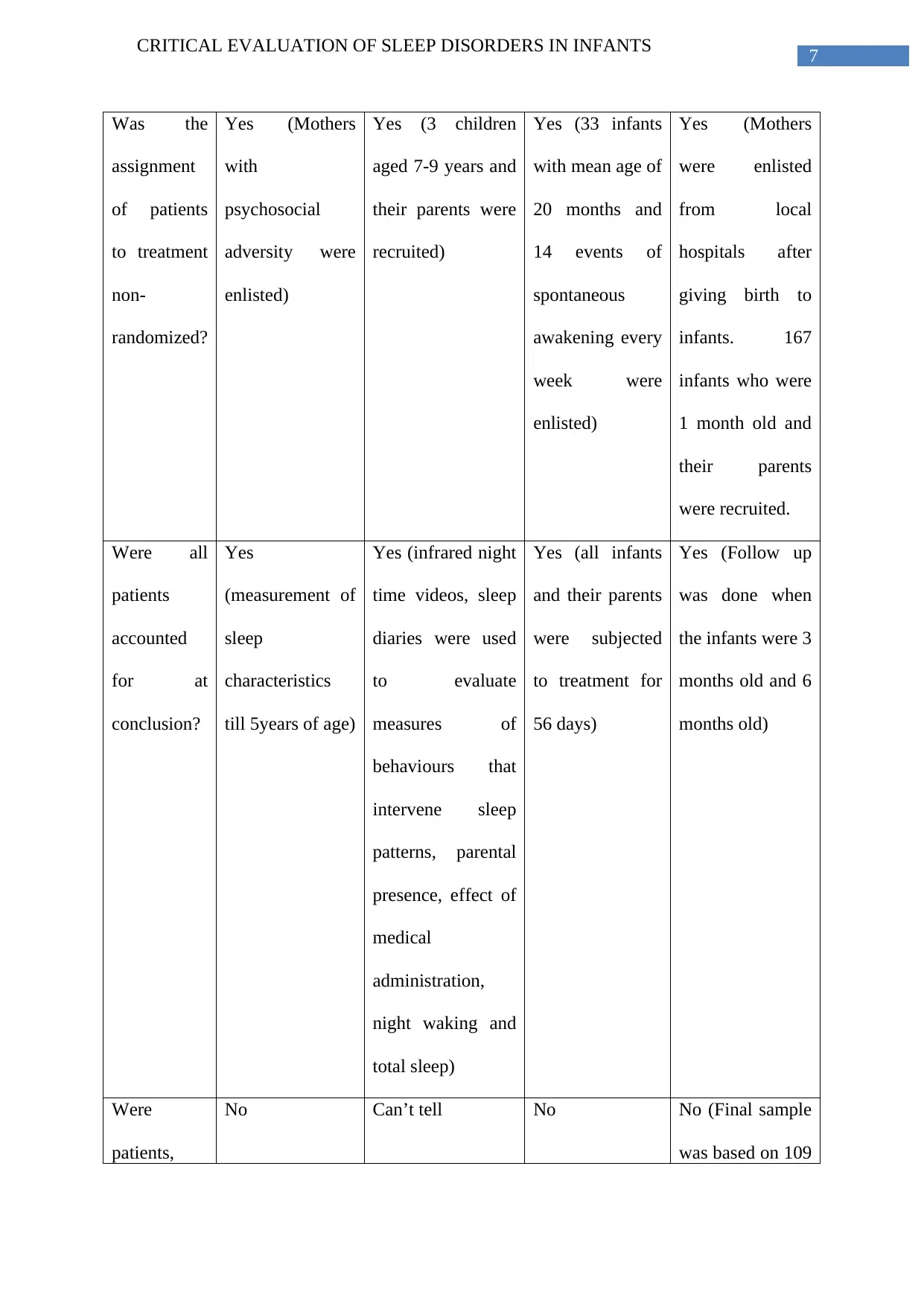
Was the
assignment
of patients
to treatment
non-
randomized?
Yes (Mothers
with
psychosocial
adversity were
enlisted)
Yes (3 children
aged 7-9 years and
their parents were
recruited)
Yes (33 infants
with mean age of
20 months and
14 events of
spontaneous
awakening every
week were
enlisted)
Yes (Mothers
were enlisted
from local
hospitals after
giving birth to
infants. 167
infants who were
1 month old and
their parents
were recruited.
Were all
patients
accounted
for at
conclusion?
Yes
(measurement of
sleep
characteristics
till 5years of age)
Yes (infrared night
time videos, sleep
diaries were used
to evaluate
measures of
behaviours that
intervene sleep
patterns, parental
presence, effect of
medical
administration,
night waking and
total sleep)
Yes (all infants
and their parents
were subjected
to treatment for
56 days)
Yes (Follow up
was done when
the infants were 3
months old and 6
months old)
Were
patients,
No Can’t tell No No (Final sample
was based on 109
CRITICAL EVALUATION OF SLEEP DISORDERS IN INFANTS
Was the
assignment
of patients
to treatment
non-
randomized?
Yes (Mothers
with
psychosocial
adversity were
enlisted)
Yes (3 children
aged 7-9 years and
their parents were
recruited)
Yes (33 infants
with mean age of
20 months and
14 events of
spontaneous
awakening every
week were
enlisted)
Yes (Mothers
were enlisted
from local
hospitals after
giving birth to
infants. 167
infants who were
1 month old and
their parents
were recruited.
Were all
patients
accounted
for at
conclusion?
Yes
(measurement of
sleep
characteristics
till 5years of age)
Yes (infrared night
time videos, sleep
diaries were used
to evaluate
measures of
behaviours that
intervene sleep
patterns, parental
presence, effect of
medical
administration,
night waking and
total sleep)
Yes (all infants
and their parents
were subjected
to treatment for
56 days)
Yes (Follow up
was done when
the infants were 3
months old and 6
months old)
Were
patients,
No Can’t tell No No (Final sample
was based on 109
8
CRITICAL EVALUATION OF SLEEP DISORDERS IN INFANTS
health
workers and
study
personnel
blind to
treatment?
mothers and their
infants due to
unavailability of
bed time data
scores from
several families)
Were the
groups
similar at
start of trial?
Yes Yes (Walter was 7
years old and
experienced delay
in sleep onset;
Andy was 9 years
old and had been
diagnosed with
Autism spectrum
disorder. He
reported night
awakenings and
sleep onset delay;
The third patient
Lou was 9 years
old and faced
difficulty to fall
asleep., He woke
up in the middle of
night and got out
Yes (21 two
parent families
and 6 single
parent families
were recruited;
18 boys and 15
girls reported
same number of
spontaneous
awakening
events per week;
all parents were
high school
graduates; 12
families had
parents who
were college
pass outs)
Yes (84%
mothers were
married and lived
with their
partners; the
average age of
the mothers was
29.9 years in the
range 19-43
years old; 90%
mothers had
completed post
secondary
education and
57% were
employed)
CRITICAL EVALUATION OF SLEEP DISORDERS IN INFANTS
health
workers and
study
personnel
blind to
treatment?
mothers and their
infants due to
unavailability of
bed time data
scores from
several families)
Were the
groups
similar at
start of trial?
Yes Yes (Walter was 7
years old and
experienced delay
in sleep onset;
Andy was 9 years
old and had been
diagnosed with
Autism spectrum
disorder. He
reported night
awakenings and
sleep onset delay;
The third patient
Lou was 9 years
old and faced
difficulty to fall
asleep., He woke
up in the middle of
night and got out
Yes (21 two
parent families
and 6 single
parent families
were recruited;
18 boys and 15
girls reported
same number of
spontaneous
awakening
events per week;
all parents were
high school
graduates; 12
families had
parents who
were college
pass outs)
Yes (84%
mothers were
married and lived
with their
partners; the
average age of
the mothers was
29.9 years in the
range 19-43
years old; 90%
mothers had
completed post
secondary
education and
57% were
employed)
⊘ This is a preview!⊘
Do you want full access?
Subscribe today to unlock all pages.
Trusted by 1+ million students worldwide
9
CRITICAL EVALUATION OF SLEEP DISORDERS IN INFANTS
of bed)
Were the
groups
treated
equally?
Yes Yes (study was
conducted at their
homes under
parent
surveillance. All
children were
made to sleep in
their own
bedrooms without
their siblings. The
bedrooms were
either dimly lit or
dark.
All parents
documented their
child’s sleep
patterns and events
of night
awakenings, sleep
resumption,
morning
awakening, naps
during a 24 hour
cycle. A cam
Yes (all parents
were engaged in
telephonic
conversations
and were made
to collect data of
their child’s
daily schedule;
they were
instructed not to
change any
treatment
patterns for the
duration of the
study; fathers
were made to
record data for a
day every week
during baseline
measures,
treatment and
follow up;
parents recorded
physical reasons
Yes (Video
cameras were
placed inside the
house to capture
the interaction
between parents
and infants
during bed time
and record the
place where the
infant was taken
upon night
awakening;
Emotional
Availability
Scales were used
to assess
maternal
emotions during
infant bedtime- 4
scales based on
structuring,
sensitivity, non-
hostility and non-
CRITICAL EVALUATION OF SLEEP DISORDERS IN INFANTS
of bed)
Were the
groups
treated
equally?
Yes Yes (study was
conducted at their
homes under
parent
surveillance. All
children were
made to sleep in
their own
bedrooms without
their siblings. The
bedrooms were
either dimly lit or
dark.
All parents
documented their
child’s sleep
patterns and events
of night
awakenings, sleep
resumption,
morning
awakening, naps
during a 24 hour
cycle. A cam
Yes (all parents
were engaged in
telephonic
conversations
and were made
to collect data of
their child’s
daily schedule;
they were
instructed not to
change any
treatment
patterns for the
duration of the
study; fathers
were made to
record data for a
day every week
during baseline
measures,
treatment and
follow up;
parents recorded
physical reasons
Yes (Video
cameras were
placed inside the
house to capture
the interaction
between parents
and infants
during bed time
and record the
place where the
infant was taken
upon night
awakening;
Emotional
Availability
Scales were used
to assess
maternal
emotions during
infant bedtime- 4
scales based on
structuring,
sensitivity, non-
hostility and non-
Paraphrase This Document
Need a fresh take? Get an instant paraphrase of this document with our AI Paraphraser
10
CRITICAL EVALUATION OF SLEEP DISORDERS IN INFANTS
recorder recorded
the children’s
night time
behaviour to
support the
evidence
documented by
their parents.
However, one
limitation was that
the camera
recorded events
that occurred near
the child’s bed
only.
for their infant’s
crying; they did
not provide
feeding bottles
or breast feed
their child
during such
episodes; no
parents reported
scheduled
awakening by
the 2nd follow
up)
intrusiveness
were measured;
presence or
absence of close
contact, arousing
activities, co-
sleeping with
parents, infant
distress and
breast feeding
were measured
for each 30
second interval;
all mothers had
to complete a
maternal
depression
survey based on
13 questionnaire
items, sleep
quality among all
mothers was
assessed for 7
days using a
mini-mitter
CRITICAL EVALUATION OF SLEEP DISORDERS IN INFANTS
recorder recorded
the children’s
night time
behaviour to
support the
evidence
documented by
their parents.
However, one
limitation was that
the camera
recorded events
that occurred near
the child’s bed
only.
for their infant’s
crying; they did
not provide
feeding bottles
or breast feed
their child
during such
episodes; no
parents reported
scheduled
awakening by
the 2nd follow
up)
intrusiveness
were measured;
presence or
absence of close
contact, arousing
activities, co-
sleeping with
parents, infant
distress and
breast feeding
were measured
for each 30
second interval;
all mothers had
to complete a
maternal
depression
survey based on
13 questionnaire
items, sleep
quality among all
mothers was
assessed for 7
days using a
mini-mitter

11
CRITICAL EVALUATION OF SLEEP DISORDERS IN INFANTS
actigraphy
wristwatch)
How large
was the
treatment
effect?
Sleep
disturbances
persisted till five
years in high risk
infants. Maternal
involvement was
found to be
larger in mothers
at a high risk
mothers in infant
setting and
predicted less
optimal sleep at
five years.
Agreement data
collected was 43%
and 24% for delay
in sleep onset;
36% and 28% for
overall sleep
interfering
behaviour; 25%
and 22% for
specific sleep
interfering
behaviour.
Partitioning the
duration of
observation into 10
second intervals
and converting the
results to
percentages gave
the average for all
intervals.
1 way variance
analysis were
performed
between the
groups; baseline
data for
treatment groups
were compared
to number of
awakening
episodes; 3*8
multivariate
analysis was
performed with
1 between factor
(groups) and 1
within factor
(weeks).
SAS 9.4 and Proc
Mixed were used
for multilevel
model analysis.
Hypothesis 1-3
predicted night
time distress in
infants by
analysing parent
variables,
hypothesis 4
predicted
parenting
practice and
maternal EA by
focusing on
infant variables.
88% infants and
66% parents
provided data for
at least 2 time
points.
How precise Less optimal Mean agreement No significant Night time
CRITICAL EVALUATION OF SLEEP DISORDERS IN INFANTS
actigraphy
wristwatch)
How large
was the
treatment
effect?
Sleep
disturbances
persisted till five
years in high risk
infants. Maternal
involvement was
found to be
larger in mothers
at a high risk
mothers in infant
setting and
predicted less
optimal sleep at
five years.
Agreement data
collected was 43%
and 24% for delay
in sleep onset;
36% and 28% for
overall sleep
interfering
behaviour; 25%
and 22% for
specific sleep
interfering
behaviour.
Partitioning the
duration of
observation into 10
second intervals
and converting the
results to
percentages gave
the average for all
intervals.
1 way variance
analysis were
performed
between the
groups; baseline
data for
treatment groups
were compared
to number of
awakening
episodes; 3*8
multivariate
analysis was
performed with
1 between factor
(groups) and 1
within factor
(weeks).
SAS 9.4 and Proc
Mixed were used
for multilevel
model analysis.
Hypothesis 1-3
predicted night
time distress in
infants by
analysing parent
variables,
hypothesis 4
predicted
parenting
practice and
maternal EA by
focusing on
infant variables.
88% infants and
66% parents
provided data for
at least 2 time
points.
How precise Less optimal Mean agreement No significant Night time
⊘ This is a preview!⊘
Do you want full access?
Subscribe today to unlock all pages.
Trusted by 1+ million students worldwide

1 out of 23


Your All-in-One AI-Powered Toolkit for Academic Success.
+13062052269
info@desklib.com
Available 24*7 on WhatsApp / Email
![[object Object]](/_next/static/media/star-bottom.7253800d.svg)
Unlock your academic potential
Copyright © 2020–2026 A2Z Services. All Rights Reserved. Developed and managed by ZUCOL.