Critical Social Work Theories: Exploring Gender Inequality in Society

Verified

Added on  2023/04/23

|8
|1958
|476
Report
AI Summary
This report delves into critical social work theories, exploring the concept of critical social work and its role in identifying and addressing social injustices, particularly gender inequality. The report examines the key issues within critical theory and practice, such as unequal power distribution and discrimination, referencing articles that discuss gender inequality and its impact on society. The literature review summarizes the ideas presented, highlighting the philosophies underpinning the information, including holism, feminism, and Marxism. Furthermore, the report discusses how the reviewed articles can influence social work practices by analyzing the underlying reasons for social imbalances and promoting societal transformation. The conclusion emphasizes the significance of understanding critical social work for effective social work practices and acknowledges the challenges faced by critical social work.
Document Page
Running head: Critical social work theories
CRITICAL SOCIAL WORK THEORIES
tabler-icon-diamond-filled.svg

Paraphrase This Document

Need a fresh take? Get an instant paraphrase of this document with our AI Paraphraser
Document Page
1
Critical social work theories
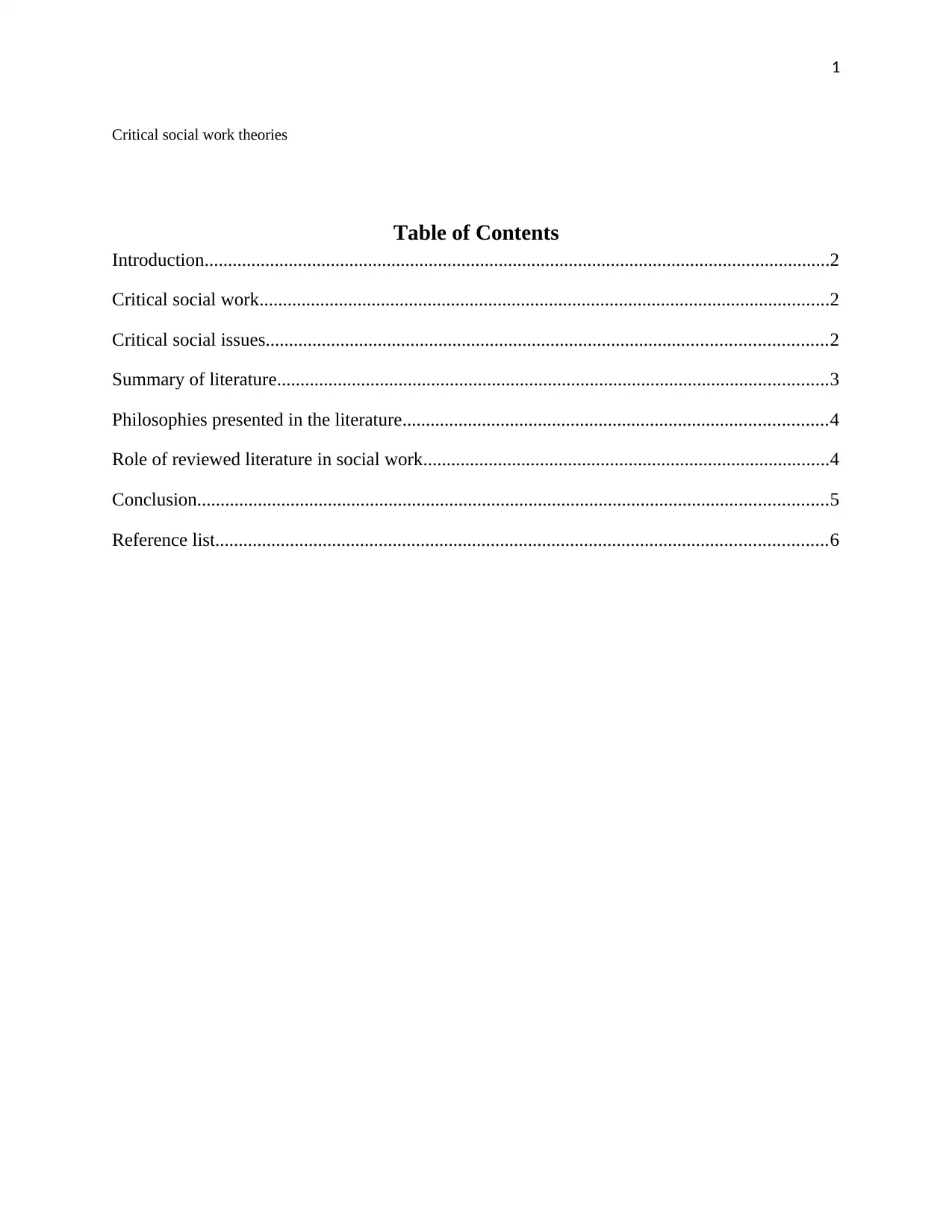
Table of Contents
Introduction......................................................................................................................................2
Critical social work..........................................................................................................................2
Critical social issues........................................................................................................................2
Summary of literature......................................................................................................................3
Philosophies presented in the literature...........................................................................................4
Role of reviewed literature in social work.......................................................................................4
Conclusion.......................................................................................................................................5
Reference list...................................................................................................................................6
Document Page
2
Critical social work theories
Introduction
Critical social work deals with social works that aim at identifying social injustices in
order to solve them. This aligns with the critical theory and practice perspective that views social
injustices as outcomes of various kinds of violence and oppression in the capitalist societies.
There are several critical issues in the critical theory such as gender discrimination, oppression of
the marginalized people, violence on immigrants and more. Thus, this study has revolved around
critical social work and the aspects that surround it. For that reason, some key issues in critical
theory and practice have been illuminated here. Among them, one particular issue has been
discussed in detail in this study that is gender inequality. Two articles have been reviewed
critically for the discussion of the chosen key critical theory issue. Moreover, the reviewed
articles have been reflected upon in order to identify its role in my actions as a social worker.
Critical social work
Critical social work refers to questioning and investigating the society that we live in
order to explore the issues relevant in this society such as unequal power distribution, harmful
discrimination based on irrational divisions. The motto of this critique is to overcome and solve
the issues of injustice deeply rooted in the capitalist society. According to (Assefa, 2019), critical
social work has been under various kinds if pressure from the powerful people of this society
because this whole realm of critical social work questions those in power and the validity of their
authority and superiority over others who have been termed as marginalized. Another reason
behind this issue relies on the fact that the success of the critical social work depends on how
efficiently it challenges the existing structure of the society that has been causing the critical
social issues (Guo, Huang, & Porterfield, 2018). Moreover, critical social work focuses on
various social issues of oppression that are harmful for the future of our society.
Document Page
3
Critical social work theories
Critical social issues
As mentioned earlier, there are several social issues that have been the reason of concern
for critical theory and practices. Among them, gender inequality or equity us one of the weakest
area of the present society that has been hampering the growth of the society. According to Ion
(2018), it is one of the human rights to be in a society that facilitates gender equity. On the
contrary, in reality, there is still a huge gap between women and men when the issue is about
having equal opportunities or having the power of decision making in any significant field. Thus,
this issue needs to be taken seriously not only because it hampers the growth of women but also
because gender inequality or oppression on women hampers the development of every country in
the world. As mentioned by Paudel (2018), women have been facing oppression every single day
and thus it is very important to give them the power to share their stories with the world.
Critical social work has been enabling these women to come forward to have a power in
order to stop their oppressive states in the society. Various movements like #me2 have been
started that have been helping women to break the silence and to help in transforming the
imbalanced society. Critical social work has been making bonds with these ongoing social
movements to reach the remotest places where women are still viewed as commodities or fancy
objects (Good, 2019). This is so because, it is the development of social work practices is highly
dependent on the needs of the oppressed section of the capitalist society.
There is an easy way out for stopping the oppression of women and that is making them
self independent. However, it has been noticed that women face a high level of discrimination in
the field of their work or in their workplaces. According to Baines (2007), downsizing of the
welfare state has some negative effects on women. This is so because the number of full-time has
been reduced due to this welfare state by replacing the better paid jobs with low aid and
temporary jobs. In addition, women have continuously been stigmatized where a major part of
the society believes that women are suited for a certain kinds of jobs such as counselling,
facilitation, problem solving and so on. Critical social work practices helps in breaking the
stereotypical notions regarding women and their skills.
tabler-icon-diamond-filled.svg

Paraphrase This Document

Need a fresh take? Get an instant paraphrase of this document with our AI Paraphraser
Document Page
4
Critical social work theories
Summary of literature
In the article namely the Critical Potential of Social Work, the author states that the role
of critical social work is to question the basis inequalities of our society that have been
generating various kinds of oppression on the socially marginalized classes. This is so because
social work practices tend to fight against those imbalanced power equations that are the reasons
behind social injustices (Morley, Macfarlane, Ablett & Ife, 2014). On the other hand, in the
article namely Doing Anti-oppressive Practice, the author believes that participatory democracy
is a solution to the key issues of critical theory and practice (Baines, 2007). This is so because
this equal participation of every people in the development of the society can be helpful in
transforming the present social evils into a progressive one.
Philosophies presented in the literature
Various theories and philosophies have underpinned the two above mentioned articles
such as Holism, Neoliberalism, Managerialism, radicalism, post structuralism, Marxism,
Humanism, Social activism, Feminism, Economic rationalism and more. However all of the
theories are diverse in nature but somehow they promote a singular approach towards our society
(Molyneux, 2019). This approach is to view the society and the people in it as equal from every
angle because only this equality can transform the present society into a holistic society where
each and everyone can exercise equal opportunities (Deranty, 2018). Among the theories,
Radicalism, Feminism and Marxism talk about bringing a drastic change in the present fabric of
society in order to blur the power relation between the powerful and the powerless. These
theories have influenced critical social work theories because both of them tend to give power to
the powerless to build a liberal and economically rational society.
Role of reviewed literature in social work
The reviewed articles have highly influenced me that will be helpful for me to brush up
my social work approaches. In order to elaborate, the information, presented in the articles, has
helped me in perceiving the underlying reasons behind the social imbalance between people
Document Page
5
Critical social work theories
belonging to diverse caste, class, race and gender (Cunningham, Zimmerman & Carter, 2019).
On the other hand, I also realized that social work is not about solving individual problems but it
is about transforming the whole society so that no individual suffers from any kind of
marginalization or oppression.
Conclusion
The significance of knowing critical social work lies on the fact that they let us delve
deeper into the issues of critical theory and practices. This is so because it is important to know
the diverse social issues in order to indulge ourselves in social work practices. The needs of the
oppressed have to be known and acknowledged before helping them. On the other hand, the
reviewed articles have discussed some challenges of critical social work that are very relevant to
know in order to come up with their solutions. For example, discouragement for critical social
work can come from a major part of the society because the success of these social work
practices depends on how fast the power equation can be changed. For that reason, it can be hard
to make the powerful section of the society our allies while practicing social work globally.
Document Page
6
Critical social work theories
Reference list
Assefa, E. B. (2019). What is Good or Evil? A Philosophical Reflection on the Problem of Moral
Responsibility. Journal of Citizenship and Morality, 2(1), 21-39. Retrieved on: 27th Feb,
2019, From:
http://www.mu.edu.et/clg/images/journal/Eyasu_Barento_JCM_January_2019.pdf
Baines, D. (2007). Anti-oppressive social work practice. Doing anti-oppressive practice,
Building transformative politicized social work, 12(1), 1-30. Retrieved on: 27th Feb, 2019,
From: http://brunswickbooks.ca/website_pdfs/doinganti-opprac.pdf
Cunningham, R. M., Zimmerman, M. A., & Carter, P. M. (2019). Money, Politics, and Firearm
Safety: Physician Political Action Committees in the Era of “This is Our Lane”. JAMA
Network Open, 2(2), 12-20. Retrieved on: 27th Feb, 2019, From:
https://jamanetwork.com/journals/jamanetworkopen/fullarticle/2725481
Deranty, J. P. (2018). Critical Theory between Marx and Honneth. Civitas-Revista de
CiênciasSociais, 18(3), 630-653. Retrieved on: 27th Feb, 2019, From:
http://www.scielo.br/scielo.php?pid=S1519-60892018000300630&script=sci_arttext
Good, K. D. (2019). CHIRPS. Teaching Media Quarterly, 7(1), 13-39. Retrieved on: 27th Feb,
2019, From: https://pubs.lib.umn.edu/index.php/tmq/article/download/1501/1426
Guo, B., Huang, J., & Porterfield, S. L. (2018). Transition to Adulthood: Dynamics of Disability,
Food Security, Health, and SNAP Participation. University of Kentucky Center for
Poverty Research Discussion Paper Series, DP2018-01. University of Kentucky Center
for Poverty Research. 11(3), 23-27.Retrieved on: 27th Feb, 2019, From:
https://files.eric.ed.gov/fulltext/ED590210.pdf
Ion, B. (2018). Inequality-Poignant Phenomenon of the Beginning of the 21st Century. Ovidius
University Annals, Economic Sciences Series, 18(2), 209-213. Retrieved on: 27th Feb,
tabler-icon-diamond-filled.svg

Paraphrase This Document

Need a fresh take? Get an instant paraphrase of this document with our AI Paraphraser
Document Page
7
Critical social work theories
2019, From: http://stec.univ-ovidius.ro/html/anale/RO/wp-content/uploads/2019/02/4-
2.pdf
Molyneux, J. (2019). The future of Marxism. Irish Marxist Review, 8(23), 5-14. Retrieved on:
27th Feb, 2019, From:
http://www.irishmarxistreview.net/index.php/imr/article/viewFile/313/304
Morley, C., Macfarlane, S., Ablett, P., & Ife, J. (2014). The critical potential of social work.
In Engaging with Social Work: A Critical Introduction 10(2), 1-30.
doi:10.1017/CBO9781107445321.001
Paudel, B. (2018). Impact Analysis of Physical Violence on Women. Research Nepal Journal of
Development Studies, 1(2), 116-130. Retrieved on: 27th Feb, 2019, From:
https://www.nepjol.info/index.php/rnjds/article/download/22431/19088
chevron_up_icon
1 out of 8
circle_padding
hide_on_mobile
zoom_out_icon
[object Object]