Critical Social Work Theory: Analysis, Relevance, and Practice

Verified

Added on  2022/12/28

|7
|1799
|1
Essay
AI Summary
This essay provides a comprehensive critical analysis of the Critical Social Work Theory. It begins with an introduction to the theory, highlighting its development in response to changing social conditions and inequalities, and its aim to address the flaws of traditional social work. The essay then offers a synoptic view of Critical Social Work Theory, emphasizing its critique of conservative approaches and its focus on addressing the root causes of social problems, drawing heavily on feminist and Marxist perspectives. A critique of the theory's limitations, particularly concerning its structural orientation, is also included. Furthermore, the essay explores the relevance of Critical Social Work Theory in contemporary times, especially within the Australian context, referencing the Australian Association of Social Workers (AASW) practice standards and code of ethics. The essay concludes by highlighting how AASW's principles align with the goals of Critical Social Work Theory, emphasizing the importance of social justice and professional integrity in social work practice.
Document Page
Running head: CRITICAL SOCIAL WORK
CRITICAL SOCIAL WORK
Name of the Student
Name of the University
Author Note
tabler-icon-diamond-filled.svg

Paraphrase This Document

Need a fresh take? Get an instant paraphrase of this document with our AI Paraphraser
Document Page
1CRITICAL SOCIAL WORK
Introduction
With the advancement of the age, there have been a development in the thought and that
has in turn led to the development of the existing theories which have been a response to the
changing social conditions. Social work has been one such field which have undergone
development in order to suit the needs of the time, and that has led to the inception of the Critical
Social Work Theory, aimed at rectifying the flaws and incompetencies of the existing theoretical
premise. With the advancement of age, and the societal structure getting complicated the existing
theory of social work had undergone a critical assessment and the developments have been
incorporated into the existing theoretical premise of social work. Rising inequalities,
magnification of the intensity of causes leading to the social inequalities, has led to the rising
social problems which has become impossible for the traditional social work theories to deal
with the changing social conditions which is growing more complex. The critical social work
theory had developed in the 1970s and the approach that had led to the evolution of the critical
social work theory was a radical one and was aimed at rooting out the oppression. The 1970s had
been a turbulent age due to several reasons. The cold war was at its peak; the third world nations
of the continents of Asia, Africa and Latin America had gained their independence; economic
inequality between the nations; the mass immigration from the third world to the first world
creating the problems of integration and armed conflict had not yet come to an end despite the
Second World War coming to an end. These factors had caused immense amount of instability in
the world. Thus the critical social work theory had been developed to deal with the complex
situations in the society (Morley, Ablett & Macfarlane, 2019).
Document Page
2CRITICAL SOCIAL WORK
Statement of purpose
This particular essay shall be dealing with a critical analysis of the critical social work
theory, from both the theoretical and the practical perspective. In the following sections the
discussion shall be focusing upon a brief introduction to the theory of Critical Social Work, a
critique of it, and the relevance of it in the Australian context with specific reference to the
practice standards and the code of ethic followed by Australian Association of Social Work.
Body
Synoptic view of Critical Social Work Theory
Critical Social Work Theory was born against the background of the post second world
war scenario and the ravages of the cold war scenario in the 1970s. Critical Social Work Theory
is, as the name suggests have been a critique to the Conservative or the Traditional Social Work
Theory in order to bring about a change in the method of reaching out to the masses and helping
them out to come out of the crisis situation. The Conservative or the Traditional Social Work
Theory harps upon just treating the symptons without trying to treat the root cause leading to the
social evils. The Conservative or the Traditional Social Work Theory deals with the social
problems as an issue which affects the individuals by means of detaching it from the social and
political scenario. Naturally, there was a lacuna in the way the Conservative or the Traditional
Social Work Theory functioned. It is however not being implied that the Conservative or the
Traditional Social Work Theory has been incompetent with regard to finding a solution to the
human problems, rather, the approach of isolating the individual issue from the greater social
context has been identified as inadequate to deal with the rising social problems. The approach of
treating the human problems without challenging the factors leading to the problems followed by
Document Page
3CRITICAL SOCIAL WORK
the Conservative or the Traditional Social Work Theory has been deemed as problematic. On the
other hand, Critical Social Work Theory seeks to challenge the social problems which lead to the
individual problems. Critical Social Work Theory considers individual problems as a result of
the social evils and that individual problems are embedded in the social structures itself. Hence
in order to treat the individual problems, the social work scheme must aim at rooting out the
social problems in the most effective way. Individual treatment of the issues without taking into
account the social conditions is a folly as per the views of Critical Social Work Theory. The
theoretical premise of feminism and Marxism have had a profound impact on the discipline of
Critical Social Work Theory, which are emancipator ideals aimed at targeting the social evils at
the root thereby aiming to bring changes at the institutional level for the sake of dealing with the
social evils in an effective way. Thus it can be said that the element of humanism motivated by
the philosophy of bringing about holistic changes in the society is the aim of the Critical Social
Work Theory. The Critical Social Work Theory is thus post structural in its orientation as it
seeks to root out the ills that are embedded in the social and institutional structure of capitalism
and patriarchy (Morley, Ablett & Macfarlane, 2019).
Critique of Critical Social Work Theory
The strength of the Critical Social Work Theory lies in the fact that it has taken the issues
of the emerging security issues which pose a threat to all other aspects of human life apart from
territorial security concerns thereby causing a broader application of the principles of justice and
humanity. Thus the scope of action is broader and the approach is much more holistic which
aims at rooting out the problem from the society and not just treating individual instances in
isolation from the society. However, there are certain limitations of the Critical Social Work
Theory as well which arises from the point of view of practice and that is a result of the
tabler-icon-diamond-filled.svg

Paraphrase This Document

Need a fresh take? Get an instant paraphrase of this document with our AI Paraphraser
Document Page
4CRITICAL SOCIAL WORK
orientation of Critical Social Work Theory towards structures and institutions. The Critical
Social Work Theory does not take into account the structures and the institutions and the
interaction between them while formulating the practice style (Fook, 2016).
Relevance of Critical Social Work Theory for Social Work practice
The relevance of the Critical Social Work Theory in the contemporary times can be
explained by viewing the world and its realities from a Feminist and Marxist perspective as those
theoretical premises have provided a resistance to the oppressive institutions, structures and
systems of the society, which is upheld by the AASW (Home - AASW - Australian Association
of Social Workers, 2019). The Marxist perspective view the capitalistic system to be oppressive
and exploitative which seeks to create income inequality and increases the gap between the rich
and the poor. Critical Social Work Theory thus seeks to harp on social inequality by means of
pressing for structural and institutional changes that shall be necessitating equitable distribution
of resources, eliminating exploitation, guaranteeing conditions of receiving the justified payment
of wages for the work the labours delivers and safeguarding the third world nations from the ills
of capitalistic exploitation. The feminist theory seeks to introduce the gender justice in the fold
of social work as the women are one of the worst affected sections of the society and the reason
being the institution of patriarchy which victimizes and marginalizes them in the society. From
the institutional level to the societal, the women have been relegated to the private spheres and
their issues neglected which Critical Social Work Theory has sought to address. Apart from that,
the issues of minority justice, immigration and the safeguarding of the environment are the issues
which have come up due to the paradigmatic shift in the definition of security from the
traditional territorial aspect to the non traditional definition which incorporates all issues
Document Page
5CRITICAL SOCIAL WORK
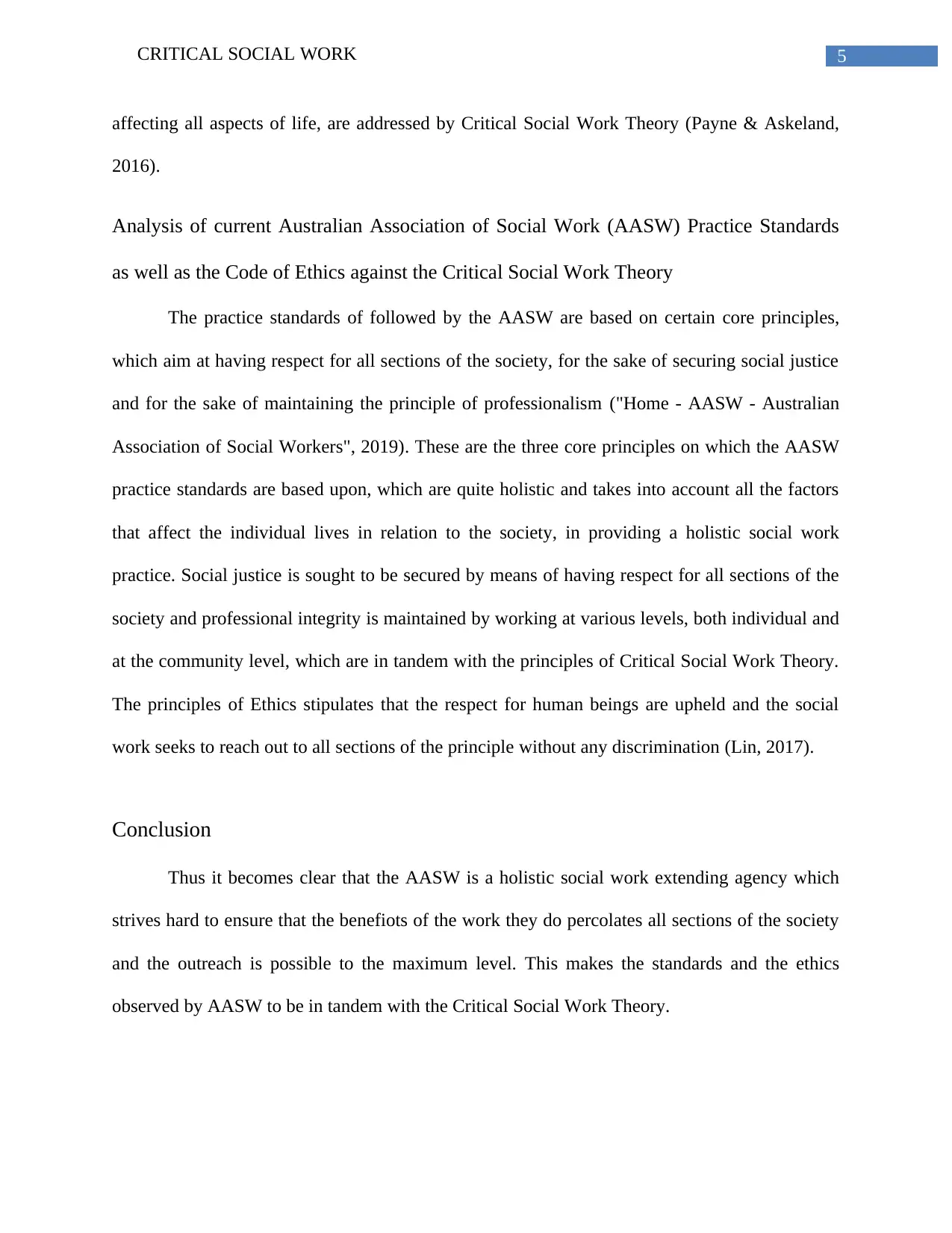
affecting all aspects of life, are addressed by Critical Social Work Theory (Payne & Askeland,
2016).
Analysis of current Australian Association of Social Work (AASW) Practice Standards
as well as the Code of Ethics against the Critical Social Work Theory
The practice standards of followed by the AASW are based on certain core principles,
which aim at having respect for all sections of the society, for the sake of securing social justice
and for the sake of maintaining the principle of professionalism ("Home - AASW - Australian
Association of Social Workers", 2019). These are the three core principles on which the AASW
practice standards are based upon, which are quite holistic and takes into account all the factors
that affect the individual lives in relation to the society, in providing a holistic social work
practice. Social justice is sought to be secured by means of having respect for all sections of the
society and professional integrity is maintained by working at various levels, both individual and
at the community level, which are in tandem with the principles of Critical Social Work Theory.
The principles of Ethics stipulates that the respect for human beings are upheld and the social
work seeks to reach out to all sections of the principle without any discrimination (Lin, 2017).
Conclusion
Thus it becomes clear that the AASW is a holistic social work extending agency which
strives hard to ensure that the benefiots of the work they do percolates all sections of the society
and the outreach is possible to the maximum level. This makes the standards and the ethics
observed by AASW to be in tandem with the Critical Social Work Theory.
Document Page
6CRITICAL SOCIAL WORK
References
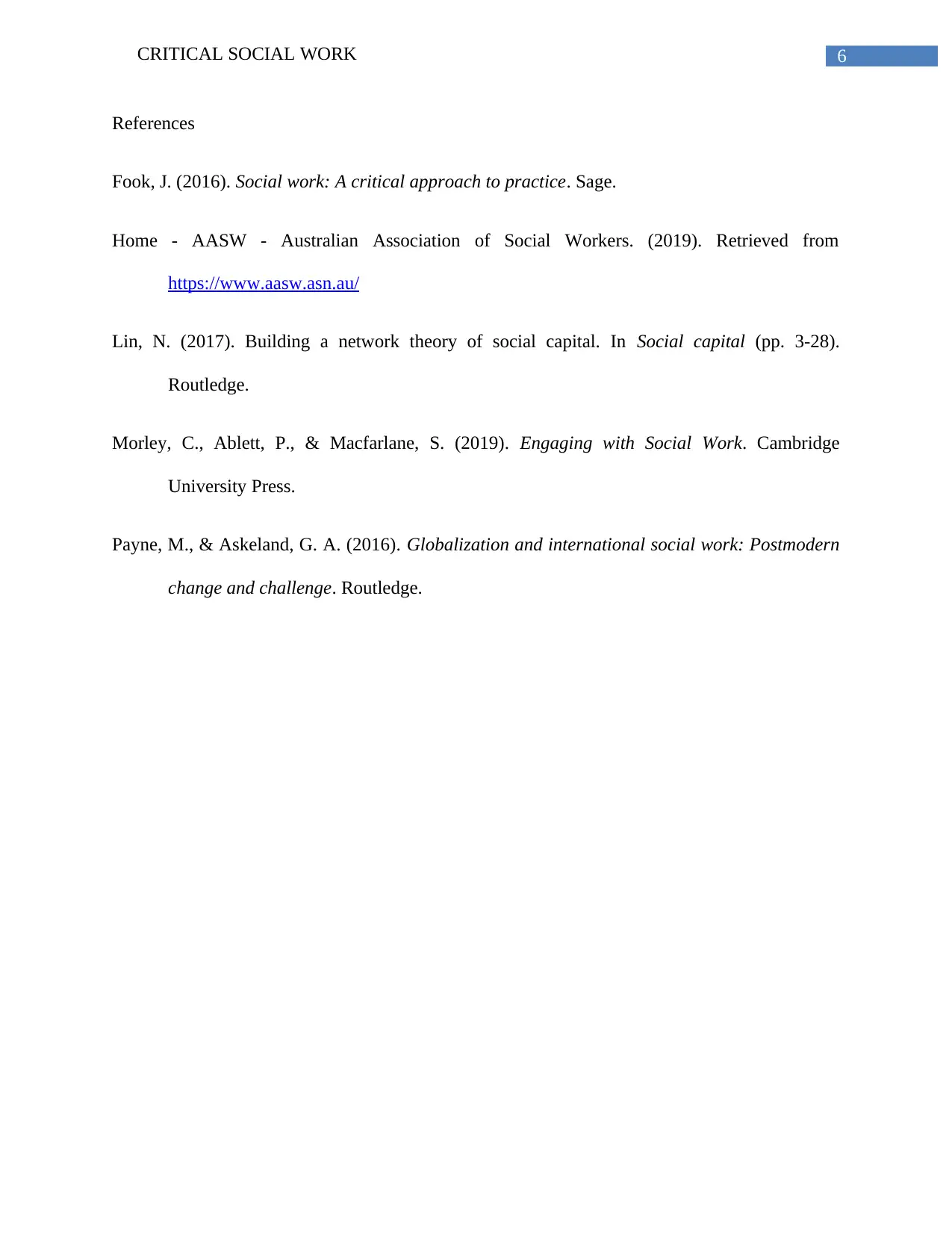
Fook, J. (2016). Social work: A critical approach to practice. Sage.
Home - AASW - Australian Association of Social Workers. (2019). Retrieved from
https://www.aasw.asn.au/
Lin, N. (2017). Building a network theory of social capital. In Social capital (pp. 3-28).
Routledge.
Morley, C., Ablett, P., & Macfarlane, S. (2019). Engaging with Social Work. Cambridge
University Press.
Payne, M., & Askeland, G. A. (2016). Globalization and international social work: Postmodern
change and challenge. Routledge.
chevron_up_icon
1 out of 7
circle_padding
hide_on_mobile
zoom_out_icon
[object Object]