Article Review: Designing Learning Environments for Critical Thinking

Verified

Added on  2022/10/12

|8
|2286
|20
Report
AI Summary
This report is a critical review of the article "Designing Learning Environments for Critical Thinking: Examining Effective Instructional Approaches" by Tiruneh, De Cock, and Elen (2018). The review analyzes the article's background, research objectives, core questions, methodology, and major findings, which investigated the effects of embedding critical thinking (CT) instruction in domain-specific courses. The study involved a quasi-experimental design with undergraduate students in physics, comparing Immersion, Infusion, and control instructional conditions. The review evaluates the article's strengths, such as providing insights into the role of educators and the systematic design of instructional interventions, and weaknesses, including limitations in the study's setup. The findings of the article suggests that the instructional interventions helped in the development of the critical thinking skills among the students. The conclusion emphasizes the significant role of educators in fostering CT skills and highlights the implications for future research and management practice. The review incorporates 12 peer-reviewed journal articles to support the analysis and adheres to APA style for referencing.
Document Page
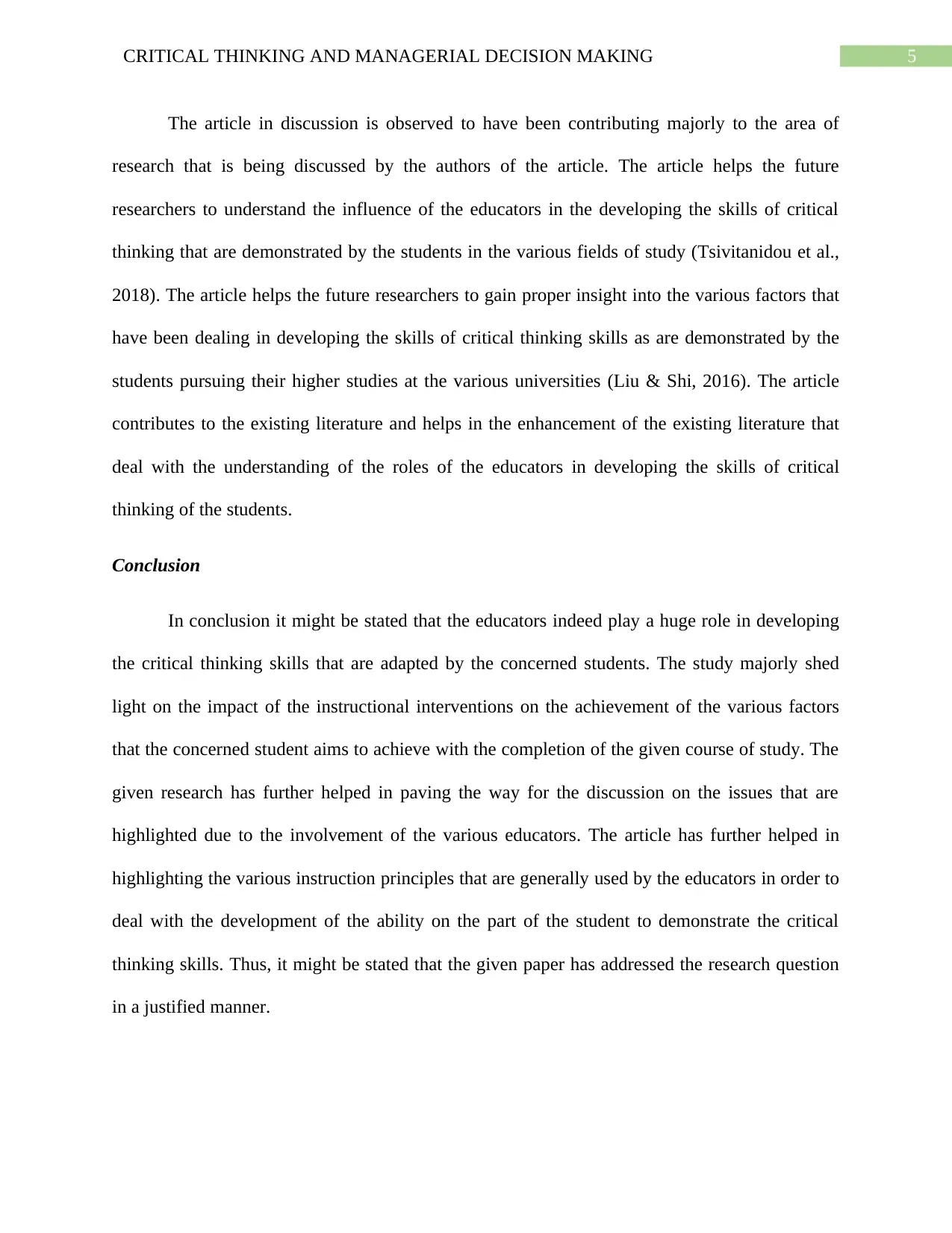
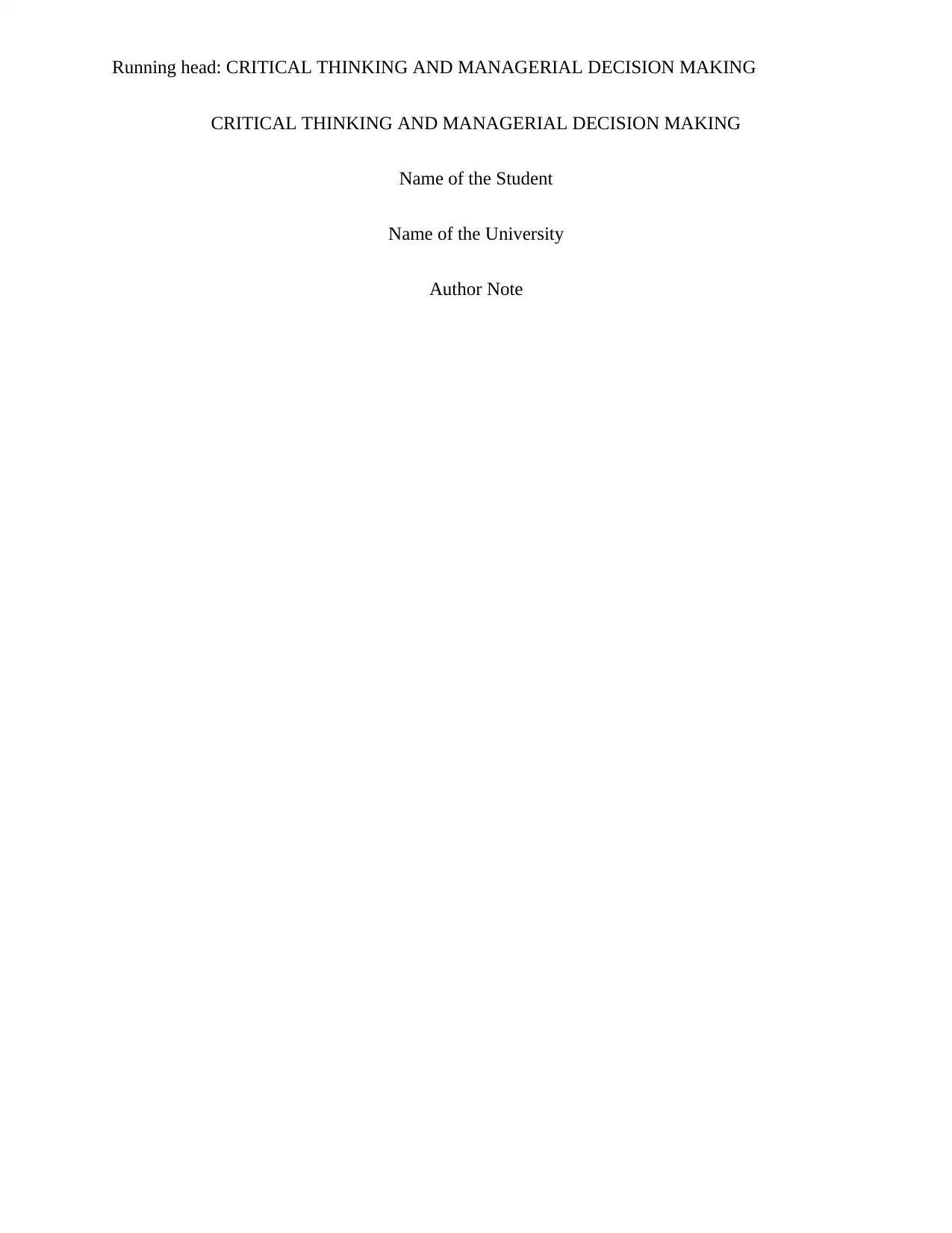
Running head: CRITICAL THINKING AND MANAGERIAL DECISION MAKING
CRITICAL THINKING AND MANAGERIAL DECISION MAKING
Name of the Student
Name of the University
Author Note
tabler-icon-diamond-filled.svg

Paraphrase This Document

Need a fresh take? Get an instant paraphrase of this document with our AI Paraphraser
Document Page
1CRITICAL THINKING AND MANAGERIAL DECISION MAKING
Introduction
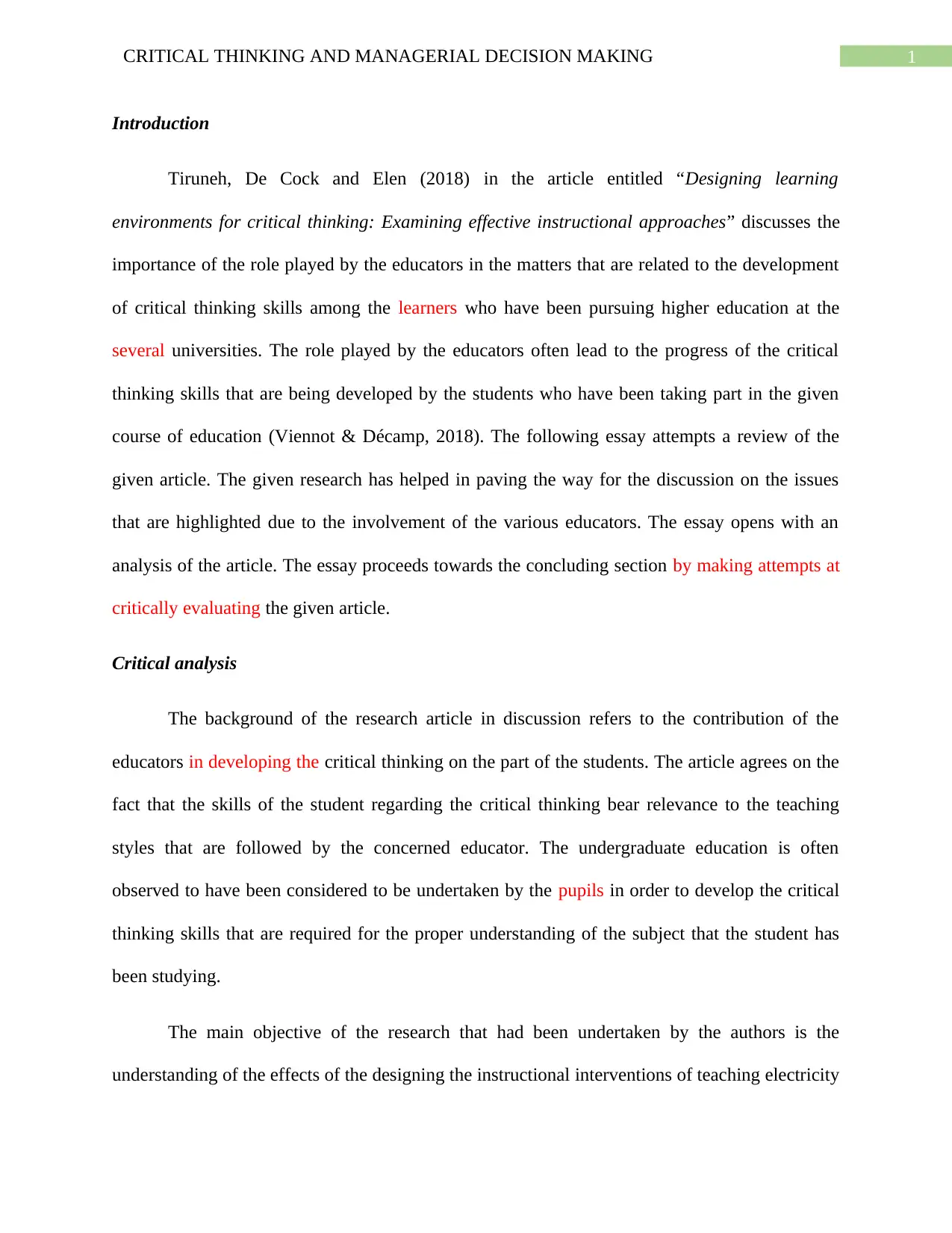
Tiruneh, De Cock and Elen (2018) in the article entitled Designing learning
environments for critical thinking: Examining effective instructional approaches” discusses the
importance of the role played by the educators in the matters that are related to the development
of critical thinking skills among the learners who have been pursuing higher education at the
several universities. The role played by the educators often lead to the progress of the critical
thinking skills that are being developed by the students who have been taking part in the given
course of education (Viennot & Décamp, 2018). The following essay attempts a review of the
given article. The given research has helped in paving the way for the discussion on the issues
that are highlighted due to the involvement of the various educators. The essay opens with an
analysis of the article. The essay proceeds towards the concluding section by making attempts at
critically evaluating the given article.
Critical analysis
The background of the research article in discussion refers to the contribution of the
educators in developing the critical thinking on the part of the students. The article agrees on the
fact that the skills of the student regarding the critical thinking bear relevance to the teaching
styles that are followed by the concerned educator. The undergraduate education is often
observed to have been considered to be undertaken by the pupils in order to develop the critical
thinking skills that are required for the proper understanding of the subject that the student has
been studying.
The main objective of the research that had been undertaken by the authors is the
understanding of the effects of the designing the instructional interventions of teaching electricity
Document Page
2CRITICAL THINKING AND MANAGERIAL DECISION MAKING
and magnetism on the basis of immersion, infusion and the other regularized approaches that
help in developing the skills for critical thinking that need to be acquired in both the general and
the specific factors within the concerned domain. The study focusses on the impact of these
interventions on the achievement of the various factors that the concerned student aims to
achieve with the completion of the given course of study.
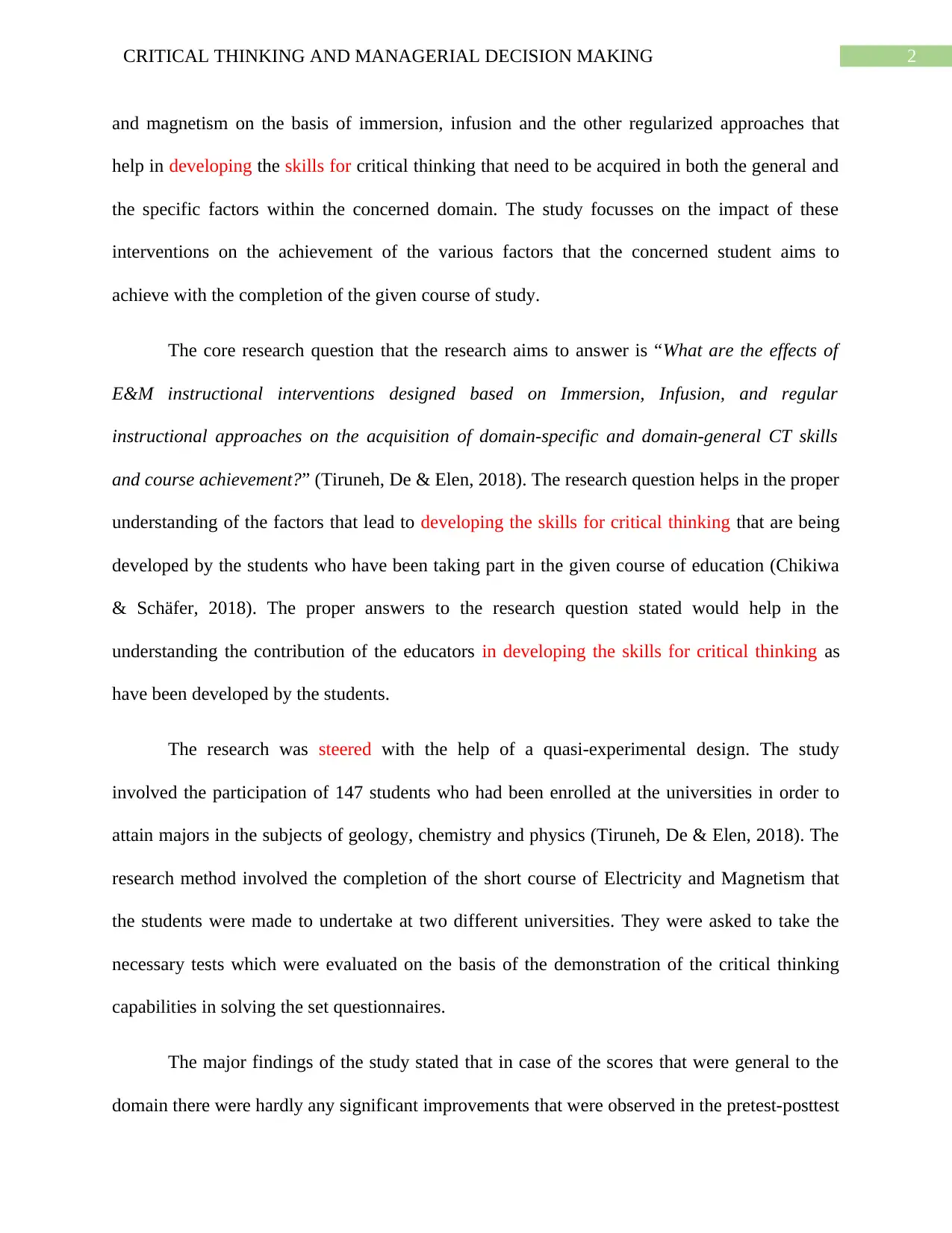
The core research question that the research aims to answer is “What are the effects of
E&M instructional interventions designed based on Immersion, Infusion, and regular
instructional approaches on the acquisition of domain-specific and domain-general CT skills
and course achievement?” (Tiruneh, De & Elen, 2018). The research question helps in the proper
understanding of the factors that lead to developing the skills for critical thinking that are being
developed by the students who have been taking part in the given course of education (Chikiwa
& Schäfer, 2018). The proper answers to the research question stated would help in the
understanding the contribution of the educators in developing the skills for critical thinking as
have been developed by the students.
The research was steered with the help of a quasi-experimental design. The study
involved the participation of 147 students who had been enrolled at the universities in order to
attain majors in the subjects of geology, chemistry and physics (Tiruneh, De & Elen, 2018). The
research method involved the completion of the short course of Electricity and Magnetism that
the students were made to undertake at two different universities. They were asked to take the
necessary tests which were evaluated on the basis of the demonstration of the critical thinking
capabilities in solving the set questionnaires.
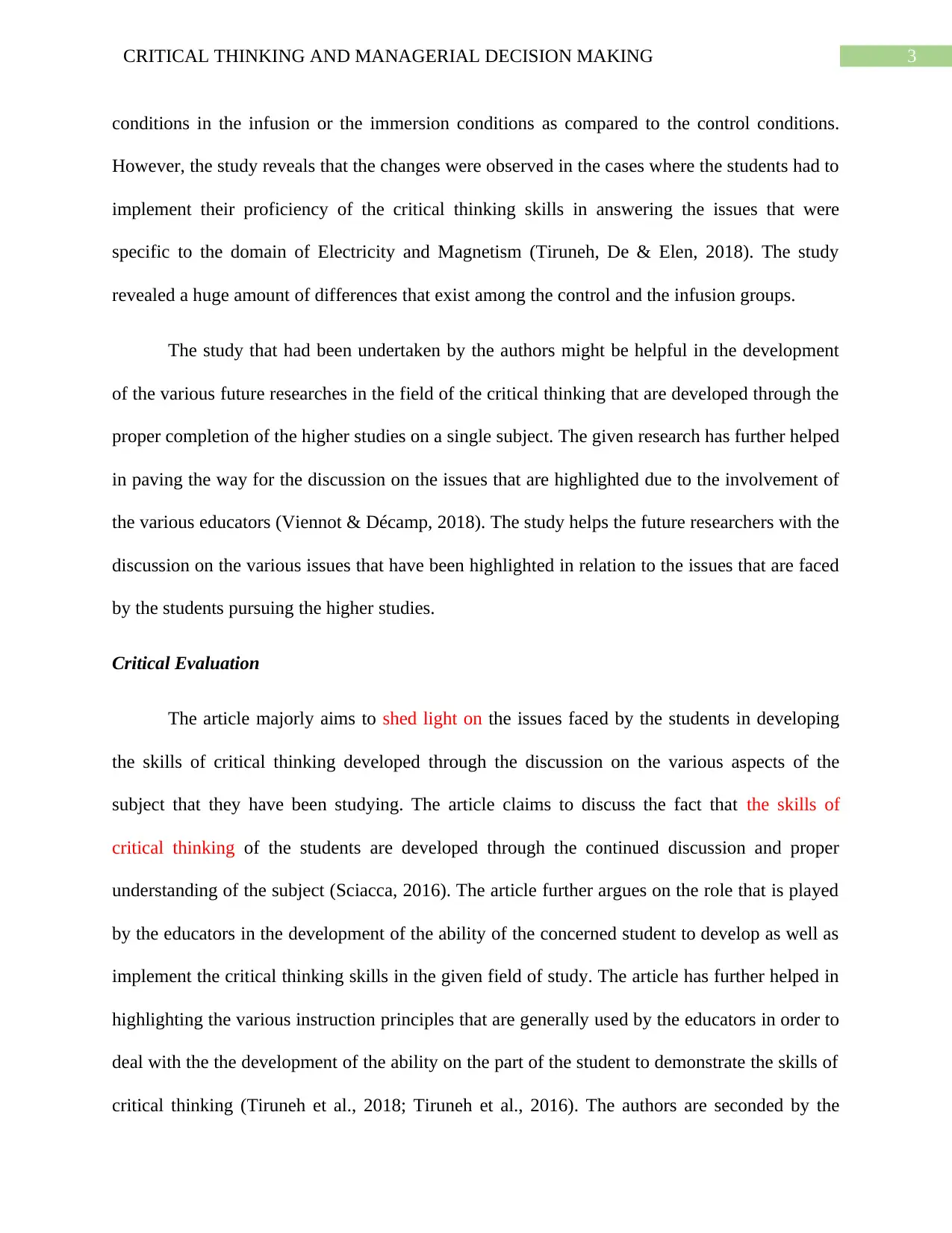
The major findings of the study stated that in case of the scores that were general to the
domain there were hardly any significant improvements that were observed in the pretest-posttest
Document Page
3CRITICAL THINKING AND MANAGERIAL DECISION MAKING
conditions in the infusion or the immersion conditions as compared to the control conditions.
However, the study reveals that the changes were observed in the cases where the students had to
implement their proficiency of the critical thinking skills in answering the issues that were
specific to the domain of Electricity and Magnetism (Tiruneh, De & Elen, 2018). The study
revealed a huge amount of differences that exist among the control and the infusion groups.
The study that had been undertaken by the authors might be helpful in the development
of the various future researches in the field of the critical thinking that are developed through the
proper completion of the higher studies on a single subject. The given research has further helped
in paving the way for the discussion on the issues that are highlighted due to the involvement of
the various educators (Viennot & Décamp, 2018). The study helps the future researchers with the
discussion on the various issues that have been highlighted in relation to the issues that are faced
by the students pursuing the higher studies.
Critical Evaluation
The article majorly aims to shed light on the issues faced by the students in developing
the skills of critical thinking developed through the discussion on the various aspects of the
subject that they have been studying. The article claims to discuss the fact that the skills of
critical thinking of the students are developed through the continued discussion and proper
understanding of the subject (Sciacca, 2016). The article further argues on the role that is played
by the educators in the development of the ability of the concerned student to develop as well as
implement the critical thinking skills in the given field of study. The article has further helped in
highlighting the various instruction principles that are generally used by the educators in order to
deal with the the development of the ability on the part of the student to demonstrate the skills of
critical thinking (Tiruneh et al., 2018; Tiruneh et al., 2016). The authors are seconded by the
tabler-icon-diamond-filled.svg

Paraphrase This Document

Need a fresh take? Get an instant paraphrase of this document with our AI Paraphraser
Document Page
4CRITICAL THINKING AND MANAGERIAL DECISION MAKING
various future researches that were conducted by the other researchers who have been observed
to deal with the similar issues on the role of the educator in the developing the thinking skills of
the concerned students.
The major strengths of the article lay in the fact that the article provides a proper insight
on the role that is played by the educators and the educational settings in the overall development
of the learning skills of the concerned students. The other major strength as is demonstrated by
the author of the article tends to state the fact that the implementation of the transparent and the
systematic designing in the fields of instructional interventions help in the developing the various
skills of critical thinking among the students pursuing their career in a particular field of study
(Tiruneh et al., 2017).
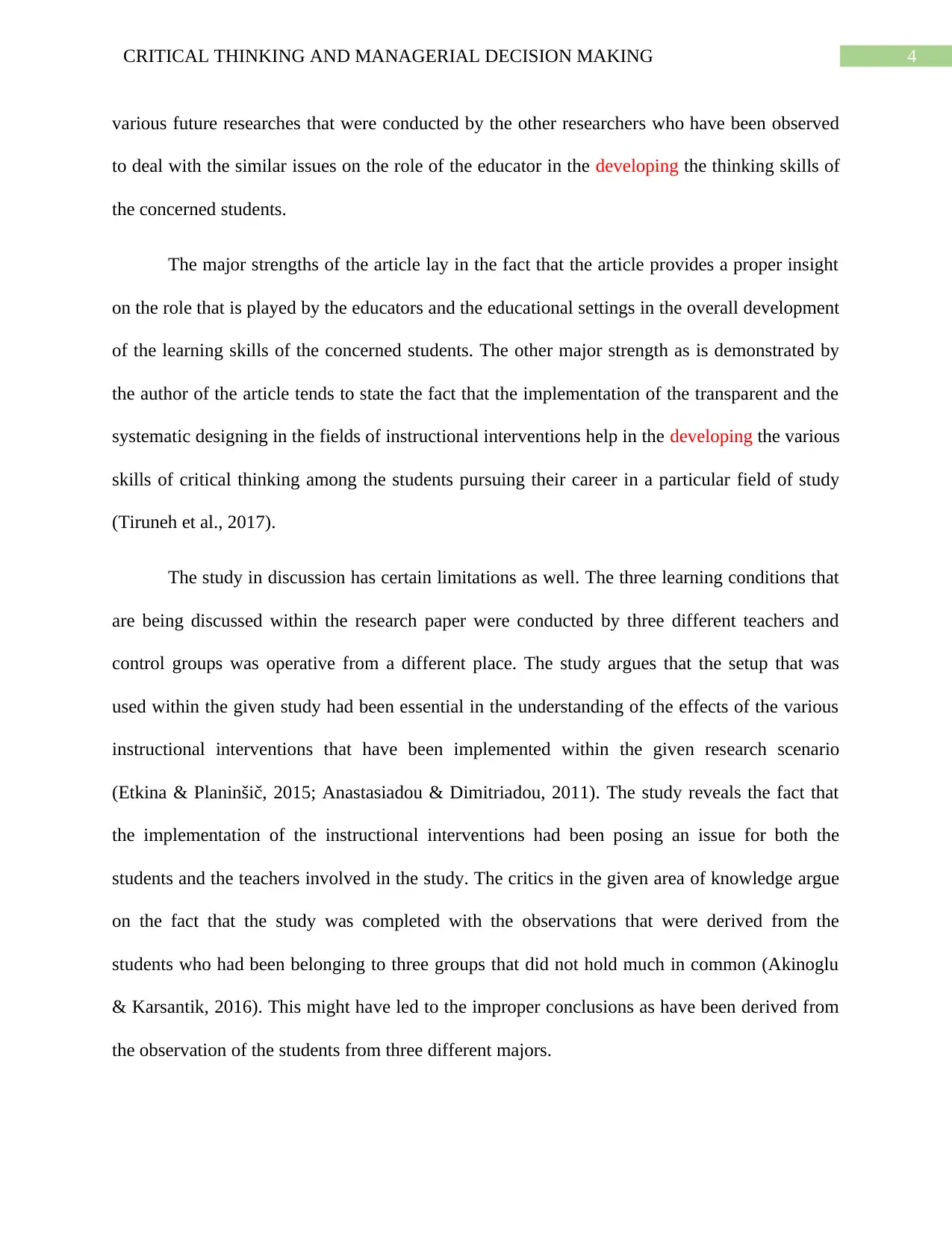
The study in discussion has certain limitations as well. The three learning conditions that
are being discussed within the research paper were conducted by three different teachers and
control groups was operative from a different place. The study argues that the setup that was
used within the given study had been essential in the understanding of the effects of the various
instructional interventions that have been implemented within the given research scenario
(Etkina & Planinšič, 2015; Anastasiadou & Dimitriadou, 2011). The study reveals the fact that
the implementation of the instructional interventions had been posing an issue for both the
students and the teachers involved in the study. The critics in the given area of knowledge argue
on the fact that the study was completed with the observations that were derived from the
students who had been belonging to three groups that did not hold much in common (Akinoglu
& Karsantik, 2016). This might have led to the improper conclusions as have been derived from
the observation of the students from three different majors.
Document Page
5CRITICAL THINKING AND MANAGERIAL DECISION MAKING
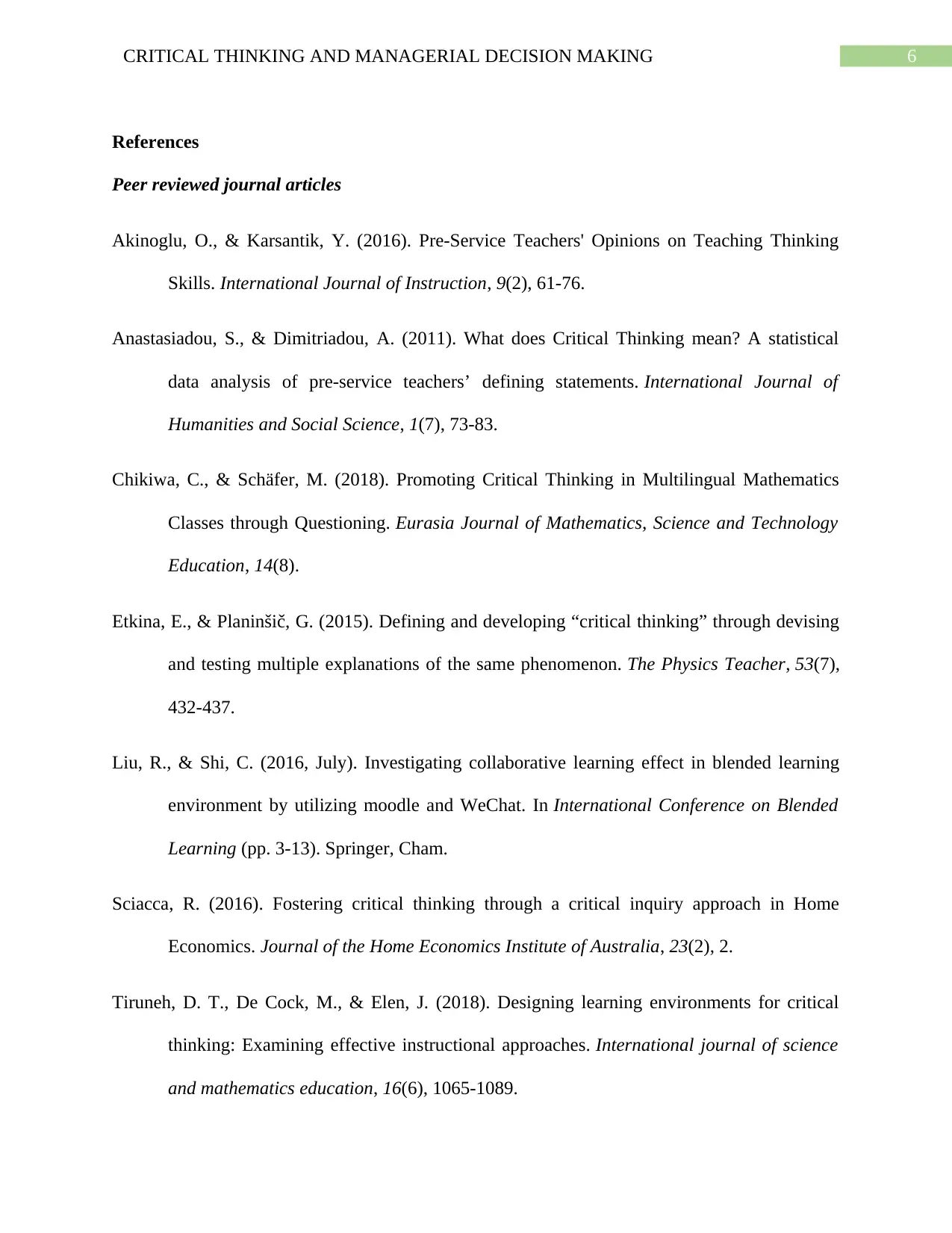
The article in discussion is observed to have been contributing majorly to the area of
research that is being discussed by the authors of the article. The article helps the future
researchers to understand the influence of the educators in the developing the skills of critical
thinking that are demonstrated by the students in the various fields of study (Tsivitanidou et al.,
2018). The article helps the future researchers to gain proper insight into the various factors that
have been dealing in developing the skills of critical thinking skills as are demonstrated by the
students pursuing their higher studies at the various universities (Liu & Shi, 2016). The article
contributes to the existing literature and helps in the enhancement of the existing literature that
deal with the understanding of the roles of the educators in developing the skills of critical
thinking of the students.
Conclusion
In conclusion it might be stated that the educators indeed play a huge role in developing
the critical thinking skills that are adapted by the concerned students. The study majorly shed
light on the impact of the instructional interventions on the achievement of the various factors
that the concerned student aims to achieve with the completion of the given course of study. The
given research has further helped in paving the way for the discussion on the issues that are
highlighted due to the involvement of the various educators. The article has further helped in
highlighting the various instruction principles that are generally used by the educators in order to
deal with the development of the ability on the part of the student to demonstrate the critical
thinking skills. Thus, it might be stated that the given paper has addressed the research question
in a justified manner.
Document Page
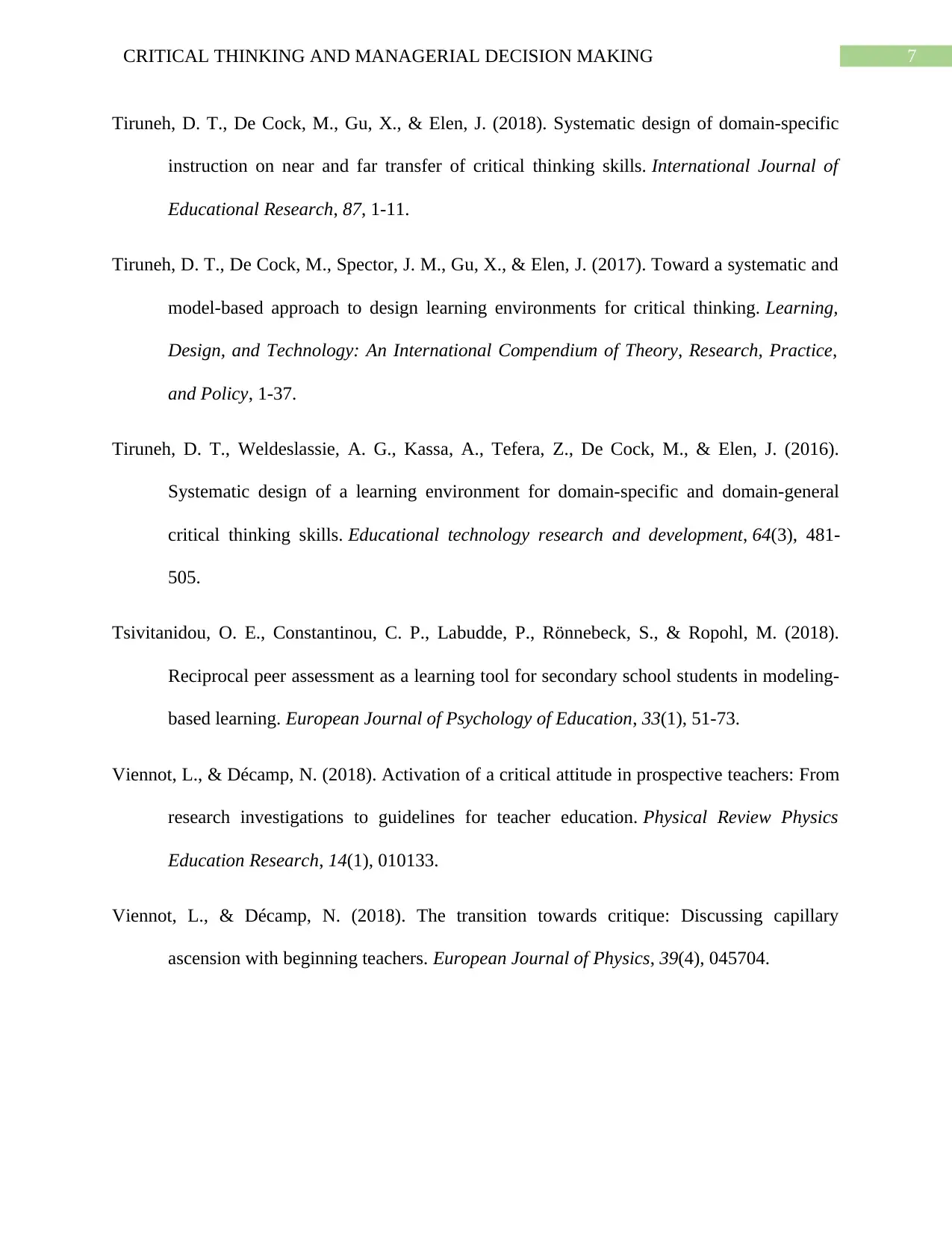
6CRITICAL THINKING AND MANAGERIAL DECISION MAKING
References
Peer reviewed journal articles
Akinoglu, O., & Karsantik, Y. (2016). Pre-Service Teachers' Opinions on Teaching Thinking
Skills. International Journal of Instruction, 9(2), 61-76.
Anastasiadou, S., & Dimitriadou, A. (2011). What does Critical Thinking mean? A statistical
data analysis of pre-service teachers’ defining statements. International Journal of
Humanities and Social Science, 1(7), 73-83.
Chikiwa, C., & Schäfer, M. (2018). Promoting Critical Thinking in Multilingual Mathematics
Classes through Questioning. Eurasia Journal of Mathematics, Science and Technology
Education, 14(8).
Etkina, E., & Planinšič, G. (2015). Defining and developing “critical thinking” through devising
and testing multiple explanations of the same phenomenon. The Physics Teacher, 53(7),
432-437.
Liu, R., & Shi, C. (2016, July). Investigating collaborative learning effect in blended learning
environment by utilizing moodle and WeChat. In International Conference on Blended
Learning (pp. 3-13). Springer, Cham.
Sciacca, R. (2016). Fostering critical thinking through a critical inquiry approach in Home
Economics. Journal of the Home Economics Institute of Australia, 23(2), 2.
Tiruneh, D. T., De Cock, M., & Elen, J. (2018). Designing learning environments for critical
thinking: Examining effective instructional approaches. International journal of science
and mathematics education, 16(6), 1065-1089.
tabler-icon-diamond-filled.svg

Paraphrase This Document

Need a fresh take? Get an instant paraphrase of this document with our AI Paraphraser
Document Page
7CRITICAL THINKING AND MANAGERIAL DECISION MAKING
Tiruneh, D. T., De Cock, M., Gu, X., & Elen, J. (2018). Systematic design of domain-specific
instruction on near and far transfer of critical thinking skills. International Journal of
Educational Research, 87, 1-11.
Tiruneh, D. T., De Cock, M., Spector, J. M., Gu, X., & Elen, J. (2017). Toward a systematic and
model-based approach to design learning environments for critical thinking. Learning,
Design, and Technology: An International Compendium of Theory, Research, Practice,
and Policy, 1-37.
Tiruneh, D. T., Weldeslassie, A. G., Kassa, A., Tefera, Z., De Cock, M., & Elen, J. (2016).
Systematic design of a learning environment for domain-specific and domain-general
critical thinking skills. Educational technology research and development, 64(3), 481-
505.
Tsivitanidou, O. E., Constantinou, C. P., Labudde, P., Rönnebeck, S., & Ropohl, M. (2018).
Reciprocal peer assessment as a learning tool for secondary school students in modeling-
based learning. European Journal of Psychology of Education, 33(1), 51-73.
Viennot, L., & Décamp, N. (2018). Activation of a critical attitude in prospective teachers: From
research investigations to guidelines for teacher education. Physical Review Physics
Education Research, 14(1), 010133.
Viennot, L., & Décamp, N. (2018). The transition towards critique: Discussing capillary
ascension with beginning teachers. European Journal of Physics, 39(4), 045704.
chevron_up_icon
1 out of 8
circle_padding
hide_on_mobile
zoom_out_icon
[object Object]