An Examination of Nietzsche's Critique of Christianity: Philosophy
VerifiedAdded on 2022/08/18
|11
|3366
|21
Essay
AI Summary
This essay provides an in-depth analysis of Friedrich Nietzsche's criticism of Christianity. It examines Nietzsche's skepticism towards Christian tenets, exploring his concept of the 'death of God' and his views on the Church's teachings. The essay delves into Nietzsche's arguments against Christian morality, the role of priests, and the impact of religious beliefs on society. It highlights Nietzsche's critiques of key Christian concepts such as the 'kingdom of God' and the significance of Jesus Christ's death. The essay also discusses Nietzsche's perspective on the origins of Christian morality and his promotion of a revaluation of values. Furthermore, the essay touches upon Nietzsche's perspective on the role of resentment, slave morality, and the promotion of the strong versus the weak. Overall, the essay provides a comprehensive overview of Nietzsche's philosophical stance on Christianity and its implications.
Running head: CRITICISM OF CHRISTIANITY BY NIETZSCHE
Criticism of Christianity by Nietzsche
Name of the student
Name of the University
Author note
Criticism of Christianity by Nietzsche
Name of the student
Name of the University
Author note

Paraphrase This Document
Need a fresh take? Get an instant paraphrase of this document with our AI Paraphraser
1CRITICISM OF CHRISTIANITY BY NIETZSCHE
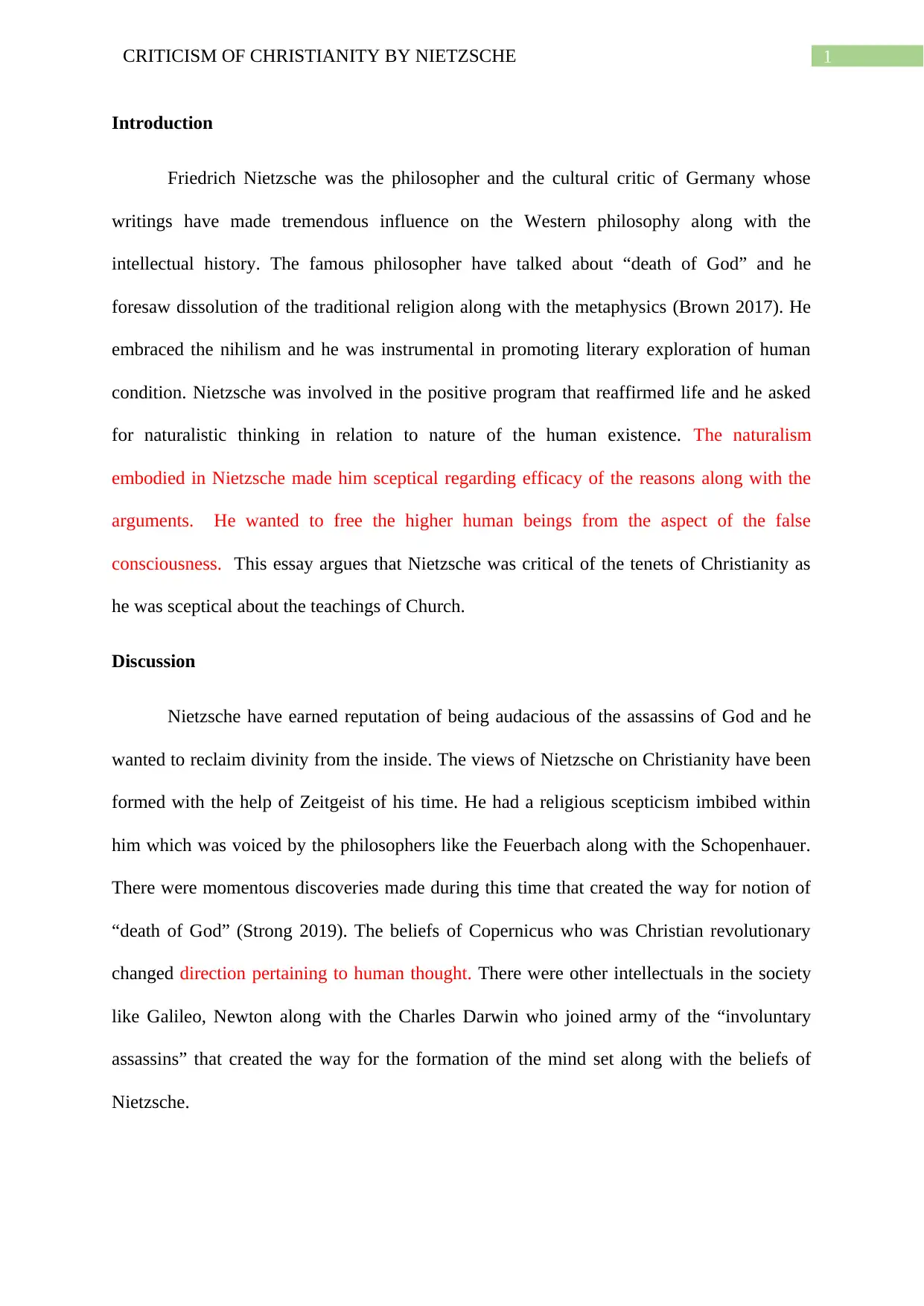
Introduction
Friedrich Nietzsche was the philosopher and the cultural critic of Germany whose
writings have made tremendous influence on the Western philosophy along with the
intellectual history. The famous philosopher have talked about “death of God” and he
foresaw dissolution of the traditional religion along with the metaphysics (Brown 2017). He
embraced the nihilism and he was instrumental in promoting literary exploration of human
condition. Nietzsche was involved in the positive program that reaffirmed life and he asked
for naturalistic thinking in relation to nature of the human existence. The naturalism
embodied in Nietzsche made him sceptical regarding efficacy of the reasons along with the
arguments. He wanted to free the higher human beings from the aspect of the false
consciousness. This essay argues that Nietzsche was critical of the tenets of Christianity as
he was sceptical about the teachings of Church.
Discussion
Nietzsche have earned reputation of being audacious of the assassins of God and he
wanted to reclaim divinity from the inside. The views of Nietzsche on Christianity have been
formed with the help of Zeitgeist of his time. He had a religious scepticism imbibed within
him which was voiced by the philosophers like the Feuerbach along with the Schopenhauer.
There were momentous discoveries made during this time that created the way for notion of
“death of God” (Strong 2019). The beliefs of Copernicus who was Christian revolutionary
changed direction pertaining to human thought. There were other intellectuals in the society
like Galileo, Newton along with the Charles Darwin who joined army of the “involuntary
assassins” that created the way for the formation of the mind set along with the beliefs of
Nietzsche.
Introduction
Friedrich Nietzsche was the philosopher and the cultural critic of Germany whose
writings have made tremendous influence on the Western philosophy along with the
intellectual history. The famous philosopher have talked about “death of God” and he
foresaw dissolution of the traditional religion along with the metaphysics (Brown 2017). He
embraced the nihilism and he was instrumental in promoting literary exploration of human
condition. Nietzsche was involved in the positive program that reaffirmed life and he asked
for naturalistic thinking in relation to nature of the human existence. The naturalism
embodied in Nietzsche made him sceptical regarding efficacy of the reasons along with the
arguments. He wanted to free the higher human beings from the aspect of the false
consciousness. This essay argues that Nietzsche was critical of the tenets of Christianity as
he was sceptical about the teachings of Church.
Discussion
Nietzsche have earned reputation of being audacious of the assassins of God and he
wanted to reclaim divinity from the inside. The views of Nietzsche on Christianity have been
formed with the help of Zeitgeist of his time. He had a religious scepticism imbibed within
him which was voiced by the philosophers like the Feuerbach along with the Schopenhauer.
There were momentous discoveries made during this time that created the way for notion of
“death of God” (Strong 2019). The beliefs of Copernicus who was Christian revolutionary
changed direction pertaining to human thought. There were other intellectuals in the society
like Galileo, Newton along with the Charles Darwin who joined army of the “involuntary
assassins” that created the way for the formation of the mind set along with the beliefs of
Nietzsche.
2CRITICISM OF CHRISTIANITY BY NIETZSCHE
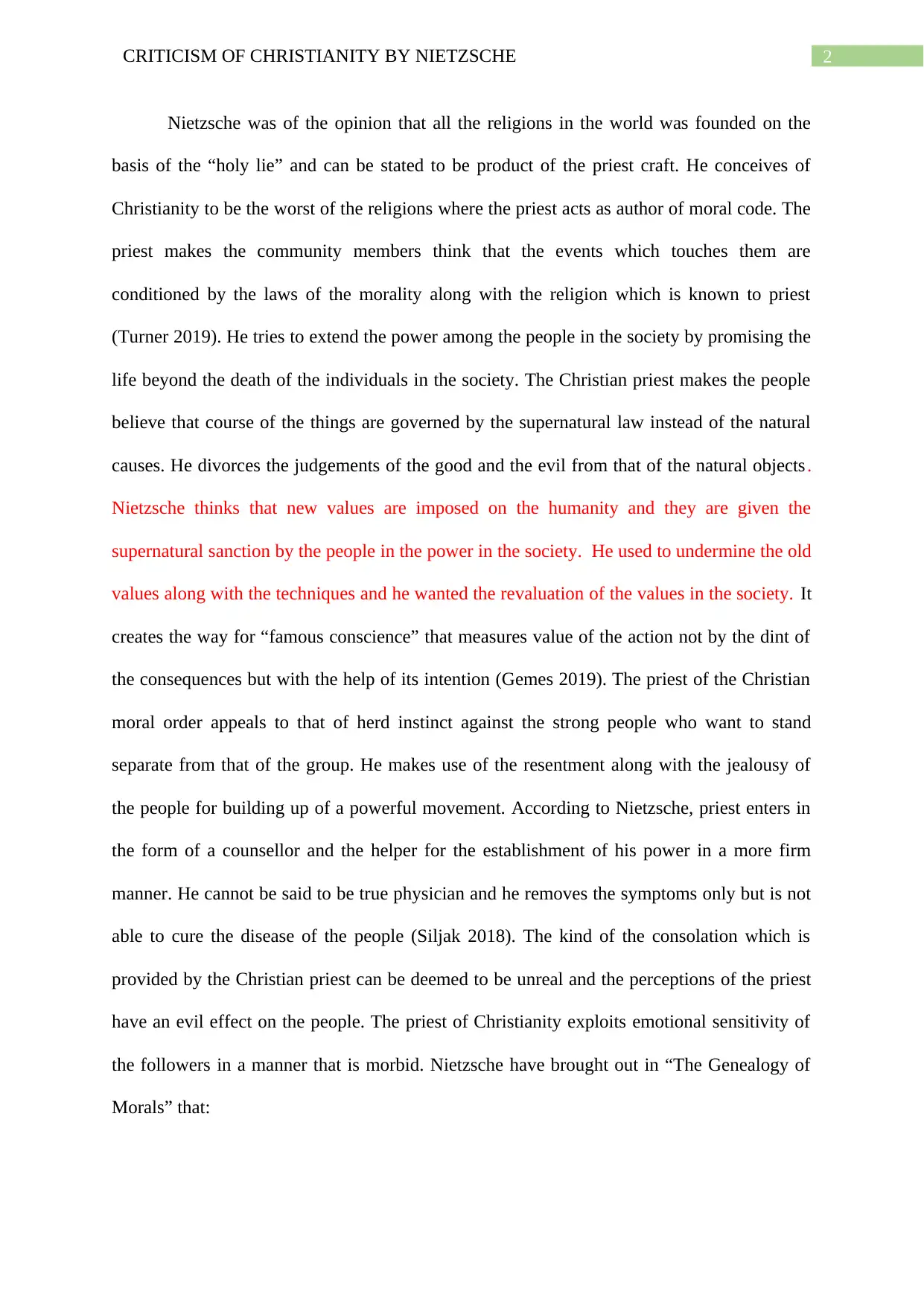
Nietzsche was of the opinion that all the religions in the world was founded on the
basis of the “holy lie” and can be stated to be product of the priest craft. He conceives of
Christianity to be the worst of the religions where the priest acts as author of moral code. The
priest makes the community members think that the events which touches them are
conditioned by the laws of the morality along with the religion which is known to priest
(Turner 2019). He tries to extend the power among the people in the society by promising the
life beyond the death of the individuals in the society. The Christian priest makes the people
believe that course of the things are governed by the supernatural law instead of the natural
causes. He divorces the judgements of the good and the evil from that of the natural objects.
Nietzsche thinks that new values are imposed on the humanity and they are given the
supernatural sanction by the people in the power in the society. He used to undermine the old
values along with the techniques and he wanted the revaluation of the values in the society. It
creates the way for “famous conscience” that measures value of the action not by the dint of
the consequences but with the help of its intention (Gemes 2019). The priest of the Christian
moral order appeals to that of herd instinct against the strong people who want to stand
separate from that of the group. He makes use of the resentment along with the jealousy of
the people for building up of a powerful movement. According to Nietzsche, priest enters in
the form of a counsellor and the helper for the establishment of his power in a more firm
manner. He cannot be said to be true physician and he removes the symptoms only but is not
able to cure the disease of the people (Siljak 2018). The kind of the consolation which is
provided by the Christian priest can be deemed to be unreal and the perceptions of the priest
have an evil effect on the people. The priest of Christianity exploits emotional sensitivity of
the followers in a manner that is morbid. Nietzsche have brought out in “The Genealogy of
Morals” that:
Nietzsche was of the opinion that all the religions in the world was founded on the
basis of the “holy lie” and can be stated to be product of the priest craft. He conceives of
Christianity to be the worst of the religions where the priest acts as author of moral code. The
priest makes the community members think that the events which touches them are
conditioned by the laws of the morality along with the religion which is known to priest
(Turner 2019). He tries to extend the power among the people in the society by promising the
life beyond the death of the individuals in the society. The Christian priest makes the people
believe that course of the things are governed by the supernatural law instead of the natural
causes. He divorces the judgements of the good and the evil from that of the natural objects.
Nietzsche thinks that new values are imposed on the humanity and they are given the
supernatural sanction by the people in the power in the society. He used to undermine the old
values along with the techniques and he wanted the revaluation of the values in the society. It
creates the way for “famous conscience” that measures value of the action not by the dint of
the consequences but with the help of its intention (Gemes 2019). The priest of the Christian
moral order appeals to that of herd instinct against the strong people who want to stand
separate from that of the group. He makes use of the resentment along with the jealousy of
the people for building up of a powerful movement. According to Nietzsche, priest enters in
the form of a counsellor and the helper for the establishment of his power in a more firm
manner. He cannot be said to be true physician and he removes the symptoms only but is not
able to cure the disease of the people (Siljak 2018). The kind of the consolation which is
provided by the Christian priest can be deemed to be unreal and the perceptions of the priest
have an evil effect on the people. The priest of Christianity exploits emotional sensitivity of
the followers in a manner that is morbid. Nietzsche have brought out in “The Genealogy of
Morals” that:
⊘ This is a preview!⊘
Do you want full access?
Subscribe today to unlock all pages.

Trusted by 1+ million students worldwide
3CRITICISM OF CHRISTIANITY BY NIETZSCHE
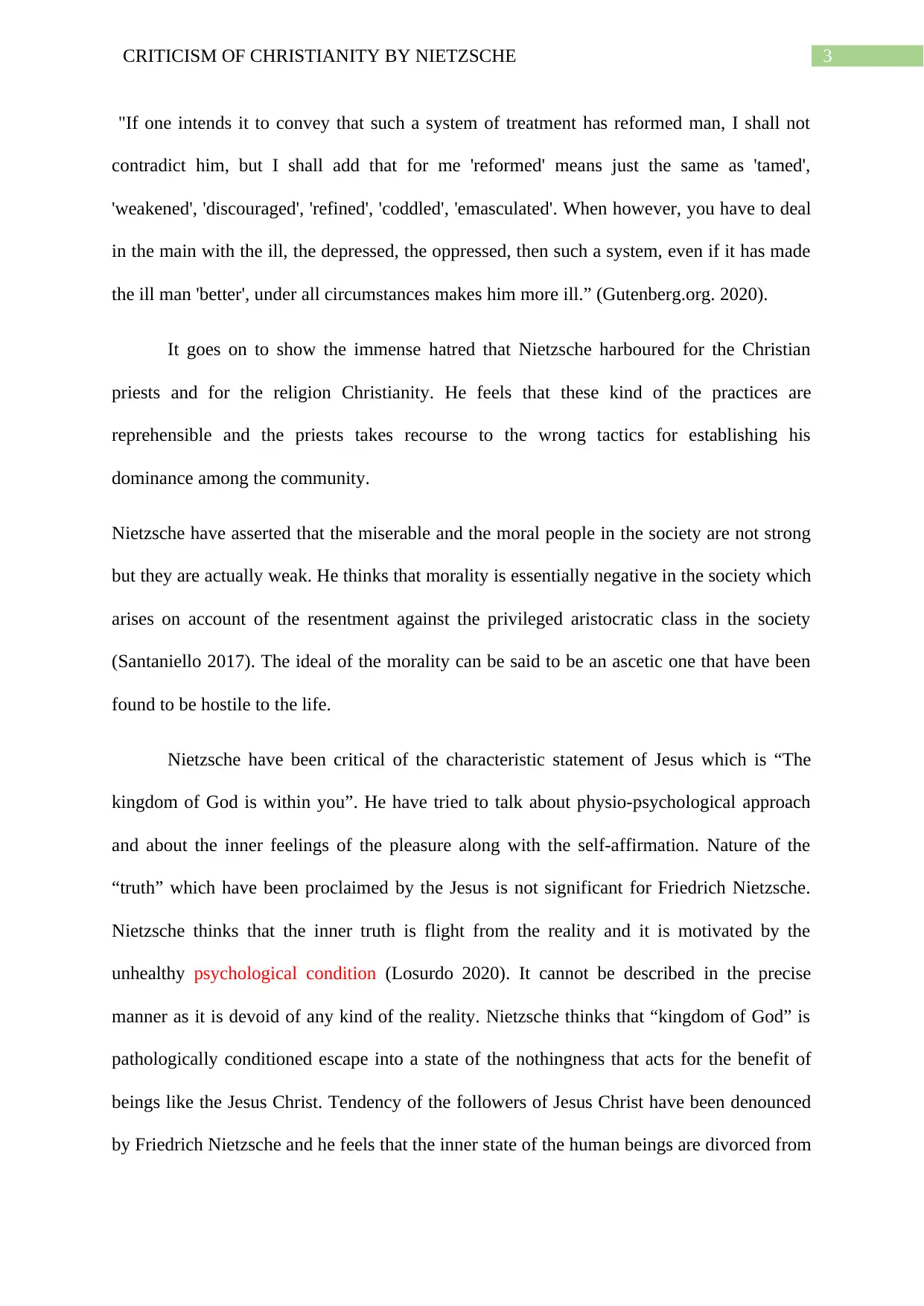
"If one intends it to convey that such a system of treatment has reformed man, I shall not
contradict him, but I shall add that for me 'reformed' means just the same as 'tamed',
'weakened', 'discouraged', 'refined', 'coddled', 'emasculated'. When however, you have to deal
in the main with the ill, the depressed, the oppressed, then such a system, even if it has made
the ill man 'better', under all circumstances makes him more ill.” (Gutenberg.org. 2020).
It goes on to show the immense hatred that Nietzsche harboured for the Christian
priests and for the religion Christianity. He feels that these kind of the practices are
reprehensible and the priests takes recourse to the wrong tactics for establishing his
dominance among the community.
Nietzsche have asserted that the miserable and the moral people in the society are not strong
but they are actually weak. He thinks that morality is essentially negative in the society which
arises on account of the resentment against the privileged aristocratic class in the society
(Santaniello 2017). The ideal of the morality can be said to be an ascetic one that have been
found to be hostile to the life.
Nietzsche have been critical of the characteristic statement of Jesus which is “The
kingdom of God is within you”. He have tried to talk about physio-psychological approach
and about the inner feelings of the pleasure along with the self-affirmation. Nature of the
“truth” which have been proclaimed by the Jesus is not significant for Friedrich Nietzsche.
Nietzsche thinks that the inner truth is flight from the reality and it is motivated by the
unhealthy psychological condition (Losurdo 2020). It cannot be described in the precise
manner as it is devoid of any kind of the reality. Nietzsche thinks that “kingdom of God” is
pathologically conditioned escape into a state of the nothingness that acts for the benefit of
beings like the Jesus Christ. Tendency of the followers of Jesus Christ have been denounced
by Friedrich Nietzsche and he feels that the inner state of the human beings are divorced from
"If one intends it to convey that such a system of treatment has reformed man, I shall not
contradict him, but I shall add that for me 'reformed' means just the same as 'tamed',
'weakened', 'discouraged', 'refined', 'coddled', 'emasculated'. When however, you have to deal
in the main with the ill, the depressed, the oppressed, then such a system, even if it has made
the ill man 'better', under all circumstances makes him more ill.” (Gutenberg.org. 2020).
It goes on to show the immense hatred that Nietzsche harboured for the Christian
priests and for the religion Christianity. He feels that these kind of the practices are
reprehensible and the priests takes recourse to the wrong tactics for establishing his
dominance among the community.
Nietzsche have asserted that the miserable and the moral people in the society are not strong
but they are actually weak. He thinks that morality is essentially negative in the society which
arises on account of the resentment against the privileged aristocratic class in the society
(Santaniello 2017). The ideal of the morality can be said to be an ascetic one that have been
found to be hostile to the life.
Nietzsche have been critical of the characteristic statement of Jesus which is “The
kingdom of God is within you”. He have tried to talk about physio-psychological approach
and about the inner feelings of the pleasure along with the self-affirmation. Nature of the
“truth” which have been proclaimed by the Jesus is not significant for Friedrich Nietzsche.
Nietzsche thinks that the inner truth is flight from the reality and it is motivated by the
unhealthy psychological condition (Losurdo 2020). It cannot be described in the precise
manner as it is devoid of any kind of the reality. Nietzsche thinks that “kingdom of God” is
pathologically conditioned escape into a state of the nothingness that acts for the benefit of
beings like the Jesus Christ. Tendency of the followers of Jesus Christ have been denounced
by Friedrich Nietzsche and he feels that the inner state of the human beings are divorced from
Paraphrase This Document
Need a fresh take? Get an instant paraphrase of this document with our AI Paraphraser
4CRITICISM OF CHRISTIANITY BY NIETZSCHE
that of the outer spatio-temporal realities. The concept of “Son of Man” does not denote inner
state but it can be stated to be ‘eternal fact’ which is freed from conception of the time. The
followers of Jesus Christ have been instrumental in interpreting the symbolism in a gross
manner which have paved the path for the malice in the society (Ohana 2019). Nietzsche
thinks that death of the Jesus Christ is the illustration of the evangelical practice. Jesus is not
instrumental in resisting guards and he does not say anything that can defend him before the
judges. He does not want to avoid the prospect of death but he is involved in provoking it.
Nietzsche thinks that Jesus Christ is a man who wanted to turn away from the reality and
wanted to preoccupy himself with the inner world of the pleasure along with the self-
affirmation. Outer world is primarily meant for the “anti-realist” which is merely source of
the symbol along with the metaphor (Milne 2019).
Nietzsche was sceptical of the Church along with the ideology and he felt that
existential perversion does not stem from Jesus Christ but from that of church. He feels that
there have been only one Christian and the rest lost their lives on the cross. The teachings of
Jesus Christ which have been found within Gospels have been attacked by Friedrich
Nietzsche. He felt that pity along with the pietism are responsible for the creation of slaves
within the framework of the society (Zain 2018). He feels that the individual should affirm
their power with the help of the will-power that can aid in offering protection to the weak
human beings. He feels that the identity of the individuals are borne out of the church and it
limits the personal development of an individual. The human beings are the autonomous
creatures and they should not be affected by the destructive emotions but should rather
acknowledge the natural motives along with the feelings. Nietzsche have been found to be
critical of cardinal value of the Christianity and he felt that happiness within the framework
of the society cannot be achieved with the help of self-sacrifice of Jesus Christ (Armitage
2017). He felt that associating the “love” with the commandments along with the moral rules
that of the outer spatio-temporal realities. The concept of “Son of Man” does not denote inner
state but it can be stated to be ‘eternal fact’ which is freed from conception of the time. The
followers of Jesus Christ have been instrumental in interpreting the symbolism in a gross
manner which have paved the path for the malice in the society (Ohana 2019). Nietzsche
thinks that death of the Jesus Christ is the illustration of the evangelical practice. Jesus is not
instrumental in resisting guards and he does not say anything that can defend him before the
judges. He does not want to avoid the prospect of death but he is involved in provoking it.
Nietzsche thinks that Jesus Christ is a man who wanted to turn away from the reality and
wanted to preoccupy himself with the inner world of the pleasure along with the self-
affirmation. Outer world is primarily meant for the “anti-realist” which is merely source of
the symbol along with the metaphor (Milne 2019).
Nietzsche was sceptical of the Church along with the ideology and he felt that
existential perversion does not stem from Jesus Christ but from that of church. He feels that
there have been only one Christian and the rest lost their lives on the cross. The teachings of
Jesus Christ which have been found within Gospels have been attacked by Friedrich
Nietzsche. He felt that pity along with the pietism are responsible for the creation of slaves
within the framework of the society (Zain 2018). He feels that the individual should affirm
their power with the help of the will-power that can aid in offering protection to the weak
human beings. He feels that the identity of the individuals are borne out of the church and it
limits the personal development of an individual. The human beings are the autonomous
creatures and they should not be affected by the destructive emotions but should rather
acknowledge the natural motives along with the feelings. Nietzsche have been found to be
critical of cardinal value of the Christianity and he felt that happiness within the framework
of the society cannot be achieved with the help of self-sacrifice of Jesus Christ (Armitage
2017). He felt that associating the “love” with the commandments along with the moral rules
5CRITICISM OF CHRISTIANITY BY NIETZSCHE
would prevent autonomous person from living a life of the freedom along with the self-
realization. Alternative to the Christian ethics is that the individuals have the freedom of the
creation of his own categorical imperative. The weak should not be provided with the
attention but the strong people should be cultivated in the society. Nietzsche felt that
Christianity was the non-progressive religion as it lays the emphasis on the weak people in
the society. He questioned Christianity in a vigorous manner and he was sceptical of
judgement within the framework of the Bible (Cybulska 2016). He was opposed to that of
New Testament idea of the eternal pain. He have laid forth the fact that Christianity lays
emphasis on the Gospel whereas there are many Christians who believes in the concept of the
eternal judgement.
In the work of Friedrich Nietzsche called “The Anti- Christ” he have talked about the
fact that the enemy of the human progress are the Christians whom he referred to as
“domestic animal”. He felt that Christianity have sided with the things that are weak in the
society and it have been instrumental in corrupting reason of the spiritual creatures on the
face of the earth. The doctrines along with the beliefs of Christianity have made human
beings weak that have a detrimental effect on the society. He waged the war on the
theological instinct and he felt that the Christians have the habit of approaching the things
with the deceitful attitude. The God have been instrumental in degenerating the life
conditions and God have proved himself to be averse to the life along with the nature.
Nietzsche had strong belief in the fact that death of the God was necessary for the liberation
of the individuals within the framework of new intellectual age (Appel 2019). He felt that
Christianity was acting as an obstacle for the liberation of the human beings. He felt that the
religion was pathetic which gave birth to faulty creatures in form of the Christians. The
human beings were in need of the prayer along with the faith as they had already been
afflicted by the vice of Christianity. Christianity gave birth to the people who could not
would prevent autonomous person from living a life of the freedom along with the self-
realization. Alternative to the Christian ethics is that the individuals have the freedom of the
creation of his own categorical imperative. The weak should not be provided with the
attention but the strong people should be cultivated in the society. Nietzsche felt that
Christianity was the non-progressive religion as it lays the emphasis on the weak people in
the society. He questioned Christianity in a vigorous manner and he was sceptical of
judgement within the framework of the Bible (Cybulska 2016). He was opposed to that of
New Testament idea of the eternal pain. He have laid forth the fact that Christianity lays
emphasis on the Gospel whereas there are many Christians who believes in the concept of the
eternal judgement.
In the work of Friedrich Nietzsche called “The Anti- Christ” he have talked about the
fact that the enemy of the human progress are the Christians whom he referred to as
“domestic animal”. He felt that Christianity have sided with the things that are weak in the
society and it have been instrumental in corrupting reason of the spiritual creatures on the
face of the earth. The doctrines along with the beliefs of Christianity have made human
beings weak that have a detrimental effect on the society. He waged the war on the
theological instinct and he felt that the Christians have the habit of approaching the things
with the deceitful attitude. The God have been instrumental in degenerating the life
conditions and God have proved himself to be averse to the life along with the nature.
Nietzsche had strong belief in the fact that death of the God was necessary for the liberation
of the individuals within the framework of new intellectual age (Appel 2019). He felt that
Christianity was acting as an obstacle for the liberation of the human beings. He felt that the
religion was pathetic which gave birth to faulty creatures in form of the Christians. The
human beings were in need of the prayer along with the faith as they had already been
afflicted by the vice of Christianity. Christianity gave birth to the people who could not
⊘ This is a preview!⊘
Do you want full access?
Subscribe today to unlock all pages.
Trusted by 1+ million students worldwide
6CRITICISM OF CHRISTIANITY BY NIETZSCHE
contribute in a meaningful manner to the society and this acted as a barrier in the path of
growth of a nation. It hindered the ability of the human beings in emerging as the strong
people within the framework of the society. The thoughts of Nietzsche made him pursue
radical philosophy of the nihilism and it made him averse to the Christian beliefs in the
society.
The fundamental proposition of Nietzsche was that the Christian Church was the
“logical consequence” of that of “Jewish instinct”. The instinct of the resentment can be said
to be the base of slave morality which had triumphed within Israel before appearance of the
Jesus Christ. Noble morality which have the value judgement of the “good” and the “bad”
creates the way for the powerful rulers within the framework of the society. The concept
denotes the political superiority which helps in denoting the superiority of the soul. The
masters think that the high-born along with the strong people are good in the society and they
try to affirm themselves before the other people in the society. The “bad” people can be
stated to be those people who are lowly and weak within the boundaries of the society. The
bad people receive the hatred or the contempt but they should be treated with the pity along
with the consideration as they are actually weak. Noble morality have been found to be strong
and the joyful and it can cast a positive influence on the people. Anti-thesis of that of noble
morality can be said to be the morality of the “ressentiment” which possess the value
judgement of the “good” and the “evil”. The noble morality springs forth from self-
affirmation of strong people and on the other hand slave morality emerges out of
“ressentiment” of the sick people which is not translated into the action. Nietzsche have
borrowed the word, “ressentiment” from that of French language and it helps in denoting the
beliefs of Friedrich Nietzsche. The weak affirm themselves within the morality but in an
indirect manner which is at expense of values of the noble people. The weak people assert
their position with the help of their morality however they do not find the prospect joyful.
contribute in a meaningful manner to the society and this acted as a barrier in the path of
growth of a nation. It hindered the ability of the human beings in emerging as the strong
people within the framework of the society. The thoughts of Nietzsche made him pursue
radical philosophy of the nihilism and it made him averse to the Christian beliefs in the
society.
The fundamental proposition of Nietzsche was that the Christian Church was the
“logical consequence” of that of “Jewish instinct”. The instinct of the resentment can be said
to be the base of slave morality which had triumphed within Israel before appearance of the
Jesus Christ. Noble morality which have the value judgement of the “good” and the “bad”
creates the way for the powerful rulers within the framework of the society. The concept
denotes the political superiority which helps in denoting the superiority of the soul. The
masters think that the high-born along with the strong people are good in the society and they
try to affirm themselves before the other people in the society. The “bad” people can be
stated to be those people who are lowly and weak within the boundaries of the society. The
bad people receive the hatred or the contempt but they should be treated with the pity along
with the consideration as they are actually weak. Noble morality have been found to be strong
and the joyful and it can cast a positive influence on the people. Anti-thesis of that of noble
morality can be said to be the morality of the “ressentiment” which possess the value
judgement of the “good” and the “evil”. The noble morality springs forth from self-
affirmation of strong people and on the other hand slave morality emerges out of
“ressentiment” of the sick people which is not translated into the action. Nietzsche have
borrowed the word, “ressentiment” from that of French language and it helps in denoting the
beliefs of Friedrich Nietzsche. The weak affirm themselves within the morality but in an
indirect manner which is at expense of values of the noble people. The weak people assert
their position with the help of their morality however they do not find the prospect joyful.
Paraphrase This Document
Need a fresh take? Get an instant paraphrase of this document with our AI Paraphraser
7CRITICISM OF CHRISTIANITY BY NIETZSCHE
They on the other hand take recourse to the external forces which can be denied by them with
contempt of the vengefulness. The good people in the society are oppressed by evil and they
cannot express the anger with the help of their outward action. They are forced to take the
revenge on the masters by taking recourse to their imagination. The weak develop the
tendency of being sick on account of the hatred that they harbour against the rulers.
Friedrich Nietzsche was revolutionary as he brought into the age the atheistic
implications and the interpretations which were able to convince atheistic wing of the
existentialism. Marx had eliminated the God from the practical life. He believed in the fact
that in the event of the man attributing to the God he was not able to attribute to himself.
Schopenhauer, the German philosopher felt that Hegelian use of principle of the sufficient
reason for establishing existence of the God can be said to be unwarranted. He believed in the
fact that message of the Christianity was denial of world in terms of the sensual aspects along
with the inner will. Nietzsche was able to see within the system of Schopenhauer resurrection
of Christian conception of world within nature of the man. Nietzsche was fascinated by myth
of the Prometheus who hurled the defiant hatred against the Gods. He believed in the fact that
the promethean atheism arose from the element of hubris or the passionate pride in relation to
the human freedom. Nietzsche felt that an individual should not speak about the absolute
truth but he should rather speak about the truth which have been founded by the humanity.
He felt that it was meaningless of proclaiming absolute truth of the transcendental reality of
the God. The human truths can be said to be the perspectives which have been taken in
relation to a particular situation and purpose. There does not exist any kind of the universal
moral order and it can also be applicable to the course of life of the humanity. Nietzsche
harboured the opinion that there cannot exist independent reality of the God. The entire issue
deals with origin along with value of idea of the God.
Conclusion
They on the other hand take recourse to the external forces which can be denied by them with
contempt of the vengefulness. The good people in the society are oppressed by evil and they
cannot express the anger with the help of their outward action. They are forced to take the
revenge on the masters by taking recourse to their imagination. The weak develop the
tendency of being sick on account of the hatred that they harbour against the rulers.
Friedrich Nietzsche was revolutionary as he brought into the age the atheistic
implications and the interpretations which were able to convince atheistic wing of the
existentialism. Marx had eliminated the God from the practical life. He believed in the fact
that in the event of the man attributing to the God he was not able to attribute to himself.
Schopenhauer, the German philosopher felt that Hegelian use of principle of the sufficient
reason for establishing existence of the God can be said to be unwarranted. He believed in the
fact that message of the Christianity was denial of world in terms of the sensual aspects along
with the inner will. Nietzsche was able to see within the system of Schopenhauer resurrection
of Christian conception of world within nature of the man. Nietzsche was fascinated by myth
of the Prometheus who hurled the defiant hatred against the Gods. He believed in the fact that
the promethean atheism arose from the element of hubris or the passionate pride in relation to
the human freedom. Nietzsche felt that an individual should not speak about the absolute
truth but he should rather speak about the truth which have been founded by the humanity.
He felt that it was meaningless of proclaiming absolute truth of the transcendental reality of
the God. The human truths can be said to be the perspectives which have been taken in
relation to a particular situation and purpose. There does not exist any kind of the universal
moral order and it can also be applicable to the course of life of the humanity. Nietzsche
harboured the opinion that there cannot exist independent reality of the God. The entire issue
deals with origin along with value of idea of the God.
Conclusion
8CRITICISM OF CHRISTIANITY BY NIETZSCHE
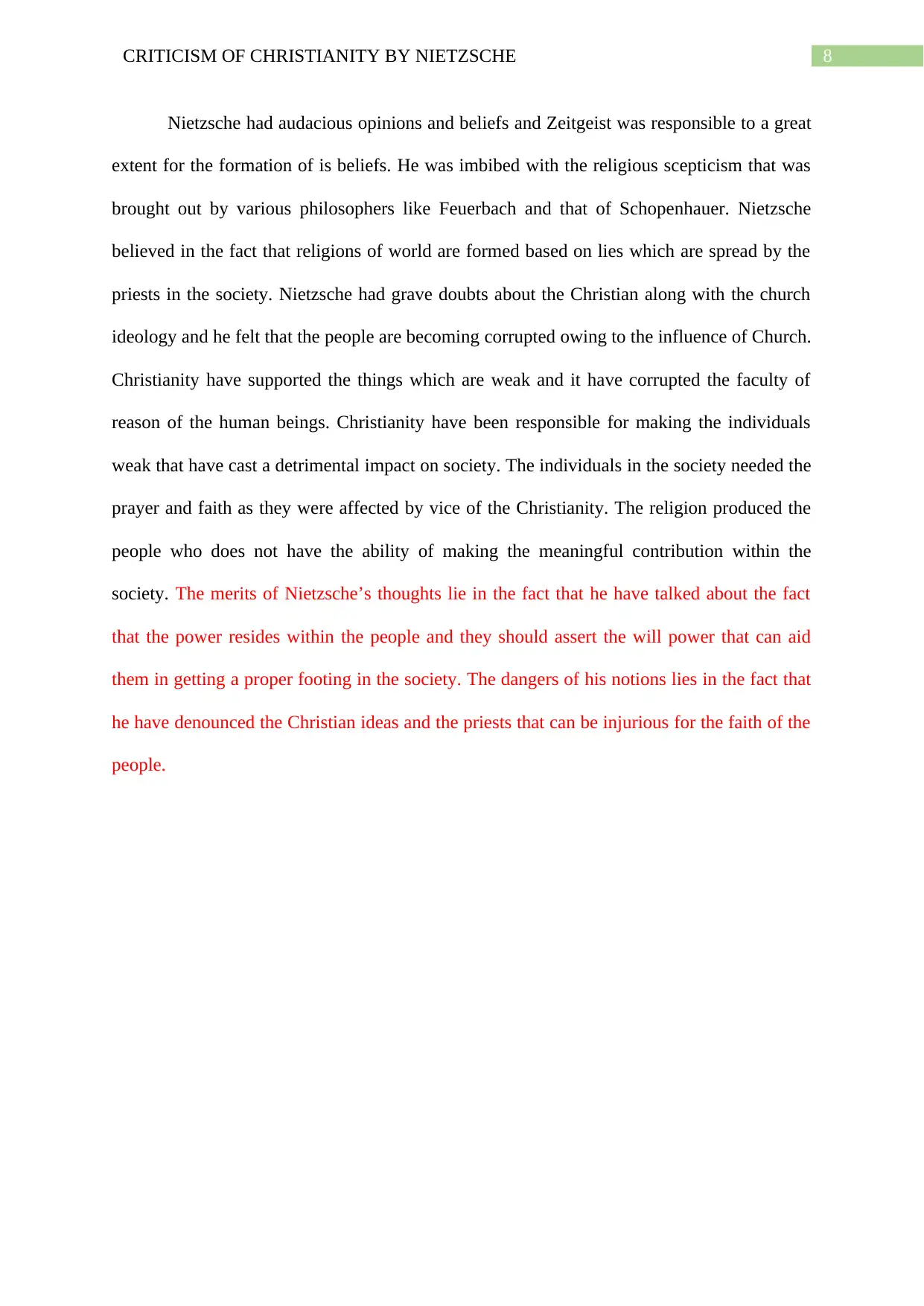
Nietzsche had audacious opinions and beliefs and Zeitgeist was responsible to a great
extent for the formation of is beliefs. He was imbibed with the religious scepticism that was
brought out by various philosophers like Feuerbach and that of Schopenhauer. Nietzsche
believed in the fact that religions of world are formed based on lies which are spread by the
priests in the society. Nietzsche had grave doubts about the Christian along with the church
ideology and he felt that the people are becoming corrupted owing to the influence of Church.
Christianity have supported the things which are weak and it have corrupted the faculty of
reason of the human beings. Christianity have been responsible for making the individuals
weak that have cast a detrimental impact on society. The individuals in the society needed the
prayer and faith as they were affected by vice of the Christianity. The religion produced the
people who does not have the ability of making the meaningful contribution within the
society. The merits of Nietzsche’s thoughts lie in the fact that he have talked about the fact
that the power resides within the people and they should assert the will power that can aid
them in getting a proper footing in the society. The dangers of his notions lies in the fact that
he have denounced the Christian ideas and the priests that can be injurious for the faith of the
people.
Nietzsche had audacious opinions and beliefs and Zeitgeist was responsible to a great
extent for the formation of is beliefs. He was imbibed with the religious scepticism that was
brought out by various philosophers like Feuerbach and that of Schopenhauer. Nietzsche
believed in the fact that religions of world are formed based on lies which are spread by the
priests in the society. Nietzsche had grave doubts about the Christian along with the church
ideology and he felt that the people are becoming corrupted owing to the influence of Church.
Christianity have supported the things which are weak and it have corrupted the faculty of
reason of the human beings. Christianity have been responsible for making the individuals
weak that have cast a detrimental impact on society. The individuals in the society needed the
prayer and faith as they were affected by vice of the Christianity. The religion produced the
people who does not have the ability of making the meaningful contribution within the
society. The merits of Nietzsche’s thoughts lie in the fact that he have talked about the fact
that the power resides within the people and they should assert the will power that can aid
them in getting a proper footing in the society. The dangers of his notions lies in the fact that
he have denounced the Christian ideas and the priests that can be injurious for the faith of the
people.
⊘ This is a preview!⊘
Do you want full access?
Subscribe today to unlock all pages.
Trusted by 1+ million students worldwide
9CRITICISM OF CHRISTIANITY BY NIETZSCHE
References
Appel, Fredrick. Nietzsche contra democracy. Cornell University Press, 2019.
Armitage, Duane. Heidegger and the Death of God: Between Plato and Nietzsche. Springer,
2017.
Brown, Richard SG. "Nietzsche:‘That profound physiologist’." In Nietzsche and science, pp.
63-82. Routledge, 2017.
Cybulska, Eva. "Nietzsche contra God: A battle within." Indo-Pacific Journal of
Phenomenology 16, no. 1-2 (2016).
Gemes, Ken. "The biology of evil: Nietzsche on Entartung and Verjüdung (Degeneration and
Jewification)." The Journal of Nietzsche Studies (2019).
Gutenberg.org. 2020. "The Project Gutenberg Ebook Of The Genealogy Of Morals, By
Friedrich Nietzsche.". Gutenberg.Org.
https://www.gutenberg.org/files/52319/52319-h/52319-h.htm.
Losurdo, Domenico. Nietzsche, the Aristocratic Rebel: Intellectual Biography and Critical
Balance-sheet. Brill, 2020.
Milne, Andrew, and Western Australia. "Nietzsche, mysticism and the god who isn’t one."
(2019).
Ohana, David. "Nietzsche and Rosenzweig." Teleology and Modernity (2019).
Santaniello, Weaver. "Nietzsche: American Idol or European Prophet? The “Death of God”
in America and Nietzsche's Madman." American Journal of Theology & Philosophy 38, no.
2-3 (2017): 201-222.
Siljak, Ana. "Friedrich Nietzsche, Dmitrii Merezhkovskii, and the Russian
Renaissance." Canadian Slavonic Papers 60, no. 1-2 (2018): 236-255.
References
Appel, Fredrick. Nietzsche contra democracy. Cornell University Press, 2019.
Armitage, Duane. Heidegger and the Death of God: Between Plato and Nietzsche. Springer,
2017.
Brown, Richard SG. "Nietzsche:‘That profound physiologist’." In Nietzsche and science, pp.
63-82. Routledge, 2017.
Cybulska, Eva. "Nietzsche contra God: A battle within." Indo-Pacific Journal of
Phenomenology 16, no. 1-2 (2016).
Gemes, Ken. "The biology of evil: Nietzsche on Entartung and Verjüdung (Degeneration and
Jewification)." The Journal of Nietzsche Studies (2019).
Gutenberg.org. 2020. "The Project Gutenberg Ebook Of The Genealogy Of Morals, By
Friedrich Nietzsche.". Gutenberg.Org.
https://www.gutenberg.org/files/52319/52319-h/52319-h.htm.
Losurdo, Domenico. Nietzsche, the Aristocratic Rebel: Intellectual Biography and Critical
Balance-sheet. Brill, 2020.
Milne, Andrew, and Western Australia. "Nietzsche, mysticism and the god who isn’t one."
(2019).
Ohana, David. "Nietzsche and Rosenzweig." Teleology and Modernity (2019).
Santaniello, Weaver. "Nietzsche: American Idol or European Prophet? The “Death of God”
in America and Nietzsche's Madman." American Journal of Theology & Philosophy 38, no.
2-3 (2017): 201-222.
Siljak, Ana. "Friedrich Nietzsche, Dmitrii Merezhkovskii, and the Russian
Renaissance." Canadian Slavonic Papers 60, no. 1-2 (2018): 236-255.
Paraphrase This Document
Need a fresh take? Get an instant paraphrase of this document with our AI Paraphraser
10CRITICISM OF CHRISTIANITY BY NIETZSCHE
Strong, Tracy B. "Nietzsche and the Critique of Religion." Nietzsche and The Antichrist:
Religion, Politics, and Culture in Late Modernity (2019): 141.
Turner, Bryan S. "Nietzsche and Happiness." In Nietzsche and Critical Social Theory, pp.
481-497. Brill, 2019.
Zain, M. Osama. "Übermensch: Nietzsche’s Idea for the Man of Future." MILLER’S
DREAM (2018): 35.
Strong, Tracy B. "Nietzsche and the Critique of Religion." Nietzsche and The Antichrist:
Religion, Politics, and Culture in Late Modernity (2019): 141.
Turner, Bryan S. "Nietzsche and Happiness." In Nietzsche and Critical Social Theory, pp.
481-497. Brill, 2019.
Zain, M. Osama. "Übermensch: Nietzsche’s Idea for the Man of Future." MILLER’S
DREAM (2018): 35.

1 out of 11


Related Documents


Your All-in-One AI-Powered Toolkit for Academic Success.
+13062052269
info@desklib.com
Available 24*7 on WhatsApp / Email
![[object Object]](/_next/static/media/star-bottom.7253800d.svg)
Unlock your academic potential
Copyright © 2020–2026 A2Z Services. All Rights Reserved. Developed and managed by ZUCOL.