Report: Workplace Communication Skills and Cross-Cultural Factors

Verified

Added on  2021/04/24

|10
|1449
|171
Report
AI Summary
This report addresses crucial aspects of workplace communication, focusing on non-verbal communication and cross-cultural considerations. The first section delves into the fundamentals of non-verbal communication, explaining its meaning, functions, involuntary nature, ambiguity, and lack of strict rules. It provides insights into how these factors influence workplace behavior. The second section shifts its focus to cross-cultural communication, particularly in the context of doing business in New Delhi, India. It highlights essential factors such as appropriate dressing, expected workplace behavior, and effective communication strategies, including the importance of telephonic and email communication. The report aims to equip employees with the necessary knowledge to navigate diverse workplace environments effectively, enhancing their professional skills and promoting successful business interactions.
Document Page
Running head: WORKPLACE COMMUNICATION SKILLS
Workplace Communication Skills
Name of the student:
Name of the university:
Author note
tabler-icon-diamond-filled.svg

Paraphrase This Document

Need a fresh take? Get an instant paraphrase of this document with our AI Paraphraser
Document Page
1WORKPLACE COMMUNICATION SKILLS
Question 1:
Introduction
As a business trailer of Almera Consultancy International it is required to train a group of
new employees of a large company known as Solexion Communications. Therefore it is
expected that they experience a great training on ‘the basics of non- verbal communication.’ The
five points on which the training session will focus are elaborated below.
What is it all about?
The employees will have to understand what non- verbal communication means. It
includes unspoken messages or information which might be intentional and most importantly,
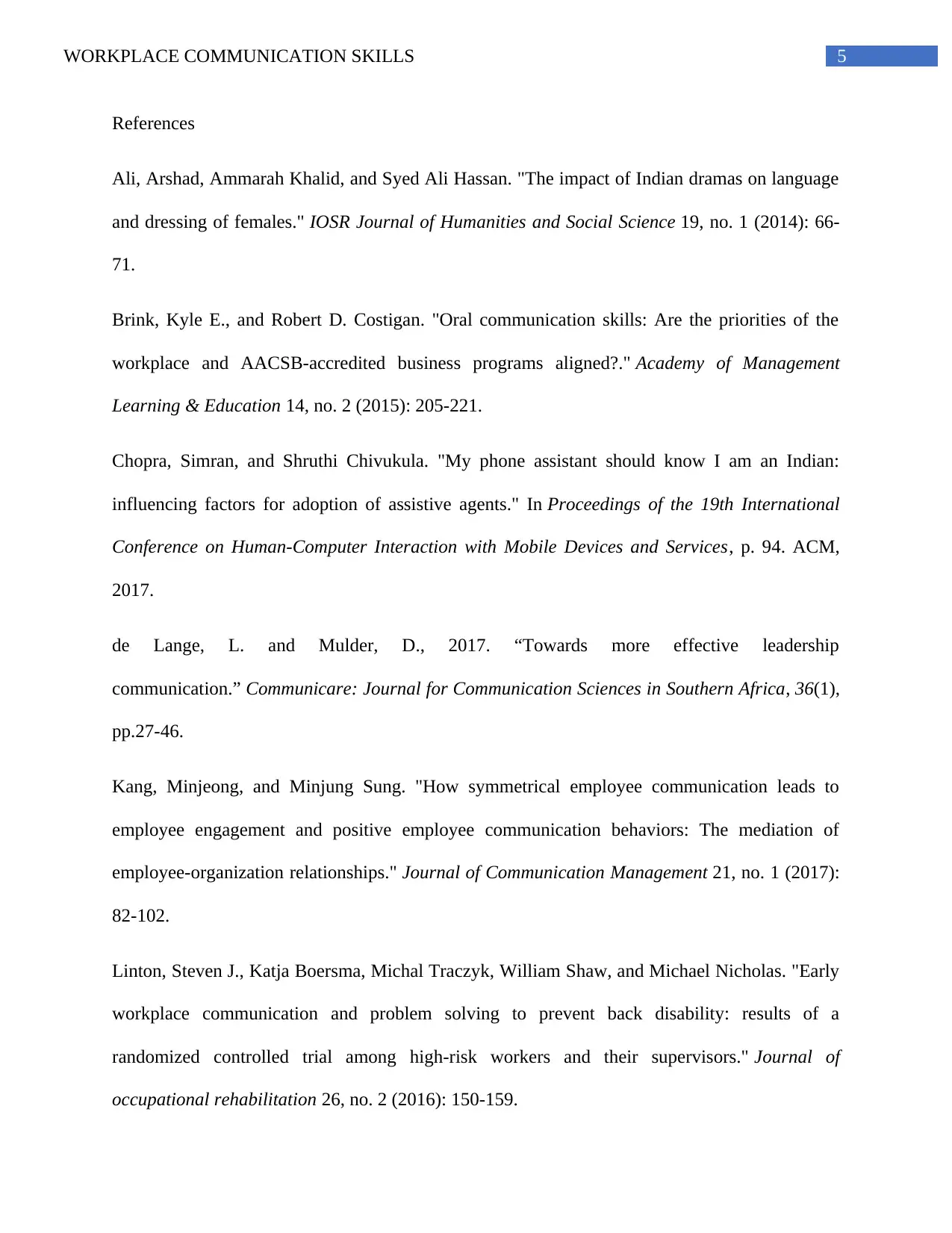
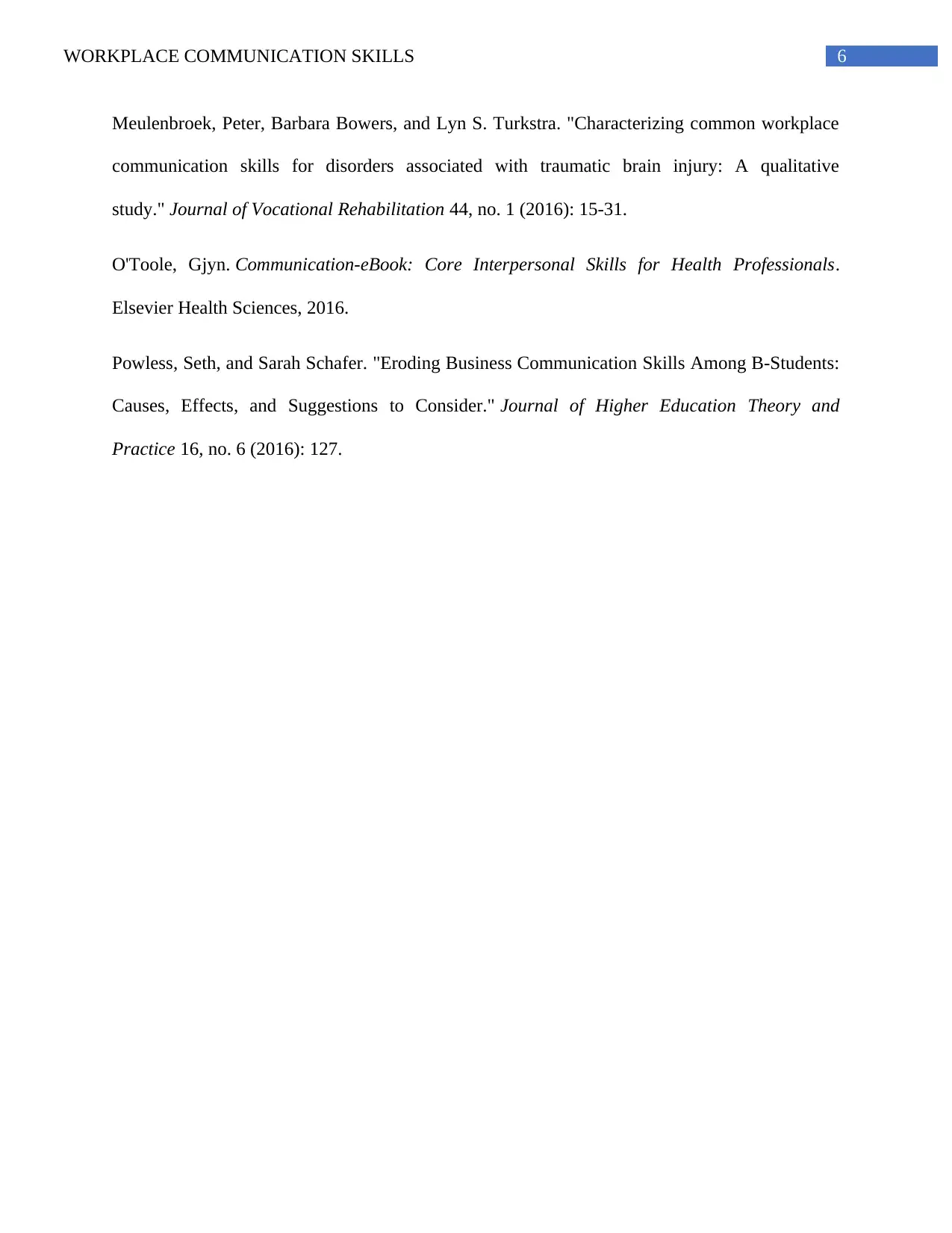
these are expressed through in non- verbal forms. Non- verbal behavior refers to facial
expressions, body language, voice pitch or tone, proximity and others (Brink and Costigan
2015). The common forms of non- verbal communication include shaking hands, patting back,
pushing, hugging or any other form of touch. Thus the employees were told that as a sign of
appreciating someone’s achievement one can pat the others back without uttering anything.
Functions
The primary function of non- verbal communication is to reach out to the receiver by
conveying the meaning to either emphasize, oppose or as replacement of verbal communication.
It acts a method to influence the opponent to be engaged in the regular conversation (de Lange
and Mulder 2017). It can be said that a better meaning is conveyed through non- verbal
communication than verbal communication. Human beings have the tendency to take the support
of non- verbal communication where there is a conflict among the verbal messages in terms of
Document Page
2WORKPLACE COMMUNICATION SKILLS
emotional communication. For instance, if one of you asks your friend that what is his plan for
the night then it can be replied by nodding head or some other posture.
Involuntary nature
The involuntary nature of non- verbal communication is common and takes place in our
sub-consciousness therefore difficult to control and sometimes it becomes difficult to fake
behavior (Kang and Sung 2017). For example, it is easy to show a smiling face or greet someone
when meeting someone for the first time but it is difficult to show fake happiness in front of
them. This is because it gets exposed within the underlying thoughts or feelings.
Ambiguous
Non- verbal communication is more ambiguous or vague than verbal communication
because it does not have any significant meaning (Linton et al. 2016). For example some of you
have seen an opponent person winked at you but there is confusion about the reason behind it.
Was it show affection, pleasure or as a part of joke?
No rule
Non verbal communication does not follow any grammar such as verbal communication
and there is no fixed pattern, structure or rules of usage (Meulenbroek, Bowers and Turkstra
2016). It is more credible than verbal communication because human beings tend to believe
more in a person’s actions than words. For example, kids who are blind by birth express the
same facial signs as other children.
Conclusion
Document Page
3WORKPLACE COMMUNICATION SKILLS
Thus the training session had tried to summarize the important facts about non- verbal
communication. It will help the employees to modify their workplace behavior accordingly by
keeping in mind the listed factors.
Question 2:
As the company personnel will be going to New Delhi in India certain key points need to
be considered for avoiding cross cultural conflict. Cross cultural is an important part of business
relationships because it helps in working with a diverse workforce and understanding their
individual culture. By understanding the cultural aspects of different backgrounds it becomes
easy to mange working with the people across the border and spread the business in trans-
national areas.
Four main factors are elaborated below which will make the team easy to communicate in
the new region.
Dressing- dressing is an important part as it carries the first impression in a business
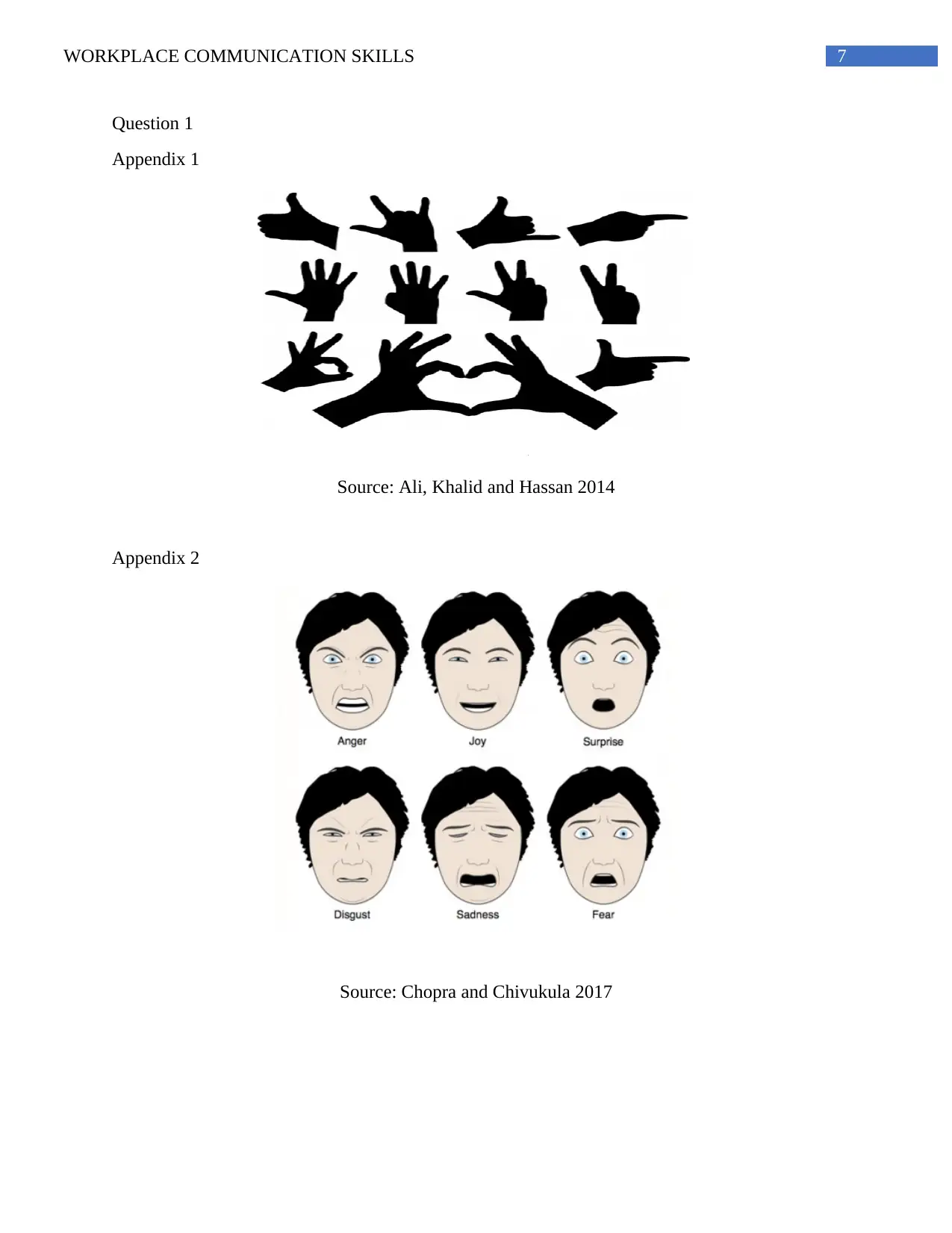
relationship. For a country like India which shelters a huge population, there are Indian formals
and western formals which are used commonly. Although the dressing varies from one part to
another in this country but at the workplace the male mainly wear shirts and trousers and the
female wear kurti or churidaar. The Indians are conservative in their way of dressing but are
open to all kinds of garments. Nowadays women have been seen wearing western formals such
as skirt or trousers with shirts at the workplaces (O’Toole 2016). However saree is also
considered as a formal wear depending on the way in which it is draped.
Behavior- since India has the largest democracy in the world and the second largest
population therefore it is important to have a good knowledge about the workplace behavior in
tabler-icon-diamond-filled.svg

Paraphrase This Document

Need a fresh take? Get an instant paraphrase of this document with our AI Paraphraser
Document Page
4WORKPLACE COMMUNICATION SKILLS
this country. Indians have a tendency to conduct business transactions only with known people.
If an outside company wants to carry out business in India then they need to send letter one or
two months in advance to get appointment. For conducting a meeting with a person in India, the
date needs to be confirmed one week before and also on the same day. The schedule needs to be
kept flexible because there might be household restrictions which can lead to last minute changes
(Powless and Schafer 2016).
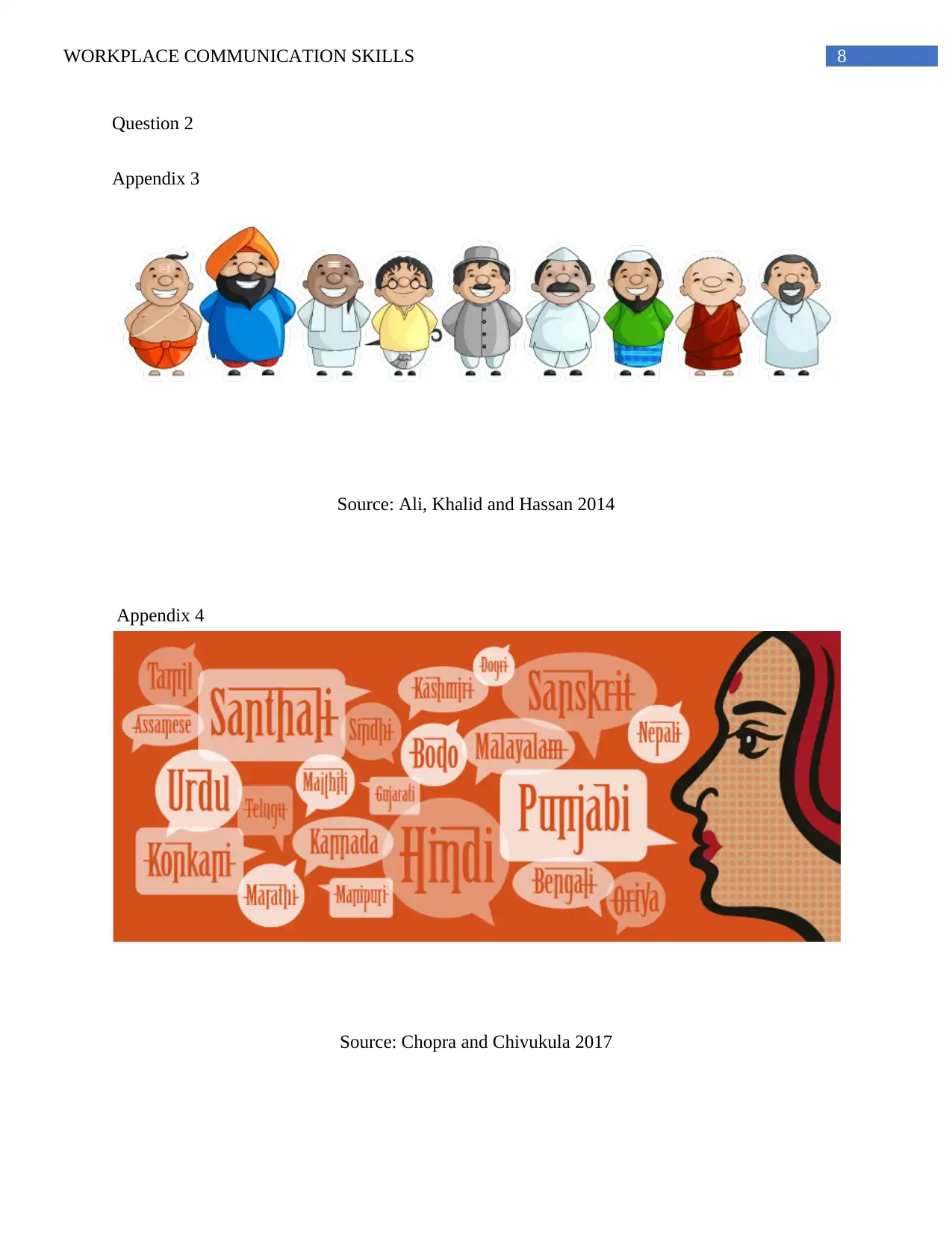
Communication- in a country where more than 20 languages are spoken, communication
plays an important role. Telephonic communication is one of the major factors while carrying
out business in India. Email should be used in addition for documentation. Moreover there
should not be any intended pun or humor in the written form of communication as it leads to
controversy at the Indian workplace
Document Page
5WORKPLACE COMMUNICATION SKILLS
References
Ali, Arshad, Ammarah Khalid, and Syed Ali Hassan. "The impact of Indian dramas on language
and dressing of females." IOSR Journal of Humanities and Social Science 19, no. 1 (2014): 66-
71.
Brink, Kyle E., and Robert D. Costigan. "Oral communication skills: Are the priorities of the
workplace and AACSB-accredited business programs aligned?." Academy of Management
Learning & Education 14, no. 2 (2015): 205-221.
Chopra, Simran, and Shruthi Chivukula. "My phone assistant should know I am an Indian:
influencing factors for adoption of assistive agents." In Proceedings of the 19th International
Conference on Human-Computer Interaction with Mobile Devices and Services, p. 94. ACM,
2017.
de Lange, L. and Mulder, D., 2017. “Towards more effective leadership
communication.” Communicare: Journal for Communication Sciences in Southern Africa, 36(1),
pp.27-46.
Kang, Minjeong, and Minjung Sung. "How symmetrical employee communication leads to
employee engagement and positive employee communication behaviors: The mediation of
employee-organization relationships." Journal of Communication Management 21, no. 1 (2017):
82-102.
Linton, Steven J., Katja Boersma, Michal Traczyk, William Shaw, and Michael Nicholas. "Early
workplace communication and problem solving to prevent back disability: results of a
randomized controlled trial among high-risk workers and their supervisors." Journal of
occupational rehabilitation 26, no. 2 (2016): 150-159.
Document Page
6WORKPLACE COMMUNICATION SKILLS
Meulenbroek, Peter, Barbara Bowers, and Lyn S. Turkstra. "Characterizing common workplace
communication skills for disorders associated with traumatic brain injury: A qualitative
study." Journal of Vocational Rehabilitation 44, no. 1 (2016): 15-31.
O'Toole, Gjyn. Communication-eBook: Core Interpersonal Skills for Health Professionals.
Elsevier Health Sciences, 2016.
Powless, Seth, and Sarah Schafer. "Eroding Business Communication Skills Among B-Students:
Causes, Effects, and Suggestions to Consider." Journal of Higher Education Theory and
Practice 16, no. 6 (2016): 127.
tabler-icon-diamond-filled.svg

Paraphrase This Document

Need a fresh take? Get an instant paraphrase of this document with our AI Paraphraser
Document Page
7WORKPLACE COMMUNICATION SKILLS
Question 1
Appendix 1
Source: Ali, Khalid and Hassan 2014
Appendix 2
Source: Chopra and Chivukula 2017
Document Page
8WORKPLACE COMMUNICATION SKILLS
Question 2
Appendix 3
Source: Ali, Khalid and Hassan 2014
Appendix 4
Source: Chopra and Chivukula 2017
Document Page
9WORKPLACE COMMUNICATION SKILLS
chevron_up_icon
1 out of 10
circle_padding
hide_on_mobile
zoom_out_icon
[object Object]