Cross-Cultural Management: Article Analysis and Managerial Briefing
VerifiedAdded on 2023/04/22
|15
|4753
|212
Report
AI Summary
This report provides a comprehensive analysis of cross-cultural management and diversity, divided into two parts. The first part reviews two articles: one focusing on the effectiveness of business language initiatives by Judith Ainsworth and the other exploring the internalization of the IKEA brand in Russia and China by Veronika V. Tarnovskaya and Leslie de Chernatony. The reviews discuss the articles' objectives, methodologies, key findings, and contributions to understanding intercultural communication and brand internationalization. The report highlights issues such as the adoption of language skills, strategies for intercultural effectiveness, and challenges in transferring brand identity across borders. The second part of the assignment is a briefing directed to managers of a computer manufacturing company in Malaysia tasked with establishing a long-term relationship with a component supplier in Guangzhou, China, aiming to provide cultural insights and business practice understanding.

Cross- culture management and
diversity
Student’s name
diversity
Student’s name

Paraphrase This Document
Need a fresh take? Get an instant paraphrase of this document with our AI Paraphraser
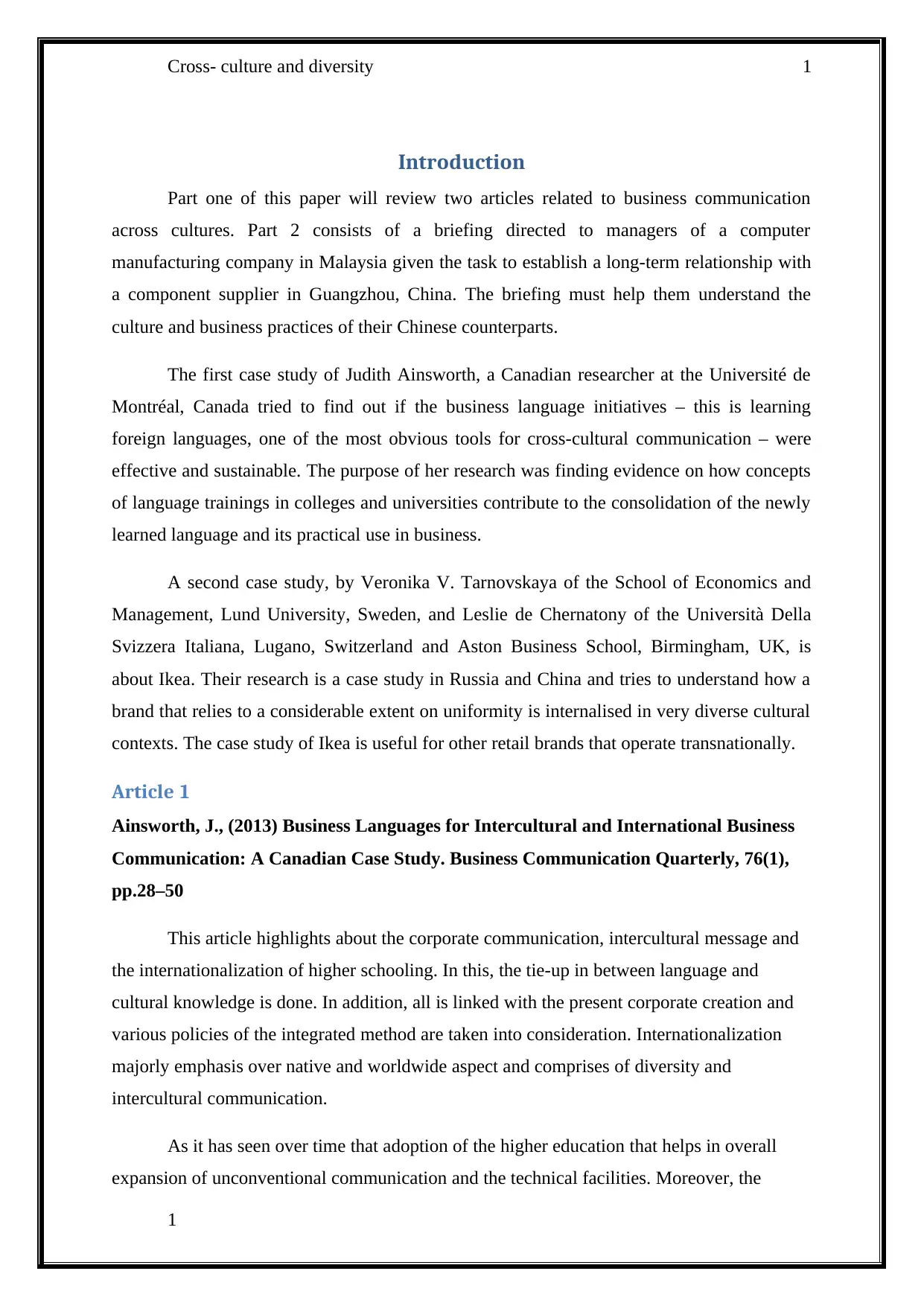
Cross- culture and diversity 1
Introduction
Part one of this paper will review two articles related to business communication
across cultures. Part 2 consists of a briefing directed to managers of a computer
manufacturing company in Malaysia given the task to establish a long-term relationship with
a component supplier in Guangzhou, China. The briefing must help them understand the
culture and business practices of their Chinese counterparts.
The first case study of Judith Ainsworth, a Canadian researcher at the Université de
Montréal, Canada tried to find out if the business language initiatives – this is learning
foreign languages, one of the most obvious tools for cross-cultural communication – were
effective and sustainable. The purpose of her research was finding evidence on how concepts
of language trainings in colleges and universities contribute to the consolidation of the newly
learned language and its practical use in business.
A second case study, by Veronika V. Tarnovskaya of the School of Economics and
Management, Lund University, Sweden, and Leslie de Chernatony of the Università Della
Svizzera Italiana, Lugano, Switzerland and Aston Business School, Birmingham, UK, is
about Ikea. Their research is a case study in Russia and China and tries to understand how a
brand that relies to a considerable extent on uniformity is internalised in very diverse cultural
contexts. The case study of Ikea is useful for other retail brands that operate transnationally.
Article 1
Ainsworth, J., (2013) Business Languages for Intercultural and International Business
Communication: A Canadian Case Study. Business Communication Quarterly, 76(1),
pp.28–50
This article highlights about the corporate communication, intercultural message and
the internationalization of higher schooling. In this, the tie-up in between language and
cultural knowledge is done. In addition, all is linked with the present corporate creation and
various policies of the integrated method are taken into consideration. Internationalization
majorly emphasis over native and worldwide aspect and comprises of diversity and
intercultural communication.
As it has seen over time that adoption of the higher education that helps in overall
expansion of unconventional communication and the technical facilities. Moreover, the
1
Introduction
Part one of this paper will review two articles related to business communication
across cultures. Part 2 consists of a briefing directed to managers of a computer
manufacturing company in Malaysia given the task to establish a long-term relationship with
a component supplier in Guangzhou, China. The briefing must help them understand the
culture and business practices of their Chinese counterparts.
The first case study of Judith Ainsworth, a Canadian researcher at the Université de
Montréal, Canada tried to find out if the business language initiatives – this is learning
foreign languages, one of the most obvious tools for cross-cultural communication – were
effective and sustainable. The purpose of her research was finding evidence on how concepts
of language trainings in colleges and universities contribute to the consolidation of the newly
learned language and its practical use in business.
A second case study, by Veronika V. Tarnovskaya of the School of Economics and
Management, Lund University, Sweden, and Leslie de Chernatony of the Università Della
Svizzera Italiana, Lugano, Switzerland and Aston Business School, Birmingham, UK, is
about Ikea. Their research is a case study in Russia and China and tries to understand how a
brand that relies to a considerable extent on uniformity is internalised in very diverse cultural
contexts. The case study of Ikea is useful for other retail brands that operate transnationally.
Article 1
Ainsworth, J., (2013) Business Languages for Intercultural and International Business
Communication: A Canadian Case Study. Business Communication Quarterly, 76(1),
pp.28–50
This article highlights about the corporate communication, intercultural message and
the internationalization of higher schooling. In this, the tie-up in between language and
cultural knowledge is done. In addition, all is linked with the present corporate creation and
various policies of the integrated method are taken into consideration. Internationalization
majorly emphasis over native and worldwide aspect and comprises of diversity and
intercultural communication.
As it has seen over time that adoption of the higher education that helps in overall
expansion of unconventional communication and the technical facilities. Moreover, the
1
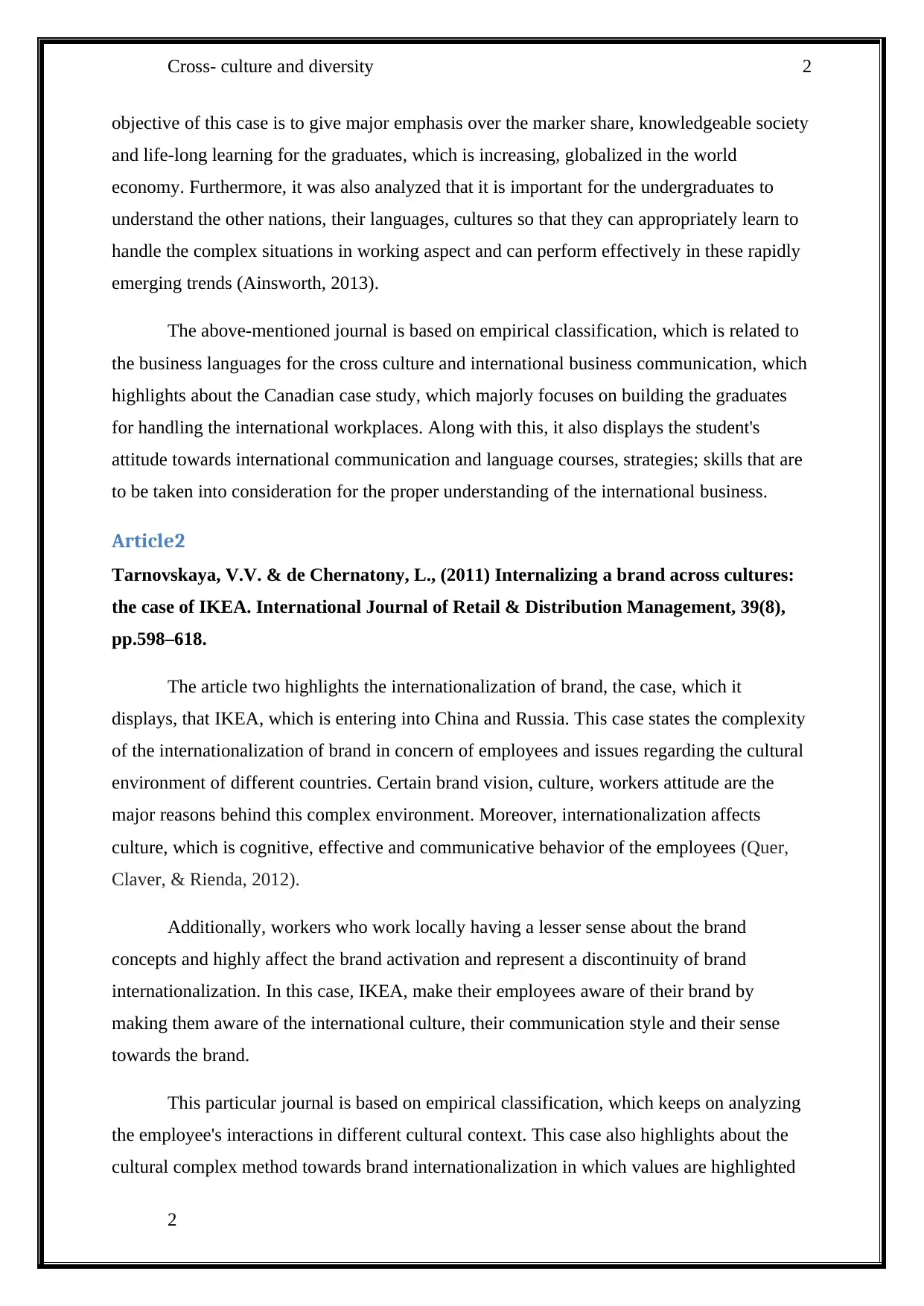
Cross- culture and diversity 2
objective of this case is to give major emphasis over the marker share, knowledgeable society
and life-long learning for the graduates, which is increasing, globalized in the world
economy. Furthermore, it was also analyzed that it is important for the undergraduates to
understand the other nations, their languages, cultures so that they can appropriately learn to
handle the complex situations in working aspect and can perform effectively in these rapidly
emerging trends (Ainsworth, 2013).
The above-mentioned journal is based on empirical classification, which is related to
the business languages for the cross culture and international business communication, which
highlights about the Canadian case study, which majorly focuses on building the graduates
for handling the international workplaces. Along with this, it also displays the student's
attitude towards international communication and language courses, strategies; skills that are
to be taken into consideration for the proper understanding of the international business.
Article2
Tarnovskaya, V.V. & de Chernatony, L., (2011) Internalizing a brand across cultures:
the case of IKEA. International Journal of Retail & Distribution Management, 39(8),
pp.598–618.
The article two highlights the internationalization of brand, the case, which it
displays, that IKEA, which is entering into China and Russia. This case states the complexity
of the internationalization of brand in concern of employees and issues regarding the cultural
environment of different countries. Certain brand vision, culture, workers attitude are the
major reasons behind this complex environment. Moreover, internationalization affects
culture, which is cognitive, effective and communicative behavior of the employees (Quer,
Claver, & Rienda, 2012).
Additionally, workers who work locally having a lesser sense about the brand
concepts and highly affect the brand activation and represent a discontinuity of brand
internationalization. In this case, IKEA, make their employees aware of their brand by
making them aware of the international culture, their communication style and their sense
towards the brand.
This particular journal is based on empirical classification, which keeps on analyzing
the employee's interactions in different cultural context. This case also highlights about the
cultural complex method towards brand internationalization in which values are highlighted
2
objective of this case is to give major emphasis over the marker share, knowledgeable society
and life-long learning for the graduates, which is increasing, globalized in the world
economy. Furthermore, it was also analyzed that it is important for the undergraduates to
understand the other nations, their languages, cultures so that they can appropriately learn to
handle the complex situations in working aspect and can perform effectively in these rapidly
emerging trends (Ainsworth, 2013).
The above-mentioned journal is based on empirical classification, which is related to
the business languages for the cross culture and international business communication, which
highlights about the Canadian case study, which majorly focuses on building the graduates
for handling the international workplaces. Along with this, it also displays the student's
attitude towards international communication and language courses, strategies; skills that are
to be taken into consideration for the proper understanding of the international business.
Article2
Tarnovskaya, V.V. & de Chernatony, L., (2011) Internalizing a brand across cultures:
the case of IKEA. International Journal of Retail & Distribution Management, 39(8),
pp.598–618.
The article two highlights the internationalization of brand, the case, which it
displays, that IKEA, which is entering into China and Russia. This case states the complexity
of the internationalization of brand in concern of employees and issues regarding the cultural
environment of different countries. Certain brand vision, culture, workers attitude are the
major reasons behind this complex environment. Moreover, internationalization affects
culture, which is cognitive, effective and communicative behavior of the employees (Quer,
Claver, & Rienda, 2012).
Additionally, workers who work locally having a lesser sense about the brand
concepts and highly affect the brand activation and represent a discontinuity of brand
internationalization. In this case, IKEA, make their employees aware of their brand by
making them aware of the international culture, their communication style and their sense
towards the brand.
This particular journal is based on empirical classification, which keeps on analyzing
the employee's interactions in different cultural context. This case also highlights about the
cultural complex method towards brand internationalization in which values are highlighted
2
⊘ This is a preview!⊘
Do you want full access?
Subscribe today to unlock all pages.

Trusted by 1+ million students worldwide
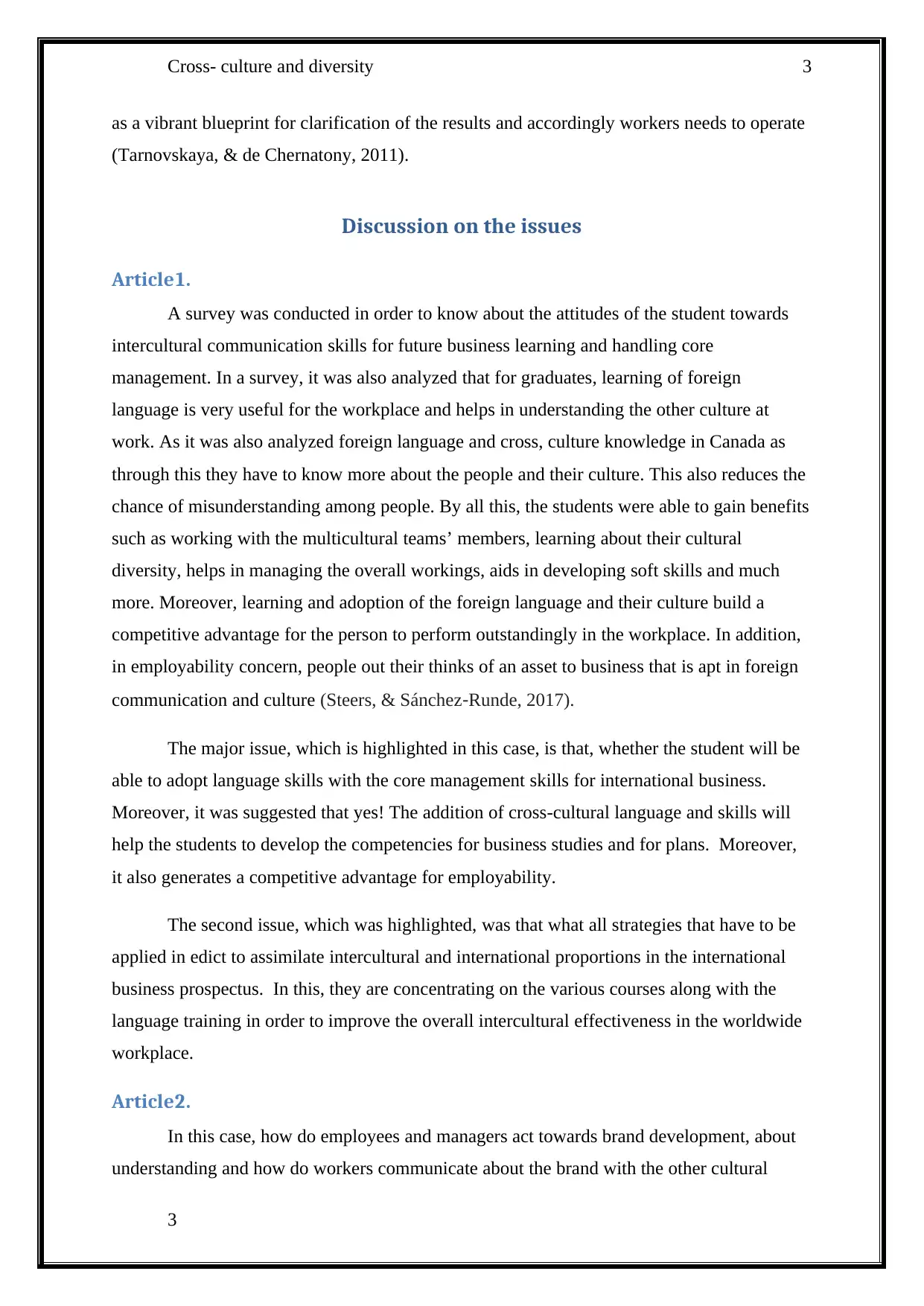
Cross- culture and diversity 3
as a vibrant blueprint for clarification of the results and accordingly workers needs to operate
(Tarnovskaya, & de Chernatony, 2011).
Discussion on the issues
Article1.
A survey was conducted in order to know about the attitudes of the student towards
intercultural communication skills for future business learning and handling core
management. In a survey, it was also analyzed that for graduates, learning of foreign
language is very useful for the workplace and helps in understanding the other culture at
work. As it was also analyzed foreign language and cross, culture knowledge in Canada as
through this they have to know more about the people and their culture. This also reduces the
chance of misunderstanding among people. By all this, the students were able to gain benefits
such as working with the multicultural teams’ members, learning about their cultural
diversity, helps in managing the overall workings, aids in developing soft skills and much
more. Moreover, learning and adoption of the foreign language and their culture build a
competitive advantage for the person to perform outstandingly in the workplace. In addition,
in employability concern, people out their thinks of an asset to business that is apt in foreign
communication and culture (Steers, & Sánchez‐Runde, 2017).
The major issue, which is highlighted in this case, is that, whether the student will be
able to adopt language skills with the core management skills for international business.
Moreover, it was suggested that yes! The addition of cross-cultural language and skills will
help the students to develop the competencies for business studies and for plans. Moreover,
it also generates a competitive advantage for employability.
The second issue, which was highlighted, was that what all strategies that have to be
applied in edict to assimilate intercultural and international proportions in the international
business prospectus. In this, they are concentrating on the various courses along with the
language training in order to improve the overall intercultural effectiveness in the worldwide
workplace.
Article2.
In this case, how do employees and managers act towards brand development, about
understanding and how do workers communicate about the brand with the other cultural
3
as a vibrant blueprint for clarification of the results and accordingly workers needs to operate
(Tarnovskaya, & de Chernatony, 2011).
Discussion on the issues
Article1.
A survey was conducted in order to know about the attitudes of the student towards
intercultural communication skills for future business learning and handling core
management. In a survey, it was also analyzed that for graduates, learning of foreign
language is very useful for the workplace and helps in understanding the other culture at
work. As it was also analyzed foreign language and cross, culture knowledge in Canada as
through this they have to know more about the people and their culture. This also reduces the
chance of misunderstanding among people. By all this, the students were able to gain benefits
such as working with the multicultural teams’ members, learning about their cultural
diversity, helps in managing the overall workings, aids in developing soft skills and much
more. Moreover, learning and adoption of the foreign language and their culture build a
competitive advantage for the person to perform outstandingly in the workplace. In addition,
in employability concern, people out their thinks of an asset to business that is apt in foreign
communication and culture (Steers, & Sánchez‐Runde, 2017).
The major issue, which is highlighted in this case, is that, whether the student will be
able to adopt language skills with the core management skills for international business.
Moreover, it was suggested that yes! The addition of cross-cultural language and skills will
help the students to develop the competencies for business studies and for plans. Moreover,
it also generates a competitive advantage for employability.
The second issue, which was highlighted, was that what all strategies that have to be
applied in edict to assimilate intercultural and international proportions in the international
business prospectus. In this, they are concentrating on the various courses along with the
language training in order to improve the overall intercultural effectiveness in the worldwide
workplace.
Article2.
In this case, how do employees and managers act towards brand development, about
understanding and how do workers communicate about the brand with the other cultural
3
Paraphrase This Document
Need a fresh take? Get an instant paraphrase of this document with our AI Paraphraser
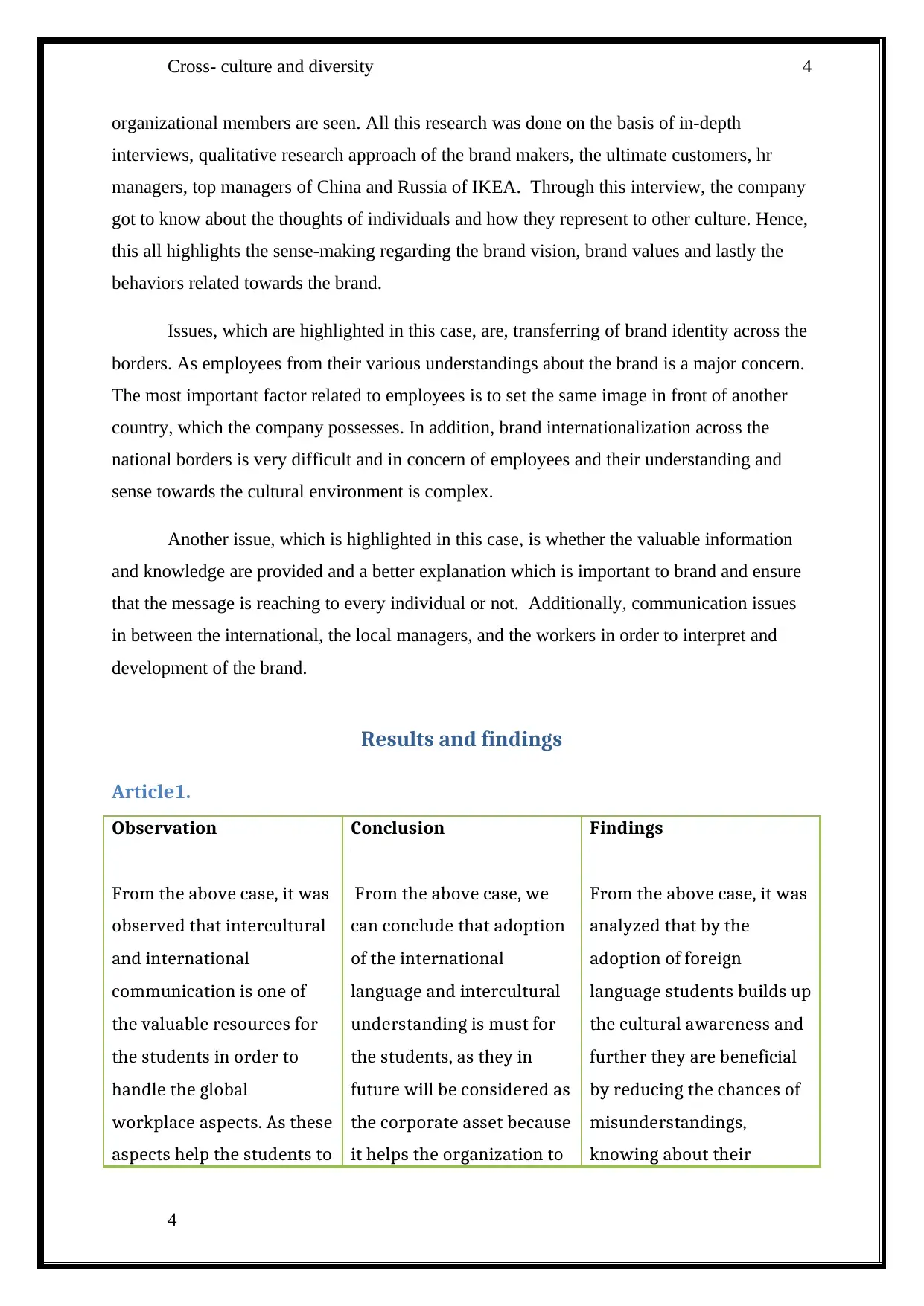
Cross- culture and diversity 4
organizational members are seen. All this research was done on the basis of in-depth
interviews, qualitative research approach of the brand makers, the ultimate customers, hr
managers, top managers of China and Russia of IKEA. Through this interview, the company
got to know about the thoughts of individuals and how they represent to other culture. Hence,
this all highlights the sense-making regarding the brand vision, brand values and lastly the
behaviors related towards the brand.
Issues, which are highlighted in this case, are, transferring of brand identity across the
borders. As employees from their various understandings about the brand is a major concern.
The most important factor related to employees is to set the same image in front of another
country, which the company possesses. In addition, brand internationalization across the
national borders is very difficult and in concern of employees and their understanding and
sense towards the cultural environment is complex.
Another issue, which is highlighted in this case, is whether the valuable information
and knowledge are provided and a better explanation which is important to brand and ensure
that the message is reaching to every individual or not. Additionally, communication issues
in between the international, the local managers, and the workers in order to interpret and
development of the brand.
Results and findings
Article1.
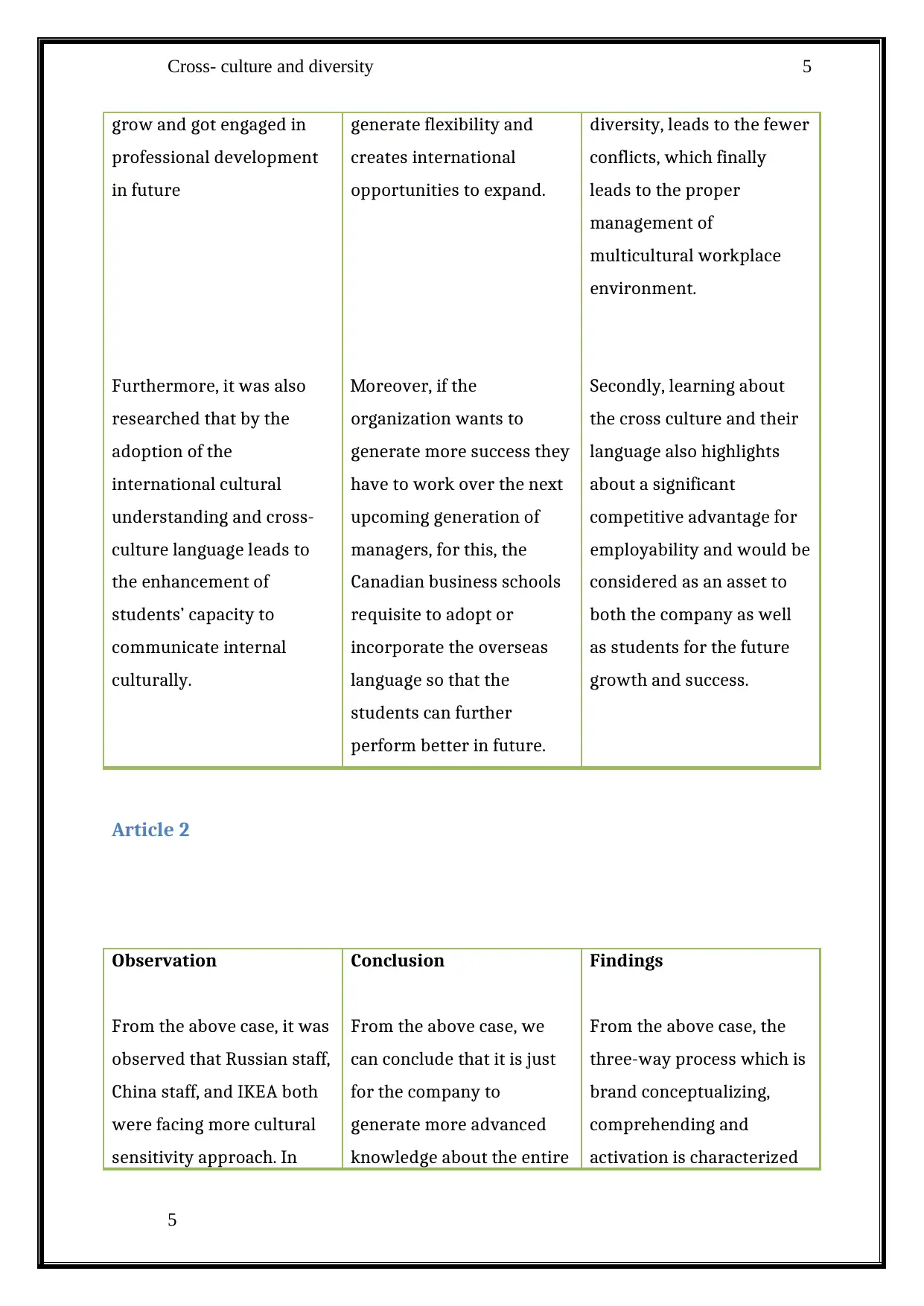
Observation
From the above case, it was
observed that intercultural
and international
communication is one of
the valuable resources for
the students in order to
handle the global
workplace aspects. As these
aspects help the students to
Conclusion
From the above case, we
can conclude that adoption
of the international
language and intercultural
understanding is must for
the students, as they in
future will be considered as
the corporate asset because
it helps the organization to
Findings
From the above case, it was
analyzed that by the
adoption of foreign
language students builds up
the cultural awareness and
further they are beneficial
by reducing the chances of
misunderstandings,
knowing about their
4
organizational members are seen. All this research was done on the basis of in-depth
interviews, qualitative research approach of the brand makers, the ultimate customers, hr
managers, top managers of China and Russia of IKEA. Through this interview, the company
got to know about the thoughts of individuals and how they represent to other culture. Hence,
this all highlights the sense-making regarding the brand vision, brand values and lastly the
behaviors related towards the brand.
Issues, which are highlighted in this case, are, transferring of brand identity across the
borders. As employees from their various understandings about the brand is a major concern.
The most important factor related to employees is to set the same image in front of another
country, which the company possesses. In addition, brand internationalization across the
national borders is very difficult and in concern of employees and their understanding and
sense towards the cultural environment is complex.
Another issue, which is highlighted in this case, is whether the valuable information
and knowledge are provided and a better explanation which is important to brand and ensure
that the message is reaching to every individual or not. Additionally, communication issues
in between the international, the local managers, and the workers in order to interpret and
development of the brand.
Results and findings
Article1.
Observation
From the above case, it was
observed that intercultural
and international
communication is one of
the valuable resources for
the students in order to
handle the global
workplace aspects. As these
aspects help the students to
Conclusion
From the above case, we
can conclude that adoption
of the international
language and intercultural
understanding is must for
the students, as they in
future will be considered as
the corporate asset because
it helps the organization to
Findings
From the above case, it was
analyzed that by the
adoption of foreign
language students builds up
the cultural awareness and
further they are beneficial
by reducing the chances of
misunderstandings,
knowing about their
4
Cross- culture and diversity 5
grow and got engaged in
professional development
in future
Furthermore, it was also
researched that by the
adoption of the
international cultural
understanding and cross-
culture language leads to
the enhancement of
students’ capacity to
communicate internal
culturally.
generate flexibility and
creates international
opportunities to expand.
Moreover, if the
organization wants to
generate more success they
have to work over the next
upcoming generation of
managers, for this, the
Canadian business schools
requisite to adopt or
incorporate the overseas
language so that the
students can further
perform better in future.
diversity, leads to the fewer
conflicts, which finally
leads to the proper
management of
multicultural workplace
environment.
Secondly, learning about
the cross culture and their
language also highlights
about a significant
competitive advantage for
employability and would be
considered as an asset to
both the company as well
as students for the future
growth and success.
Article 2
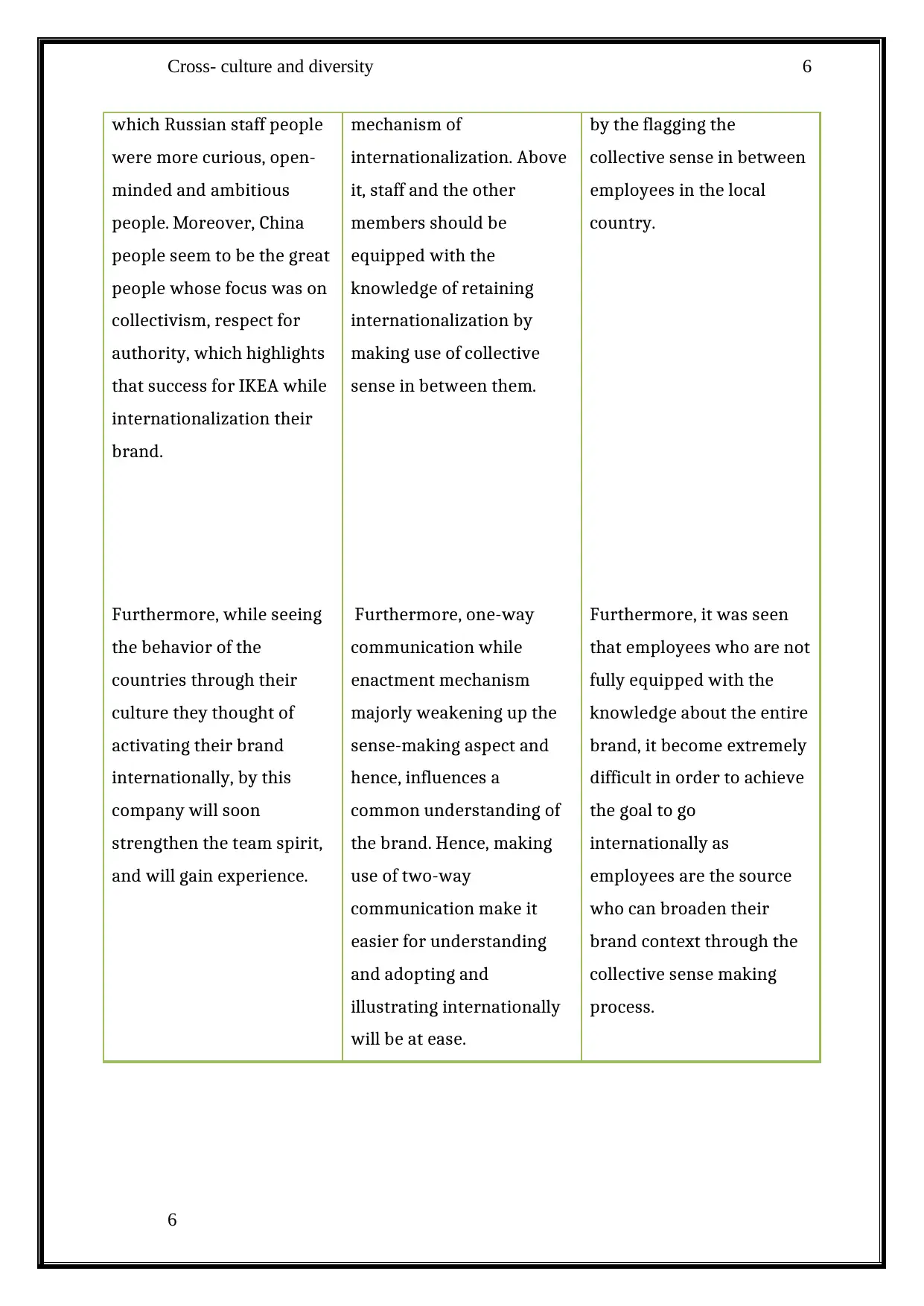
Observation
From the above case, it was
observed that Russian staff,
China staff, and IKEA both
were facing more cultural
sensitivity approach. In
Conclusion
From the above case, we
can conclude that it is just
for the company to
generate more advanced
knowledge about the entire
Findings
From the above case, the
three-way process which is
brand conceptualizing,
comprehending and
activation is characterized
5
grow and got engaged in
professional development
in future
Furthermore, it was also
researched that by the
adoption of the
international cultural
understanding and cross-
culture language leads to
the enhancement of
students’ capacity to
communicate internal
culturally.
generate flexibility and
creates international
opportunities to expand.
Moreover, if the
organization wants to
generate more success they
have to work over the next
upcoming generation of
managers, for this, the
Canadian business schools
requisite to adopt or
incorporate the overseas
language so that the
students can further
perform better in future.
diversity, leads to the fewer
conflicts, which finally
leads to the proper
management of
multicultural workplace
environment.
Secondly, learning about
the cross culture and their
language also highlights
about a significant
competitive advantage for
employability and would be
considered as an asset to
both the company as well
as students for the future
growth and success.
Article 2
Observation
From the above case, it was
observed that Russian staff,
China staff, and IKEA both
were facing more cultural
sensitivity approach. In
Conclusion
From the above case, we
can conclude that it is just
for the company to
generate more advanced
knowledge about the entire
Findings
From the above case, the
three-way process which is
brand conceptualizing,
comprehending and
activation is characterized
5
⊘ This is a preview!⊘
Do you want full access?
Subscribe today to unlock all pages.
Trusted by 1+ million students worldwide
Cross- culture and diversity 6
which Russian staff people
were more curious, open-
minded and ambitious
people. Moreover, China
people seem to be the great
people whose focus was on
collectivism, respect for
authority, which highlights
that success for IKEA while
internationalization their
brand.
Furthermore, while seeing
the behavior of the
countries through their
culture they thought of
activating their brand
internationally, by this
company will soon
strengthen the team spirit,
and will gain experience.
mechanism of
internationalization. Above
it, staff and the other
members should be
equipped with the
knowledge of retaining
internationalization by
making use of collective
sense in between them.
Furthermore, one-way
communication while
enactment mechanism
majorly weakening up the
sense-making aspect and
hence, influences a
common understanding of
the brand. Hence, making
use of two-way
communication make it
easier for understanding
and adopting and
illustrating internationally
will be at ease.
by the flagging the
collective sense in between
employees in the local
country.
Furthermore, it was seen
that employees who are not
fully equipped with the
knowledge about the entire
brand, it become extremely
difficult in order to achieve
the goal to go
internationally as
employees are the source
who can broaden their
brand context through the
collective sense making
process.
6
which Russian staff people
were more curious, open-
minded and ambitious
people. Moreover, China
people seem to be the great
people whose focus was on
collectivism, respect for
authority, which highlights
that success for IKEA while
internationalization their
brand.
Furthermore, while seeing
the behavior of the
countries through their
culture they thought of
activating their brand
internationally, by this
company will soon
strengthen the team spirit,
and will gain experience.
mechanism of
internationalization. Above
it, staff and the other
members should be
equipped with the
knowledge of retaining
internationalization by
making use of collective
sense in between them.
Furthermore, one-way
communication while
enactment mechanism
majorly weakening up the
sense-making aspect and
hence, influences a
common understanding of
the brand. Hence, making
use of two-way
communication make it
easier for understanding
and adopting and
illustrating internationally
will be at ease.
by the flagging the
collective sense in between
employees in the local
country.
Furthermore, it was seen
that employees who are not
fully equipped with the
knowledge about the entire
brand, it become extremely
difficult in order to achieve
the goal to go
internationally as
employees are the source
who can broaden their
brand context through the
collective sense making
process.
6
Paraphrase This Document
Need a fresh take? Get an instant paraphrase of this document with our AI Paraphraser
Cross- culture and diversity 7
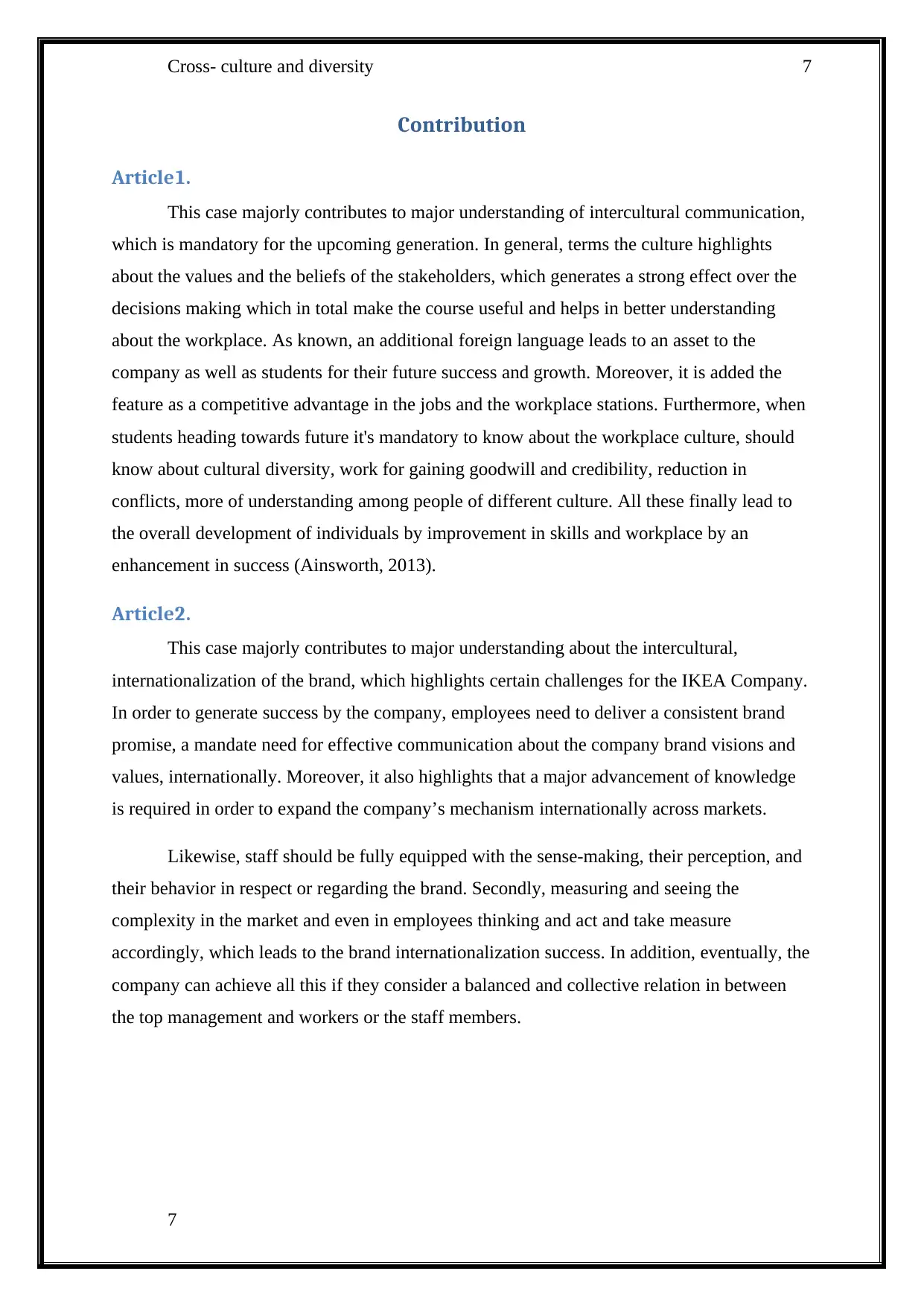
Contribution
Article1.
This case majorly contributes to major understanding of intercultural communication,
which is mandatory for the upcoming generation. In general, terms the culture highlights
about the values and the beliefs of the stakeholders, which generates a strong effect over the
decisions making which in total make the course useful and helps in better understanding
about the workplace. As known, an additional foreign language leads to an asset to the
company as well as students for their future success and growth. Moreover, it is added the
feature as a competitive advantage in the jobs and the workplace stations. Furthermore, when
students heading towards future it's mandatory to know about the workplace culture, should
know about cultural diversity, work for gaining goodwill and credibility, reduction in
conflicts, more of understanding among people of different culture. All these finally lead to
the overall development of individuals by improvement in skills and workplace by an
enhancement in success (Ainsworth, 2013).
Article2.
This case majorly contributes to major understanding about the intercultural,
internationalization of the brand, which highlights certain challenges for the IKEA Company.
In order to generate success by the company, employees need to deliver a consistent brand
promise, a mandate need for effective communication about the company brand visions and
values, internationally. Moreover, it also highlights that a major advancement of knowledge
is required in order to expand the company’s mechanism internationally across markets.
Likewise, staff should be fully equipped with the sense-making, their perception, and
their behavior in respect or regarding the brand. Secondly, measuring and seeing the
complexity in the market and even in employees thinking and act and take measure
accordingly, which leads to the brand internationalization success. In addition, eventually, the
company can achieve all this if they consider a balanced and collective relation in between
the top management and workers or the staff members.
7
Contribution
Article1.
This case majorly contributes to major understanding of intercultural communication,
which is mandatory for the upcoming generation. In general, terms the culture highlights
about the values and the beliefs of the stakeholders, which generates a strong effect over the
decisions making which in total make the course useful and helps in better understanding
about the workplace. As known, an additional foreign language leads to an asset to the
company as well as students for their future success and growth. Moreover, it is added the
feature as a competitive advantage in the jobs and the workplace stations. Furthermore, when
students heading towards future it's mandatory to know about the workplace culture, should
know about cultural diversity, work for gaining goodwill and credibility, reduction in
conflicts, more of understanding among people of different culture. All these finally lead to
the overall development of individuals by improvement in skills and workplace by an
enhancement in success (Ainsworth, 2013).
Article2.
This case majorly contributes to major understanding about the intercultural,
internationalization of the brand, which highlights certain challenges for the IKEA Company.
In order to generate success by the company, employees need to deliver a consistent brand
promise, a mandate need for effective communication about the company brand visions and
values, internationally. Moreover, it also highlights that a major advancement of knowledge
is required in order to expand the company’s mechanism internationally across markets.
Likewise, staff should be fully equipped with the sense-making, their perception, and
their behavior in respect or regarding the brand. Secondly, measuring and seeing the
complexity in the market and even in employees thinking and act and take measure
accordingly, which leads to the brand internationalization success. In addition, eventually, the
company can achieve all this if they consider a balanced and collective relation in between
the top management and workers or the staff members.
7
Cross- culture and diversity 8
Briefing paper
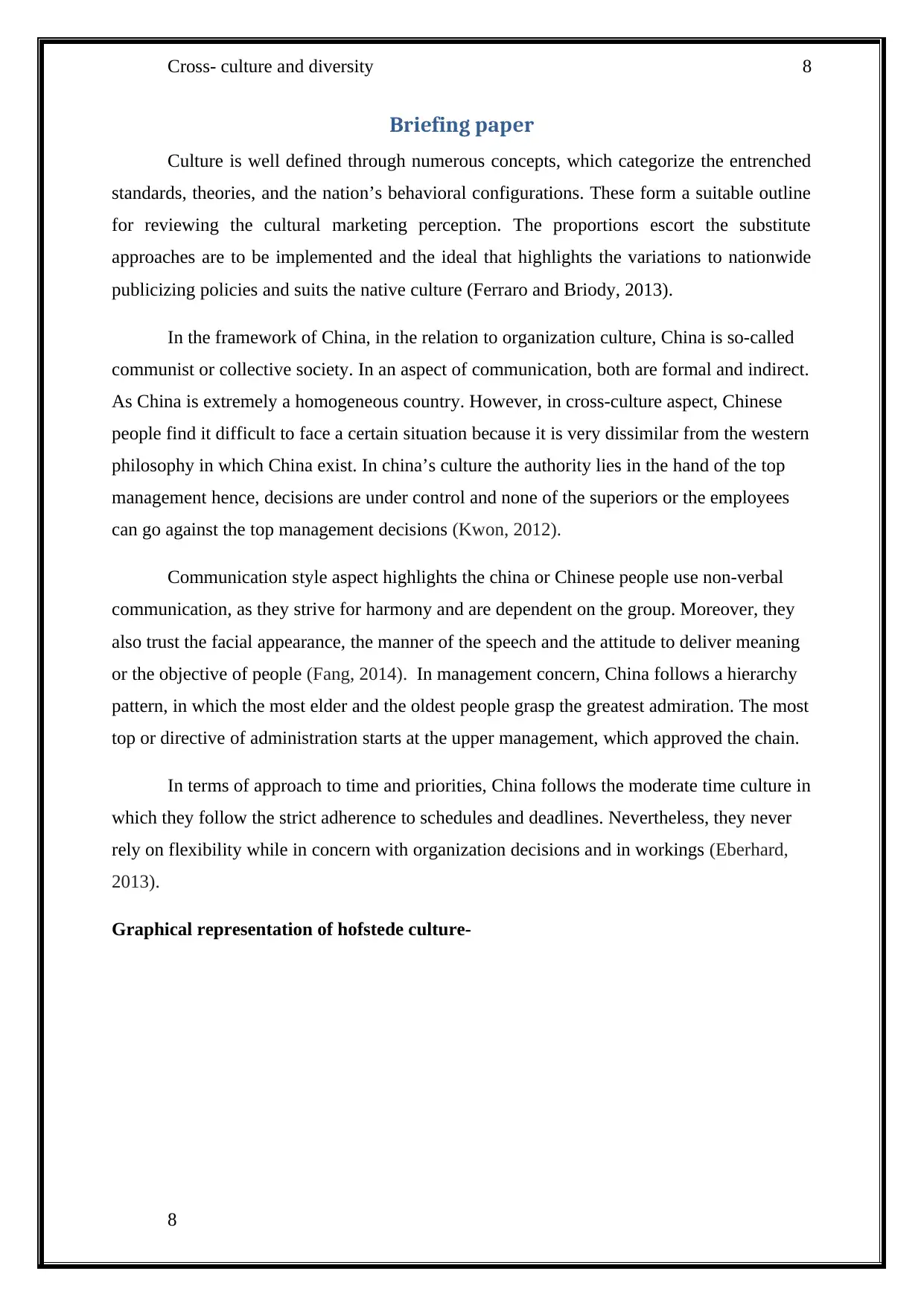
Culture is well defined through numerous concepts, which categorize the entrenched
standards, theories, and the nation’s behavioral configurations. These form a suitable outline
for reviewing the cultural marketing perception. The proportions escort the substitute
approaches are to be implemented and the ideal that highlights the variations to nationwide
publicizing policies and suits the native culture (Ferraro and Briody, 2013).
In the framework of China, in the relation to organization culture, China is so-called
communist or collective society. In an aspect of communication, both are formal and indirect.
As China is extremely a homogeneous country. However, in cross-culture aspect, Chinese
people find it difficult to face a certain situation because it is very dissimilar from the western
philosophy in which China exist. In china’s culture the authority lies in the hand of the top
management hence, decisions are under control and none of the superiors or the employees
can go against the top management decisions (Kwon, 2012).
Communication style aspect highlights the china or Chinese people use non-verbal
communication, as they strive for harmony and are dependent on the group. Moreover, they
also trust the facial appearance, the manner of the speech and the attitude to deliver meaning
or the objective of people (Fang, 2014). In management concern, China follows a hierarchy
pattern, in which the most elder and the oldest people grasp the greatest admiration. The most
top or directive of administration starts at the upper management, which approved the chain.
In terms of approach to time and priorities, China follows the moderate time culture in
which they follow the strict adherence to schedules and deadlines. Nevertheless, they never
rely on flexibility while in concern with organization decisions and in workings (Eberhard,
2013).
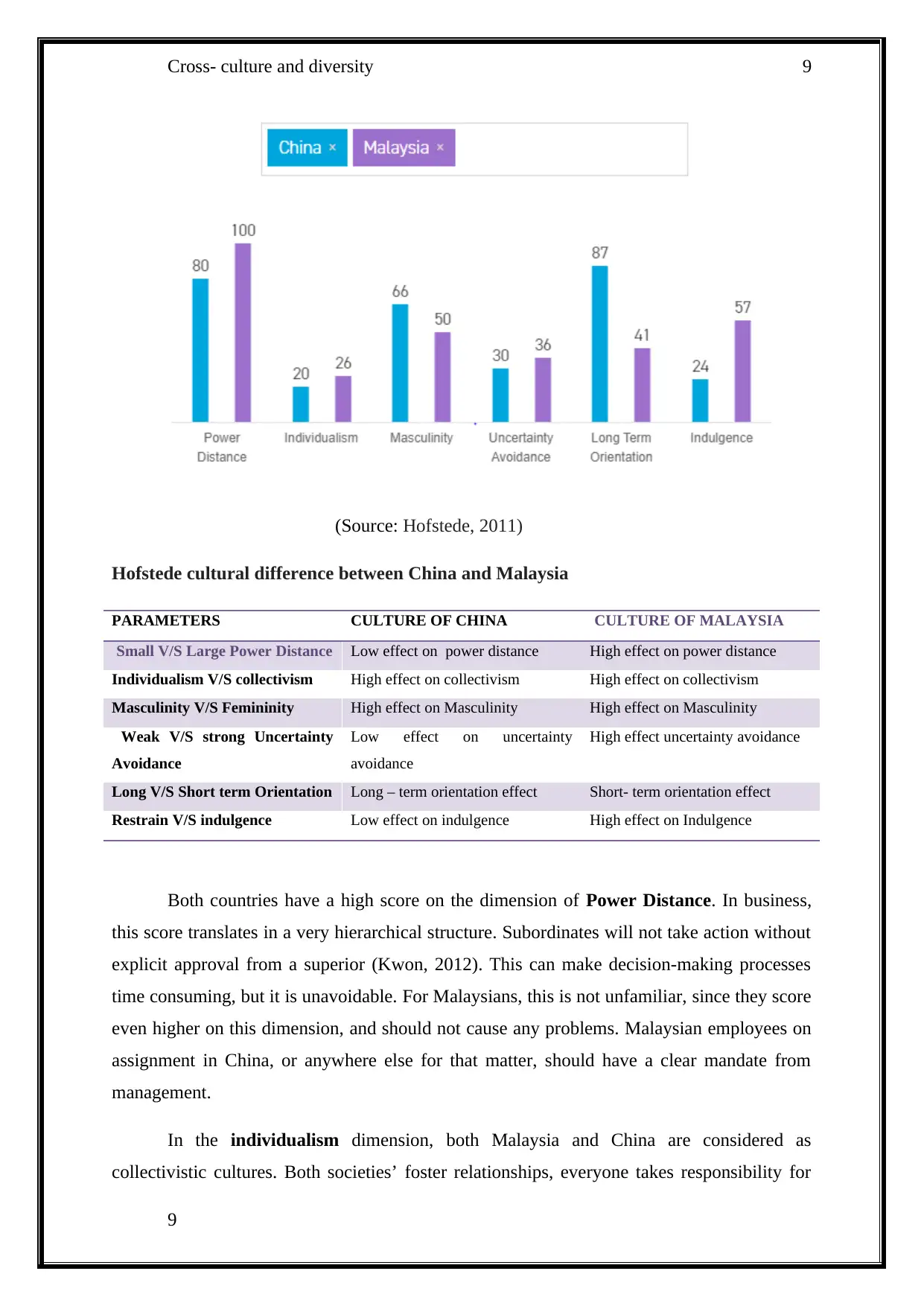
Graphical representation of hofstede culture-
8
Briefing paper
Culture is well defined through numerous concepts, which categorize the entrenched
standards, theories, and the nation’s behavioral configurations. These form a suitable outline
for reviewing the cultural marketing perception. The proportions escort the substitute
approaches are to be implemented and the ideal that highlights the variations to nationwide
publicizing policies and suits the native culture (Ferraro and Briody, 2013).
In the framework of China, in the relation to organization culture, China is so-called
communist or collective society. In an aspect of communication, both are formal and indirect.
As China is extremely a homogeneous country. However, in cross-culture aspect, Chinese
people find it difficult to face a certain situation because it is very dissimilar from the western
philosophy in which China exist. In china’s culture the authority lies in the hand of the top
management hence, decisions are under control and none of the superiors or the employees
can go against the top management decisions (Kwon, 2012).
Communication style aspect highlights the china or Chinese people use non-verbal
communication, as they strive for harmony and are dependent on the group. Moreover, they
also trust the facial appearance, the manner of the speech and the attitude to deliver meaning
or the objective of people (Fang, 2014). In management concern, China follows a hierarchy
pattern, in which the most elder and the oldest people grasp the greatest admiration. The most
top or directive of administration starts at the upper management, which approved the chain.
In terms of approach to time and priorities, China follows the moderate time culture in
which they follow the strict adherence to schedules and deadlines. Nevertheless, they never
rely on flexibility while in concern with organization decisions and in workings (Eberhard,
2013).
Graphical representation of hofstede culture-
8
⊘ This is a preview!⊘
Do you want full access?
Subscribe today to unlock all pages.
Trusted by 1+ million students worldwide
Cross- culture and diversity 9
(Source: Hofstede, 2011)
Hofstede cultural difference between China and Malaysia
PARAMETERS CULTURE OF CHINA CULTURE OF MALAYSIA
Small V/S Large Power Distance Low effect on power distance High effect on power distance
Individualism V/S collectivism High effect on collectivism High effect on collectivism
Masculinity V/S Femininity High effect on Masculinity High effect on Masculinity
Weak V/S strong Uncertainty
Avoidance
Low effect on uncertainty
avoidance
High effect uncertainty avoidance
Long V/S Short term Orientation Long – term orientation effect Short- term orientation effect
Restrain V/S indulgence Low effect on indulgence High effect on Indulgence
Both countries have a high score on the dimension of Power Distance. In business,
this score translates in a very hierarchical structure. Subordinates will not take action without
explicit approval from a superior (Kwon, 2012). This can make decision-making processes
time consuming, but it is unavoidable. For Malaysians, this is not unfamiliar, since they score
even higher on this dimension, and should not cause any problems. Malaysian employees on
assignment in China, or anywhere else for that matter, should have a clear mandate from
management.
In the individualism dimension, both Malaysia and China are considered as
collectivistic cultures. Both societies’ foster relationships, everyone takes responsibility for
9
(Source: Hofstede, 2011)
Hofstede cultural difference between China and Malaysia
PARAMETERS CULTURE OF CHINA CULTURE OF MALAYSIA
Small V/S Large Power Distance Low effect on power distance High effect on power distance
Individualism V/S collectivism High effect on collectivism High effect on collectivism
Masculinity V/S Femininity High effect on Masculinity High effect on Masculinity
Weak V/S strong Uncertainty
Avoidance
Low effect on uncertainty
avoidance
High effect uncertainty avoidance
Long V/S Short term Orientation Long – term orientation effect Short- term orientation effect
Restrain V/S indulgence Low effect on indulgence High effect on Indulgence
Both countries have a high score on the dimension of Power Distance. In business,
this score translates in a very hierarchical structure. Subordinates will not take action without
explicit approval from a superior (Kwon, 2012). This can make decision-making processes
time consuming, but it is unavoidable. For Malaysians, this is not unfamiliar, since they score
even higher on this dimension, and should not cause any problems. Malaysian employees on
assignment in China, or anywhere else for that matter, should have a clear mandate from
management.
In the individualism dimension, both Malaysia and China are considered as
collectivistic cultures. Both societies’ foster relationships, everyone takes responsibility for
9
Paraphrase This Document
Need a fresh take? Get an instant paraphrase of this document with our AI Paraphraser
Cross- culture and diversity 10
each other in the in-group (Commission global, 2019). According to Hofstede’s insight on
China, the loyalty lies with the people in the organisation, and not necessarily with the
organisation itself1. Towards outsiders, or the out-group, the Chinese might even act quite
hostile.
In the masculinity dimension, we cannot determine the position of Malaysia with its
score of 50. With a score of 66, we can definitely say that China is more masculine. As they
focus on competition, achievement, success which keeps on continuing throughout the
organizational life (Matusitz, & Musambira, 2013).
In case of uncertainty avoidance, Malaysia is higher in comparison to China that
seems to have a more relaxed attitudes and practices. A certain level of pragmatism can be
even seen in legal matters. Schedules are more flexible and lack precision and punctuality.
Even though Malaysia does not have a high score in this dimension, it might require some
adjustment from employees on assignment in China.
The next two dimensions show a bigger difference between China and Malaysia.
In the long-term orientation dimension, China scores 87 in this dimension, which
means that it is a very pragmatic culture, as we could see in the uncertainty avoidance.
Situation, context and time are the dominant drivers, and the Chinese seem to handle those
very pragmatically. They invest enormously in the future through R&D and innovation.
Malaysia on the other hand is a lot more normative. Malaysians show great respect for
traditions and seem less motivated to build towards long-term goals. This might be important
to remember, since the difference between both countries is significant.
In indulgence and restraint concern, Malaysia is high overindulgence, which
highlights that people are having a strong desire or impulse towards enjoying life and having
fun. Hence, they are having higher appreciation for leisure time and a positive attitude and a
higher tendency towards optimism in comparative to China (Yang, & Yaacob, 2012). In this
perspective, the Malaysians, who like quick wins, should be aware of the risks of not thinking
long-term. It is important to consider and understand the potential long-term interest of the
Chinese counterparts during business negotiations.
1
10
each other in the in-group (Commission global, 2019). According to Hofstede’s insight on
China, the loyalty lies with the people in the organisation, and not necessarily with the
organisation itself1. Towards outsiders, or the out-group, the Chinese might even act quite
hostile.
In the masculinity dimension, we cannot determine the position of Malaysia with its
score of 50. With a score of 66, we can definitely say that China is more masculine. As they
focus on competition, achievement, success which keeps on continuing throughout the
organizational life (Matusitz, & Musambira, 2013).
In case of uncertainty avoidance, Malaysia is higher in comparison to China that
seems to have a more relaxed attitudes and practices. A certain level of pragmatism can be
even seen in legal matters. Schedules are more flexible and lack precision and punctuality.
Even though Malaysia does not have a high score in this dimension, it might require some
adjustment from employees on assignment in China.
The next two dimensions show a bigger difference between China and Malaysia.
In the long-term orientation dimension, China scores 87 in this dimension, which
means that it is a very pragmatic culture, as we could see in the uncertainty avoidance.
Situation, context and time are the dominant drivers, and the Chinese seem to handle those
very pragmatically. They invest enormously in the future through R&D and innovation.
Malaysia on the other hand is a lot more normative. Malaysians show great respect for
traditions and seem less motivated to build towards long-term goals. This might be important
to remember, since the difference between both countries is significant.
In indulgence and restraint concern, Malaysia is high overindulgence, which
highlights that people are having a strong desire or impulse towards enjoying life and having
fun. Hence, they are having higher appreciation for leisure time and a positive attitude and a
higher tendency towards optimism in comparative to China (Yang, & Yaacob, 2012). In this
perspective, the Malaysians, who like quick wins, should be aware of the risks of not thinking
long-term. It is important to consider and understand the potential long-term interest of the
Chinese counterparts during business negotiations.
1
10
Cross- culture and diversity 11
Negotiations handling:
In the given case, a computer manufacturing company in Malaysia task is to maintain
the long term relation team members has to follow Guanxi ( maintaining a personal
relationship), and works with ethics and morals by applying Confucian element for
generating success while negotiations.
Guanxi
The importance of Guanxi highlights about the networks of personal contacts. In
general, terms it is said to be “social capital” as it is used for professional advancement. In
this, the Chinese businesspersons’ relationship among their friends, close associates are
maintained on a long time basis. On the principle of reciprocity (if a person does a favor to
another person, people out there expect a favor in return) (Leung, Chan, Lai, & Ngai, 2011).
Hence, for favors accounts are maintained and are reciprocity is done and received from
every member through their personal contact networks. Moreover, if the favors are not
returned then it gives a negative impact on the people’s future business. Hence, ignoring
reciprocity is considered as immoral (Kaynak, Wong, & Leung, 2013).
Confucianism
Confucianism is one of the form of moral ethics which majorly highlights about the
practical doctrine of interpersonal relationships, which are encompassed the perspective of
negotiation core values such as importance to be given to interpersonal relationship, moral
cultivation, family orientation, respect to be given to seniority, family orientation and
pursuance of harmony and avoidance of conflict (Xu, & Cheung, 2015). The central theme of
the Confucianism is maintaining relationships. The relationship can be any relationship
whether it's in business terms or in personal terms, which are needed to be taken care of.
Moreover, interdependence and reciprocity are the main features of Confucianism in the
context of a personal relationship. In addition, if there any failure while honoring these
characteristics leads to jeopardize the interpersonal relationship as well as mutual trust among
negotiating parties (Rivers, 2013).
China’s business communication in order to handle negotiations
While negotiating in China certain rules are regulations are set in between the
negotiator and the ultimate party members. Likewise, always there should be the
maintenance of balance and harmony while negotiating with the Chinese negotiators
(Harvard law school, 2019).
11
Negotiations handling:
In the given case, a computer manufacturing company in Malaysia task is to maintain
the long term relation team members has to follow Guanxi ( maintaining a personal
relationship), and works with ethics and morals by applying Confucian element for
generating success while negotiations.
Guanxi
The importance of Guanxi highlights about the networks of personal contacts. In
general, terms it is said to be “social capital” as it is used for professional advancement. In
this, the Chinese businesspersons’ relationship among their friends, close associates are
maintained on a long time basis. On the principle of reciprocity (if a person does a favor to
another person, people out there expect a favor in return) (Leung, Chan, Lai, & Ngai, 2011).
Hence, for favors accounts are maintained and are reciprocity is done and received from
every member through their personal contact networks. Moreover, if the favors are not
returned then it gives a negative impact on the people’s future business. Hence, ignoring
reciprocity is considered as immoral (Kaynak, Wong, & Leung, 2013).
Confucianism
Confucianism is one of the form of moral ethics which majorly highlights about the
practical doctrine of interpersonal relationships, which are encompassed the perspective of
negotiation core values such as importance to be given to interpersonal relationship, moral
cultivation, family orientation, respect to be given to seniority, family orientation and
pursuance of harmony and avoidance of conflict (Xu, & Cheung, 2015). The central theme of
the Confucianism is maintaining relationships. The relationship can be any relationship
whether it's in business terms or in personal terms, which are needed to be taken care of.
Moreover, interdependence and reciprocity are the main features of Confucianism in the
context of a personal relationship. In addition, if there any failure while honoring these
characteristics leads to jeopardize the interpersonal relationship as well as mutual trust among
negotiating parties (Rivers, 2013).
China’s business communication in order to handle negotiations
While negotiating in China certain rules are regulations are set in between the
negotiator and the ultimate party members. Likewise, always there should be the
maintenance of balance and harmony while negotiating with the Chinese negotiators
(Harvard law school, 2019).
11
⊘ This is a preview!⊘
Do you want full access?
Subscribe today to unlock all pages.
Trusted by 1+ million students worldwide

1 out of 15


Related Documents


Your All-in-One AI-Powered Toolkit for Academic Success.
+13062052269
info@desklib.com
Available 24*7 on WhatsApp / Email
![[object Object]](/_next/static/media/star-bottom.7253800d.svg)
Unlock your academic potential
Copyright © 2020–2026 A2Z Services. All Rights Reserved. Developed and managed by ZUCOL.