Cross-Cultural Marketing Analysis for Jakist's UK Expansion Report
VerifiedAdded on 2023/01/16
|10
|3484
|25
Report
AI Summary
This report presents a cross-cultural analysis focusing on Jakist, an international trading company based in Istanbul, Turkey, and its planned expansion into the UK market. It examines the cultural differences between Turkey and the UK using Hofstede's model, analyzing dimensions like power distance, individualism, uncertainty avoidance, masculinity, time orientation, and indulgence. The report further explores how social and cultural factors influence the marketing mix (product, place, price, promotion, people, process, and physical evidence) and how Jakist can adapt its strategies to effectively target UK consumers. The report also provides strategies for Jakist to successfully enter the UK market by considering consumer behavior and cultural nuances. The analysis aims to provide Jakist with insights to develop effective marketing strategies for its products and services in the UK market.
Marketing Across
Cultures CW2
Cultures CW2

Paraphrase This Document
Need a fresh take? Get an instant paraphrase of this document with our AI Paraphraser
Contents
INTRODUCTION...........................................................................................................................3
MAIN BODY...................................................................................................................................3
1) A cross-cultural analysis....................................................................................................3
Social and cultural factors and Marketing-mix......................................................................5
Market entry strategy..............................................................................................................7
CONCLUSION................................................................................................................................9
REFERENCES..............................................................................................................................10
INTRODUCTION...........................................................................................................................3
MAIN BODY...................................................................................................................................3
1) A cross-cultural analysis....................................................................................................3
Social and cultural factors and Marketing-mix......................................................................5
Market entry strategy..............................................................................................................7
CONCLUSION................................................................................................................................9
REFERENCES..............................................................................................................................10
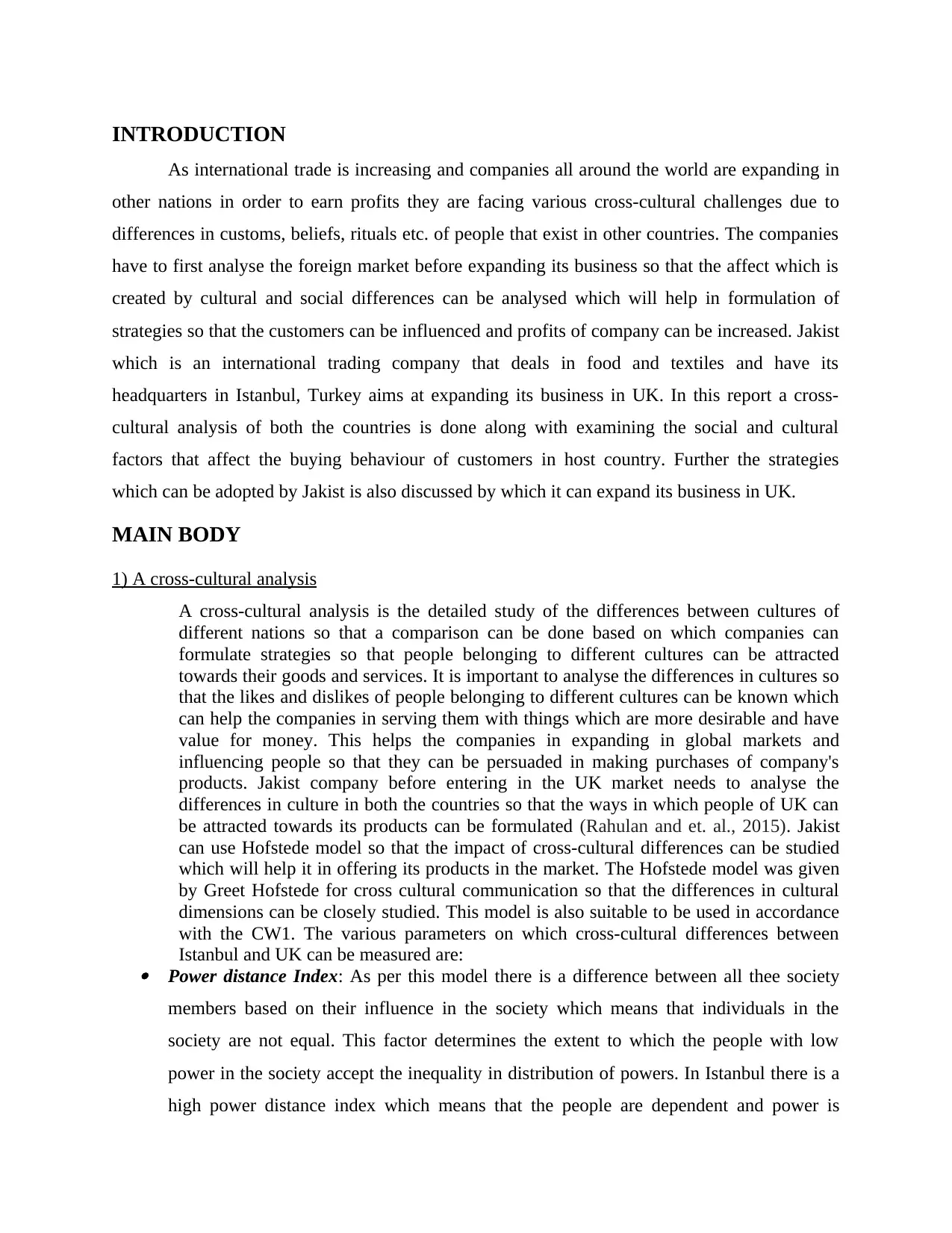
INTRODUCTION
As international trade is increasing and companies all around the world are expanding in
other nations in order to earn profits they are facing various cross-cultural challenges due to
differences in customs, beliefs, rituals etc. of people that exist in other countries. The companies
have to first analyse the foreign market before expanding its business so that the affect which is
created by cultural and social differences can be analysed which will help in formulation of
strategies so that the customers can be influenced and profits of company can be increased. Jakist
which is an international trading company that deals in food and textiles and have its
headquarters in Istanbul, Turkey aims at expanding its business in UK. In this report a cross-
cultural analysis of both the countries is done along with examining the social and cultural
factors that affect the buying behaviour of customers in host country. Further the strategies
which can be adopted by Jakist is also discussed by which it can expand its business in UK.
MAIN BODY
1) A cross-cultural analysis
A cross-cultural analysis is the detailed study of the differences between cultures of
different nations so that a comparison can be done based on which companies can
formulate strategies so that people belonging to different cultures can be attracted
towards their goods and services. It is important to analyse the differences in cultures so
that the likes and dislikes of people belonging to different cultures can be known which
can help the companies in serving them with things which are more desirable and have
value for money. This helps the companies in expanding in global markets and
influencing people so that they can be persuaded in making purchases of company's
products. Jakist company before entering in the UK market needs to analyse the
differences in culture in both the countries so that the ways in which people of UK can
be attracted towards its products can be formulated (Rahulan and et. al., 2015). Jakist
can use Hofstede model so that the impact of cross-cultural differences can be studied
which will help it in offering its products in the market. The Hofstede model was given
by Greet Hofstede for cross cultural communication so that the differences in cultural
dimensions can be closely studied. This model is also suitable to be used in accordance
with the CW1. The various parameters on which cross-cultural differences between
Istanbul and UK can be measured are:
Power distance Index: As per this model there is a difference between all thee society
members based on their influence in the society which means that individuals in the
society are not equal. This factor determines the extent to which the people with low
power in the society accept the inequality in distribution of powers. In Istanbul there is a
high power distance index which means that the people are dependent and power is
As international trade is increasing and companies all around the world are expanding in
other nations in order to earn profits they are facing various cross-cultural challenges due to
differences in customs, beliefs, rituals etc. of people that exist in other countries. The companies
have to first analyse the foreign market before expanding its business so that the affect which is
created by cultural and social differences can be analysed which will help in formulation of
strategies so that the customers can be influenced and profits of company can be increased. Jakist
which is an international trading company that deals in food and textiles and have its
headquarters in Istanbul, Turkey aims at expanding its business in UK. In this report a cross-
cultural analysis of both the countries is done along with examining the social and cultural
factors that affect the buying behaviour of customers in host country. Further the strategies
which can be adopted by Jakist is also discussed by which it can expand its business in UK.
MAIN BODY
1) A cross-cultural analysis
A cross-cultural analysis is the detailed study of the differences between cultures of
different nations so that a comparison can be done based on which companies can
formulate strategies so that people belonging to different cultures can be attracted
towards their goods and services. It is important to analyse the differences in cultures so
that the likes and dislikes of people belonging to different cultures can be known which
can help the companies in serving them with things which are more desirable and have
value for money. This helps the companies in expanding in global markets and
influencing people so that they can be persuaded in making purchases of company's
products. Jakist company before entering in the UK market needs to analyse the
differences in culture in both the countries so that the ways in which people of UK can
be attracted towards its products can be formulated (Rahulan and et. al., 2015). Jakist
can use Hofstede model so that the impact of cross-cultural differences can be studied
which will help it in offering its products in the market. The Hofstede model was given
by Greet Hofstede for cross cultural communication so that the differences in cultural
dimensions can be closely studied. This model is also suitable to be used in accordance
with the CW1. The various parameters on which cross-cultural differences between
Istanbul and UK can be measured are:
Power distance Index: As per this model there is a difference between all thee society
members based on their influence in the society which means that individuals in the
society are not equal. This factor determines the extent to which the people with low
power in the society accept the inequality in distribution of powers. In Istanbul there is a
high power distance index which means that the people are dependent and power is
⊘ This is a preview!⊘
Do you want full access?
Subscribe today to unlock all pages.

Trusted by 1+ million students worldwide
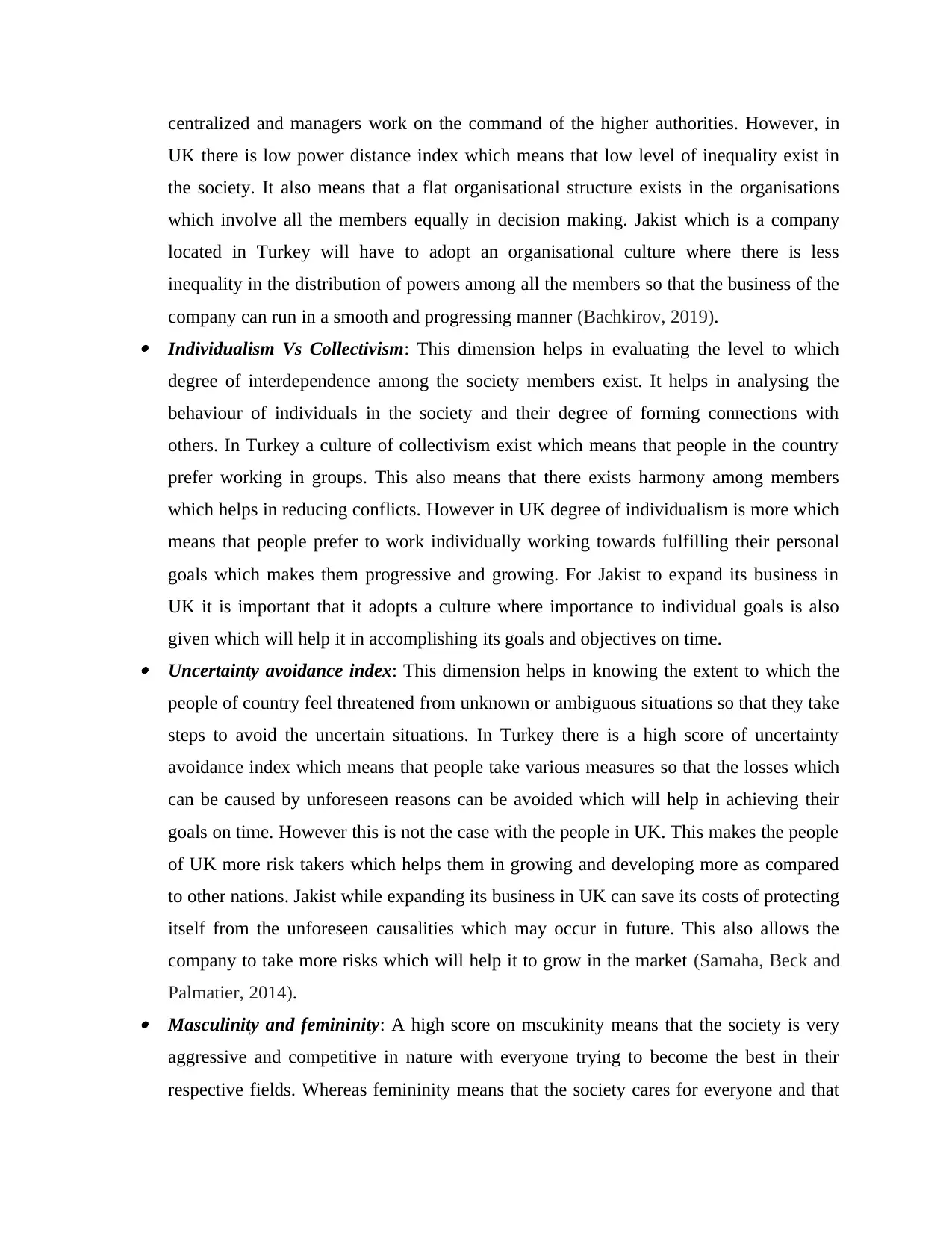
centralized and managers work on the command of the higher authorities. However, in
UK there is low power distance index which means that low level of inequality exist in
the society. It also means that a flat organisational structure exists in the organisations
which involve all the members equally in decision making. Jakist which is a company
located in Turkey will have to adopt an organisational culture where there is less
inequality in the distribution of powers among all the members so that the business of the
company can run in a smooth and progressing manner (Bachkirov, 2019). Individualism Vs Collectivism: This dimension helps in evaluating the level to which
degree of interdependence among the society members exist. It helps in analysing the
behaviour of individuals in the society and their degree of forming connections with
others. In Turkey a culture of collectivism exist which means that people in the country
prefer working in groups. This also means that there exists harmony among members
which helps in reducing conflicts. However in UK degree of individualism is more which
means that people prefer to work individually working towards fulfilling their personal
goals which makes them progressive and growing. For Jakist to expand its business in
UK it is important that it adopts a culture where importance to individual goals is also
given which will help it in accomplishing its goals and objectives on time. Uncertainty avoidance index: This dimension helps in knowing the extent to which the
people of country feel threatened from unknown or ambiguous situations so that they take
steps to avoid the uncertain situations. In Turkey there is a high score of uncertainty
avoidance index which means that people take various measures so that the losses which
can be caused by unforeseen reasons can be avoided which will help in achieving their
goals on time. However this is not the case with the people in UK. This makes the people
of UK more risk takers which helps them in growing and developing more as compared
to other nations. Jakist while expanding its business in UK can save its costs of protecting
itself from the unforeseen causalities which may occur in future. This also allows the
company to take more risks which will help it to grow in the market (Samaha, Beck and
Palmatier, 2014). Masculinity and femininity: A high score on mscukinity means that the society is very
aggressive and competitive in nature with everyone trying to become the best in their
respective fields. Whereas femininity means that the society cares for everyone and that
UK there is low power distance index which means that low level of inequality exist in
the society. It also means that a flat organisational structure exists in the organisations
which involve all the members equally in decision making. Jakist which is a company
located in Turkey will have to adopt an organisational culture where there is less
inequality in the distribution of powers among all the members so that the business of the
company can run in a smooth and progressing manner (Bachkirov, 2019). Individualism Vs Collectivism: This dimension helps in evaluating the level to which
degree of interdependence among the society members exist. It helps in analysing the
behaviour of individuals in the society and their degree of forming connections with
others. In Turkey a culture of collectivism exist which means that people in the country
prefer working in groups. This also means that there exists harmony among members
which helps in reducing conflicts. However in UK degree of individualism is more which
means that people prefer to work individually working towards fulfilling their personal
goals which makes them progressive and growing. For Jakist to expand its business in
UK it is important that it adopts a culture where importance to individual goals is also
given which will help it in accomplishing its goals and objectives on time. Uncertainty avoidance index: This dimension helps in knowing the extent to which the
people of country feel threatened from unknown or ambiguous situations so that they take
steps to avoid the uncertain situations. In Turkey there is a high score of uncertainty
avoidance index which means that people take various measures so that the losses which
can be caused by unforeseen reasons can be avoided which will help in achieving their
goals on time. However this is not the case with the people in UK. This makes the people
of UK more risk takers which helps them in growing and developing more as compared
to other nations. Jakist while expanding its business in UK can save its costs of protecting
itself from the unforeseen causalities which may occur in future. This also allows the
company to take more risks which will help it to grow in the market (Samaha, Beck and
Palmatier, 2014). Masculinity and femininity: A high score on mscukinity means that the society is very
aggressive and competitive in nature with everyone trying to become the best in their
respective fields. Whereas femininity means that the society cares for everyone and that
Paraphrase This Document
Need a fresh take? Get an instant paraphrase of this document with our AI Paraphraser
the quality of life is given more importance. Turkey has a culture which encourages
harmony, care and sympathy for others whereas in UK more importance to competition,
achievement and success is given. There is thus a cultural difference of how people
perceive their goals and aims and how they choose their paths of careers. Short Vs Long time orientation: This dimension helps in measuring the extent to which
link is maintained with the past while dealing with the present and future challenges.
Turkey has a culture of taking lessons from the past so that future situations can be dealt
based on the way in which past situations had affected the people. In UK however a
pragmatic approach is adopted in dealing with the situations which means that the people
put efforts in order to deal with any situation they face (Minkov and et. al., 2017).
Indulgence Vs Restraint: It is the extent to which people can control their desires and
impulses which is based on the way they have been raised. A weak control on the desires
means indulgence whereas a high control relates to resistance. In Turkey people are
mainly resistant which means that they try to put a control on their desires and expenses
whereas in UK people have an indulgence kind of a behaviour which means that they
spend the amount as and when they want.
Hence from the above it can be analysed that there is a difference in the cultural and social
beliefs of the two nations which must be analysed by Jakist before expanding its business in
UK so that appropriate strategies can be formulated to attract customers in UK (Eringa and
et.al., 2015).
Social and cultural factors and Marketing-mix
Marketing mix refers to the strategies and tactics which are used by the companies so that
they can effectively attract their target customers so that their goals can be timely achieved.
The marketing mix helps in promoting the products at the place, price and time so that they
can reach the right people at right time and at right place which helps in building strong
brand image of the company. Different combination of the 7Ps is used in order to influence
the customers and make them purchase their products and services. These strategies also
help the company in taking a competitive advantage in the market which can help it in
successfully establishing its unique position in the market. The difference in cultural and
social frameworks of different nations means that the company need to adopt different
strategies to determine the 7Ps which can help it in influencing the people so that purchases
harmony, care and sympathy for others whereas in UK more importance to competition,
achievement and success is given. There is thus a cultural difference of how people
perceive their goals and aims and how they choose their paths of careers. Short Vs Long time orientation: This dimension helps in measuring the extent to which
link is maintained with the past while dealing with the present and future challenges.
Turkey has a culture of taking lessons from the past so that future situations can be dealt
based on the way in which past situations had affected the people. In UK however a
pragmatic approach is adopted in dealing with the situations which means that the people
put efforts in order to deal with any situation they face (Minkov and et. al., 2017).
Indulgence Vs Restraint: It is the extent to which people can control their desires and
impulses which is based on the way they have been raised. A weak control on the desires
means indulgence whereas a high control relates to resistance. In Turkey people are
mainly resistant which means that they try to put a control on their desires and expenses
whereas in UK people have an indulgence kind of a behaviour which means that they
spend the amount as and when they want.
Hence from the above it can be analysed that there is a difference in the cultural and social
beliefs of the two nations which must be analysed by Jakist before expanding its business in
UK so that appropriate strategies can be formulated to attract customers in UK (Eringa and
et.al., 2015).
Social and cultural factors and Marketing-mix
Marketing mix refers to the strategies and tactics which are used by the companies so that
they can effectively attract their target customers so that their goals can be timely achieved.
The marketing mix helps in promoting the products at the place, price and time so that they
can reach the right people at right time and at right place which helps in building strong
brand image of the company. Different combination of the 7Ps is used in order to influence
the customers and make them purchase their products and services. These strategies also
help the company in taking a competitive advantage in the market which can help it in
successfully establishing its unique position in the market. The difference in cultural and
social frameworks of different nations means that the company need to adopt different
strategies to determine the 7Ps which can help it in influencing the people so that purchases
can be made. Jakist which is a Turkish company and wants to expand its business in UK will
face differences in the social and cultural framework of both the nations so that it can
determine its 7Ps in such a way which will help it in successfully expanding its business in
UK. The elements which are related to the marketing mix are discussed as follows:
Product: The products that are offered by Jakist are high quality woven fabrics and
food which it exports to various other nations in order to increase its sales. The
company will attract the people of UK by offering them high quality of clothes
which are stylish to wear so that all the people irrespective of their sizes, sex and age
can enjoy the comfortable clothes that the company offers. Along with this the
company also offers high quality of dried fruits like dates which are expensive and
are mainly found in Turkey (Ting-Toomey and Dorjee, 2018).
Place: The company will open various stores in various locations in UK where the
target market can be captured so that the company can offer its products to the
customers. Also the company will also use online platform in order to reach the
customers which will help it in expanding its customer base. The company can start
online applications where it can sell its clothes and food to the customers which will
help it in successfully expanding its business.
Price: The company offers exclusive woven fabrics to the customers along with high
quality of food which means that high prices will be set by the company and as the
people of UK have high purchasing power the high priced products are affordable by
the customers of UK. The premium pricing policy that can be used by the company
will help it in making a distinguished image in the market wich also helps the
company in targeting its products to the desired section of the market.
Promotion: The company will promote its products in the UK market by the way of
social media platforms, exhibitions, discounts and offers etc. so that the expansion
can be successful. The promotional strategy that is used by the company helps in
making the people aware about the prices and items which are offered by the
company which can help it in converting prospects into customers (Demangeot and
et. al., 2015).
People: The company is targeting all the people belonging to all the age groups in
offering its clothes to customers also the food offered by it is targeted to all the
face differences in the social and cultural framework of both the nations so that it can
determine its 7Ps in such a way which will help it in successfully expanding its business in
UK. The elements which are related to the marketing mix are discussed as follows:
Product: The products that are offered by Jakist are high quality woven fabrics and
food which it exports to various other nations in order to increase its sales. The
company will attract the people of UK by offering them high quality of clothes
which are stylish to wear so that all the people irrespective of their sizes, sex and age
can enjoy the comfortable clothes that the company offers. Along with this the
company also offers high quality of dried fruits like dates which are expensive and
are mainly found in Turkey (Ting-Toomey and Dorjee, 2018).
Place: The company will open various stores in various locations in UK where the
target market can be captured so that the company can offer its products to the
customers. Also the company will also use online platform in order to reach the
customers which will help it in expanding its customer base. The company can start
online applications where it can sell its clothes and food to the customers which will
help it in successfully expanding its business.
Price: The company offers exclusive woven fabrics to the customers along with high
quality of food which means that high prices will be set by the company and as the
people of UK have high purchasing power the high priced products are affordable by
the customers of UK. The premium pricing policy that can be used by the company
will help it in making a distinguished image in the market wich also helps the
company in targeting its products to the desired section of the market.
Promotion: The company will promote its products in the UK market by the way of
social media platforms, exhibitions, discounts and offers etc. so that the expansion
can be successful. The promotional strategy that is used by the company helps in
making the people aware about the prices and items which are offered by the
company which can help it in converting prospects into customers (Demangeot and
et. al., 2015).
People: The company is targeting all the people belonging to all the age groups in
offering its clothes to customers also the food offered by it is targeted to all the
⊘ This is a preview!⊘
Do you want full access?
Subscribe today to unlock all pages.
Trusted by 1+ million students worldwide
people equally. This means that all the people of UK in general are targeted. Along
with this the other people associated with company are its employees who will be
trained so that they can build long-term relations with their customers which will
help in establishing a brand image of company.
Process: The people in UK are more advanced and are more inclined towards the use
of advanced technology which means that the company needs to use high end
technology so that the people associated with the manufacture of goods of the
company can use it. This will help in increasing the efficiency of the company and
also the performance of the workers can be enhanced (De Mooij, 2015).
Physical evidence: These are the tangible aspects which tells that transaction has
taken place between the customers which can be seen through various evidences like
bills, carry bags which contains the tag or logo of the company etc. Apart from this
the building of the company, its decorations and interiors which are designed in
order to attract customers also forms the part of physical evidence.
Thus a mixture of these strategies can be used by the company before expanding its market
in the UK which will help it in increasing its profitability. Also it can help the company in
building a brand image in the global market which can help the company in becoming
famous among customers and can help it in increasing its sales.
Market entry strategy
These are the strategies which are used by the companies in order to enter into different
markets which help it in expanding its business and also increasing its sales so that the
profitability of the company gets increased. These are the various ways which can be
adopted by companies so that they can enter in the foreign markets and can attract people of
the country (Cruz García, 2018). Before expanding their business in other markets the
companies first analyse the risk associated with expansion which help it in evaluating the
profitability of investing in the expansion techniques that are adopted by the company.
These options help the company in determining the best way in which foreign market can be
captured at low costs and low risks so that high profitability can be achieved. Some of the
common methods which are used by companies are making foreign direct investments,
exporting directly into the country franchising, licensing etc. which can be chosen so that
successful expansion of the company in different market can take place. It is important that
with this the other people associated with company are its employees who will be
trained so that they can build long-term relations with their customers which will
help in establishing a brand image of company.
Process: The people in UK are more advanced and are more inclined towards the use
of advanced technology which means that the company needs to use high end
technology so that the people associated with the manufacture of goods of the
company can use it. This will help in increasing the efficiency of the company and
also the performance of the workers can be enhanced (De Mooij, 2015).
Physical evidence: These are the tangible aspects which tells that transaction has
taken place between the customers which can be seen through various evidences like
bills, carry bags which contains the tag or logo of the company etc. Apart from this
the building of the company, its decorations and interiors which are designed in
order to attract customers also forms the part of physical evidence.
Thus a mixture of these strategies can be used by the company before expanding its market
in the UK which will help it in increasing its profitability. Also it can help the company in
building a brand image in the global market which can help the company in becoming
famous among customers and can help it in increasing its sales.
Market entry strategy
These are the strategies which are used by the companies in order to enter into different
markets which help it in expanding its business and also increasing its sales so that the
profitability of the company gets increased. These are the various ways which can be
adopted by companies so that they can enter in the foreign markets and can attract people of
the country (Cruz García, 2018). Before expanding their business in other markets the
companies first analyse the risk associated with expansion which help it in evaluating the
profitability of investing in the expansion techniques that are adopted by the company.
These options help the company in determining the best way in which foreign market can be
captured at low costs and low risks so that high profitability can be achieved. Some of the
common methods which are used by companies are making foreign direct investments,
exporting directly into the country franchising, licensing etc. which can be chosen so that
successful expansion of the company in different market can take place. It is important that
Paraphrase This Document
Need a fresh take? Get an instant paraphrase of this document with our AI Paraphraser
Jakist choose the best option which is suitable for its expansion in the UK market and which
can help it in making the expansion successful. Some of the methods which can be used by
the company are as follows:
Franchising: This is the strategy of expansion in which the franchisor company
gives some of its rights to the franchisee company which can use the brand name,
resources and processes of the company so that the goods that are produced by the
original company can be produced in the host company. This is the most commonly
used method by various multinational companies which help them in taking the
advantage of the already existing market of the franchisee company and also its
awareness about the market. This can help the company in offering its products to
the target market in an efficient manner. This way the company can earn high profits
than by establishing a new business in a foreign country. Jakist can thus use this
method which can help it in easily penetrating in the already existing market.
However the drawback of using this method is that it is very lengthy process and also
require paper work so that the legal formalities can be completed and franchise can
be established (Mathur and et. al., 2018).
Acquisition: It is another method which can be used by the companies so as to enter
in a new market. In this method a company is acquired by the acquiring company by
purchasing its more than 50% of shares which helps the company in gaining the
ownership over the acquired company. This method can be used by Jakist by
acquiring a company in UK which can help it in gaining a strategic advantage in the
market. Although the advantage of this method is that the entry can become easy in
the foreign market but the disadvantage is that the method require huge investment to
acquire a company in the host country (Choi And et. al., 2018).
Partnering: This method can also be used to enter a new market wherein two or
more companies come together so that they can carry out the business in a
predetermined proportion of profits and losses so that they can work together and
earn huge amount of profits. This method can be used by Jakist by partnering with
other companies of UK which will help it in taking the advantage of utilizing the
market of partner companies thus making expansion of company in UK successful
can help it in making the expansion successful. Some of the methods which can be used by
the company are as follows:
Franchising: This is the strategy of expansion in which the franchisor company
gives some of its rights to the franchisee company which can use the brand name,
resources and processes of the company so that the goods that are produced by the
original company can be produced in the host company. This is the most commonly
used method by various multinational companies which help them in taking the
advantage of the already existing market of the franchisee company and also its
awareness about the market. This can help the company in offering its products to
the target market in an efficient manner. This way the company can earn high profits
than by establishing a new business in a foreign country. Jakist can thus use this
method which can help it in easily penetrating in the already existing market.
However the drawback of using this method is that it is very lengthy process and also
require paper work so that the legal formalities can be completed and franchise can
be established (Mathur and et. al., 2018).
Acquisition: It is another method which can be used by the companies so as to enter
in a new market. In this method a company is acquired by the acquiring company by
purchasing its more than 50% of shares which helps the company in gaining the
ownership over the acquired company. This method can be used by Jakist by
acquiring a company in UK which can help it in gaining a strategic advantage in the
market. Although the advantage of this method is that the entry can become easy in
the foreign market but the disadvantage is that the method require huge investment to
acquire a company in the host country (Choi And et. al., 2018).
Partnering: This method can also be used to enter a new market wherein two or
more companies come together so that they can carry out the business in a
predetermined proportion of profits and losses so that they can work together and
earn huge amount of profits. This method can be used by Jakist by partnering with
other companies of UK which will help it in taking the advantage of utilizing the
market of partner companies thus making expansion of company in UK successful
From the above methods it can be said that the best method which can be used by Jakist to
expand its market in UK is through franchising. This will help the company in providing the
customers of UK with the same quality of clothes and food products which will help it in
maintaining its brand image in the country. Through this strategy the processes which are
used by the company in order t manufacture its products can be used which helps in
maintaining the uniformity of the products produced by the company. Also this method will
help the company in providing its products to customers under its brand name which will
help the company in building its reputation among customers (Song, Swaminathan and
Anderson, 2015).
CONCLUSION
From the above report it can be concluded that during the expansion of business in other
nations there are various challenges which are to be faced by the company like difference in
social and cultural values, difference in beliefs etc. which affects the customer buying
behaviour. These differences must be identified by the company so that appropriate changes
can be made in the strategies which can help it in attracting customers so that the sales and
profitability of the company gets increased. Also it can be said that there are various ways in
which entry in new markets can be done like franchising, licensing, acquisition etc. The
companies must choose the most suitable methods which can help in making the expansion
of company successful.
expand its market in UK is through franchising. This will help the company in providing the
customers of UK with the same quality of clothes and food products which will help it in
maintaining its brand image in the country. Through this strategy the processes which are
used by the company in order t manufacture its products can be used which helps in
maintaining the uniformity of the products produced by the company. Also this method will
help the company in providing its products to customers under its brand name which will
help the company in building its reputation among customers (Song, Swaminathan and
Anderson, 2015).
CONCLUSION
From the above report it can be concluded that during the expansion of business in other
nations there are various challenges which are to be faced by the company like difference in
social and cultural values, difference in beliefs etc. which affects the customer buying
behaviour. These differences must be identified by the company so that appropriate changes
can be made in the strategies which can help it in attracting customers so that the sales and
profitability of the company gets increased. Also it can be said that there are various ways in
which entry in new markets can be done like franchising, licensing, acquisition etc. The
companies must choose the most suitable methods which can help in making the expansion
of company successful.
⊘ This is a preview!⊘
Do you want full access?
Subscribe today to unlock all pages.
Trusted by 1+ million students worldwide
REFERENCES
Books and Journals
Rahulan, M. and et. al., 2015. Consumer behavior of generational cohorts for compression
sportswear. Journal of Fashion Marketing and Management, 19(1), pp.87-104.
Bachkirov, A.A., 2019. Towards a better understanding of organizational buying behavior across
cultures: empirical evidence from the Arabian Gulf. Journal of Business & Industrial
Marketing.
Minkov, M. and et.al., 2017. A revision of Hofstede’s individualism-collectivism dimension: A
new national index from a 56-country study. Cross Cultural & Strategic Management.
24(3). pp.386-404.
Eringa, K. and et.al., 2015. How relevant are Hofstede’s dimensions for inter-cultural studies? A
replication of Hofstede’s research among current international business students.
Research in Hospitality Management .5(2). pp.187-198.
Ting-Toomey, S. and Dorjee, T., 2018. Communicating across cultures. Guilford Publications.
Demangeot, C. and et. al., 2015. Multicultural marketplaces: New territory for international
marketing and consumer research. International Marketing Review. 32(2). pp.118-140.
De Mooij, M., 2015. Cross-cultural research in international marketing: clearing up some of the
confusion. International Marketing Review. 32(6). pp.646-662.
Cruz García, L., 2018. Advertising across cultures, where translation is nothing... or
everything. Journal of Specialised Translation.
Mathur, A. and et. al., 2018. Global personal spirituality: Concept, measurement, and correlates
across cultures. International journal of consumer studies .42(6). pp.865-877.
Choi, Y.K. And et. al., 2018. Matching luxury brand appeals with attitude functions on social
media across cultures. Journal of Business Research.
Song, L., Swaminathan, S. and Anderson, R.E., 2015. Differences in customers’ online service
satisfaction across cultures: the role of thinking style. Journal of Marketing
Channels .22(1). pp.52-61.
Samaha, S.A., Beck, J.T. and Palmatier, R.W., 2014. The role of culture in international
relationship marketing. Journal of Marketing .78(5). pp.78-98.
Books and Journals
Rahulan, M. and et. al., 2015. Consumer behavior of generational cohorts for compression
sportswear. Journal of Fashion Marketing and Management, 19(1), pp.87-104.
Bachkirov, A.A., 2019. Towards a better understanding of organizational buying behavior across
cultures: empirical evidence from the Arabian Gulf. Journal of Business & Industrial
Marketing.
Minkov, M. and et.al., 2017. A revision of Hofstede’s individualism-collectivism dimension: A
new national index from a 56-country study. Cross Cultural & Strategic Management.
24(3). pp.386-404.
Eringa, K. and et.al., 2015. How relevant are Hofstede’s dimensions for inter-cultural studies? A
replication of Hofstede’s research among current international business students.
Research in Hospitality Management .5(2). pp.187-198.
Ting-Toomey, S. and Dorjee, T., 2018. Communicating across cultures. Guilford Publications.
Demangeot, C. and et. al., 2015. Multicultural marketplaces: New territory for international
marketing and consumer research. International Marketing Review. 32(2). pp.118-140.
De Mooij, M., 2015. Cross-cultural research in international marketing: clearing up some of the
confusion. International Marketing Review. 32(6). pp.646-662.
Cruz García, L., 2018. Advertising across cultures, where translation is nothing... or
everything. Journal of Specialised Translation.
Mathur, A. and et. al., 2018. Global personal spirituality: Concept, measurement, and correlates
across cultures. International journal of consumer studies .42(6). pp.865-877.
Choi, Y.K. And et. al., 2018. Matching luxury brand appeals with attitude functions on social
media across cultures. Journal of Business Research.
Song, L., Swaminathan, S. and Anderson, R.E., 2015. Differences in customers’ online service
satisfaction across cultures: the role of thinking style. Journal of Marketing
Channels .22(1). pp.52-61.
Samaha, S.A., Beck, J.T. and Palmatier, R.W., 2014. The role of culture in international
relationship marketing. Journal of Marketing .78(5). pp.78-98.

1 out of 10


Related Documents


Your All-in-One AI-Powered Toolkit for Academic Success.
+13062052269
info@desklib.com
Available 24*7 on WhatsApp / Email
![[object Object]](/_next/static/media/star-bottom.7253800d.svg)
Unlock your academic potential
Copyright © 2020–2025 A2Z Services. All Rights Reserved. Developed and managed by ZUCOL.