Designing a Research Project: CSR and Brand Equity in UK Retail
VerifiedAdded on 2023/06/13
|17
|3800
|483
Report
AI Summary
This report investigates the impact of Corporate Social Responsibility (CSR) on brand equity within the UK retail sector. It begins by defining CSR and brand equity, highlighting the potential for CSR to enhance brand value and awareness. The research explores different CSR models, including the Traditional Conflict Model, Added Value Model, and Multiple Goals Model. The chosen methodology employs a positivism research philosophy with a deductive approach, utilizing quantitative research methods to analyze data collected from 145 respondents in the UK retail sector. The report aims to determine the relationship between CSR practices and brand equity, testing the hypothesis that effective CSR positively influences brand equity. It also acknowledges limitations and ethical considerations inherent in the research process. Desklib provides access to this and other solved assignments.
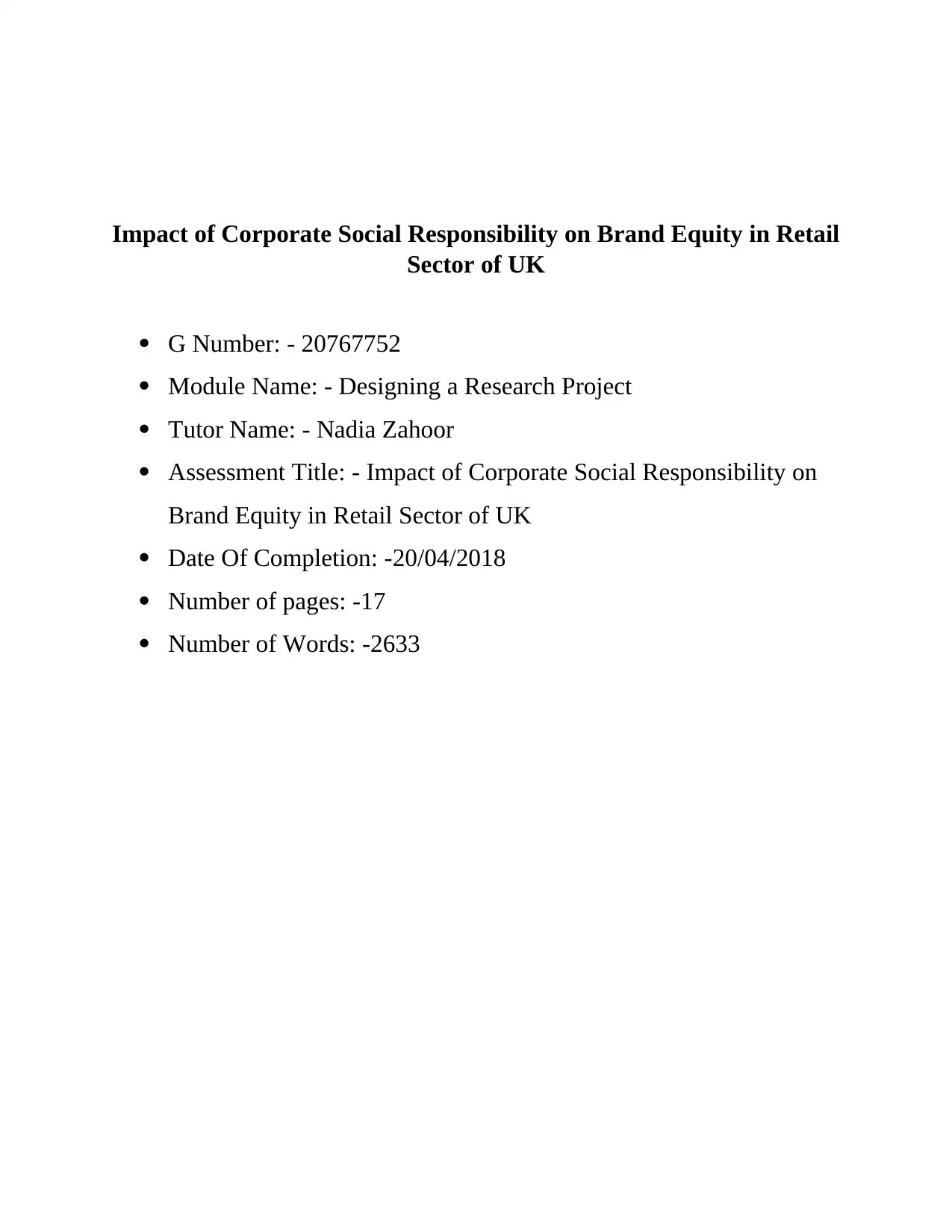
Impact of Corporate Social Responsibility on Brand Equity in Retail
Sector of UK
G Number: - 20767752
Module Name: - Designing a Research Project
Tutor Name: - Nadia Zahoor
Assessment Title: - Impact of Corporate Social Responsibility on
Brand Equity in Retail Sector of UK
Date Of Completion: -20/04/2018
Number of pages: -17
Number of Words: -2633
Sector of UK
G Number: - 20767752
Module Name: - Designing a Research Project
Tutor Name: - Nadia Zahoor
Assessment Title: - Impact of Corporate Social Responsibility on
Brand Equity in Retail Sector of UK
Date Of Completion: -20/04/2018
Number of pages: -17
Number of Words: -2633

Paraphrase This Document
Need a fresh take? Get an instant paraphrase of this document with our AI Paraphraser
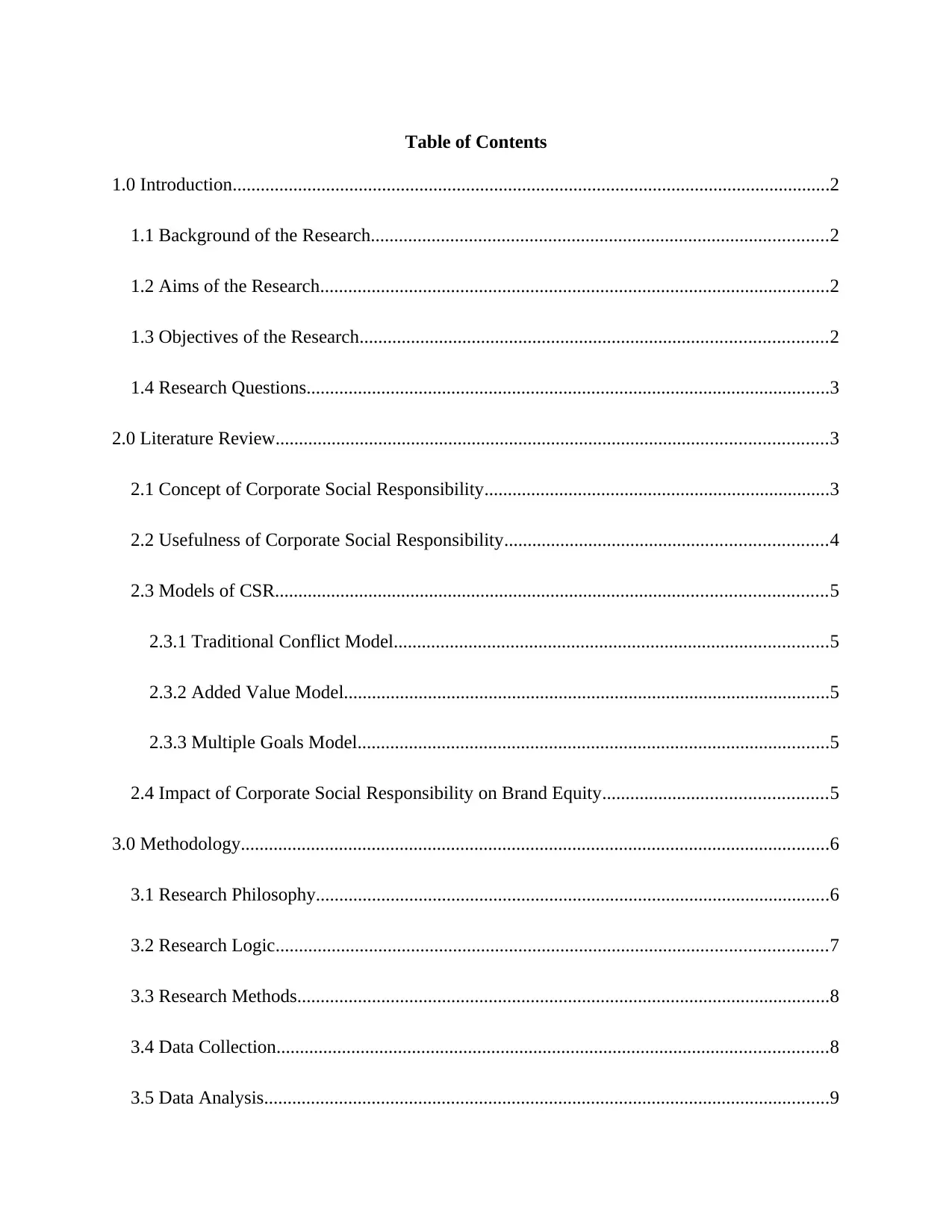
Table of Contents
1.0 Introduction................................................................................................................................2
1.1 Background of the Research..................................................................................................2
1.2 Aims of the Research.............................................................................................................2
1.3 Objectives of the Research....................................................................................................2
1.4 Research Questions................................................................................................................3
2.0 Literature Review......................................................................................................................3
2.1 Concept of Corporate Social Responsibility..........................................................................3
2.2 Usefulness of Corporate Social Responsibility.....................................................................4
2.3 Models of CSR......................................................................................................................5
2.3.1 Traditional Conflict Model.............................................................................................5
2.3.2 Added Value Model........................................................................................................5
2.3.3 Multiple Goals Model.....................................................................................................5
2.4 Impact of Corporate Social Responsibility on Brand Equity................................................5
3.0 Methodology..............................................................................................................................6
3.1 Research Philosophy..............................................................................................................6
3.2 Research Logic......................................................................................................................7
3.3 Research Methods..................................................................................................................8
3.4 Data Collection......................................................................................................................8
3.5 Data Analysis.........................................................................................................................9
1.0 Introduction................................................................................................................................2
1.1 Background of the Research..................................................................................................2
1.2 Aims of the Research.............................................................................................................2
1.3 Objectives of the Research....................................................................................................2
1.4 Research Questions................................................................................................................3
2.0 Literature Review......................................................................................................................3
2.1 Concept of Corporate Social Responsibility..........................................................................3
2.2 Usefulness of Corporate Social Responsibility.....................................................................4
2.3 Models of CSR......................................................................................................................5
2.3.1 Traditional Conflict Model.............................................................................................5
2.3.2 Added Value Model........................................................................................................5
2.3.3 Multiple Goals Model.....................................................................................................5
2.4 Impact of Corporate Social Responsibility on Brand Equity................................................5
3.0 Methodology..............................................................................................................................6
3.1 Research Philosophy..............................................................................................................6
3.2 Research Logic......................................................................................................................7
3.3 Research Methods..................................................................................................................8
3.4 Data Collection......................................................................................................................8
3.5 Data Analysis.........................................................................................................................9

3.6 Challenges and Limitations.................................................................................................10
3.7 Ethical Issues.......................................................................................................................10
4.0 Research Timetable.................................................................................................................12
References......................................................................................................................................13
3.7 Ethical Issues.......................................................................................................................10
4.0 Research Timetable.................................................................................................................12
References......................................................................................................................................13
⊘ This is a preview!⊘
Do you want full access?
Subscribe today to unlock all pages.

Trusted by 1+ million students worldwide
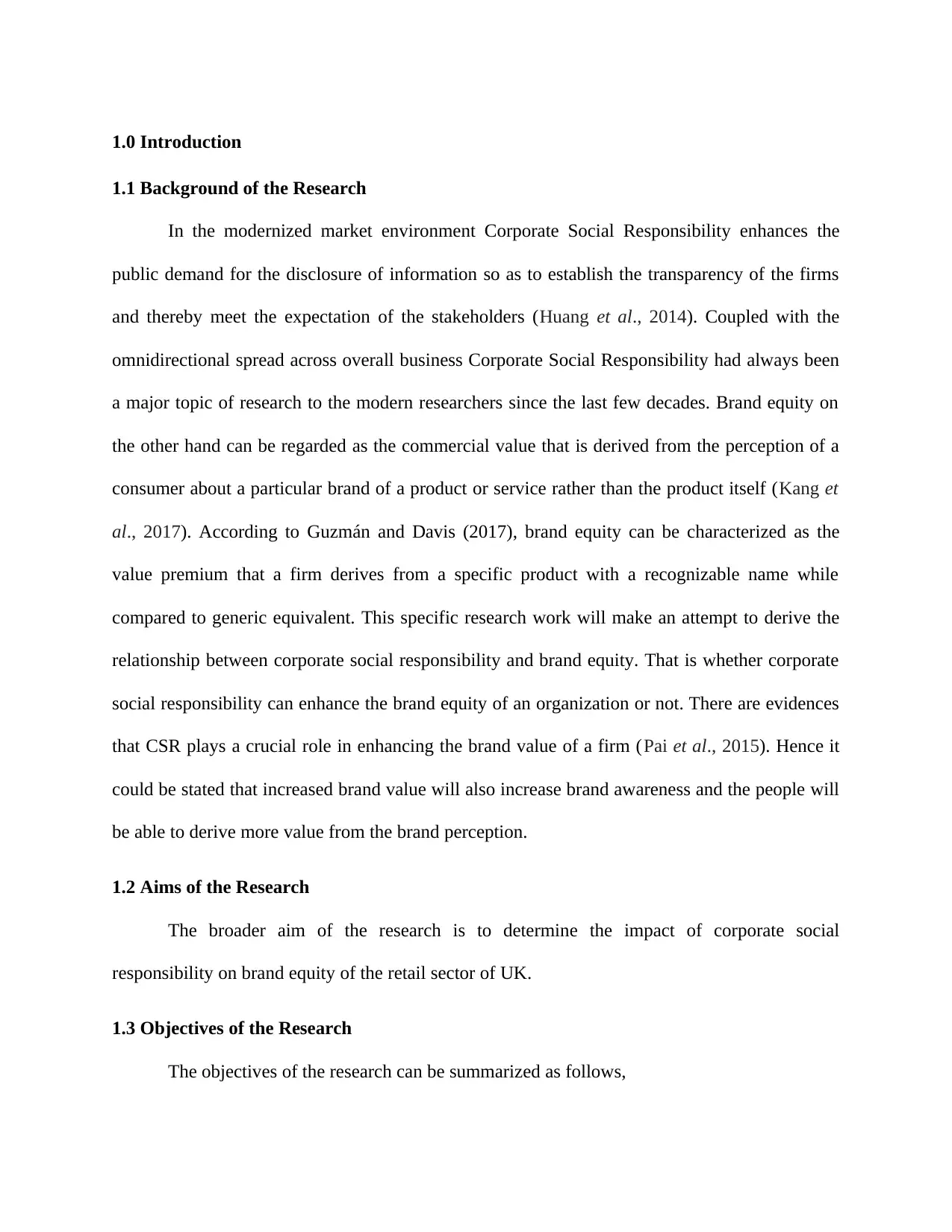
1.0 Introduction
1.1 Background of the Research
In the modernized market environment Corporate Social Responsibility enhances the
public demand for the disclosure of information so as to establish the transparency of the firms
and thereby meet the expectation of the stakeholders (Huang et al., 2014). Coupled with the
omnidirectional spread across overall business Corporate Social Responsibility had always been
a major topic of research to the modern researchers since the last few decades. Brand equity on
the other hand can be regarded as the commercial value that is derived from the perception of a
consumer about a particular brand of a product or service rather than the product itself (Kang et
al., 2017). According to Guzmán and Davis (2017), brand equity can be characterized as the
value premium that a firm derives from a specific product with a recognizable name while
compared to generic equivalent. This specific research work will make an attempt to derive the
relationship between corporate social responsibility and brand equity. That is whether corporate
social responsibility can enhance the brand equity of an organization or not. There are evidences
that CSR plays a crucial role in enhancing the brand value of a firm (Pai et al., 2015). Hence it
could be stated that increased brand value will also increase brand awareness and the people will
be able to derive more value from the brand perception.
1.2 Aims of the Research
The broader aim of the research is to determine the impact of corporate social
responsibility on brand equity of the retail sector of UK.
1.3 Objectives of the Research
The objectives of the research can be summarized as follows,
1.1 Background of the Research
In the modernized market environment Corporate Social Responsibility enhances the
public demand for the disclosure of information so as to establish the transparency of the firms
and thereby meet the expectation of the stakeholders (Huang et al., 2014). Coupled with the
omnidirectional spread across overall business Corporate Social Responsibility had always been
a major topic of research to the modern researchers since the last few decades. Brand equity on
the other hand can be regarded as the commercial value that is derived from the perception of a
consumer about a particular brand of a product or service rather than the product itself (Kang et
al., 2017). According to Guzmán and Davis (2017), brand equity can be characterized as the
value premium that a firm derives from a specific product with a recognizable name while
compared to generic equivalent. This specific research work will make an attempt to derive the
relationship between corporate social responsibility and brand equity. That is whether corporate
social responsibility can enhance the brand equity of an organization or not. There are evidences
that CSR plays a crucial role in enhancing the brand value of a firm (Pai et al., 2015). Hence it
could be stated that increased brand value will also increase brand awareness and the people will
be able to derive more value from the brand perception.
1.2 Aims of the Research
The broader aim of the research is to determine the impact of corporate social
responsibility on brand equity of the retail sector of UK.
1.3 Objectives of the Research
The objectives of the research can be summarized as follows,
Paraphrase This Document
Need a fresh take? Get an instant paraphrase of this document with our AI Paraphraser
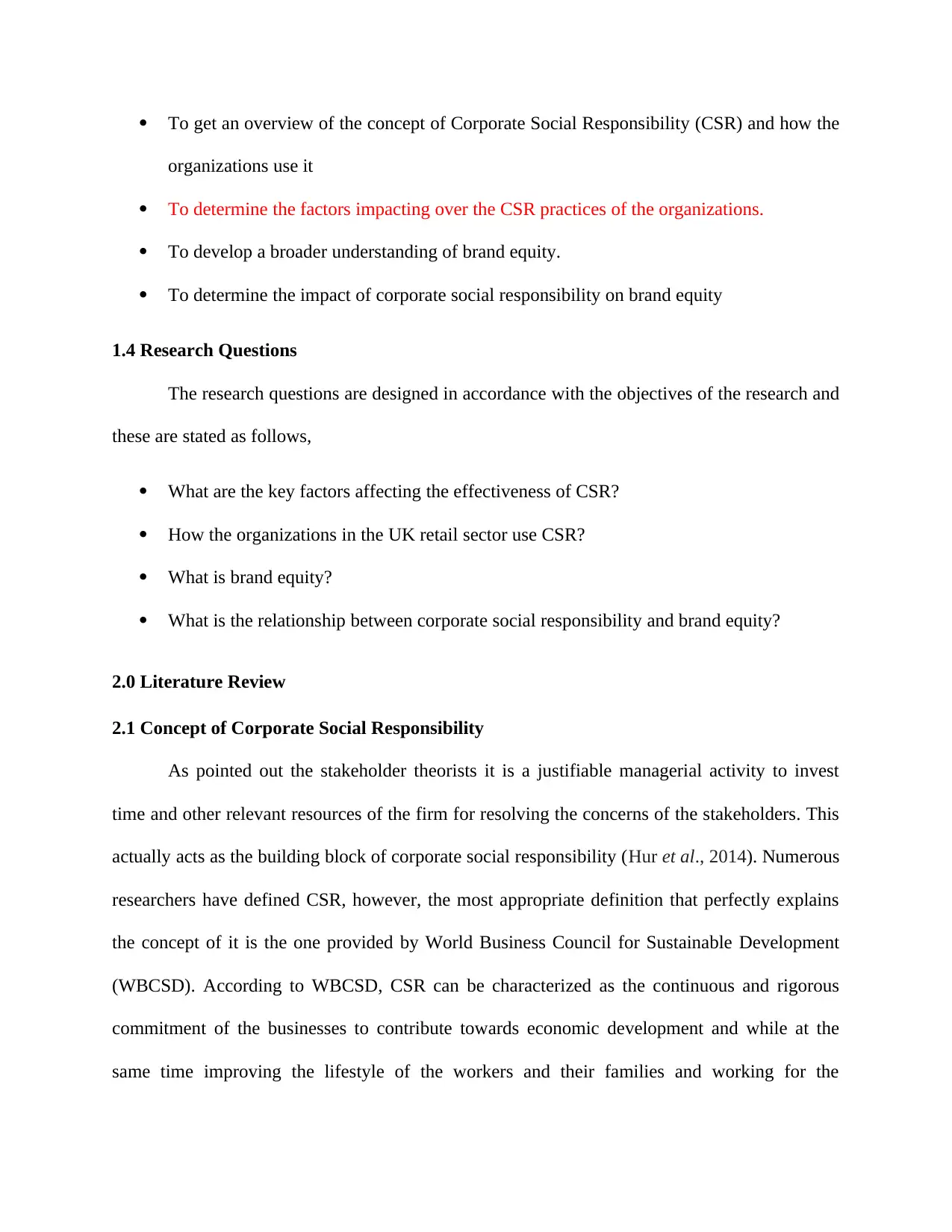
To get an overview of the concept of Corporate Social Responsibility (CSR) and how the
organizations use it
To determine the factors impacting over the CSR practices of the organizations.
To develop a broader understanding of brand equity.
To determine the impact of corporate social responsibility on brand equity
1.4 Research Questions
The research questions are designed in accordance with the objectives of the research and
these are stated as follows,
What are the key factors affecting the effectiveness of CSR?
How the organizations in the UK retail sector use CSR?
What is brand equity?
What is the relationship between corporate social responsibility and brand equity?
2.0 Literature Review
2.1 Concept of Corporate Social Responsibility
As pointed out the stakeholder theorists it is a justifiable managerial activity to invest
time and other relevant resources of the firm for resolving the concerns of the stakeholders. This
actually acts as the building block of corporate social responsibility (Hur et al., 2014). Numerous
researchers have defined CSR, however, the most appropriate definition that perfectly explains
the concept of it is the one provided by World Business Council for Sustainable Development
(WBCSD). According to WBCSD, CSR can be characterized as the continuous and rigorous
commitment of the businesses to contribute towards economic development and while at the
same time improving the lifestyle of the workers and their families and working for the
organizations use it
To determine the factors impacting over the CSR practices of the organizations.
To develop a broader understanding of brand equity.
To determine the impact of corporate social responsibility on brand equity
1.4 Research Questions
The research questions are designed in accordance with the objectives of the research and
these are stated as follows,
What are the key factors affecting the effectiveness of CSR?
How the organizations in the UK retail sector use CSR?
What is brand equity?
What is the relationship between corporate social responsibility and brand equity?
2.0 Literature Review
2.1 Concept of Corporate Social Responsibility
As pointed out the stakeholder theorists it is a justifiable managerial activity to invest
time and other relevant resources of the firm for resolving the concerns of the stakeholders. This
actually acts as the building block of corporate social responsibility (Hur et al., 2014). Numerous
researchers have defined CSR, however, the most appropriate definition that perfectly explains
the concept of it is the one provided by World Business Council for Sustainable Development
(WBCSD). According to WBCSD, CSR can be characterized as the continuous and rigorous
commitment of the businesses to contribute towards economic development and while at the
same time improving the lifestyle of the workers and their families and working for the
betterment of the society at large (Bravo et al., 2017). Generally CSR has always been
considered as either a philanthropic activity or an innovative way to achieve tax deductibility. As
defined by the Brundtland Commission corporate sustainability is that developments through
which the needs of the present generation are being mitigated but without compromising the
needs of the future generation and ensuring that they would be able to meet their own needs
(Gürhan-Canli et al., 2016).
2.2 Usefulness of Corporate Social Responsibility
Corporate social responsibility has become a standard business practice as of now for all
the organizations (Eteokleous et al., 2016). The organizations which have committed to CSR
practices have become able to enhance their overall reputation. These organizations have become
able to make a powerful statement about the purpose for which they are standing often in an
unstable business world as well.
The implementation of CSR policy which is sometimes also called as the sustainability
strategy is a quintessential component of the competitiveness of the company and it is a
component which should be led by the firm only (Singh and Verma, 2017). The implementation
of CSR provides the business with a few advantages irrespective of the size and sector of it. The
key benefits of implementing CSR can be stated as follows,
Improved brand recognition, which means increased brand awareness and higher chance
of acquiring a loyal customer base (Deng and Xu, 2017).
Betterment of the reputation of the business.
The amount of sales and customer loyalty is expected to rise.
Cost savings
The financial performance of the organization will improve (Rivera et al., 2016).
considered as either a philanthropic activity or an innovative way to achieve tax deductibility. As
defined by the Brundtland Commission corporate sustainability is that developments through
which the needs of the present generation are being mitigated but without compromising the
needs of the future generation and ensuring that they would be able to meet their own needs
(Gürhan-Canli et al., 2016).
2.2 Usefulness of Corporate Social Responsibility
Corporate social responsibility has become a standard business practice as of now for all
the organizations (Eteokleous et al., 2016). The organizations which have committed to CSR
practices have become able to enhance their overall reputation. These organizations have become
able to make a powerful statement about the purpose for which they are standing often in an
unstable business world as well.
The implementation of CSR policy which is sometimes also called as the sustainability
strategy is a quintessential component of the competitiveness of the company and it is a
component which should be led by the firm only (Singh and Verma, 2017). The implementation
of CSR provides the business with a few advantages irrespective of the size and sector of it. The
key benefits of implementing CSR can be stated as follows,
Improved brand recognition, which means increased brand awareness and higher chance
of acquiring a loyal customer base (Deng and Xu, 2017).
Betterment of the reputation of the business.
The amount of sales and customer loyalty is expected to rise.
Cost savings
The financial performance of the organization will improve (Rivera et al., 2016).
⊘ This is a preview!⊘
Do you want full access?
Subscribe today to unlock all pages.
Trusted by 1+ million students worldwide
Accessibility to the capital resources increase.
2.3 Models of CSR
2.3.1 Traditional Conflict Model
The traditional conflict model of corporate social responsibility consider that the social
values and benefits are in conflict with the profit of the shareholder. As per this model the
organizations which are opting to implement CSR would certainly consider the added cost for
conducting this activity (Cha et al., 2016). The proponents of this model argue that business is
considered among the trade-offs between moral and economic values and the managers will
certainly be compelled to choose between the fiduciary and social responsibilities.
2.3.2 Added Value Model
This model considers that the commitment of an organization towards the society or
environment as the method for increasing the profit. This model signifies that through investing
in CSR activities socially conscious customers can be attracted towards the organization and this
in turn benefits the organization (Wang et al., 2016).
2.3.3 Multiple Goals Model
The third model corporates do possess goals beyond the values of the shareholder,
incorporating the community enhancement without respect towards the monetary gain.
2.4 Impact of Corporate Social Responsibility on Brand Equity
The literature and researches associated with corporate social responsibility and brand
equity defines the corporate social responsibility as the status and activities of the company in
reference to the perceived societal obligations. As pointed out by Marín et al., (2016) the cause
related marketing process aims at increasing the total revenue of the firm as well as the annual
2.3 Models of CSR
2.3.1 Traditional Conflict Model
The traditional conflict model of corporate social responsibility consider that the social
values and benefits are in conflict with the profit of the shareholder. As per this model the
organizations which are opting to implement CSR would certainly consider the added cost for
conducting this activity (Cha et al., 2016). The proponents of this model argue that business is
considered among the trade-offs between moral and economic values and the managers will
certainly be compelled to choose between the fiduciary and social responsibilities.
2.3.2 Added Value Model
This model considers that the commitment of an organization towards the society or
environment as the method for increasing the profit. This model signifies that through investing
in CSR activities socially conscious customers can be attracted towards the organization and this
in turn benefits the organization (Wang et al., 2016).
2.3.3 Multiple Goals Model
The third model corporates do possess goals beyond the values of the shareholder,
incorporating the community enhancement without respect towards the monetary gain.
2.4 Impact of Corporate Social Responsibility on Brand Equity
The literature and researches associated with corporate social responsibility and brand
equity defines the corporate social responsibility as the status and activities of the company in
reference to the perceived societal obligations. As pointed out by Marín et al., (2016) the cause
related marketing process aims at increasing the total revenue of the firm as well as the annual
Paraphrase This Document
Need a fresh take? Get an instant paraphrase of this document with our AI Paraphraser
sales through projecting the attribute of social responsibility towards the society. On an added
notion, He and Lai (2014), mentioned the fact that maximum number of brand managers portray
the concerns of the consumers for the responsibility of the business as a tool towards protecting
the competitive advantage. On the other hand, brand equity consists of various different elements
such as perceived quality, brand loyalty, brand association and brand awareness (Magnusson et
al., 2015). The previous research work also substantiate the fact that a projecting an appropriate
responsibility towards the society and environment will enhance the brand equity.
2.5 Research Hypothesis
The research hypotheses that is the null and alternative hypothesis can be stated as follows,
Null Hypothesis: Effective CSR practices positively influences the brand equity of the retail
sector
Alternative Hypothesis: Effective CSR practices cannot positively influence the brand equity of
the retail sector
3.0 Methodology
3.1 Research Philosophy
A research work can be conducted on the basis of a number of philosophical techniques
in order to achieve the desired outcome (Lewis, 2015). The present research work is concerned
about the impact of CSR on brand equity in the retail industry of UK. Two types of philosophical
approaches can be taken into consideration, which are namely positivism and interpretivism.
The positivism approach makes use of the available data, facts and figures relevant to the
research issue. On the contrary, the interpretivism approach considers the emotional responses of
the employees or people associated with the retail sector of UK regarding the research topic. The
notion, He and Lai (2014), mentioned the fact that maximum number of brand managers portray
the concerns of the consumers for the responsibility of the business as a tool towards protecting
the competitive advantage. On the other hand, brand equity consists of various different elements
such as perceived quality, brand loyalty, brand association and brand awareness (Magnusson et
al., 2015). The previous research work also substantiate the fact that a projecting an appropriate
responsibility towards the society and environment will enhance the brand equity.
2.5 Research Hypothesis
The research hypotheses that is the null and alternative hypothesis can be stated as follows,
Null Hypothesis: Effective CSR practices positively influences the brand equity of the retail
sector
Alternative Hypothesis: Effective CSR practices cannot positively influence the brand equity of
the retail sector
3.0 Methodology
3.1 Research Philosophy
A research work can be conducted on the basis of a number of philosophical techniques
in order to achieve the desired outcome (Lewis, 2015). The present research work is concerned
about the impact of CSR on brand equity in the retail industry of UK. Two types of philosophical
approaches can be taken into consideration, which are namely positivism and interpretivism.
The positivism approach makes use of the available data, facts and figures relevant to the
research issue. On the contrary, the interpretivism approach considers the emotional responses of
the employees or people associated with the retail sector of UK regarding the research topic. The
feedback of these people can be taken into consideration and then analyzing the organizational
behavior would suffice whether the CSR impacts over the brand equity or not. This research
work will take into account a positivism philosophy of research. Both primary and secondary
data will be collected and presented with the help of graphs and charts would help to evaluate the
validity of the research hypothesis.
3.2 Research Logic
There are mainly three types of research approaches which are namely inductive,
deductive and abductive. Inductive research approach is used when there is a new theory or
concept is developed through the research work (Flick, 2015). Information can be obtained
effectively from different sources and at the same time new theories are also invented during the
research. The researcher then becomes able to deduce the idea behind the theory from the other
theories available. More appropriately, it can be stated that the inductive approach is more
concerned about developing new ideas emerging from the data. This approach is mainly used
with the qualitative research works.
Deductive approach on the other hand is used when the theories and models used in the
research in order to deduce the desired outcome of the research have previously been presented.
In this case the researcher can make use of different theories and models in order to deduce the
outcome. The theories which have been used by the researcher should be mentioned clearly in
the research work (Flick, 2015). This means that the deductive research will begin with a
predesigned hypothesis and the researcher makes use of the relevant theories and models for
substantializing the hypothesis.
The present research work will be based on deductive research approach and it will take
into account the theories and models specified by the researches and thereby give rise to a new
behavior would suffice whether the CSR impacts over the brand equity or not. This research
work will take into account a positivism philosophy of research. Both primary and secondary
data will be collected and presented with the help of graphs and charts would help to evaluate the
validity of the research hypothesis.
3.2 Research Logic
There are mainly three types of research approaches which are namely inductive,
deductive and abductive. Inductive research approach is used when there is a new theory or
concept is developed through the research work (Flick, 2015). Information can be obtained
effectively from different sources and at the same time new theories are also invented during the
research. The researcher then becomes able to deduce the idea behind the theory from the other
theories available. More appropriately, it can be stated that the inductive approach is more
concerned about developing new ideas emerging from the data. This approach is mainly used
with the qualitative research works.
Deductive approach on the other hand is used when the theories and models used in the
research in order to deduce the desired outcome of the research have previously been presented.
In this case the researcher can make use of different theories and models in order to deduce the
outcome. The theories which have been used by the researcher should be mentioned clearly in
the research work (Flick, 2015). This means that the deductive research will begin with a
predesigned hypothesis and the researcher makes use of the relevant theories and models for
substantializing the hypothesis.
The present research work will be based on deductive research approach and it will take
into account the theories and models specified by the researches and thereby give rise to a new
⊘ This is a preview!⊘
Do you want full access?
Subscribe today to unlock all pages.
Trusted by 1+ million students worldwide
notion in the genre of impact of corporate social responsibility on brand equity in the context of
the retail sector.
3.3 Research Methods
Two types of research methods are there which are qualitative research and quantitative
research. The qualitative research is another form of exploratory research. This research method
is manly used to develop an understanding about the opinions, motivations and the underlying
reasons behind the research issues (Silverman, 2016). The key advantage of this research method
is that it provides a broader insight of the research problem ad helps to develop a hypothesis
which in turn could be used for further quantitative research. Qualitative research is also used to
unveil the ideas and though process of the researchers and thereby dig deeper to the though
process.
Under the quantitative method of research problems are mainly quantified with the help
of generation of numerical data which on a later stage transformed into relevant statistics. It is
used to quantify opinions, attitude, behavior and other defined variables. Through this the results
obtained from a larger sample population can also be generalized with the help of this method
(Smith, 2015). This specific research work will use quantitative research method only.
3.4 Data Collection
In order to complete the research work mainly two types of data will be collected which
are primary data and secondary data. The primary data will be collected in the form of response
from the participants (Lewis, 2015). The research will take into consideration 145 number of
respondents who will be associated with the retail sector, 5 managers of the top five retail
companies of UK will also be interviewed to evaluate whether the research hypothesis is true or
false. The secondary data will be collected through reviewing books, journals, case studies,
the retail sector.
3.3 Research Methods
Two types of research methods are there which are qualitative research and quantitative
research. The qualitative research is another form of exploratory research. This research method
is manly used to develop an understanding about the opinions, motivations and the underlying
reasons behind the research issues (Silverman, 2016). The key advantage of this research method
is that it provides a broader insight of the research problem ad helps to develop a hypothesis
which in turn could be used for further quantitative research. Qualitative research is also used to
unveil the ideas and though process of the researchers and thereby dig deeper to the though
process.
Under the quantitative method of research problems are mainly quantified with the help
of generation of numerical data which on a later stage transformed into relevant statistics. It is
used to quantify opinions, attitude, behavior and other defined variables. Through this the results
obtained from a larger sample population can also be generalized with the help of this method
(Smith, 2015). This specific research work will use quantitative research method only.
3.4 Data Collection
In order to complete the research work mainly two types of data will be collected which
are primary data and secondary data. The primary data will be collected in the form of response
from the participants (Lewis, 2015). The research will take into consideration 145 number of
respondents who will be associated with the retail sector, 5 managers of the top five retail
companies of UK will also be interviewed to evaluate whether the research hypothesis is true or
false. The secondary data will be collected through reviewing books, journals, case studies,
Paraphrase This Document
Need a fresh take? Get an instant paraphrase of this document with our AI Paraphraser
company publications and websites. The data available from these sources which will be relevant
to the impact of CSR on brad equity. As a part of the secondary research various theories and
models available in this regard will also be studied.
The feedbacks from the end of the employees will be collected through questionnaire
survey. The employees will be provided with a relevant questionnaire where they will be
required to provide their opinion regarding the impact of CSR on brand equity. There will be
multiple choice questions and the customers will have to choose the most appropriate alternative
according to them. They will also be asked to rate different aspects of CSR or brand equity on a
scale of one to five. The key issue of collecting primary data through questionnaire survey is that
the respondents may not be willing to respond spontaneously. However, to cope with this issue
the respondents are asked for their consent to take part in the survey and after obtaining positive
response from them the questionnaires are provided to them over mail.
Simple non-probability random sampling will be used in this research work as the
number of respondents are known from the very beginning of the research.
3.5 Data Analysis
The primary data will be presented and analyzed with the help of the software like MS
Excel, SPSS and EViews. Primary representation will be done on MS Excel, the data will be
sorted and prepared for further analysis. Descriptive analytical tools will be used to obtain
significant results from the data collected. As the number of respondents is significantly high it
will be difficult collect descriptive answers from them. Multiple choice questions will provide a
brief overview about the impact of Corporate Social Responsibility on Brand equity. The
descriptive statistics analysis helps to identify the key features of the data collected through non-
probability sampling.
to the impact of CSR on brad equity. As a part of the secondary research various theories and
models available in this regard will also be studied.
The feedbacks from the end of the employees will be collected through questionnaire
survey. The employees will be provided with a relevant questionnaire where they will be
required to provide their opinion regarding the impact of CSR on brand equity. There will be
multiple choice questions and the customers will have to choose the most appropriate alternative
according to them. They will also be asked to rate different aspects of CSR or brand equity on a
scale of one to five. The key issue of collecting primary data through questionnaire survey is that
the respondents may not be willing to respond spontaneously. However, to cope with this issue
the respondents are asked for their consent to take part in the survey and after obtaining positive
response from them the questionnaires are provided to them over mail.
Simple non-probability random sampling will be used in this research work as the
number of respondents are known from the very beginning of the research.
3.5 Data Analysis
The primary data will be presented and analyzed with the help of the software like MS
Excel, SPSS and EViews. Primary representation will be done on MS Excel, the data will be
sorted and prepared for further analysis. Descriptive analytical tools will be used to obtain
significant results from the data collected. As the number of respondents is significantly high it
will be difficult collect descriptive answers from them. Multiple choice questions will provide a
brief overview about the impact of Corporate Social Responsibility on Brand equity. The
descriptive statistics analysis helps to identify the key features of the data collected through non-
probability sampling.
3.6 Challenges and Limitations
It is expected that the researcher will face a few difficulties and challenges while
conducting the research work. The first and foremost anticipated challenge that the researcher
will face will be regarding the data collection method. The respondents sometimes may feel
reluctant to respond to the questions and may not provide appropriate feedbacks. It may also be
the case that they are not getting enough time (Lewis, 2015). Getting permission for carrying out
the survey is another time-consuming process. Another important aspect of collecting the
secondary data is not all the secondary data is available over the internet. Most of the websites
used to provide limited access and paid subscriptions are required to access all the available data.
The limited financial funding poses significant threat before the researcher as primary and
secondary data collection both may be an expensive activity.
3.7 Ethical Issues
During the collection of primary and secondary data a few ethical guidelines should
certainly be maintained. The researcher should ensure that none of the participants of the primary
study were forced to provide their responses (Silverman, 2016). Moreover, they would not be
threatened to provide favorable feedbacks as well. The researcher will also ensure the fact that
the personal information of the respondents are not exposed or used for any personal or
professional purposes. The personal information have not been published directly anywhere in
the entire paper because the researcher is bound to comply with the data protection act. If there
arises a situation where the information regarding the customers are needed to be published the
researcher will certainly ask for permission from the respondents.
In the context of the secondary research the researcher will appropriately cite the works
of the previous researchers which have been utilized for the present research work. On the other
It is expected that the researcher will face a few difficulties and challenges while
conducting the research work. The first and foremost anticipated challenge that the researcher
will face will be regarding the data collection method. The respondents sometimes may feel
reluctant to respond to the questions and may not provide appropriate feedbacks. It may also be
the case that they are not getting enough time (Lewis, 2015). Getting permission for carrying out
the survey is another time-consuming process. Another important aspect of collecting the
secondary data is not all the secondary data is available over the internet. Most of the websites
used to provide limited access and paid subscriptions are required to access all the available data.
The limited financial funding poses significant threat before the researcher as primary and
secondary data collection both may be an expensive activity.
3.7 Ethical Issues
During the collection of primary and secondary data a few ethical guidelines should
certainly be maintained. The researcher should ensure that none of the participants of the primary
study were forced to provide their responses (Silverman, 2016). Moreover, they would not be
threatened to provide favorable feedbacks as well. The researcher will also ensure the fact that
the personal information of the respondents are not exposed or used for any personal or
professional purposes. The personal information have not been published directly anywhere in
the entire paper because the researcher is bound to comply with the data protection act. If there
arises a situation where the information regarding the customers are needed to be published the
researcher will certainly ask for permission from the respondents.
In the context of the secondary research the researcher will appropriately cite the works
of the previous researchers which have been utilized for the present research work. On the other
⊘ This is a preview!⊘
Do you want full access?
Subscribe today to unlock all pages.
Trusted by 1+ million students worldwide

1 out of 17


Related Documents


Your All-in-One AI-Powered Toolkit for Academic Success.
+13062052269
info@desklib.com
Available 24*7 on WhatsApp / Email
![[object Object]](/_next/static/media/star-bottom.7253800d.svg)
Unlock your academic potential
Copyright © 2020–2026 A2Z Services. All Rights Reserved. Developed and managed by ZUCOL.