Managing Successful Business: CSR Implementation for 4com
VerifiedAdded on 2020/01/23
|20
|6566
|297
Report
AI Summary
This report provides a comprehensive overview of managing a successful business, focusing on the implementation of Corporate Social Responsibility (CSR) strategies at 4com, a telecommunications company. The report outlines project aims, objectives, and timeframes, including the development of a project management plan, work breakdown structure, and Gantt chart. It details small-scale qualitative research, data collection methods, and analysis techniques, including thematic analysis. The report explores collaborative working with the local community, socially responsible investment, and environmental sustainability. It communicates recommendations based on research findings, evaluating the selection of tools and techniques and reflecting on the value gained from the project to support sustainable organizational performance. The report uses various sources, including tables and charts, to support its findings and recommendations.
MANAGING SUCCESSFUL BUSINESS
Page 1 of 22
Page 1 of 22

Paraphrase This Document
Need a fresh take? Get an instant paraphrase of this document with our AI Paraphraser
Table of content
Introduction......................................................................................................................................4
Task 1...............................................................................................................................................4
LO 1 Establishing project aims, objectives and timeframes........................................................4
P1. Devising project aims and objectives...........................................................................4
P2. Producing a project management plan..........................................................................5
P3. Producing a work breakdown structure and a Gantt chart to provide timeframes........6
M1 Producing comprehensive project management plan............................................................7
Task 2...............................................................................................................................................9
LO2 Conducting small- scale research, information gathering and data collection, generating
knowledge to support the project.................................................................................................9
P4. Carrying out small-scale research.................................................................................9
M2 Evaluation of accuracy and reliability of different research methods.................................11
Task 3.............................................................................................................................................13
LO3 Presenting the project and communicating appropriate recommendations.......................13
P5. Analysing research and data.......................................................................................13
P6. Communicating appropriate recommendations..........................................................14
M3 Evaluation of selection of tools and techniques for accuracy and authenticity to support
and justify recommendation.......................................................................................................15
Task 4.............................................................................................................................................16
LO4 Reflecting on the value gained from conducting the project and its usefulness to support
sustainable organisational performance.....................................................................................16
P7 & D2. Reflecting on the value of undertaking the research to meet stated objectives and
own learning and performance..........................................................................................16
M4 Evaluation of project management process and use of quality of research.........................17
Page 2 of 22
Introduction......................................................................................................................................4
Task 1...............................................................................................................................................4
LO 1 Establishing project aims, objectives and timeframes........................................................4
P1. Devising project aims and objectives...........................................................................4
P2. Producing a project management plan..........................................................................5
P3. Producing a work breakdown structure and a Gantt chart to provide timeframes........6
M1 Producing comprehensive project management plan............................................................7
Task 2...............................................................................................................................................9
LO2 Conducting small- scale research, information gathering and data collection, generating
knowledge to support the project.................................................................................................9
P4. Carrying out small-scale research.................................................................................9
M2 Evaluation of accuracy and reliability of different research methods.................................11
Task 3.............................................................................................................................................13
LO3 Presenting the project and communicating appropriate recommendations.......................13
P5. Analysing research and data.......................................................................................13
P6. Communicating appropriate recommendations..........................................................14
M3 Evaluation of selection of tools and techniques for accuracy and authenticity to support
and justify recommendation.......................................................................................................15
Task 4.............................................................................................................................................16
LO4 Reflecting on the value gained from conducting the project and its usefulness to support
sustainable organisational performance.....................................................................................16
P7 & D2. Reflecting on the value of undertaking the research to meet stated objectives and
own learning and performance..........................................................................................16
M4 Evaluation of project management process and use of quality of research.........................17
Page 2 of 22

References......................................................................................................................................18
Page 3 of 22
Page 3 of 22
⊘ This is a preview!⊘
Do you want full access?
Subscribe today to unlock all pages.

Trusted by 1+ million students worldwide
Introduction
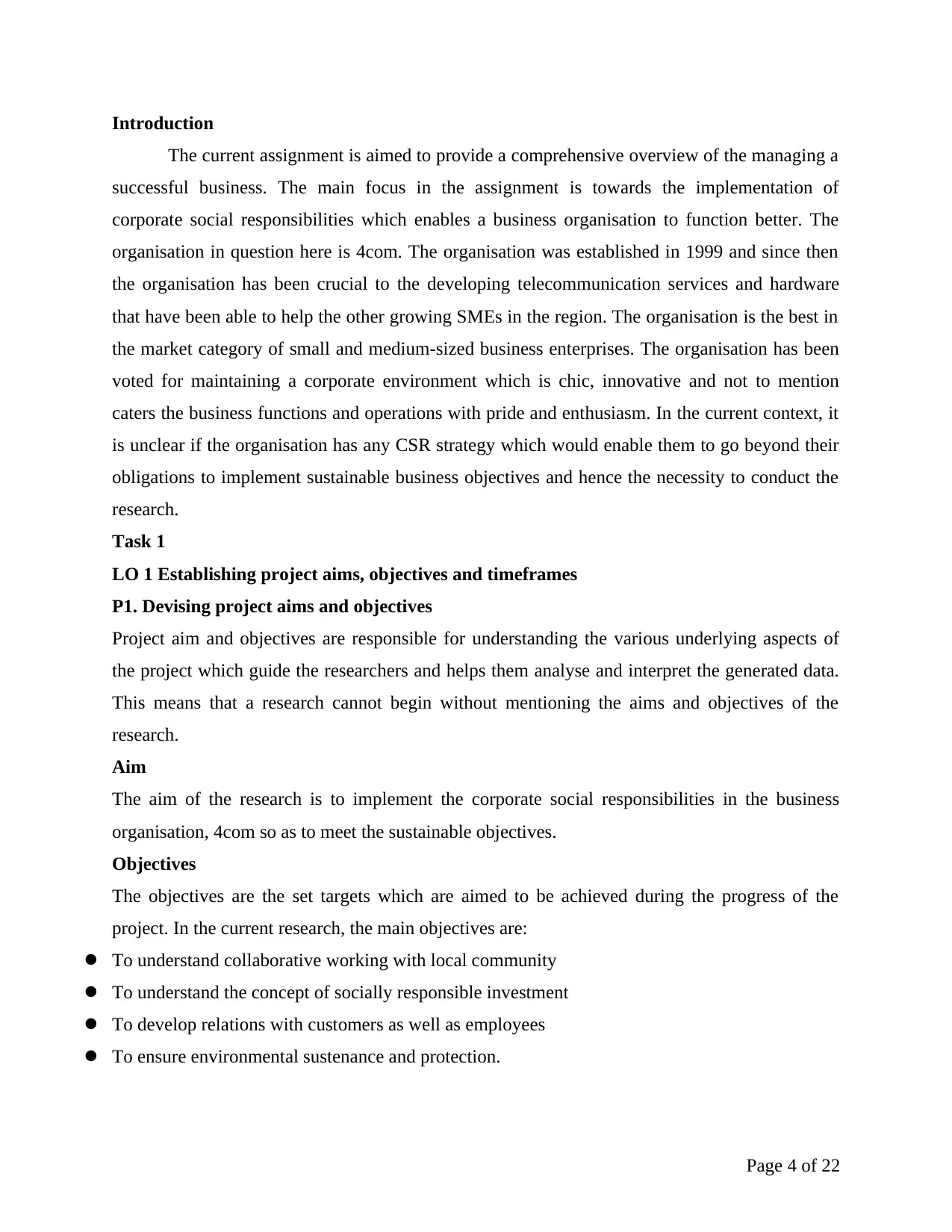
The current assignment is aimed to provide a comprehensive overview of the managing a
successful business. The main focus in the assignment is towards the implementation of
corporate social responsibilities which enables a business organisation to function better. The
organisation in question here is 4com. The organisation was established in 1999 and since then
the organisation has been crucial to the developing telecommunication services and hardware
that have been able to help the other growing SMEs in the region. The organisation is the best in
the market category of small and medium-sized business enterprises. The organisation has been
voted for maintaining a corporate environment which is chic, innovative and not to mention
caters the business functions and operations with pride and enthusiasm. In the current context, it
is unclear if the organisation has any CSR strategy which would enable them to go beyond their
obligations to implement sustainable business objectives and hence the necessity to conduct the
research.
Task 1
LO 1 Establishing project aims, objectives and timeframes
P1. Devising project aims and objectives
Project aim and objectives are responsible for understanding the various underlying aspects of
the project which guide the researchers and helps them analyse and interpret the generated data.
This means that a research cannot begin without mentioning the aims and objectives of the
research.
Aim
The aim of the research is to implement the corporate social responsibilities in the business
organisation, 4com so as to meet the sustainable objectives.
Objectives
The objectives are the set targets which are aimed to be achieved during the progress of the
project. In the current research, the main objectives are:
To understand collaborative working with local community
To understand the concept of socially responsible investment
To develop relations with customers as well as employees
To ensure environmental sustenance and protection.
Page 4 of 22
The current assignment is aimed to provide a comprehensive overview of the managing a
successful business. The main focus in the assignment is towards the implementation of
corporate social responsibilities which enables a business organisation to function better. The
organisation in question here is 4com. The organisation was established in 1999 and since then
the organisation has been crucial to the developing telecommunication services and hardware
that have been able to help the other growing SMEs in the region. The organisation is the best in
the market category of small and medium-sized business enterprises. The organisation has been
voted for maintaining a corporate environment which is chic, innovative and not to mention
caters the business functions and operations with pride and enthusiasm. In the current context, it
is unclear if the organisation has any CSR strategy which would enable them to go beyond their
obligations to implement sustainable business objectives and hence the necessity to conduct the
research.
Task 1
LO 1 Establishing project aims, objectives and timeframes
P1. Devising project aims and objectives
Project aim and objectives are responsible for understanding the various underlying aspects of
the project which guide the researchers and helps them analyse and interpret the generated data.
This means that a research cannot begin without mentioning the aims and objectives of the
research.
Aim
The aim of the research is to implement the corporate social responsibilities in the business
organisation, 4com so as to meet the sustainable objectives.
Objectives
The objectives are the set targets which are aimed to be achieved during the progress of the
project. In the current research, the main objectives are:
To understand collaborative working with local community
To understand the concept of socially responsible investment
To develop relations with customers as well as employees
To ensure environmental sustenance and protection.
Page 4 of 22
Paraphrase This Document
Need a fresh take? Get an instant paraphrase of this document with our AI Paraphraser
P2. Producing a project management plan
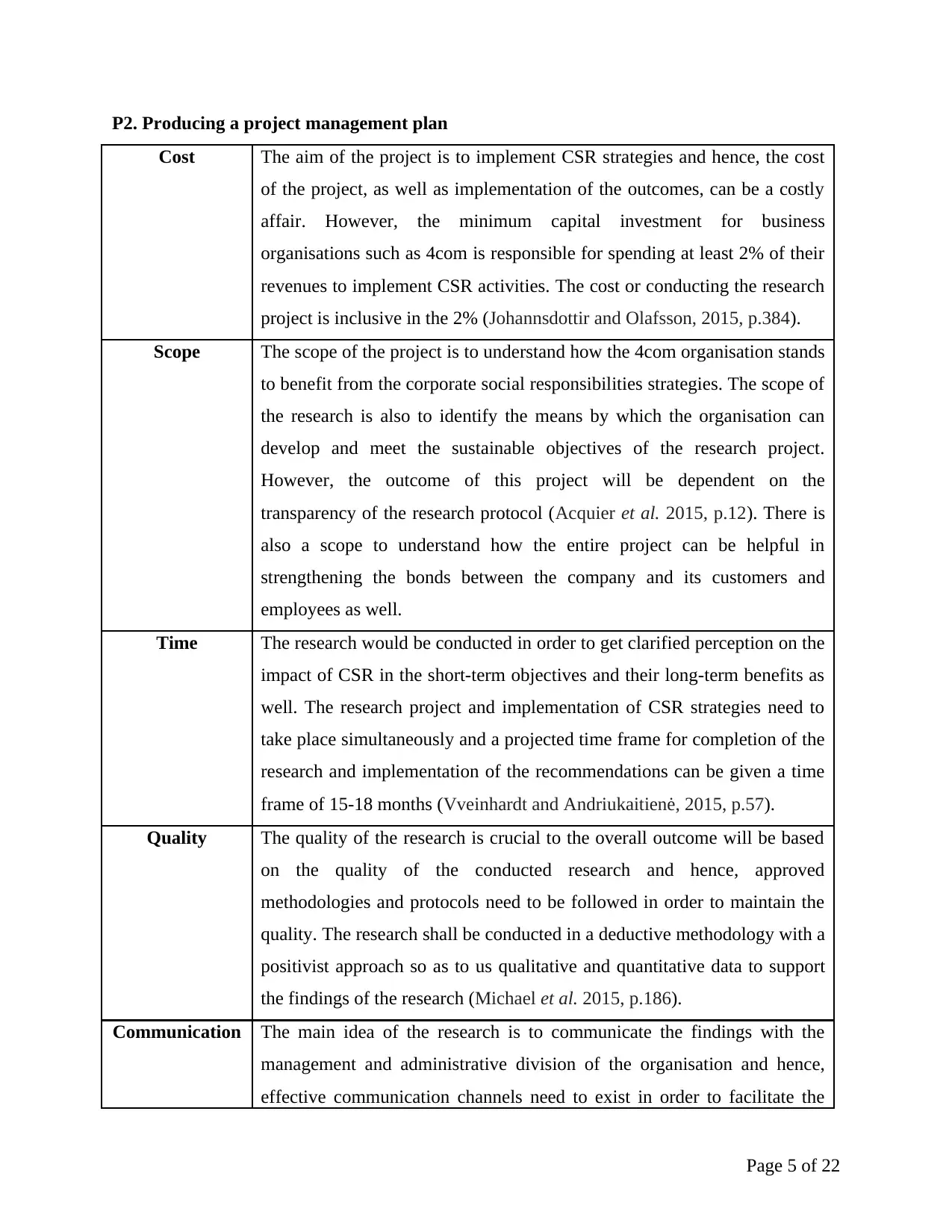
Cost The aim of the project is to implement CSR strategies and hence, the cost
of the project, as well as implementation of the outcomes, can be a costly
affair. However, the minimum capital investment for business
organisations such as 4com is responsible for spending at least 2% of their
revenues to implement CSR activities. The cost or conducting the research
project is inclusive in the 2% (Johannsdottir and Olafsson, 2015, p.384).
Scope The scope of the project is to understand how the 4com organisation stands
to benefit from the corporate social responsibilities strategies. The scope of
the research is also to identify the means by which the organisation can
develop and meet the sustainable objectives of the research project.
However, the outcome of this project will be dependent on the
transparency of the research protocol (Acquier et al. 2015, p.12). There is
also a scope to understand how the entire project can be helpful in
strengthening the bonds between the company and its customers and
employees as well.
Time The research would be conducted in order to get clarified perception on the
impact of CSR in the short-term objectives and their long-term benefits as
well. The research project and implementation of CSR strategies need to
take place simultaneously and a projected time frame for completion of the
research and implementation of the recommendations can be given a time
frame of 15-18 months (Vveinhardt and Andriukaitienė, 2015, p.57).
Quality The quality of the research is crucial to the overall outcome will be based
on the quality of the conducted research and hence, approved
methodologies and protocols need to be followed in order to maintain the
quality. The research shall be conducted in a deductive methodology with a
positivist approach so as to us qualitative and quantitative data to support
the findings of the research (Michael et al. 2015, p.186).
Communication The main idea of the research is to communicate the findings with the
management and administrative division of the organisation and hence,
effective communication channels need to exist in order to facilitate the
Page 5 of 22
Cost The aim of the project is to implement CSR strategies and hence, the cost
of the project, as well as implementation of the outcomes, can be a costly
affair. However, the minimum capital investment for business
organisations such as 4com is responsible for spending at least 2% of their
revenues to implement CSR activities. The cost or conducting the research
project is inclusive in the 2% (Johannsdottir and Olafsson, 2015, p.384).
Scope The scope of the project is to understand how the 4com organisation stands
to benefit from the corporate social responsibilities strategies. The scope of
the research is also to identify the means by which the organisation can
develop and meet the sustainable objectives of the research project.
However, the outcome of this project will be dependent on the
transparency of the research protocol (Acquier et al. 2015, p.12). There is
also a scope to understand how the entire project can be helpful in
strengthening the bonds between the company and its customers and
employees as well.
Time The research would be conducted in order to get clarified perception on the
impact of CSR in the short-term objectives and their long-term benefits as
well. The research project and implementation of CSR strategies need to
take place simultaneously and a projected time frame for completion of the
research and implementation of the recommendations can be given a time
frame of 15-18 months (Vveinhardt and Andriukaitienė, 2015, p.57).
Quality The quality of the research is crucial to the overall outcome will be based
on the quality of the conducted research and hence, approved
methodologies and protocols need to be followed in order to maintain the
quality. The research shall be conducted in a deductive methodology with a
positivist approach so as to us qualitative and quantitative data to support
the findings of the research (Michael et al. 2015, p.186).
Communication The main idea of the research is to communicate the findings with the
management and administrative division of the organisation and hence,
effective communication channels need to exist in order to facilitate the
Page 5 of 22
exchange of information and data. This free flow of information is also
crucial in the implementation phase as well (Thakur et al. 2015, p.143).
Risk The main risk of the research is a credibility issue. CSR has it owns set of
limitations which need to be taken care of. In order to collaborative
working with the various stakeholders to promote the sustainable
development. The costs are bound to increase and this impairs the
performance of the organisation. However, these strategies are negatively
impactful if the government tries to regulate the overall strategies (Gaweł
et al. 2015, p.153).
Resources The resources that are necessary to undertake the research project is the
availability of the internal and external factors which would allow the
organisation to implement CSR and analyse the barriers to them (Frolova
and Lapina, 2015, p.262).
Table 1: Project Management Plan
(Source: Moisescu, 2015, p.208)
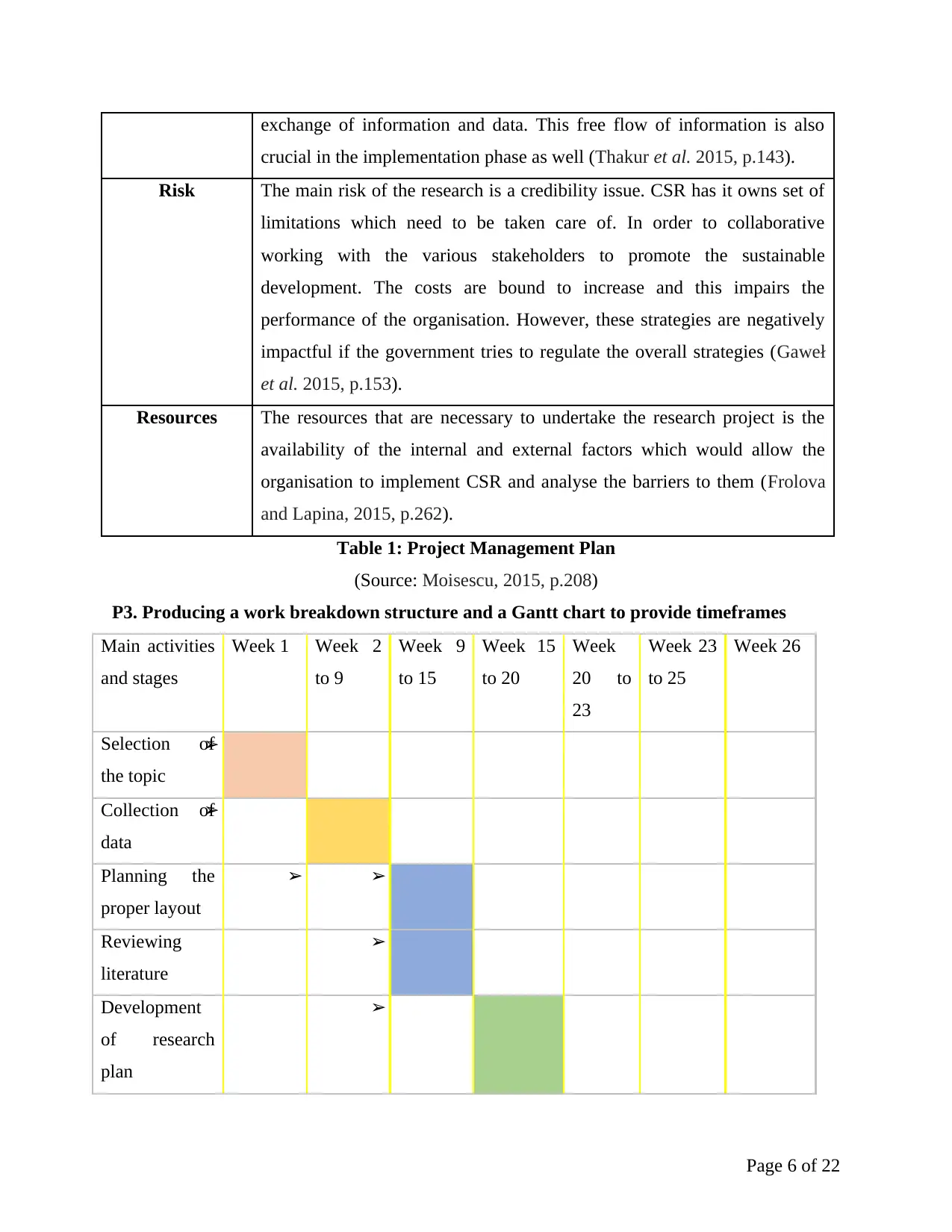
P3. Producing a work breakdown structure and a Gantt chart to provide timeframes
Main activities
and stages
Week 1 Week 2
to 9
Week 9
to 15
Week 15
to 20
Week
20 to
23
Week 23
to 25
Week 26
Selection of
the topic
➢
Collection of
data
➢
Planning the
proper layout
➢ ➢
Reviewing
literature
➢
Development
of research
plan
➢
Page 6 of 22
crucial in the implementation phase as well (Thakur et al. 2015, p.143).
Risk The main risk of the research is a credibility issue. CSR has it owns set of
limitations which need to be taken care of. In order to collaborative
working with the various stakeholders to promote the sustainable
development. The costs are bound to increase and this impairs the
performance of the organisation. However, these strategies are negatively
impactful if the government tries to regulate the overall strategies (Gaweł
et al. 2015, p.153).
Resources The resources that are necessary to undertake the research project is the
availability of the internal and external factors which would allow the
organisation to implement CSR and analyse the barriers to them (Frolova
and Lapina, 2015, p.262).
Table 1: Project Management Plan
(Source: Moisescu, 2015, p.208)
P3. Producing a work breakdown structure and a Gantt chart to provide timeframes
Main activities
and stages
Week 1 Week 2
to 9
Week 9
to 15
Week 15
to 20
Week
20 to
23
Week 23
to 25
Week 26
Selection of
the topic
➢
Collection of
data
➢
Planning the
proper layout
➢ ➢
Reviewing
literature
➢
Development
of research
plan
➢
Page 6 of 22
⊘ This is a preview!⊘
Do you want full access?
Subscribe today to unlock all pages.
Trusted by 1+ million students worldwide
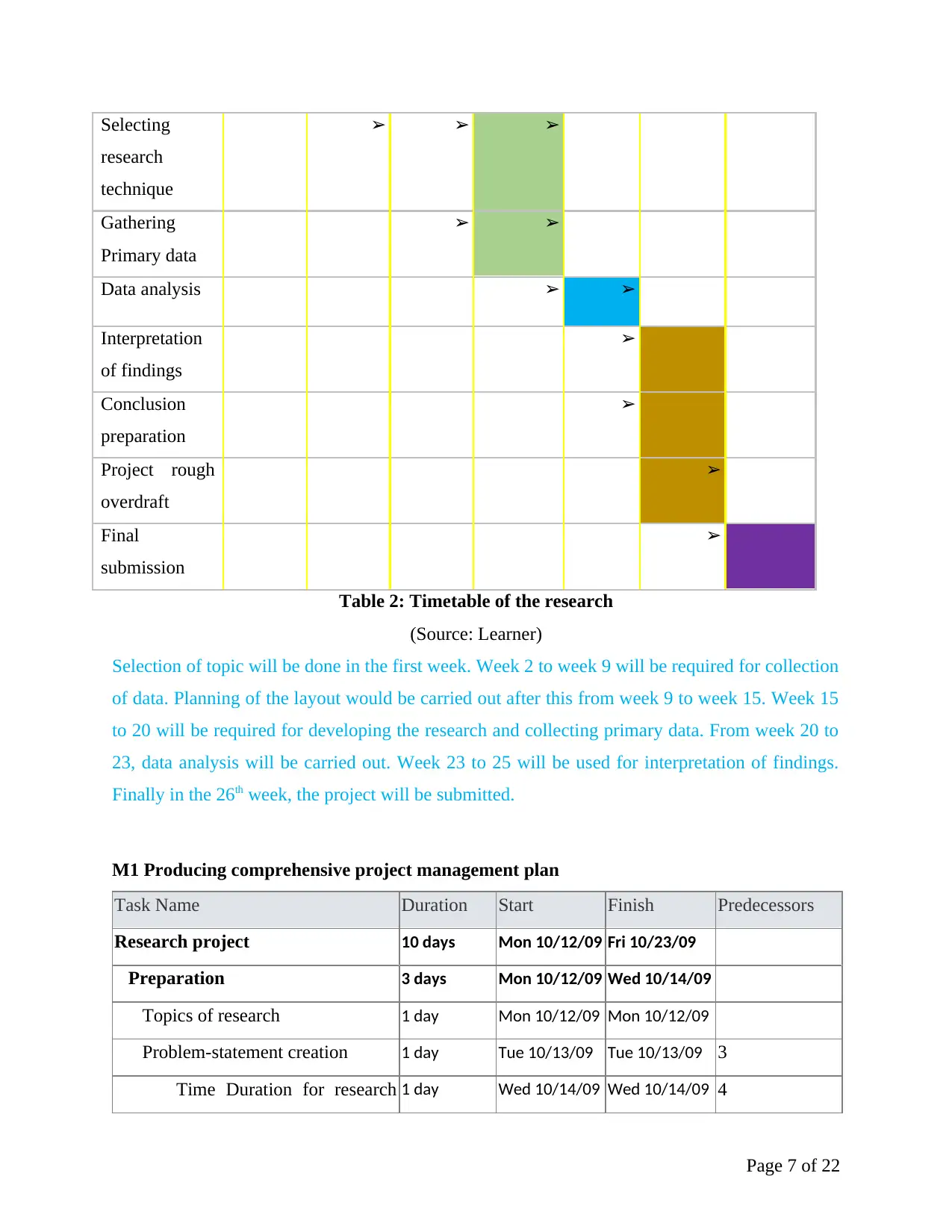
Selecting
research
technique
➢ ➢ ➢
Gathering
Primary data
➢ ➢
Data analysis ➢ ➢
Interpretation
of findings
➢
Conclusion
preparation
➢
Project rough
overdraft
➢
Final
submission
➢
Table 2: Timetable of the research
(Source: Learner)
Selection of topic will be done in the first week. Week 2 to week 9 will be required for collection
of data. Planning of the layout would be carried out after this from week 9 to week 15. Week 15
to 20 will be required for developing the research and collecting primary data. From week 20 to
23, data analysis will be carried out. Week 23 to 25 will be used for interpretation of findings.
Finally in the 26th week, the project will be submitted.
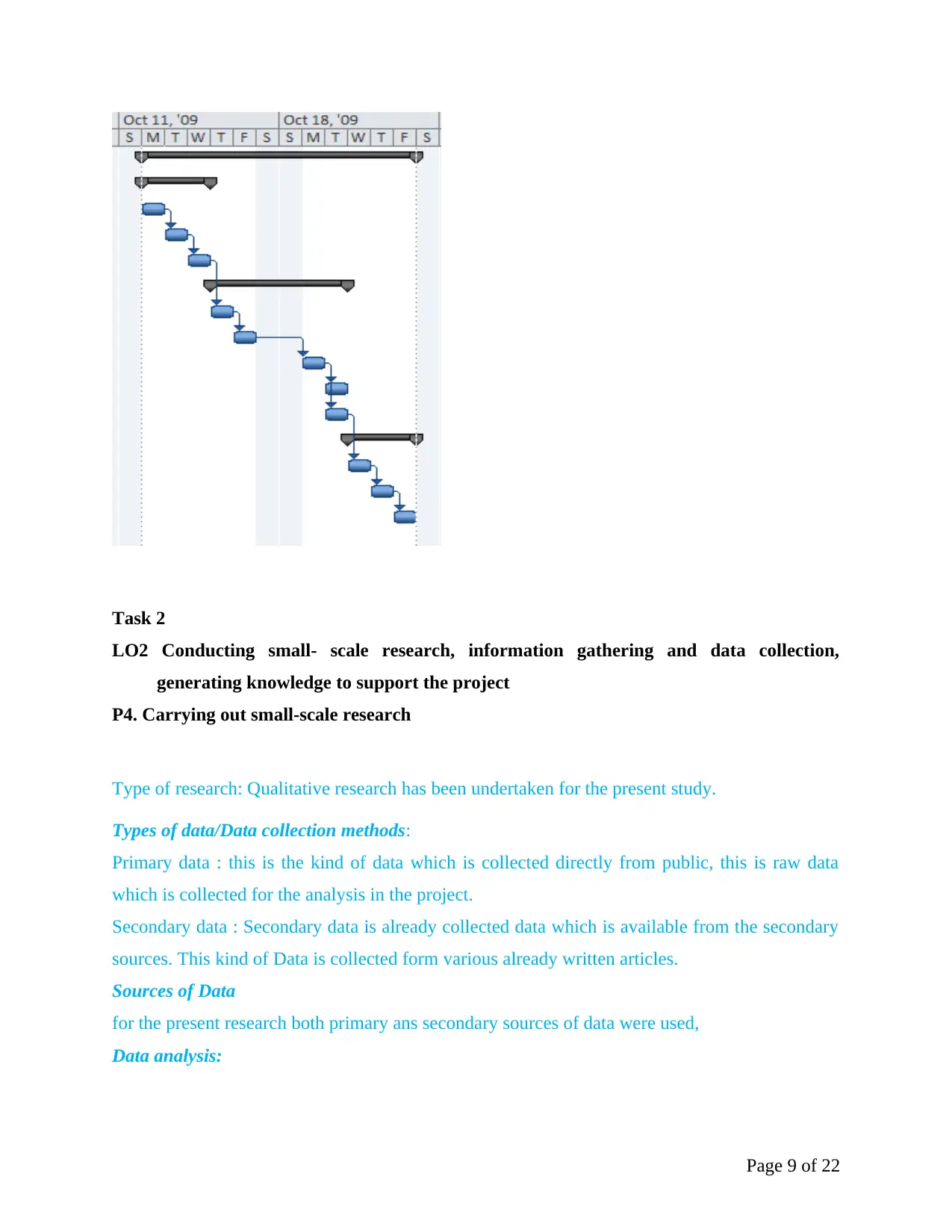
M1 Producing comprehensive project management plan
Task Name Duration Start Finish Predecessors
Research project 10 days Mon 10/12/09 Fri 10/23/09
Preparation 3 days Mon 10/12/09 Wed 10/14/09
Topics of research 1 day Mon 10/12/09 Mon 10/12/09
Problem-statement creation 1 day Tue 10/13/09 Tue 10/13/09 3
Time Duration for research 1 day Wed 10/14/09 Wed 10/14/09 4
Page 7 of 22
research
technique
➢ ➢ ➢
Gathering
Primary data
➢ ➢
Data analysis ➢ ➢
Interpretation
of findings
➢
Conclusion
preparation
➢
Project rough
overdraft
➢
Final
submission
➢
Table 2: Timetable of the research
(Source: Learner)
Selection of topic will be done in the first week. Week 2 to week 9 will be required for collection
of data. Planning of the layout would be carried out after this from week 9 to week 15. Week 15
to 20 will be required for developing the research and collecting primary data. From week 20 to
23, data analysis will be carried out. Week 23 to 25 will be used for interpretation of findings.
Finally in the 26th week, the project will be submitted.
M1 Producing comprehensive project management plan
Task Name Duration Start Finish Predecessors
Research project 10 days Mon 10/12/09 Fri 10/23/09
Preparation 3 days Mon 10/12/09 Wed 10/14/09
Topics of research 1 day Mon 10/12/09 Mon 10/12/09
Problem-statement creation 1 day Tue 10/13/09 Tue 10/13/09 3
Time Duration for research 1 day Wed 10/14/09 Wed 10/14/09 4
Page 7 of 22
Paraphrase This Document
Need a fresh take? Get an instant paraphrase of this document with our AI Paraphraser
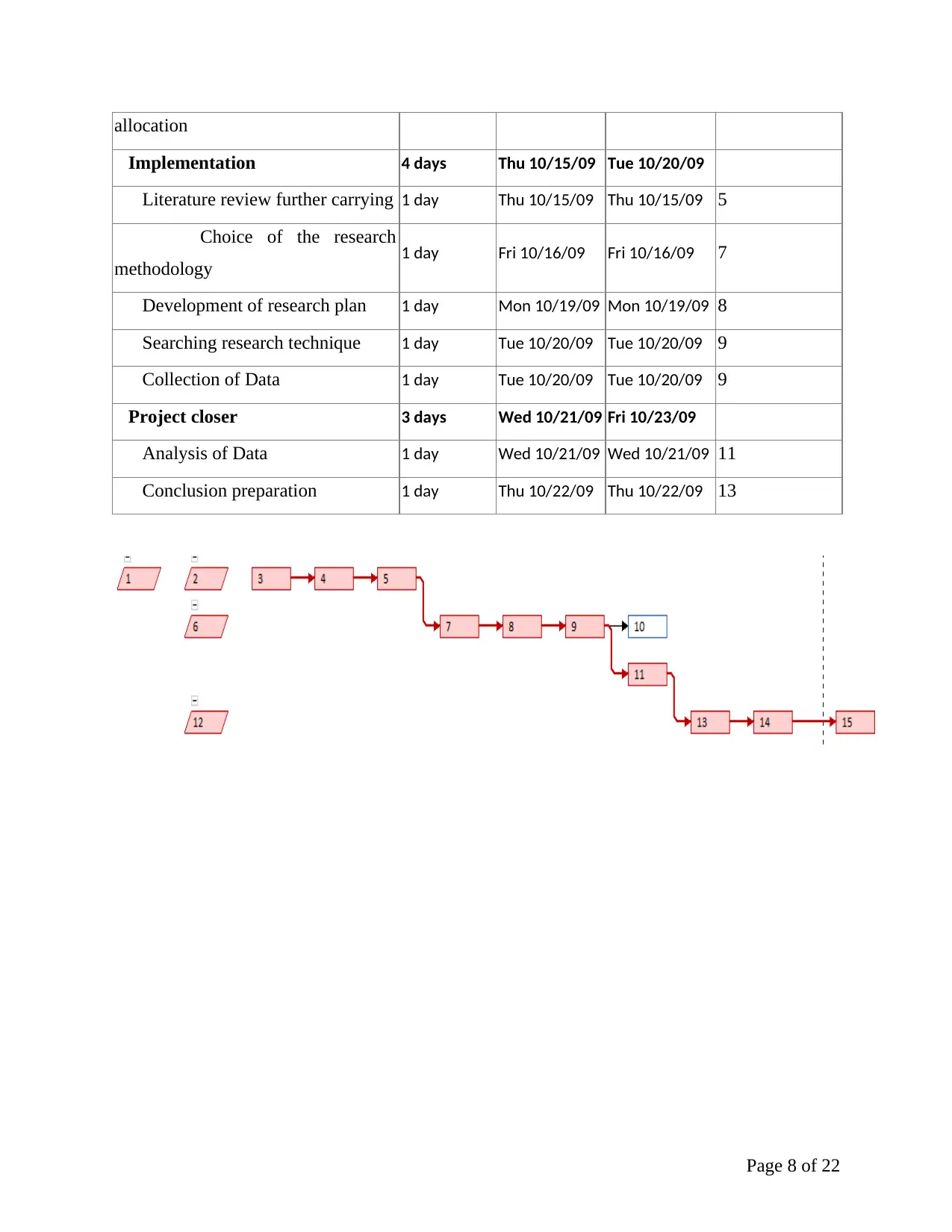
allocation
Implementation 4 days Thu 10/15/09 Tue 10/20/09
Literature review further carrying 1 day Thu 10/15/09 Thu 10/15/09 5
Choice of the research
methodology 1 day Fri 10/16/09 Fri 10/16/09 7
Development of research plan 1 day Mon 10/19/09 Mon 10/19/09 8
Searching research technique 1 day Tue 10/20/09 Tue 10/20/09 9
Collection of Data 1 day Tue 10/20/09 Tue 10/20/09 9
Project closer 3 days Wed 10/21/09 Fri 10/23/09
Analysis of Data 1 day Wed 10/21/09 Wed 10/21/09 11
Conclusion preparation 1 day Thu 10/22/09 Thu 10/22/09 13
Page 8 of 22
Implementation 4 days Thu 10/15/09 Tue 10/20/09
Literature review further carrying 1 day Thu 10/15/09 Thu 10/15/09 5
Choice of the research
methodology 1 day Fri 10/16/09 Fri 10/16/09 7
Development of research plan 1 day Mon 10/19/09 Mon 10/19/09 8
Searching research technique 1 day Tue 10/20/09 Tue 10/20/09 9
Collection of Data 1 day Tue 10/20/09 Tue 10/20/09 9
Project closer 3 days Wed 10/21/09 Fri 10/23/09
Analysis of Data 1 day Wed 10/21/09 Wed 10/21/09 11
Conclusion preparation 1 day Thu 10/22/09 Thu 10/22/09 13
Page 8 of 22
Task 2
LO2 Conducting small- scale research, information gathering and data collection,
generating knowledge to support the project
P4. Carrying out small-scale research
Type of research: Qualitative research has been undertaken for the present study.
Types of data/Data collection methods:
Primary data : this is the kind of data which is collected directly from public, this is raw data
which is collected for the analysis in the project.
Secondary data : Secondary data is already collected data which is available from the secondary
sources. This kind of Data is collected form various already written articles.
Sources of Data
for the present research both primary ans secondary sources of data were used,
Data analysis:
Page 9 of 22
LO2 Conducting small- scale research, information gathering and data collection,
generating knowledge to support the project
P4. Carrying out small-scale research
Type of research: Qualitative research has been undertaken for the present study.
Types of data/Data collection methods:
Primary data : this is the kind of data which is collected directly from public, this is raw data
which is collected for the analysis in the project.
Secondary data : Secondary data is already collected data which is available from the secondary
sources. This kind of Data is collected form various already written articles.
Sources of Data
for the present research both primary ans secondary sources of data were used,
Data analysis:
Page 9 of 22
⊘ This is a preview!⊘
Do you want full access?
Subscribe today to unlock all pages.
Trusted by 1+ million students worldwide
Data analysis was carried out by using qualitative analysis. Thematic technique was used for
analysing the data.
Qualitative research
Collaborative working with public
CSR is known to bring out the best behaviour of the organisation. The 4com understands that the
perception of the society directly affects the overall image of the organisation and hence the need
and requirement to collaborate with the society can is recommended. These organisations know
the positive impact of a well-established brand image and value which is why they find it easy to
adapt strategies and investments in order to meet the expectations of the public. However, these
business organisations are perceived largely as the cruel corporate organisation who do not
understand the need of the society (Lam and Lim, 2016, p.278). When business organisations
take initiatives to work along with public in order to resolve societal issues of health, hygiene,
sanitations etcetera, it is responsible for driving home a positive image of the organisation in the
mind of the society and this leads to increasing brand value and brand loyalty which is the main
reason of why the organisation decided to collaborate with the society in the first place.
According to de Oliveira and Jabbour (2017, p.132), considering the variety of activities that can
be undertaken by the organisation depending on the scenario and circumstances, working in
collaboration with the society is a positive step forward to implement the Corporate Social
Responsibilities strategy.
Socially responsible investment
There have been instances when the investment made by the organisation wishes to create a rift
in the society and this means that organisation needs to understand the importance of building
the society and not destroying it. While organisations who identify the divide and rule policy can
be tried as criminal organisations in the court of law and can be heavily penalised if they threaten
to harm the peacefulness of the society. However, according to Christensen et al. (2014, p.168),
companies who understand that every component of the market and business are just people and
the only way to ensure growth is to maintain the safety and rights of the people. The society is a
collective of such individuals and thus, the right of the society can also not be violated in order to
garner revenue. For example, if the organisation 4com gets interested in acquiring new lands
which are part of the forest, the investment by the organisation to cut down the trees can generate
Page 10 of 22
analysing the data.
Qualitative research
Collaborative working with public
CSR is known to bring out the best behaviour of the organisation. The 4com understands that the
perception of the society directly affects the overall image of the organisation and hence the need
and requirement to collaborate with the society can is recommended. These organisations know
the positive impact of a well-established brand image and value which is why they find it easy to
adapt strategies and investments in order to meet the expectations of the public. However, these
business organisations are perceived largely as the cruel corporate organisation who do not
understand the need of the society (Lam and Lim, 2016, p.278). When business organisations
take initiatives to work along with public in order to resolve societal issues of health, hygiene,
sanitations etcetera, it is responsible for driving home a positive image of the organisation in the
mind of the society and this leads to increasing brand value and brand loyalty which is the main
reason of why the organisation decided to collaborate with the society in the first place.
According to de Oliveira and Jabbour (2017, p.132), considering the variety of activities that can
be undertaken by the organisation depending on the scenario and circumstances, working in
collaboration with the society is a positive step forward to implement the Corporate Social
Responsibilities strategy.
Socially responsible investment
There have been instances when the investment made by the organisation wishes to create a rift
in the society and this means that organisation needs to understand the importance of building
the society and not destroying it. While organisations who identify the divide and rule policy can
be tried as criminal organisations in the court of law and can be heavily penalised if they threaten
to harm the peacefulness of the society. However, according to Christensen et al. (2014, p.168),
companies who understand that every component of the market and business are just people and
the only way to ensure growth is to maintain the safety and rights of the people. The society is a
collective of such individuals and thus, the right of the society can also not be violated in order to
garner revenue. For example, if the organisation 4com gets interested in acquiring new lands
which are part of the forest, the investment by the organisation to cut down the trees can generate
Page 10 of 22
Paraphrase This Document
Need a fresh take? Get an instant paraphrase of this document with our AI Paraphraser
a lot of negativity surrounding the organisation which makes them much more prone to liabilities
and business disasters. The customers start losing the confidence and as they turn away from the
company, the organisation will start losing its market share which will lead it to collapse
(Herrera, 2015, p.1472).
Environmental sustenance and protection
The growing effect of corporations and industries is well felt around the world and this means
that environment has become a key factor that needs to be taken into consideration while
formulating tactics and strategies. The organisations such as 4com understand the growing
ecological concern among the customers and citizens of the world and this means that whatever
strategies they undertake should ensure a green sustenance which aims to protect the
environment (Bhardwaj, 2016, p.458). Quite contrary to the beliefs that corporations do not
consider their negative effects on the society, it should be understood that unlike the global
bureaucratic controlling organisations, small and medium-sized industries also have a role to
play in order to ensure the safety of the world and thus, more and more of these kinds of
organisations have taken up ways to become more efficient and put even lesser burden on the
society and nature. In words of Awan and Akhtar (2014, p.72), organisations such as 4com
understand the human emotions and this enables them to take measures to ensure that whatever
actions and decisions are taken up by the organisation helps in protecting the environment and
not degrade it.
Quantitative research
(The following questions were asked to the head or operations, marketing and the CEO of the
company in order to get their insights into the matter of CSR)
Q1. How do the programmes undertaken by 4com affect the CSR?
CEO: CSR is a necessity that has been understood by the board of directors running 4com. We
have understood that the way we chose to work and live decides our ability to survive. The
initiatives by 4com such as planting saplings or visiting the older community living in the care of
professionals help us to form a bond with nature and community and this means we would be
able to take influence a lot of people and change their perception towards the company.
Operations Head: The operations is such a department where you cannot simply focus on green
earth, clean earth. We are responsible for developing and producing products which are required
by the individuals for satisfying their daily needs and this means that even though we are trying
Page 11 of 22
and business disasters. The customers start losing the confidence and as they turn away from the
company, the organisation will start losing its market share which will lead it to collapse
(Herrera, 2015, p.1472).
Environmental sustenance and protection
The growing effect of corporations and industries is well felt around the world and this means
that environment has become a key factor that needs to be taken into consideration while
formulating tactics and strategies. The organisations such as 4com understand the growing
ecological concern among the customers and citizens of the world and this means that whatever
strategies they undertake should ensure a green sustenance which aims to protect the
environment (Bhardwaj, 2016, p.458). Quite contrary to the beliefs that corporations do not
consider their negative effects on the society, it should be understood that unlike the global
bureaucratic controlling organisations, small and medium-sized industries also have a role to
play in order to ensure the safety of the world and thus, more and more of these kinds of
organisations have taken up ways to become more efficient and put even lesser burden on the
society and nature. In words of Awan and Akhtar (2014, p.72), organisations such as 4com
understand the human emotions and this enables them to take measures to ensure that whatever
actions and decisions are taken up by the organisation helps in protecting the environment and
not degrade it.
Quantitative research
(The following questions were asked to the head or operations, marketing and the CEO of the
company in order to get their insights into the matter of CSR)
Q1. How do the programmes undertaken by 4com affect the CSR?
CEO: CSR is a necessity that has been understood by the board of directors running 4com. We
have understood that the way we chose to work and live decides our ability to survive. The
initiatives by 4com such as planting saplings or visiting the older community living in the care of
professionals help us to form a bond with nature and community and this means we would be
able to take influence a lot of people and change their perception towards the company.
Operations Head: The operations is such a department where you cannot simply focus on green
earth, clean earth. We are responsible for developing and producing products which are required
by the individuals for satisfying their daily needs and this means that even though we are trying
Page 11 of 22
to effectively set up sustainable practices, it is not a joke to implement in the operations present
within the organisation. This means that the apart from being time-consuming, their effects
cannot be observed right away which in turn represents the unworthiness of performing activities
which waste valuable time.
Marketing head: CSR allows us to reach a wide community of people who have to begin to
realise that their home, the earth is being destroyed and the way the product is produced can be
able to make a significant disadvantage for selling the products. Thus, an effective marketing
strategy needs to identify the buttons that require being pushed in order to understand how the
activities in relation to CSR have an impact on the demands of the people.
Q2. How does CSR affect 4com?
CEO: As the CEO of the company it is of primary importance that the CSR strategies be
implemented in the organisation. Implementing CSR helps in providing a sense of sustainable
organisational function which is required to maintain these moral and ethical obligations of the
organisation. However, there are some induced costs which to be frankly are not very effective in
dealing with sustenance.
Operations head: The cost of the production process rises in order to maintain the ethical
regulations and this means lowering profits of the organisation. The role of the operation head is
to minimise the use and release of toxic materials, whose alternative can be quite pricey and any
rise in the product will result of the under-researched facts of CSR.
Marketing head: Implementing CSR means that the organisation has been able to attract the
customers. This leads to increase in brand image and value which is one the very requirement for
which CSR is implemented.
M2 Evaluation of accuracy and reliability of different research methods
1. Quantitative Method: In terms of accuracy quantitative method of research succeed in
determining the factors which are related to CSR activities of 4com incorporations. All
the entities of management describe the effectiveness of these activities in appropriate
ways. The cost was accurately estimated by operation head which implies that this
method of research was accurate. In terms of reliability all the information was consistent
and related to CSR activities of 4com. Affect of these activities were analysed in
quantitative research. Thus, it is directly related to the validity of research.
Page 12 of 22
within the organisation. This means that the apart from being time-consuming, their effects
cannot be observed right away which in turn represents the unworthiness of performing activities
which waste valuable time.
Marketing head: CSR allows us to reach a wide community of people who have to begin to
realise that their home, the earth is being destroyed and the way the product is produced can be
able to make a significant disadvantage for selling the products. Thus, an effective marketing
strategy needs to identify the buttons that require being pushed in order to understand how the
activities in relation to CSR have an impact on the demands of the people.
Q2. How does CSR affect 4com?
CEO: As the CEO of the company it is of primary importance that the CSR strategies be
implemented in the organisation. Implementing CSR helps in providing a sense of sustainable
organisational function which is required to maintain these moral and ethical obligations of the
organisation. However, there are some induced costs which to be frankly are not very effective in
dealing with sustenance.
Operations head: The cost of the production process rises in order to maintain the ethical
regulations and this means lowering profits of the organisation. The role of the operation head is
to minimise the use and release of toxic materials, whose alternative can be quite pricey and any
rise in the product will result of the under-researched facts of CSR.
Marketing head: Implementing CSR means that the organisation has been able to attract the
customers. This leads to increase in brand image and value which is one the very requirement for
which CSR is implemented.
M2 Evaluation of accuracy and reliability of different research methods
1. Quantitative Method: In terms of accuracy quantitative method of research succeed in
determining the factors which are related to CSR activities of 4com incorporations. All
the entities of management describe the effectiveness of these activities in appropriate
ways. The cost was accurately estimated by operation head which implies that this
method of research was accurate. In terms of reliability all the information was consistent
and related to CSR activities of 4com. Affect of these activities were analysed in
quantitative research. Thus, it is directly related to the validity of research.
Page 12 of 22
⊘ This is a preview!⊘
Do you want full access?
Subscribe today to unlock all pages.
Trusted by 1+ million students worldwide

1 out of 20


Related Documents


Your All-in-One AI-Powered Toolkit for Academic Success.
+13062052269
info@desklib.com
Available 24*7 on WhatsApp / Email
![[object Object]](/_next/static/media/star-bottom.7253800d.svg)
Unlock your academic potential
Copyright © 2020–2026 A2Z Services. All Rights Reserved. Developed and managed by ZUCOL.