Stakeholder Influence on CSR, Reputation, and Performance Analysis
VerifiedAdded on 2022/09/08
|29
|17055
|16
Report
AI Summary
This report analyzes a study that investigates the influence of stakeholders on corporate social responsibility (CSR) initiatives and their subsequent impact on corporate reputation and business performance. The research, conducted through a mail survey of senior managers in Australian businesses, identifies employees and the public as key influential stakeholders in CSR decision-making. It reveals a positive relationship between CSR and reputation, which in turn affects market share, although not profitability. The study emphasizes the importance of managers understanding stakeholders' interests and incorporating them into CSR strategies to enhance reputation and business performance. The research also highlights concerns regarding the perceived lack of importance of regulatory stakeholders in CSR activities and suggests a need for revisiting government involvement in this area. The analysis provides insights into the link between CSR, reputation, and organizational performance, offering practical implications for managers aiming to improve business outcomes through stakeholder-influenced CSR strategies.
This is the authors’ final peer reviewed (post print) version of the item
published as:
Taghian,M, D'Souza,C and Polonsky,MJ 2015, A stakeholder approach to
corporate social responsibility, reputation and business performance, Social
Responsibility Journal, vol. 11, no. 2, pp. 340-363.
Available from Deakin Research Online:
http://hdl.handle.net/10536/DRO/DU:30073833
Reproduced with the kind permission of the copyright owner
Copyright: 2015, Emerald Group Publishing
published as:
Taghian,M, D'Souza,C and Polonsky,MJ 2015, A stakeholder approach to
corporate social responsibility, reputation and business performance, Social
Responsibility Journal, vol. 11, no. 2, pp. 340-363.
Available from Deakin Research Online:
http://hdl.handle.net/10536/DRO/DU:30073833
Reproduced with the kind permission of the copyright owner
Copyright: 2015, Emerald Group Publishing

Paraphrase This Document
Need a fresh take? Get an instant paraphrase of this document with our AI Paraphraser
A stakeholder approach to corporate
social responsibility, reputation and
business performance
Mehdi Taghian, Clare D’Souza and Michael J. Polonsky
Abstract
Purpose – This paper aims to investigate business managers’ assessment of stakeholders’ influence
on corporate social responsibility (CSR) initiatives. The key stakeholders included “employees” and
“unions” as internal and “public”, the “media” and the “government” as external stakeholders. The
purpose was to estimate the influence of stakeholders that managers perceive as important.
Moreover, the study sought to identify association between the CSR construct and corporate
reputation and in turn whether this influences business performance.
Design/methodology/approach – This study uses a mail survey with a random sampling of senior
managers sourced from Dun & Bradstreet’s Australian business database, focusing on large
organizations (i.e. minimum $10 million p.a. reported sales and minimum 100 employees) as the
selection criteria. A conceptual model was developed and tested using structural equation modeling.
Findings – The results identified that “employees” and the “public” are perceived to be the
influential stakeholder groups in CSR decision making. There was evidence of a positive relationship‐
between the CSR construct and reputation, which in turn influenced market share, but not
profitability.
Research limitations/implications – This study examined a cross section of organizations using Dun‐
& Bradstreet’s database of Australian businesses and may not fully represent the Australian business
mix. The effective response rate of 7.2 per cent appears to be low, even though it is comparable with
other research in the CSR area. There may have been some self selection by the respondents,‐
although there were no statistically significant differences identified in the corporate characteristics
of those invited to participate and those responding with usable questionnaires.
Practical implications – Managers can adopt a stakeholder influenced CSR strategy to generate‐
strong corporate reputation to improve business performance. It is important to ensure that the
interests of “employees” and “public” stakeholders are addressed within organizational strategy.
Respondents were less concerned about government stakeholders and thus government
involvement in organizational CSR may need to be revisited.
Social implications – The major concern that emerges from these findings is the absence of the
perceived importance of regulatory stakeholders on firms’ CSR activities. Regulatory controls of CSR
messages could reduce or eliminate inaccurate and misleading information to the public.
Originality/value – The analysis explains the perceived relative influence of stakeholders on CSR
decisions. It also provides an understanding of the link between organizational CSR reputation and
organization’s performance.
social responsibility, reputation and
business performance
Mehdi Taghian, Clare D’Souza and Michael J. Polonsky
Abstract
Purpose – This paper aims to investigate business managers’ assessment of stakeholders’ influence
on corporate social responsibility (CSR) initiatives. The key stakeholders included “employees” and
“unions” as internal and “public”, the “media” and the “government” as external stakeholders. The
purpose was to estimate the influence of stakeholders that managers perceive as important.
Moreover, the study sought to identify association between the CSR construct and corporate
reputation and in turn whether this influences business performance.
Design/methodology/approach – This study uses a mail survey with a random sampling of senior
managers sourced from Dun & Bradstreet’s Australian business database, focusing on large
organizations (i.e. minimum $10 million p.a. reported sales and minimum 100 employees) as the
selection criteria. A conceptual model was developed and tested using structural equation modeling.
Findings – The results identified that “employees” and the “public” are perceived to be the
influential stakeholder groups in CSR decision making. There was evidence of a positive relationship‐
between the CSR construct and reputation, which in turn influenced market share, but not
profitability.
Research limitations/implications – This study examined a cross section of organizations using Dun‐
& Bradstreet’s database of Australian businesses and may not fully represent the Australian business
mix. The effective response rate of 7.2 per cent appears to be low, even though it is comparable with
other research in the CSR area. There may have been some self selection by the respondents,‐
although there were no statistically significant differences identified in the corporate characteristics
of those invited to participate and those responding with usable questionnaires.
Practical implications – Managers can adopt a stakeholder influenced CSR strategy to generate‐
strong corporate reputation to improve business performance. It is important to ensure that the
interests of “employees” and “public” stakeholders are addressed within organizational strategy.
Respondents were less concerned about government stakeholders and thus government
involvement in organizational CSR may need to be revisited.
Social implications – The major concern that emerges from these findings is the absence of the
perceived importance of regulatory stakeholders on firms’ CSR activities. Regulatory controls of CSR
messages could reduce or eliminate inaccurate and misleading information to the public.
Originality/value – The analysis explains the perceived relative influence of stakeholders on CSR
decisions. It also provides an understanding of the link between organizational CSR reputation and
organization’s performance.
Keywords Corporate social responsibility, Stakeholders, Business performance, Profit, Market share
Paper type Research paper
Introduction
Corporate social responsibility (CSR) is the voluntary actions taken by firms to benefit social and
environmental causes and communicated to the organization’s key stakeholders. CSR activities have
been found to influence corporate reputation which, in turn, has been found to increase business
performance (Ackerman, 1975; Baron, 2001; Garriga and Mele, 2004; McGuire et al., 1988; Menon
and Menon, 1997; Siegel and Vitaliano, 2007; Turker, 2009; Weaver et al., 1999). Firms’ adopt CSR to
allow them to be perceived as being “socially responsible”, gaining customer and other stakeholder
support (Golob and Bartlett, 2007).
However, for any strategic activities to be effective, managers must assess stakeholders’ interests to
identify what factors are important to them (Berman et al., 1999). Stakeholder orientation requires
that firms actively monitor and engage with their stakeholder environment, which has been likened
to expanding on the traditional marketing orientation approach (Ferrell et al., 2010). Evaluating of
the role of environmental forces has long been identified as important to strategy development
(Hambrick, 1982). Firms that are more effective in understanding these forces are better able to
develop strategy and, thus, improve organizational performance (Beal, 2000).
Research has suggested that managers are also considering how stakeholders view their actions
when developing activities that have a societal influence (Miles et al., 2006; Zink, 2005), which may
be influenced by a range of individuals or institutional factors (González Benito and González Benito,‐ ‐
2010). However, there are many instances where organizations have incorrectly assessed
stakeholder’s interests. For example, Shell revised its decisions in regard to the sinking of the Brent
Spar oil rig and chose instead to dismantle it, directly in response to the criticism of the global
community, a key stakeholder for Shell (Wheeler et al., 2002; Zyglidopoulos, 2002).
The effectiveness of managerial actions is, therefore, dependent on how well managers understand
stakeholders’ interests and influence and how appropriately they respond to them (Miles et al.,
2006; Wing Hung Lo et al., 2010). As a result, prior to designing and implementing strategy,‐
managers should undertake a variety of marketing research and environmental scanning activities to
understand the views of their stakeholders whom they believe are important (Berman et al., 1999).
Understanding the approaches used to monitor stakeholders such as stakeholder orientation, or
environmental scanning is important for understanding the wider business environment in which
strategic CSR decisions are made. Within this paper, we do not assess the process of how managers
collect stakeholder information, but rather the degree to which managers’ perceptions of
stakeholders’ influence affect their CSR decision making and, in turn, its impact on corporate‐
reputation and through this, how it impacts on the firm’s performance. We then provide some
recommendations on the importance of managers understanding and assessing the key
stakeholders’ attitudes, sentiments and expectations and addressing the business case for CSR. The
paper also refers to how government activities and initiatives may be used to assist in encouraging
organizations to be socially responsible.
The objectives of this study are:
Paper type Research paper
Introduction
Corporate social responsibility (CSR) is the voluntary actions taken by firms to benefit social and
environmental causes and communicated to the organization’s key stakeholders. CSR activities have
been found to influence corporate reputation which, in turn, has been found to increase business
performance (Ackerman, 1975; Baron, 2001; Garriga and Mele, 2004; McGuire et al., 1988; Menon
and Menon, 1997; Siegel and Vitaliano, 2007; Turker, 2009; Weaver et al., 1999). Firms’ adopt CSR to
allow them to be perceived as being “socially responsible”, gaining customer and other stakeholder
support (Golob and Bartlett, 2007).
However, for any strategic activities to be effective, managers must assess stakeholders’ interests to
identify what factors are important to them (Berman et al., 1999). Stakeholder orientation requires
that firms actively monitor and engage with their stakeholder environment, which has been likened
to expanding on the traditional marketing orientation approach (Ferrell et al., 2010). Evaluating of
the role of environmental forces has long been identified as important to strategy development
(Hambrick, 1982). Firms that are more effective in understanding these forces are better able to
develop strategy and, thus, improve organizational performance (Beal, 2000).
Research has suggested that managers are also considering how stakeholders view their actions
when developing activities that have a societal influence (Miles et al., 2006; Zink, 2005), which may
be influenced by a range of individuals or institutional factors (González Benito and González Benito,‐ ‐
2010). However, there are many instances where organizations have incorrectly assessed
stakeholder’s interests. For example, Shell revised its decisions in regard to the sinking of the Brent
Spar oil rig and chose instead to dismantle it, directly in response to the criticism of the global
community, a key stakeholder for Shell (Wheeler et al., 2002; Zyglidopoulos, 2002).
The effectiveness of managerial actions is, therefore, dependent on how well managers understand
stakeholders’ interests and influence and how appropriately they respond to them (Miles et al.,
2006; Wing Hung Lo et al., 2010). As a result, prior to designing and implementing strategy,‐
managers should undertake a variety of marketing research and environmental scanning activities to
understand the views of their stakeholders whom they believe are important (Berman et al., 1999).
Understanding the approaches used to monitor stakeholders such as stakeholder orientation, or
environmental scanning is important for understanding the wider business environment in which
strategic CSR decisions are made. Within this paper, we do not assess the process of how managers
collect stakeholder information, but rather the degree to which managers’ perceptions of
stakeholders’ influence affect their CSR decision making and, in turn, its impact on corporate‐
reputation and through this, how it impacts on the firm’s performance. We then provide some
recommendations on the importance of managers understanding and assessing the key
stakeholders’ attitudes, sentiments and expectations and addressing the business case for CSR. The
paper also refers to how government activities and initiatives may be used to assist in encouraging
organizations to be socially responsible.
The objectives of this study are:
⊘ This is a preview!⊘
Do you want full access?
Subscribe today to unlock all pages.

Trusted by 1+ million students worldwide
to identify the extent to which key stakeholders’ influence managers CSR
decision making;‐
to seek evidence of an association between the CSR measure and corporate reputation; and
to identify if there is an association between corporate reputation and business
performance.
The study begins by discussing CSR, its influence on corporate reputation, and in turn its influence on
firm performance. In particular, it is argued that when CSR actions are communicated to
stakeholders, there is the likelihood that such activities influence corporate image and reputation.
Consequently, such activities need to be considered as an element of marketing communication and,
so, be free from potentially deceptive information. The suggestion is that existing marketing
communication control mechanisms need to be applied to the communication of CSR activities, even
though such activities are voluntary in nature. We then outline the key stakeholders and discuss the
components of the proposed model, which has been developed to examine the proposed
associations. The associations include identification of the stakeholders’ perceived influence on
management’s decisions, assessment of whether CSR activities influence organizational reputation
and, in turn, the impact of reputation on organizational performance. The business performance
measures are then explained. These are based on managers’ subjective assessments of changes in
performance by the respondents, rather than objective assessment of performance.
CSR and its impact on corporate reputation and firm’s performance
There is a growing interest in the theoretical development and practical aspects of CSR. Dahlsrud
(2008) has reviewed 37 definitions of CSR, most of which he suggests are generally similar in focus.
In this study, we define CSR activities as voluntary actions undertaken by organizations extending
beyond their legal obligations, providing benefits to the environment and to society (Andreasen,
1994; Turker, 2009; Werther and Chandler, 2006).
CSR has become a popular corporate practice, as well as being important for stakeholders when
assessing corporate activities (Perrini and Minoja, 2008). Motivation for the growing academic
interest is, at least partly, the result of recent global corporate problems arising from unethical
corporate behavior. The global consequence of unethical conduct has resulted in a general loss of
consumers’ trust and confidence in business practices (Minor and Morgan, 2011).
In many cases, therefore, the application of CSR initiatives may be characterized as a marketing
activity, especially if the activity is designed to influence stakeholders’ perception of the firm. In
looking at CSR as a marketing initiative, such activities would be subject to legal frameworks that
regulate the veracity of marketing activities, such as the Federal Trade Commission in the USA, and
the Consumer and Competition Commission in Australia (Golob and Bartlett, 2007). These
governmental frameworks already regulate the promotion of CSR related activities such as green‐
marketing claims (Kangun and Polonsky, 1995). There are also other international frameworks that
have an impact on CSR related activities, such as the International Organisation for Standardization‐
(ISO) social accountability standards (Miles and Munilla, 2004).
CSR can also be characterized as strategic choices that are incorporated into a firm’s business
strategy and linked to its brand personality. For CSR to be effective, it has to affect societal outcomes
as well as be expressed through corporate communications, with the intention of informing and
decision making;‐
to seek evidence of an association between the CSR measure and corporate reputation; and
to identify if there is an association between corporate reputation and business
performance.
The study begins by discussing CSR, its influence on corporate reputation, and in turn its influence on
firm performance. In particular, it is argued that when CSR actions are communicated to
stakeholders, there is the likelihood that such activities influence corporate image and reputation.
Consequently, such activities need to be considered as an element of marketing communication and,
so, be free from potentially deceptive information. The suggestion is that existing marketing
communication control mechanisms need to be applied to the communication of CSR activities, even
though such activities are voluntary in nature. We then outline the key stakeholders and discuss the
components of the proposed model, which has been developed to examine the proposed
associations. The associations include identification of the stakeholders’ perceived influence on
management’s decisions, assessment of whether CSR activities influence organizational reputation
and, in turn, the impact of reputation on organizational performance. The business performance
measures are then explained. These are based on managers’ subjective assessments of changes in
performance by the respondents, rather than objective assessment of performance.
CSR and its impact on corporate reputation and firm’s performance
There is a growing interest in the theoretical development and practical aspects of CSR. Dahlsrud
(2008) has reviewed 37 definitions of CSR, most of which he suggests are generally similar in focus.
In this study, we define CSR activities as voluntary actions undertaken by organizations extending
beyond their legal obligations, providing benefits to the environment and to society (Andreasen,
1994; Turker, 2009; Werther and Chandler, 2006).
CSR has become a popular corporate practice, as well as being important for stakeholders when
assessing corporate activities (Perrini and Minoja, 2008). Motivation for the growing academic
interest is, at least partly, the result of recent global corporate problems arising from unethical
corporate behavior. The global consequence of unethical conduct has resulted in a general loss of
consumers’ trust and confidence in business practices (Minor and Morgan, 2011).
In many cases, therefore, the application of CSR initiatives may be characterized as a marketing
activity, especially if the activity is designed to influence stakeholders’ perception of the firm. In
looking at CSR as a marketing initiative, such activities would be subject to legal frameworks that
regulate the veracity of marketing activities, such as the Federal Trade Commission in the USA, and
the Consumer and Competition Commission in Australia (Golob and Bartlett, 2007). These
governmental frameworks already regulate the promotion of CSR related activities such as green‐
marketing claims (Kangun and Polonsky, 1995). There are also other international frameworks that
have an impact on CSR related activities, such as the International Organisation for Standardization‐
(ISO) social accountability standards (Miles and Munilla, 2004).
CSR can also be characterized as strategic choices that are incorporated into a firm’s business
strategy and linked to its brand personality. For CSR to be effective, it has to affect societal outcomes
as well as be expressed through corporate communications, with the intention of informing and
Paraphrase This Document
Need a fresh take? Get an instant paraphrase of this document with our AI Paraphraser
influencing the firm’s internal and external key stakeholders in such a way that it is seen as value
adding (Miles et al., 2006; Neville et al., 2005). Such organization wide action (Golob and Bartlett,‐
2007) is intended to promote CSR related claims that are often designed to influence corporate‐
positioning and reputation. The reputation of an organization reflects their stakeholders’ perception
of the organizational personality. This perception is formed over time based on consumers’
experiences with the company, influences from other stakeholders and corporate communications.
As such, both CSR related claims and corporate reputation are central to a firm’s strategic direction‐
(Du et al. (2010)).
Given that CSR is becoming a prerequisite for organizations to operate (Minor and Morgan, 2011),
this study builds on the theoretical perspective that a firm’s adoption of CSR is a strategic decision,
aimed at achieving specific business performance objectives rather than being pursued for purely
philanthropic purposes (Garriga and Mele, 2004). Thus, managers need to consider all their legal,
ethical and discretionary responsibilities (Burton and Goldsby, 2007), as well as how their actions will
affect all stakeholders.
Notably, the positioning of CSR as an ethical and moral responsibility of business decision makers‐
could potentially be misplaced if, as some argue, CSR activities generate additional costs without
contributing additional profits. The dilemma of additional costs contradicts the fundamental tenet of
agency, where managers should be the generators of wealth for the firm’s owners while operating
within the legal framework (Freeman and Hasnaoui, 2010; Galan, 2006; Tsoutsoura, 2004). This
raises the issue, in regard to CSR, of which issues a firm wishes to pursue (Polonsky and Jevons,
2009).
CSR activities need to be considered from a moral and ethical basis, assuming that firms self regulate‐
their CSR behavior and their communication of those activities. However, they rely on individual
managers whose personality characteristics (i.e. attitudes, upbringing, cultural background and
religious orientation) can influence the outcomes (Carroll and Shabana, 2010), resulting in variations
in practice, often within the same organization. The recent ethical breaches provide evidence of the
ineffectiveness of a self regulation approach to corporate behavior. The ineffectiveness of self‐ ‐
regulation has prompted a debate on stronger governmental regulation to protect the economy,
businesses and consumers, from inappropriate behavior (Kemper and Martin, 2010). In addition, the
growing importance to consumers of social issues such as the environment has resulted in
businesses actively adopting CSR activities that are designed to resonate with both the brand and
the firms’ consumers (Bigné et al., 2012), thereby improving consumers’ perceptions of the firm (Ben
Brik et al., 2011).
Targeting of consumers’ perceptions through improvements of firm’s corporate reputation might
suggest that CSR is a strategic philanthropy tool and is more about corporate profits than social
responsibility (Carroll and Shabana, 2010) whereby “doing good” is undertaken in a way that
achieves the most corporate benefit rather than focusing on societal benefit. As a result, such CSR
activities would be a reactive tactical tool rather than a proactive strategic and positioning approach
(Faulkner et al., 2005). Given that firms’ CSR strategies should be driven by both business and
societal objectives, it is critical that they involve managers who assess and react to the sentiments of
organizational stakeholders that most strongly influence their business activities (Albareda et al.,
2008; Minor and Morgan, 2011; Moon, 2004). Although, as has been mentioned earlier, these
strategies also assume that managers effectively assess stakeholders’ interests (Berman et al., 1999;
Wing Hung et al., 2010).‐
adding (Miles et al., 2006; Neville et al., 2005). Such organization wide action (Golob and Bartlett,‐
2007) is intended to promote CSR related claims that are often designed to influence corporate‐
positioning and reputation. The reputation of an organization reflects their stakeholders’ perception
of the organizational personality. This perception is formed over time based on consumers’
experiences with the company, influences from other stakeholders and corporate communications.
As such, both CSR related claims and corporate reputation are central to a firm’s strategic direction‐
(Du et al. (2010)).
Given that CSR is becoming a prerequisite for organizations to operate (Minor and Morgan, 2011),
this study builds on the theoretical perspective that a firm’s adoption of CSR is a strategic decision,
aimed at achieving specific business performance objectives rather than being pursued for purely
philanthropic purposes (Garriga and Mele, 2004). Thus, managers need to consider all their legal,
ethical and discretionary responsibilities (Burton and Goldsby, 2007), as well as how their actions will
affect all stakeholders.
Notably, the positioning of CSR as an ethical and moral responsibility of business decision makers‐
could potentially be misplaced if, as some argue, CSR activities generate additional costs without
contributing additional profits. The dilemma of additional costs contradicts the fundamental tenet of
agency, where managers should be the generators of wealth for the firm’s owners while operating
within the legal framework (Freeman and Hasnaoui, 2010; Galan, 2006; Tsoutsoura, 2004). This
raises the issue, in regard to CSR, of which issues a firm wishes to pursue (Polonsky and Jevons,
2009).
CSR activities need to be considered from a moral and ethical basis, assuming that firms self regulate‐
their CSR behavior and their communication of those activities. However, they rely on individual
managers whose personality characteristics (i.e. attitudes, upbringing, cultural background and
religious orientation) can influence the outcomes (Carroll and Shabana, 2010), resulting in variations
in practice, often within the same organization. The recent ethical breaches provide evidence of the
ineffectiveness of a self regulation approach to corporate behavior. The ineffectiveness of self‐ ‐
regulation has prompted a debate on stronger governmental regulation to protect the economy,
businesses and consumers, from inappropriate behavior (Kemper and Martin, 2010). In addition, the
growing importance to consumers of social issues such as the environment has resulted in
businesses actively adopting CSR activities that are designed to resonate with both the brand and
the firms’ consumers (Bigné et al., 2012), thereby improving consumers’ perceptions of the firm (Ben
Brik et al., 2011).
Targeting of consumers’ perceptions through improvements of firm’s corporate reputation might
suggest that CSR is a strategic philanthropy tool and is more about corporate profits than social
responsibility (Carroll and Shabana, 2010) whereby “doing good” is undertaken in a way that
achieves the most corporate benefit rather than focusing on societal benefit. As a result, such CSR
activities would be a reactive tactical tool rather than a proactive strategic and positioning approach
(Faulkner et al., 2005). Given that firms’ CSR strategies should be driven by both business and
societal objectives, it is critical that they involve managers who assess and react to the sentiments of
organizational stakeholders that most strongly influence their business activities (Albareda et al.,
2008; Minor and Morgan, 2011; Moon, 2004). Although, as has been mentioned earlier, these
strategies also assume that managers effectively assess stakeholders’ interests (Berman et al., 1999;
Wing Hung et al., 2010).‐
The organization’s identity in the minds of the corporate stakeholders can be considered its
reputation or corporate identity. As such, firms societal activities play a critical role in shaping how
stakeholder’s assess organization’s reputation (Lii and Lee, 2012) and this in turn impacts on
corporate performance (Lai et al., 2010). Corporate reputation has been referred to as a collective
judgment of a corporation over time (Barnett et al., 2006). Reputation influences how stakeholders
assess the corporation and it enables consumers to make comparisons with other organizations. The
firm’s corporate reputation also creates expectations in regard to actions aligning with its
reputation. Research has indicated that there is an association between corporate reputation and
business performance, in other words, the more positive the reputation, the higher the performance
(Fombrun and Shanley, 1990; Lai et al., 2010; Neville et al., 2005). Given CSR activities affect
corporate reputation (Bertels and Peloza, 2008; Lai et al., 2010), it is important to investigate
whether or not improved corporate reputation through stakeholder engagement increases business
performance.
Key stakeholders
Stakeholder theory asserts that managers need to consider the values, sentiments and expectations
of their key stakeholders, where a stakeholder is any individual or group that has a “stake” in the
firm and “can affect or be affected by the achievement of an organization’s objectives” (Freeman
and McVea, 2001, p. 4), either as a claimant or influencer (Fassin, 2008). Managers design strategy
and corporate actions, including CSR actions, to address or respond to what the managers believe
are their key stakeholders’ expectations (Clarkson, 1995; Dawkins and Lewis, 2003; Donaldson and
Preston, 1995; Maignan et al., 2005; Wing Hung Lo et al., 2010). Researchers have identified that‐
any firm can focus on meeting stakeholders’ expectations (i.e. being stakeholder oriented) and that‐
such strategy potentially enhances business performance (Bhattacharya and Korschun, 2008; Bosse
et al., 2008; Ferrell et al., 2010; Phillips et al., 2010; Rivera Camino, 2007).‐
Research has classified stakeholders in a number of ways (Clarkson, 1995). In this study, de
Chernatony and Harris’s (2000) approach for classifying stakeholders as internal or external has been
used. Internal stakeholders include managers, shareholders, company employees and labor unions.
External stakeholders comprise the general public (i.e. the community and local residents), media
and the government. The following sub sections briefly describe key internal and external‐
stakeholders, and their influence on CSR activities.
Internal stakeholders
Internal stakeholders are those groups who directly participate in the operation of the business
(Aaltonen, 2011). They comprise managers, employees and labor unions.
Employees and managers
Internal (primary) stakeholders are perhaps the most influential groups in a business enterprise
(Masden and Ulhoi, 2001; Rupp et al., 2006). They directly participate in the formation, design,
structure and conduct of a business. The managers’ and employees’ levels of motivation, loyalty and
organizational support are crucial if stated goals are to be achieved. Employees’ attitudes toward the
organization may also influence the external stakeholders’ perceptions about the firm (de
reputation or corporate identity. As such, firms societal activities play a critical role in shaping how
stakeholder’s assess organization’s reputation (Lii and Lee, 2012) and this in turn impacts on
corporate performance (Lai et al., 2010). Corporate reputation has been referred to as a collective
judgment of a corporation over time (Barnett et al., 2006). Reputation influences how stakeholders
assess the corporation and it enables consumers to make comparisons with other organizations. The
firm’s corporate reputation also creates expectations in regard to actions aligning with its
reputation. Research has indicated that there is an association between corporate reputation and
business performance, in other words, the more positive the reputation, the higher the performance
(Fombrun and Shanley, 1990; Lai et al., 2010; Neville et al., 2005). Given CSR activities affect
corporate reputation (Bertels and Peloza, 2008; Lai et al., 2010), it is important to investigate
whether or not improved corporate reputation through stakeholder engagement increases business
performance.
Key stakeholders
Stakeholder theory asserts that managers need to consider the values, sentiments and expectations
of their key stakeholders, where a stakeholder is any individual or group that has a “stake” in the
firm and “can affect or be affected by the achievement of an organization’s objectives” (Freeman
and McVea, 2001, p. 4), either as a claimant or influencer (Fassin, 2008). Managers design strategy
and corporate actions, including CSR actions, to address or respond to what the managers believe
are their key stakeholders’ expectations (Clarkson, 1995; Dawkins and Lewis, 2003; Donaldson and
Preston, 1995; Maignan et al., 2005; Wing Hung Lo et al., 2010). Researchers have identified that‐
any firm can focus on meeting stakeholders’ expectations (i.e. being stakeholder oriented) and that‐
such strategy potentially enhances business performance (Bhattacharya and Korschun, 2008; Bosse
et al., 2008; Ferrell et al., 2010; Phillips et al., 2010; Rivera Camino, 2007).‐
Research has classified stakeholders in a number of ways (Clarkson, 1995). In this study, de
Chernatony and Harris’s (2000) approach for classifying stakeholders as internal or external has been
used. Internal stakeholders include managers, shareholders, company employees and labor unions.
External stakeholders comprise the general public (i.e. the community and local residents), media
and the government. The following sub sections briefly describe key internal and external‐
stakeholders, and their influence on CSR activities.
Internal stakeholders
Internal stakeholders are those groups who directly participate in the operation of the business
(Aaltonen, 2011). They comprise managers, employees and labor unions.
Employees and managers
Internal (primary) stakeholders are perhaps the most influential groups in a business enterprise
(Masden and Ulhoi, 2001; Rupp et al., 2006). They directly participate in the formation, design,
structure and conduct of a business. The managers’ and employees’ levels of motivation, loyalty and
organizational support are crucial if stated goals are to be achieved. Employees’ attitudes toward the
organization may also influence the external stakeholders’ perceptions about the firm (de
⊘ This is a preview!⊘
Do you want full access?
Subscribe today to unlock all pages.
Trusted by 1+ million students worldwide
Chernatony and Harris, 2000). Employees and managers participate in the development and
implementation of corporate strategies, including those related to CSR activities, as well as
reflecting, representing and supporting activities related to societal norms (sentiments and
preferences). Employees generally like working for companies that are ethical, both in terms of the
way they treat their employees and the way they engage with the broader society (Coldwell et al.,
2008; Stevens, 2008; Valentine and Fleischman, 2008). As such, employees are important in a firm’s
success and influence corporate decision making (Spitzeck and Hansen, 2010). Therefore,‐
employees’ attitudes and support of corporate actions would be of critical interest to the
management. This requires that managers investigate their employees’ attitudes and sentiments
about the CSR activities of the company. This can be done through consultation and communication,
allowing the employees to express themselves and react to the current organizational activities
(Roeck and Delobbe, 2012).
Unions
Unions are an aggregation of employees who seek to protect employee interests and the working
conditions of employees (Darnall et al., 2009). Unions have varying importance to organizations
depending on their ability to influence organizational actions (Savage et al., 1991). In some
countries, unions have broader social agendas, which move beyond working conditions. Unions,
therefore, have the potential to assist organizations in their business objectives, as well as influence
businesses’ broader social interests, including organizations’ CSR activities (Gjølberg, 2011).
External stakeholders
External stakeholders are individuals or groups outside the company that can affect or be affected
by an organization’s activities (Fassin, 2008). These stakeholders can influence the firm’s decision‐
making by applying direct and indirect pressure. External stakeholders’ acceptance of firms’ socially
responsible positioning is important to gain their support (Minor and Morgan, 2011). An
organization can formulate and manage external stakeholders’ perceptions of a firm through direct
corporate actions and communication (Randel et al., 2009).
Public stakeholders
Public stakeholders include two groups: the local residents and the community in general. As will be
discussed in the components explanation of the model (Figure 1), these two groups have been
combined because of the high correlation between them. This stakeholder group incorporates
consumers and social support groups for the company, who are critical in the effective operation of
the organization. For example, in the case of Shell, they changed their strategic decision because the
wider community protested over their proposed actions in regards to the disposal of the Brent Spar
oil rig (Wheeler et al., 2002; Zyglidopoulos, 2002). In other instances, the community acting as
consumers has chosen to boycott firms because of their unethical behavior, which represents a lack
of CSR activities (Klein et al., 2004). Finally, local residents may support or oppose corporate
activities that are vital to organizational success. For example, activities such as hosting and
sponsoring community events, engaging in local community activities or donating money to
community organizations like local schools, libraries, hospitals, cultural organizations and charities
can initiate local resident support and cooperation (Cho, and Kim, 2012). A positive CSR reputation
implementation of corporate strategies, including those related to CSR activities, as well as
reflecting, representing and supporting activities related to societal norms (sentiments and
preferences). Employees generally like working for companies that are ethical, both in terms of the
way they treat their employees and the way they engage with the broader society (Coldwell et al.,
2008; Stevens, 2008; Valentine and Fleischman, 2008). As such, employees are important in a firm’s
success and influence corporate decision making (Spitzeck and Hansen, 2010). Therefore,‐
employees’ attitudes and support of corporate actions would be of critical interest to the
management. This requires that managers investigate their employees’ attitudes and sentiments
about the CSR activities of the company. This can be done through consultation and communication,
allowing the employees to express themselves and react to the current organizational activities
(Roeck and Delobbe, 2012).
Unions
Unions are an aggregation of employees who seek to protect employee interests and the working
conditions of employees (Darnall et al., 2009). Unions have varying importance to organizations
depending on their ability to influence organizational actions (Savage et al., 1991). In some
countries, unions have broader social agendas, which move beyond working conditions. Unions,
therefore, have the potential to assist organizations in their business objectives, as well as influence
businesses’ broader social interests, including organizations’ CSR activities (Gjølberg, 2011).
External stakeholders
External stakeholders are individuals or groups outside the company that can affect or be affected
by an organization’s activities (Fassin, 2008). These stakeholders can influence the firm’s decision‐
making by applying direct and indirect pressure. External stakeholders’ acceptance of firms’ socially
responsible positioning is important to gain their support (Minor and Morgan, 2011). An
organization can formulate and manage external stakeholders’ perceptions of a firm through direct
corporate actions and communication (Randel et al., 2009).
Public stakeholders
Public stakeholders include two groups: the local residents and the community in general. As will be
discussed in the components explanation of the model (Figure 1), these two groups have been
combined because of the high correlation between them. This stakeholder group incorporates
consumers and social support groups for the company, who are critical in the effective operation of
the organization. For example, in the case of Shell, they changed their strategic decision because the
wider community protested over their proposed actions in regards to the disposal of the Brent Spar
oil rig (Wheeler et al., 2002; Zyglidopoulos, 2002). In other instances, the community acting as
consumers has chosen to boycott firms because of their unethical behavior, which represents a lack
of CSR activities (Klein et al., 2004). Finally, local residents may support or oppose corporate
activities that are vital to organizational success. For example, activities such as hosting and
sponsoring community events, engaging in local community activities or donating money to
community organizations like local schools, libraries, hospitals, cultural organizations and charities
can initiate local resident support and cooperation (Cho, and Kim, 2012). A positive CSR reputation
Paraphrase This Document
Need a fresh take? Get an instant paraphrase of this document with our AI Paraphraser
may generate goodwill, respect and support of these public stakeholders. Such support is crucial for
the long term success and prosperity of the organization (Foote et al., 2010).‐
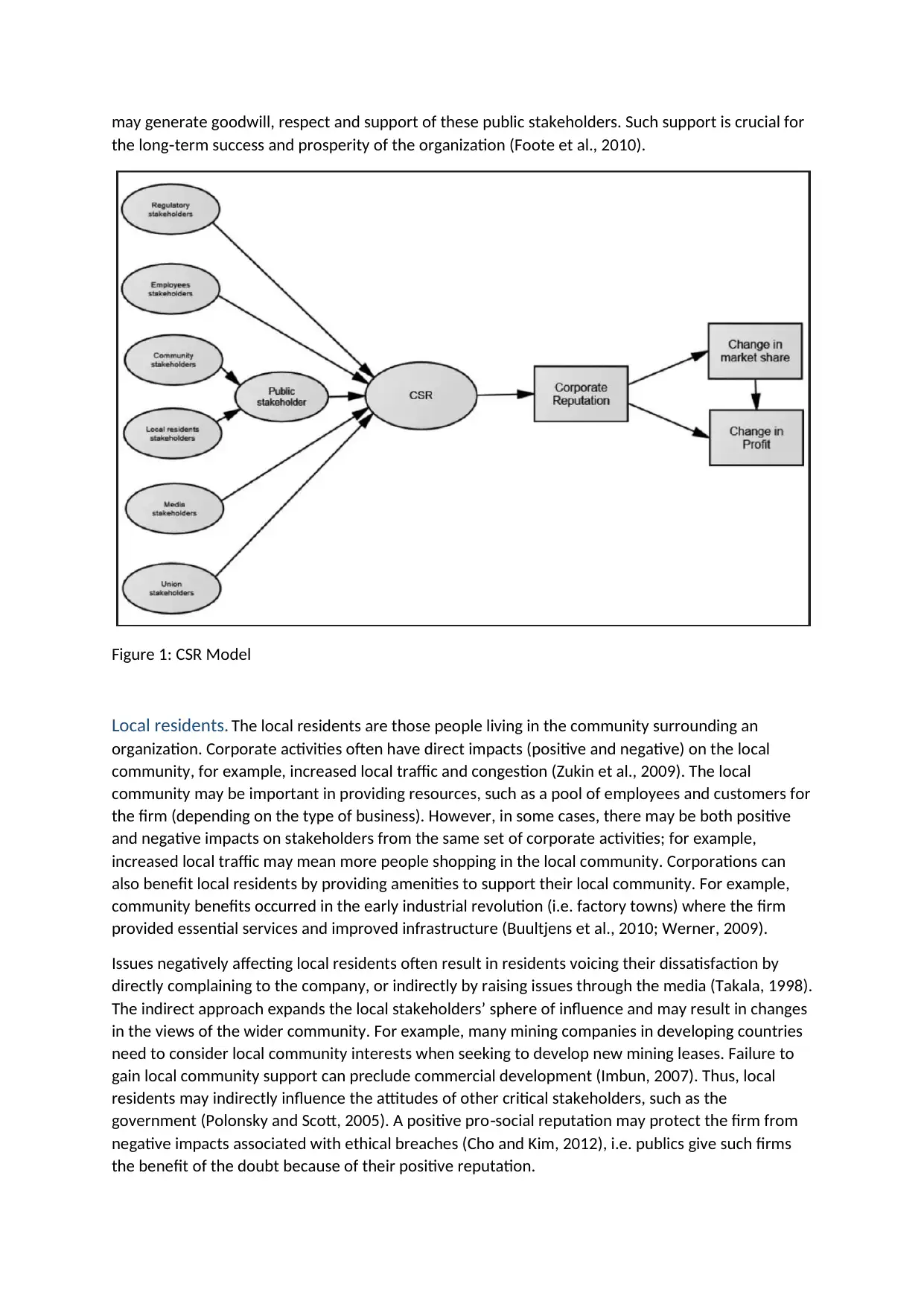
Figure 1: CSR Model
Local residents. The local residents are those people living in the community surrounding an
organization. Corporate activities often have direct impacts (positive and negative) on the local
community, for example, increased local traffic and congestion (Zukin et al., 2009). The local
community may be important in providing resources, such as a pool of employees and customers for
the firm (depending on the type of business). However, in some cases, there may be both positive
and negative impacts on stakeholders from the same set of corporate activities; for example,
increased local traffic may mean more people shopping in the local community. Corporations can
also benefit local residents by providing amenities to support their local community. For example,
community benefits occurred in the early industrial revolution (i.e. factory towns) where the firm
provided essential services and improved infrastructure (Buultjens et al., 2010; Werner, 2009).
Issues negatively affecting local residents often result in residents voicing their dissatisfaction by
directly complaining to the company, or indirectly by raising issues through the media (Takala, 1998).
The indirect approach expands the local stakeholders’ sphere of influence and may result in changes
in the views of the wider community. For example, many mining companies in developing countries
need to consider local community interests when seeking to develop new mining leases. Failure to
gain local community support can preclude commercial development (Imbun, 2007). Thus, local
residents may indirectly influence the attitudes of other critical stakeholders, such as the
government (Polonsky and Scott, 2005). A positive pro social reputation may protect the firm from‐
negative impacts associated with ethical breaches (Cho and Kim, 2012), i.e. publics give such firms
the benefit of the doubt because of their positive reputation.
the long term success and prosperity of the organization (Foote et al., 2010).‐
Figure 1: CSR Model
Local residents. The local residents are those people living in the community surrounding an
organization. Corporate activities often have direct impacts (positive and negative) on the local
community, for example, increased local traffic and congestion (Zukin et al., 2009). The local
community may be important in providing resources, such as a pool of employees and customers for
the firm (depending on the type of business). However, in some cases, there may be both positive
and negative impacts on stakeholders from the same set of corporate activities; for example,
increased local traffic may mean more people shopping in the local community. Corporations can
also benefit local residents by providing amenities to support their local community. For example,
community benefits occurred in the early industrial revolution (i.e. factory towns) where the firm
provided essential services and improved infrastructure (Buultjens et al., 2010; Werner, 2009).
Issues negatively affecting local residents often result in residents voicing their dissatisfaction by
directly complaining to the company, or indirectly by raising issues through the media (Takala, 1998).
The indirect approach expands the local stakeholders’ sphere of influence and may result in changes
in the views of the wider community. For example, many mining companies in developing countries
need to consider local community interests when seeking to develop new mining leases. Failure to
gain local community support can preclude commercial development (Imbun, 2007). Thus, local
residents may indirectly influence the attitudes of other critical stakeholders, such as the
government (Polonsky and Scott, 2005). A positive pro social reputation may protect the firm from‐
negative impacts associated with ethical breaches (Cho and Kim, 2012), i.e. publics give such firms
the benefit of the doubt because of their positive reputation.
Community in general. Community groups include the population at large, consumers and special
interest groups. Their perceptions of a company reflect the firm’s status and reputation (Neville et
al., 2005), as well as how the firm is positioned in respect to other organizations. Community groups’
perceptions are formed through long term corporate communications, their experience with the‐
firm and its products, as well as their perceptions of an organization’s societal impacts (Hoeffler et
al., 2010). The community plays many roles including as consumers, where consumers have a direct
impact on corporate action. For example, consumers can boycott firms because of their unethical
behavior, as this represents a lack of socially responsible activities (Klein et al., 2004). Perceived
inappropriate corporate actions can have long term consequences, affecting both corporate‐
reputation and firm performance. For example, Nestlé is still being punished by some consumers
over its activities in regards to the questionable promoting of infant formula in developing countries
two decades earlier (Boyd, 2012). Of course, community groups also have the ability to indirectly
influence others through the media as well. As was identified earlier, Shell changed their decision to
sink the Brent Spar oil rig because of global community protests (Wheeler et al., 2002;
Zyglidopoulos, 2002).
Media
The role of the media is to inform the wider community about issues of public interest. A neutral and
unbiased media can, however, also shape public opinion (Bodemer et al., 2012; Haddock Fraser,‐
2012). The media are indirect external stakeholders operating independently of the organization.
The media is an essential facilitator of communication between the firm and its stakeholders
(Deephouse and Heugend, 2009). The media’s support for a firm can be gained through maintaining
ongoing contacts and providing newsworthy information. However, firms cannot control the media,
thus support will be variable. The media, therefore, have the power to shape other stakeholders’
perceptions about an organization’s activities (Baum and Potter, 2008).
Government – regulatory stakeholders
Legal entities, such as companies, are formed for a specific purpose and are allowed to operate
within the legal framework of specified jurisdiction(s), with interactions regulated by government. To
maintain their operations, companies must behave in a legally and socially acceptable fashion. A key
area of legal concern in regard to corporate conduct relates to strategies and activities associated
with accurately communicating with their stakeholders (Kerr et al., 2008). Claiming to be socially
responsible is, increasingly, being used as a marketing claim (Hoeffler et al., 2010), and the accuracy
of these claims needs to be regulated to ensure consumers are not intentionally or unintentionally
misled.
Governments are also involved with corporate social activities as part of their governing function
and have a range of tools for facilitating the collaboration between themselves, businesses and the
civil society (Moon, 2004; Albareda et al., 2008). Therefore, governments at all levels, potentially,
have substantial influence on management’s decision making and corporate behavior, directly and‐
indirectly, through shaping the wider legal and regulatory framework within which managers’ work.
For example, how tax incentives are offered may encourage firms to undertake a range of socially
focused activities.
interest groups. Their perceptions of a company reflect the firm’s status and reputation (Neville et
al., 2005), as well as how the firm is positioned in respect to other organizations. Community groups’
perceptions are formed through long term corporate communications, their experience with the‐
firm and its products, as well as their perceptions of an organization’s societal impacts (Hoeffler et
al., 2010). The community plays many roles including as consumers, where consumers have a direct
impact on corporate action. For example, consumers can boycott firms because of their unethical
behavior, as this represents a lack of socially responsible activities (Klein et al., 2004). Perceived
inappropriate corporate actions can have long term consequences, affecting both corporate‐
reputation and firm performance. For example, Nestlé is still being punished by some consumers
over its activities in regards to the questionable promoting of infant formula in developing countries
two decades earlier (Boyd, 2012). Of course, community groups also have the ability to indirectly
influence others through the media as well. As was identified earlier, Shell changed their decision to
sink the Brent Spar oil rig because of global community protests (Wheeler et al., 2002;
Zyglidopoulos, 2002).
Media
The role of the media is to inform the wider community about issues of public interest. A neutral and
unbiased media can, however, also shape public opinion (Bodemer et al., 2012; Haddock Fraser,‐
2012). The media are indirect external stakeholders operating independently of the organization.
The media is an essential facilitator of communication between the firm and its stakeholders
(Deephouse and Heugend, 2009). The media’s support for a firm can be gained through maintaining
ongoing contacts and providing newsworthy information. However, firms cannot control the media,
thus support will be variable. The media, therefore, have the power to shape other stakeholders’
perceptions about an organization’s activities (Baum and Potter, 2008).
Government – regulatory stakeholders
Legal entities, such as companies, are formed for a specific purpose and are allowed to operate
within the legal framework of specified jurisdiction(s), with interactions regulated by government. To
maintain their operations, companies must behave in a legally and socially acceptable fashion. A key
area of legal concern in regard to corporate conduct relates to strategies and activities associated
with accurately communicating with their stakeholders (Kerr et al., 2008). Claiming to be socially
responsible is, increasingly, being used as a marketing claim (Hoeffler et al., 2010), and the accuracy
of these claims needs to be regulated to ensure consumers are not intentionally or unintentionally
misled.
Governments are also involved with corporate social activities as part of their governing function
and have a range of tools for facilitating the collaboration between themselves, businesses and the
civil society (Moon, 2004; Albareda et al., 2008). Therefore, governments at all levels, potentially,
have substantial influence on management’s decision making and corporate behavior, directly and‐
indirectly, through shaping the wider legal and regulatory framework within which managers’ work.
For example, how tax incentives are offered may encourage firms to undertake a range of socially
focused activities.
⊘ This is a preview!⊘
Do you want full access?
Subscribe today to unlock all pages.
Trusted by 1+ million students worldwide
Corporate reputation
Corporate actions related to socially responsible activities (and irresponsible actions) have the ability
to influence the reputation and performance of a company (Boyd et al., 2010; Lai et al., 2010; Lii and
Lee, 2012). Reputation helps shape consumer attitudes and perceptions about a company (Fombrun
and Shanley, 1990), with positive perceptions motivating consumer purchase and developing
positive brand associations (Neville et al., 2005).
The inclusion of “corporate reputation” as an intervening variable between CSR measure and
organizational performance indicators is a recognition that some consumer purchases are influenced
by the firm’s reputation (Du et al., 2010; Lai et al., 2010; Lii and Lee, 2012). This is increasingly
recognized by firms that strategically use CSR to alter their positioning in the market. The purpose of
using “corporate reputation” as an intervening variable is to determine the extent to which
organizational reputation may be attributed to CSR and to what extent it is associated with
organizational performance (market share) (Peloza and Shang, 2011; Spitzeck and Hansen, 2010).
Several definitions have been provided for corporate reputation (Fombrun and Shanley, 1990; Weiss
et al., 1999). Fombrun (1996, p. 72) defined reputation as “a perceptual representation of a
company’s past actions and future prospects that describes the firm’s overall appeal of its key
constituents when compared with other leading rivals”. Corporate reputation can, therefore, be
characterized as the stakeholders’ evaluation of a company on key performance dimensions. This
definition proposes that a reputation is the synthesis of stakeholders’ perceptions and creates a
persona that can be formulated, implemented and managed (Neville et al., 2005).
In this study, corporate reputation is regarded as managers’ perceptions of how well the
organization meets the needs of its stakeholders, which is consistent with the definition offered by
Wartick (1992, p. 34) as “the aggregation of a single stakeholder’s perception of how well
organizational responses are meeting the demand and expectations of many organizational
stakeholders”. A managerial focused definition of reputation is possibly more realistic and functional‐
because it considers a holistic viewpoint of one stakeholder group in regard to how the firm
interacts with its other stakeholders. Relying on senior management perspectives is also
appropriate, as managers engage with all the organization’s stakeholders through a variety of formal
and informal exchanges, as well as shaping strategies that are based on the managers’ assessments
of stakeholders’ importance (Ferrell et al., 2010). It may be argued that as each stakeholder has
varying corporate expectations and attitudes, their interpretations and perceptions of a company’s
activities would differ. Therefore, aggregating the perceptions of all key stakeholders may result in
an inaccurate measure of corporate reputation, which is not reflective of any individual stakeholder
group (Polonsky and Scott, 2005).
The impact of CSR activities on corporate reputation is measured by managers’ perceptions of how
an organization is being perceived across a set of stakeholders in general, rather than by each
specific stakeholder, which is often done when assessing strategy related issues (Maignan et al.,‐
2011). This managerial perspective identifies the dimensions and attributes of corporate self‐
perception, reflecting what the management believes stakeholders consider as realistic, meaningful
and long lasting.‐
Corporate actions related to socially responsible activities (and irresponsible actions) have the ability
to influence the reputation and performance of a company (Boyd et al., 2010; Lai et al., 2010; Lii and
Lee, 2012). Reputation helps shape consumer attitudes and perceptions about a company (Fombrun
and Shanley, 1990), with positive perceptions motivating consumer purchase and developing
positive brand associations (Neville et al., 2005).
The inclusion of “corporate reputation” as an intervening variable between CSR measure and
organizational performance indicators is a recognition that some consumer purchases are influenced
by the firm’s reputation (Du et al., 2010; Lai et al., 2010; Lii and Lee, 2012). This is increasingly
recognized by firms that strategically use CSR to alter their positioning in the market. The purpose of
using “corporate reputation” as an intervening variable is to determine the extent to which
organizational reputation may be attributed to CSR and to what extent it is associated with
organizational performance (market share) (Peloza and Shang, 2011; Spitzeck and Hansen, 2010).
Several definitions have been provided for corporate reputation (Fombrun and Shanley, 1990; Weiss
et al., 1999). Fombrun (1996, p. 72) defined reputation as “a perceptual representation of a
company’s past actions and future prospects that describes the firm’s overall appeal of its key
constituents when compared with other leading rivals”. Corporate reputation can, therefore, be
characterized as the stakeholders’ evaluation of a company on key performance dimensions. This
definition proposes that a reputation is the synthesis of stakeholders’ perceptions and creates a
persona that can be formulated, implemented and managed (Neville et al., 2005).
In this study, corporate reputation is regarded as managers’ perceptions of how well the
organization meets the needs of its stakeholders, which is consistent with the definition offered by
Wartick (1992, p. 34) as “the aggregation of a single stakeholder’s perception of how well
organizational responses are meeting the demand and expectations of many organizational
stakeholders”. A managerial focused definition of reputation is possibly more realistic and functional‐
because it considers a holistic viewpoint of one stakeholder group in regard to how the firm
interacts with its other stakeholders. Relying on senior management perspectives is also
appropriate, as managers engage with all the organization’s stakeholders through a variety of formal
and informal exchanges, as well as shaping strategies that are based on the managers’ assessments
of stakeholders’ importance (Ferrell et al., 2010). It may be argued that as each stakeholder has
varying corporate expectations and attitudes, their interpretations and perceptions of a company’s
activities would differ. Therefore, aggregating the perceptions of all key stakeholders may result in
an inaccurate measure of corporate reputation, which is not reflective of any individual stakeholder
group (Polonsky and Scott, 2005).
The impact of CSR activities on corporate reputation is measured by managers’ perceptions of how
an organization is being perceived across a set of stakeholders in general, rather than by each
specific stakeholder, which is often done when assessing strategy related issues (Maignan et al.,‐
2011). This managerial perspective identifies the dimensions and attributes of corporate self‐
perception, reflecting what the management believes stakeholders consider as realistic, meaningful
and long lasting.‐
Paraphrase This Document
Need a fresh take? Get an instant paraphrase of this document with our AI Paraphraser
Business performance
The impact of CSR activities on corporate reputation leads to business performance (Berman et al.,
1999; Lai et al., 2010). Business performance is a complicated concept to assess, given the various
ways it can be measured and the factors that can influence it (Clark et al., 2006; de Waal, 2002).
Performance may be considered, generally, as the corporate results achieved, or a change in results
through the implementation of targeted strategies (de Waal, 2002). Business performance may also
be viewed as the degree to which an organization has achieved its own set of defined objectives
(Dieckman, 2001). Business performance can also be assessed in relation to industry norms, the
historical firm performance or the established objectives and expectations of the organization
(Herremans and Ryans, 1995; Homburg et al., 1999). An organization’s defined objectives and
expectations could include different measures, such as the level of customer satisfaction,
profitability, market share, sales value and sales volume (Gustafsson and Johnson, 2002), just to
mention a few. In this study, business performance is considered as a subjective assessment by
managers of the change in market share and change in profitability, rather than an absolute
measure of performance. This approach is appropriate, as managers have been found to be effective
in making subjective assessments of changes in corporate performance (Harris, 2001; Narver and
Slater, 1990; Slater and Narver, 1996).
From the above review of the literature surrounding CSR, and the roles and responsibility of the
relevant stakeholders influencing the conduct of a business, the following research questions
emerge:
RQ1. Can CSR as a strategic focus be represented as a latent variable formed by managers’
perceptions of their stakeholders’ influences on corporate decision making?‐
RQ2. Is there an association between the levels of CSR focus and organizational reputation?
RQ3. Is there an association between organizational reputation and the business
performance indicators of: (a) change in market share; and (b) change in overall profitability
performance?
To address the above research questions, a model (see Figure 1) is proposed which suggests that
various stakeholders contribute to corporate CSR, the reputation of the organization and business
performance.
Model components
The model of CSR (Figure 1) is constructed such that there are multiple stakeholder influences
occurring simultaneously. The constituent factors in the model are designed to represent a multi‐
faceted structure of stakeholders’ influences which shape management’s decision making.‐
The model indicates that these factors, potentially, interact and create a synergistic outcome that
determines the relative strength of the organization’s CSR and, in turn, reputation, and through this,
the firm’s performance. CSR is measured as the overall influence of key stakeholders directly
relevant to an organization, as discussed previously.
Within the model, the “community in general” and “local residents” groups have been integrated
into one “public” stakeholder group. The data on the influence of these two groups were collected
separately; however, the variables of the two groups were highly correlated (76.6) and, therefore,
were integrated to avoid repetition while maintaining their representation in the model (Figure 1).
The impact of CSR activities on corporate reputation leads to business performance (Berman et al.,
1999; Lai et al., 2010). Business performance is a complicated concept to assess, given the various
ways it can be measured and the factors that can influence it (Clark et al., 2006; de Waal, 2002).
Performance may be considered, generally, as the corporate results achieved, or a change in results
through the implementation of targeted strategies (de Waal, 2002). Business performance may also
be viewed as the degree to which an organization has achieved its own set of defined objectives
(Dieckman, 2001). Business performance can also be assessed in relation to industry norms, the
historical firm performance or the established objectives and expectations of the organization
(Herremans and Ryans, 1995; Homburg et al., 1999). An organization’s defined objectives and
expectations could include different measures, such as the level of customer satisfaction,
profitability, market share, sales value and sales volume (Gustafsson and Johnson, 2002), just to
mention a few. In this study, business performance is considered as a subjective assessment by
managers of the change in market share and change in profitability, rather than an absolute
measure of performance. This approach is appropriate, as managers have been found to be effective
in making subjective assessments of changes in corporate performance (Harris, 2001; Narver and
Slater, 1990; Slater and Narver, 1996).
From the above review of the literature surrounding CSR, and the roles and responsibility of the
relevant stakeholders influencing the conduct of a business, the following research questions
emerge:
RQ1. Can CSR as a strategic focus be represented as a latent variable formed by managers’
perceptions of their stakeholders’ influences on corporate decision making?‐
RQ2. Is there an association between the levels of CSR focus and organizational reputation?
RQ3. Is there an association between organizational reputation and the business
performance indicators of: (a) change in market share; and (b) change in overall profitability
performance?
To address the above research questions, a model (see Figure 1) is proposed which suggests that
various stakeholders contribute to corporate CSR, the reputation of the organization and business
performance.
Model components
The model of CSR (Figure 1) is constructed such that there are multiple stakeholder influences
occurring simultaneously. The constituent factors in the model are designed to represent a multi‐
faceted structure of stakeholders’ influences which shape management’s decision making.‐
The model indicates that these factors, potentially, interact and create a synergistic outcome that
determines the relative strength of the organization’s CSR and, in turn, reputation, and through this,
the firm’s performance. CSR is measured as the overall influence of key stakeholders directly
relevant to an organization, as discussed previously.
Within the model, the “community in general” and “local residents” groups have been integrated
into one “public” stakeholder group. The data on the influence of these two groups were collected
separately; however, the variables of the two groups were highly correlated (76.6) and, therefore,
were integrated to avoid repetition while maintaining their representation in the model (Figure 1).
Corporate reputation is included in the model as an intervening variable between CSR and business
performance (Neville et al., 2005). This is done because of the focal role of corporate reputation in
performance and marketing outcomes (Lai et al., 2010; Tsoutsoura, 2004). Reputation is designed to
measure the association between corporate reputation and business performance indicators
(change in market share and profitability).
The market share measure is assessed based on respondents’ perceived change in the share of the
market by the strategic business unit in comparison to the previous year, and is not intended to be
product or market specific. It reflects the managers’ perception of the extent of the overall change‐
in the organization’s market share, that is, the firm’s strength in their target market (Hooley et al.,
2005). “Profit” is also measured based on respondents’ perception of the change in profits from the
previous year. Thus, the performance measures used in the study reflect the perceived effectiveness
of CSR, as well as the ability of the organization to respond to environmental change (Homburg et
al., 1999).
The inclusion of these two performance measures enables a comparison between:
1. a measure that, predominantly, reflects the influence of marketing decisions, that is,
changes in market share; and
2. changes in the profit of the organization, representing the results of the entire
organization’s activities, which is also important, as stakeholders have different interests in
corporate activities (Polonsky and Scott, 2005).
Including multiple outcome measures allows a comparison between the marketing and non‐
marketing indicators in regard to the benefits of CSR.
The key assumptions in the construction of this model are that:
the reputation of an organization influences its level of success in achieving its business
performance objectives (Boyd et al., 2010);
CSR strategy may contribute to a positive corporate reputation (Bertels and Peloza, 2008);
and
CSR strategy can influence business performance through corporate reputation (Ben Brik et
al., 2011).
Method
A mail survey was designed and conducted to investigate the research questions and test the
proposed model of CSR. The questionnaire was developed based on the CSR literature and the
stakeholder theory (Agle et al., 1999; Turker, 2009). The items assessing senior managers’
perceptions of corporate reputation (Caruna, 1997; Caruna and Chircop, 2000; Helm, 2005), and
performance (Hooley et al., 2005) were adopted from existing studies.
The research instrument was modified through a two stage pre test process. The first stage included‐ ‐
review by six senior managers to verify the relevance of the items included and recommend items
that required changes. Minor changes were suggested and made to the wording and sequence of
some items, where considered appropriate, and the modified version of the instrument was re‐
tested using a different panel of six senior marketing managers (Wren, 1997).
performance (Neville et al., 2005). This is done because of the focal role of corporate reputation in
performance and marketing outcomes (Lai et al., 2010; Tsoutsoura, 2004). Reputation is designed to
measure the association between corporate reputation and business performance indicators
(change in market share and profitability).
The market share measure is assessed based on respondents’ perceived change in the share of the
market by the strategic business unit in comparison to the previous year, and is not intended to be
product or market specific. It reflects the managers’ perception of the extent of the overall change‐
in the organization’s market share, that is, the firm’s strength in their target market (Hooley et al.,
2005). “Profit” is also measured based on respondents’ perception of the change in profits from the
previous year. Thus, the performance measures used in the study reflect the perceived effectiveness
of CSR, as well as the ability of the organization to respond to environmental change (Homburg et
al., 1999).
The inclusion of these two performance measures enables a comparison between:
1. a measure that, predominantly, reflects the influence of marketing decisions, that is,
changes in market share; and
2. changes in the profit of the organization, representing the results of the entire
organization’s activities, which is also important, as stakeholders have different interests in
corporate activities (Polonsky and Scott, 2005).
Including multiple outcome measures allows a comparison between the marketing and non‐
marketing indicators in regard to the benefits of CSR.
The key assumptions in the construction of this model are that:
the reputation of an organization influences its level of success in achieving its business
performance objectives (Boyd et al., 2010);
CSR strategy may contribute to a positive corporate reputation (Bertels and Peloza, 2008);
and
CSR strategy can influence business performance through corporate reputation (Ben Brik et
al., 2011).
Method
A mail survey was designed and conducted to investigate the research questions and test the
proposed model of CSR. The questionnaire was developed based on the CSR literature and the
stakeholder theory (Agle et al., 1999; Turker, 2009). The items assessing senior managers’
perceptions of corporate reputation (Caruna, 1997; Caruna and Chircop, 2000; Helm, 2005), and
performance (Hooley et al., 2005) were adopted from existing studies.
The research instrument was modified through a two stage pre test process. The first stage included‐ ‐
review by six senior managers to verify the relevance of the items included and recommend items
that required changes. Minor changes were suggested and made to the wording and sequence of
some items, where considered appropriate, and the modified version of the instrument was re‐
tested using a different panel of six senior marketing managers (Wren, 1997).
⊘ This is a preview!⊘
Do you want full access?
Subscribe today to unlock all pages.
Trusted by 1+ million students worldwide

1 out of 29


Related Documents


Your All-in-One AI-Powered Toolkit for Academic Success.
+13062052269
info@desklib.com
Available 24*7 on WhatsApp / Email
![[object Object]](/_next/static/media/star-bottom.7253800d.svg)
Unlock your academic potential
Copyright © 2020–2026 A2Z Services. All Rights Reserved. Developed and managed by ZUCOL.