Strategic Management & CSR: Nestle Case Study on Social Responsibility
VerifiedAdded on 2023/06/10
|23
|6587
|260
Report
AI Summary
This report examines Corporate Social Responsibility (CSR) as a strategic management model, exploring its definition, history, and evolution. It emphasizes the shift from viewing CSR as voluntary to a mandatory business practice driven by stakeholder expectations and regulations. The report critically reviews CSR, highlighting its ethical and social dimensions beyond mere charity, and contrasts perspectives from Milton Friedman's profit-centric view to stakeholder-focused approaches. A case study of Nestlé analyzes the company's CSR activities, PESTEL environment, and challenges faced, providing a practical understanding of CSR implementation. The report concludes that CSR is integral to modern business, requiring companies to balance economic goals with social and environmental responsibilities.

Running head: CORPORATE SOCIAL RESPONSIBILITY
Corporate social responsibility
Name of the student:
Name of the university:
Author note:
Corporate social responsibility
Name of the student:
Name of the university:
Author note:

Paraphrase This Document
Need a fresh take? Get an instant paraphrase of this document with our AI Paraphraser
1CORPORATE SOCIAL RESPONSIBILITY
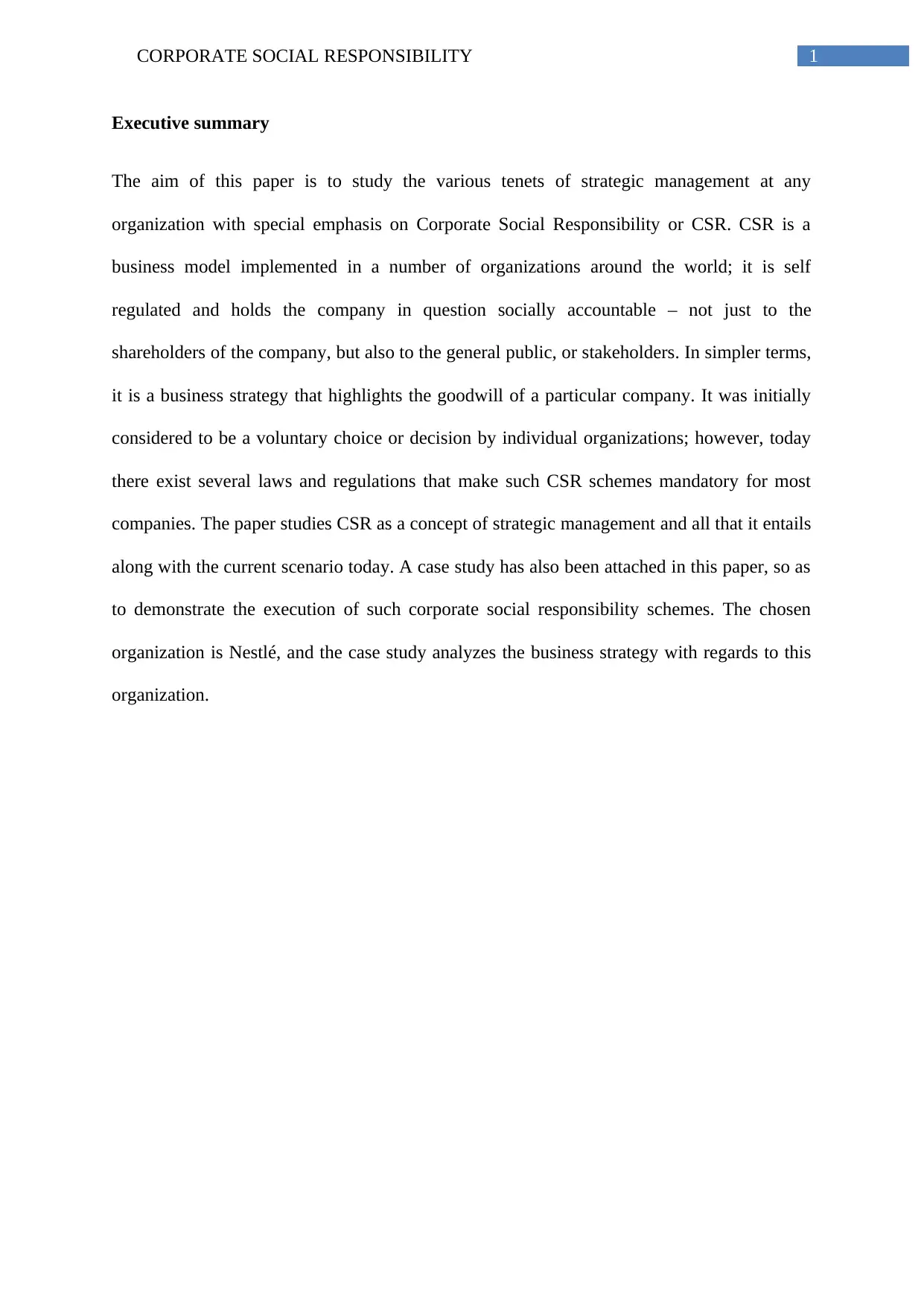
Executive summary
The aim of this paper is to study the various tenets of strategic management at any
organization with special emphasis on Corporate Social Responsibility or CSR. CSR is a
business model implemented in a number of organizations around the world; it is self
regulated and holds the company in question socially accountable – not just to the
shareholders of the company, but also to the general public, or stakeholders. In simpler terms,
it is a business strategy that highlights the goodwill of a particular company. It was initially
considered to be a voluntary choice or decision by individual organizations; however, today
there exist several laws and regulations that make such CSR schemes mandatory for most
companies. The paper studies CSR as a concept of strategic management and all that it entails
along with the current scenario today. A case study has also been attached in this paper, so as
to demonstrate the execution of such corporate social responsibility schemes. The chosen
organization is Nestlé, and the case study analyzes the business strategy with regards to this
organization.
Executive summary
The aim of this paper is to study the various tenets of strategic management at any
organization with special emphasis on Corporate Social Responsibility or CSR. CSR is a
business model implemented in a number of organizations around the world; it is self
regulated and holds the company in question socially accountable – not just to the
shareholders of the company, but also to the general public, or stakeholders. In simpler terms,
it is a business strategy that highlights the goodwill of a particular company. It was initially
considered to be a voluntary choice or decision by individual organizations; however, today
there exist several laws and regulations that make such CSR schemes mandatory for most
companies. The paper studies CSR as a concept of strategic management and all that it entails
along with the current scenario today. A case study has also been attached in this paper, so as
to demonstrate the execution of such corporate social responsibility schemes. The chosen
organization is Nestlé, and the case study analyzes the business strategy with regards to this
organization.
2CORPORATE SOCIAL RESPONSIBILITY
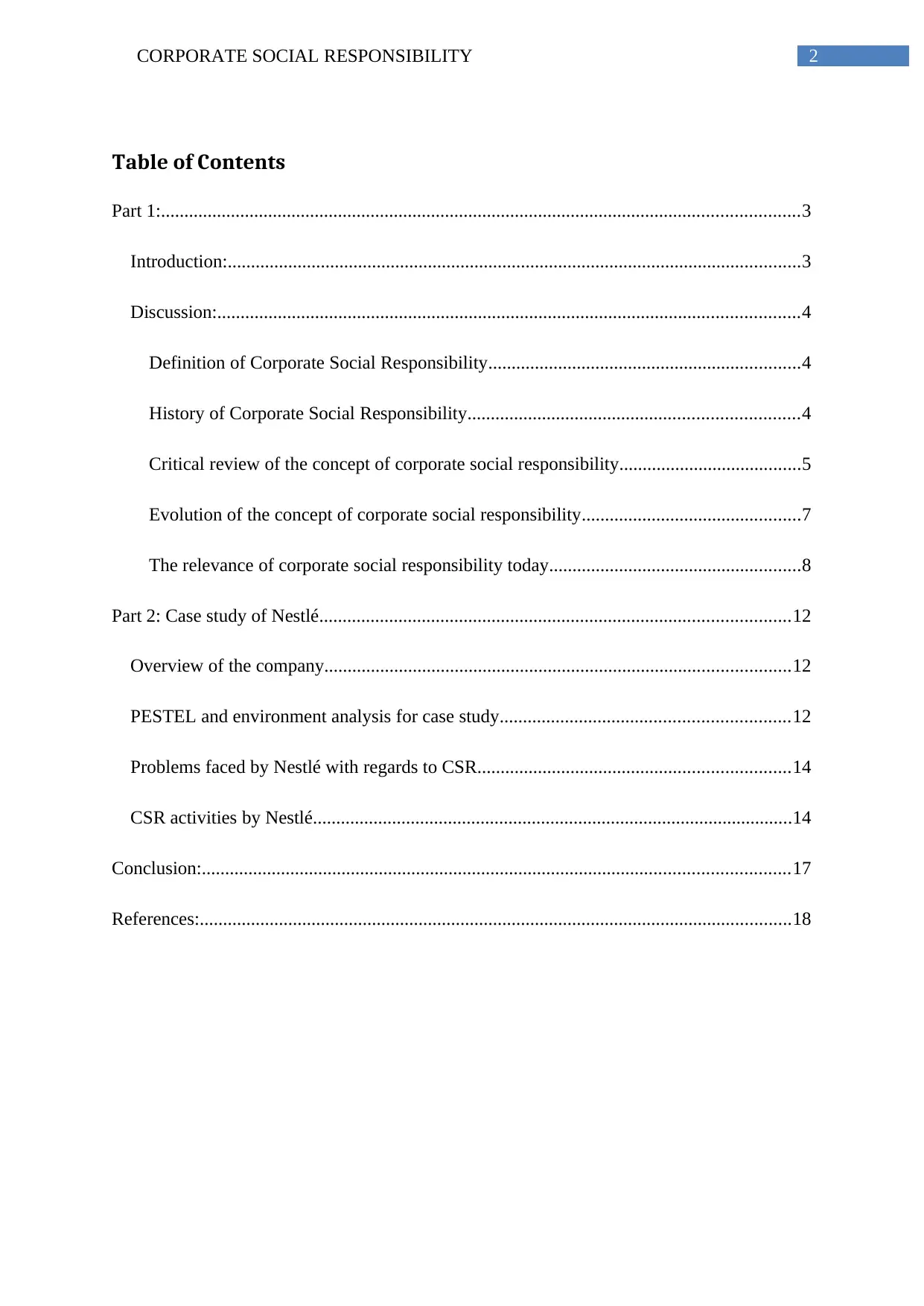
Table of Contents
Part 1:.........................................................................................................................................3
Introduction:...........................................................................................................................3
Discussion:.............................................................................................................................4
Definition of Corporate Social Responsibility...................................................................4
History of Corporate Social Responsibility.......................................................................4
Critical review of the concept of corporate social responsibility.......................................5
Evolution of the concept of corporate social responsibility...............................................7
The relevance of corporate social responsibility today......................................................8
Part 2: Case study of Nestlé.....................................................................................................12
Overview of the company....................................................................................................12
PESTEL and environment analysis for case study..............................................................12
Problems faced by Nestlé with regards to CSR...................................................................14
CSR activities by Nestlé.......................................................................................................14
Conclusion:..............................................................................................................................17
References:...............................................................................................................................18
Table of Contents
Part 1:.........................................................................................................................................3
Introduction:...........................................................................................................................3
Discussion:.............................................................................................................................4
Definition of Corporate Social Responsibility...................................................................4
History of Corporate Social Responsibility.......................................................................4
Critical review of the concept of corporate social responsibility.......................................5
Evolution of the concept of corporate social responsibility...............................................7
The relevance of corporate social responsibility today......................................................8
Part 2: Case study of Nestlé.....................................................................................................12
Overview of the company....................................................................................................12
PESTEL and environment analysis for case study..............................................................12
Problems faced by Nestlé with regards to CSR...................................................................14
CSR activities by Nestlé.......................................................................................................14
Conclusion:..............................................................................................................................17
References:...............................................................................................................................18
⊘ This is a preview!⊘
Do you want full access?
Subscribe today to unlock all pages.

Trusted by 1+ million students worldwide
3CORPORATE SOCIAL RESPONSIBILITY
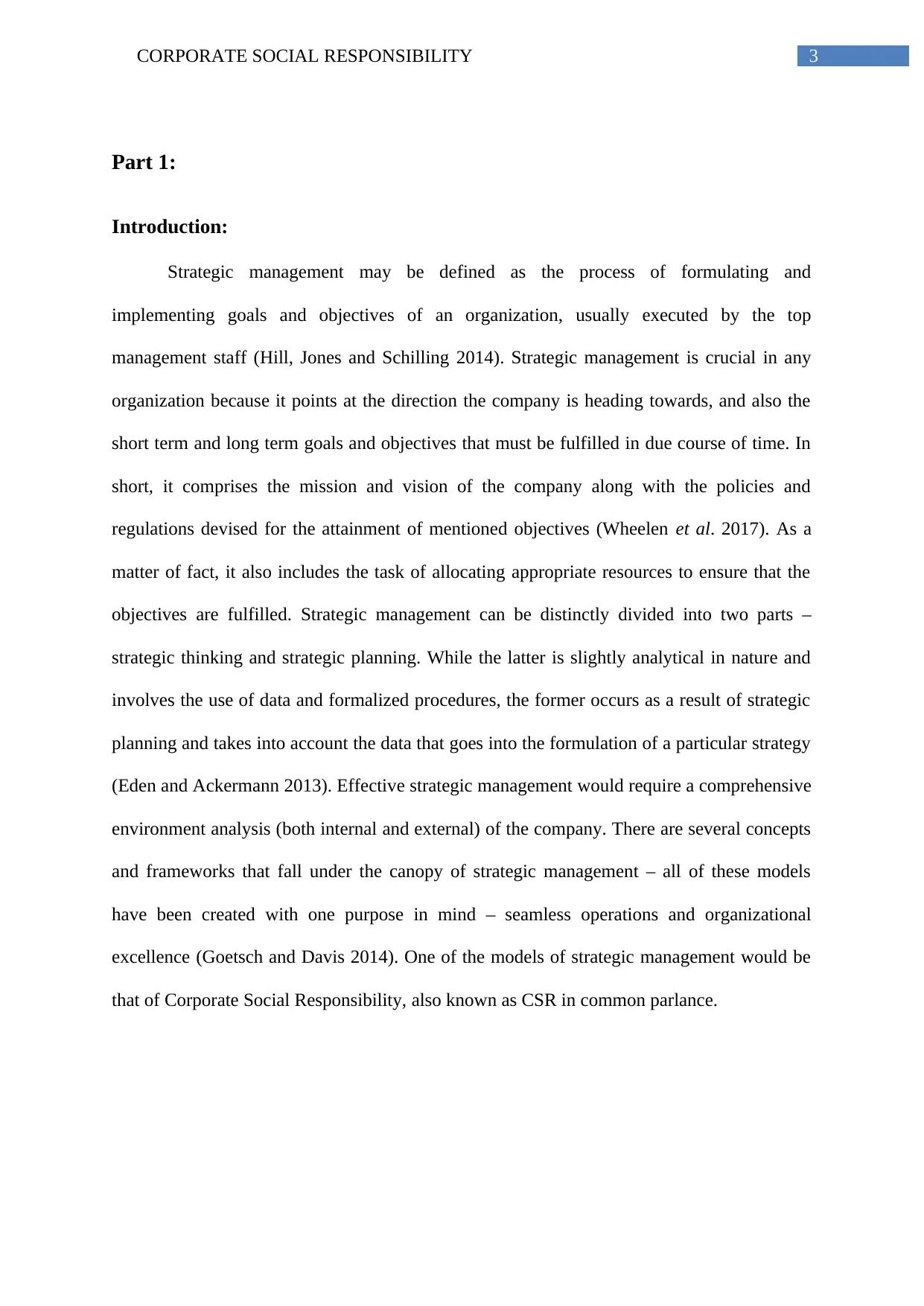
Part 1:
Introduction:
Strategic management may be defined as the process of formulating and
implementing goals and objectives of an organization, usually executed by the top
management staff (Hill, Jones and Schilling 2014). Strategic management is crucial in any
organization because it points at the direction the company is heading towards, and also the
short term and long term goals and objectives that must be fulfilled in due course of time. In
short, it comprises the mission and vision of the company along with the policies and
regulations devised for the attainment of mentioned objectives (Wheelen et al. 2017). As a
matter of fact, it also includes the task of allocating appropriate resources to ensure that the
objectives are fulfilled. Strategic management can be distinctly divided into two parts –
strategic thinking and strategic planning. While the latter is slightly analytical in nature and
involves the use of data and formalized procedures, the former occurs as a result of strategic
planning and takes into account the data that goes into the formulation of a particular strategy
(Eden and Ackermann 2013). Effective strategic management would require a comprehensive
environment analysis (both internal and external) of the company. There are several concepts
and frameworks that fall under the canopy of strategic management – all of these models
have been created with one purpose in mind – seamless operations and organizational
excellence (Goetsch and Davis 2014). One of the models of strategic management would be
that of Corporate Social Responsibility, also known as CSR in common parlance.
Part 1:
Introduction:
Strategic management may be defined as the process of formulating and
implementing goals and objectives of an organization, usually executed by the top
management staff (Hill, Jones and Schilling 2014). Strategic management is crucial in any
organization because it points at the direction the company is heading towards, and also the
short term and long term goals and objectives that must be fulfilled in due course of time. In
short, it comprises the mission and vision of the company along with the policies and
regulations devised for the attainment of mentioned objectives (Wheelen et al. 2017). As a
matter of fact, it also includes the task of allocating appropriate resources to ensure that the
objectives are fulfilled. Strategic management can be distinctly divided into two parts –
strategic thinking and strategic planning. While the latter is slightly analytical in nature and
involves the use of data and formalized procedures, the former occurs as a result of strategic
planning and takes into account the data that goes into the formulation of a particular strategy
(Eden and Ackermann 2013). Effective strategic management would require a comprehensive
environment analysis (both internal and external) of the company. There are several concepts
and frameworks that fall under the canopy of strategic management – all of these models
have been created with one purpose in mind – seamless operations and organizational
excellence (Goetsch and Davis 2014). One of the models of strategic management would be
that of Corporate Social Responsibility, also known as CSR in common parlance.
Paraphrase This Document
Need a fresh take? Get an instant paraphrase of this document with our AI Paraphraser
4CORPORATE SOCIAL RESPONSIBILITY
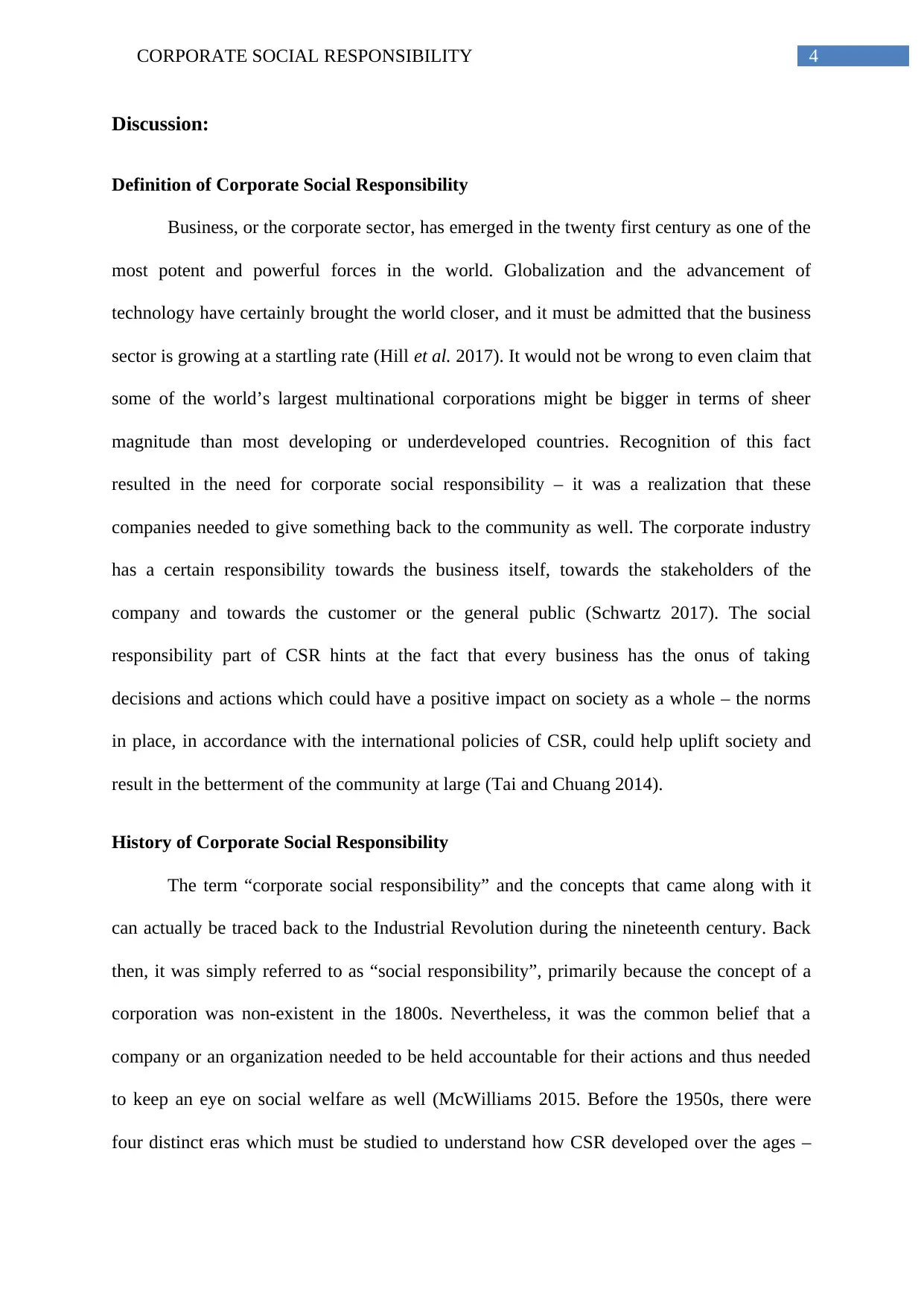
Discussion:
Definition of Corporate Social Responsibility
Business, or the corporate sector, has emerged in the twenty first century as one of the
most potent and powerful forces in the world. Globalization and the advancement of
technology have certainly brought the world closer, and it must be admitted that the business
sector is growing at a startling rate (Hill et al. 2017). It would not be wrong to even claim that
some of the world’s largest multinational corporations might be bigger in terms of sheer
magnitude than most developing or underdeveloped countries. Recognition of this fact
resulted in the need for corporate social responsibility – it was a realization that these
companies needed to give something back to the community as well. The corporate industry
has a certain responsibility towards the business itself, towards the stakeholders of the
company and towards the customer or the general public (Schwartz 2017). The social
responsibility part of CSR hints at the fact that every business has the onus of taking
decisions and actions which could have a positive impact on society as a whole – the norms
in place, in accordance with the international policies of CSR, could help uplift society and
result in the betterment of the community at large (Tai and Chuang 2014).
History of Corporate Social Responsibility
The term “corporate social responsibility” and the concepts that came along with it
can actually be traced back to the Industrial Revolution during the nineteenth century. Back
then, it was simply referred to as “social responsibility”, primarily because the concept of a
corporation was non-existent in the 1800s. Nevertheless, it was the common belief that a
company or an organization needed to be held accountable for their actions and thus needed
to keep an eye on social welfare as well (McWilliams 2015. Before the 1950s, there were
four distinct eras which must be studied to understand how CSR developed over the ages –
Discussion:
Definition of Corporate Social Responsibility
Business, or the corporate sector, has emerged in the twenty first century as one of the
most potent and powerful forces in the world. Globalization and the advancement of
technology have certainly brought the world closer, and it must be admitted that the business
sector is growing at a startling rate (Hill et al. 2017). It would not be wrong to even claim that
some of the world’s largest multinational corporations might be bigger in terms of sheer
magnitude than most developing or underdeveloped countries. Recognition of this fact
resulted in the need for corporate social responsibility – it was a realization that these
companies needed to give something back to the community as well. The corporate industry
has a certain responsibility towards the business itself, towards the stakeholders of the
company and towards the customer or the general public (Schwartz 2017). The social
responsibility part of CSR hints at the fact that every business has the onus of taking
decisions and actions which could have a positive impact on society as a whole – the norms
in place, in accordance with the international policies of CSR, could help uplift society and
result in the betterment of the community at large (Tai and Chuang 2014).
History of Corporate Social Responsibility
The term “corporate social responsibility” and the concepts that came along with it
can actually be traced back to the Industrial Revolution during the nineteenth century. Back
then, it was simply referred to as “social responsibility”, primarily because the concept of a
corporation was non-existent in the 1800s. Nevertheless, it was the common belief that a
company or an organization needed to be held accountable for their actions and thus needed
to keep an eye on social welfare as well (McWilliams 2015. Before the 1950s, there were
four distinct eras which must be studied to understand how CSR developed over the ages –
5CORPORATE SOCIAL RESPONSIBILITY
these phases were specified by Patrick Murphy (Murphy and Schlegelmilch 2013). Before the
onset of the 1950s, businesses and large corporations were extremely philanthropic and did
not hesitate to donate huge sums to charity. During the second phase, there was a growing
consciousness as to the actual responsibility of a company within a community and a need to
get involved in the affairs of the society was felt. In the next phase, during the early 1970s,
the companies began to take up issues like racial discrimination and pollution and attempted
to raise their voice against these prejudices and malpractices. It was only during the late
1970s and early 1980s that organizations actually began to devise policies and regulations
with regards to corporate social responsibility in order to implement them (Windsor 2013).
Howard Bowen was one of the first scholars who were able to concisely define social
responsibility, which later came to be known as CSR. According to him, social responsibility
referred to the course of action undertaken by a businessman or the decisions made by him
which took into account the values pertaining to society (Bowen 2013).
Critical review of the concept of corporate social responsibility
It would be wrong to assume that CSR simply refers to acts of charity carried out by
an organization. On the contrary, this concept of CSR refers to the way companies integrate
moral, social, ethical and environmental concerns as part of their business strategy – as a
matter of fact, most companies are legally obligated to do so (Hiller 2013). The business
sector is no longer merely the traditional means of earning profits; the recognition of the
various evils pervading society gives rise to the growing concerns about business’s role in
finding a solution to these persisting problems. Companies today are thus expected to act and
function in a way that is economically, environmentally and socially sustainable (Ioannou
and Serafeim 2015).
Corporate social responsibility as a concept is steeped in rhetoric; that is primarily
because there is no solid analytical foundation for it. Any corporate manager would agree
these phases were specified by Patrick Murphy (Murphy and Schlegelmilch 2013). Before the
onset of the 1950s, businesses and large corporations were extremely philanthropic and did
not hesitate to donate huge sums to charity. During the second phase, there was a growing
consciousness as to the actual responsibility of a company within a community and a need to
get involved in the affairs of the society was felt. In the next phase, during the early 1970s,
the companies began to take up issues like racial discrimination and pollution and attempted
to raise their voice against these prejudices and malpractices. It was only during the late
1970s and early 1980s that organizations actually began to devise policies and regulations
with regards to corporate social responsibility in order to implement them (Windsor 2013).
Howard Bowen was one of the first scholars who were able to concisely define social
responsibility, which later came to be known as CSR. According to him, social responsibility
referred to the course of action undertaken by a businessman or the decisions made by him
which took into account the values pertaining to society (Bowen 2013).
Critical review of the concept of corporate social responsibility
It would be wrong to assume that CSR simply refers to acts of charity carried out by
an organization. On the contrary, this concept of CSR refers to the way companies integrate
moral, social, ethical and environmental concerns as part of their business strategy – as a
matter of fact, most companies are legally obligated to do so (Hiller 2013). The business
sector is no longer merely the traditional means of earning profits; the recognition of the
various evils pervading society gives rise to the growing concerns about business’s role in
finding a solution to these persisting problems. Companies today are thus expected to act and
function in a way that is economically, environmentally and socially sustainable (Ioannou
and Serafeim 2015).
Corporate social responsibility as a concept is steeped in rhetoric; that is primarily
because there is no solid analytical foundation for it. Any corporate manager would agree
⊘ This is a preview!⊘
Do you want full access?
Subscribe today to unlock all pages.
Trusted by 1+ million students worldwide
6CORPORATE SOCIAL RESPONSIBILITY
with the fact that corporate social responsibility or socially sustainable actions are the morally
and ethically right things to do for a company. However, the question arises as to why a
company should invest in a business strategy like CSR where there is no financial benefit to
the company as a whole. In order to understand that, one must first attempt to define what a
corporation actually is. While some might say that a corporate exists solely because of the
government, some are of the opinion that a corporate has an individual identity of its own.
The actual answer lies somewhat in between; a corporate is an entity that may owe part of its
existence to the government but is actually formed by the collaborative effort of both the
government and the individuals involved in it - the people who formulate the policies and run
the business (Chin, Hambrick and Treviño 2013). Going by this concept, there has to be some
kind of harmony between the two parties, namely the government and the individuals. Good
faith between both parties can ensure smooth functioning of the organization as a whole. This
is where corporate social responsibility comes into being (Crane, Matten and Spence 2013).
This also means that an organization, that is collaboratively owned and operated as
mentioned above, would have to engage in morally and socially sustainable behaviors not
only when there is a possibility of profits being earned but in two other situations - one, in a
situation where the corporate has little or no chance of earning any financial gains whatsoever
and two, when the question of financial gain is uncertain. In any of the three cases, an
organization is expected to act on their corporate social responsibility, purely on the grounds
of good faith (Ni and Van Wart 2015).
It must be remembered that a business does not function in complete isolation. Even
some of the largest corporations in the world are dependent on their stakeholders for their
success. Earlier it was believed that the sole purpose of any business was to optimize profit
generation; back then, the distinction between stakeholders and shareholders was ambiguous.
A stakeholder may not necessarily be a shareholder. This means a stakeholder is an
with the fact that corporate social responsibility or socially sustainable actions are the morally
and ethically right things to do for a company. However, the question arises as to why a
company should invest in a business strategy like CSR where there is no financial benefit to
the company as a whole. In order to understand that, one must first attempt to define what a
corporation actually is. While some might say that a corporate exists solely because of the
government, some are of the opinion that a corporate has an individual identity of its own.
The actual answer lies somewhat in between; a corporate is an entity that may owe part of its
existence to the government but is actually formed by the collaborative effort of both the
government and the individuals involved in it - the people who formulate the policies and run
the business (Chin, Hambrick and Treviño 2013). Going by this concept, there has to be some
kind of harmony between the two parties, namely the government and the individuals. Good
faith between both parties can ensure smooth functioning of the organization as a whole. This
is where corporate social responsibility comes into being (Crane, Matten and Spence 2013).
This also means that an organization, that is collaboratively owned and operated as
mentioned above, would have to engage in morally and socially sustainable behaviors not
only when there is a possibility of profits being earned but in two other situations - one, in a
situation where the corporate has little or no chance of earning any financial gains whatsoever
and two, when the question of financial gain is uncertain. In any of the three cases, an
organization is expected to act on their corporate social responsibility, purely on the grounds
of good faith (Ni and Van Wart 2015).
It must be remembered that a business does not function in complete isolation. Even
some of the largest corporations in the world are dependent on their stakeholders for their
success. Earlier it was believed that the sole purpose of any business was to optimize profit
generation; back then, the distinction between stakeholders and shareholders was ambiguous.
A stakeholder may not necessarily be a shareholder. This means a stakeholder is an
Paraphrase This Document
Need a fresh take? Get an instant paraphrase of this document with our AI Paraphraser
7CORPORATE SOCIAL RESPONSIBILITY
individual or a group of people who are directly or indirectly affected by the activities of the
company and vice versa (Rodrigue, Magnan, and Boulianne 2013). Thus, suppliers,
customers, employees and other such groups may also be called stakeholders (Malin,
Michelon and Raggi 2013). As a consequence, it becomes the responsibility of the
organization to pay due attention to their stakeholders and ensure ethical and social concerns
into their business policies; in other words, corporate social responsibility goes well beyond
charity or simply doing good by others (Frederick 2016).
Evolution of the concept of corporate social responsibility
To really understand the concept of corporate social responsibility and its current
scenario today, one must understand the process of evolution right from Milton Friedman
who in 1991 claimed that the sole purpose of a corporation was to make profits. Contrary to
his view, modern critics like Kramer and Porter have stressed on the theory of collaboration
as discussed above. A business does not exist for the sole purpose of profits; as a matter of
fact, corporate social responsibility means that an organization would have to shift their focus
from profits to the greater good; they would have to forego a portion of their fortune in the
interest of their stakeholders (Bosch-Badia, Montllor-Serrats and Tarrazon 2013). Friedman
opined that the purpose of business should be to increase profits, not decrease them; also,
managers who tried to impose principles of corporate social responsibility should be
considered disloyal. He believed that any kind of activity that was purely philanthropic and
did not contribute to the overall revenue generation of the organization would be deemed
unnecessary (Ferrero, Hoffman and McNulty 2014). Friedman’s argument was negated by
Freeman in this stakeholder theory. Freeman was of the opinion that just like the shareholders
were considered important by an organization, the stakeholders’ interests also needed to be
taken into account (Hörisch, Freeman and Schaltegger 2014). Including the stakeholders as
part of the business strategy would give the organization a kind of competitive edge over
individual or a group of people who are directly or indirectly affected by the activities of the
company and vice versa (Rodrigue, Magnan, and Boulianne 2013). Thus, suppliers,
customers, employees and other such groups may also be called stakeholders (Malin,
Michelon and Raggi 2013). As a consequence, it becomes the responsibility of the
organization to pay due attention to their stakeholders and ensure ethical and social concerns
into their business policies; in other words, corporate social responsibility goes well beyond
charity or simply doing good by others (Frederick 2016).
Evolution of the concept of corporate social responsibility
To really understand the concept of corporate social responsibility and its current
scenario today, one must understand the process of evolution right from Milton Friedman
who in 1991 claimed that the sole purpose of a corporation was to make profits. Contrary to
his view, modern critics like Kramer and Porter have stressed on the theory of collaboration
as discussed above. A business does not exist for the sole purpose of profits; as a matter of
fact, corporate social responsibility means that an organization would have to shift their focus
from profits to the greater good; they would have to forego a portion of their fortune in the
interest of their stakeholders (Bosch-Badia, Montllor-Serrats and Tarrazon 2013). Friedman
opined that the purpose of business should be to increase profits, not decrease them; also,
managers who tried to impose principles of corporate social responsibility should be
considered disloyal. He believed that any kind of activity that was purely philanthropic and
did not contribute to the overall revenue generation of the organization would be deemed
unnecessary (Ferrero, Hoffman and McNulty 2014). Friedman’s argument was negated by
Freeman in this stakeholder theory. Freeman was of the opinion that just like the shareholders
were considered important by an organization, the stakeholders’ interests also needed to be
taken into account (Hörisch, Freeman and Schaltegger 2014). Including the stakeholders as
part of the business strategy would give the organization a kind of competitive edge over
8CORPORATE SOCIAL RESPONSIBILITY
other companies in the sector; for instance, such a policy might attract talented work force as
well (Jones, Wicks and Freeman 2017).
According to Porter and Kramer (2014), it is the societal needs which should
determine the course of action of an organization and not just the economic needs. By
following a shared strategy format, a company would attempt to convert a capitalistic
environment at the organization into one that is both economically and socially sustainable
(Beschorner 2014). Suffice to say, the evolution of corporate social responsibility took place
in three phases; at first, CSR simply referred to the philanthropic nature of the organization,
then it was utilized for value creation and finally a shared value strategy was devised.
However, the major problem with CSR is the fact that simply focusing on returning profits to
the society might not be financially wise for the company. Yet, from a managerial
perspective, it may be beneficial if CSR is not viewed as an expense, but as an investment
(Aigner 2016).
The relevance of corporate social responsibility today
The policy of corporate social responsibility aims at encouraging both small scale and
large scale corporations to partake in activities that have a positive effect on the stakeholders
and the environment of the organization (Servaes and Tamayo 2013). Basically, it was
founded on the belief that an organization should be held accountable for the way its behavior
or decisions affect others. While some people believed that CSR is a proponent of capital
legitimacy, some were of the opinion that it was a mere social movement. However, it was
this social movement which slowly emerged into a full blown strategy for business
corporations. Strategic management in the form of a corporate social responsibility can add a
competitive edge to a company; it is one of the most important aspects of strategic
management today because of the benefits relating to cost, risk management, customer
other companies in the sector; for instance, such a policy might attract talented work force as
well (Jones, Wicks and Freeman 2017).
According to Porter and Kramer (2014), it is the societal needs which should
determine the course of action of an organization and not just the economic needs. By
following a shared strategy format, a company would attempt to convert a capitalistic
environment at the organization into one that is both economically and socially sustainable
(Beschorner 2014). Suffice to say, the evolution of corporate social responsibility took place
in three phases; at first, CSR simply referred to the philanthropic nature of the organization,
then it was utilized for value creation and finally a shared value strategy was devised.
However, the major problem with CSR is the fact that simply focusing on returning profits to
the society might not be financially wise for the company. Yet, from a managerial
perspective, it may be beneficial if CSR is not viewed as an expense, but as an investment
(Aigner 2016).
The relevance of corporate social responsibility today
The policy of corporate social responsibility aims at encouraging both small scale and
large scale corporations to partake in activities that have a positive effect on the stakeholders
and the environment of the organization (Servaes and Tamayo 2013). Basically, it was
founded on the belief that an organization should be held accountable for the way its behavior
or decisions affect others. While some people believed that CSR is a proponent of capital
legitimacy, some were of the opinion that it was a mere social movement. However, it was
this social movement which slowly emerged into a full blown strategy for business
corporations. Strategic management in the form of a corporate social responsibility can add a
competitive edge to a company; it is one of the most important aspects of strategic
management today because of the benefits relating to cost, risk management, customer
⊘ This is a preview!⊘
Do you want full access?
Subscribe today to unlock all pages.
Trusted by 1+ million students worldwide
9CORPORATE SOCIAL RESPONSIBILITY
relationships, innovation capacity and human resource management as well (Homberg Stierl
and Bornemann 2013).
The primary principle underlying the concept of CSR is the fact that besides focusing
on financial objectives, it is also important for an organization to pay attention to its social
responsibility. CSR would involve interactions with both the external and internal
stakeholders; this would enable the organizations to understand the expectations of these
stakeholders and adapt to the changing scenario. This would also enable the companies to
target new markets and pave the way for more opportunities and growth. Corporate social
responsibility is instrumental in establishing a relationship of trust between the employees,
the organization and the customer. This allows for a sustainable business model and allows
companies to innovate and create as well (Deng, Kang and Low 2013). The ongoing
economic crisis, along with the ensuing social consequences, has created negative
impressions in the minds of the stakeholders; this has resulted in stakeholders turning their
attention to the ethical and social considerations of organizations. The economic and social
crisis has led to dwindling job opportunities which can also be countered through corporate
social responsibility programs.
The millennial population is on the rise in the twenty first century and for most young
people seeking jobs today, implementation of a CSR model could be alluring. Today,
millennials are likely to look up an organization online before applying for a job; they are
also inclined to look at the company’s records as far as its ethical and legal records are
concerned. If they like what they see, they are twice as likely to apply for a post. In simpler
words, the inclusion of a CSR model equips the company with favorable branding or brand
image and this goes for customer relationships as well. For instance, a customer is more
likely to opt for a company with a favorable reputation than one that is known for ignoring its
social, ethical and environmental responsibilities.
relationships, innovation capacity and human resource management as well (Homberg Stierl
and Bornemann 2013).
The primary principle underlying the concept of CSR is the fact that besides focusing
on financial objectives, it is also important for an organization to pay attention to its social
responsibility. CSR would involve interactions with both the external and internal
stakeholders; this would enable the organizations to understand the expectations of these
stakeholders and adapt to the changing scenario. This would also enable the companies to
target new markets and pave the way for more opportunities and growth. Corporate social
responsibility is instrumental in establishing a relationship of trust between the employees,
the organization and the customer. This allows for a sustainable business model and allows
companies to innovate and create as well (Deng, Kang and Low 2013). The ongoing
economic crisis, along with the ensuing social consequences, has created negative
impressions in the minds of the stakeholders; this has resulted in stakeholders turning their
attention to the ethical and social considerations of organizations. The economic and social
crisis has led to dwindling job opportunities which can also be countered through corporate
social responsibility programs.
The millennial population is on the rise in the twenty first century and for most young
people seeking jobs today, implementation of a CSR model could be alluring. Today,
millennials are likely to look up an organization online before applying for a job; they are
also inclined to look at the company’s records as far as its ethical and legal records are
concerned. If they like what they see, they are twice as likely to apply for a post. In simpler
words, the inclusion of a CSR model equips the company with favorable branding or brand
image and this goes for customer relationships as well. For instance, a customer is more
likely to opt for a company with a favorable reputation than one that is known for ignoring its
social, ethical and environmental responsibilities.
Paraphrase This Document
Need a fresh take? Get an instant paraphrase of this document with our AI Paraphraser
10CORPORATE SOCIAL RESPONSIBILITY
Not only does CSR help in increasing the revenue outcome of a company but also
promotes progress and change throughout the world. It must be understood that philanthropy
and CSR are two very different concepts. Corporate social responsibility should be ingrained
within the values, vision and mission of a company. The mission statement of a company
should reflect the policy of CSR and the measures taken by the company to maintain it.
Organizations that are ignoring their corporate social responsibility could gain a bad
reputation which could adversely affect their profitability.
There are numerous factors that have led to the evolution of CSR and its current status
in the corporate world today. Two of them are consumer demands and the new trends in
societal values. There is a greater need for companies to be in the good books of the
consumers as far as social justice is concerned; this is all the more poignant keeping in mind
the various scams and meltdowns that have happened in the past. This has called for more
transparency in terms of CSR policies within an organization. However, while discussing the
relevance of CSR, it must also be stressed that corporate social responsibility has led to
several controversies as well. While supporters claim that CSR could yield numerous benefits
for the company as discussed above, some have critiqued the policy saying that emphasizing
CSR policies mean that shareholders would have to take a backseat. According to these
skeptics, company’s primary responsibility and accountability should be to the shareholders,
and then to the stakeholders and not the other way around. The fundamental purpose of a
company is to earn profits, which would eventually lead to the benefit of the economy and
consequently that of society as well. Despite valid points in the case of each argument, both
skeptics and supporters would have to agree that any corporation, big or small, has a role to
play in the society and has today emerged as a key player in the community. Moreover, with
the easy availability of the internet and widespread reach of social media, lines of
communication have opened up between the company and stakeholders. This enables the
Not only does CSR help in increasing the revenue outcome of a company but also
promotes progress and change throughout the world. It must be understood that philanthropy
and CSR are two very different concepts. Corporate social responsibility should be ingrained
within the values, vision and mission of a company. The mission statement of a company
should reflect the policy of CSR and the measures taken by the company to maintain it.
Organizations that are ignoring their corporate social responsibility could gain a bad
reputation which could adversely affect their profitability.
There are numerous factors that have led to the evolution of CSR and its current status
in the corporate world today. Two of them are consumer demands and the new trends in
societal values. There is a greater need for companies to be in the good books of the
consumers as far as social justice is concerned; this is all the more poignant keeping in mind
the various scams and meltdowns that have happened in the past. This has called for more
transparency in terms of CSR policies within an organization. However, while discussing the
relevance of CSR, it must also be stressed that corporate social responsibility has led to
several controversies as well. While supporters claim that CSR could yield numerous benefits
for the company as discussed above, some have critiqued the policy saying that emphasizing
CSR policies mean that shareholders would have to take a backseat. According to these
skeptics, company’s primary responsibility and accountability should be to the shareholders,
and then to the stakeholders and not the other way around. The fundamental purpose of a
company is to earn profits, which would eventually lead to the benefit of the economy and
consequently that of society as well. Despite valid points in the case of each argument, both
skeptics and supporters would have to agree that any corporation, big or small, has a role to
play in the society and has today emerged as a key player in the community. Moreover, with
the easy availability of the internet and widespread reach of social media, lines of
communication have opened up between the company and stakeholders. This enables the
11CORPORATE SOCIAL RESPONSIBILITY
consumer to directly interact with the company in case they need an issue discussed or if they
feel that the company is not living up to its social responsibilities. As a result, most
corporations are taking up measures of incorporating CSR as part of their legal obligations.
In addition, corporate social responsibility, especially the concept that a company is
making an effort towards the greater good wins the goodwill and loyalty of the consumers.
However, it must also be mentioned that a company should stick to one activity as far as CSR
is concerned because not all social activities have an effect on the customers. Also, the
relevance of CSR in a corporation would depend on how far the practices are compatible with
the overall business policies and strategies so as to ensure that the company does not incur
losses. As of today, corporate social responsibility is a canopy term used to refer to a number
of activities emanating from the human resources department, the public relations team or
even the business development department of an organization.
To understand how corporate social responsibility fits in with other aspects of
strategic management within a business, it is important to understand what makes it a
strategic issue. A strategy can broadly be defined as a plan or an agenda that can help a
company attain its objectives and goals by making the most of the available resources.
Moreover, a strategy like CSR provides a competitive advantage to the company as well.
However, it must be understood that corporate social responsibility is closely associated with
another major tenet of strategic management – CFP or corporate financial performance which
seeks to evaluate the financial goals and measures performance of the company.
consumer to directly interact with the company in case they need an issue discussed or if they
feel that the company is not living up to its social responsibilities. As a result, most
corporations are taking up measures of incorporating CSR as part of their legal obligations.
In addition, corporate social responsibility, especially the concept that a company is
making an effort towards the greater good wins the goodwill and loyalty of the consumers.
However, it must also be mentioned that a company should stick to one activity as far as CSR
is concerned because not all social activities have an effect on the customers. Also, the
relevance of CSR in a corporation would depend on how far the practices are compatible with
the overall business policies and strategies so as to ensure that the company does not incur
losses. As of today, corporate social responsibility is a canopy term used to refer to a number
of activities emanating from the human resources department, the public relations team or
even the business development department of an organization.
To understand how corporate social responsibility fits in with other aspects of
strategic management within a business, it is important to understand what makes it a
strategic issue. A strategy can broadly be defined as a plan or an agenda that can help a
company attain its objectives and goals by making the most of the available resources.
Moreover, a strategy like CSR provides a competitive advantage to the company as well.
However, it must be understood that corporate social responsibility is closely associated with
another major tenet of strategic management – CFP or corporate financial performance which
seeks to evaluate the financial goals and measures performance of the company.
⊘ This is a preview!⊘
Do you want full access?
Subscribe today to unlock all pages.
Trusted by 1+ million students worldwide

1 out of 23


Related Documents


Your All-in-One AI-Powered Toolkit for Academic Success.
+13062052269
info@desklib.com
Available 24*7 on WhatsApp / Email
![[object Object]](/_next/static/media/star-bottom.7253800d.svg)
Unlock your academic potential
Copyright © 2020–2026 A2Z Services. All Rights Reserved. Developed and managed by ZUCOL.