Analyzing Cuba's Special Period: Lessons for a Low Carbon Economy
VerifiedAdded on 2020/10/22
|10
|3300
|125
Essay
AI Summary
This essay delves into Cuba's Special Period, a critical phase marked by the collapse of the Soviet Union and subsequent economic hardship, and its implications for transitioning to a low carbon economy. It examines the drastic changes implemented by the Cuban government, including the adoption of sustainable practices, promotion of renewable energy sources, and restructuring of key sectors like agriculture and transportation to reduce reliance on fossil fuels. The essay highlights the lessons learned from this period, emphasizing the importance of energy efficiency, decentralized systems, and human well-being as measures of economic growth. It also analyzes the impact of these changes on various sectors, including electricity generation, transportation, and social development, demonstrating how Cuba's experience offers valuable insights for countries aiming to achieve sustainable development and reduce carbon emissions. The essay underscores the significance of strategic planning, environmental awareness, and the adoption of innovative approaches to overcome economic challenges and build a more resilient and sustainable future.

ESSAY QUESTIONS

Paraphrase This Document
Need a fresh take? Get an instant paraphrase of this document with our AI Paraphraser
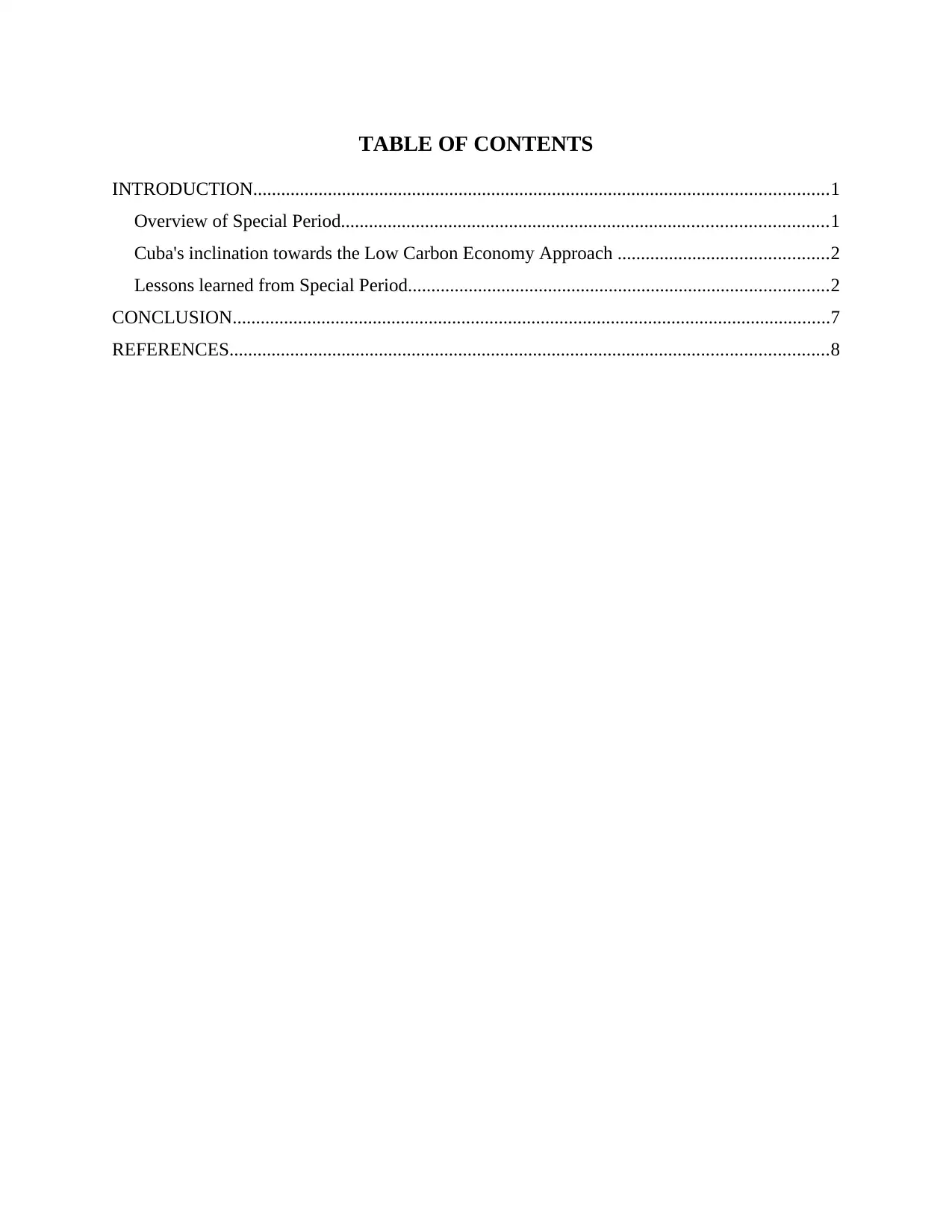
TABLE OF CONTENTS
INTRODUCTION...........................................................................................................................1
Overview of Special Period........................................................................................................1
Cuba's inclination towards the Low Carbon Economy Approach .............................................2
Lessons learned from Special Period..........................................................................................2
CONCLUSION................................................................................................................................7
REFERENCES................................................................................................................................8
INTRODUCTION...........................................................................................................................1
Overview of Special Period........................................................................................................1
Cuba's inclination towards the Low Carbon Economy Approach .............................................2
Lessons learned from Special Period..........................................................................................2
CONCLUSION................................................................................................................................7
REFERENCES................................................................................................................................8
INTRODUCTION
Special Period of Cuba is defined as that phase which saw the decline of the Soviet Union
in 1990's which led to termination of several subsidiaries of Cuba. This was refereed as “Special
period in a time of peace” and was coined by Fidel Castro. This period shed light when the
USSR (Union of Soviet Socialist Republics) collapsed and led to economic and political crisis in
Cuba to such extent that the Cuban economy went into a downfall. It affected a widespread
hunger, suffering and rippling effects on the people in the most harsh manner. This assignment is
based on the lessons learnt from this “special period” in context to the implications of a low
carbon economy at both national and international levels. It will highlight the changes that were
adopted by the Cuban Government to rebuild their foundation and restructure their economic
conditions at the map of the world. Moreover, these changes have laid a systematic lesson plan
for the coming generations to understand and adopt for better future and sustainable environment
towards the path of growth and development of humans.
MAIN BODY
Overview of Special Period
With foundation of Comecon in the year of 1949 paved the path of an extensive
commercial business relationship between Cuba and involved countries. In this regard, Cuba
joined this organization, Comicon in 1972 under the leadership of USSR. Here, petroleum and
natural gas were sold at those rates which were below the marked prices. This benefited both the
involved parties. Consequently, Cuba was one of the largest sugar producing countries who
exported it to the USSR for many years. In return, they received oils at subsidized rates which
benefited Cuba at larger scale. They tend to re-sold the excess amount to their neighbouring
countries. However, this made the Cuban government dependent on them for approximately 80
percent of international trade.
Later, when Soviet Union disintegrated, it affected the Cuban economy to a contraction
with a need of re-structuring as there was loss of oil subsidies. Additionally, it affected the
Cuban economy in decelerating manner (Li and Lin, 2013). The imports on the Cuban land was
dropped at a steep rate as there was a huge burden on the transportation cost. This island's
generation of electricity was totally depended on the oil and thus, it impacted a rise of costing in
1
Special Period of Cuba is defined as that phase which saw the decline of the Soviet Union
in 1990's which led to termination of several subsidiaries of Cuba. This was refereed as “Special
period in a time of peace” and was coined by Fidel Castro. This period shed light when the
USSR (Union of Soviet Socialist Republics) collapsed and led to economic and political crisis in
Cuba to such extent that the Cuban economy went into a downfall. It affected a widespread
hunger, suffering and rippling effects on the people in the most harsh manner. This assignment is
based on the lessons learnt from this “special period” in context to the implications of a low
carbon economy at both national and international levels. It will highlight the changes that were
adopted by the Cuban Government to rebuild their foundation and restructure their economic
conditions at the map of the world. Moreover, these changes have laid a systematic lesson plan
for the coming generations to understand and adopt for better future and sustainable environment
towards the path of growth and development of humans.
MAIN BODY
Overview of Special Period
With foundation of Comecon in the year of 1949 paved the path of an extensive
commercial business relationship between Cuba and involved countries. In this regard, Cuba
joined this organization, Comicon in 1972 under the leadership of USSR. Here, petroleum and
natural gas were sold at those rates which were below the marked prices. This benefited both the
involved parties. Consequently, Cuba was one of the largest sugar producing countries who
exported it to the USSR for many years. In return, they received oils at subsidized rates which
benefited Cuba at larger scale. They tend to re-sold the excess amount to their neighbouring
countries. However, this made the Cuban government dependent on them for approximately 80
percent of international trade.
Later, when Soviet Union disintegrated, it affected the Cuban economy to a contraction
with a need of re-structuring as there was loss of oil subsidies. Additionally, it affected the
Cuban economy in decelerating manner (Li and Lin, 2013). The imports on the Cuban land was
dropped at a steep rate as there was a huge burden on the transportation cost. This island's
generation of electricity was totally depended on the oil and thus, it impacted a rise of costing in
1
⊘ This is a preview!⊘
Do you want full access?
Subscribe today to unlock all pages.

Trusted by 1+ million students worldwide
context to the use of fuels that indirectly added pressure on the electricity prices and outputs of
industrial processes.
Cuba's inclination towards the Low Carbon Economy Approach
This period made the Cuban government and people realised about understanding the
importance of sustainability factors when there are no sources of power in terms of energy,
electricity, water and others. The after-effects were so devastating that it led the Cubans to
always adopt a low carbonised economy. The government not only adopted this strategic green
economy approach but also promoted minimising the greenhouse emissions into the
environment. They adopted the low-carbon economy to get back to its feet and provide food and
other amenities to their public (Ludlam, 2012). Their residents and local bodies tried to develop
practices bringing back their lost sheen in terms of economic factors.
Additionally, in regard to the above discussion, the ulterior aim was to scale up the
capital for such transitional changes that encourage use of low carbon, fossil fuels and focused
on reducing the high risks associated with carbon assets. In the view of Pretty, 2013 there was a
shift from oil based to more sustainable approaches saw a stimulating modifications in the socio-
economic landscape of Cuba. They enhanced their knowledge for self-employment and this led
to the rise of entrepreneurship. Furthermore, after the USSR disintegration, they pushed a band-
aid approach to bring changes that legalized the dollar, affected their subsidiaries in decreasing
order, promoted tourism to recover their economy and restructured their primary sectors like
agri-based businesses more sustainable to remove the dependency on other countries.
Lessons learned from Special Period
Insights on sustainable development for low carbon economy
It can be easily demonstrated that there were many lessons that can be learned from this
epic event that laid the foundation of rebuilding the eco-socialist framework at a worldwide
level. It clearly indicated that the improvements to bring back the normal lifestyle of Cuban
public was based on the same unsustainable practices only. However, there were incorporation of
renewable energy capacities and adoption of few advanced methodologies. This can be used at
international level for better implementation of de-carbonized economy. For example, they
became energy efficient in terms of discarding the use of fossil fuels and started promoting more
convertible, sustainable techniques and methods. The Cuban people also implemented the urban
2
industrial processes.
Cuba's inclination towards the Low Carbon Economy Approach
This period made the Cuban government and people realised about understanding the
importance of sustainability factors when there are no sources of power in terms of energy,
electricity, water and others. The after-effects were so devastating that it led the Cubans to
always adopt a low carbonised economy. The government not only adopted this strategic green
economy approach but also promoted minimising the greenhouse emissions into the
environment. They adopted the low-carbon economy to get back to its feet and provide food and
other amenities to their public (Ludlam, 2012). Their residents and local bodies tried to develop
practices bringing back their lost sheen in terms of economic factors.
Additionally, in regard to the above discussion, the ulterior aim was to scale up the
capital for such transitional changes that encourage use of low carbon, fossil fuels and focused
on reducing the high risks associated with carbon assets. In the view of Pretty, 2013 there was a
shift from oil based to more sustainable approaches saw a stimulating modifications in the socio-
economic landscape of Cuba. They enhanced their knowledge for self-employment and this led
to the rise of entrepreneurship. Furthermore, after the USSR disintegration, they pushed a band-
aid approach to bring changes that legalized the dollar, affected their subsidiaries in decreasing
order, promoted tourism to recover their economy and restructured their primary sectors like
agri-based businesses more sustainable to remove the dependency on other countries.
Lessons learned from Special Period
Insights on sustainable development for low carbon economy
It can be easily demonstrated that there were many lessons that can be learned from this
epic event that laid the foundation of rebuilding the eco-socialist framework at a worldwide
level. It clearly indicated that the improvements to bring back the normal lifestyle of Cuban
public was based on the same unsustainable practices only. However, there were incorporation of
renewable energy capacities and adoption of few advanced methodologies. This can be used at
international level for better implementation of de-carbonized economy. For example, they
became energy efficient in terms of discarding the use of fossil fuels and started promoting more
convertible, sustainable techniques and methods. The Cuban people also implemented the urban
2
Paraphrase This Document
Need a fresh take? Get an instant paraphrase of this document with our AI Paraphraser
agriculture which indirectly promoted the green engineering concepts and helped in de-
carbonised economy. Their over-dependency on oil production paralysed them in the early
1990's. However, it led them towards adopting more effective techniques which later helped
Cuba's GDP become tripled without any incremental values in the consumption of oils. This laid
to the usage of the greener approaches that supported in establishment of de-carbonised economy
(Suárez and et.al., 2012).
In addition to this, one can learn that growth in the economic sector can be attained by
becoming environmental aware to eliminate the degradation. Along with this, the emissions had
been reduced down in order to improve the energy efficiency and adopt principles of de-
carbonized economy. During this Special Period, Cuba's emission per capita was drastically
declined due to no electricity and usage of vehicles. The government made few changes in the
structure to become less dependent on fossil fuels. Hydro-electricity constitutes about one
percent that promote the renewable energy sources but this did not minimise Cuba's dependency
on oil during this time. Such conditions pushed the Cuba's economic transition to adopt few
strategies in context to environmental practices to avoid the starvation situation in near future.
Nevertheless, with passing times, the carbon emissions have reached pre-crisis levels on
the basis of per capita. Such changes must be adopted at wider scale by all the countries or
international regulatory bodies to use renewable sources of energy for power generation. Along
with, the dependency on fossil fuels or electrical plants that are running on oil must be discarded
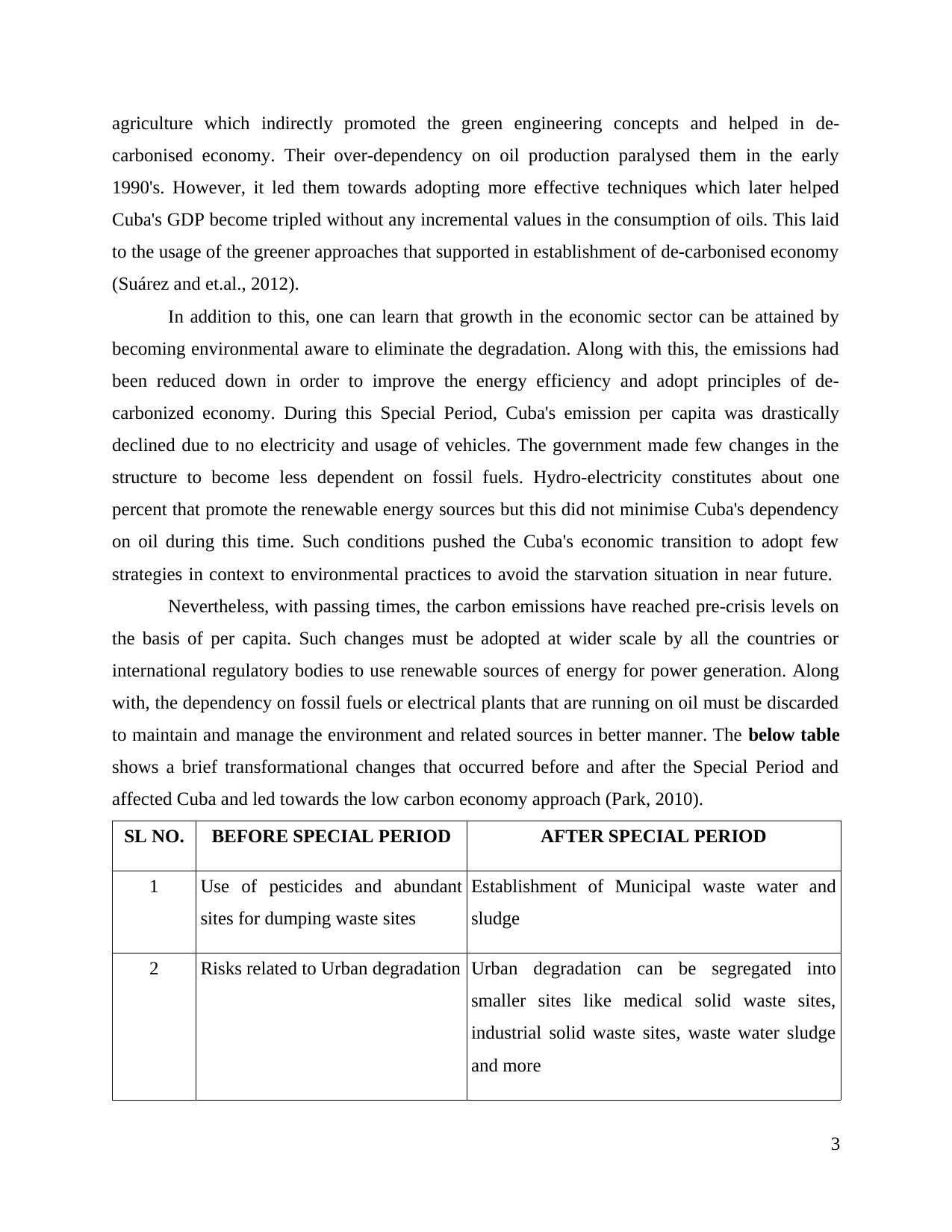
to maintain and manage the environment and related sources in better manner. The below table
shows a brief transformational changes that occurred before and after the Special Period and
affected Cuba and led towards the low carbon economy approach (Park, 2010).
SL NO. BEFORE SPECIAL PERIOD AFTER SPECIAL PERIOD
1 Use of pesticides and abundant
sites for dumping waste sites
Establishment of Municipal waste water and
sludge
2 Risks related to Urban degradation Urban degradation can be segregated into
smaller sites like medical solid waste sites,
industrial solid waste sites, waste water sludge
and more
3
carbonised economy. Their over-dependency on oil production paralysed them in the early
1990's. However, it led them towards adopting more effective techniques which later helped
Cuba's GDP become tripled without any incremental values in the consumption of oils. This laid
to the usage of the greener approaches that supported in establishment of de-carbonised economy
(Suárez and et.al., 2012).
In addition to this, one can learn that growth in the economic sector can be attained by
becoming environmental aware to eliminate the degradation. Along with this, the emissions had
been reduced down in order to improve the energy efficiency and adopt principles of de-
carbonized economy. During this Special Period, Cuba's emission per capita was drastically
declined due to no electricity and usage of vehicles. The government made few changes in the
structure to become less dependent on fossil fuels. Hydro-electricity constitutes about one
percent that promote the renewable energy sources but this did not minimise Cuba's dependency
on oil during this time. Such conditions pushed the Cuba's economic transition to adopt few
strategies in context to environmental practices to avoid the starvation situation in near future.
Nevertheless, with passing times, the carbon emissions have reached pre-crisis levels on
the basis of per capita. Such changes must be adopted at wider scale by all the countries or
international regulatory bodies to use renewable sources of energy for power generation. Along
with, the dependency on fossil fuels or electrical plants that are running on oil must be discarded
to maintain and manage the environment and related sources in better manner. The below table
shows a brief transformational changes that occurred before and after the Special Period and
affected Cuba and led towards the low carbon economy approach (Park, 2010).
SL NO. BEFORE SPECIAL PERIOD AFTER SPECIAL PERIOD
1 Use of pesticides and abundant
sites for dumping waste sites
Establishment of Municipal waste water and
sludge
2 Risks related to Urban degradation Urban degradation can be segregated into
smaller sites like medical solid waste sites,
industrial solid waste sites, waste water sludge
and more
3
3 Airborne lead and particulate
matter are prone to moderate risks
Minimising airborne lead by using substitutes
and using proper elimination of particulate
matter in industries
Impact on electricity generation
The most prolonged effects of this Special Period is consumption and generation of
electricity. Gutiérrez and et.al (2018) described the Cuba's dependency on oils, which was so
dominant that their economy got collapsed. This also affected their energy system in the most
adverse manner with long-term consequences. The locals lived without electricity for more than
sixteen hours a day and used to remain in blackouts which lasted for many years. However, this
gave a lesson to design a comprehensive and long term energy plan at national level to minimise
such problems like power-cuts, blackouts etc. Such plan would help in framing an integrated
balance for conservation of energy, brining growth in economic aspects and protecting the
environment in more sustainable order.
Mundaca, Markandya and Nørgaard (2013), elucidated that with time, Cuba replaced its
oil led electrical plants with cycle turbines that uses gas-fired combined technologies. This aids
in maintenance of low carbon economy and led to cleaner with more efficient systems. Along
with this, the focus is to develop a de-centralised provision for energy systems to ensure a robust
design for reducing the compromises made during the time of any natural calamity like
hurricanes etc. Mostly, such frameworks would help in managing and maintaining the energy
supply systems with critical water supplies. It also will emphasis on creating micro-electrical
systems at both national and state levels to provide a guarantee that population would not get
disturbed and would receive constant energy systems for smooth running of operations, activities
and services.
Implementation of social development framework
The major implication of the Special Period was that growth must be measured with
respect to the human well-being. Gross Domestic Product never accounted for any country's life
expectancy rate, mortality rate and more. Henceforth, the biggest lesson that has been learnt is to
make small modifications in the overall energy supply of a country or combined efforts by group
4
matter are prone to moderate risks
Minimising airborne lead by using substitutes
and using proper elimination of particulate
matter in industries
Impact on electricity generation
The most prolonged effects of this Special Period is consumption and generation of
electricity. Gutiérrez and et.al (2018) described the Cuba's dependency on oils, which was so
dominant that their economy got collapsed. This also affected their energy system in the most
adverse manner with long-term consequences. The locals lived without electricity for more than
sixteen hours a day and used to remain in blackouts which lasted for many years. However, this
gave a lesson to design a comprehensive and long term energy plan at national level to minimise
such problems like power-cuts, blackouts etc. Such plan would help in framing an integrated
balance for conservation of energy, brining growth in economic aspects and protecting the
environment in more sustainable order.
Mundaca, Markandya and Nørgaard (2013), elucidated that with time, Cuba replaced its
oil led electrical plants with cycle turbines that uses gas-fired combined technologies. This aids
in maintenance of low carbon economy and led to cleaner with more efficient systems. Along
with this, the focus is to develop a de-centralised provision for energy systems to ensure a robust
design for reducing the compromises made during the time of any natural calamity like
hurricanes etc. Mostly, such frameworks would help in managing and maintaining the energy
supply systems with critical water supplies. It also will emphasis on creating micro-electrical
systems at both national and state levels to provide a guarantee that population would not get
disturbed and would receive constant energy systems for smooth running of operations, activities
and services.
Implementation of social development framework
The major implication of the Special Period was that growth must be measured with
respect to the human well-being. Gross Domestic Product never accounted for any country's life
expectancy rate, mortality rate and more. Henceforth, the biggest lesson that has been learnt is to
make small modifications in the overall energy supply of a country or combined efforts by group
4
⊘ This is a preview!⊘
Do you want full access?
Subscribe today to unlock all pages.
Trusted by 1+ million students worldwide
of countries. Such changes would support in maintaining the human development growth in
terms of health and help in encouraging optimum levels of sustainability.
This will have huge outcomes in adjusting to policy-making and utilisation of available
resources properly, along with lowering the levels of harmful emissions like CO2, CO,N2O and
other volatile compounds. Hereby, Wilson (2011), stated the Special Period made the world
realize the significance of adopting effective strategic planning to promote sustainability and
have a way-out, without exploiting the natural resources by focusing on fulfilling the necessities
of lives.
Transportation sector
Nonetheless, the recovering period from such a downfall of Cuban economy transformed
the re-structuring procedure into a band-aid approach. This led their government to take
challenging spheres that aid in upliftment of the society on the whole. One of the collapses were
seen in the transportation system. Due to shortages of fuels, lack of maintenance of roads, late
delivery of food etc. posed barriers and hampered their recovery. However, the solutions to this
issue consist of many options. Use of bicycles became a good substitute in place of fuel based
vehicles (Vazquez and et.al., 2015). This is one of the cheaper and environmental friendly
transport facilities that support heavily in the low-carbon economy.
Along with this, it has been learnt that infrastructure related to the public transport must
be designed in such a manner that local and tourists might prefer to use it for better conveyance.
Additionally, it will minimise the use of fuels or oil based vehicles for commercial purposes. For
instance, development of truck buses, camel transporters were established. These laid the
foundation of de-carbonized economy by flourishing the mass transportation in urban and rural
communities as well. The overall capacities of such transport system is huge and is good
replacement for buses etc. It also led to the introduction of novel modes in this transportation
sector under a legal framework (Borowy, 2013). Such new changes assisted in minimising the
pressure on consumption of fossil fuels by dividing the entire usage into larger sections through
employing sharing of vehicles in government vehicles, public transport systems etc.
Decentralization and Re-localization strategies
In addition to the above, one of the prime lessons is to decentralise the key services in all
the major sectors to provide robust functioning and better facilities to public. This would assist in
easing the mobility factor and re-localisation strategies. Such measures can be accessed and
5
terms of health and help in encouraging optimum levels of sustainability.
This will have huge outcomes in adjusting to policy-making and utilisation of available
resources properly, along with lowering the levels of harmful emissions like CO2, CO,N2O and
other volatile compounds. Hereby, Wilson (2011), stated the Special Period made the world
realize the significance of adopting effective strategic planning to promote sustainability and
have a way-out, without exploiting the natural resources by focusing on fulfilling the necessities
of lives.
Transportation sector
Nonetheless, the recovering period from such a downfall of Cuban economy transformed
the re-structuring procedure into a band-aid approach. This led their government to take
challenging spheres that aid in upliftment of the society on the whole. One of the collapses were
seen in the transportation system. Due to shortages of fuels, lack of maintenance of roads, late
delivery of food etc. posed barriers and hampered their recovery. However, the solutions to this
issue consist of many options. Use of bicycles became a good substitute in place of fuel based
vehicles (Vazquez and et.al., 2015). This is one of the cheaper and environmental friendly
transport facilities that support heavily in the low-carbon economy.
Along with this, it has been learnt that infrastructure related to the public transport must
be designed in such a manner that local and tourists might prefer to use it for better conveyance.
Additionally, it will minimise the use of fuels or oil based vehicles for commercial purposes. For
instance, development of truck buses, camel transporters were established. These laid the
foundation of de-carbonized economy by flourishing the mass transportation in urban and rural
communities as well. The overall capacities of such transport system is huge and is good
replacement for buses etc. It also led to the introduction of novel modes in this transportation
sector under a legal framework (Borowy, 2013). Such new changes assisted in minimising the
pressure on consumption of fossil fuels by dividing the entire usage into larger sections through
employing sharing of vehicles in government vehicles, public transport systems etc.
Decentralization and Re-localization strategies
In addition to the above, one of the prime lessons is to decentralise the key services in all
the major sectors to provide robust functioning and better facilities to public. This would assist in
easing the mobility factor and re-localisation strategies. Such measures can be accessed and
5
Paraphrase This Document
Need a fresh take? Get an instant paraphrase of this document with our AI Paraphraser
evaluated to understand the re-functioning of the economy to encourage the sustainable
development by using the low-carbon fossil fuels objective. This re-localization strategy would
reduce the complications associated with transportation, health promotion and other such areas.
In order to understand the re-localization strategy, Sekulova and et.al (2013) stated that it
is important to know how decentralization of key areas would be effective. Herein, by
establishing necessities such as hospitals, schools, colleges, etc. within a specific area would help
the front line services and related professionals to offer their services at particular ratio. For e.g.
one truck bus for 300 humans or one doctor for 170 people. This approach would ensure
minimum burden on natural resources by sharing and dividing the activities according to the
populace. Moreover, a better strategic planning must be used to gain profits by maintaining the
sustainability and proper consumption of resources.
Agriculture and Food security
There is also an important sector that gave a lesson for sustainable development of
country's economic factors. The use of organic agriculture by the Cubans led to the most
mechanized agriculture in the whole Latin America. Subsequently, there were many adjustments
made in the agricultural policies of Cuba to promote the organic approaches that brought radical
changes in the urban communities. Henceforth, it gave the teachings that paved the path of
genuine sustainability with prosperity of resources in proficient manner. This supported to scale
up the de-carbonised economy techniques to scale up the optimum utilization of resources.
According to Almeida and et.al (2013), there are number of measures such as movement
for organic agriculture, emphasis on use of animals like oxen and encouraged the manual labour
to minimise the dependency on machinery and transport facilities that are directly linked with oil
or petrol. This also helped in the employment to people along with supplementary benefits in
context to environmental factors. Moreover, the organic agriculture maintained the soil
productivity and help in reducing the generation of greenhouse gases.
There is also use of different systems of agricultural methodologies on the basis of
internal factors such as type of soil, climatic suitability, settings, using natural inputs like bio-
pesticides, techniques like inter-planting, crop rotation, green manure, mechanical cultivation,
manure etc. Such steps would lead the movement of de-carbonised economy in beneficial
manner and help the government to reach their goals and objectives with better productivity and
profitability.
6
development by using the low-carbon fossil fuels objective. This re-localization strategy would
reduce the complications associated with transportation, health promotion and other such areas.
In order to understand the re-localization strategy, Sekulova and et.al (2013) stated that it
is important to know how decentralization of key areas would be effective. Herein, by
establishing necessities such as hospitals, schools, colleges, etc. within a specific area would help
the front line services and related professionals to offer their services at particular ratio. For e.g.
one truck bus for 300 humans or one doctor for 170 people. This approach would ensure
minimum burden on natural resources by sharing and dividing the activities according to the
populace. Moreover, a better strategic planning must be used to gain profits by maintaining the
sustainability and proper consumption of resources.
Agriculture and Food security
There is also an important sector that gave a lesson for sustainable development of
country's economic factors. The use of organic agriculture by the Cubans led to the most
mechanized agriculture in the whole Latin America. Subsequently, there were many adjustments
made in the agricultural policies of Cuba to promote the organic approaches that brought radical
changes in the urban communities. Henceforth, it gave the teachings that paved the path of
genuine sustainability with prosperity of resources in proficient manner. This supported to scale
up the de-carbonised economy techniques to scale up the optimum utilization of resources.
According to Almeida and et.al (2013), there are number of measures such as movement
for organic agriculture, emphasis on use of animals like oxen and encouraged the manual labour
to minimise the dependency on machinery and transport facilities that are directly linked with oil
or petrol. This also helped in the employment to people along with supplementary benefits in
context to environmental factors. Moreover, the organic agriculture maintained the soil
productivity and help in reducing the generation of greenhouse gases.
There is also use of different systems of agricultural methodologies on the basis of
internal factors such as type of soil, climatic suitability, settings, using natural inputs like bio-
pesticides, techniques like inter-planting, crop rotation, green manure, mechanical cultivation,
manure etc. Such steps would lead the movement of de-carbonised economy in beneficial
manner and help the government to reach their goals and objectives with better productivity and
profitability.
6
Formulation in policy-making under legislative framework
Nonetheless, this decentralization has shed light on the need of social development of
entire community to generate the awareness to adopt the low carbon economy. This has given an
important lesson that the government must frame policies and regulations to give a fair chance
and equal opportunities to their local residents (González-Corzo, 2015). They must re-localize
the activities and operations in context to the economy to demonstrate the use of resources in
distributed manner. It would provide the local workplaces to extend their businesses and along
with, it would aid in promoting the communities to fulfil their standards of living. The most
practical application is to make the residents access to key facilities and provisions to foster the
de-carbonized economy that will get rid of the situational crisis that was faced by Cubans due to
the Special Period.
CONCLUSION
It has been concluded that there were many lessons that taught the world to impart
education regarding the sustainable performance in all walks of lives. It also highlighted the fact
that it is high time to move towards the low carbonized economy to protect the environment in
proficient manner. With regard to the Special Period of Cuba, it opened the eyes of the world to
become less dependent on the availability of natural resources and minimise the exploitation by
employing sustainable practices in sectors like transportation, industries etc.
Furthermore, it has emphasized on the needs of understanding that the human race has
the ability to become more resilient during any crisis. This would be beneficial for the humanity
to lay the foundation of utopian society when in time of any scarcity and bring radical changes
through innovative and novel approaches. To sum up, it is important to adopt this low carbon
economy system to save the world from uncertain and sudden changes in terms of economy and
help in reducing the generation of greenhouse gases.
7
Nonetheless, this decentralization has shed light on the need of social development of
entire community to generate the awareness to adopt the low carbon economy. This has given an
important lesson that the government must frame policies and regulations to give a fair chance
and equal opportunities to their local residents (González-Corzo, 2015). They must re-localize
the activities and operations in context to the economy to demonstrate the use of resources in
distributed manner. It would provide the local workplaces to extend their businesses and along
with, it would aid in promoting the communities to fulfil their standards of living. The most
practical application is to make the residents access to key facilities and provisions to foster the
de-carbonized economy that will get rid of the situational crisis that was faced by Cubans due to
the Special Period.
CONCLUSION
It has been concluded that there were many lessons that taught the world to impart
education regarding the sustainable performance in all walks of lives. It also highlighted the fact
that it is high time to move towards the low carbonized economy to protect the environment in
proficient manner. With regard to the Special Period of Cuba, it opened the eyes of the world to
become less dependent on the availability of natural resources and minimise the exploitation by
employing sustainable practices in sectors like transportation, industries etc.
Furthermore, it has emphasized on the needs of understanding that the human race has
the ability to become more resilient during any crisis. This would be beneficial for the humanity
to lay the foundation of utopian society when in time of any scarcity and bring radical changes
through innovative and novel approaches. To sum up, it is important to adopt this low carbon
economy system to save the world from uncertain and sudden changes in terms of economy and
help in reducing the generation of greenhouse gases.
7
⊘ This is a preview!⊘
Do you want full access?
Subscribe today to unlock all pages.
Trusted by 1+ million students worldwide
REFERENCES
Books and Journals
Almeida, C.M.V.B. and et.al., 2013. Cleaner production initiatives and challenges for a
sustainable world: an introduction to this special volume.
Borowy, I., 2013. Degrowth and public health in Cuba: lessons from the past? Journal of
Cleaner Production.38. pp.17-26.
González-Corzo, M.A., 2015. Cuba’s Agricultural Transformations: Moving toward Market
Socialism?. In Handbook of contemporary Cuba (pp. 117-130). Routledge.
Gutiérrez, A.S. and et.al., 2018. The current potential of low-carbon economy and biomass-
based electricity in Cuba. The case of sugarcane, energy cane and marabu (Dichrostachys
cinerea) as biomass sources. Journal of Cleaner Production.172. pp.2108-2122.
Li, X. and Lin, B., 2013. Global convergence in per capita CO2 emissions. Renewable and
Sustainable Energy Reviews.24. pp.357-363.
Ludlam, S., 2012. Aspects of Cuba's strategy to revive socialist development. Science &
Society.76(1). pp.41-65.
Mundaca, L., Markandya, A. and Nørgaard, J., 2013. Walking away from a low-carbon
economy? Recent and historical trends using a regional decomposition analysis. Energy
Policy.61. pp.1471-1480.
Pretty, J., 2013. The consumption of a finite planet: well-being, convergence, divergence and the
nascent green economy. Environmental and Resource Economics.55(4). pp.475-499.
Sekulova, F. and et.al., 2013. Degrowth: from theory to practice. Journal of cleaner
Production.38. pp.1-6.
Suárez, J.A. and et.al., 2012. Energy, environment and development in Cuba. Renewable and
Sustainable Energy Reviews.16(5). pp.2724-2731.
Vazquez, L. and et.al., 2015. Decomposition analysis of Cuban energy production and use:
Analysis of energy transformation for sustainability. Renewable and Sustainable Energy
Reviews.49. pp.638-645.
Online
Park,H., 2010. Cuba's Response to Energy Crisis. [Pdf]. Available
through:<http://udel.edu/~hunpark/papers/Cuba_s%20Response%20to%20Energy
%20Crisis.pdf>.
Wilson, S.L., 2011. When Disorder is the Order:Cuba during the Special Period. [Pdf].
Available
through:<http://digitalassets.lib.berkeley.edu/etd/ucb/text/Wilson_berkeley_0028E_11649
.pdf>.
8
Books and Journals
Almeida, C.M.V.B. and et.al., 2013. Cleaner production initiatives and challenges for a
sustainable world: an introduction to this special volume.
Borowy, I., 2013. Degrowth and public health in Cuba: lessons from the past? Journal of
Cleaner Production.38. pp.17-26.
González-Corzo, M.A., 2015. Cuba’s Agricultural Transformations: Moving toward Market
Socialism?. In Handbook of contemporary Cuba (pp. 117-130). Routledge.
Gutiérrez, A.S. and et.al., 2018. The current potential of low-carbon economy and biomass-
based electricity in Cuba. The case of sugarcane, energy cane and marabu (Dichrostachys
cinerea) as biomass sources. Journal of Cleaner Production.172. pp.2108-2122.
Li, X. and Lin, B., 2013. Global convergence in per capita CO2 emissions. Renewable and
Sustainable Energy Reviews.24. pp.357-363.
Ludlam, S., 2012. Aspects of Cuba's strategy to revive socialist development. Science &
Society.76(1). pp.41-65.
Mundaca, L., Markandya, A. and Nørgaard, J., 2013. Walking away from a low-carbon
economy? Recent and historical trends using a regional decomposition analysis. Energy
Policy.61. pp.1471-1480.
Pretty, J., 2013. The consumption of a finite planet: well-being, convergence, divergence and the
nascent green economy. Environmental and Resource Economics.55(4). pp.475-499.
Sekulova, F. and et.al., 2013. Degrowth: from theory to practice. Journal of cleaner
Production.38. pp.1-6.
Suárez, J.A. and et.al., 2012. Energy, environment and development in Cuba. Renewable and
Sustainable Energy Reviews.16(5). pp.2724-2731.
Vazquez, L. and et.al., 2015. Decomposition analysis of Cuban energy production and use:
Analysis of energy transformation for sustainability. Renewable and Sustainable Energy
Reviews.49. pp.638-645.
Online
Park,H., 2010. Cuba's Response to Energy Crisis. [Pdf]. Available
through:<http://udel.edu/~hunpark/papers/Cuba_s%20Response%20to%20Energy
%20Crisis.pdf>.
Wilson, S.L., 2011. When Disorder is the Order:Cuba during the Special Period. [Pdf].
Available
through:<http://digitalassets.lib.berkeley.edu/etd/ucb/text/Wilson_berkeley_0028E_11649
.pdf>.
8

1 out of 10


Your All-in-One AI-Powered Toolkit for Academic Success.
+13062052269
info@desklib.com
Available 24*7 on WhatsApp / Email
![[object Object]](/_next/static/media/star-bottom.7253800d.svg)
Unlock your academic potential
Copyright © 2020–2026 A2Z Services. All Rights Reserved. Developed and managed by ZUCOL.