CUC107 Cultural Capabilities Report: Analyzing 'Friends' Season 4 Clip
VerifiedAdded on 2023/06/10
|10
|2966
|275
Report
AI Summary
This report analyzes cultural capability, cultural intelligence, and safe spaces in the context of an episode from Season 4 of the American television series 'Friends'. It examines the characters' behaviors in a complicated communication situation, specifically focusing on Rachel's interview experience and her boss's interference. The report evaluates Rachel's ability to handle the situation with cultural intelligence and maintain a safe space, referencing concepts from intercultural communication and individual adjustment. It also provides recommendations for improving cultural competence and securing one's space in a diverse environment. The analysis considers Rachel's accomplishment of goals, personal adjustment, and interpersonal communication skills, concluding that she demonstrates a high level of cultural capability. The report suggests that Rachel's ability to retain patience, communicate effectively, and understand the fashion industry's culture contributed to her success in navigating the challenging situation and ultimately securing a safe space in her workplace.
Running head: A REPORT ON CULTURAL CAPABILITY
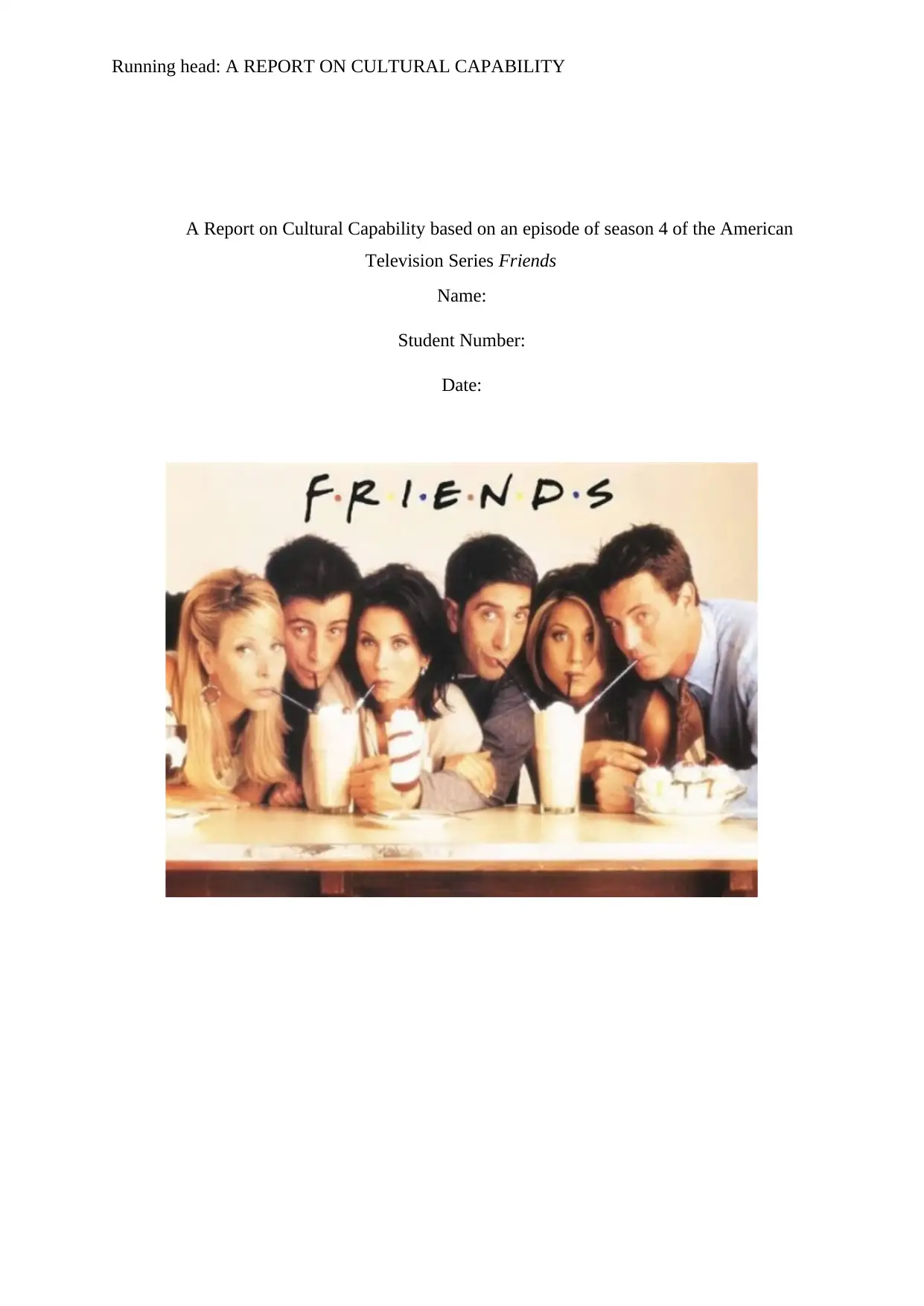
A Report on Cultural Capability based on an episode of season 4 of the American
Television Series Friends
Name:
Student Number:
Date:
A Report on Cultural Capability based on an episode of season 4 of the American
Television Series Friends
Name:
Student Number:
Date:

Paraphrase This Document
Need a fresh take? Get an instant paraphrase of this document with our AI Paraphraser
1
A REPORT ON CULTURAL CAPABILITY
Executive summary
This report sheds light on the character trait of cultural capability and discusses the process
by which it can be achieved. Considering the context of an American Television series
Friends (1994-2004), this report has elaborated the concepts of cultural intelligence, safe and
unsafe spaces within workplace or society. The video clip selected for the report is from the
TV series Friends, season 4. It has analysed the behaviour of the characters in a complicated
communication situation. The report further recommended the effective tactics that should be
followed in order to gain cultural competence and secure own space within a culturally
diverse or complicated scenario.
A REPORT ON CULTURAL CAPABILITY
Executive summary
This report sheds light on the character trait of cultural capability and discusses the process
by which it can be achieved. Considering the context of an American Television series
Friends (1994-2004), this report has elaborated the concepts of cultural intelligence, safe and
unsafe spaces within workplace or society. The video clip selected for the report is from the
TV series Friends, season 4. It has analysed the behaviour of the characters in a complicated
communication situation. The report further recommended the effective tactics that should be
followed in order to gain cultural competence and secure own space within a culturally
diverse or complicated scenario.
2
A REPORT ON CULTURAL CAPABILITY
Table of Contents
1. Introduction..........................................................................................................3
1.1 Background of the study......................................................................................3
1.2 Aim of the study...................................................................................................3
1.3 Scope of the study................................................................................................4
2. Summary and observation....................................................................................4
2.1 Summary of the video clip...................................................................................4
2.2 Critical observations.............................................................................................5
3. Analysis................................................................................................................5
3.1 Accomplish of goals within a job role.................................................................5
3.2 Ability of personal adjustment.............................................................................6
3.3 Maintenance of interpersonal communication.....................................................6
4. Recommendations................................................................................................6
5. Summary and Conclusion....................................................................................7
References......................................................................................................................8
A REPORT ON CULTURAL CAPABILITY
Table of Contents
1. Introduction..........................................................................................................3
1.1 Background of the study......................................................................................3
1.2 Aim of the study...................................................................................................3
1.3 Scope of the study................................................................................................4
2. Summary and observation....................................................................................4
2.1 Summary of the video clip...................................................................................4
2.2 Critical observations.............................................................................................5
3. Analysis................................................................................................................5
3.1 Accomplish of goals within a job role.................................................................5
3.2 Ability of personal adjustment.............................................................................6
3.3 Maintenance of interpersonal communication.....................................................6
4. Recommendations................................................................................................6
5. Summary and Conclusion....................................................................................7
References......................................................................................................................8
⊘ This is a preview!⊘
Do you want full access?
Subscribe today to unlock all pages.

Trusted by 1+ million students worldwide
3
A REPORT ON CULTURAL CAPABILITY
1. Introduction
The report aims to share and analyse the fact that cultural capabilities have become
fundamental to operate the business effectively. Theories, deriverd from Mae, Cortez and
Preiss, (2013) suggests, in order to do safe work and create safe spaces in the workplace;
cultural self-awareness, intelligence and capability are essential part of business
organisations. It is believed that managers and human resource with a capability of
understanding cultural differences can function more effectively under the contemporary
global business scenario. It helps the organisation to achieve efficiency with the global
business deals. Although, an industry can increase its competitive advantage by developing
culturally diverse and intelligent workforce, yet at first they have to make sure, if the
employees are capable of creating their own safe space with the help of individual cultural
intelligence within the organisation or not (Crowne, 2013). This report will further introduce
some strategies to create safe spaces and with a reference of a scene from a popular television
series of 90’s, ‘Friends’, it will add several dimensions to this report. Season 4 of this TV
series will be discussed in the report. It is going to be an analysis of the characters in terms of
cultural capabilities. The characters from the serials will help to understand the concept of
cultural intelligence as well as a discussion will be presented on the ways they should
improve themselves by following strategies in order to create safe spaces in the workplace
(Bauer et al., 2016).
1.1 Background of the study
In today’s world, no business organisation misses an opportunity to make a global
approach with the purpose of gaining competitive edge in the market (Fang et al., 2013).
Organisations believe to have a culturally diverse workforce to crack global deals yet over
last few years several researches have been conducted on certain attributes of individuals,
which enable them to act effectively in a cross-cultural or a complicated communication
situation (Schutte, Malouff & Thorsteinsson, 2013). According to Mae, Cortez and Preiss,
(2013), the concept of cultural intelligence of individuals has been introduced as quantitative
practice to measure individual differences. Although, there is no such definition, which can
deliver a perception of the cultural capability, yet conceptual resemblance can be found with
the intercultural competency in a global scenario.
A REPORT ON CULTURAL CAPABILITY
1. Introduction
The report aims to share and analyse the fact that cultural capabilities have become
fundamental to operate the business effectively. Theories, deriverd from Mae, Cortez and
Preiss, (2013) suggests, in order to do safe work and create safe spaces in the workplace;
cultural self-awareness, intelligence and capability are essential part of business
organisations. It is believed that managers and human resource with a capability of
understanding cultural differences can function more effectively under the contemporary
global business scenario. It helps the organisation to achieve efficiency with the global
business deals. Although, an industry can increase its competitive advantage by developing
culturally diverse and intelligent workforce, yet at first they have to make sure, if the
employees are capable of creating their own safe space with the help of individual cultural
intelligence within the organisation or not (Crowne, 2013). This report will further introduce
some strategies to create safe spaces and with a reference of a scene from a popular television
series of 90’s, ‘Friends’, it will add several dimensions to this report. Season 4 of this TV
series will be discussed in the report. It is going to be an analysis of the characters in terms of
cultural capabilities. The characters from the serials will help to understand the concept of
cultural intelligence as well as a discussion will be presented on the ways they should
improve themselves by following strategies in order to create safe spaces in the workplace
(Bauer et al., 2016).
1.1 Background of the study
In today’s world, no business organisation misses an opportunity to make a global
approach with the purpose of gaining competitive edge in the market (Fang et al., 2013).
Organisations believe to have a culturally diverse workforce to crack global deals yet over
last few years several researches have been conducted on certain attributes of individuals,
which enable them to act effectively in a cross-cultural or a complicated communication
situation (Schutte, Malouff & Thorsteinsson, 2013). According to Mae, Cortez and Preiss,
(2013), the concept of cultural intelligence of individuals has been introduced as quantitative
practice to measure individual differences. Although, there is no such definition, which can
deliver a perception of the cultural capability, yet conceptual resemblance can be found with
the intercultural competency in a global scenario.
Paraphrase This Document
Need a fresh take? Get an instant paraphrase of this document with our AI Paraphraser
4
A REPORT ON CULTURAL CAPABILITY
1.2 Aim of the study
Within a culturally diverse situation if an individual is capable of adjusting, whether
within the workplace or society, and perform effectively, it is considered as an example of
creating safe space. This report aims to elaborate cultural intelligence based on a brief review
of literatures, which deal with social understanding, cross-cultural communication and
cultural intelligence (Malek & Budhwar, 2013).
1.3 Scope of the study
The central focus of this report is to evaluate the characters from a popular American
television series ‘Friends’, where in one of the episodes of season 4, one of the central
characters, Racheal confronts complicated communication situation during an interview. The
idea of cultural intelligence has to be developed as well as a strategic framework will be
provided following which the characters presented in the video clip can improve their
capability.
2. Summary and observation
2.1 Summary of the video clip
As mentioned before, the report is based on one of the episodes of season 4 of the
American television series ‘Friends’, which used to be telecasted from the year of 1994
and continued till 2004 (www.imdb.com, 2018). A critical analysis will be performed to
judge whether in that particular scene, Rachel was able to handle the complicated
communication with cultural intelligence and secured her place in the workplace. The video
clip shows that Rachel is confronting an interview for a designation under the fashion brand
of Ralph Lauren. The interview was organised by a fashion store Bloomingdale where she
used to work as an employee. Rachel’s boss was present during the interview and she did not
want to lose an efficient employee like her. It has been showed that she started to interpret
Rachel’s answer in a wrong way to the interviewer in order to make the following events
happen in her favour. Although, the interviewer was more interested to listen from Rachel yet
he could not really ignore her boss. As a result, the interview went extremely bad for Rachel
and she started to yell at her boss saying she had done it deliberately (Hodgins, MacCurtain
& Mannix-McNamara, 2014). Eventually, her boss admitted that as she did not want to lose
an efficient employee, she behaved that way. Rachel considered that incident as an unethical
practice and wanted to quit her job. However, her boss offered her a raise along with a
promotion. Instead of letting her achieve a prestigious position in some other company, her
A REPORT ON CULTURAL CAPABILITY
1.2 Aim of the study
Within a culturally diverse situation if an individual is capable of adjusting, whether
within the workplace or society, and perform effectively, it is considered as an example of
creating safe space. This report aims to elaborate cultural intelligence based on a brief review
of literatures, which deal with social understanding, cross-cultural communication and
cultural intelligence (Malek & Budhwar, 2013).
1.3 Scope of the study
The central focus of this report is to evaluate the characters from a popular American
television series ‘Friends’, where in one of the episodes of season 4, one of the central
characters, Racheal confronts complicated communication situation during an interview. The
idea of cultural intelligence has to be developed as well as a strategic framework will be
provided following which the characters presented in the video clip can improve their
capability.
2. Summary and observation
2.1 Summary of the video clip
As mentioned before, the report is based on one of the episodes of season 4 of the
American television series ‘Friends’, which used to be telecasted from the year of 1994
and continued till 2004 (www.imdb.com, 2018). A critical analysis will be performed to
judge whether in that particular scene, Rachel was able to handle the complicated
communication with cultural intelligence and secured her place in the workplace. The video
clip shows that Rachel is confronting an interview for a designation under the fashion brand
of Ralph Lauren. The interview was organised by a fashion store Bloomingdale where she
used to work as an employee. Rachel’s boss was present during the interview and she did not
want to lose an efficient employee like her. It has been showed that she started to interpret
Rachel’s answer in a wrong way to the interviewer in order to make the following events
happen in her favour. Although, the interviewer was more interested to listen from Rachel yet
he could not really ignore her boss. As a result, the interview went extremely bad for Rachel
and she started to yell at her boss saying she had done it deliberately (Hodgins, MacCurtain
& Mannix-McNamara, 2014). Eventually, her boss admitted that as she did not want to lose
an efficient employee, she behaved that way. Rachel considered that incident as an unethical
practice and wanted to quit her job. However, her boss offered her a raise along with a
promotion. Instead of letting her achieve a prestigious position in some other company, her
5
A REPORT ON CULTURAL CAPABILITY
boss creates a safe space in her existing office (Ibarra, Ely & Kolb, 2013). Eventually, later in
‘Friends’, Rachel got the job in Ralph Lauren based on her fashion skills and ability to adjust
with uncomfortable situation based on her individual intelligence.
2.2 Critical observations
When Rachel first came into New York, she was dependant on his father entirely. As
she ran away from her wedding and started to live with friends, she felt the need to support
herself. She started with a job of waitress in coffee shop and then based on her fashion skill
and confidence she secured her place in a global fashion store. From there a chance occurred
to join Ralph Lauren. However, her boss’s behaviour was evident that she used to have a safe
space in her office. It is needless to say, that the character of Rachel had showed high
intensity of cultural intelligence by confronting sarcastic comments during the interview and
at the same time secures her new job and even stronger safe place in her previous workplace.
Her body language and vocal tone were confident enough which again support her capability.
However, she was on the verge of losing her confident yet she dared to express herself in
front of her boss and questioned her unethical behaviour.
3. Analysis
According to the article written by (Zeng et al., 2013) and (Yitmen, 2013), cultural
intelligence refers to a person’s ability to interact with people from different cultural
background and it depends on individual knowledge, based on which a person takes least
time to adjust under a new cultural orientation. It points out those set of behavioural aspects
like language skills or broad mentality, which make the situation easier and help the person to
create a safe space within a society or in workplace (Livermore, 2015). When an employee is
thinking of relocation or changing a job, adopting a new set of instruction and work culture
can be considered as different cultural setting. With the rapid rate of globalization business
firms always consider a bigger picture. In the course of making a global approach, firms are
need of expatriates who can perform efficiently in international projects (Roberson, Holmes
& Perry, 2017). As far as regular interaction in society is concerned, an individual may face
some difficulties to adopt cultures of new locality. Therefore, to be in a safe space, it is very
important to grow cultural capability. Hence, certain parameters can be identified by which
cultural capability can be measured. It does not have to involve numerical figures every time,
yet it can be determined based on individual’s behaviour and personal traits.
A REPORT ON CULTURAL CAPABILITY
boss creates a safe space in her existing office (Ibarra, Ely & Kolb, 2013). Eventually, later in
‘Friends’, Rachel got the job in Ralph Lauren based on her fashion skills and ability to adjust
with uncomfortable situation based on her individual intelligence.
2.2 Critical observations
When Rachel first came into New York, she was dependant on his father entirely. As
she ran away from her wedding and started to live with friends, she felt the need to support
herself. She started with a job of waitress in coffee shop and then based on her fashion skill
and confidence she secured her place in a global fashion store. From there a chance occurred
to join Ralph Lauren. However, her boss’s behaviour was evident that she used to have a safe
space in her office. It is needless to say, that the character of Rachel had showed high
intensity of cultural intelligence by confronting sarcastic comments during the interview and
at the same time secures her new job and even stronger safe place in her previous workplace.
Her body language and vocal tone were confident enough which again support her capability.
However, she was on the verge of losing her confident yet she dared to express herself in
front of her boss and questioned her unethical behaviour.
3. Analysis
According to the article written by (Zeng et al., 2013) and (Yitmen, 2013), cultural
intelligence refers to a person’s ability to interact with people from different cultural
background and it depends on individual knowledge, based on which a person takes least
time to adjust under a new cultural orientation. It points out those set of behavioural aspects
like language skills or broad mentality, which make the situation easier and help the person to
create a safe space within a society or in workplace (Livermore, 2015). When an employee is
thinking of relocation or changing a job, adopting a new set of instruction and work culture
can be considered as different cultural setting. With the rapid rate of globalization business
firms always consider a bigger picture. In the course of making a global approach, firms are
need of expatriates who can perform efficiently in international projects (Roberson, Holmes
& Perry, 2017). As far as regular interaction in society is concerned, an individual may face
some difficulties to adopt cultures of new locality. Therefore, to be in a safe space, it is very
important to grow cultural capability. Hence, certain parameters can be identified by which
cultural capability can be measured. It does not have to involve numerical figures every time,
yet it can be determined based on individual’s behaviour and personal traits.
⊘ This is a preview!⊘
Do you want full access?
Subscribe today to unlock all pages.
Trusted by 1+ million students worldwide
6
A REPORT ON CULTURAL CAPABILITY
3.1 Accomplish of goals within a job role
No matter under which cultural setting an employee is working, accomplishment of
the target is the ultimate sign of interacting with the organizational purpose and its culture
too. Individual goals may vary from one designation to another yet this gesture is essential to
create a social and professional safe space.
3.2 Ability of personal adjustment
The idea of personal adjustment is slightly critical and depends on people’s state of
mind. According to recent studies, it has been observed that if a person possesses great
adjustment power then he or she can cope with any complicated situation with their skill,
knowledge and will power. However, an individual who lacks these characteristics confronts
with issues even within own, native cultural environment.
3.3 Maintenance of interpersonal communication
An elaborate knowledge of cultural differences can make an employee or an
individual communicate without much difficulty. Strong interpersonal interaction enable a
person to be more culturally enriched.
Therefore, as described in Kisfalvi and Oliver, (2015), cultural capability or
intelligence can be defined as an art of interacting with cultural knowledge and personal skills
in order to adapt aspects of cultural environment around them. In order to understand this
notion distinctly, instances of critical situation and under that scenario how an individual
behaves that should be considered first. In that episode of ‘Friends’, Rachel did her best by
confronting sarcastic comments against her answer. Initially she was in a confusion how to
handle and became uncomfortable for a moment yet she recovered quickly showed her
intelligence by maintaining direct eye contact. Throughout the video clip, she tried to be as
confident as possible. Her voice was firm while describing her capability. Her capability of
personal adjustment is evident from here and her communication skills and use of language,
choice of words as well worked in her favour. It is needless to say, that Rachel was a
consistent performing employee and that is why her previous boss was so adamant to retain
her as a resource. This proves her safe space within the company. Therefore, it can be stated a
high level of cultural capability has been noticed as a trait of the character. The video
presents such an example of complicated situation as well as handled well by effective
behavioural skills followed by creating a safe space.
A REPORT ON CULTURAL CAPABILITY
3.1 Accomplish of goals within a job role
No matter under which cultural setting an employee is working, accomplishment of
the target is the ultimate sign of interacting with the organizational purpose and its culture
too. Individual goals may vary from one designation to another yet this gesture is essential to
create a social and professional safe space.
3.2 Ability of personal adjustment
The idea of personal adjustment is slightly critical and depends on people’s state of
mind. According to recent studies, it has been observed that if a person possesses great
adjustment power then he or she can cope with any complicated situation with their skill,
knowledge and will power. However, an individual who lacks these characteristics confronts
with issues even within own, native cultural environment.
3.3 Maintenance of interpersonal communication
An elaborate knowledge of cultural differences can make an employee or an
individual communicate without much difficulty. Strong interpersonal interaction enable a
person to be more culturally enriched.
Therefore, as described in Kisfalvi and Oliver, (2015), cultural capability or
intelligence can be defined as an art of interacting with cultural knowledge and personal skills
in order to adapt aspects of cultural environment around them. In order to understand this
notion distinctly, instances of critical situation and under that scenario how an individual
behaves that should be considered first. In that episode of ‘Friends’, Rachel did her best by
confronting sarcastic comments against her answer. Initially she was in a confusion how to
handle and became uncomfortable for a moment yet she recovered quickly showed her
intelligence by maintaining direct eye contact. Throughout the video clip, she tried to be as
confident as possible. Her voice was firm while describing her capability. Her capability of
personal adjustment is evident from here and her communication skills and use of language,
choice of words as well worked in her favour. It is needless to say, that Rachel was a
consistent performing employee and that is why her previous boss was so adamant to retain
her as a resource. This proves her safe space within the company. Therefore, it can be stated a
high level of cultural capability has been noticed as a trait of the character. The video
presents such an example of complicated situation as well as handled well by effective
behavioural skills followed by creating a safe space.
Paraphrase This Document
Need a fresh take? Get an instant paraphrase of this document with our AI Paraphraser
7
A REPORT ON CULTURAL CAPABILITY
4. Recommendations
As far as the video is concerned, the central character Rachel proved to be in a safe
space in her workplace. She was confronting a complicated situation during an interview,
which was created by her previous boss. Rachel’s ability of retaining her patience,
communicating with smart choice of words under such pressure were the indicators of
individual intelligence (Kisfalvi & Oliver, 2015). Rachel’s knowledge about the culture of
fashion industry made her aware of her boss’s indications along with that help her to raise
appropriate argument for that. She was initially unhappy after the interview; however, at the
end of the video, she secured a safe place both in the new company and in her own. Her boss
was pleased on her in the first place, which supports Rachel’s cultural intelligence strongly.
This report can be helpful as a guideline on how people should behave in order to achieve a
safe place under critical circumstances both in society and in workplace.
5. Summary and Conclusion
After considering the aspects of ideal cultural capability of an individual, it can be
concluded that it is indeed a necessary personal trait, which makes both the social and
professional life easy. The entire theme of this report revolves around finding the definition
and aspects that makes an individual culturally capable. As per the reference of the video is
concerned, that can be considered as an instance of creating safe space under critical cultural
situation as well as used as a guideline to learn the tactics of being confident.
A REPORT ON CULTURAL CAPABILITY
4. Recommendations
As far as the video is concerned, the central character Rachel proved to be in a safe
space in her workplace. She was confronting a complicated situation during an interview,
which was created by her previous boss. Rachel’s ability of retaining her patience,
communicating with smart choice of words under such pressure were the indicators of
individual intelligence (Kisfalvi & Oliver, 2015). Rachel’s knowledge about the culture of
fashion industry made her aware of her boss’s indications along with that help her to raise
appropriate argument for that. She was initially unhappy after the interview; however, at the
end of the video, she secured a safe place both in the new company and in her own. Her boss
was pleased on her in the first place, which supports Rachel’s cultural intelligence strongly.
This report can be helpful as a guideline on how people should behave in order to achieve a
safe place under critical circumstances both in society and in workplace.
5. Summary and Conclusion
After considering the aspects of ideal cultural capability of an individual, it can be
concluded that it is indeed a necessary personal trait, which makes both the social and
professional life easy. The entire theme of this report revolves around finding the definition
and aspects that makes an individual culturally capable. As per the reference of the video is
concerned, that can be considered as an instance of creating safe space under critical cultural
situation as well as used as a guideline to learn the tactics of being confident.
8
A REPORT ON CULTURAL CAPABILITY
References
Bauer, F., Schriber, S., King, D. R., & Uzelac, B. (2016). Entrepreneurial integration skills:
Knowing what you acquire to integrate it. In Mergers and Acquisitions,
Entrepreneurship and Innovation (pp. 1-29). Emerald Group Publishing Limited.
Crowne, K. A. (2013). Cultural exposure, emotional intelligence, and cultural intelligence:
An exploratory study. International Journal of Cross Cultural Management, 13(1), 5-
22.
Fang, Y., Wade, M., Delios, A., & Beamish, P. W. (2013). An exploration of multinational
enterprise knowledge resources and foreign subsidiary performance. Journal of World
Business, 48(1), 30-38.
Hodgins, M., MacCurtain, S., & Mannix-McNamara, P. (2014). Workplace bullying and
incivility: a systematic review of interventions. International Journal of Workplace
Health Management, 7(1), 54-72.
Ibarra, H., Ely, R., & Kolb, D. (2013). Women rising: The unseen barriers. Harvard business
review, 91(9), 60-66.
Kisfalvi, V., & Oliver, D. (2015). Creating and maintaining a safe space in experiential
learning. Journal of Management Education, 39(6), 713-740.
Livermore, D. (2015). Leading with cultural intelligence: The real secret to success.
AMACOM Div American Mgmt Assn.
Mae, B., Cortez, D., & Preiss, R. W. (2013). Safe spaces, difficult dialogues, and critical
thinking. International Journal for the Scholarship of Teaching and Learning, 7(2), 5.
Malek, M. A., & Budhwar, P. (2013). Cultural intelligence as a predictor of expatriate
adjustment and performance in Malaysia. Journal of world business, 48(2), 222-231.
Roberson, Q., Holmes IV, O., & Perry, J. L. (2017). Transforming research on diversity and
firm performance: A dynamic capabilities perspective. Academy of Management
Annals, 11(1), 189-216.
Schutte, N. S., Malouff, J. M., & Thorsteinsson, E. B. (2013). Increasing emotional
intelligence through training: Current status and future directions. International
Journal of Emotional Education, 5(1), 56.
www.imdb.com (2018). Friends (TV Series 1994–2004). [online] IMDb. Available at:
https://www.imdb.com/title/tt0108778/ [Accessed 15 Sep. 2018].
A REPORT ON CULTURAL CAPABILITY
References
Bauer, F., Schriber, S., King, D. R., & Uzelac, B. (2016). Entrepreneurial integration skills:
Knowing what you acquire to integrate it. In Mergers and Acquisitions,
Entrepreneurship and Innovation (pp. 1-29). Emerald Group Publishing Limited.
Crowne, K. A. (2013). Cultural exposure, emotional intelligence, and cultural intelligence:
An exploratory study. International Journal of Cross Cultural Management, 13(1), 5-
22.
Fang, Y., Wade, M., Delios, A., & Beamish, P. W. (2013). An exploration of multinational
enterprise knowledge resources and foreign subsidiary performance. Journal of World
Business, 48(1), 30-38.
Hodgins, M., MacCurtain, S., & Mannix-McNamara, P. (2014). Workplace bullying and
incivility: a systematic review of interventions. International Journal of Workplace
Health Management, 7(1), 54-72.
Ibarra, H., Ely, R., & Kolb, D. (2013). Women rising: The unseen barriers. Harvard business
review, 91(9), 60-66.
Kisfalvi, V., & Oliver, D. (2015). Creating and maintaining a safe space in experiential
learning. Journal of Management Education, 39(6), 713-740.
Livermore, D. (2015). Leading with cultural intelligence: The real secret to success.
AMACOM Div American Mgmt Assn.
Mae, B., Cortez, D., & Preiss, R. W. (2013). Safe spaces, difficult dialogues, and critical
thinking. International Journal for the Scholarship of Teaching and Learning, 7(2), 5.
Malek, M. A., & Budhwar, P. (2013). Cultural intelligence as a predictor of expatriate
adjustment and performance in Malaysia. Journal of world business, 48(2), 222-231.
Roberson, Q., Holmes IV, O., & Perry, J. L. (2017). Transforming research on diversity and
firm performance: A dynamic capabilities perspective. Academy of Management
Annals, 11(1), 189-216.
Schutte, N. S., Malouff, J. M., & Thorsteinsson, E. B. (2013). Increasing emotional
intelligence through training: Current status and future directions. International
Journal of Emotional Education, 5(1), 56.
www.imdb.com (2018). Friends (TV Series 1994–2004). [online] IMDb. Available at:
https://www.imdb.com/title/tt0108778/ [Accessed 15 Sep. 2018].
⊘ This is a preview!⊘
Do you want full access?
Subscribe today to unlock all pages.
Trusted by 1+ million students worldwide
9
A REPORT ON CULTURAL CAPABILITY
Yitmen, I. (2013). Organizational cultural intelligence: A competitive capability for strategic
alliances in the international construction industry. Project Management
Journal, 44(4), 5-25.
Zeng, Y., Shenkar, O., Lee, S. H., & Song, S. (2013). Cultural differences, MNE learning
abilities, and the effect of experience on subsidiary mortality in a dissimilar culture:
Evidence from Korean MNEs. Journal of International Business Studies, 44(1), 42-
65.
A REPORT ON CULTURAL CAPABILITY
Yitmen, I. (2013). Organizational cultural intelligence: A competitive capability for strategic
alliances in the international construction industry. Project Management
Journal, 44(4), 5-25.
Zeng, Y., Shenkar, O., Lee, S. H., & Song, S. (2013). Cultural differences, MNE learning
abilities, and the effect of experience on subsidiary mortality in a dissimilar culture:
Evidence from Korean MNEs. Journal of International Business Studies, 44(1), 42-
65.

1 out of 10


Related Documents


Your All-in-One AI-Powered Toolkit for Academic Success.
+13062052269
info@desklib.com
Available 24*7 on WhatsApp / Email
![[object Object]](/_next/static/media/star-bottom.7253800d.svg)
Unlock your academic potential
Copyright © 2020–2026 A2Z Services. All Rights Reserved. Developed and managed by ZUCOL.