Cultural Assessment: Analyzing Family Dynamics in 'The Help'
VerifiedAdded on 2021/04/17
|7
|2218
|122
Project
AI Summary
This project provides a cultural assessment of the movie 'The Help,' focusing on the family dynamics, cultural values, and ethnic traits depicted in the film. The analysis examines the sociocultural and environmental contexts, including the racism experienced by African-American maids and their white employers. The paper explores the family processes, roles, and power dynamics within the families portrayed, using examples from the movie to support the analysis. The student also assesses the level of family development or functional competency, applying the Beavers Systems Model. The conclusion summarizes the key findings, highlighting the movie's portrayal of racism, family dysfunction, and the efforts to create a better life, particularly the role of Aibileen in improving Mae Mobley's life. References are provided in APA format.
N3352 Legacy of the Family
Cultural Assessment Assignment
Submit by 2359 Saturday of Module 3.
Name: Date:
Overview
View a movie of your choice from the list below. While watching the movie, assess the movie
family’s characteristics and behaviors relative to the assessment criteria discussed in the class
notes and textbook readings. Address each criterion including specific examples from the
movie to validate your analysis. You must use references (textbook, class notes, others) and
these must be cited throughout your paper. Submit your analysis in this document, typed using
APA format. Limit is three (3) content pages.
Choose one of these movies:
Hotel Rowanda Under the Same Moon Home for the Holidays
Moonstruck Selena Bend It Like Beckham
Crash Snow Falling on Cedars Australia
The Help The Butler
If you want to select a movie other than those on the list, please obtain prior approval from your
instructor.
Objectives
Explore cultural differences among families.
©Feb 2014 University of Texas at Arlington Page 1 of 7
Cultural Assessment Assignment
Submit by 2359 Saturday of Module 3.
Name: Date:
Overview
View a movie of your choice from the list below. While watching the movie, assess the movie
family’s characteristics and behaviors relative to the assessment criteria discussed in the class
notes and textbook readings. Address each criterion including specific examples from the
movie to validate your analysis. You must use references (textbook, class notes, others) and
these must be cited throughout your paper. Submit your analysis in this document, typed using
APA format. Limit is three (3) content pages.
Choose one of these movies:
Hotel Rowanda Under the Same Moon Home for the Holidays
Moonstruck Selena Bend It Like Beckham
Crash Snow Falling on Cedars Australia
The Help The Butler
If you want to select a movie other than those on the list, please obtain prior approval from your
instructor.
Objectives
Explore cultural differences among families.
©Feb 2014 University of Texas at Arlington Page 1 of 7

Paraphrase This Document
Need a fresh take? Get an instant paraphrase of this document with our AI Paraphraser
N3352 Legacy of the Family
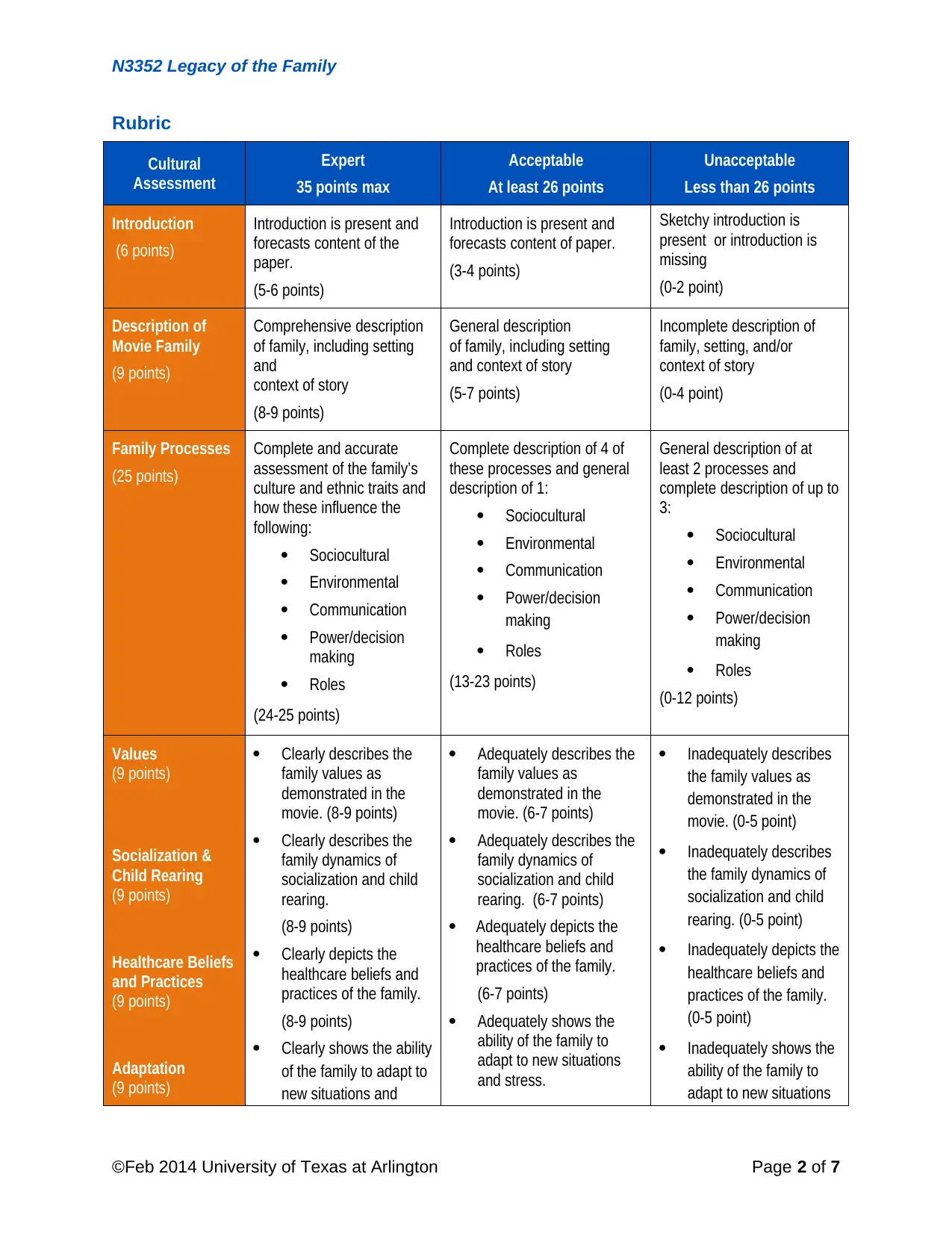
Rubric
Cultural
Assessment
Expert
35 points max
Acceptable
At least 26 points
Unacceptable
Less than 26 points
Introduction
(6 points)
Introduction is present and
forecasts content of the
paper.
(5-6 points)
Introduction is present and
forecasts content of paper.
(3-4 points)
Sketchy introduction is
present or introduction is
missing
(0-2 point)
Description of
Movie Family
(9 points)
Comprehensive description
of family, including setting
and
context of story
(8-9 points)
General description
of family, including setting
and context of story
(5-7 points)
Incomplete description of
family, setting, and/or
context of story
(0-4 point)
Family Processes
(25 points)
Complete and accurate
assessment of the family’s
culture and ethnic traits and
how these influence the
following:
Sociocultural
Environmental
Communication
Power/decision
making
Roles
(24-25 points)
Complete description of 4 of
these processes and general
description of 1:
Sociocultural
Environmental
Communication
Power/decision
making
Roles
(13-23 points)
General description of at
least 2 processes and
complete description of up to
3:
Sociocultural
Environmental
Communication
Power/decision
making
Roles
(0-12 points)
Values
(9 points)
Socialization &
Child Rearing
(9 points)
Healthcare Beliefs
and Practices
(9 points)
Adaptation
(9 points)
Clearly describes the
family values as
demonstrated in the
movie. (8-9 points)
Clearly describes the
family dynamics of
socialization and child
rearing.
(8-9 points)
Clearly depicts the
healthcare beliefs and
practices of the family.
(8-9 points)
Clearly shows the ability
of the family to adapt to
new situations and
Adequately describes the
family values as
demonstrated in the
movie. (6-7 points)
Adequately describes the
family dynamics of
socialization and child
rearing. (6-7 points)
Adequately depicts the
healthcare beliefs and
practices of the family.
(6-7 points)
Adequately shows the
ability of the family to
adapt to new situations
and stress.
Inadequately describes
the family values as
demonstrated in the
movie. (0-5 point)
Inadequately describes
the family dynamics of
socialization and child
rearing. (0-5 point)
Inadequately depicts the
healthcare beliefs and
practices of the family.
(0-5 point)
Inadequately shows the
ability of the family to
adapt to new situations
©Feb 2014 University of Texas at Arlington Page 2 of 7
Rubric
Cultural
Assessment
Expert
35 points max
Acceptable
At least 26 points
Unacceptable
Less than 26 points
Introduction
(6 points)
Introduction is present and
forecasts content of the
paper.
(5-6 points)
Introduction is present and
forecasts content of paper.
(3-4 points)
Sketchy introduction is
present or introduction is
missing
(0-2 point)
Description of
Movie Family
(9 points)
Comprehensive description
of family, including setting
and
context of story
(8-9 points)
General description
of family, including setting
and context of story
(5-7 points)
Incomplete description of
family, setting, and/or
context of story
(0-4 point)
Family Processes
(25 points)
Complete and accurate
assessment of the family’s
culture and ethnic traits and
how these influence the
following:
Sociocultural
Environmental
Communication
Power/decision
making
Roles
(24-25 points)
Complete description of 4 of
these processes and general
description of 1:
Sociocultural
Environmental
Communication
Power/decision
making
Roles
(13-23 points)
General description of at
least 2 processes and
complete description of up to
3:
Sociocultural
Environmental
Communication
Power/decision
making
Roles
(0-12 points)
Values
(9 points)
Socialization &
Child Rearing
(9 points)
Healthcare Beliefs
and Practices
(9 points)
Adaptation
(9 points)
Clearly describes the
family values as
demonstrated in the
movie. (8-9 points)
Clearly describes the
family dynamics of
socialization and child
rearing.
(8-9 points)
Clearly depicts the
healthcare beliefs and
practices of the family.
(8-9 points)
Clearly shows the ability
of the family to adapt to
new situations and
Adequately describes the
family values as
demonstrated in the
movie. (6-7 points)
Adequately describes the
family dynamics of
socialization and child
rearing. (6-7 points)
Adequately depicts the
healthcare beliefs and
practices of the family.
(6-7 points)
Adequately shows the
ability of the family to
adapt to new situations
and stress.
Inadequately describes
the family values as
demonstrated in the
movie. (0-5 point)
Inadequately describes
the family dynamics of
socialization and child
rearing. (0-5 point)
Inadequately depicts the
healthcare beliefs and
practices of the family.
(0-5 point)
Inadequately shows the
ability of the family to
adapt to new situations
©Feb 2014 University of Texas at Arlington Page 2 of 7
N3352 Legacy of the Family
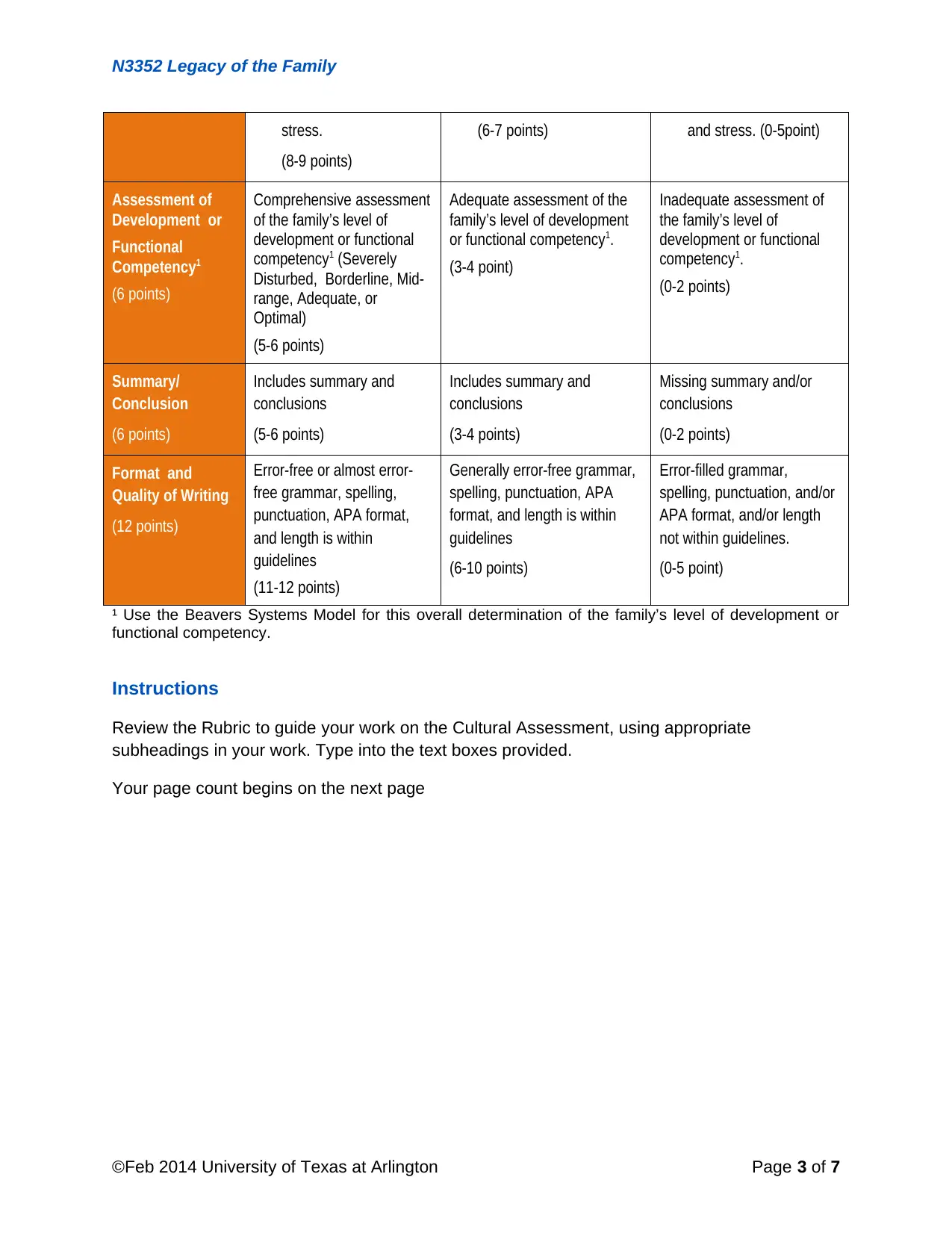
stress.
(8-9 points)
(6-7 points) and stress. (0-5point)
Assessment of
Development or
Functional
Competency1
(6 points)
Comprehensive assessment
of the family’s level of
development or functional
competency1 (Severely
Disturbed, Borderline, Mid-
range, Adequate, or
Optimal)
(5-6 points)
Adequate assessment of the
family’s level of development
or functional competency1.
(3-4 point)
Inadequate assessment of
the family’s level of
development or functional
competency1.
(0-2 points)
Summary/
Conclusion
(6 points)
Includes summary and
conclusions
(5-6 points)
Includes summary and
conclusions
(3-4 points)
Missing summary and/or
conclusions
(0-2 points)
Format and
Quality of Writing
(12 points)
Error-free or almost error-
free grammar, spelling,
punctuation, APA format,
and length is within
guidelines
(11-12 points)
Generally error-free grammar,
spelling, punctuation, APA
format, and length is within
guidelines
(6-10 points)
Error-filled grammar,
spelling, punctuation, and/or
APA format, and/or length
not within guidelines.
(0-5 point)
¹ Use the Beavers Systems Model for this overall determination of the family’s level of development or
functional competency.
Instructions
Review the Rubric to guide your work on the Cultural Assessment, using appropriate
subheadings in your work. Type into the text boxes provided.
Your page count begins on the next page
©Feb 2014 University of Texas at Arlington Page 3 of 7
stress.
(8-9 points)
(6-7 points) and stress. (0-5point)
Assessment of
Development or
Functional
Competency1
(6 points)
Comprehensive assessment
of the family’s level of
development or functional
competency1 (Severely
Disturbed, Borderline, Mid-
range, Adequate, or
Optimal)
(5-6 points)
Adequate assessment of the
family’s level of development
or functional competency1.
(3-4 point)
Inadequate assessment of
the family’s level of
development or functional
competency1.
(0-2 points)
Summary/
Conclusion
(6 points)
Includes summary and
conclusions
(5-6 points)
Includes summary and
conclusions
(3-4 points)
Missing summary and/or
conclusions
(0-2 points)
Format and
Quality of Writing
(12 points)
Error-free or almost error-
free grammar, spelling,
punctuation, APA format,
and length is within
guidelines
(11-12 points)
Generally error-free grammar,
spelling, punctuation, APA
format, and length is within
guidelines
(6-10 points)
Error-filled grammar,
spelling, punctuation, and/or
APA format, and/or length
not within guidelines.
(0-5 point)
¹ Use the Beavers Systems Model for this overall determination of the family’s level of development or
functional competency.
Instructions
Review the Rubric to guide your work on the Cultural Assessment, using appropriate
subheadings in your work. Type into the text boxes provided.
Your page count begins on the next page
©Feb 2014 University of Texas at Arlington Page 3 of 7
⊘ This is a preview!⊘
Do you want full access?
Subscribe today to unlock all pages.

Trusted by 1+ million students worldwide
N3352 Legacy of the Family
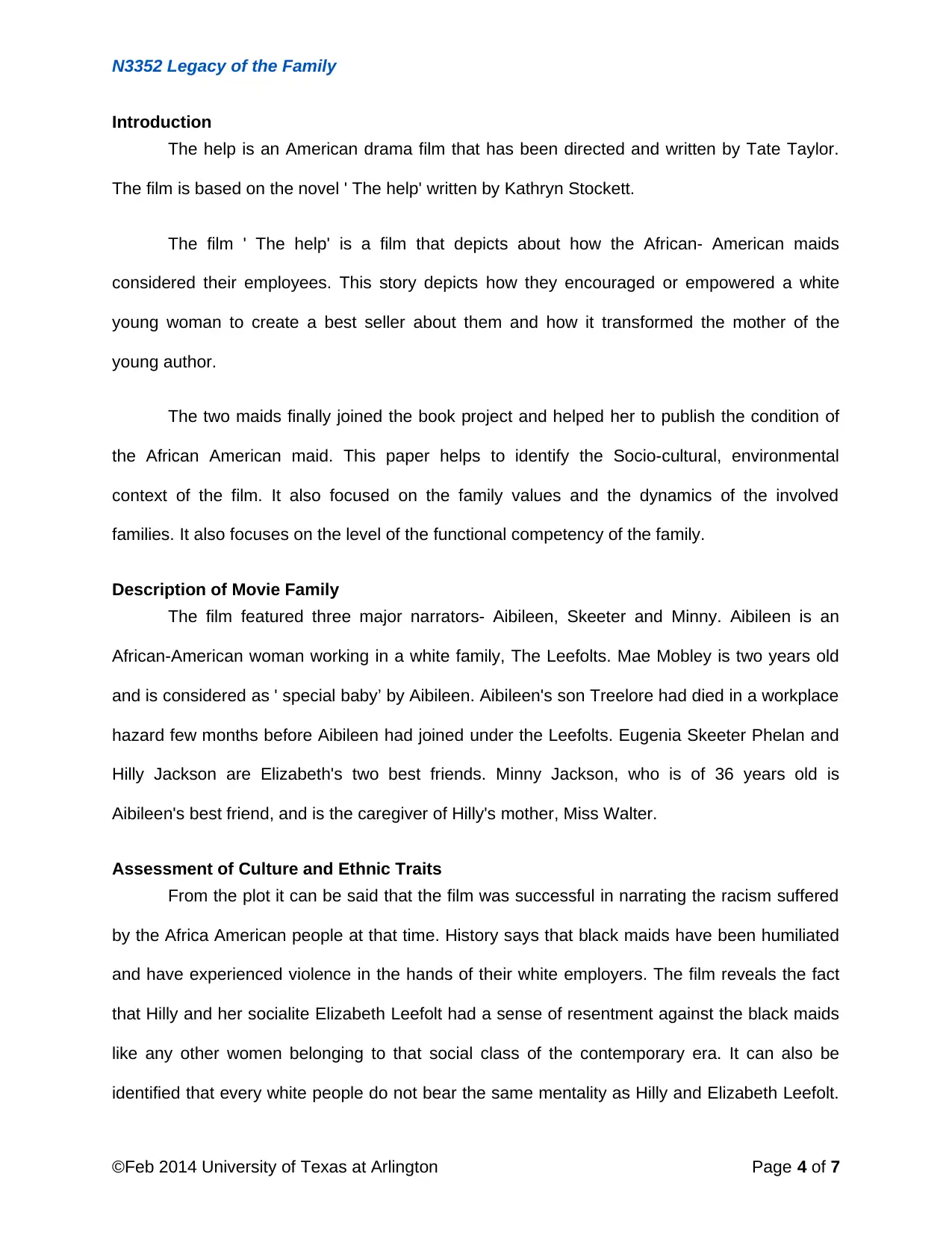
Introduction
The help is an American drama film that has been directed and written by Tate Taylor.
The film is based on the novel ' The help' written by Kathryn Stockett.
The film ' The help' is a film that depicts about how the African- American maids
considered their employees. This story depicts how they encouraged or empowered a white
young woman to create a best seller about them and how it transformed the mother of the
young author.
The two maids finally joined the book project and helped her to publish the condition of
the African American maid. This paper helps to identify the Socio-cultural, environmental
context of the film. It also focused on the family values and the dynamics of the involved
families. It also focuses on the level of the functional competency of the family.
Description of Movie Family
The film featured three major narrators- Aibileen, Skeeter and Minny. Aibileen is an
African-American woman working in a white family, The Leefolts. Mae Mobley is two years old
and is considered as ' special baby’ by Aibileen. Aibileen's son Treelore had died in a workplace
hazard few months before Aibileen had joined under the Leefolts. Eugenia Skeeter Phelan and
Hilly Jackson are Elizabeth's two best friends. Minny Jackson, who is of 36 years old is
Aibileen's best friend, and is the caregiver of Hilly's mother, Miss Walter.
Assessment of Culture and Ethnic Traits
From the plot it can be said that the film was successful in narrating the racism suffered
by the Africa American people at that time. History says that black maids have been humiliated
and have experienced violence in the hands of their white employers. The film reveals the fact
that Hilly and her socialite Elizabeth Leefolt had a sense of resentment against the black maids
like any other women belonging to that social class of the contemporary era. It can also be
identified that every white people do not bear the same mentality as Hilly and Elizabeth Leefolt.
©Feb 2014 University of Texas at Arlington Page 4 of 7
Introduction
The help is an American drama film that has been directed and written by Tate Taylor.
The film is based on the novel ' The help' written by Kathryn Stockett.
The film ' The help' is a film that depicts about how the African- American maids
considered their employees. This story depicts how they encouraged or empowered a white
young woman to create a best seller about them and how it transformed the mother of the
young author.
The two maids finally joined the book project and helped her to publish the condition of
the African American maid. This paper helps to identify the Socio-cultural, environmental
context of the film. It also focused on the family values and the dynamics of the involved
families. It also focuses on the level of the functional competency of the family.
Description of Movie Family
The film featured three major narrators- Aibileen, Skeeter and Minny. Aibileen is an
African-American woman working in a white family, The Leefolts. Mae Mobley is two years old
and is considered as ' special baby’ by Aibileen. Aibileen's son Treelore had died in a workplace
hazard few months before Aibileen had joined under the Leefolts. Eugenia Skeeter Phelan and
Hilly Jackson are Elizabeth's two best friends. Minny Jackson, who is of 36 years old is
Aibileen's best friend, and is the caregiver of Hilly's mother, Miss Walter.
Assessment of Culture and Ethnic Traits
From the plot it can be said that the film was successful in narrating the racism suffered
by the Africa American people at that time. History says that black maids have been humiliated
and have experienced violence in the hands of their white employers. The film reveals the fact
that Hilly and her socialite Elizabeth Leefolt had a sense of resentment against the black maids
like any other women belonging to that social class of the contemporary era. It can also be
identified that every white people do not bear the same mentality as Hilly and Elizabeth Leefolt.
©Feb 2014 University of Texas at Arlington Page 4 of 7
Paraphrase This Document
Need a fresh take? Get an instant paraphrase of this document with our AI Paraphraser
N3352 Legacy of the Family
The predominance of the racism concept at that time is evident from the fact that Skeeter's
mother once fired her childhood maid Constantine without any solid reasons. At the
contemporary period, to be an African –American was quite a big reason to be abused,
humiliated and tortured (Stockett, 2016). The film shows values of the different families showed
in this film. On one side it portrays that Elizabeth Leefolt is a rich woman and can go beyond
any limit to maintain her social status. Mrs. Leefolt doesn’t even hesitate to neglect and
physically abuse her own child Mae Mobley, who was just two years old. On the other hand one
can see Aibileen who takes care of Mobley just as her own child. It seems that Aibileen wanted
to compensate the loss of her own child Treelore by loving Mae Mobley. At that time most of
the rich ladies used to keep their children under the custody of maids and governesses such
that they could invest their time in maintaining the social position and Mrs. Leefolt was in no way
different from that. Simultaneously it can also been seen that Hilly's replacement maid Yule
May, pawned a discarded ring of Hilly just to get her twin sons to high schools. These incidents
gave a clear indication about the differences of perception towards their children. At that time
people belonging to the higher strata of the social hierarchy never considered the African-
American maids as human beings and considered them as impure, impure enough to deter
them from using the same bathroom (Stockett, 2016).
Minny was not able to hold her job because of her sass mouth for Mrs Walter, but
eventually found a job as a maid in the house of Celia Foote. The tolerance level of Minny
Jackson reached to the brim and she ended up making a plan for murdering Hilly by poisoning
her chocolate pie. The book based on which the movie has been made provided a strong base
for the oppressed black maids to stand up for themselves and bring the issues under the
limelight. It also helped them to get a legal base such that they can get access to legal help as
and when needed.
Assessment of Development or Functional Competency
©Feb 2014 University of Texas at Arlington Page 5 of 7
The predominance of the racism concept at that time is evident from the fact that Skeeter's
mother once fired her childhood maid Constantine without any solid reasons. At the
contemporary period, to be an African –American was quite a big reason to be abused,
humiliated and tortured (Stockett, 2016). The film shows values of the different families showed
in this film. On one side it portrays that Elizabeth Leefolt is a rich woman and can go beyond
any limit to maintain her social status. Mrs. Leefolt doesn’t even hesitate to neglect and
physically abuse her own child Mae Mobley, who was just two years old. On the other hand one
can see Aibileen who takes care of Mobley just as her own child. It seems that Aibileen wanted
to compensate the loss of her own child Treelore by loving Mae Mobley. At that time most of
the rich ladies used to keep their children under the custody of maids and governesses such
that they could invest their time in maintaining the social position and Mrs. Leefolt was in no way
different from that. Simultaneously it can also been seen that Hilly's replacement maid Yule
May, pawned a discarded ring of Hilly just to get her twin sons to high schools. These incidents
gave a clear indication about the differences of perception towards their children. At that time
people belonging to the higher strata of the social hierarchy never considered the African-
American maids as human beings and considered them as impure, impure enough to deter
them from using the same bathroom (Stockett, 2016).
Minny was not able to hold her job because of her sass mouth for Mrs Walter, but
eventually found a job as a maid in the house of Celia Foote. The tolerance level of Minny
Jackson reached to the brim and she ended up making a plan for murdering Hilly by poisoning
her chocolate pie. The book based on which the movie has been made provided a strong base
for the oppressed black maids to stand up for themselves and bring the issues under the
limelight. It also helped them to get a legal base such that they can get access to legal help as
and when needed.
Assessment of Development or Functional Competency
©Feb 2014 University of Texas at Arlington Page 5 of 7
N3352 Legacy of the Family
The film beautifully depicts the way how Aibileen took care of the chubby wild child Mae
Mobley, as Elizabeth hardly had any time to look at her. The film reveals the fact that Aibileen
always helped out Mae Mobley to boost up her self esteem. She also tried to imbibe the concept
of racial equality and civil rights in the young mind. It has to be remembered that Family is a
group of persons that are tied by blood, marriage or adoption and involves only a single
household. Attitude of one member of the family would certainly affect the other (Friedman,
Bowden & Jones, 2009). Hence Elizabeth’s inclination towards racism would certainly affect the
young mind her child. As a maid Aibileen not only took care of the daily chores but also tried to
teach the child how to develop interpersonally. Family nursing involves the relationships among
the family and the care givers. Aibileen tried her best to manipulate the environment and for
increasing the likelihood of interaction between Elizabeth and her child. Family style and the
family competence are the two major styles of the Beavers Systems Model of Family
Functioning. According to the Beavers model the horizontal axis can be considered as the
family competence, which depends upon the adaptive system of the flexibility (Beavers &
Hampson, 2000). Elizabeth's family belonged to the class of borderline families where each one
was suffering from the chaotic overt power. The family can also be considered as a severely
dysfunctional family where the child is neglected by her mother.
Summary/Conclusion
The film is an excellent manifestation of racism and functional competency of a family.
The story proceeds in the way that Skeeter is quite uncomfortable with the racist attitude that
her socialite friend Hilly shows towards her maids. The negligence of Elizabeth towards her
child and her family life makes it a severely dysfunctional family. In spite of all the oppressions
Aibileen tried her best to provide a good life to Mae Mobley and requested Elizabeth to give her
that chance. In a word Aibileen tried to convert the family into an optimal and balanced family.
©Feb 2014 University of Texas at Arlington Page 6 of 7
The film beautifully depicts the way how Aibileen took care of the chubby wild child Mae
Mobley, as Elizabeth hardly had any time to look at her. The film reveals the fact that Aibileen
always helped out Mae Mobley to boost up her self esteem. She also tried to imbibe the concept
of racial equality and civil rights in the young mind. It has to be remembered that Family is a
group of persons that are tied by blood, marriage or adoption and involves only a single
household. Attitude of one member of the family would certainly affect the other (Friedman,
Bowden & Jones, 2009). Hence Elizabeth’s inclination towards racism would certainly affect the
young mind her child. As a maid Aibileen not only took care of the daily chores but also tried to
teach the child how to develop interpersonally. Family nursing involves the relationships among
the family and the care givers. Aibileen tried her best to manipulate the environment and for
increasing the likelihood of interaction between Elizabeth and her child. Family style and the
family competence are the two major styles of the Beavers Systems Model of Family
Functioning. According to the Beavers model the horizontal axis can be considered as the
family competence, which depends upon the adaptive system of the flexibility (Beavers &
Hampson, 2000). Elizabeth's family belonged to the class of borderline families where each one
was suffering from the chaotic overt power. The family can also be considered as a severely
dysfunctional family where the child is neglected by her mother.
Summary/Conclusion
The film is an excellent manifestation of racism and functional competency of a family.
The story proceeds in the way that Skeeter is quite uncomfortable with the racist attitude that
her socialite friend Hilly shows towards her maids. The negligence of Elizabeth towards her
child and her family life makes it a severely dysfunctional family. In spite of all the oppressions
Aibileen tried her best to provide a good life to Mae Mobley and requested Elizabeth to give her
that chance. In a word Aibileen tried to convert the family into an optimal and balanced family.
©Feb 2014 University of Texas at Arlington Page 6 of 7
⊘ This is a preview!⊘
Do you want full access?
Subscribe today to unlock all pages.
Trusted by 1+ million students worldwide
N3352 Legacy of the Family
References
Beavers, R., & Hampson, R. B. (2000). The Beavers systems model of family functioning.
Journal of Family Therapy, 22(2), 128-143.
Friedman, M., Bowden, V., & Jones, E. (2009). Family nursing. Upper Saddle River, N.J.:
Prentice Hall.
Stockett, K. (2016). Help. [Place of publication not identified]: Penguin Books.
©Feb 2014 University of Texas at Arlington Page 7 of 7
References
Beavers, R., & Hampson, R. B. (2000). The Beavers systems model of family functioning.
Journal of Family Therapy, 22(2), 128-143.
Friedman, M., Bowden, V., & Jones, E. (2009). Family nursing. Upper Saddle River, N.J.:
Prentice Hall.
Stockett, K. (2016). Help. [Place of publication not identified]: Penguin Books.
©Feb 2014 University of Texas at Arlington Page 7 of 7

1 out of 7


Your All-in-One AI-Powered Toolkit for Academic Success.
+13062052269
info@desklib.com
Available 24*7 on WhatsApp / Email
![[object Object]](/_next/static/media/star-bottom.7253800d.svg)
Unlock your academic potential
Copyright © 2020–2026 A2Z Services. All Rights Reserved. Developed and managed by ZUCOL.