Cultural Influences on Human Cognition: A Multidisciplinary Analysis
VerifiedAdded on 2020/04/07
|10
|2725
|119
AI Summary
The text provides an analytical overview of how culture interacts with human cognition and behavior. It discusses the role of cultural factors in shaping individual perceptions and actions while also considering inherent human judgments that develop naturally over time. Various scholars argue about the extent to which cultural influences impact cognitive abilities, proposing that experiences, education, and social interactions may modify these impacts. The analysis touches upon controversial viewpoints from both sides: those emphasizing culture's significant role and others highlighting innate brain functions as more pivotal. Ultimately, while acknowledging the presence of universal similarities across cultures, it emphasizes that human cognition is a complex interplay between cultural inputs and inherent mental processes.
Running head: CULTURAL ASPECTS OF COGNITION
Cultural Aspects of Cognition
Name of the Student:
Name of the University:
Author note:
Cultural Aspects of Cognition
Name of the Student:
Name of the University:
Author note:

Paraphrase This Document
Need a fresh take? Get an instant paraphrase of this document with our AI Paraphraser
CULTURAL ASPECTS OF COGNITION
Culture of an individual shapes his or her cognition, thinking, perception as well as the
personality of the individuals. There are various aspects of culture, like values, beliefs and
norms. These values affects the thought process of individuals. Whatever individuals perceive,
understand and at times interpret, are largely affected by the individual’s cultural values. For an
instance, a well educated person who lives in a city will have different thinking and viewpoints
than an individual that lives in a remote or underdeveloped area. They will have different
opinions about life, one living in a city will work want to make career in his desired area and the
one living in any remote an underdeveloped area will have different opinion, he might think of
day to day survival. This big difference in their thought process is mostly because of the culture
they have grown (Kahan et al., 2011).
Cognitive abilities of an individual, thought process, attitude, personality and behavior
are determined by the cultural values individuals have adopted. This is the main reason why
individuals differ from each others, they have different perceptions. According to women living
in conservative societies would not aspire high for their career, rather they will think of marriage
and family lives. On the other hand according to it is not necessary that people living in
conservative societies have conservative thoughts for example, the Noble Laurate Malala who
belonged to a very conservative and remote area but her thinking was not affected by the
environment she lived in rather she rose and fought for the right of other women. There are so
many examples of individuals whose cultural values have not affected them rather they thought
different from the masses, they challenged the norms and did not accept to follow the generally
accepted rules or the values that was prevalent in the society.
According to Yaghoobi & Abdolahimoghadam, (2016) Culture does affect thinking
process of individuals but there are other factors as well that have a greater impact on the
Culture of an individual shapes his or her cognition, thinking, perception as well as the
personality of the individuals. There are various aspects of culture, like values, beliefs and
norms. These values affects the thought process of individuals. Whatever individuals perceive,
understand and at times interpret, are largely affected by the individual’s cultural values. For an
instance, a well educated person who lives in a city will have different thinking and viewpoints
than an individual that lives in a remote or underdeveloped area. They will have different
opinions about life, one living in a city will work want to make career in his desired area and the
one living in any remote an underdeveloped area will have different opinion, he might think of
day to day survival. This big difference in their thought process is mostly because of the culture
they have grown (Kahan et al., 2011).
Cognitive abilities of an individual, thought process, attitude, personality and behavior
are determined by the cultural values individuals have adopted. This is the main reason why
individuals differ from each others, they have different perceptions. According to women living
in conservative societies would not aspire high for their career, rather they will think of marriage
and family lives. On the other hand according to it is not necessary that people living in
conservative societies have conservative thoughts for example, the Noble Laurate Malala who
belonged to a very conservative and remote area but her thinking was not affected by the
environment she lived in rather she rose and fought for the right of other women. There are so
many examples of individuals whose cultural values have not affected them rather they thought
different from the masses, they challenged the norms and did not accept to follow the generally
accepted rules or the values that was prevalent in the society.
According to Yaghoobi & Abdolahimoghadam, (2016) Culture does affect thinking
process of individuals but there are other factors as well that have a greater impact on the
CULTURAL ASPECTS OF COGNITION
cognition of human beings. Learning and experience are some of the factors that have greater
impact on the cognition of individuals.
According to a very famous philosopher Daniel Dennett, human beings are affected by
the culture they have embedded in a very myriad way. The beliefs vary in different cultures
across the word, and there are profound implications in the thought and behavior of human
beings. This pattern of similarity within culture and differences between cultures in human
beings are evidence of role of the acquired beliefs, desires and values of culture. Also, there are
evidences of the similarity in the beliefs of individuals that occur between the cultures of human
beings despite the specific patterns that occur in different cultures (Yaghoobi &
Abdolahimoghadam, 2016).
Many psychologists and cross-cultural anthropologists have argued this fact, they have
been focusing on the patterns of similarities and differences that occur between the cultures
around the world. The nature and the extent or the roles that are played by cultural factors have
been the one of the most discussed topic of psychology, anthropology and sociology. The
differences between universalism and relativitism and culture and nature show the enduring
interest. Emphasizing on the relations between culture and cognition a distinction between weak
and strong cultural cognitions can be made. The fact that the contents of cognition are very much
variable between different cultures are often conceded by the weak version of relationship
between culture and cognition. The processes that determine these variables across the different
cultures are cross culturally not variable (Kahan, 2014).
For instance the language around the world differs in its basic features but there are
certain similarities, there is universality in the grammars which are generated by universal
cognition of human beings. Learning and experience are some of the factors that have greater
impact on the cognition of individuals.
According to a very famous philosopher Daniel Dennett, human beings are affected by
the culture they have embedded in a very myriad way. The beliefs vary in different cultures
across the word, and there are profound implications in the thought and behavior of human
beings. This pattern of similarity within culture and differences between cultures in human
beings are evidence of role of the acquired beliefs, desires and values of culture. Also, there are
evidences of the similarity in the beliefs of individuals that occur between the cultures of human
beings despite the specific patterns that occur in different cultures (Yaghoobi &
Abdolahimoghadam, 2016).
Many psychologists and cross-cultural anthropologists have argued this fact, they have
been focusing on the patterns of similarities and differences that occur between the cultures
around the world. The nature and the extent or the roles that are played by cultural factors have
been the one of the most discussed topic of psychology, anthropology and sociology. The
differences between universalism and relativitism and culture and nature show the enduring
interest. Emphasizing on the relations between culture and cognition a distinction between weak
and strong cultural cognitions can be made. The fact that the contents of cognition are very much
variable between different cultures are often conceded by the weak version of relationship
between culture and cognition. The processes that determine these variables across the different
cultures are cross culturally not variable (Kahan, 2014).
For instance the language around the world differs in its basic features but there are
certain similarities, there is universality in the grammars which are generated by universal
⊘ This is a preview!⊘
Do you want full access?
Subscribe today to unlock all pages.

Trusted by 1+ million students worldwide
CULTURAL ASPECTS OF COGNITION
psychological mechanisms. The evidence for the weak version of cultural cognition are provided
by some empirical researches. For instance, the taxonomies for living things in various cultures
have certain commonalities. Certain contents of the division are naturally different, there are
cross cultural similarity in classifying the living beings in a hierarchical fashion. However there
are certain different plants and animals found in different areas are different biogeographically
(Riding & Rayner, 2013).
On the contrary the weak version of cultural cognition, the advocates of the strong
version ensures that not just the content of cognition but also the nature of cognitive processes
vary across different cultures. Culture hence is seen as radically influencing the fundamental
nature cognitive and neutral architecture (Strandell, 2016). According to psychologist Santos,
Varnum & Grossmann, (2017) human minds are shaped and structured by cultures not just in
terms of elements of cognition which are culturally bound but they also they also organize minds
fundamentals, neurologically. Many psychologists give the evidences of such influences, which
are based on neural organization. According to, people who are brought up in urban
establishments respond in a different way to the visual tests than people who are brought in rural
areas. He further claims that people of urban areas give response to the stimuli which are angular
and structured more readily than the people brought up in rural areas (Santos, Varnum &
Grossmann, 2017).
The cognitive anthropologists claim that environmental factors, that are mostly related to
culture affect the nature of cognition. D’Andrade puts emphasis that the relationship between
culture and cognition needs to be conceptualized as they are reciprocal to each other. Culture
representations influences the psyche which selects own their own and modifies as per the
abilities of human cognitive system (Hutchins, 2014).
psychological mechanisms. The evidence for the weak version of cultural cognition are provided
by some empirical researches. For instance, the taxonomies for living things in various cultures
have certain commonalities. Certain contents of the division are naturally different, there are
cross cultural similarity in classifying the living beings in a hierarchical fashion. However there
are certain different plants and animals found in different areas are different biogeographically
(Riding & Rayner, 2013).
On the contrary the weak version of cultural cognition, the advocates of the strong
version ensures that not just the content of cognition but also the nature of cognitive processes
vary across different cultures. Culture hence is seen as radically influencing the fundamental
nature cognitive and neutral architecture (Strandell, 2016). According to psychologist Santos,
Varnum & Grossmann, (2017) human minds are shaped and structured by cultures not just in
terms of elements of cognition which are culturally bound but they also they also organize minds
fundamentals, neurologically. Many psychologists give the evidences of such influences, which
are based on neural organization. According to, people who are brought up in urban
establishments respond in a different way to the visual tests than people who are brought in rural
areas. He further claims that people of urban areas give response to the stimuli which are angular
and structured more readily than the people brought up in rural areas (Santos, Varnum &
Grossmann, 2017).
The cognitive anthropologists claim that environmental factors, that are mostly related to
culture affect the nature of cognition. D’Andrade puts emphasis that the relationship between
culture and cognition needs to be conceptualized as they are reciprocal to each other. Culture
representations influences the psyche which selects own their own and modifies as per the
abilities of human cognitive system (Hutchins, 2014).
Paraphrase This Document
Need a fresh take? Get an instant paraphrase of this document with our AI Paraphraser
CULTURAL ASPECTS OF COGNITION
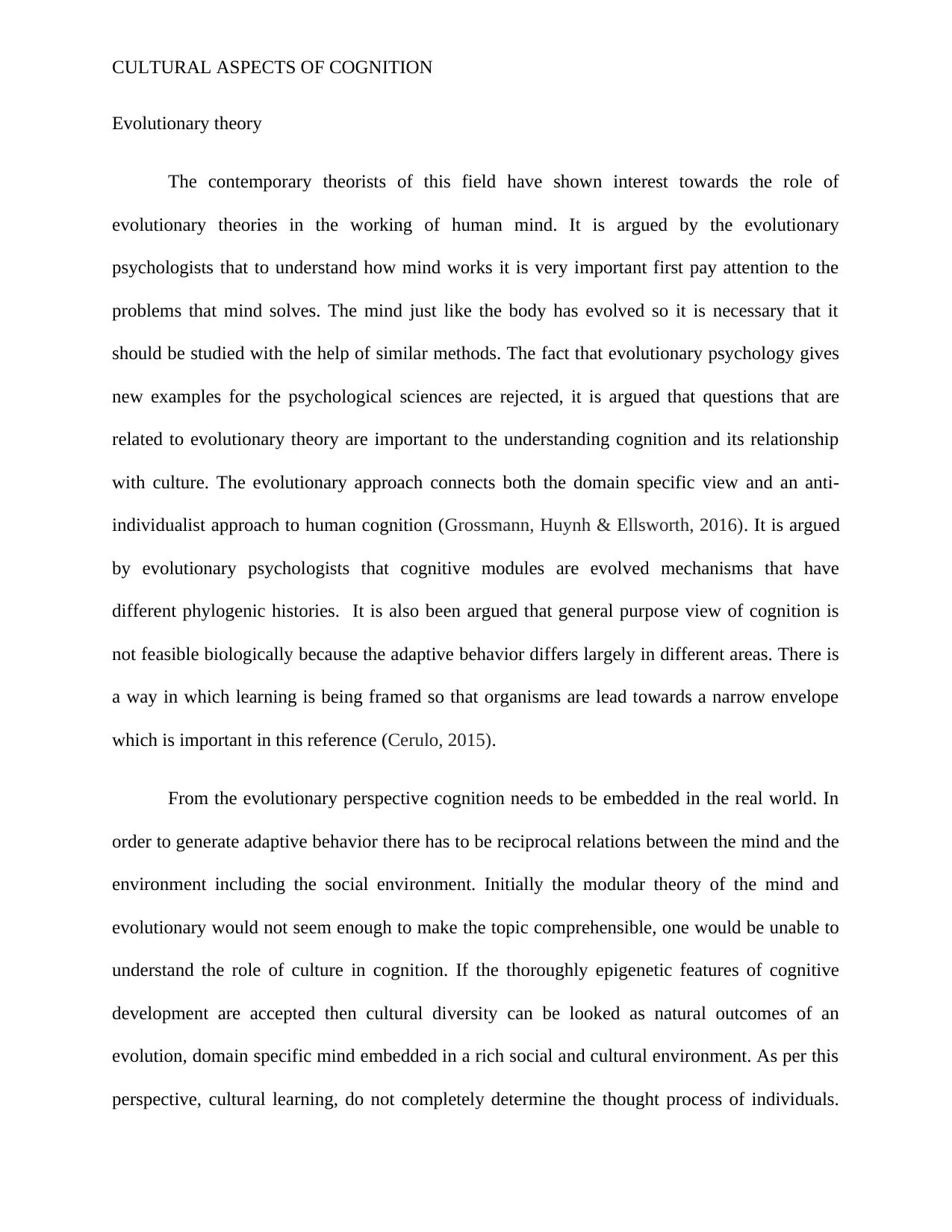
Evolutionary theory
The contemporary theorists of this field have shown interest towards the role of
evolutionary theories in the working of human mind. It is argued by the evolutionary
psychologists that to understand how mind works it is very important first pay attention to the
problems that mind solves. The mind just like the body has evolved so it is necessary that it
should be studied with the help of similar methods. The fact that evolutionary psychology gives
new examples for the psychological sciences are rejected, it is argued that questions that are
related to evolutionary theory are important to the understanding cognition and its relationship
with culture. The evolutionary approach connects both the domain specific view and an anti-
individualist approach to human cognition (Grossmann, Huynh & Ellsworth, 2016). It is argued
by evolutionary psychologists that cognitive modules are evolved mechanisms that have
different phylogenic histories. It is also been argued that general purpose view of cognition is
not feasible biologically because the adaptive behavior differs largely in different areas. There is
a way in which learning is being framed so that organisms are lead towards a narrow envelope
which is important in this reference (Cerulo, 2015).
From the evolutionary perspective cognition needs to be embedded in the real world. In
order to generate adaptive behavior there has to be reciprocal relations between the mind and the
environment including the social environment. Initially the modular theory of the mind and
evolutionary would not seem enough to make the topic comprehensible, one would be unable to
understand the role of culture in cognition. If the thoroughly epigenetic features of cognitive
development are accepted then cultural diversity can be looked as natural outcomes of an
evolution, domain specific mind embedded in a rich social and cultural environment. As per this
perspective, cultural learning, do not completely determine the thought process of individuals.
Evolutionary theory
The contemporary theorists of this field have shown interest towards the role of
evolutionary theories in the working of human mind. It is argued by the evolutionary
psychologists that to understand how mind works it is very important first pay attention to the
problems that mind solves. The mind just like the body has evolved so it is necessary that it
should be studied with the help of similar methods. The fact that evolutionary psychology gives
new examples for the psychological sciences are rejected, it is argued that questions that are
related to evolutionary theory are important to the understanding cognition and its relationship
with culture. The evolutionary approach connects both the domain specific view and an anti-
individualist approach to human cognition (Grossmann, Huynh & Ellsworth, 2016). It is argued
by evolutionary psychologists that cognitive modules are evolved mechanisms that have
different phylogenic histories. It is also been argued that general purpose view of cognition is
not feasible biologically because the adaptive behavior differs largely in different areas. There is
a way in which learning is being framed so that organisms are lead towards a narrow envelope
which is important in this reference (Cerulo, 2015).
From the evolutionary perspective cognition needs to be embedded in the real world. In
order to generate adaptive behavior there has to be reciprocal relations between the mind and the
environment including the social environment. Initially the modular theory of the mind and
evolutionary would not seem enough to make the topic comprehensible, one would be unable to
understand the role of culture in cognition. If the thoroughly epigenetic features of cognitive
development are accepted then cultural diversity can be looked as natural outcomes of an
evolution, domain specific mind embedded in a rich social and cultural environment. As per this
perspective, cultural learning, do not completely determine the thought process of individuals.
CULTURAL ASPECTS OF COGNITION
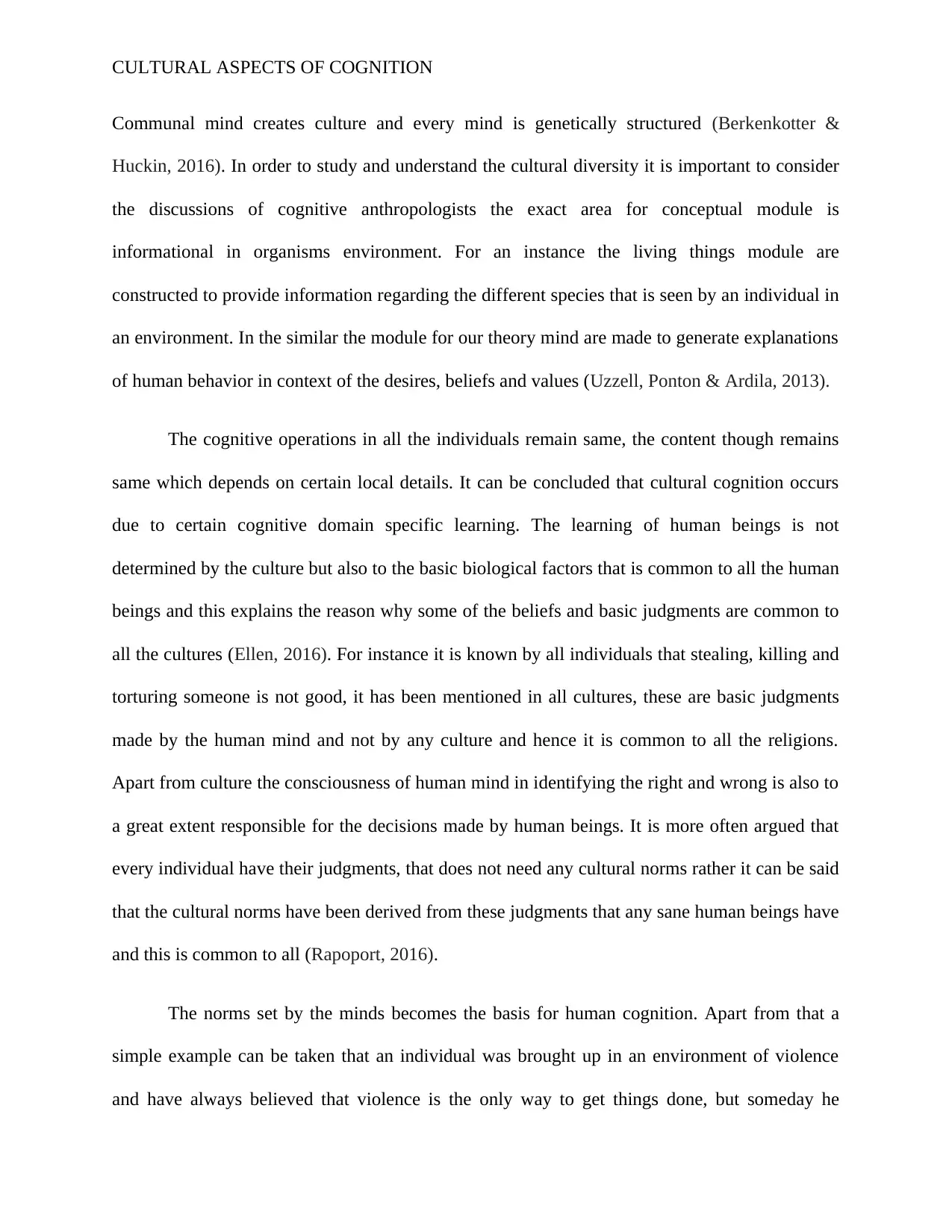
Communal mind creates culture and every mind is genetically structured (Berkenkotter &
Huckin, 2016). In order to study and understand the cultural diversity it is important to consider
the discussions of cognitive anthropologists the exact area for conceptual module is
informational in organisms environment. For an instance the living things module are
constructed to provide information regarding the different species that is seen by an individual in
an environment. In the similar the module for our theory mind are made to generate explanations
of human behavior in context of the desires, beliefs and values (Uzzell, Ponton & Ardila, 2013).
The cognitive operations in all the individuals remain same, the content though remains
same which depends on certain local details. It can be concluded that cultural cognition occurs
due to certain cognitive domain specific learning. The learning of human beings is not
determined by the culture but also to the basic biological factors that is common to all the human
beings and this explains the reason why some of the beliefs and basic judgments are common to
all the cultures (Ellen, 2016). For instance it is known by all individuals that stealing, killing and
torturing someone is not good, it has been mentioned in all cultures, these are basic judgments
made by the human mind and not by any culture and hence it is common to all the religions.
Apart from culture the consciousness of human mind in identifying the right and wrong is also to
a great extent responsible for the decisions made by human beings. It is more often argued that
every individual have their judgments, that does not need any cultural norms rather it can be said
that the cultural norms have been derived from these judgments that any sane human beings have
and this is common to all (Rapoport, 2016).
The norms set by the minds becomes the basis for human cognition. Apart from that a
simple example can be taken that an individual was brought up in an environment of violence
and have always believed that violence is the only way to get things done, but someday he
Communal mind creates culture and every mind is genetically structured (Berkenkotter &
Huckin, 2016). In order to study and understand the cultural diversity it is important to consider
the discussions of cognitive anthropologists the exact area for conceptual module is
informational in organisms environment. For an instance the living things module are
constructed to provide information regarding the different species that is seen by an individual in
an environment. In the similar the module for our theory mind are made to generate explanations
of human behavior in context of the desires, beliefs and values (Uzzell, Ponton & Ardila, 2013).
The cognitive operations in all the individuals remain same, the content though remains
same which depends on certain local details. It can be concluded that cultural cognition occurs
due to certain cognitive domain specific learning. The learning of human beings is not
determined by the culture but also to the basic biological factors that is common to all the human
beings and this explains the reason why some of the beliefs and basic judgments are common to
all the cultures (Ellen, 2016). For instance it is known by all individuals that stealing, killing and
torturing someone is not good, it has been mentioned in all cultures, these are basic judgments
made by the human mind and not by any culture and hence it is common to all the religions.
Apart from culture the consciousness of human mind in identifying the right and wrong is also to
a great extent responsible for the decisions made by human beings. It is more often argued that
every individual have their judgments, that does not need any cultural norms rather it can be said
that the cultural norms have been derived from these judgments that any sane human beings have
and this is common to all (Rapoport, 2016).
The norms set by the minds becomes the basis for human cognition. Apart from that a
simple example can be taken that an individual was brought up in an environment of violence
and have always believed that violence is the only way to get things done, but someday he
⊘ This is a preview!⊘
Do you want full access?
Subscribe today to unlock all pages.
Trusted by 1+ million students worldwide
CULTURAL ASPECTS OF COGNITION
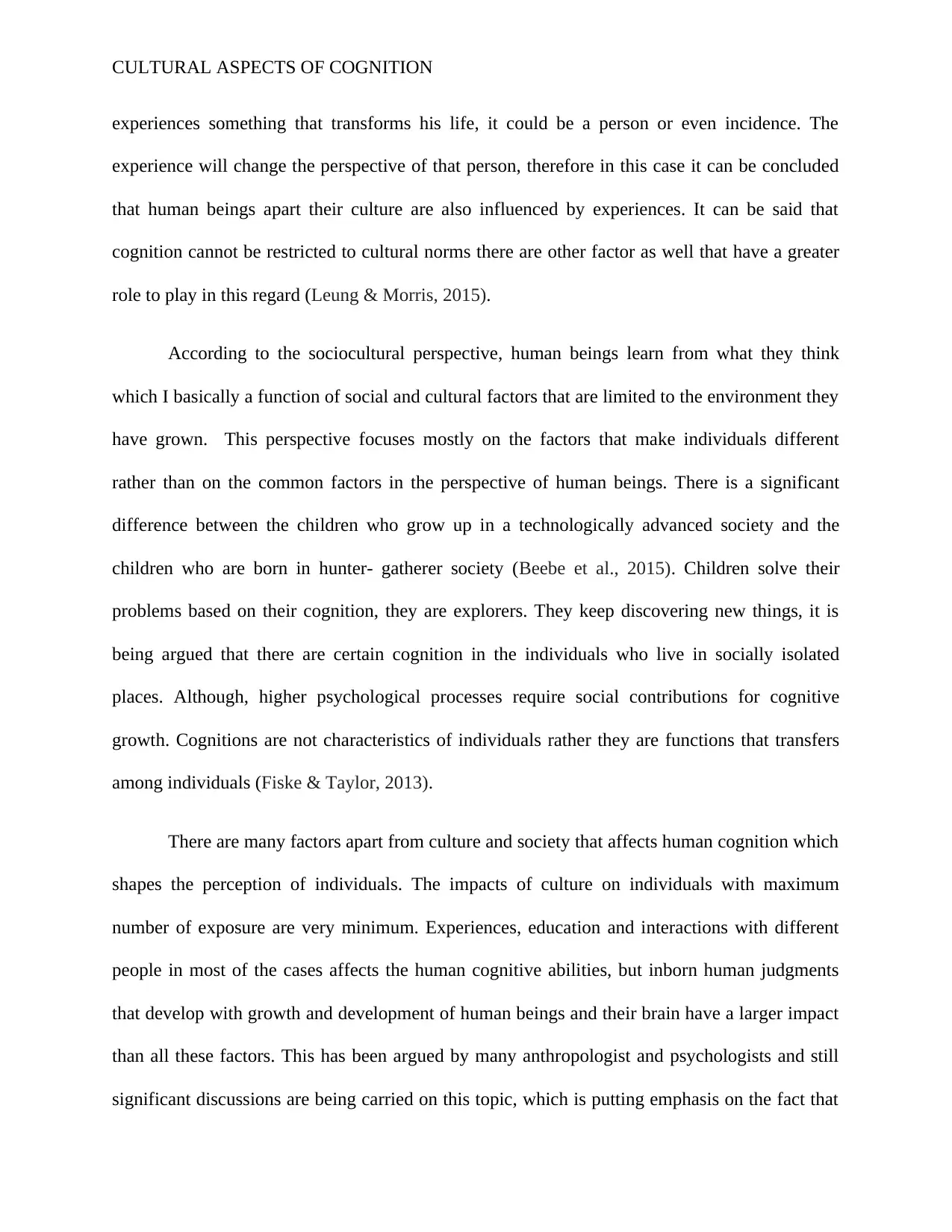
experiences something that transforms his life, it could be a person or even incidence. The
experience will change the perspective of that person, therefore in this case it can be concluded
that human beings apart their culture are also influenced by experiences. It can be said that
cognition cannot be restricted to cultural norms there are other factor as well that have a greater
role to play in this regard (Leung & Morris, 2015).
According to the sociocultural perspective, human beings learn from what they think
which I basically a function of social and cultural factors that are limited to the environment they
have grown. This perspective focuses mostly on the factors that make individuals different
rather than on the common factors in the perspective of human beings. There is a significant
difference between the children who grow up in a technologically advanced society and the
children who are born in hunter- gatherer society (Beebe et al., 2015). Children solve their
problems based on their cognition, they are explorers. They keep discovering new things, it is
being argued that there are certain cognition in the individuals who live in socially isolated
places. Although, higher psychological processes require social contributions for cognitive
growth. Cognitions are not characteristics of individuals rather they are functions that transfers
among individuals (Fiske & Taylor, 2013).
There are many factors apart from culture and society that affects human cognition which
shapes the perception of individuals. The impacts of culture on individuals with maximum
number of exposure are very minimum. Experiences, education and interactions with different
people in most of the cases affects the human cognitive abilities, but inborn human judgments
that develop with growth and development of human beings and their brain have a larger impact
than all these factors. This has been argued by many anthropologist and psychologists and still
significant discussions are being carried on this topic, which is putting emphasis on the fact that
experiences something that transforms his life, it could be a person or even incidence. The
experience will change the perspective of that person, therefore in this case it can be concluded
that human beings apart their culture are also influenced by experiences. It can be said that
cognition cannot be restricted to cultural norms there are other factor as well that have a greater
role to play in this regard (Leung & Morris, 2015).
According to the sociocultural perspective, human beings learn from what they think
which I basically a function of social and cultural factors that are limited to the environment they
have grown. This perspective focuses mostly on the factors that make individuals different
rather than on the common factors in the perspective of human beings. There is a significant
difference between the children who grow up in a technologically advanced society and the
children who are born in hunter- gatherer society (Beebe et al., 2015). Children solve their
problems based on their cognition, they are explorers. They keep discovering new things, it is
being argued that there are certain cognition in the individuals who live in socially isolated
places. Although, higher psychological processes require social contributions for cognitive
growth. Cognitions are not characteristics of individuals rather they are functions that transfers
among individuals (Fiske & Taylor, 2013).
There are many factors apart from culture and society that affects human cognition which
shapes the perception of individuals. The impacts of culture on individuals with maximum
number of exposure are very minimum. Experiences, education and interactions with different
people in most of the cases affects the human cognitive abilities, but inborn human judgments
that develop with growth and development of human beings and their brain have a larger impact
than all these factors. This has been argued by many anthropologist and psychologists and still
significant discussions are being carried on this topic, which is putting emphasis on the fact that
Paraphrase This Document
Need a fresh take? Get an instant paraphrase of this document with our AI Paraphraser
CULTURAL ASPECTS OF COGNITION
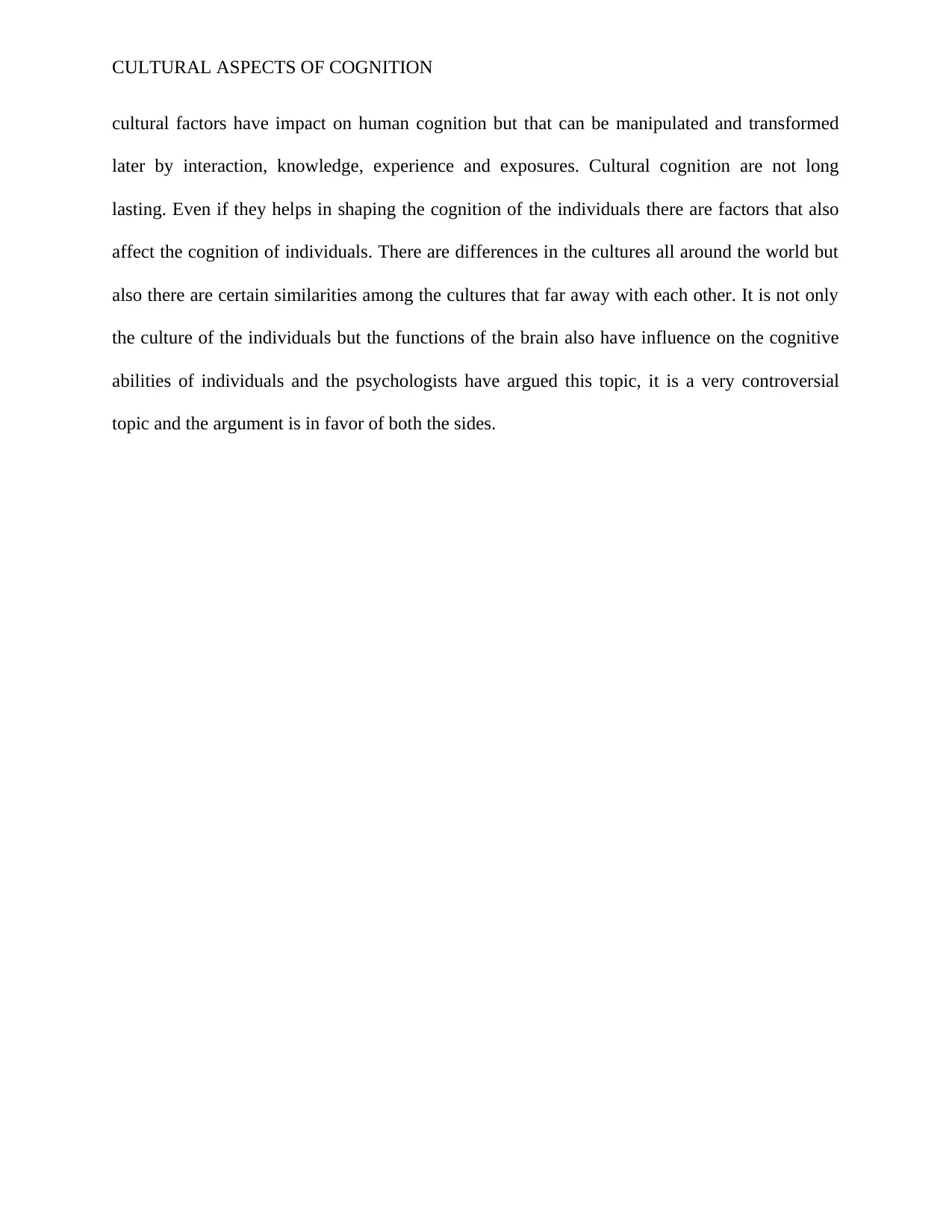
cultural factors have impact on human cognition but that can be manipulated and transformed
later by interaction, knowledge, experience and exposures. Cultural cognition are not long
lasting. Even if they helps in shaping the cognition of the individuals there are factors that also
affect the cognition of individuals. There are differences in the cultures all around the world but
also there are certain similarities among the cultures that far away with each other. It is not only
the culture of the individuals but the functions of the brain also have influence on the cognitive
abilities of individuals and the psychologists have argued this topic, it is a very controversial
topic and the argument is in favor of both the sides.
cultural factors have impact on human cognition but that can be manipulated and transformed
later by interaction, knowledge, experience and exposures. Cultural cognition are not long
lasting. Even if they helps in shaping the cognition of the individuals there are factors that also
affect the cognition of individuals. There are differences in the cultures all around the world but
also there are certain similarities among the cultures that far away with each other. It is not only
the culture of the individuals but the functions of the brain also have influence on the cognitive
abilities of individuals and the psychologists have argued this topic, it is a very controversial
topic and the argument is in favor of both the sides.
CULTURAL ASPECTS OF COGNITION
References
Beebe, J., Qiaoan, R., Wysocki, T., & Endara, M. A. (2015). Corrigendum Corrigendum to:
Moral Objectivism in Cross-Cultural Perspective (Journal of Cognition and Culture 15
(2015) 386–401, doi: 10.1163/15685373-12342157). Journal of Cognition and
Culture, 15(5), 543-544.
Berkenkotter, C., & Huckin, T. N. (2016). Genre knowledge in disciplinary communication:
Cognition/culture/power. Routledge.
Cerulo, K. A. (2015). Culture and cognition. Emerging Trends in the Social and Behavioral
Sciences: An Interdisciplinary, Searchable, and Linkable Resource.
Ellen, R. (2016). The cultural cognition of time: some anthropological perspectives.
Fiske, S. T., & Taylor, S. E. (2013). Social cognition: From brains to culture. Sage.
Grossmann, I., Huynh, A. C., & Ellsworth, P. C. (2016). Emotional complexity: Clarifying
definitions and cultural correlates. Journal of personality and social psychology, 111(6),
895.
Hutchins, E. (2014). The cultural ecosystem of human cognition. Philosophical
Psychology, 27(1), 34-49.
Kahan, Dan. "Cultural Cognition Project at Yale Law School." (2014).
Kahan, D. M., Jenkins‐Smith, H., & Braman, D. (2011). Cultural cognition of scientific
consensus. Journal of Risk Research, 14(2), 147-174.
References
Beebe, J., Qiaoan, R., Wysocki, T., & Endara, M. A. (2015). Corrigendum Corrigendum to:
Moral Objectivism in Cross-Cultural Perspective (Journal of Cognition and Culture 15
(2015) 386–401, doi: 10.1163/15685373-12342157). Journal of Cognition and
Culture, 15(5), 543-544.
Berkenkotter, C., & Huckin, T. N. (2016). Genre knowledge in disciplinary communication:
Cognition/culture/power. Routledge.
Cerulo, K. A. (2015). Culture and cognition. Emerging Trends in the Social and Behavioral
Sciences: An Interdisciplinary, Searchable, and Linkable Resource.
Ellen, R. (2016). The cultural cognition of time: some anthropological perspectives.
Fiske, S. T., & Taylor, S. E. (2013). Social cognition: From brains to culture. Sage.
Grossmann, I., Huynh, A. C., & Ellsworth, P. C. (2016). Emotional complexity: Clarifying
definitions and cultural correlates. Journal of personality and social psychology, 111(6),
895.
Hutchins, E. (2014). The cultural ecosystem of human cognition. Philosophical
Psychology, 27(1), 34-49.
Kahan, Dan. "Cultural Cognition Project at Yale Law School." (2014).
Kahan, D. M., Jenkins‐Smith, H., & Braman, D. (2011). Cultural cognition of scientific
consensus. Journal of Risk Research, 14(2), 147-174.
⊘ This is a preview!⊘
Do you want full access?
Subscribe today to unlock all pages.
Trusted by 1+ million students worldwide
CULTURAL ASPECTS OF COGNITION
Leung, K., & Morris, M. W. (2015). Values, schemas, and norms in the culture–behavior nexus:
A situated dynamics framework. Journal of International Business Studies, 46(9), 1028-
1050.
Rapoport, A. (2016). Human aspects of urban form: towards a man—environment approach to
urban form and design. Elsevier.
Riding, R., & Rayner, S. (2013). Cognitive styles and learning strategies: Understanding style
differences in learning and behavior. Routledge.
Strandell, J. (2016). Culture, cognition and behavior in the pursuit of self-esteem. Poetics, 54,
14-24.
Santos, H. C., Varnum, M. E., & Grossmann, I. (2017). Class, Cognition and Cultural Change in
Social Class.
Uzzell, B. P., Ponton, M., & Ardila, A. (Eds.). (2013). International handbook of cross-cultural
neuropsychology. Psychology Press.
YAGHOOBI, A., & ABDOLAHIMOGHADAM, M. (2016). Investigating the relationship
between moral reasoning and moral behavior in adolescents mediated by social cognition
theory.
Leung, K., & Morris, M. W. (2015). Values, schemas, and norms in the culture–behavior nexus:
A situated dynamics framework. Journal of International Business Studies, 46(9), 1028-
1050.
Rapoport, A. (2016). Human aspects of urban form: towards a man—environment approach to
urban form and design. Elsevier.
Riding, R., & Rayner, S. (2013). Cognitive styles and learning strategies: Understanding style
differences in learning and behavior. Routledge.
Strandell, J. (2016). Culture, cognition and behavior in the pursuit of self-esteem. Poetics, 54,
14-24.
Santos, H. C., Varnum, M. E., & Grossmann, I. (2017). Class, Cognition and Cultural Change in
Social Class.
Uzzell, B. P., Ponton, M., & Ardila, A. (Eds.). (2013). International handbook of cross-cultural
neuropsychology. Psychology Press.
YAGHOOBI, A., & ABDOLAHIMOGHADAM, M. (2016). Investigating the relationship
between moral reasoning and moral behavior in adolescents mediated by social cognition
theory.

1 out of 10


Related Documents


Your All-in-One AI-Powered Toolkit for Academic Success.
+13062052269
info@desklib.com
Available 24*7 on WhatsApp / Email
![[object Object]](/_next/static/media/star-bottom.7253800d.svg)
Unlock your academic potential
Copyright © 2020–2026 A2Z Services. All Rights Reserved. Developed and managed by ZUCOL.