Cultural Competence in Nursing: A Patient-Centered Care Analysis

Verified

Added on  2023/04/24

|3
|315
|439
Report
AI Summary
This report delves into the critical role of cultural competence in nursing and its impact on patient-centered care. It highlights the importance of nurses being culturally competent to meet the diverse needs of patients and achieve optimal patient outcomes. The report discusses various instruments and tools, such as the Cultural Self-efficacy Scale and the Transcultural Self-Efficacy Tool, used to measure cultural competence. Additionally, it emphasizes the significance of using appropriate indicators to effectively characterize cultural competence and the ability of nurses to provide patient-centered care. The report references Ahmed et al. (2018) and Loftin et al. (2013) to support its findings.
Document Page
Running head: NURSING
Nursing
Name of the student:
Name of the University:
Author’s note
tabler-icon-diamond-filled.svg

Paraphrase This Document

Need a fresh take? Get an instant paraphrase of this document with our AI Paraphraser
Document Page
1NURSING
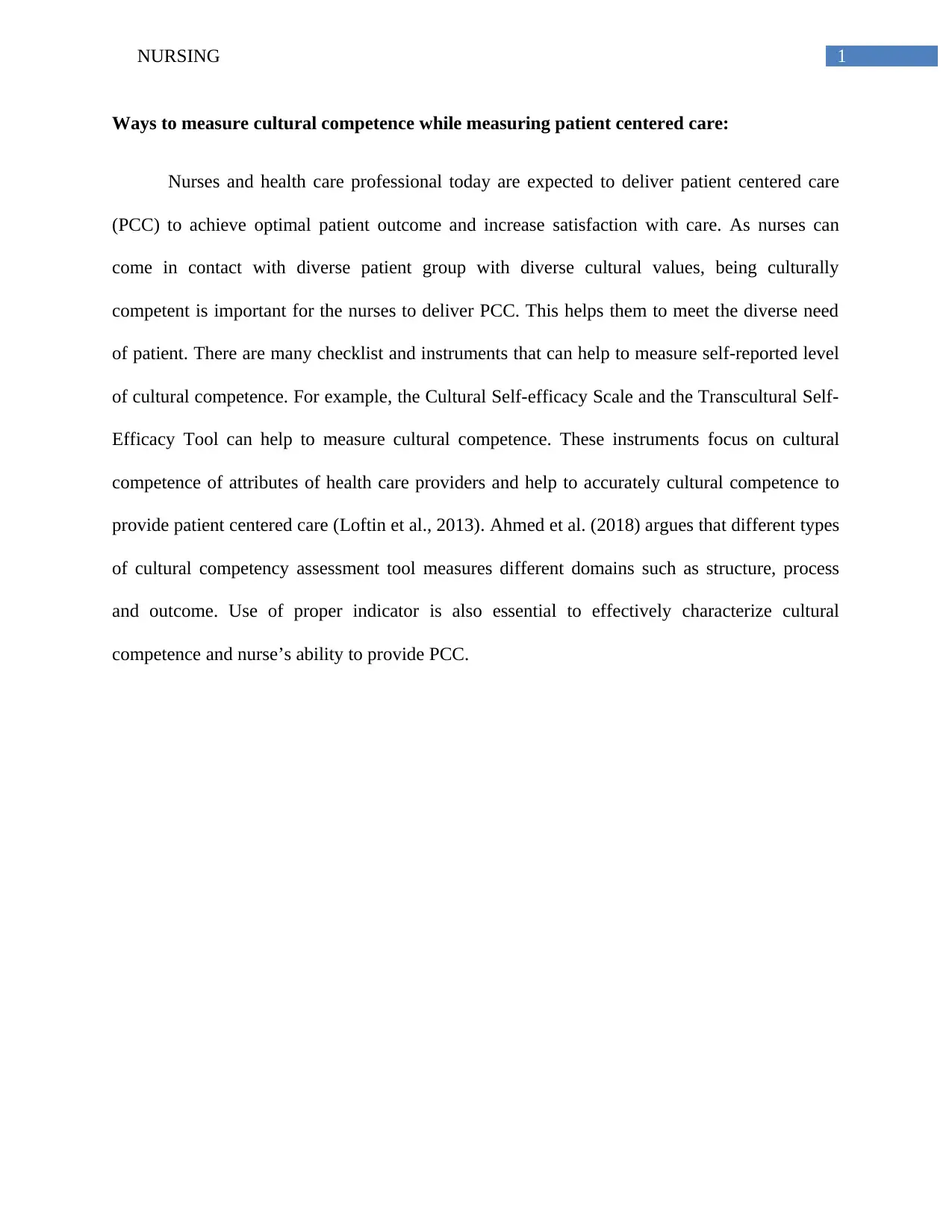
Ways to measure cultural competence while measuring patient centered care:
Nurses and health care professional today are expected to deliver patient centered care
(PCC) to achieve optimal patient outcome and increase satisfaction with care. As nurses can
come in contact with diverse patient group with diverse cultural values, being culturally
competent is important for the nurses to deliver PCC. This helps them to meet the diverse need
of patient. There are many checklist and instruments that can help to measure self-reported level
of cultural competence. For example, the Cultural Self-efficacy Scale and the Transcultural Self-
Efficacy Tool can help to measure cultural competence. These instruments focus on cultural
competence of attributes of health care providers and help to accurately cultural competence to
provide patient centered care (Loftin et al., 2013). Ahmed et al. (2018) argues that different types
of cultural competency assessment tool measures different domains such as structure, process
and outcome. Use of proper indicator is also essential to effectively characterize cultural
competence and nurse’s ability to provide PCC.
Document Page
2NURSING
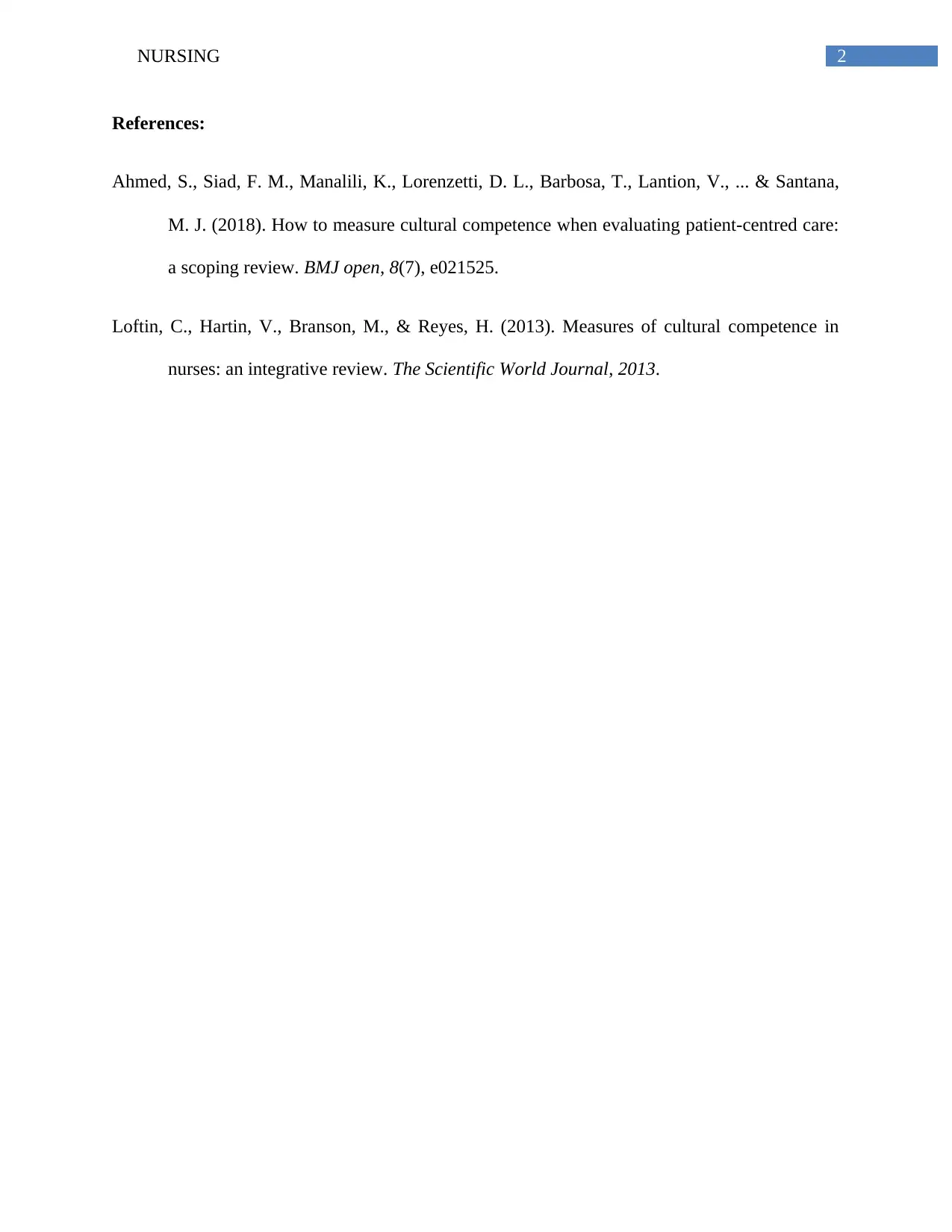
References:
Ahmed, S., Siad, F. M., Manalili, K., Lorenzetti, D. L., Barbosa, T., Lantion, V., ... & Santana,
M. J. (2018). How to measure cultural competence when evaluating patient-centred care:
a scoping review. BMJ open, 8(7), e021525.
Loftin, C., Hartin, V., Branson, M., & Reyes, H. (2013). Measures of cultural competence in
nurses: an integrative review. The Scientific World Journal, 2013.
chevron_up_icon
1 out of 3
circle_padding
hide_on_mobile
zoom_out_icon
[object Object]