Forming a Culturally Competent Strategic Plan: Tobacco Reduction
VerifiedAdded on 2023/06/18
|13
|3928
|146
Report
AI Summary
This report outlines a strategic plan for cultural competence focused on reducing tobacco consumption. It emphasizes cultural awareness, knowledge, sensitivity, and competence to effectively interact with diverse populations. The plan includes SMART objectives such as reducing tobacco use by 50% within a year and lowering tobacco consumption among young people. Strategies involve nicotine replacement therapy, trigger avoidance, and increased awareness campaigns. The Campinha-Bacote model (ASKED - Awareness, Skill, Knowledge, Encounter, Desire) is discussed as a framework for addressing cultural issues in healthcare, promoting cultural awareness among healthcare professionals, and improving interactions with marginalized groups to reduce health disparities related to tobacco use.
FORMING A
CULTURALLY
COMPETENT STRATEGIC
PLAN
CULTURALLY
COMPETENT STRATEGIC
PLAN

Paraphrase This Document
Need a fresh take? Get an instant paraphrase of this document with our AI Paraphraser
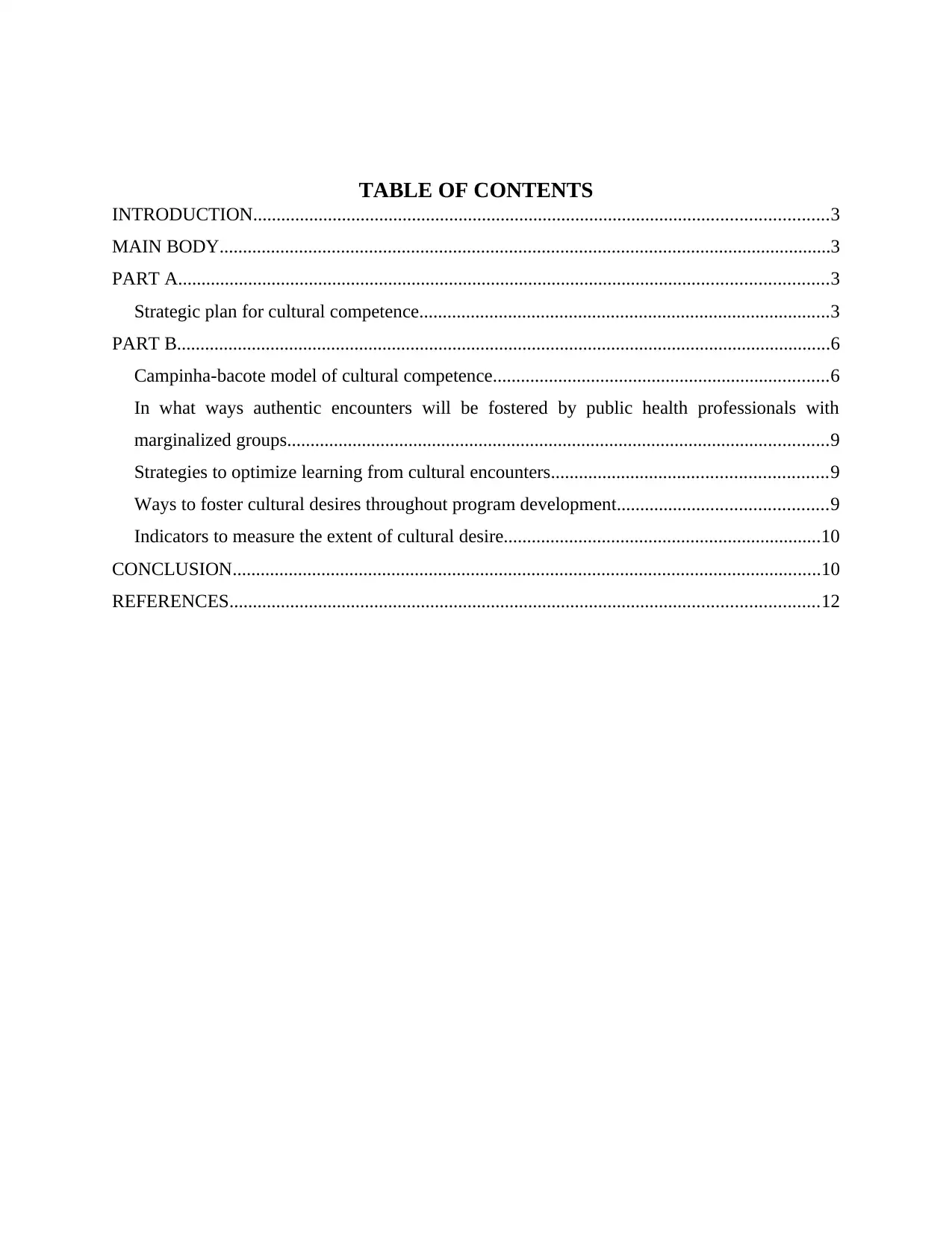
TABLE OF CONTENTS
INTRODUCTION...........................................................................................................................3
MAIN BODY...................................................................................................................................3
PART A...........................................................................................................................................3
Strategic plan for cultural competence........................................................................................3
PART B............................................................................................................................................6
Campinha-bacote model of cultural competence........................................................................6
In what ways authentic encounters will be fostered by public health professionals with
marginalized groups....................................................................................................................9
Strategies to optimize learning from cultural encounters...........................................................9
Ways to foster cultural desires throughout program development.............................................9
Indicators to measure the extent of cultural desire....................................................................10
CONCLUSION..............................................................................................................................10
REFERENCES..............................................................................................................................12
INTRODUCTION...........................................................................................................................3
MAIN BODY...................................................................................................................................3
PART A...........................................................................................................................................3
Strategic plan for cultural competence........................................................................................3
PART B............................................................................................................................................6
Campinha-bacote model of cultural competence........................................................................6
In what ways authentic encounters will be fostered by public health professionals with
marginalized groups....................................................................................................................9
Strategies to optimize learning from cultural encounters...........................................................9
Ways to foster cultural desires throughout program development.............................................9
Indicators to measure the extent of cultural desire....................................................................10
CONCLUSION..............................................................................................................................10
REFERENCES..............................................................................................................................12
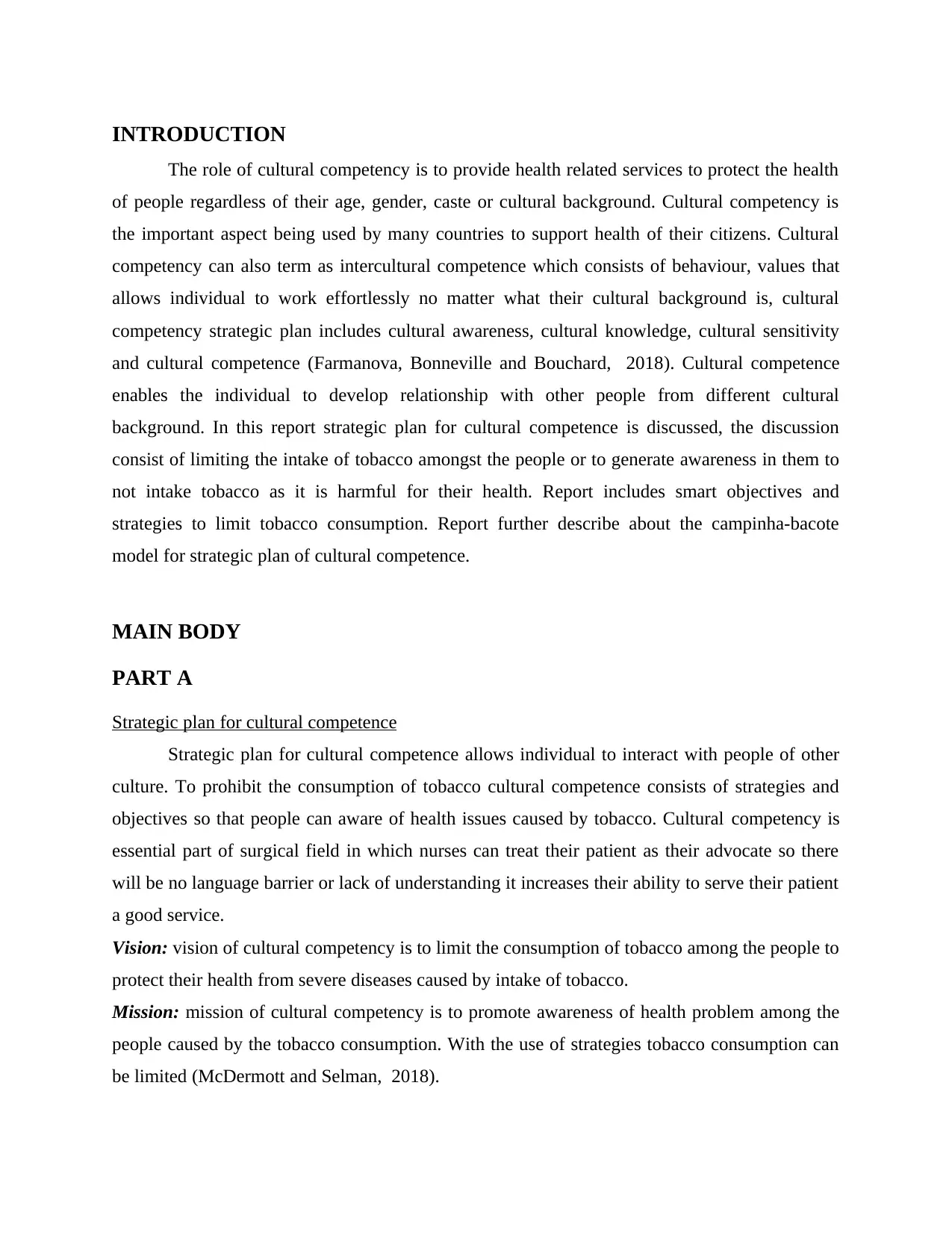
INTRODUCTION
The role of cultural competency is to provide health related services to protect the health
of people regardless of their age, gender, caste or cultural background. Cultural competency is
the important aspect being used by many countries to support health of their citizens. Cultural
competency can also term as intercultural competence which consists of behaviour, values that
allows individual to work effortlessly no matter what their cultural background is, cultural
competency strategic plan includes cultural awareness, cultural knowledge, cultural sensitivity
and cultural competence (Farmanova, Bonneville and Bouchard, 2018). Cultural competence
enables the individual to develop relationship with other people from different cultural
background. In this report strategic plan for cultural competence is discussed, the discussion
consist of limiting the intake of tobacco amongst the people or to generate awareness in them to
not intake tobacco as it is harmful for their health. Report includes smart objectives and
strategies to limit tobacco consumption. Report further describe about the campinha-bacote
model for strategic plan of cultural competence.
MAIN BODY
PART A
Strategic plan for cultural competence
Strategic plan for cultural competence allows individual to interact with people of other
culture. To prohibit the consumption of tobacco cultural competence consists of strategies and
objectives so that people can aware of health issues caused by tobacco. Cultural competency is
essential part of surgical field in which nurses can treat their patient as their advocate so there
will be no language barrier or lack of understanding it increases their ability to serve their patient
a good service.
Vision: vision of cultural competency is to limit the consumption of tobacco among the people to
protect their health from severe diseases caused by intake of tobacco.
Mission: mission of cultural competency is to promote awareness of health problem among the
people caused by the tobacco consumption. With the use of strategies tobacco consumption can
be limited (McDermott and Selman, 2018).
The role of cultural competency is to provide health related services to protect the health
of people regardless of their age, gender, caste or cultural background. Cultural competency is
the important aspect being used by many countries to support health of their citizens. Cultural
competency can also term as intercultural competence which consists of behaviour, values that
allows individual to work effortlessly no matter what their cultural background is, cultural
competency strategic plan includes cultural awareness, cultural knowledge, cultural sensitivity
and cultural competence (Farmanova, Bonneville and Bouchard, 2018). Cultural competence
enables the individual to develop relationship with other people from different cultural
background. In this report strategic plan for cultural competence is discussed, the discussion
consist of limiting the intake of tobacco amongst the people or to generate awareness in them to
not intake tobacco as it is harmful for their health. Report includes smart objectives and
strategies to limit tobacco consumption. Report further describe about the campinha-bacote
model for strategic plan of cultural competence.
MAIN BODY
PART A
Strategic plan for cultural competence
Strategic plan for cultural competence allows individual to interact with people of other
culture. To prohibit the consumption of tobacco cultural competence consists of strategies and
objectives so that people can aware of health issues caused by tobacco. Cultural competency is
essential part of surgical field in which nurses can treat their patient as their advocate so there
will be no language barrier or lack of understanding it increases their ability to serve their patient
a good service.
Vision: vision of cultural competency is to limit the consumption of tobacco among the people to
protect their health from severe diseases caused by intake of tobacco.
Mission: mission of cultural competency is to promote awareness of health problem among the
people caused by the tobacco consumption. With the use of strategies tobacco consumption can
be limited (McDermott and Selman, 2018).
⊘ This is a preview!⊘
Do you want full access?
Subscribe today to unlock all pages.

Trusted by 1+ million students worldwide
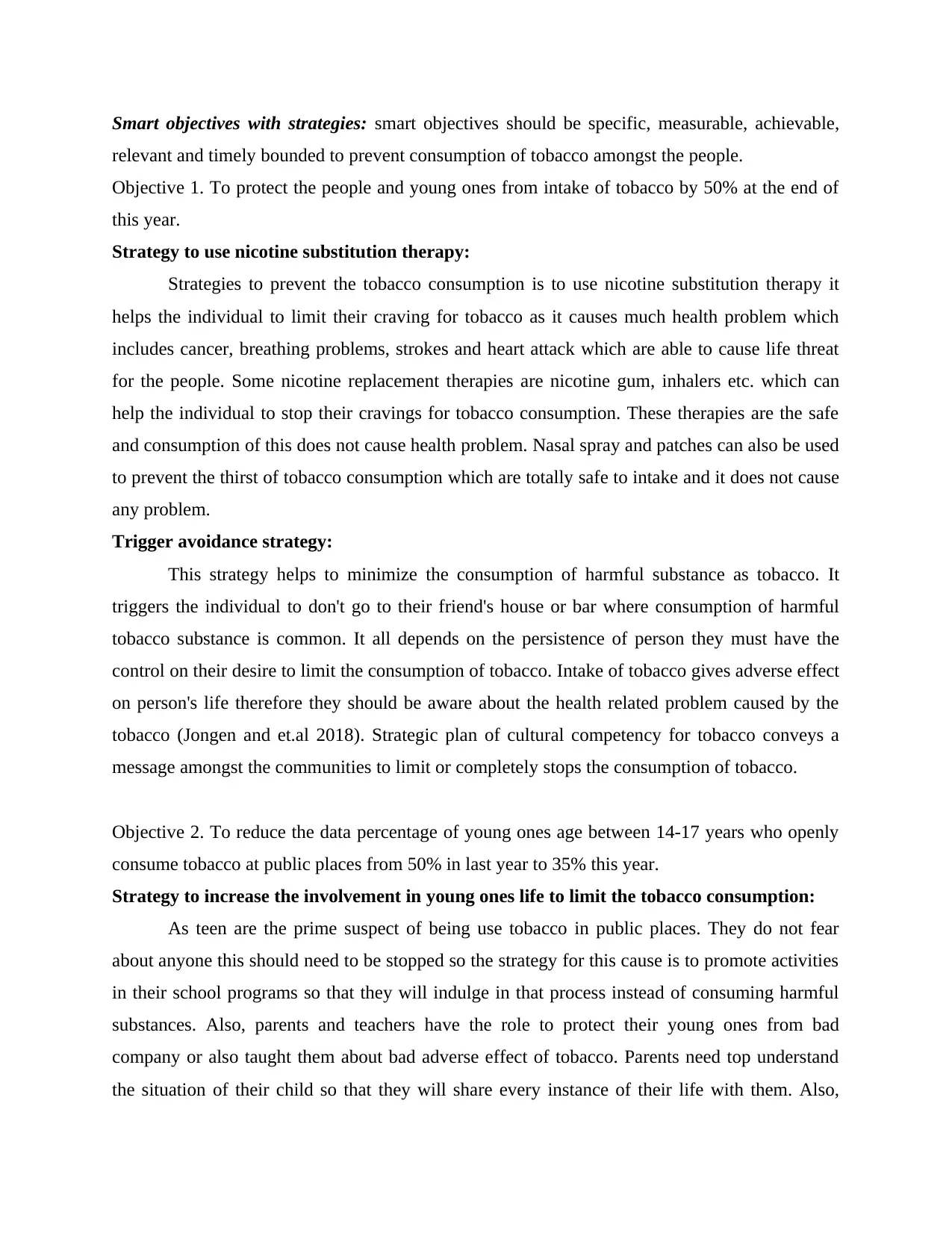
Smart objectives with strategies: smart objectives should be specific, measurable, achievable,
relevant and timely bounded to prevent consumption of tobacco amongst the people.
Objective 1. To protect the people and young ones from intake of tobacco by 50% at the end of
this year.
Strategy to use nicotine substitution therapy:
Strategies to prevent the tobacco consumption is to use nicotine substitution therapy it
helps the individual to limit their craving for tobacco as it causes much health problem which
includes cancer, breathing problems, strokes and heart attack which are able to cause life threat
for the people. Some nicotine replacement therapies are nicotine gum, inhalers etc. which can
help the individual to stop their cravings for tobacco consumption. These therapies are the safe
and consumption of this does not cause health problem. Nasal spray and patches can also be used
to prevent the thirst of tobacco consumption which are totally safe to intake and it does not cause
any problem.
Trigger avoidance strategy:
This strategy helps to minimize the consumption of harmful substance as tobacco. It
triggers the individual to don't go to their friend's house or bar where consumption of harmful
tobacco substance is common. It all depends on the persistence of person they must have the
control on their desire to limit the consumption of tobacco. Intake of tobacco gives adverse effect
on person's life therefore they should be aware about the health related problem caused by the
tobacco (Jongen and et.al 2018). Strategic plan of cultural competency for tobacco conveys a
message amongst the communities to limit or completely stops the consumption of tobacco.
Objective 2. To reduce the data percentage of young ones age between 14-17 years who openly
consume tobacco at public places from 50% in last year to 35% this year.
Strategy to increase the involvement in young ones life to limit the tobacco consumption:
As teen are the prime suspect of being use tobacco in public places. They do not fear
about anyone this should need to be stopped so the strategy for this cause is to promote activities
in their school programs so that they will indulge in that process instead of consuming harmful
substances. Also, parents and teachers have the role to protect their young ones from bad
company or also taught them about bad adverse effect of tobacco. Parents need top understand
the situation of their child so that they will share every instance of their life with them. Also,
relevant and timely bounded to prevent consumption of tobacco amongst the people.
Objective 1. To protect the people and young ones from intake of tobacco by 50% at the end of
this year.
Strategy to use nicotine substitution therapy:
Strategies to prevent the tobacco consumption is to use nicotine substitution therapy it
helps the individual to limit their craving for tobacco as it causes much health problem which
includes cancer, breathing problems, strokes and heart attack which are able to cause life threat
for the people. Some nicotine replacement therapies are nicotine gum, inhalers etc. which can
help the individual to stop their cravings for tobacco consumption. These therapies are the safe
and consumption of this does not cause health problem. Nasal spray and patches can also be used
to prevent the thirst of tobacco consumption which are totally safe to intake and it does not cause
any problem.
Trigger avoidance strategy:
This strategy helps to minimize the consumption of harmful substance as tobacco. It
triggers the individual to don't go to their friend's house or bar where consumption of harmful
tobacco substance is common. It all depends on the persistence of person they must have the
control on their desire to limit the consumption of tobacco. Intake of tobacco gives adverse effect
on person's life therefore they should be aware about the health related problem caused by the
tobacco (Jongen and et.al 2018). Strategic plan of cultural competency for tobacco conveys a
message amongst the communities to limit or completely stops the consumption of tobacco.
Objective 2. To reduce the data percentage of young ones age between 14-17 years who openly
consume tobacco at public places from 50% in last year to 35% this year.
Strategy to increase the involvement in young ones life to limit the tobacco consumption:
As teen are the prime suspect of being use tobacco in public places. They do not fear
about anyone this should need to be stopped so the strategy for this cause is to promote activities
in their school programs so that they will indulge in that process instead of consuming harmful
substances. Also, parents and teachers have the role to protect their young ones from bad
company or also taught them about bad adverse effect of tobacco. Parents need top understand
the situation of their child so that they will share every instance of their life with them. Also,
Paraphrase This Document
Need a fresh take? Get an instant paraphrase of this document with our AI Paraphraser
government need to ban the tobacco or to increase the tax so no one will try to consume that
harmful substance.
Strategy to protect teen's self conceit:
It is the responsibility of the parents to protect their child from any malicious activity
they need to keep track their child's behaviour if they indulge in any kind of bad habit, so they
need to ensure their child about adverse effect of bad habit and try to stop their bad habit at early
stages. Tobacco consumption in teens are common nowadays people must know about the
activities of their child or to aware them about the bad adverse effect of tobacco, so they stop
consuming at their early ages, or they can also promote them to develop different skills so that
they should be distracted from the tobacco or other substance abuse consumption (Duxbury,
Kangas and De Beukelaer, 2017).
Objective 3. To increase the awareness about bad effect of tobacco among the people to reduce
the health issues by 85% in next year.
Strategy to generate self awareness among the people:
As consumption of substance abuse as tobacco can lead life threat to the person, its
consequences are adverse which cause life threat diseases in person therefore it should need to
stop. People need to understand about bad effect of tobacco for that government need to
implement with the strategies as they can show ads about cause of tobacco or also print the
adverse effect of tobacco on newspaper so that people can understand their message and stops
the tobacco consumption. People need to aware about bad effect of tobacco consumption as
telecommunication companies can show the ads and shows to aware the people about the adverse
effect of tobacco so that they do not intake such substances (Tehee, Isaacs and Rodríguez, 2020).
Strategy to prevent substance abuse consumption:
People can go with other activities as to develop skills which can distract them from
tobacco or harmful substance consumption, or they can intake fruits and nuts or chewing gum so
that they don not crave for tobacco. Or they can take part in different activities so that they do
not crave for tobacco. Parent needs to develop a healthy relation with their children so that they
can share everything with them or if they might fall in bad habit they ensure to understand their
situation and help them to quit this bad habit (Henderson and et.al 2018).
harmful substance.
Strategy to protect teen's self conceit:
It is the responsibility of the parents to protect their child from any malicious activity
they need to keep track their child's behaviour if they indulge in any kind of bad habit, so they
need to ensure their child about adverse effect of bad habit and try to stop their bad habit at early
stages. Tobacco consumption in teens are common nowadays people must know about the
activities of their child or to aware them about the bad adverse effect of tobacco, so they stop
consuming at their early ages, or they can also promote them to develop different skills so that
they should be distracted from the tobacco or other substance abuse consumption (Duxbury,
Kangas and De Beukelaer, 2017).
Objective 3. To increase the awareness about bad effect of tobacco among the people to reduce
the health issues by 85% in next year.
Strategy to generate self awareness among the people:
As consumption of substance abuse as tobacco can lead life threat to the person, its
consequences are adverse which cause life threat diseases in person therefore it should need to
stop. People need to understand about bad effect of tobacco for that government need to
implement with the strategies as they can show ads about cause of tobacco or also print the
adverse effect of tobacco on newspaper so that people can understand their message and stops
the tobacco consumption. People need to aware about bad effect of tobacco consumption as
telecommunication companies can show the ads and shows to aware the people about the adverse
effect of tobacco so that they do not intake such substances (Tehee, Isaacs and Rodríguez, 2020).
Strategy to prevent substance abuse consumption:
People can go with other activities as to develop skills which can distract them from
tobacco or harmful substance consumption, or they can intake fruits and nuts or chewing gum so
that they don not crave for tobacco. Or they can take part in different activities so that they do
not crave for tobacco. Parent needs to develop a healthy relation with their children so that they
can share everything with them or if they might fall in bad habit they ensure to understand their
situation and help them to quit this bad habit (Henderson and et.al 2018).
PART B
Campinha-bacote model of cultural competence
Campinha-bacote model consist of process which is mnemonic of ASKED as awareness,
skill, knowledge, encounter and desire. This model address the issues in culture related to
individual's health. It describes that how health care authorities can treat the person in diverse
cultural environment. Model shows how health care person can treat their patients without
discriminate them based on their cultural background.
Cultural awareness:
Model's component describes about the cultural awareness in which how healthcare
people know their own culture to avoid discrimination towards various culture. Strategic plans
for cultural competency enables all the healthcare person to know their culture background first
to avoid any kind of discrimination towards the person from different culture. As for the
healthcare people it is important for them to do not discriminate their patients based on their
race, age and gender. Cultural awareness helps the healthcare person to develop better
communication with their patients as it allows their patients to recover fast. To create cultural
competence healthcare person needs to know their own belief and awareness about their own
culture which helps them to understand the cross culture of their patient. Cultural awareness
includes better communication between the healthcare person and their patient as if there is lack
of communication so that treatment can't be done properly. Consumption of tobacco leads to
many problems in human body as to create awareness of this cause government can proceed with
different strategies (Shahi, Anand and Sharma, 2021). As they can share the templates about
quieting tobacco or to implement with the rules as consumption of any substance abuse at public
place can lead that person to legal activities. Yes cultural awareness develops good manners and
habits in person or it also enables the healthcare professional to know about their culture or about
cross culture of their patient for treatment.
Cultural awareness help the healthcare person to practice or develop good manners so
that they can treat their patient without discriminating them. As discrimination of person based
on their race, gender, cultural background is crime so to avoid this kind of miserable practices
cultural awareness is very important as it allows the healthcare professional to learn about their
own cultural beliefs. To protect the people from using substance abuse as tobacco, cigarette
government needs to imply strict rule so that people can quit the use of harmful substance.
Campinha-bacote model of cultural competence
Campinha-bacote model consist of process which is mnemonic of ASKED as awareness,
skill, knowledge, encounter and desire. This model address the issues in culture related to
individual's health. It describes that how health care authorities can treat the person in diverse
cultural environment. Model shows how health care person can treat their patients without
discriminate them based on their cultural background.
Cultural awareness:
Model's component describes about the cultural awareness in which how healthcare
people know their own culture to avoid discrimination towards various culture. Strategic plans
for cultural competency enables all the healthcare person to know their culture background first
to avoid any kind of discrimination towards the person from different culture. As for the
healthcare people it is important for them to do not discriminate their patients based on their
race, age and gender. Cultural awareness helps the healthcare person to develop better
communication with their patients as it allows their patients to recover fast. To create cultural
competence healthcare person needs to know their own belief and awareness about their own
culture which helps them to understand the cross culture of their patient. Cultural awareness
includes better communication between the healthcare person and their patient as if there is lack
of communication so that treatment can't be done properly. Consumption of tobacco leads to
many problems in human body as to create awareness of this cause government can proceed with
different strategies (Shahi, Anand and Sharma, 2021). As they can share the templates about
quieting tobacco or to implement with the rules as consumption of any substance abuse at public
place can lead that person to legal activities. Yes cultural awareness develops good manners and
habits in person or it also enables the healthcare professional to know about their culture or about
cross culture of their patient for treatment.
Cultural awareness help the healthcare person to practice or develop good manners so
that they can treat their patient without discriminating them. As discrimination of person based
on their race, gender, cultural background is crime so to avoid this kind of miserable practices
cultural awareness is very important as it allows the healthcare professional to learn about their
own cultural beliefs. To protect the people from using substance abuse as tobacco, cigarette
government needs to imply strict rule so that people can quit the use of harmful substance.
⊘ This is a preview!⊘
Do you want full access?
Subscribe today to unlock all pages.
Trusted by 1+ million students worldwide
People can use nicotine therapy to reduce their crave for tobacco as intake of nicotine does not
cause health related problem or it is usually prescribed by the healthcare professional so that
people can consume it to prevent their craving for tobacco. People can also take nasal spray and
patches to prevent themselves from tobacco consumption. Issues in culture can be resolved by
practising cultural awareness. So the strategies for developing cultural awareness enables people
to quit their bad habit of substance abuse consumption so that it will not harm themselves
(Champion and et.al 2020).
Cultural skill:
Cultural skill defines how healthcare people can interact with their patients. Marginalized
people are present everywhere as they are the victim of their orthodox thinking in some culture
people are not ready to change their stereotype which can also cause life threat to them.
Marginalized people are professionally skilled in keeping low standard as they do not adopt
changes. Those people are uneducated therefore they are not able to understand things.
Marginalized people can be found everywhere as they are mainly from rural areas where people
lack in education and in sensibility. For the case of tobacco many people from backward areas
consumes from their childhood and no one restrict them to consume tobacco as a result they
suffer from severe diseases. People from backward areas consume tobacco from their young age
as their parent are also the victim of this cause so this bad behaviour continue to their next
generation. Females from backward areas also consumes tobacco from their young age which
will cause adverse effect on their health (Perez-Warnisher, de Miguel and Seijo, 2018). This
issue should need to be addressed on wider picture so that people can quit the consumption of
tobacco or other substance abuse product. For that purpose government need to educate people
about the adverse effect of tobacco on health so that marginalized people also knows about bad
health effect of tobacco.
Marginalised people living in poverty does not know about the adverse effect of
substance abuse product as tobacco. They consume those substances from their young age as
their parents also consume those harmful product because of lack of education. As for the
government should need to implement the strategies to protect the public health. For that purpose
they need to organize public health campaign for the marginalise people so that through the
campaign they got to know about the bad effect of substance abuse tobacco. Give the proper
information about the tobacco as it can lead to severe health problems as it develop cancer in
cause health related problem or it is usually prescribed by the healthcare professional so that
people can consume it to prevent their craving for tobacco. People can also take nasal spray and
patches to prevent themselves from tobacco consumption. Issues in culture can be resolved by
practising cultural awareness. So the strategies for developing cultural awareness enables people
to quit their bad habit of substance abuse consumption so that it will not harm themselves
(Champion and et.al 2020).
Cultural skill:
Cultural skill defines how healthcare people can interact with their patients. Marginalized
people are present everywhere as they are the victim of their orthodox thinking in some culture
people are not ready to change their stereotype which can also cause life threat to them.
Marginalized people are professionally skilled in keeping low standard as they do not adopt
changes. Those people are uneducated therefore they are not able to understand things.
Marginalized people can be found everywhere as they are mainly from rural areas where people
lack in education and in sensibility. For the case of tobacco many people from backward areas
consumes from their childhood and no one restrict them to consume tobacco as a result they
suffer from severe diseases. People from backward areas consume tobacco from their young age
as their parent are also the victim of this cause so this bad behaviour continue to their next
generation. Females from backward areas also consumes tobacco from their young age which
will cause adverse effect on their health (Perez-Warnisher, de Miguel and Seijo, 2018). This
issue should need to be addressed on wider picture so that people can quit the consumption of
tobacco or other substance abuse product. For that purpose government need to educate people
about the adverse effect of tobacco on health so that marginalized people also knows about bad
health effect of tobacco.
Marginalised people living in poverty does not know about the adverse effect of
substance abuse product as tobacco. They consume those substances from their young age as
their parents also consume those harmful product because of lack of education. As for the
government should need to implement the strategies to protect the public health. For that purpose
they need to organize public health campaign for the marginalise people so that through the
campaign they got to know about the bad effect of substance abuse tobacco. Give the proper
information about the tobacco as it can lead to severe health problems as it develop cancer in
Paraphrase This Document
Need a fresh take? Get an instant paraphrase of this document with our AI Paraphraser
human body or can give life threat to the person. Give proper education so that people can quit
those bad habit which also prevent their children to become victim of substance abuse. Free
services should be provided to the marginalized people so that they can take part in campaign
also free medicines should be given to the person to protect their health from life cause effect of
tobacco (Doherty and et.al 2019). And provide availability of healthy nutritional product on fair
or affordable price so that people from backward class can consume it instead of consuming
harmful tobacco substances.
Cultural knowledge:
Cultural knowledge allows healthcare to how they understand variations in different
culture. As for the perceiving the public health effort marginalised people need to listen to their
government or to take part in their public health campaigns. Government need to know the cause
of illness among the marginal people they should conduct a health check-up for them at
affordable price or give medicines to them at free of cost. Programs about awareness of tobacco
should be present to the marginal people and to develop knowledge in them about what things
are good and bad for their body. As government can provide free nutritional product to the
people of backward class. As marginal people live in poverty, and they do not pursue education
because of their stereotype government need to organize program to break the stereotype of
marginalized people so that they pursue education and know about the fact of substance abuse
tobacco product (Gomez and Darnell, 2020). People need to understand what their government
are trying to say about adverse consequences of tobacco on health. As from childhood people
from backward culture started taking tobacco as their parents also allowed them because they do
not have the knowledge about the tobacco. So as for the government it is important for them to
conduct campaigns through which they give proper knowledge about tobacco and its life threat
effect so that people can quit its consumption.
Awareness about the consumption of tobacco in marginalized people can reduce the life
threat fear among them. They first need to address their problem on wider picture as marginalize
people only follows what their ancestors told them to do because of this they lack in knowledge
and consume tobacco which give adverse effect on their health. Therefore, they need to know
about everything what is right for them so that they can educate their children to not become a
victim of substance abuse tobacco product (Roshin). Campaigns from government should
those bad habit which also prevent their children to become victim of substance abuse. Free
services should be provided to the marginalized people so that they can take part in campaign
also free medicines should be given to the person to protect their health from life cause effect of
tobacco (Doherty and et.al 2019). And provide availability of healthy nutritional product on fair
or affordable price so that people from backward class can consume it instead of consuming
harmful tobacco substances.
Cultural knowledge:
Cultural knowledge allows healthcare to how they understand variations in different
culture. As for the perceiving the public health effort marginalised people need to listen to their
government or to take part in their public health campaigns. Government need to know the cause
of illness among the marginal people they should conduct a health check-up for them at
affordable price or give medicines to them at free of cost. Programs about awareness of tobacco
should be present to the marginal people and to develop knowledge in them about what things
are good and bad for their body. As government can provide free nutritional product to the
people of backward class. As marginal people live in poverty, and they do not pursue education
because of their stereotype government need to organize program to break the stereotype of
marginalized people so that they pursue education and know about the fact of substance abuse
tobacco product (Gomez and Darnell, 2020). People need to understand what their government
are trying to say about adverse consequences of tobacco on health. As from childhood people
from backward culture started taking tobacco as their parents also allowed them because they do
not have the knowledge about the tobacco. So as for the government it is important for them to
conduct campaigns through which they give proper knowledge about tobacco and its life threat
effect so that people can quit its consumption.
Awareness about the consumption of tobacco in marginalized people can reduce the life
threat fear among them. They first need to address their problem on wider picture as marginalize
people only follows what their ancestors told them to do because of this they lack in knowledge
and consume tobacco which give adverse effect on their health. Therefore, they need to know
about everything what is right for them so that they can educate their children to not become a
victim of substance abuse tobacco product (Roshin). Campaigns from government should
organize to protect people's health so that marginalize people can also develop the knowledge
and enables them to quit the consumption of harmful tobacco.
In what ways authentic encounters will be fostered by public health professionals with
marginalized groups
Cultural encounters refer interaction between 2 and more people who work as per the
different social norms. In another words, it can be said that it is conflicting values that are shaped
by assumptions of racial superiority. It is important for public health professionals to maintain
authentic relations in order to improve quality of lives. Social media platforms and development
of public awareness program is one of the best way of improving relations with vulnerable
people (Halman, Baker and Ng, 2017). People in society still treat vulnerable people in an
ineffective manner and it lowers their value but by following all rules of anti-discrimination and
engaging vulnerable people in general awareness program, authentic encounters can be fostered.
Strategies to optimize learning from cultural encounters
There are different ways by which health care professionals and people in society can
optimize learning from cultural encounters or can improve cultural fluency.
Value diversity: It is essential in which all people need to respect values of all culture and
do not criticize their norms. it can increase respect for all cultures and can decrease the
difference between the poor and the rich, backward and upward areas (Lee, 2018).
Acceptance of responsibility: There are numbers of professionals who are transferred in
remote and backward areas for taking care and providing qualitative care to people of that areas.
Some professionals do not respect their work and accept their responsibility that leads
discrimination. So, it is important for all to accept and play their roles as per their responsibility.
Ways to foster cultural desires throughout program development
Through program development related to limiting tobacco, professionals can identify
cultural needs and culture of all participants. Personal and behavioural factors need to be
considered. Personal behaviour includes: long term health consequences, subjective expected
utility of tobacco use, personality, variables related to self-esteem. Behaviour factors include:
problem behaviour, behavioural skills and influence of peer groups. By considering all these
factors and knowing that whether participants or tobacco users have aware regarding
and enables them to quit the consumption of harmful tobacco.
In what ways authentic encounters will be fostered by public health professionals with
marginalized groups
Cultural encounters refer interaction between 2 and more people who work as per the
different social norms. In another words, it can be said that it is conflicting values that are shaped
by assumptions of racial superiority. It is important for public health professionals to maintain
authentic relations in order to improve quality of lives. Social media platforms and development
of public awareness program is one of the best way of improving relations with vulnerable
people (Halman, Baker and Ng, 2017). People in society still treat vulnerable people in an
ineffective manner and it lowers their value but by following all rules of anti-discrimination and
engaging vulnerable people in general awareness program, authentic encounters can be fostered.
Strategies to optimize learning from cultural encounters
There are different ways by which health care professionals and people in society can
optimize learning from cultural encounters or can improve cultural fluency.
Value diversity: It is essential in which all people need to respect values of all culture and
do not criticize their norms. it can increase respect for all cultures and can decrease the
difference between the poor and the rich, backward and upward areas (Lee, 2018).
Acceptance of responsibility: There are numbers of professionals who are transferred in
remote and backward areas for taking care and providing qualitative care to people of that areas.
Some professionals do not respect their work and accept their responsibility that leads
discrimination. So, it is important for all to accept and play their roles as per their responsibility.
Ways to foster cultural desires throughout program development
Through program development related to limiting tobacco, professionals can identify
cultural needs and culture of all participants. Personal and behavioural factors need to be
considered. Personal behaviour includes: long term health consequences, subjective expected
utility of tobacco use, personality, variables related to self-esteem. Behaviour factors include:
problem behaviour, behavioural skills and influence of peer groups. By considering all these
factors and knowing that whether participants or tobacco users have aware regarding
⊘ This is a preview!⊘
Do you want full access?
Subscribe today to unlock all pages.
Trusted by 1+ million students worldwide
consequences of tobacco uses or not (Nightingale, 2017). As there are some backward areas
where people do not have knowledge and they do not educate their children about using tobacco
and women also use tobacco. So, by considering norms of different cultures along with personal
and behavioural factors, cultural desires can be fostered and it can improve quality of lives.
Indicators to measure the extent of cultural desire
For measuring cultural competencies, there is requirement of having self-awareness, cultural
humility and commitment towards understanding culture as central to effective practice.
Healthcare professional and researchers mainly focuses on survey and checklists. These
measures help out in knowing all about cultural desires of patients and target people. They can
access domains related to the delivery of cultural competencies and PCC. By measuring cultural
desires, healthcare professions can accomplish goals of development of program. So, overall, it
can be said that by conducting survey, to the great extent, cultural desire can be measured.
CONCLUSION
From the above topic it is concluded that cultural competence helped to provide the
health related services to the person without discriminated them by their age, gender, cultural
background. Consumption of substance abuse as tobacco can lead many problems in human
body to stopped this or limit their consumption strategies should be implemented. People need to
aware about the adverse effect of substance abuse tobacco to prevent life threat fear from severe
diseases. As strategic plan for cultural competence allowed individual to develop healthy
relationship with other person of different cross culture. Nicotine therapy can be used to prevent
thirst for tobacco intake it usually suggested by the healthcare professional as it is does not give
bad effect on human body. Discussion carried forward with the explanation of model's
component who described about the cultural awareness, cultural skill, cultural knowledge,
cultural encounters and cultural desire.
where people do not have knowledge and they do not educate their children about using tobacco
and women also use tobacco. So, by considering norms of different cultures along with personal
and behavioural factors, cultural desires can be fostered and it can improve quality of lives.
Indicators to measure the extent of cultural desire
For measuring cultural competencies, there is requirement of having self-awareness, cultural
humility and commitment towards understanding culture as central to effective practice.
Healthcare professional and researchers mainly focuses on survey and checklists. These
measures help out in knowing all about cultural desires of patients and target people. They can
access domains related to the delivery of cultural competencies and PCC. By measuring cultural
desires, healthcare professions can accomplish goals of development of program. So, overall, it
can be said that by conducting survey, to the great extent, cultural desire can be measured.
CONCLUSION
From the above topic it is concluded that cultural competence helped to provide the
health related services to the person without discriminated them by their age, gender, cultural
background. Consumption of substance abuse as tobacco can lead many problems in human
body to stopped this or limit their consumption strategies should be implemented. People need to
aware about the adverse effect of substance abuse tobacco to prevent life threat fear from severe
diseases. As strategic plan for cultural competence allowed individual to develop healthy
relationship with other person of different cross culture. Nicotine therapy can be used to prevent
thirst for tobacco intake it usually suggested by the healthcare professional as it is does not give
bad effect on human body. Discussion carried forward with the explanation of model's
component who described about the cultural awareness, cultural skill, cultural knowledge,
cultural encounters and cultural desire.
Paraphrase This Document
Need a fresh take? Get an instant paraphrase of this document with our AI Paraphraser

REFERENCES
Books and Journals
Champion, K.E. and et.al 2020. A web-based intervention to prevent multiple chronic disease
risk factors among adolescents: co-design and user testing of the Health4Life school-based
program. JMIR formative research. 4(7). p.e19485.
Doherty, E. and et.al 2019. Implementation strategies to improve preconception and antenatal
care for tobacco smoking, alcohol consumption and weight management: a systematic
review protocol. Systematic reviews. 8(1). pp.1-8.
Duxbury, N., Kangas, A. and De Beukelaer, C., 2017. Cultural policies for sustainable
development: Four strategic paths. International Journal of Cultural Policy. 23(2). pp.214-
230.
Farmanova, E., Bonneville, L. and Bouchard, L., 2018. Organizational health literacy: review of
theories, frameworks, guides, and implementation issues. INQUIRY: The Journal of
Health Care Organization, Provision, and Financing. 55. p.0046958018757848.
Gomez, M. and Darnell, L., 2020. Developing Cultural Competence in Future Healthcare
Professionals. In Cultural Competence in Higher Education. Emerald Publishing Limited.
Halman, M., Baker, L. and Ng, S., 2017. Using critical consciousness to inform health
professions education. Perspectives on medical education. 6(1). pp.12-20.
Henderson, S. and et.al 2018. Cultural competence in healthcare in the community: A concept
analysis. Health & Social Care in the Community. 26(4). pp.590-603.
Jongen, C. and et.al 2018. Cultural competence in health: a review of the evidence. Singapore:
springer.
Lee, D., 2018. Strategies for technology-driven service encounters for patient experience
satisfaction in hospitals. Technological forecasting and social change. 137. pp.118-
127.
McDermott, E. and Selman, L.E., 2018. Cultural factors influencing advance care planning in
progressive, incurable disease: a systematic review with narrative synthesis. Journal of
pain and symptom management. 56(4). pp.613-636.
Nightingale, A.J., 2017. Power and politics in climate change adaptation efforts: Struggles over
authority and recognition in the context of political instability. Geoforum. 84. pp.11-
20.
Perez-Warnisher, M.T., de Miguel, M.P.C. and Seijo, L.M., 2018. Tobacco use worldwide:
legislative efforts to curb consumption. Annals of global health. 84(4). p.571.
Roshin, S., Effectiveness of Cultural Competency Training of Registered Nurses.
Books and Journals
Champion, K.E. and et.al 2020. A web-based intervention to prevent multiple chronic disease
risk factors among adolescents: co-design and user testing of the Health4Life school-based
program. JMIR formative research. 4(7). p.e19485.
Doherty, E. and et.al 2019. Implementation strategies to improve preconception and antenatal
care for tobacco smoking, alcohol consumption and weight management: a systematic
review protocol. Systematic reviews. 8(1). pp.1-8.
Duxbury, N., Kangas, A. and De Beukelaer, C., 2017. Cultural policies for sustainable
development: Four strategic paths. International Journal of Cultural Policy. 23(2). pp.214-
230.
Farmanova, E., Bonneville, L. and Bouchard, L., 2018. Organizational health literacy: review of
theories, frameworks, guides, and implementation issues. INQUIRY: The Journal of
Health Care Organization, Provision, and Financing. 55. p.0046958018757848.
Gomez, M. and Darnell, L., 2020. Developing Cultural Competence in Future Healthcare
Professionals. In Cultural Competence in Higher Education. Emerald Publishing Limited.
Halman, M., Baker, L. and Ng, S., 2017. Using critical consciousness to inform health
professions education. Perspectives on medical education. 6(1). pp.12-20.
Henderson, S. and et.al 2018. Cultural competence in healthcare in the community: A concept
analysis. Health & Social Care in the Community. 26(4). pp.590-603.
Jongen, C. and et.al 2018. Cultural competence in health: a review of the evidence. Singapore:
springer.
Lee, D., 2018. Strategies for technology-driven service encounters for patient experience
satisfaction in hospitals. Technological forecasting and social change. 137. pp.118-
127.
McDermott, E. and Selman, L.E., 2018. Cultural factors influencing advance care planning in
progressive, incurable disease: a systematic review with narrative synthesis. Journal of
pain and symptom management. 56(4). pp.613-636.
Nightingale, A.J., 2017. Power and politics in climate change adaptation efforts: Struggles over
authority and recognition in the context of political instability. Geoforum. 84. pp.11-
20.
Perez-Warnisher, M.T., de Miguel, M.P.C. and Seijo, L.M., 2018. Tobacco use worldwide:
legislative efforts to curb consumption. Annals of global health. 84(4). p.571.
Roshin, S., Effectiveness of Cultural Competency Training of Registered Nurses.
⊘ This is a preview!⊘
Do you want full access?
Subscribe today to unlock all pages.
Trusted by 1+ million students worldwide

1 out of 13


Your All-in-One AI-Powered Toolkit for Academic Success.
+13062052269
info@desklib.com
Available 24*7 on WhatsApp / Email
![[object Object]](/_next/static/media/star-bottom.7253800d.svg)
Unlock your academic potential
Copyright © 2020–2026 A2Z Services. All Rights Reserved. Developed and managed by ZUCOL.