Purnell Model of Cultural Competency in Sikh Women's Healthcare

Verified

Added on  2022/11/24

|15
|1950
|419
Report
AI Summary
This report provides an in-depth analysis of the Purnell Model of cultural competency as it applies to the healthcare practices of Sikh women in Canada. It begins with an overview of the Purnell Model, its components, and its application in healthcare settings. The report then explores the Sikh community in Canada, highlighting their cultural background, healthcare beliefs, and practices. The core of the analysis involves interpreting the Sikh community through the lens of the Purnell Model, examining how factors such as heritage, communication, family roles, bio-cultural ecology, nutrition, and healthcare practices influence the healthcare experiences of Sikh women. The report references relevant literature and provides a comprehensive understanding of cultural competency in healthcare, emphasizing the importance of culturally sensitive care for the Sikh diaspora in Canada. The analysis covers various aspects like communication, family roles, workforce issues, and dietary preferences of the Sikh women and how healthcare professionals should keep these factors in mind while treating them. The report also touches upon the importance of considering the spiritual aspects of health and the preference for female healthcare providers in certain situations.
Document Page
SOCIAL POLICY IN
HEALTH AND HUMAN
SERVICES
tabler-icon-diamond-filled.svg

Paraphrase This Document

Need a fresh take? Get an instant paraphrase of this document with our AI Paraphraser
Document Page
THE ASSIGNMENT IN BRIEF
Definition and details of Purnell model of cultural
competency, its parts and dynamics
Details of Sikh diaspora in Canada
Healthcare practices among Sikhs (women)
Interpreting the Sikh community (women) through
Purnell model of cultural competency and care
Purnell Model diagram
References
Document Page
ANALYSIS OF PURNELL MODEL OF
CULTURAL COMPETENCY IN
HEALTHCARE AMONG THE SIKH
WOMEN IN CANADA
Document Page
WHAT IS PURNELL MODEL OF
CULTURAL COMPETENCY ?
Purnell model of cultural competency in healthcare sector can be broadly
defined as a sociological model that are widely used for analyzing and teaching
intercultural competence in healthcare sector (Douglas et al., 2014).
The model widely encompasses the nursing profession. The model widely
incorporates the ideas about cultures, persons, healthcare and health
professionals.
The Purnell model was previously created only for the nursing profession
students, however, the respective model has become a management theory that
are being utilized by various multidisciplinary as well as interdisciplinary
subjects such as management, learning and teaching professions successfully
(Loftin et al., 2013).
The Purnell model, in this context, has been utilized as a tool to measure the
cultural competency of the healthcare professionals while working with the
south asian Sikh women of Canada in prenatal as well as postnatal period and
any kind of emergencies.
The Purnell model shows the possibilities and the limitations faced by the
healthcare professionals while working with people from different cultural and
ethnic background and how such issues can be managed efficiently with the help
of the respective model in the given context (McClimens, Brewster & Lewis,
2014).
tabler-icon-diamond-filled.svg

Paraphrase This Document

Need a fresh take? Get an instant paraphrase of this document with our AI Paraphraser
Document Page
PURNELL MODEL IN DETAILS
The Purnell Model of cultural competency had been
developed by management experts namely Larry Purnell
and Betty Paulanka in the form of an outline in order to
categorize, classify and arrange the elements that studies
an effect on the culture of a particular individual.
In order to carry out the model in pragmatic perspective,
ethnographic approach has been taken (Shen, 2015).
Ethnographic approach means an approach that studies or
takes into account different people belonging to different
culture and ethnography mainly focuses on study of culture
and community.
Ethnographic framework is used in the respective model
analysis in order to encourage cultural awareness and
appreciation in relation to healthcare arena.
The theory or the model is a basis which provides sound
knowledge to the caregivers regarding concepts and
features that relate to various ethnicity and culture which
might enable the caregivers in delivering a “culturally
competent care” in medical and clinical settings (Shen,
2015).
Document Page
SIKH COMMUNITY AND THEIR
HEALTHCARE PRACTICES: AN
OVERVIEW
The Sikh community of Canada are a south-east Asian diaspora from the Northern part
of India (Punjab) who are settled in different parts of Canada and United States and
practice their religion Sikhism in the respective country. They are often credited for
providing a milestone path for the other South Asian immigrants to enter into Canada
and have been successful in establishing the religion Sikhism (which has its origin in
India) in the United States. The Sikh community of Canada is a prolific community which
is successfully establishing itself in the arena of politics in Canada (Lefebvre & Beaman,
2014).
Certain healthcare practices the Sikhs perform are :
1. They consider their bodies to be the most precious gift by God and consider looking
after their health to be their first spiritual priority. They even say that the holistic
approach for maintaining their health has been written in their holy books of
religion.
2. They consider their relationship with “food” to be a way of life. They believe that
spirituality teaches them how to eat and control temptation, thereby enhancing
their health (Shommu et al., 2016).
Document Page
SIKH COMMUNITY AND HEALTHCARE
PRACTICES: AN OVERVIEW
3. The Sikhs believe that to be healthy, one must be spiritually strong. An
authentic Sikh would always choose the road to positivity in any adverse
situation, including terminal illness and other deadly diseases in order to heal
himself/herself mentally as well as physically, thereby, growing strong and
resistant from any external “evils” and keeping themselves robust and healthy
throughout their life.
4. The Sikhs strongly believe in taking care of themselves. According to them, an
individual is his/her best judge so it is the duty and responsibility of an
individual to take care of himself/herself with the practice of consuming healthy
food, performing physical exercise and other spiritual practices and keeping
themselves away from the “temptations” of the malicious practices such as
smoking, drinking and thinking bad about others (Sharma & Reimer-Kirkham,
2015, March).
tabler-icon-diamond-filled.svg

Paraphrase This Document

Need a fresh take? Get an instant paraphrase of this document with our AI Paraphraser
Document Page
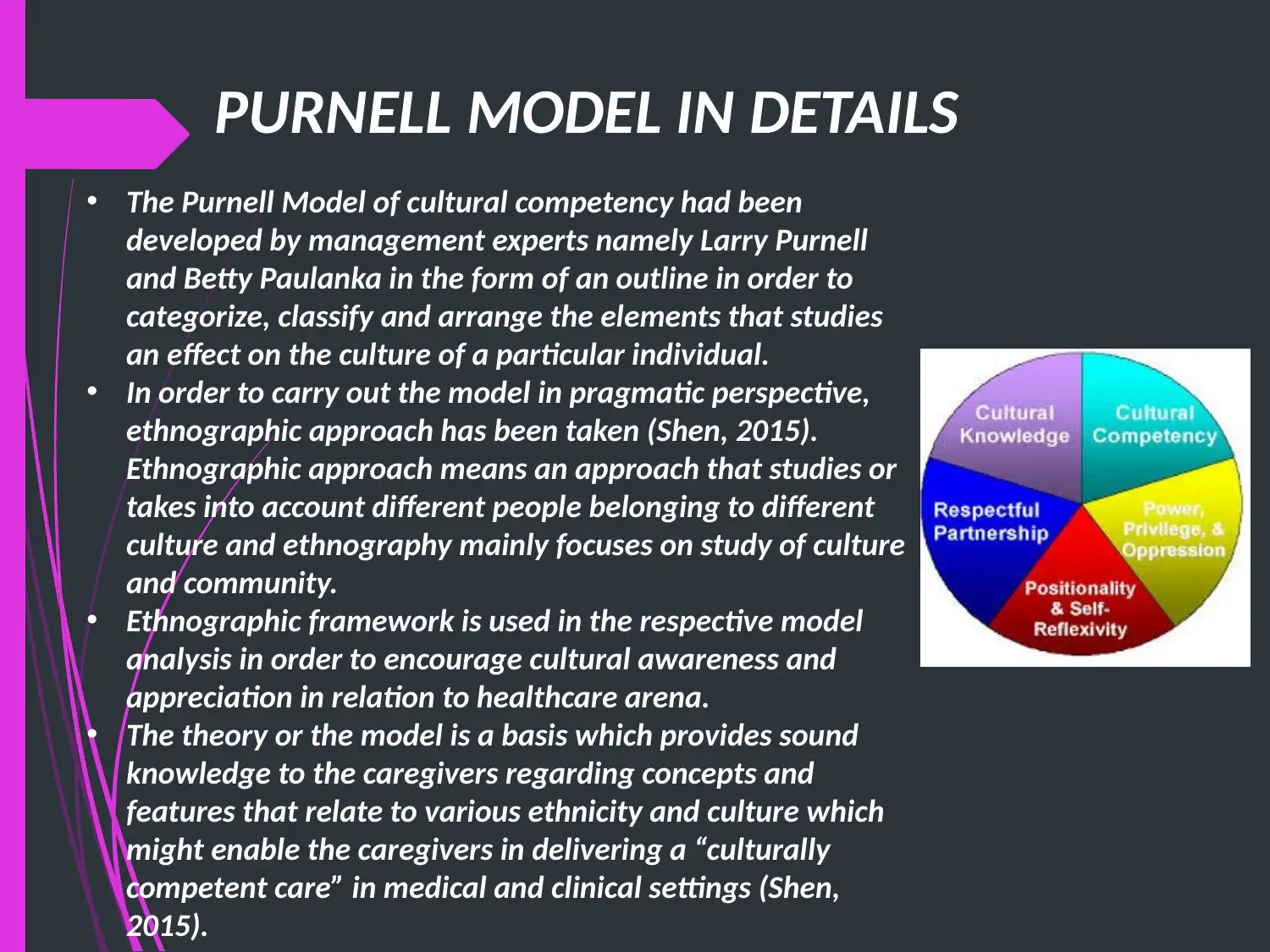
PURNELL MODEL AND ITS PARTS
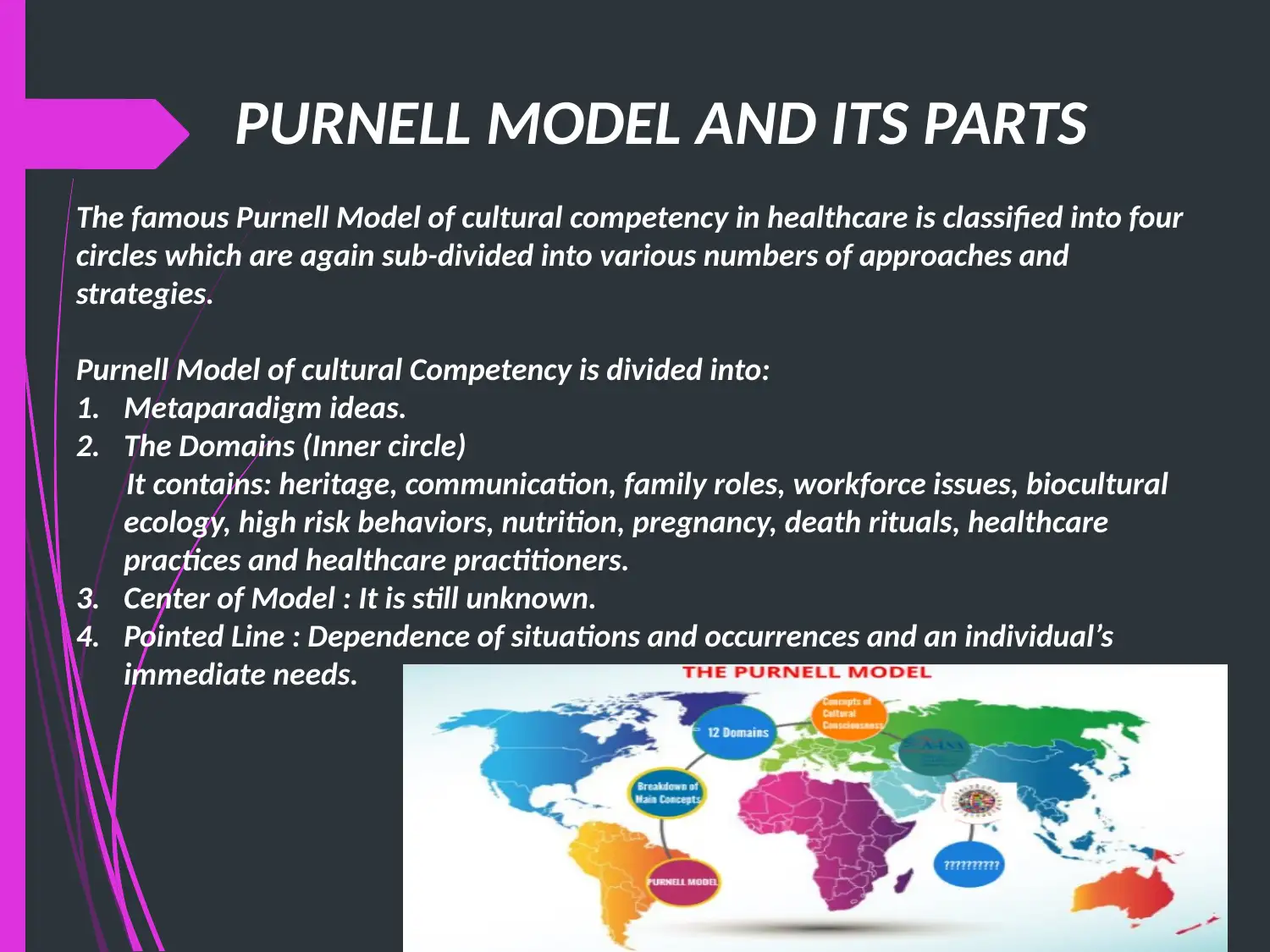
The famous Purnell Model of cultural competency in healthcare is classified into four
circles which are again sub-divided into various numbers of approaches and
strategies.
Purnell Model of cultural Competency is divided into:
1. Metaparadigm ideas.
2. The Domains (Inner circle)
It contains: heritage, communication, family roles, workforce issues, biocultural
ecology, high risk behaviors, nutrition, pregnancy, death rituals, healthcare
practices and healthcare practitioners.
3. Center of Model : It is still unknown.
4. Pointed Line : Dependence of situations and occurrences and an individual’s
immediate needs.
Document Page
INTERPRETING SIKH COMMUNITY
THROUGH PURNELL MODEL OF CULTURAL
COMPETENCY
The interpretation of the Sikh Community through Purnell Model of Cultural Competency
can be carried out hereafter.
Metaparadigm Ideas: They consist of global society, community, family, and the
individual needs and preferences in healthcare.
Inner circle:
Heritage: The Sikhs are particular about their heritage and culture and keeps upholding
them in healthcare services, for instance, Sikh women are attended only by female
doctors and healthcare providers.
Communication: In healthcare sector, Sikhs communicate through verbal as well as non
verbal ways of communication typical to their community, such as taking the name of
their God in order to make the healthcare provider understand that they are either
satisfied/dissatisfied.
Family roles: The Sikh women consider their gender roles to be spiritual and their moral
responsibility, therefore, in healthcare arena, the Sikh women tend to hide their illness
so that their families do not have to suffer.
Workforce issues: Sikh women tend to communicate within themselves in Punjabi
language, thereby, the healthcare professionals are requested to learn the basics of
their language (Sharma, S., & Reimer-Kirkham, S. (2015, March).
Document Page
INTERPRETING SIKH COMMUNITY
THROUGH PURNELL MODEL OF CULTURAL
COMPETENCY
Bio-cultural ecology: Sikh women tend to be having broad and strong physical
features compared to the other Indian women as they possess Aryan characteristics
in them, therefore, medicines such as anesthesia and other doses are to be provided
to them according to their physical and biological ability.
High Risk behavior: Sikh women tend to have alcohol more than the women in Indian
communities, therefore, such factors should be kept in mind by the healthcare
providers in order to treat them.
Nutrition: Sikh women are generally vegetarian, therefore, protein rich nutrients are
consumed less by them. The caregivers should understand the dietary preference of
Sikh women when treating them.
Pregnancy and Childbearing: Even though the Sikhs prefer male child over female
child, the Sikh women, while in labor, are encouraged to meditate and pray for
themselves as well as babies and they prefer female professionals for labor
assistance for the sake of modesty.
Death rituals: At the death, the body of the deceased is taken to the Gurudwara (Sikh
worship place) and hymns are chanted. The Sikhs consider death to be inevitable and
spiritual (Lai & Surood, 2013).
tabler-icon-diamond-filled.svg

Paraphrase This Document

Need a fresh take? Get an instant paraphrase of this document with our AI Paraphraser
Document Page
INTERPRETATION OF SIKH COMMUNITY THROUGH
PURNELL MODEL OF CULTURAL COMPETENCY
Health care practices: The Sikhs believe that the South east Asian way of diet,
exercise (such as Yoga), lifestyle practices and spiritual practices are the best
healthcare practices to remain holistically healthy. Therefore, such dynamics have to
be kept in mind by the healthcare professional while treating them.
Health care practitioners: The Sikhs value men healthcare practitioners over female
healthcare practitioners, however, in cases of treatment of women, they prefer
female midwives for them (Naganathan & Islam, 2015).
Pointed Line:
In certain cultural progressions and lapses, however, the traditional or cultural
health care preferences or practices are kept on hold and according to the individual’s
needs in contet of the situations, amendments regarding healthcare practices can be
included (Naganathan & Islam, 2015).
Document Page
chevron_up_icon
1 out of 15
circle_padding
hide_on_mobile
zoom_out_icon
[object Object]