Cross-Cultural Tourism Negotiation: A Comparison of Canada and Japan

Verified

Added on  2022/11/13

|5
|1548
|285
Essay
AI Summary
This essay provides a comprehensive analysis of cross-cultural tourism, focusing on the negotiation dynamics between Canadian and Japanese business cultures. It examines the scenario where World Adventures, a Canadian tour operator, seeks to negotiate a contract with International Travel in Japan. The essay highlights key cultural differences, particularly contrasting Canada's individualistic and low-context culture with Japan's collectivist and high-context approach. It delves into Hofstede's cultural dimensions, including power distance, uncertainty avoidance, and monochronic vs. polychronic time orientation, to anticipate potential conflicts and inform effective communication strategies. The essay emphasizes the importance of understanding non-verbal cues, building relationships, and adapting negotiation styles to the Japanese context. By providing insights into these cultural nuances, the essay aims to equip the Canadian negotiating team with the knowledge and skills needed to successfully secure the contract and foster a positive long-term business relationship.
Document Page
Cross-cultural tourism
Introduction
World Adventures has to interact with the people of varied region and country as they
have to take their patrons across the world for travel. The officers have to be familiar with the
cultural differences and negotiating practices between various countries, as they have to
strike a deal with their associate partners in foreign land. International Travel is a local
company in Japan and the representatives of World Adventures have to travel to Japan for
striking a deal of ten 21-day tours to the country. The paper intends to explore the cultural
differences between Canada and Japan and the possible conflict that can happen between the
two cultures. Additionally, it would prepare the negotiating team to interact with the Japanese
party effectively and fluently, without offending them.
Country Analysis and Comparison
Every country has their way of working and presume that foreigners coming to their
country will follow their protocols and working culture. Similarly, the Japanese partner also
expects from World Adventures to be familiarized with their cultural practices and ways of
communication the travel agents visit their country for negotiation (Zandt, 2019). The culture
and lifestyle of Japan are completely different from that of Canada (Lewis, 2014). Japan is a
collectivist society while Canada is largely individualist (Robson, 2017). In individualist
society people have the freedom to follow their own individual goals and aspiration. Such a
society tends to measure the success of an individual based on their personal achievements
and not that of the social group they belong to. To contrast, a collectivist society gives
prominence to the group over individuals and attach the status of the family to the individual.
Thus, Canadian officials travelling to Japan for business negotiations have to pay special
emphasis upon exerting the benefits accruing to their organization or society as a whole.
tabler-icon-diamond-filled.svg

Paraphrase This Document

Need a fresh take? Get an instant paraphrase of this document with our AI Paraphraser
Document Page
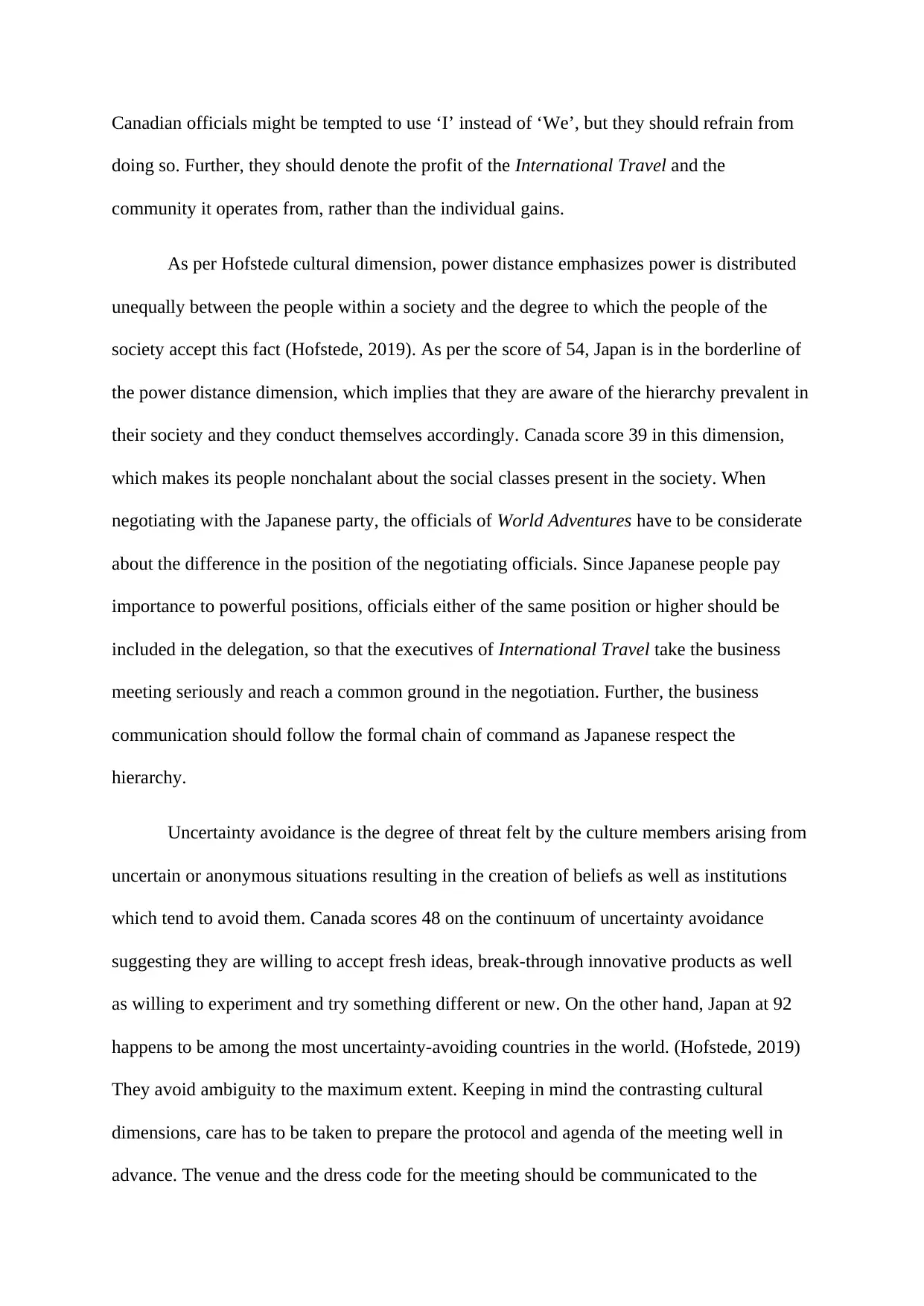
Canadian officials might be tempted to use ‘I’ instead of ‘We’, but they should refrain from
doing so. Further, they should denote the profit of the International Travel and the
community it operates from, rather than the individual gains.
As per Hofstede cultural dimension, power distance emphasizes power is distributed
unequally between the people within a society and the degree to which the people of the
society accept this fact (Hofstede, 2019). As per the score of 54, Japan is in the borderline of
the power distance dimension, which implies that they are aware of the hierarchy prevalent in
their society and they conduct themselves accordingly. Canada score 39 in this dimension,
which makes its people nonchalant about the social classes present in the society. When
negotiating with the Japanese party, the officials of World Adventures have to be considerate
about the difference in the position of the negotiating officials. Since Japanese people pay
importance to powerful positions, officials either of the same position or higher should be
included in the delegation, so that the executives of International Travel take the business
meeting seriously and reach a common ground in the negotiation. Further, the business
communication should follow the formal chain of command as Japanese respect the
hierarchy.
Uncertainty avoidance is the degree of threat felt by the culture members arising from
uncertain or anonymous situations resulting in the creation of beliefs as well as institutions
which tend to avoid them. Canada scores 48 on the continuum of uncertainty avoidance
suggesting they are willing to accept fresh ideas, break-through innovative products as well
as willing to experiment and try something different or new. On the other hand, Japan at 92
happens to be among the most uncertainty-avoiding countries in the world. (Hofstede, 2019)
They avoid ambiguity to the maximum extent. Keeping in mind the contrasting cultural
dimensions, care has to be taken to prepare the protocol and agenda of the meeting well in
advance. The venue and the dress code for the meeting should be communicated to the
Document Page
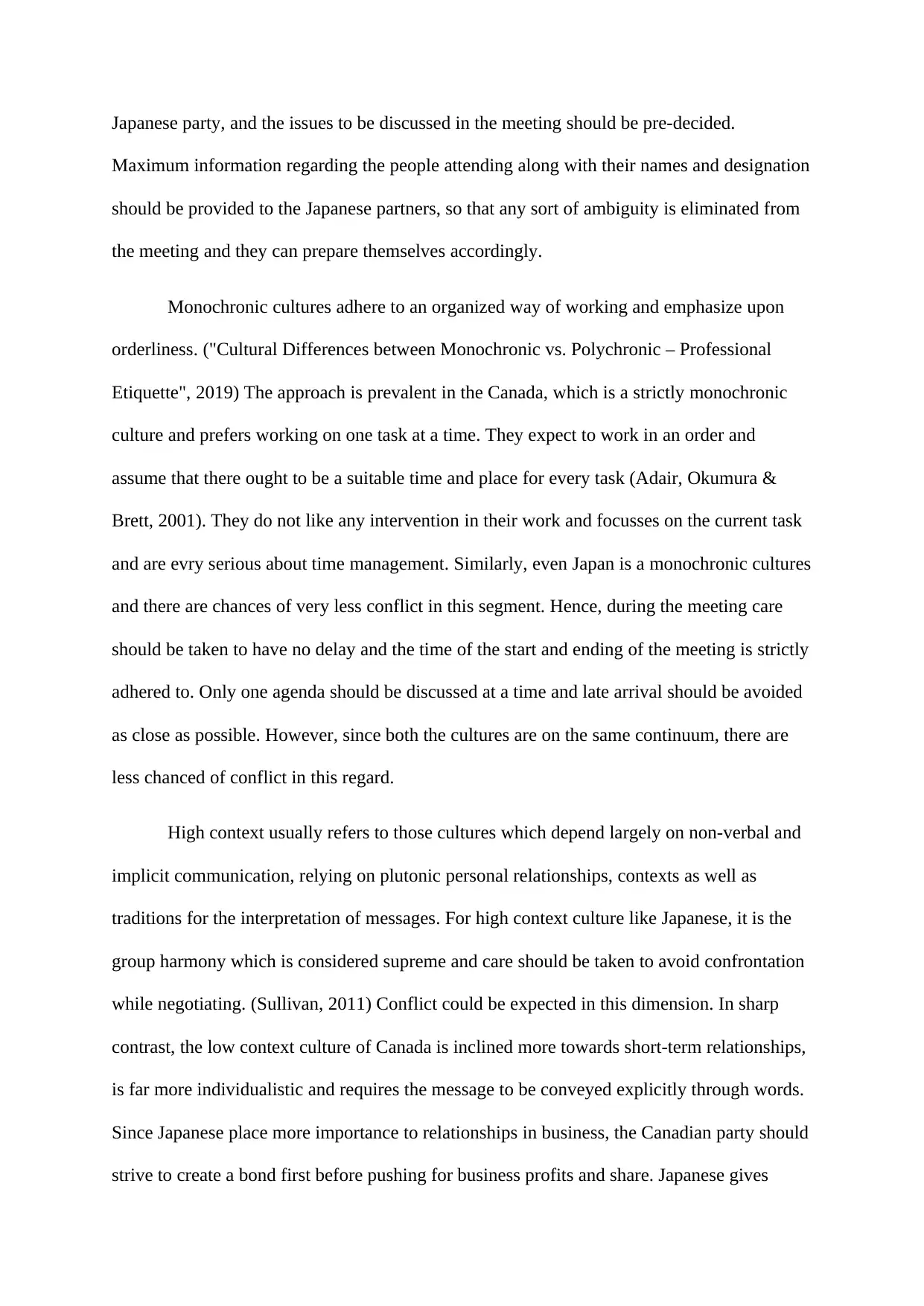
Japanese party, and the issues to be discussed in the meeting should be pre-decided.
Maximum information regarding the people attending along with their names and designation
should be provided to the Japanese partners, so that any sort of ambiguity is eliminated from
the meeting and they can prepare themselves accordingly.
Monochronic cultures adhere to an organized way of working and emphasize upon
orderliness. ("Cultural Differences between Monochronic vs. Polychronic – Professional
Etiquette", 2019) The approach is prevalent in the Canada, which is a strictly monochronic
culture and prefers working on one task at a time. They expect to work in an order and
assume that there ought to be a suitable time and place for every task (Adair, Okumura &
Brett, 2001). They do not like any intervention in their work and focusses on the current task
and are evry serious about time management. Similarly, even Japan is a monochronic cultures
and there are chances of very less conflict in this segment. Hence, during the meeting care
should be taken to have no delay and the time of the start and ending of the meeting is strictly
adhered to. Only one agenda should be discussed at a time and late arrival should be avoided
as close as possible. However, since both the cultures are on the same continuum, there are
less chanced of conflict in this regard.
High context usually refers to those cultures which depend largely on non-verbal and
implicit communication, relying on plutonic personal relationships, contexts as well as
traditions for the interpretation of messages. For high context culture like Japanese, it is the
group harmony which is considered supreme and care should be taken to avoid confrontation
while negotiating. (Sullivan, 2011) Conflict could be expected in this dimension. In sharp
contrast, the low context culture of Canada is inclined more towards short-term relationships,
is far more individualistic and requires the message to be conveyed explicitly through words.
Since Japanese place more importance to relationships in business, the Canadian party should
strive to create a bond first before pushing for business profits and share. Japanese gives
Document Page
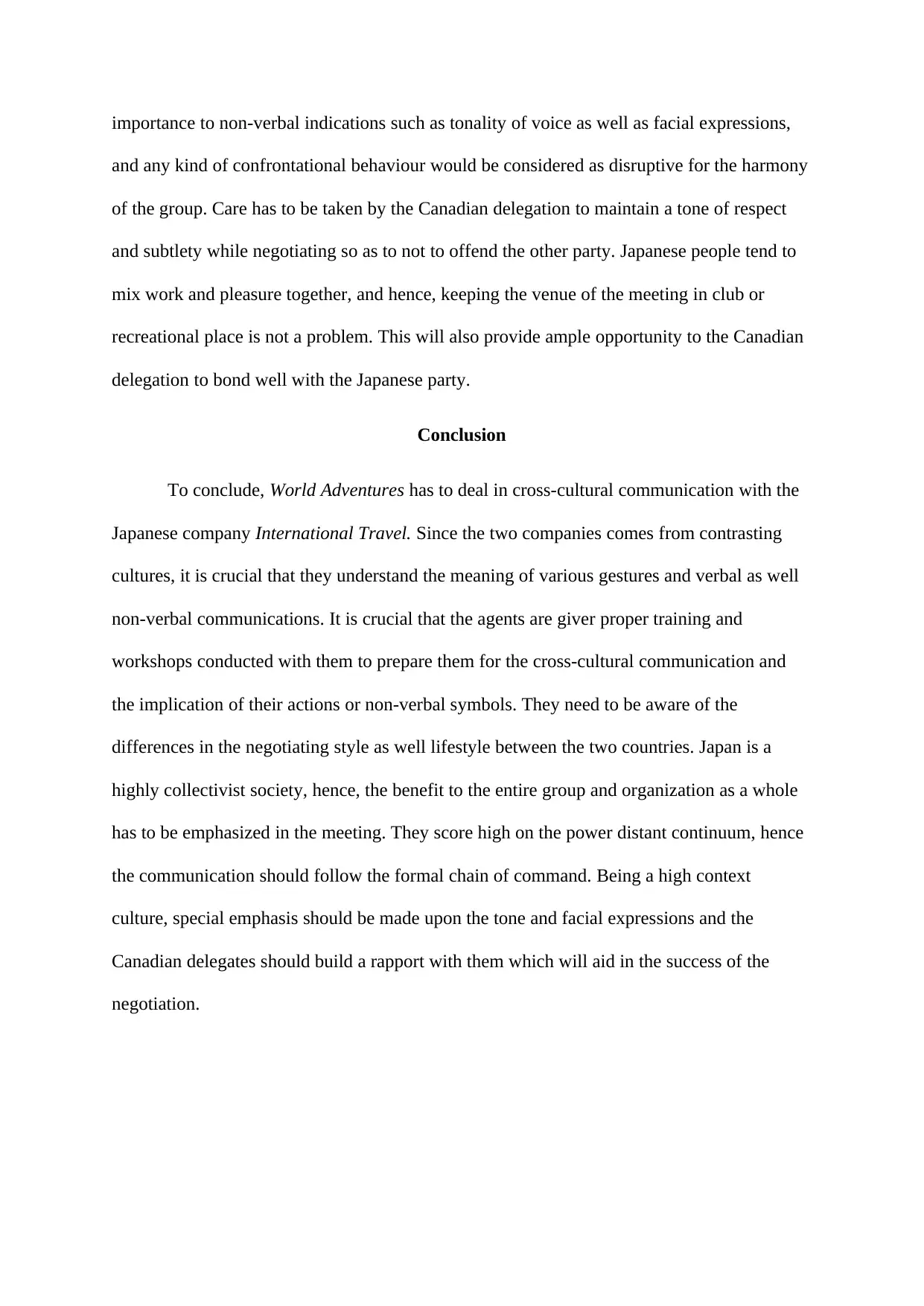
importance to non-verbal indications such as tonality of voice as well as facial expressions,
and any kind of confrontational behaviour would be considered as disruptive for the harmony
of the group. Care has to be taken by the Canadian delegation to maintain a tone of respect
and subtlety while negotiating so as to not to offend the other party. Japanese people tend to
mix work and pleasure together, and hence, keeping the venue of the meeting in club or
recreational place is not a problem. This will also provide ample opportunity to the Canadian
delegation to bond well with the Japanese party.
Conclusion
To conclude, World Adventures has to deal in cross-cultural communication with the
Japanese company International Travel. Since the two companies comes from contrasting
cultures, it is crucial that they understand the meaning of various gestures and verbal as well
non-verbal communications. It is crucial that the agents are giver proper training and
workshops conducted with them to prepare them for the cross-cultural communication and
the implication of their actions or non-verbal symbols. They need to be aware of the
differences in the negotiating style as well lifestyle between the two countries. Japan is a
highly collectivist society, hence, the benefit to the entire group and organization as a whole
has to be emphasized in the meeting. They score high on the power distant continuum, hence
the communication should follow the formal chain of command. Being a high context
culture, special emphasis should be made upon the tone and facial expressions and the
Canadian delegates should build a rapport with them which will aid in the success of the
negotiation.
tabler-icon-diamond-filled.svg

Paraphrase This Document

Need a fresh take? Get an instant paraphrase of this document with our AI Paraphraser
Document Page
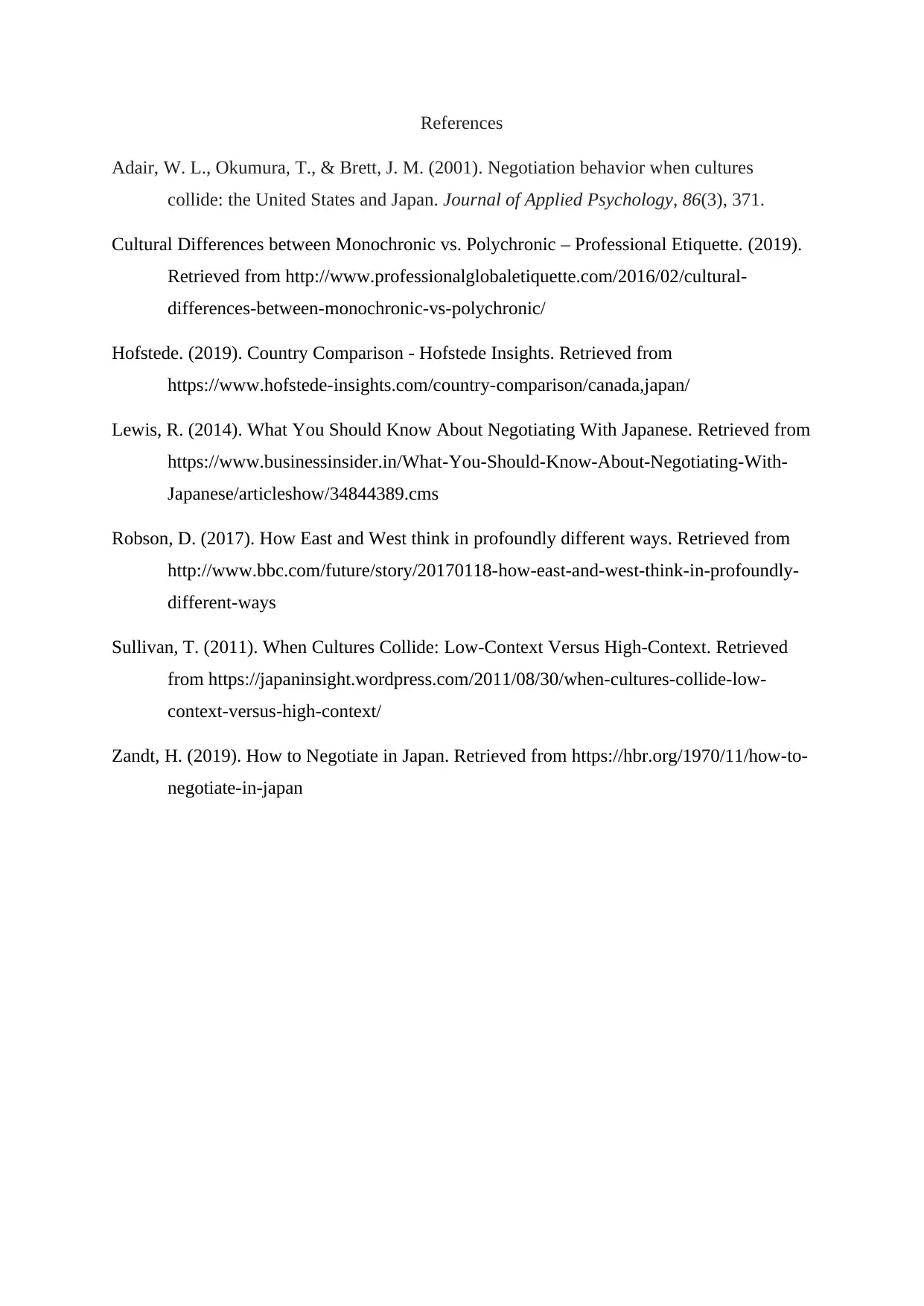
References
Adair, W. L., Okumura, T., & Brett, J. M. (2001). Negotiation behavior when cultures
collide: the United States and Japan. Journal of Applied Psychology, 86(3), 371.
Cultural Differences between Monochronic vs. Polychronic – Professional Etiquette. (2019).
Retrieved from http://www.professionalglobaletiquette.com/2016/02/cultural-
differences-between-monochronic-vs-polychronic/
Hofstede. (2019). Country Comparison - Hofstede Insights. Retrieved from
https://www.hofstede-insights.com/country-comparison/canada,japan/
Lewis, R. (2014). What You Should Know About Negotiating With Japanese. Retrieved from
https://www.businessinsider.in/What-You-Should-Know-About-Negotiating-With-
Japanese/articleshow/34844389.cms
Robson, D. (2017). How East and West think in profoundly different ways. Retrieved from
http://www.bbc.com/future/story/20170118-how-east-and-west-think-in-profoundly-
different-ways
Sullivan, T. (2011). When Cultures Collide: Low-Context Versus High-Context. Retrieved
from https://japaninsight.wordpress.com/2011/08/30/when-cultures-collide-low-
context-versus-high-context/
Zandt, H. (2019). How to Negotiate in Japan. Retrieved from https://hbr.org/1970/11/how-to-
negotiate-in-japan
chevron_up_icon
1 out of 5
circle_padding
hide_on_mobile
zoom_out_icon
[object Object]