Unit 11 Research Proposal: Cultural Diversity in Automotive Industry
VerifiedAdded on 2023/01/19
|18
|3484
|80
Report
AI Summary
This research proposal investigates the impact of managing cultural diversity on organizational performance, specifically within the automotive industry. The study aims to determine dysfunctional issues arising from cultural diversity and its positive influences, focusing on Jaguar Land Rover Automotive Plc. The proposal outlines research objectives, questions, and the rationale for selecting the project, emphasizing personal interest and the potential for skill development. It includes a literature review exploring the concept of cultural diversity, its significance, influence on organizational performance, and associated challenges. The research methodology involves a qualitative approach, descriptive research design, and interpretivism philosophy. Data will be collected from both primary and secondary sources, including questionnaires and literature review. Thematic analysis will be used for data analysis with a sample size of 30. The project also includes a Gantt chart for activities and timescales.

Research Proposal

Paraphrase This Document
Need a fresh take? Get an instant paraphrase of this document with our AI Paraphraser

Table of Contents
Research Proposal Form..................................................................................................................3
Research Ethics Approval Form....................................................................................................12
Research Proposal Form..................................................................................................................3
Research Ethics Approval Form....................................................................................................12
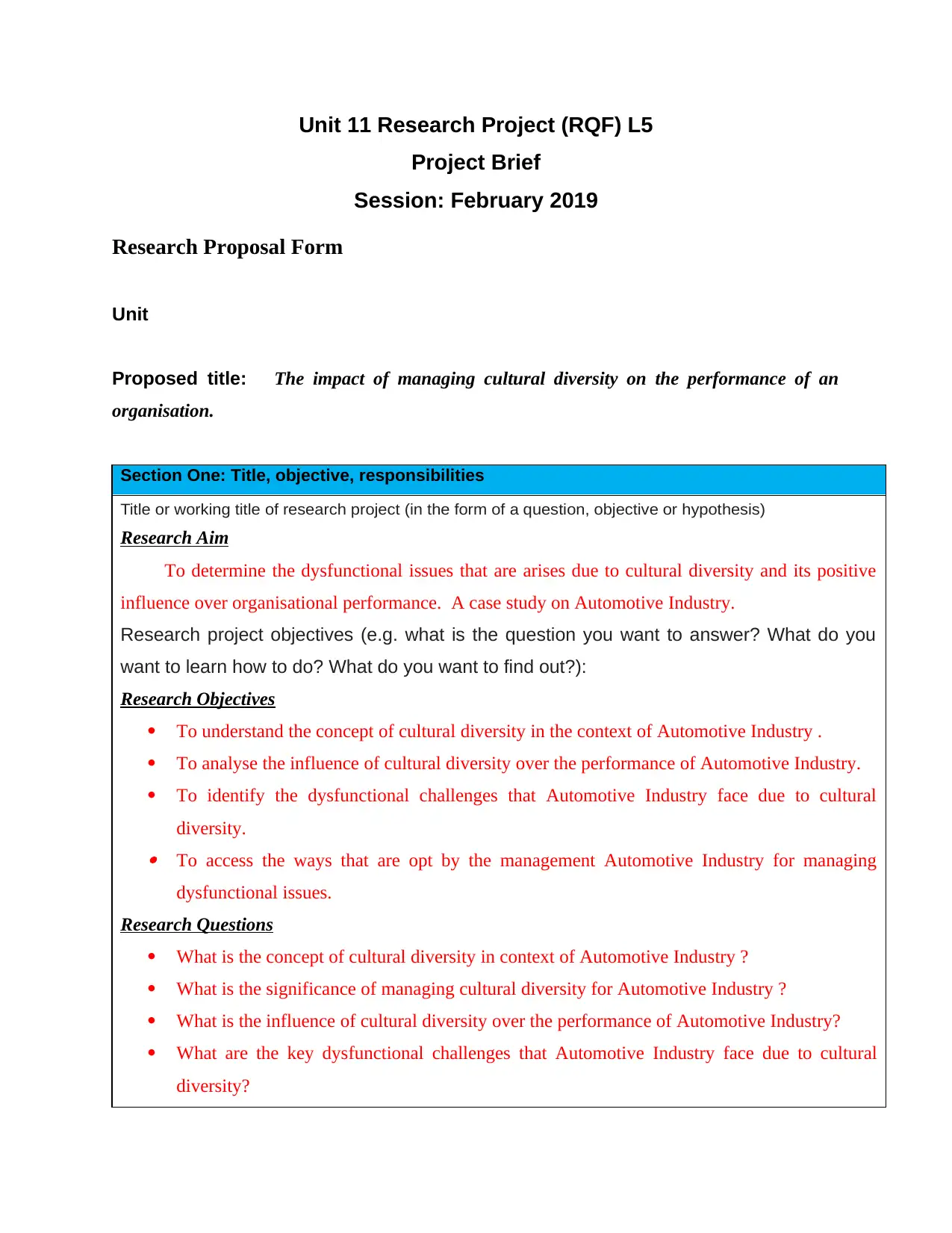
Unit 11 Research Project (RQF) L5
Project Brief
Session: February 2019
Research Proposal Form
Unit
Proposed title: The impact of managing cultural diversity on the performance of an
organisation.
Section One: Title, objective, responsibilities
Title or working title of research project (in the form of a question, objective or hypothesis)
Research Aim
To determine the dysfunctional issues that are arises due to cultural diversity and its positive
influence over organisational performance. A case study on Automotive Industry.
Research project objectives (e.g. what is the question you want to answer? What do you
want to learn how to do? What do you want to find out?):
Research Objectives
To understand the concept of cultural diversity in the context of Automotive Industry .
To analyse the influence of cultural diversity over the performance of Automotive Industry.
To identify the dysfunctional challenges that Automotive Industry face due to cultural
diversity. To access the ways that are opt by the management Automotive Industry for managing
dysfunctional issues.
Research Questions
What is the concept of cultural diversity in context of Automotive Industry ?
What is the significance of managing cultural diversity for Automotive Industry ?
What is the influence of cultural diversity over the performance of Automotive Industry?
What are the key dysfunctional challenges that Automotive Industry face due to cultural
diversity?
Project Brief
Session: February 2019
Research Proposal Form
Unit
Proposed title: The impact of managing cultural diversity on the performance of an
organisation.
Section One: Title, objective, responsibilities
Title or working title of research project (in the form of a question, objective or hypothesis)
Research Aim
To determine the dysfunctional issues that are arises due to cultural diversity and its positive
influence over organisational performance. A case study on Automotive Industry.
Research project objectives (e.g. what is the question you want to answer? What do you
want to learn how to do? What do you want to find out?):
Research Objectives
To understand the concept of cultural diversity in the context of Automotive Industry .
To analyse the influence of cultural diversity over the performance of Automotive Industry.
To identify the dysfunctional challenges that Automotive Industry face due to cultural
diversity. To access the ways that are opt by the management Automotive Industry for managing
dysfunctional issues.
Research Questions
What is the concept of cultural diversity in context of Automotive Industry ?
What is the significance of managing cultural diversity for Automotive Industry ?
What is the influence of cultural diversity over the performance of Automotive Industry?
What are the key dysfunctional challenges that Automotive Industry face due to cultural
diversity?
⊘ This is a preview!⊘
Do you want full access?
Subscribe today to unlock all pages.

Trusted by 1+ million students worldwide
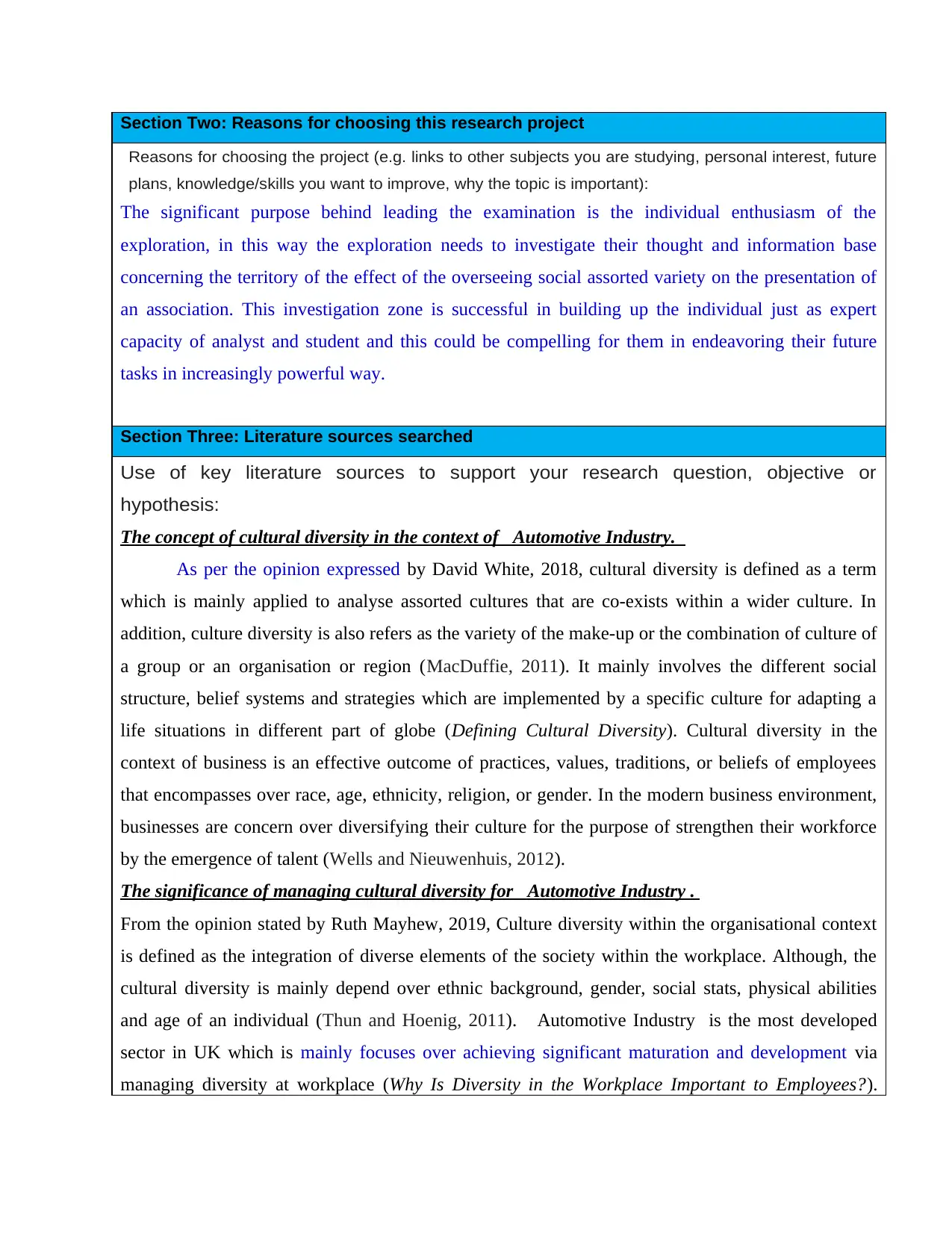
Section Two: Reasons for choosing this research project
Reasons for choosing the project (e.g. links to other subjects you are studying, personal interest, future
plans, knowledge/skills you want to improve, why the topic is important):
The significant purpose behind leading the examination is the individual enthusiasm of the
exploration, in this way the exploration needs to investigate their thought and information base
concerning the territory of the effect of the overseeing social assorted variety on the presentation of
an association. This investigation zone is successful in building up the individual just as expert
capacity of analyst and student and this could be compelling for them in endeavoring their future
tasks in increasingly powerful way.
Section Three: Literature sources searched
Use of key literature sources to support your research question, objective or
hypothesis:
The concept of cultural diversity in the context of Automotive Industry.
As per the opinion expressed by David White, 2018, cultural diversity is defined as a term
which is mainly applied to analyse assorted cultures that are co-exists within a wider culture. In
addition, culture diversity is also refers as the variety of the make-up or the combination of culture of
a group or an organisation or region (MacDuffie, 2011). It mainly involves the different social
structure, belief systems and strategies which are implemented by a specific culture for adapting a
life situations in different part of globe (Defining Cultural Diversity). Cultural diversity in the
context of business is an effective outcome of practices, values, traditions, or beliefs of employees
that encompasses over race, age, ethnicity, religion, or gender. In the modern business environment,
businesses are concern over diversifying their culture for the purpose of strengthen their workforce
by the emergence of talent (Wells and Nieuwenhuis, 2012).
The significance of managing cultural diversity for Automotive Industry .
From the opinion stated by Ruth Mayhew, 2019, Culture diversity within the organisational context
is defined as the integration of diverse elements of the society within the workplace. Although, the
cultural diversity is mainly depend over ethnic background, gender, social stats, physical abilities
and age of an individual (Thun and Hoenig, 2011). Automotive Industry is the most developed
sector in UK which is mainly focuses over achieving significant maturation and development via
managing diversity at workplace (Why Is Diversity in the Workplace Important to Employees?).
Reasons for choosing the project (e.g. links to other subjects you are studying, personal interest, future
plans, knowledge/skills you want to improve, why the topic is important):
The significant purpose behind leading the examination is the individual enthusiasm of the
exploration, in this way the exploration needs to investigate their thought and information base
concerning the territory of the effect of the overseeing social assorted variety on the presentation of
an association. This investigation zone is successful in building up the individual just as expert
capacity of analyst and student and this could be compelling for them in endeavoring their future
tasks in increasingly powerful way.
Section Three: Literature sources searched
Use of key literature sources to support your research question, objective or
hypothesis:
The concept of cultural diversity in the context of Automotive Industry.
As per the opinion expressed by David White, 2018, cultural diversity is defined as a term
which is mainly applied to analyse assorted cultures that are co-exists within a wider culture. In
addition, culture diversity is also refers as the variety of the make-up or the combination of culture of
a group or an organisation or region (MacDuffie, 2011). It mainly involves the different social
structure, belief systems and strategies which are implemented by a specific culture for adapting a
life situations in different part of globe (Defining Cultural Diversity). Cultural diversity in the
context of business is an effective outcome of practices, values, traditions, or beliefs of employees
that encompasses over race, age, ethnicity, religion, or gender. In the modern business environment,
businesses are concern over diversifying their culture for the purpose of strengthen their workforce
by the emergence of talent (Wells and Nieuwenhuis, 2012).
The significance of managing cultural diversity for Automotive Industry .
From the opinion stated by Ruth Mayhew, 2019, Culture diversity within the organisational context
is defined as the integration of diverse elements of the society within the workplace. Although, the
cultural diversity is mainly depend over ethnic background, gender, social stats, physical abilities
and age of an individual (Thun and Hoenig, 2011). Automotive Industry is the most developed
sector in UK which is mainly focuses over achieving significant maturation and development via
managing diversity at workplace (Why Is Diversity in the Workplace Important to Employees?).
Paraphrase This Document
Need a fresh take? Get an instant paraphrase of this document with our AI Paraphraser
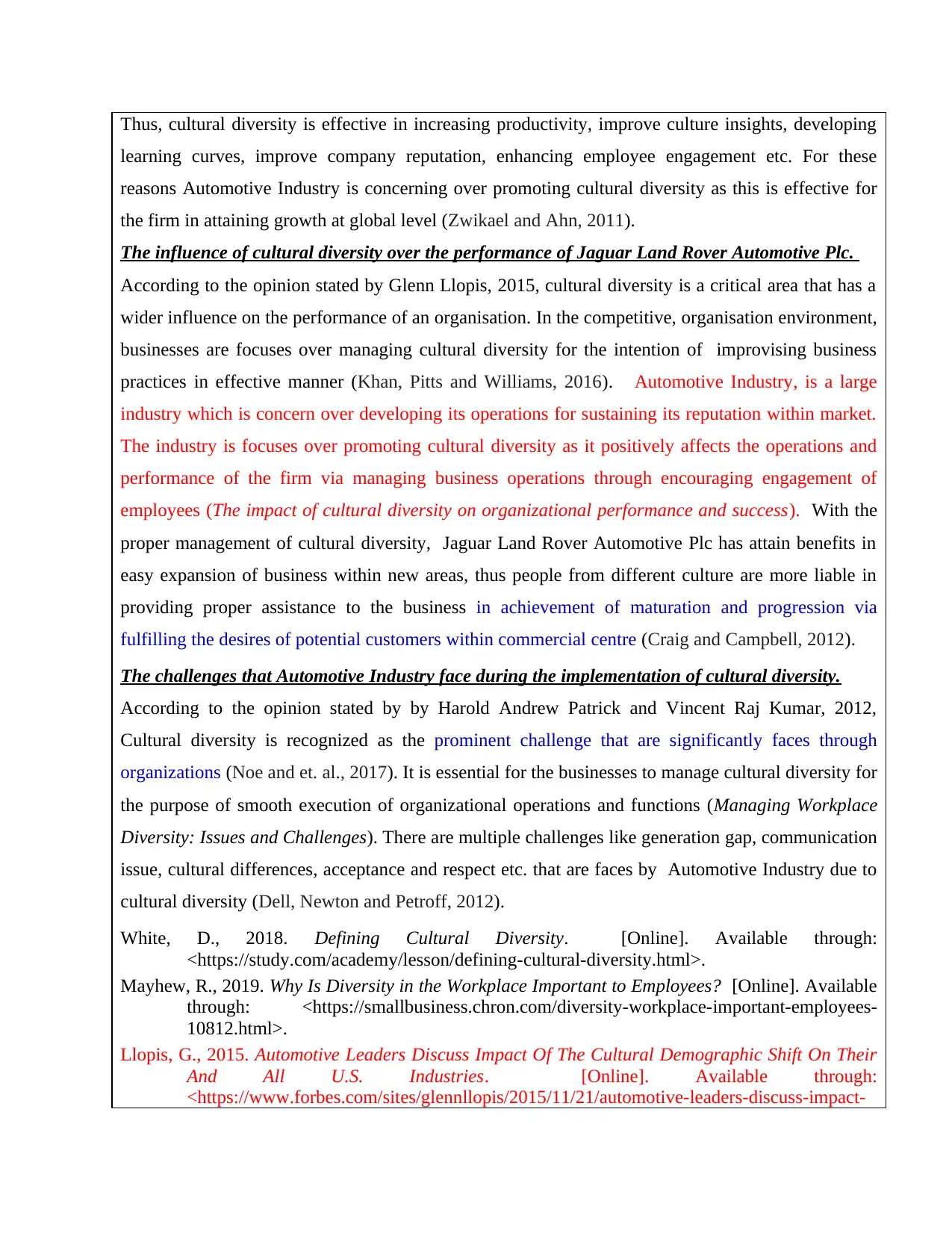
Thus, cultural diversity is effective in increasing productivity, improve culture insights, developing
learning curves, improve company reputation, enhancing employee engagement etc. For these
reasons Automotive Industry is concerning over promoting cultural diversity as this is effective for
the firm in attaining growth at global level (Zwikael and Ahn, 2011).
The influence of cultural diversity over the performance of Jaguar Land Rover Automotive Plc.
According to the opinion stated by Glenn Llopis, 2015, cultural diversity is a critical area that has a
wider influence on the performance of an organisation. In the competitive, organisation environment,
businesses are focuses over managing cultural diversity for the intention of improvising business
practices in effective manner (Khan, Pitts and Williams, 2016). Automotive Industry, is a large
industry which is concern over developing its operations for sustaining its reputation within market.
The industry is focuses over promoting cultural diversity as it positively affects the operations and
performance of the firm via managing business operations through encouraging engagement of
employees (The impact of cultural diversity on organizational performance and success). With the
proper management of cultural diversity, Jaguar Land Rover Automotive Plc has attain benefits in
easy expansion of business within new areas, thus people from different culture are more liable in
providing proper assistance to the business in achievement of maturation and progression via
fulfilling the desires of potential customers within commercial centre (Craig and Campbell, 2012).
The challenges that Automotive Industry face during the implementation of cultural diversity.
According to the opinion stated by by Harold Andrew Patrick and Vincent Raj Kumar, 2012,
Cultural diversity is recognized as the prominent challenge that are significantly faces through
organizations (Noe and et. al., 2017). It is essential for the businesses to manage cultural diversity for
the purpose of smooth execution of organizational operations and functions (Managing Workplace
Diversity: Issues and Challenges). There are multiple challenges like generation gap, communication
issue, cultural differences, acceptance and respect etc. that are faces by Automotive Industry due to
cultural diversity (Dell, Newton and Petroff, 2012).
White, D., 2018. Defining Cultural Diversity. [Online]. Available through:
<https://study.com/academy/lesson/defining-cultural-diversity.html>.
Mayhew, R., 2019. Why Is Diversity in the Workplace Important to Employees? [Online]. Available
through: <https://smallbusiness.chron.com/diversity-workplace-important-employees-
10812.html>.
Llopis, G., 2015. Automotive Leaders Discuss Impact Of The Cultural Demographic Shift On Their
And All U.S. Industries. [Online]. Available through:
<https://www.forbes.com/sites/glennllopis/2015/11/21/automotive-leaders-discuss-impact-
learning curves, improve company reputation, enhancing employee engagement etc. For these
reasons Automotive Industry is concerning over promoting cultural diversity as this is effective for
the firm in attaining growth at global level (Zwikael and Ahn, 2011).
The influence of cultural diversity over the performance of Jaguar Land Rover Automotive Plc.
According to the opinion stated by Glenn Llopis, 2015, cultural diversity is a critical area that has a
wider influence on the performance of an organisation. In the competitive, organisation environment,
businesses are focuses over managing cultural diversity for the intention of improvising business
practices in effective manner (Khan, Pitts and Williams, 2016). Automotive Industry, is a large
industry which is concern over developing its operations for sustaining its reputation within market.
The industry is focuses over promoting cultural diversity as it positively affects the operations and
performance of the firm via managing business operations through encouraging engagement of
employees (The impact of cultural diversity on organizational performance and success). With the
proper management of cultural diversity, Jaguar Land Rover Automotive Plc has attain benefits in
easy expansion of business within new areas, thus people from different culture are more liable in
providing proper assistance to the business in achievement of maturation and progression via
fulfilling the desires of potential customers within commercial centre (Craig and Campbell, 2012).
The challenges that Automotive Industry face during the implementation of cultural diversity.
According to the opinion stated by by Harold Andrew Patrick and Vincent Raj Kumar, 2012,
Cultural diversity is recognized as the prominent challenge that are significantly faces through
organizations (Noe and et. al., 2017). It is essential for the businesses to manage cultural diversity for
the purpose of smooth execution of organizational operations and functions (Managing Workplace
Diversity: Issues and Challenges). There are multiple challenges like generation gap, communication
issue, cultural differences, acceptance and respect etc. that are faces by Automotive Industry due to
cultural diversity (Dell, Newton and Petroff, 2012).
White, D., 2018. Defining Cultural Diversity. [Online]. Available through:
<https://study.com/academy/lesson/defining-cultural-diversity.html>.
Mayhew, R., 2019. Why Is Diversity in the Workplace Important to Employees? [Online]. Available
through: <https://smallbusiness.chron.com/diversity-workplace-important-employees-
10812.html>.
Llopis, G., 2015. Automotive Leaders Discuss Impact Of The Cultural Demographic Shift On Their
And All U.S. Industries. [Online]. Available through:
<https://www.forbes.com/sites/glennllopis/2015/11/21/automotive-leaders-discuss-impact-
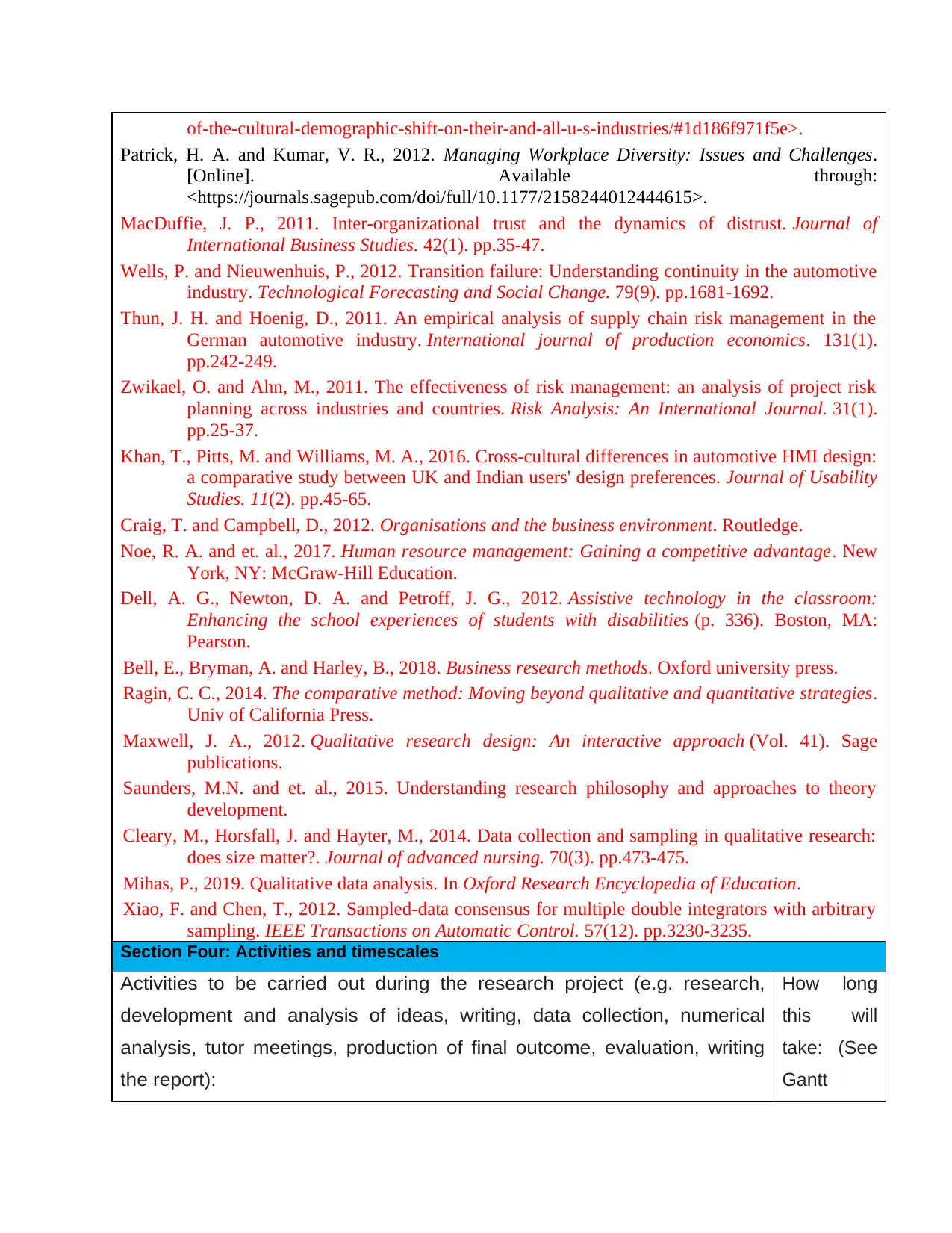
of-the-cultural-demographic-shift-on-their-and-all-u-s-industries/#1d186f971f5e>.
Patrick, H. A. and Kumar, V. R., 2012. Managing Workplace Diversity: Issues and Challenges.
[Online]. Available through:
<https://journals.sagepub.com/doi/full/10.1177/2158244012444615>.
MacDuffie, J. P., 2011. Inter-organizational trust and the dynamics of distrust. Journal of
International Business Studies. 42(1). pp.35-47.
Wells, P. and Nieuwenhuis, P., 2012. Transition failure: Understanding continuity in the automotive
industry. Technological Forecasting and Social Change. 79(9). pp.1681-1692.
Thun, J. H. and Hoenig, D., 2011. An empirical analysis of supply chain risk management in the
German automotive industry. International journal of production economics. 131(1).
pp.242-249.
Zwikael, O. and Ahn, M., 2011. The effectiveness of risk management: an analysis of project risk
planning across industries and countries. Risk Analysis: An International Journal. 31(1).
pp.25-37.
Khan, T., Pitts, M. and Williams, M. A., 2016. Cross-cultural differences in automotive HMI design:
a comparative study between UK and Indian users' design preferences. Journal of Usability
Studies. 11(2). pp.45-65.
Craig, T. and Campbell, D., 2012. Organisations and the business environment. Routledge.
Noe, R. A. and et. al., 2017. Human resource management: Gaining a competitive advantage. New
York, NY: McGraw-Hill Education.
Dell, A. G., Newton, D. A. and Petroff, J. G., 2012. Assistive technology in the classroom:
Enhancing the school experiences of students with disabilities (p. 336). Boston, MA:
Pearson.
Bell, E., Bryman, A. and Harley, B., 2018. Business research methods. Oxford university press.
Ragin, C. C., 2014. The comparative method: Moving beyond qualitative and quantitative strategies.
Univ of California Press.
Maxwell, J. A., 2012. Qualitative research design: An interactive approach (Vol. 41). Sage
publications.
Saunders, M.N. and et. al., 2015. Understanding research philosophy and approaches to theory
development.
Cleary, M., Horsfall, J. and Hayter, M., 2014. Data collection and sampling in qualitative research:
does size matter?. Journal of advanced nursing. 70(3). pp.473-475.
Mihas, P., 2019. Qualitative data analysis. In Oxford Research Encyclopedia of Education.
Xiao, F. and Chen, T., 2012. Sampled-data consensus for multiple double integrators with arbitrary
sampling. IEEE Transactions on Automatic Control. 57(12). pp.3230-3235.
Section Four: Activities and timescales
Activities to be carried out during the research project (e.g. research,
development and analysis of ideas, writing, data collection, numerical
analysis, tutor meetings, production of final outcome, evaluation, writing
the report):
How long
this will
take: (See
Gantt
Patrick, H. A. and Kumar, V. R., 2012. Managing Workplace Diversity: Issues and Challenges.
[Online]. Available through:
<https://journals.sagepub.com/doi/full/10.1177/2158244012444615>.
MacDuffie, J. P., 2011. Inter-organizational trust and the dynamics of distrust. Journal of
International Business Studies. 42(1). pp.35-47.
Wells, P. and Nieuwenhuis, P., 2012. Transition failure: Understanding continuity in the automotive
industry. Technological Forecasting and Social Change. 79(9). pp.1681-1692.
Thun, J. H. and Hoenig, D., 2011. An empirical analysis of supply chain risk management in the
German automotive industry. International journal of production economics. 131(1).
pp.242-249.
Zwikael, O. and Ahn, M., 2011. The effectiveness of risk management: an analysis of project risk
planning across industries and countries. Risk Analysis: An International Journal. 31(1).
pp.25-37.
Khan, T., Pitts, M. and Williams, M. A., 2016. Cross-cultural differences in automotive HMI design:
a comparative study between UK and Indian users' design preferences. Journal of Usability
Studies. 11(2). pp.45-65.
Craig, T. and Campbell, D., 2012. Organisations and the business environment. Routledge.
Noe, R. A. and et. al., 2017. Human resource management: Gaining a competitive advantage. New
York, NY: McGraw-Hill Education.
Dell, A. G., Newton, D. A. and Petroff, J. G., 2012. Assistive technology in the classroom:
Enhancing the school experiences of students with disabilities (p. 336). Boston, MA:
Pearson.
Bell, E., Bryman, A. and Harley, B., 2018. Business research methods. Oxford university press.
Ragin, C. C., 2014. The comparative method: Moving beyond qualitative and quantitative strategies.
Univ of California Press.
Maxwell, J. A., 2012. Qualitative research design: An interactive approach (Vol. 41). Sage
publications.
Saunders, M.N. and et. al., 2015. Understanding research philosophy and approaches to theory
development.
Cleary, M., Horsfall, J. and Hayter, M., 2014. Data collection and sampling in qualitative research:
does size matter?. Journal of advanced nursing. 70(3). pp.473-475.
Mihas, P., 2019. Qualitative data analysis. In Oxford Research Encyclopedia of Education.
Xiao, F. and Chen, T., 2012. Sampled-data consensus for multiple double integrators with arbitrary
sampling. IEEE Transactions on Automatic Control. 57(12). pp.3230-3235.
Section Four: Activities and timescales
Activities to be carried out during the research project (e.g. research,
development and analysis of ideas, writing, data collection, numerical
analysis, tutor meetings, production of final outcome, evaluation, writing
the report):
How long
this will
take: (See
Gantt
⊘ This is a preview!⊘
Do you want full access?
Subscribe today to unlock all pages.
Trusted by 1+ million students worldwide
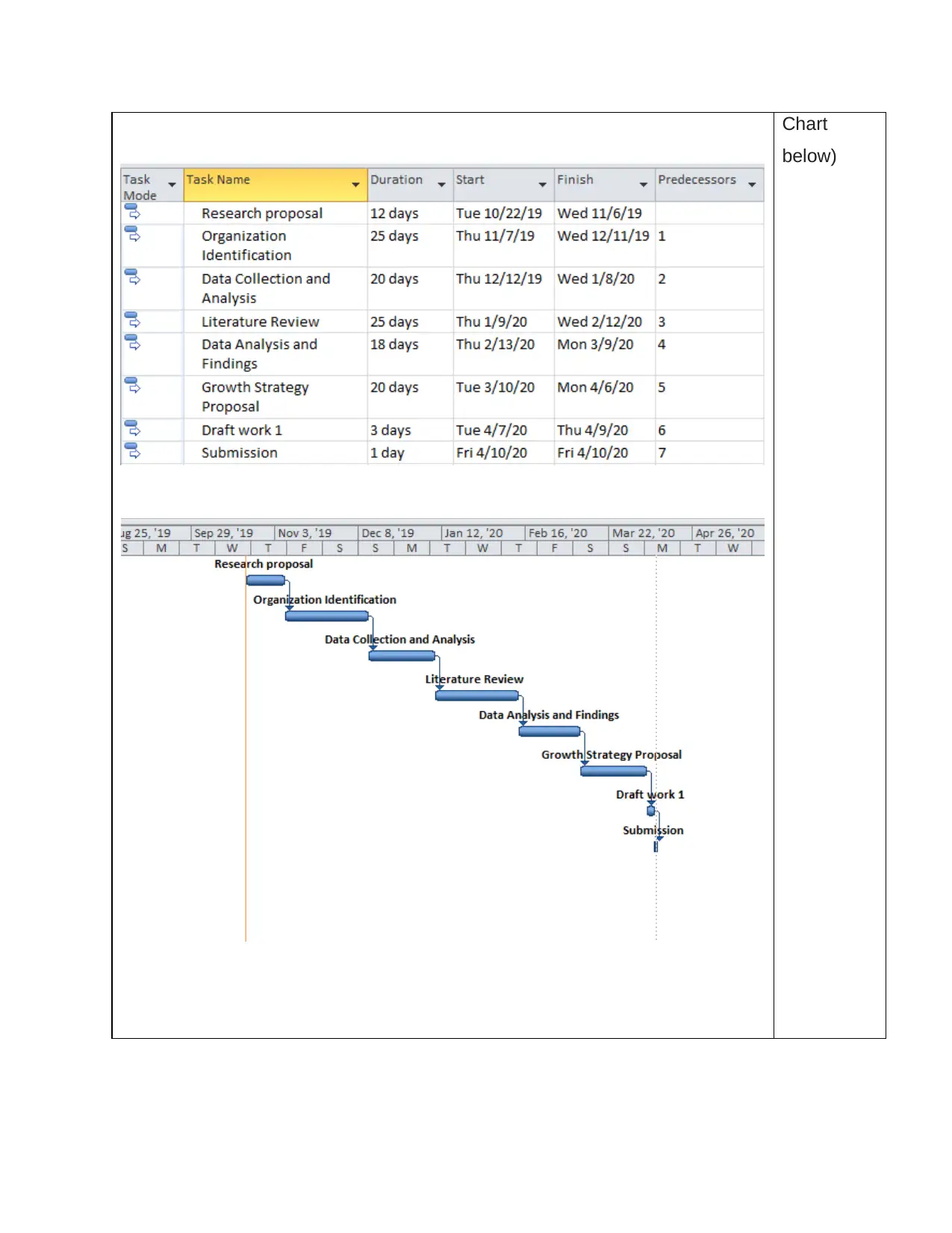
Chart
below)
below)
Paraphrase This Document
Need a fresh take? Get an instant paraphrase of this document with our AI Paraphraser
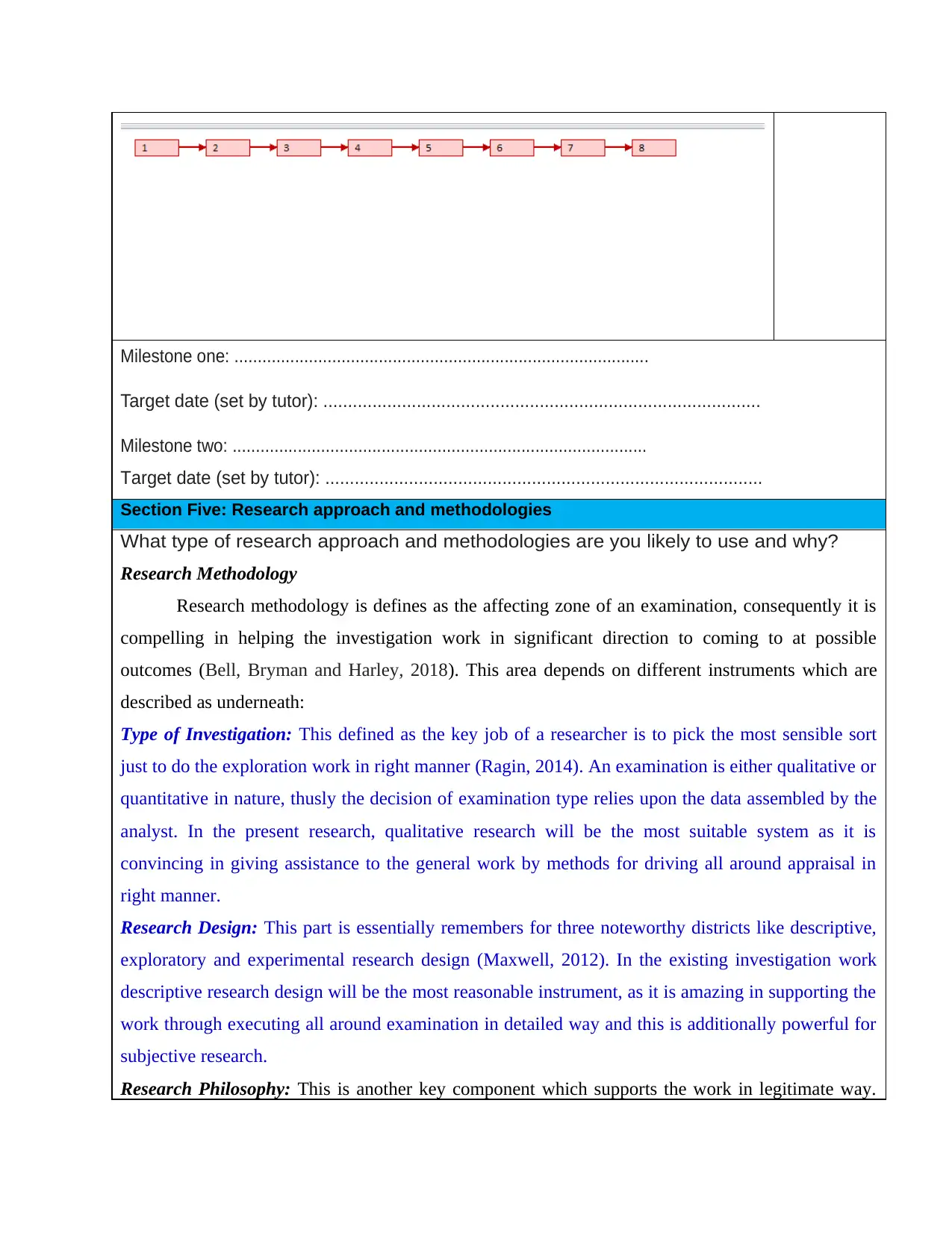
Milestone one: .........................................................................................
Target date (set by tutor): .........................................................................................
Milestone two: .........................................................................................
Target date (set by tutor): .........................................................................................
Section Five: Research approach and methodologies
What type of research approach and methodologies are you likely to use and why?
Research Methodology
Research methodology is defines as the affecting zone of an examination, consequently it is
compelling in helping the investigation work in significant direction to coming to at possible
outcomes (Bell, Bryman and Harley, 2018). This area depends on different instruments which are
described as underneath:
Type of Investigation: This defined as the key job of a researcher is to pick the most sensible sort
just to do the exploration work in right manner (Ragin, 2014). An examination is either qualitative or
quantitative in nature, thusly the decision of examination type relies upon the data assembled by the
analyst. In the present research, qualitative research will be the most suitable system as it is
convincing in giving assistance to the general work by methods for driving all around appraisal in
right manner.
Research Design: This part is essentially remembers for three noteworthy districts like descriptive,
exploratory and experimental research design (Maxwell, 2012). In the existing investigation work
descriptive research design will be the most reasonable instrument, as it is amazing in supporting the
work through executing all around examination in detailed way and this is additionally powerful for
subjective research.
Research Philosophy: This is another key component which supports the work in legitimate way.
Target date (set by tutor): .........................................................................................
Milestone two: .........................................................................................
Target date (set by tutor): .........................................................................................
Section Five: Research approach and methodologies
What type of research approach and methodologies are you likely to use and why?
Research Methodology
Research methodology is defines as the affecting zone of an examination, consequently it is
compelling in helping the investigation work in significant direction to coming to at possible
outcomes (Bell, Bryman and Harley, 2018). This area depends on different instruments which are
described as underneath:
Type of Investigation: This defined as the key job of a researcher is to pick the most sensible sort
just to do the exploration work in right manner (Ragin, 2014). An examination is either qualitative or
quantitative in nature, thusly the decision of examination type relies upon the data assembled by the
analyst. In the present research, qualitative research will be the most suitable system as it is
convincing in giving assistance to the general work by methods for driving all around appraisal in
right manner.
Research Design: This part is essentially remembers for three noteworthy districts like descriptive,
exploratory and experimental research design (Maxwell, 2012). In the existing investigation work
descriptive research design will be the most reasonable instrument, as it is amazing in supporting the
work through executing all around examination in detailed way and this is additionally powerful for
subjective research.
Research Philosophy: This is another key component which supports the work in legitimate way.
This part of approach depends on interpritivism and positivism philosophy (Saunders and et. al.,
2015). In the present investigation into actual action Interpretivisim philosophy will be the most
appropriate way of thinking as it is viable for subjective research and best in giving point by point
examination through analysing the perspectives on writers and journalists.
Data Collection: This segment is predominantly based upon, primary and secondary source of
information accumulation. In the present exploration work, both primary and secondary sources will
appropriate in gathering of legitimate and solid information, that assist the investigation in possibly
significant direction. Secondary sources like books, diaries, journals, research articles and so on are
applied to execute literature review, thus this is effective in developing theoretical framework which
is effective for learner and reader in developing better understanding in regards to the chosen subject
area. This area of investigation is suitable in creating detailed evaluation which is effective in
exploring the knowledge base of individual in regards to the chosen investigation issue (Cleary,
Horsfall and Hayter, 2014). Alongside, primary data will be assemble by means of directing survey
through the assistance of filling the questionnaire from the selected people who are having suitable
idea regarding the chosen subject area. Therefore in the present investigation work questionnaire is
developed to gather valuable information which covers the aim and objectives of the research, thus
this is most appropriate source of gathering information from the wider population.
Data Analysis: In the existing examination area, Thematic investigation will be the most reasonable
approach for determining the information in suitable way (Mihas, 2019). thus, in this themes are
made over the area that are covered in the questionnaire.
Sampling: part is in a general sense established on probabilistic and non-probabilistic inspecting,
along these lines this area supports in selection of respondents who are impersonates from the first
populace (Xiao and Chen, 2012). In the present examination locale arbitrary testing apparatus will be
the most fitting source, that leads the work in appropriate way by accumulated legitimate and
genuine information. In this work size of 30 will be appropriate to collect information.
What your areas of research will cover:
Comments and agreement from tutor
Comments (optional)
I confirm that the project is not work which has been or will be submitted for another
2015). In the present investigation into actual action Interpretivisim philosophy will be the most
appropriate way of thinking as it is viable for subjective research and best in giving point by point
examination through analysing the perspectives on writers and journalists.
Data Collection: This segment is predominantly based upon, primary and secondary source of
information accumulation. In the present exploration work, both primary and secondary sources will
appropriate in gathering of legitimate and solid information, that assist the investigation in possibly
significant direction. Secondary sources like books, diaries, journals, research articles and so on are
applied to execute literature review, thus this is effective in developing theoretical framework which
is effective for learner and reader in developing better understanding in regards to the chosen subject
area. This area of investigation is suitable in creating detailed evaluation which is effective in
exploring the knowledge base of individual in regards to the chosen investigation issue (Cleary,
Horsfall and Hayter, 2014). Alongside, primary data will be assemble by means of directing survey
through the assistance of filling the questionnaire from the selected people who are having suitable
idea regarding the chosen subject area. Therefore in the present investigation work questionnaire is
developed to gather valuable information which covers the aim and objectives of the research, thus
this is most appropriate source of gathering information from the wider population.
Data Analysis: In the existing examination area, Thematic investigation will be the most reasonable
approach for determining the information in suitable way (Mihas, 2019). thus, in this themes are
made over the area that are covered in the questionnaire.
Sampling: part is in a general sense established on probabilistic and non-probabilistic inspecting,
along these lines this area supports in selection of respondents who are impersonates from the first
populace (Xiao and Chen, 2012). In the present examination locale arbitrary testing apparatus will be
the most fitting source, that leads the work in appropriate way by accumulated legitimate and
genuine information. In this work size of 30 will be appropriate to collect information.
What your areas of research will cover:
Comments and agreement from tutor
Comments (optional)
I confirm that the project is not work which has been or will be submitted for another
⊘ This is a preview!⊘
Do you want full access?
Subscribe today to unlock all pages.
Trusted by 1+ million students worldwide
qualification and is appropriate
Agreed Name: Date:
Comments and agreement from project checker (if applicable)
Comments (optional)
I confirm that the project is not work which has been or will be submitted for another
qualification and is appropriate
Agreed Name: Date:
Agreed Name: Date:
Comments and agreement from project checker (if applicable)
Comments (optional)
I confirm that the project is not work which has been or will be submitted for another
qualification and is appropriate
Agreed Name: Date:
Paraphrase This Document
Need a fresh take? Get an instant paraphrase of this document with our AI Paraphraser
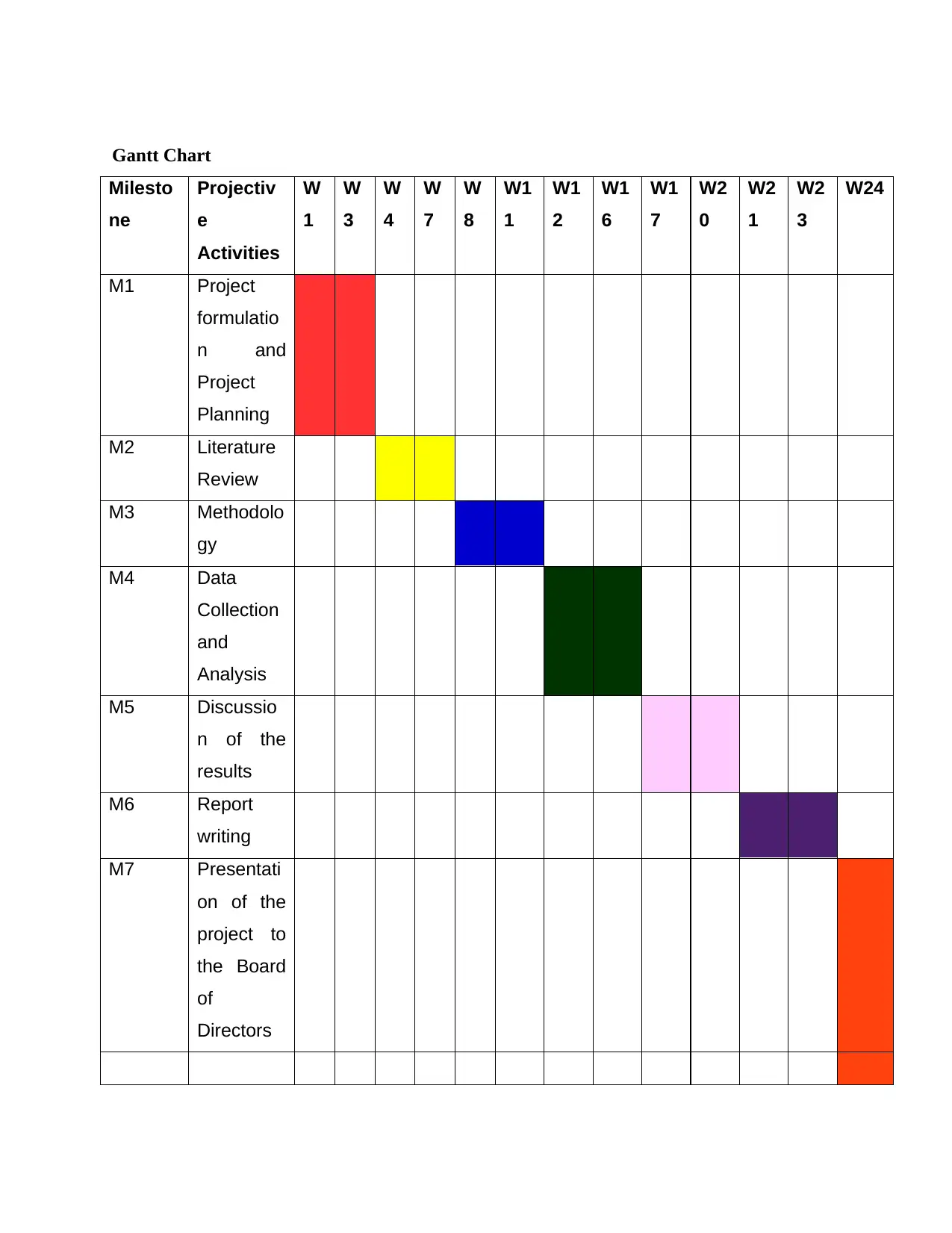
Gantt Chart
Milesto
ne
Projectiv
e
Activities
W
1
W
3
W
4
W
7
W
8
W1
1
W1
2
W1
6
W1
7
W2
0
W2
1
W2
3
W24
M1 Project
formulatio
n and
Project
Planning
M2 Literature
Review
M3 Methodolo
gy
M4 Data
Collection
and
Analysis
M5 Discussio
n of the
results
M6 Report
writing
M7 Presentati
on of the
project to
the Board
of
Directors
Milesto
ne
Projectiv
e
Activities
W
1
W
3
W
4
W
7
W
8
W1
1
W1
2
W1
6
W1
7
W2
0
W2
1
W2
3
W24
M1 Project
formulatio
n and
Project
Planning
M2 Literature
Review
M3 Methodolo
gy
M4 Data
Collection
and
Analysis
M5 Discussio
n of the
results
M6 Report
writing
M7 Presentati
on of the
project to
the Board
of
Directors
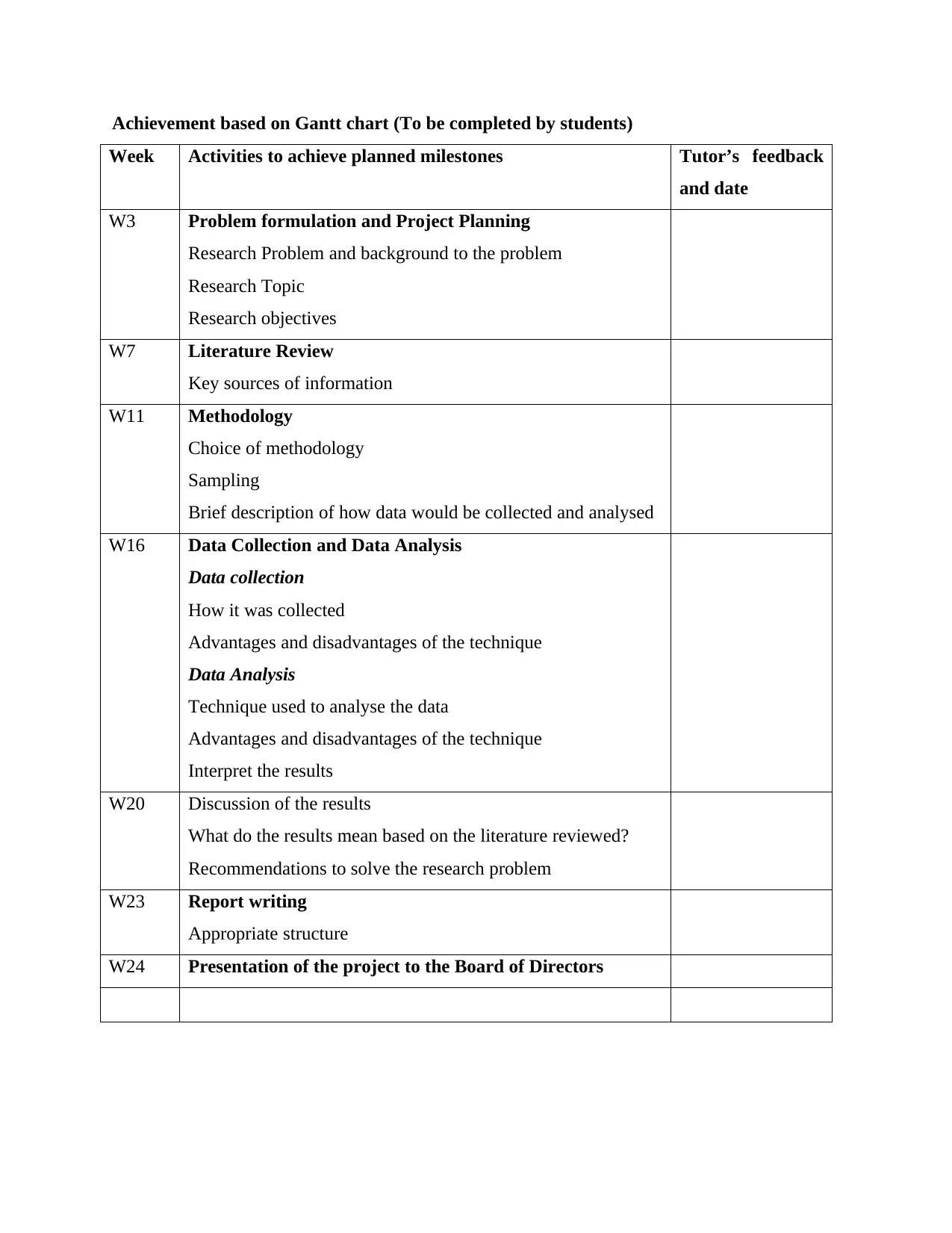
Achievement based on Gantt chart (To be completed by students)
Week Activities to achieve planned milestones Tutor’s feedback
and date
W3 Problem formulation and Project Planning
Research Problem and background to the problem
Research Topic
Research objectives
W7 Literature Review
Key sources of information
W11 Methodology
Choice of methodology
Sampling
Brief description of how data would be collected and analysed
W16 Data Collection and Data Analysis
Data collection
How it was collected
Advantages and disadvantages of the technique
Data Analysis
Technique used to analyse the data
Advantages and disadvantages of the technique
Interpret the results
W20 Discussion of the results
What do the results mean based on the literature reviewed?
Recommendations to solve the research problem
W23 Report writing
Appropriate structure
W24 Presentation of the project to the Board of Directors
Week Activities to achieve planned milestones Tutor’s feedback
and date
W3 Problem formulation and Project Planning
Research Problem and background to the problem
Research Topic
Research objectives
W7 Literature Review
Key sources of information
W11 Methodology
Choice of methodology
Sampling
Brief description of how data would be collected and analysed
W16 Data Collection and Data Analysis
Data collection
How it was collected
Advantages and disadvantages of the technique
Data Analysis
Technique used to analyse the data
Advantages and disadvantages of the technique
Interpret the results
W20 Discussion of the results
What do the results mean based on the literature reviewed?
Recommendations to solve the research problem
W23 Report writing
Appropriate structure
W24 Presentation of the project to the Board of Directors
⊘ This is a preview!⊘
Do you want full access?
Subscribe today to unlock all pages.
Trusted by 1+ million students worldwide

1 out of 18


Related Documents


Your All-in-One AI-Powered Toolkit for Academic Success.
+13062052269
info@desklib.com
Available 24*7 on WhatsApp / Email
![[object Object]](/_next/static/media/star-bottom.7253800d.svg)
Unlock your academic potential
Copyright © 2020–2026 A2Z Services. All Rights Reserved. Developed and managed by ZUCOL.