Nursing Project: Cultural Diversity, Healthcare, and Patient Care
VerifiedAdded on 2022/12/27
|17
|3500
|76
Project
AI Summary
This nursing project delves into the multifaceted aspects of cultural diversity within healthcare, encompassing definitions, characteristics of diverse individuals, and the impact of cultural awareness, safety, and competence on both the work environment and patient care. It examines Australian domestic policies, immigration's influence on cultural makeup and the workforce, and the specific challenges faced by Aboriginal and Torres Strait Islander peoples. The project addresses issues like discrimination, access to services, and cultural differences, while also exploring human rights, stakeholder responsibilities, and relevant legislation such as the Age Discrimination Act and the Racial Hatred Act. The project covers key areas of diversity including culture, disability, religious beliefs, gender, intersex, generational differences, and sexual orientation, providing strategies for promoting inclusivity and equal access to care, and addressing the five domains of disadvantage: social distress, health, community safety, economic, and education. The project further analyzes the interconnectedness of human needs and rights and emphasizes person-centered care within a framework of relevant international covenants and instruments.
Nursing Project with cultural
diversity
diversity

Paraphrase This Document
Need a fresh take? Get an instant paraphrase of this document with our AI Paraphraser
Contents
ASSESSMENT TASK 1 – QUESTIONING..................................................................................3
1...................................................................................................................................................3
2...................................................................................................................................................3
3...................................................................................................................................................3
4...................................................................................................................................................3
5...................................................................................................................................................4
6...................................................................................................................................................4
7...................................................................................................................................................4
8...................................................................................................................................................8
9...................................................................................................................................................9
10.................................................................................................................................................9
11...............................................................................................................................................10
12...............................................................................................................................................10
13...............................................................................................................................................10
14...............................................................................................................................................10
15...............................................................................................................................................12
16...............................................................................................................................................13
17...............................................................................................................................................13
18...............................................................................................................................................13
19...............................................................................................................................................13
20...............................................................................................................................................13
21...............................................................................................................................................13
22...............................................................................................................................................14
23...............................................................................................................................................15
24...............................................................................................................................................15
25...............................................................................................................................................16
REFERENCES................................................................................................................................1
ASSESSMENT TASK 1 – QUESTIONING..................................................................................3
1...................................................................................................................................................3
2...................................................................................................................................................3
3...................................................................................................................................................3
4...................................................................................................................................................3
5...................................................................................................................................................4
6...................................................................................................................................................4
7...................................................................................................................................................4
8...................................................................................................................................................8
9...................................................................................................................................................9
10.................................................................................................................................................9
11...............................................................................................................................................10
12...............................................................................................................................................10
13...............................................................................................................................................10
14...............................................................................................................................................10
15...............................................................................................................................................12
16...............................................................................................................................................13
17...............................................................................................................................................13
18...............................................................................................................................................13
19...............................................................................................................................................13
20...............................................................................................................................................13
21...............................................................................................................................................13
22...............................................................................................................................................14
23...............................................................................................................................................15
24...............................................................................................................................................15
25...............................................................................................................................................16
REFERENCES................................................................................................................................1
ASSESSMENT TASK 1 – QUESTIONING
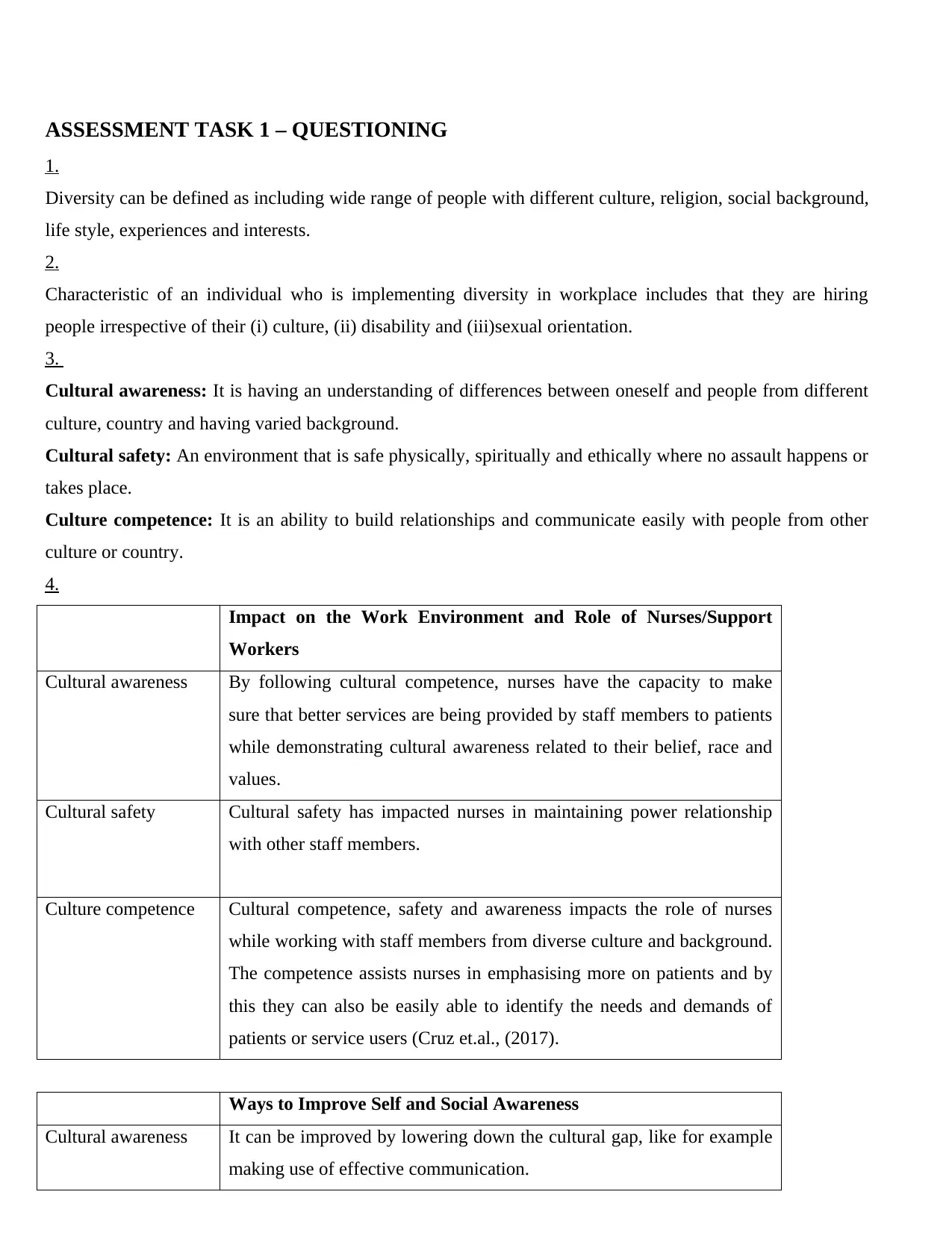
1.
Diversity can be defined as including wide range of people with different culture, religion, social background,
life style, experiences and interests.
2.
Characteristic of an individual who is implementing diversity in workplace includes that they are hiring
people irrespective of their (i) culture, (ii) disability and (iii)sexual orientation.
3.
Cultural awareness: It is having an understanding of differences between oneself and people from different
culture, country and having varied background.
Cultural safety: An environment that is safe physically, spiritually and ethically where no assault happens or
takes place.
Culture competence: It is an ability to build relationships and communicate easily with people from other
culture or country.
4.
Impact on the Work Environment and Role of Nurses/Support
Workers
Cultural awareness By following cultural competence, nurses have the capacity to make
sure that better services are being provided by staff members to patients
while demonstrating cultural awareness related to their belief, race and
values.
Cultural safety Cultural safety has impacted nurses in maintaining power relationship
with other staff members.
Culture competence Cultural competence, safety and awareness impacts the role of nurses
while working with staff members from diverse culture and background.
The competence assists nurses in emphasising more on patients and by
this they can also be easily able to identify the needs and demands of
patients or service users (Cruz et.al., (2017).
Ways to Improve Self and Social Awareness
Cultural awareness It can be improved by lowering down the cultural gap, like for example
making use of effective communication.
1.
Diversity can be defined as including wide range of people with different culture, religion, social background,
life style, experiences and interests.
2.
Characteristic of an individual who is implementing diversity in workplace includes that they are hiring
people irrespective of their (i) culture, (ii) disability and (iii)sexual orientation.
3.
Cultural awareness: It is having an understanding of differences between oneself and people from different
culture, country and having varied background.
Cultural safety: An environment that is safe physically, spiritually and ethically where no assault happens or
takes place.
Culture competence: It is an ability to build relationships and communicate easily with people from other
culture or country.
4.
Impact on the Work Environment and Role of Nurses/Support
Workers
Cultural awareness By following cultural competence, nurses have the capacity to make
sure that better services are being provided by staff members to patients
while demonstrating cultural awareness related to their belief, race and
values.
Cultural safety Cultural safety has impacted nurses in maintaining power relationship
with other staff members.
Culture competence Cultural competence, safety and awareness impacts the role of nurses
while working with staff members from diverse culture and background.
The competence assists nurses in emphasising more on patients and by
this they can also be easily able to identify the needs and demands of
patients or service users (Cruz et.al., (2017).
Ways to Improve Self and Social Awareness
Cultural awareness It can be improved by lowering down the cultural gap, like for example
making use of effective communication.
⊘ This is a preview!⊘
Do you want full access?
Subscribe today to unlock all pages.

Trusted by 1+ million students worldwide
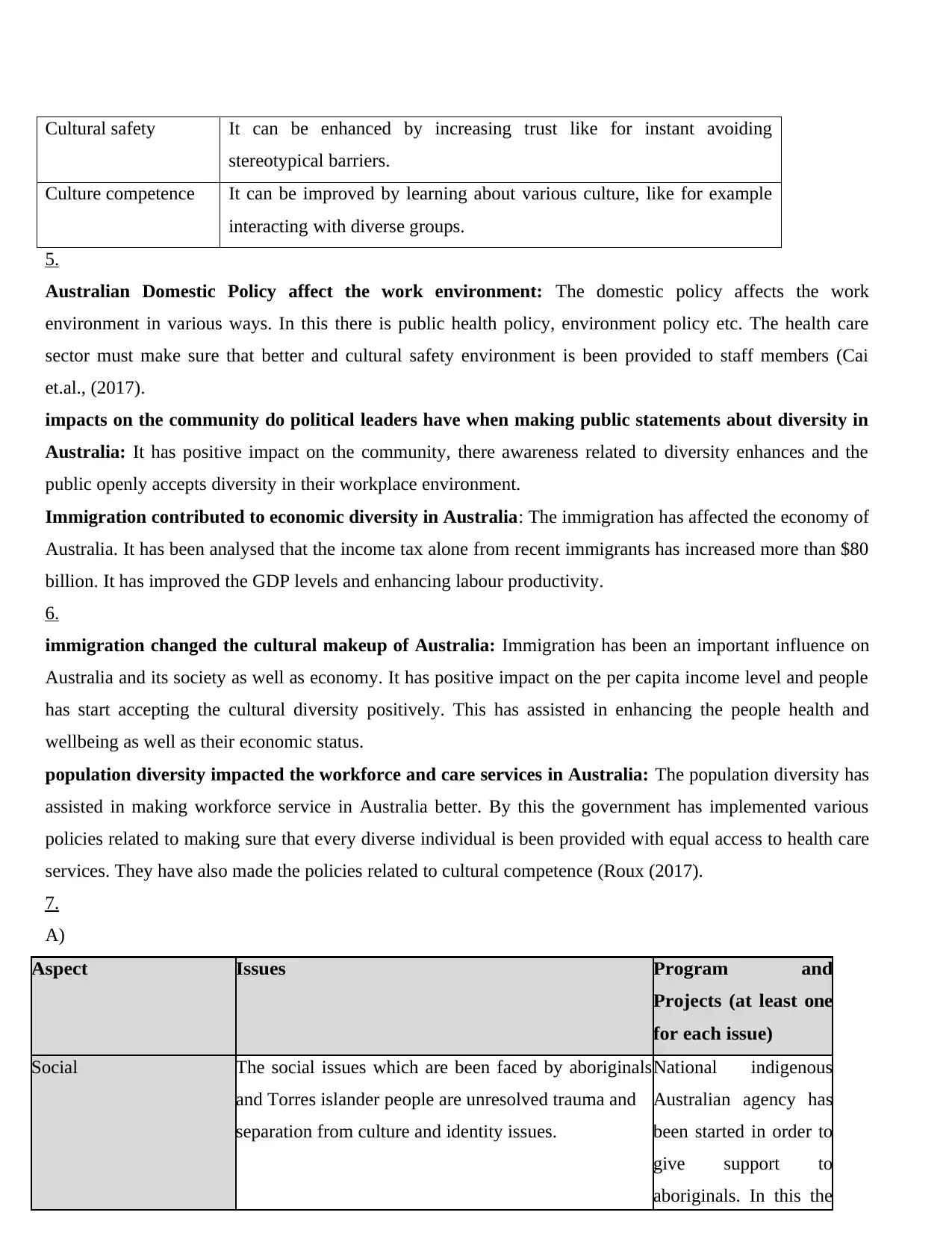
Cultural safety It can be enhanced by increasing trust like for instant avoiding
stereotypical barriers.
Culture competence It can be improved by learning about various culture, like for example
interacting with diverse groups.
5.
Australian Domestic Policy affect the work environment: The domestic policy affects the work
environment in various ways. In this there is public health policy, environment policy etc. The health care
sector must make sure that better and cultural safety environment is been provided to staff members (Cai
et.al., (2017).
impacts on the community do political leaders have when making public statements about diversity in
Australia: It has positive impact on the community, there awareness related to diversity enhances and the
public openly accepts diversity in their workplace environment.
Immigration contributed to economic diversity in Australia: The immigration has affected the economy of
Australia. It has been analysed that the income tax alone from recent immigrants has increased more than $80
billion. It has improved the GDP levels and enhancing labour productivity.
6.
immigration changed the cultural makeup of Australia: Immigration has been an important influence on
Australia and its society as well as economy. It has positive impact on the per capita income level and people
has start accepting the cultural diversity positively. This has assisted in enhancing the people health and
wellbeing as well as their economic status.
population diversity impacted the workforce and care services in Australia: The population diversity has
assisted in making workforce service in Australia better. By this the government has implemented various
policies related to making sure that every diverse individual is been provided with equal access to health care
services. They have also made the policies related to cultural competence (Roux (2017).
7.
A)
Aspect Issues Program and
Projects (at least one
for each issue)
Social The social issues which are been faced by aboriginals
and Torres islander people are unresolved trauma and
separation from culture and identity issues.
National indigenous
Australian agency has
been started in order to
give support to
aboriginals. In this the
stereotypical barriers.
Culture competence It can be improved by learning about various culture, like for example
interacting with diverse groups.
5.
Australian Domestic Policy affect the work environment: The domestic policy affects the work
environment in various ways. In this there is public health policy, environment policy etc. The health care
sector must make sure that better and cultural safety environment is been provided to staff members (Cai
et.al., (2017).
impacts on the community do political leaders have when making public statements about diversity in
Australia: It has positive impact on the community, there awareness related to diversity enhances and the
public openly accepts diversity in their workplace environment.
Immigration contributed to economic diversity in Australia: The immigration has affected the economy of
Australia. It has been analysed that the income tax alone from recent immigrants has increased more than $80
billion. It has improved the GDP levels and enhancing labour productivity.
6.
immigration changed the cultural makeup of Australia: Immigration has been an important influence on
Australia and its society as well as economy. It has positive impact on the per capita income level and people
has start accepting the cultural diversity positively. This has assisted in enhancing the people health and
wellbeing as well as their economic status.
population diversity impacted the workforce and care services in Australia: The population diversity has
assisted in making workforce service in Australia better. By this the government has implemented various
policies related to making sure that every diverse individual is been provided with equal access to health care
services. They have also made the policies related to cultural competence (Roux (2017).
7.
A)
Aspect Issues Program and
Projects (at least one
for each issue)
Social The social issues which are been faced by aboriginals
and Torres islander people are unresolved trauma and
separation from culture and identity issues.
National indigenous
Australian agency has
been started in order to
give support to
aboriginals. In this the
Paraphrase This Document
Need a fresh take? Get an instant paraphrase of this document with our AI Paraphraser
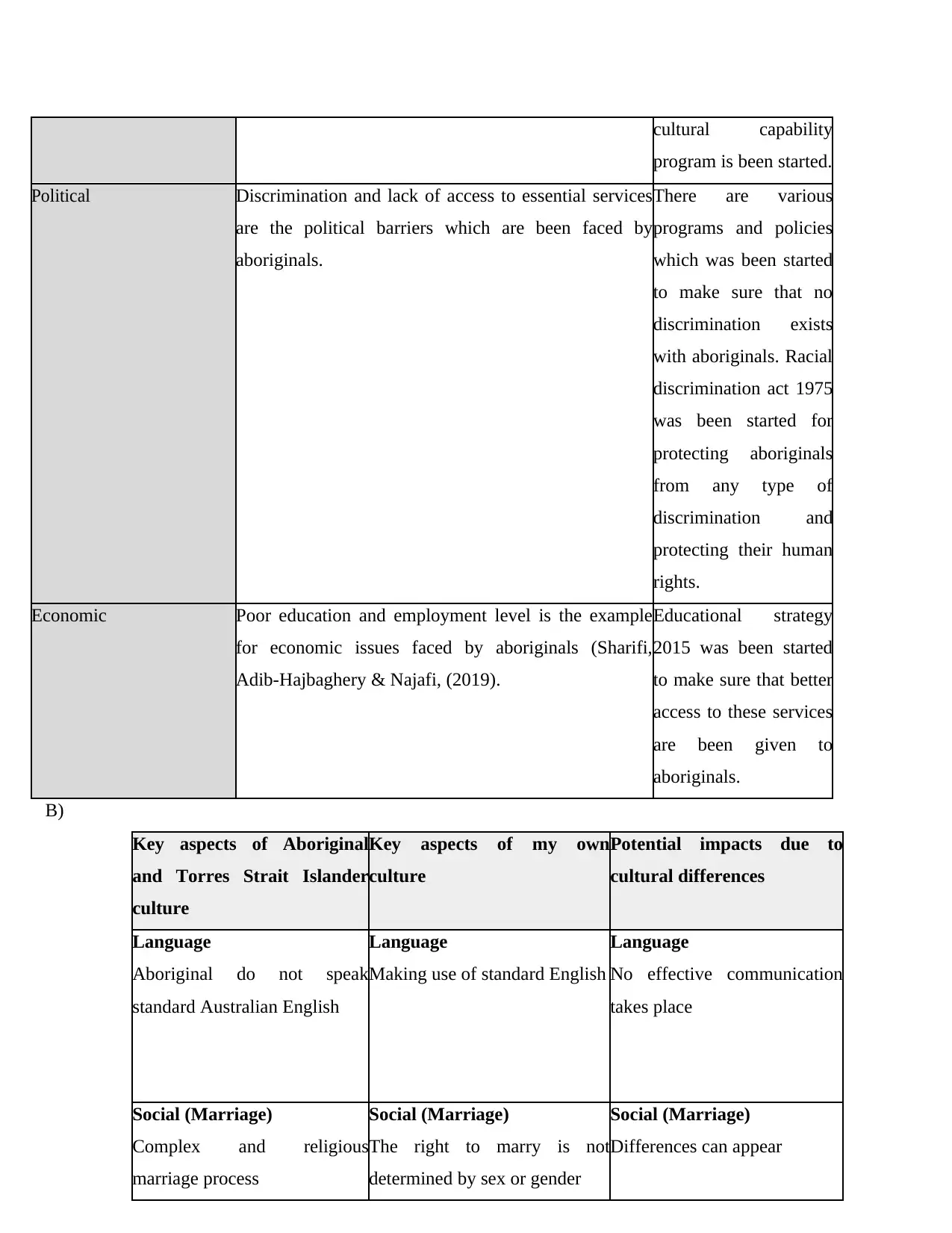
cultural capability
program is been started.
Political Discrimination and lack of access to essential services
are the political barriers which are been faced by
aboriginals.
There are various
programs and policies
which was been started
to make sure that no
discrimination exists
with aboriginals. Racial
discrimination act 1975
was been started for
protecting aboriginals
from any type of
discrimination and
protecting their human
rights.
Economic Poor education and employment level is the example
for economic issues faced by aboriginals (Sharifi,
Adib-Hajbaghery & Najafi, (2019).
Educational strategy
2015 was been started
to make sure that better
access to these services
are been given to
aboriginals.
B)
Key aspects of Aboriginal
and Torres Strait Islander
culture
Key aspects of my own
culture
Potential impacts due to
cultural differences
Language
Aboriginal do not speak
standard Australian English
Language
Making use of standard English
Language
No effective communication
takes place
Social (Marriage)
Complex and religious
marriage process
Social (Marriage)
The right to marry is not
determined by sex or gender
Social (Marriage)
Differences can appear
program is been started.
Political Discrimination and lack of access to essential services
are the political barriers which are been faced by
aboriginals.
There are various
programs and policies
which was been started
to make sure that no
discrimination exists
with aboriginals. Racial
discrimination act 1975
was been started for
protecting aboriginals
from any type of
discrimination and
protecting their human
rights.
Economic Poor education and employment level is the example
for economic issues faced by aboriginals (Sharifi,
Adib-Hajbaghery & Najafi, (2019).
Educational strategy
2015 was been started
to make sure that better
access to these services
are been given to
aboriginals.
B)
Key aspects of Aboriginal
and Torres Strait Islander
culture
Key aspects of my own
culture
Potential impacts due to
cultural differences
Language
Aboriginal do not speak
standard Australian English
Language
Making use of standard English
Language
No effective communication
takes place
Social (Marriage)
Complex and religious
marriage process
Social (Marriage)
The right to marry is not
determined by sex or gender
Social (Marriage)
Differences can appear
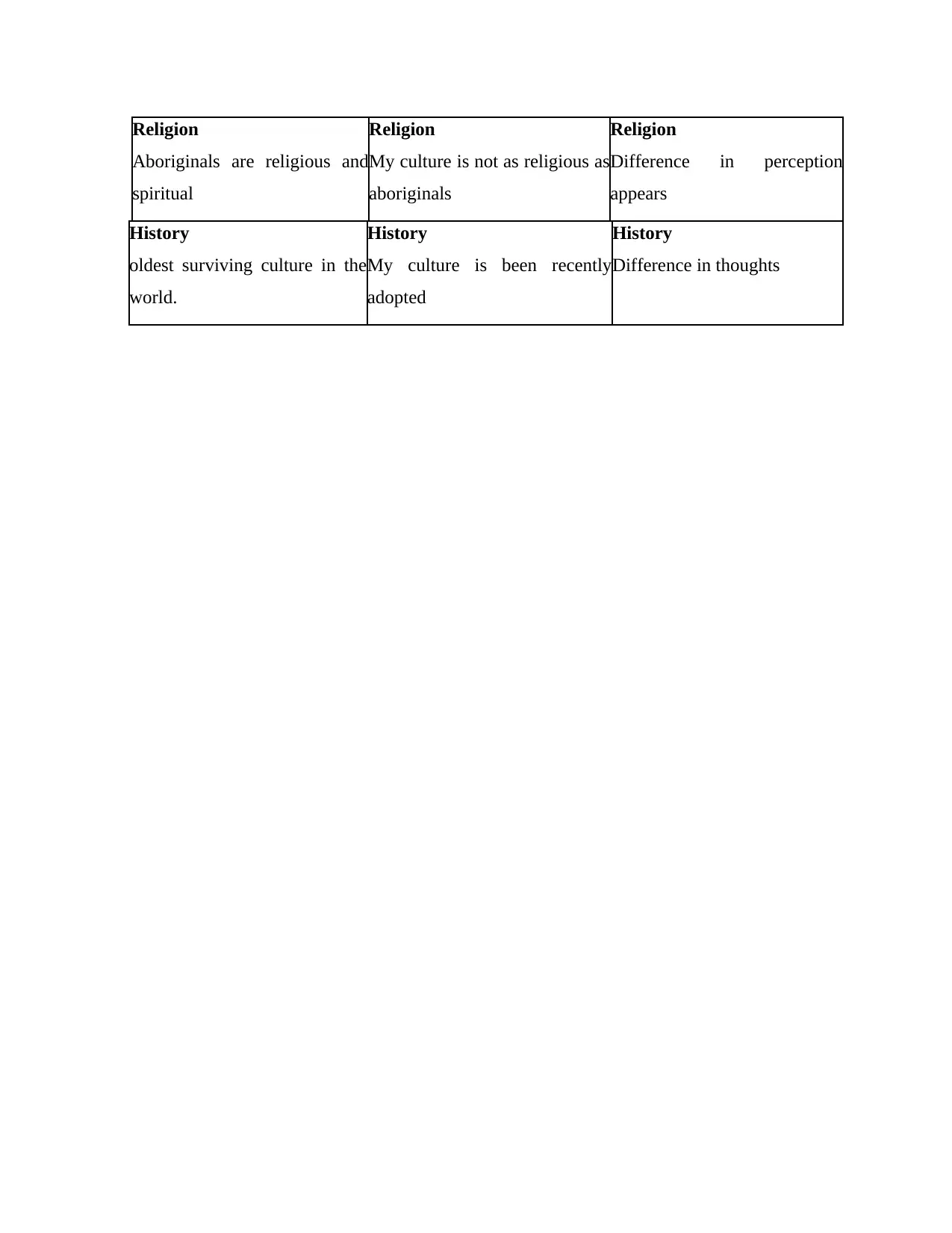
Religion
Aboriginals are religious and
spiritual
Religion
My culture is not as religious as
aboriginals
Religion
Difference in perception
appears
History
oldest surviving culture in the
world.
History
My culture is been recently
adopted
History
Difference in thoughts
Aboriginals are religious and
spiritual
Religion
My culture is not as religious as
aboriginals
Religion
Difference in perception
appears
History
oldest surviving culture in the
world.
History
My culture is been recently
adopted
History
Difference in thoughts
⊘ This is a preview!⊘
Do you want full access?
Subscribe today to unlock all pages.
Trusted by 1+ million students worldwide
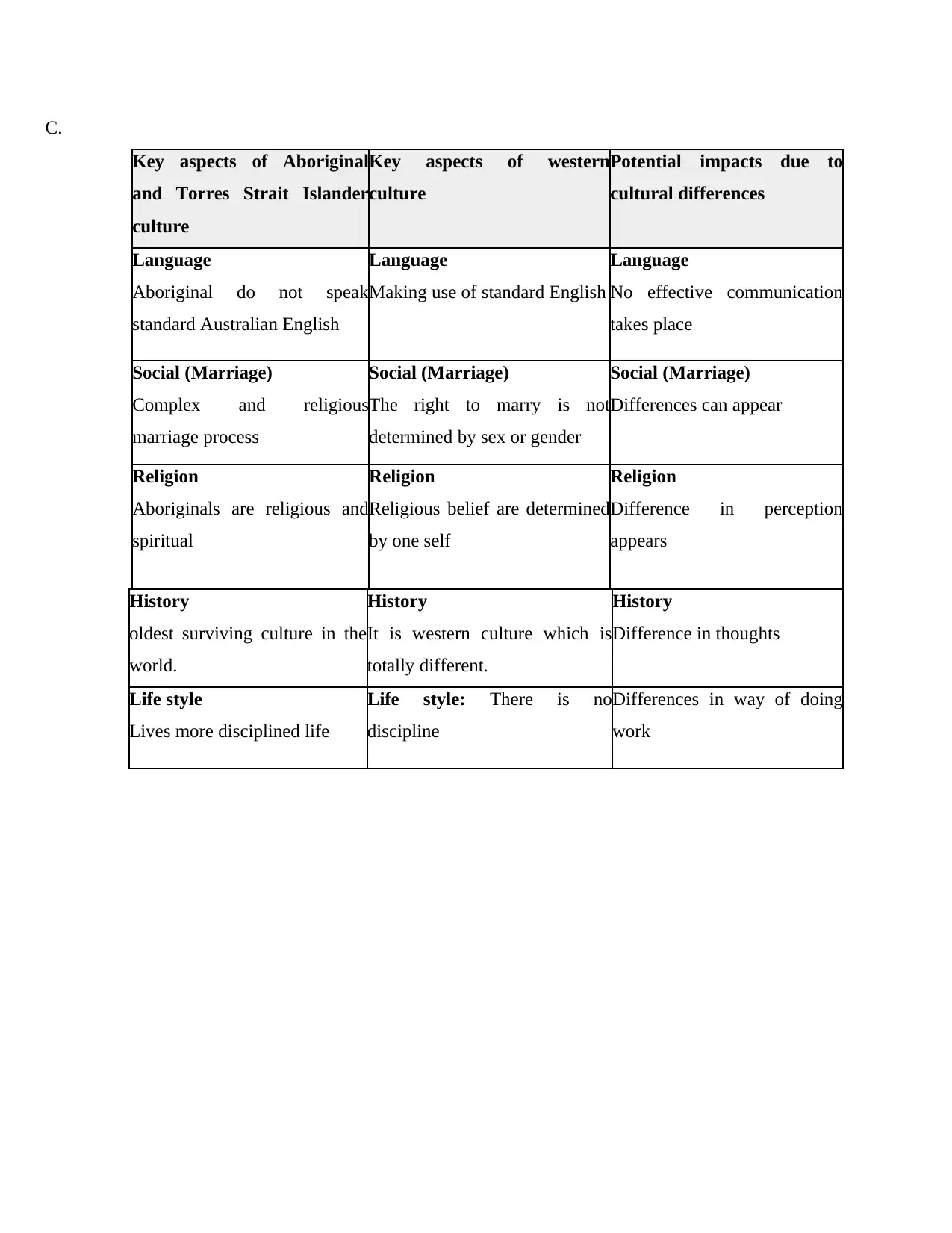
C.
Key aspects of Aboriginal
and Torres Strait Islander
culture
Key aspects of western
culture
Potential impacts due to
cultural differences
Language
Aboriginal do not speak
standard Australian English
Language
Making use of standard English
Language
No effective communication
takes place
Social (Marriage)
Complex and religious
marriage process
Social (Marriage)
The right to marry is not
determined by sex or gender
Social (Marriage)
Differences can appear
Religion
Aboriginals are religious and
spiritual
Religion
Religious belief are determined
by one self
Religion
Difference in perception
appears
History
oldest surviving culture in the
world.
History
It is western culture which is
totally different.
History
Difference in thoughts
Life style
Lives more disciplined life
Life style: There is no
discipline
Differences in way of doing
work
Key aspects of Aboriginal
and Torres Strait Islander
culture
Key aspects of western
culture
Potential impacts due to
cultural differences
Language
Aboriginal do not speak
standard Australian English
Language
Making use of standard English
Language
No effective communication
takes place
Social (Marriage)
Complex and religious
marriage process
Social (Marriage)
The right to marry is not
determined by sex or gender
Social (Marriage)
Differences can appear
Religion
Aboriginals are religious and
spiritual
Religion
Religious belief are determined
by one self
Religion
Difference in perception
appears
History
oldest surviving culture in the
world.
History
It is western culture which is
totally different.
History
Difference in thoughts
Life style
Lives more disciplined life
Life style: There is no
discipline
Differences in way of doing
work
Paraphrase This Document
Need a fresh take? Get an instant paraphrase of this document with our AI Paraphraser
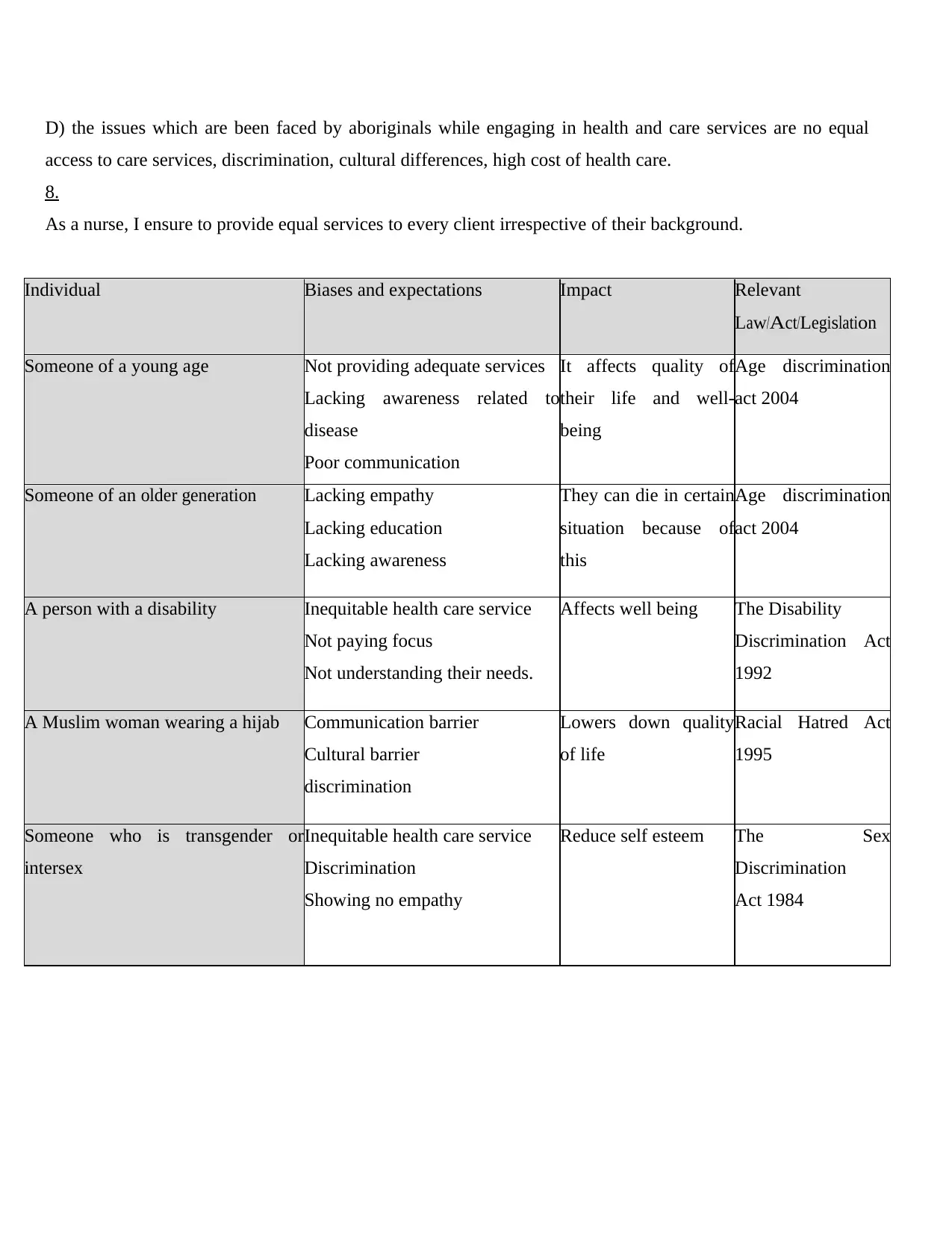
D) the issues which are been faced by aboriginals while engaging in health and care services are no equal
access to care services, discrimination, cultural differences, high cost of health care.
8.
As a nurse, I ensure to provide equal services to every client irrespective of their background.
Individual Biases and expectations Impact Relevant
L aw /Ac t/Le g i s la ti on
Someone of a young age Not providing adequate services
Lacking awareness related to
disease
Poor communication
It affects quality of
their life and well-
being
Age discrimination
act 2004
Someone of an older generation Lacking empathy
Lacking education
Lacking awareness
They can die in certain
situation because of
this
Age discrimination
act 2004
A person with a disability Inequitable health care service
Not paying focus
Not understanding their needs.
Affects well being The Disability
Discrimination Act
1992
A Muslim woman wearing a hijab Communication barrier
Cultural barrier
discrimination
Lowers down quality
of life
Racial Hatred Act
1995
Someone who is transgender or
intersex
Inequitable health care service
Discrimination
Showing no empathy
Reduce self esteem The Sex
Discrimination
Act 1984
access to care services, discrimination, cultural differences, high cost of health care.
8.
As a nurse, I ensure to provide equal services to every client irrespective of their background.
Individual Biases and expectations Impact Relevant
L aw /Ac t/Le g i s la ti on
Someone of a young age Not providing adequate services
Lacking awareness related to
disease
Poor communication
It affects quality of
their life and well-
being
Age discrimination
act 2004
Someone of an older generation Lacking empathy
Lacking education
Lacking awareness
They can die in certain
situation because of
this
Age discrimination
act 2004
A person with a disability Inequitable health care service
Not paying focus
Not understanding their needs.
Affects well being The Disability
Discrimination Act
1992
A Muslim woman wearing a hijab Communication barrier
Cultural barrier
discrimination
Lowers down quality
of life
Racial Hatred Act
1995
Someone who is transgender or
intersex
Inequitable health care service
Discrimination
Showing no empathy
Reduce self esteem The Sex
Discrimination
Act 1984
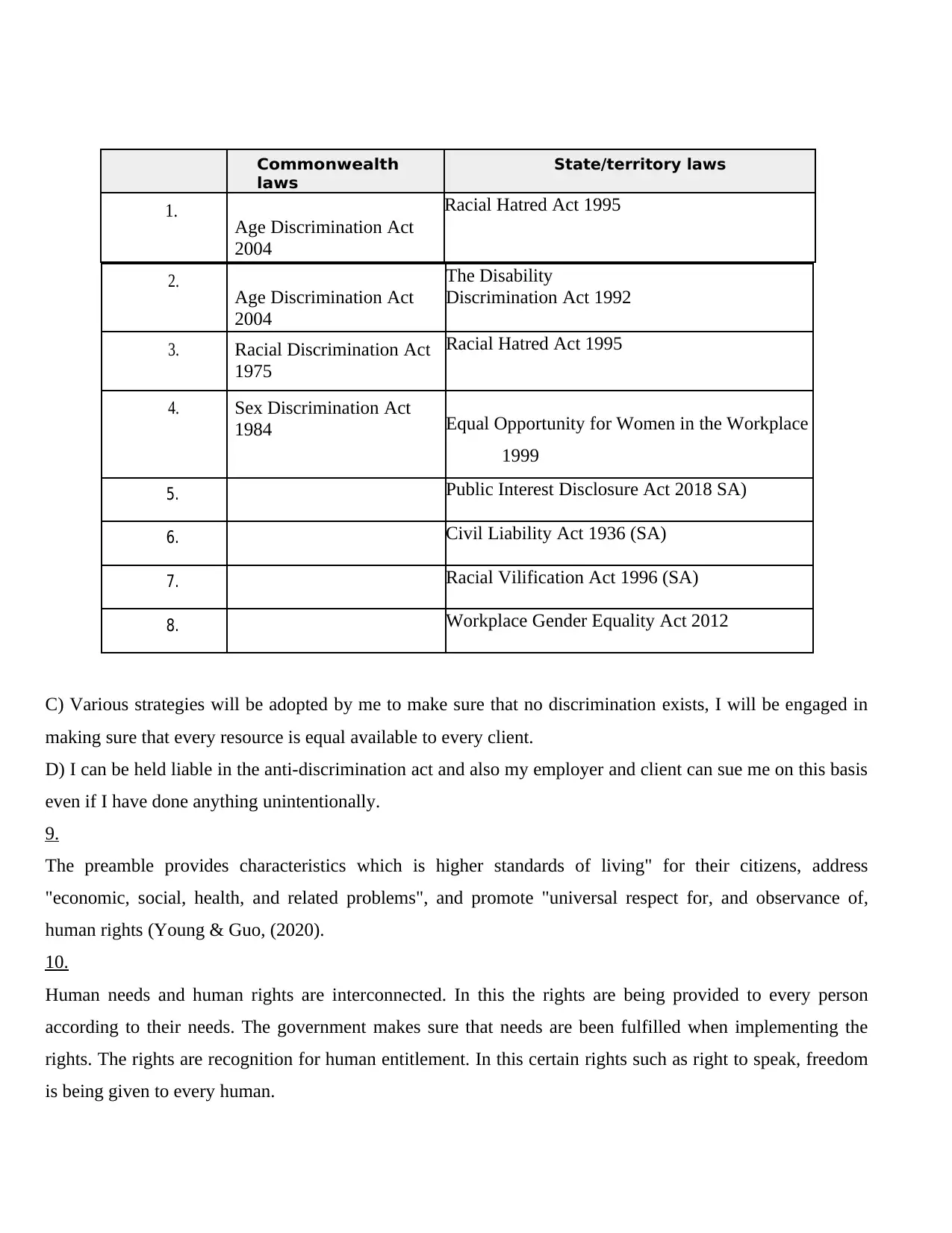
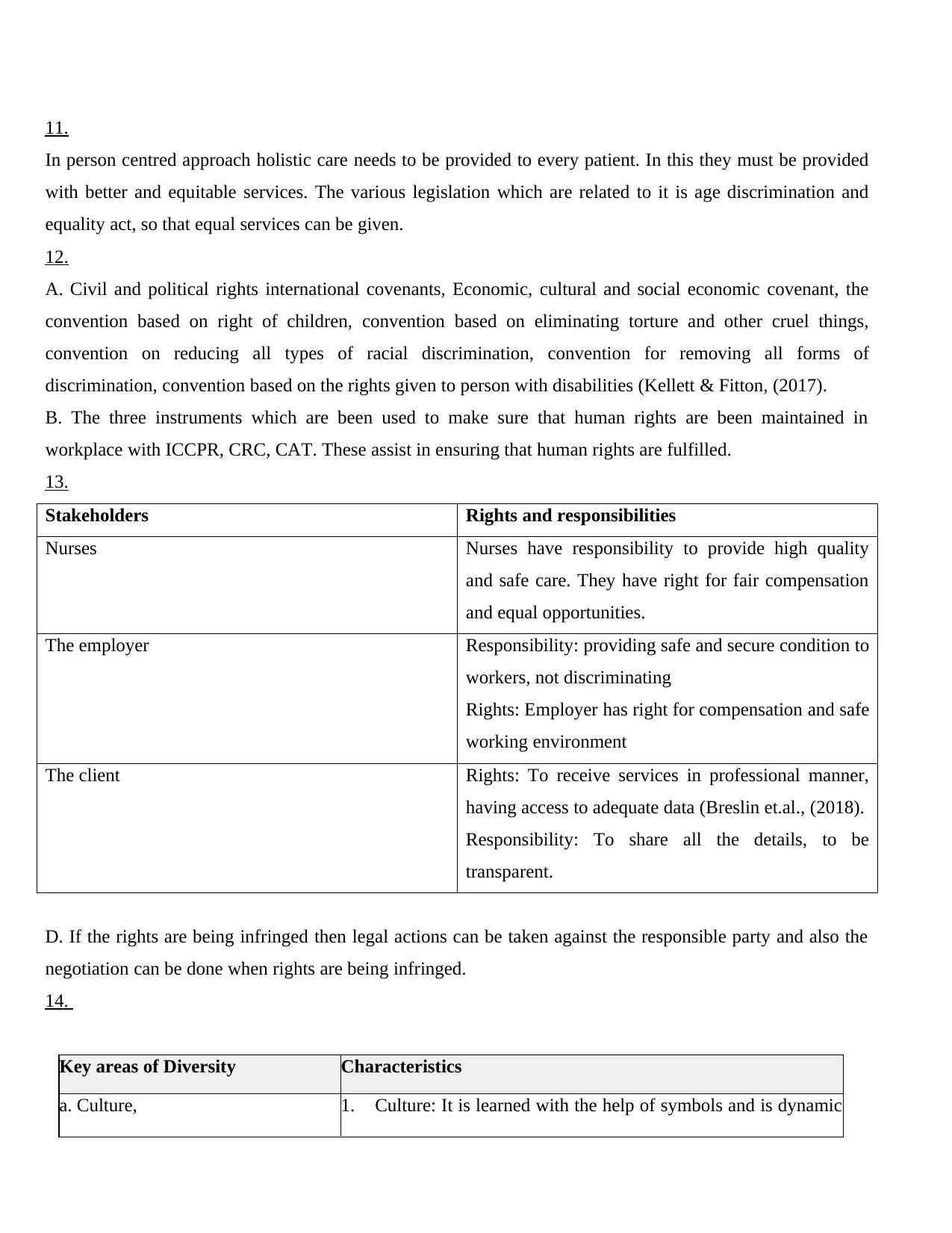
Commonwealth
laws
State/territory laws
1. Age Discrimination Act
2004
Racial Hatred Act 1995
C) Various strategies will be adopted by me to make sure that no discrimination exists, I will be engaged in
making sure that every resource is equal available to every client.
D) I can be held liable in the anti-discrimination act and also my employer and client can sue me on this basis
even if I have done anything unintentionally.
9.
The preamble provides characteristics which is higher standards of living" for their citizens, address
"economic, social, health, and related problems", and promote "universal respect for, and observance of,
human rights (Young & Guo, (2020).
10.
Human needs and human rights are interconnected. In this the rights are being provided to every person
according to their needs. The government makes sure that needs are been fulfilled when implementing the
rights. The rights are recognition for human entitlement. In this certain rights such as right to speak, freedom
is being given to every human.
2. Age Discrimination Act
2004
The Disability
Discrimination Act 1992
3. Racial Discrimination Act
1975
Racial Hatred Act 1995
4. Sex Discrimination Act
1984 Equal Opportunity for Women in the Workplace
1999
5. Public Interest Disclosure Act 2018 SA)
6. Civil Liability Act 1936 (SA)
7. Racial Vilification Act 1996 (SA)
8. Workplace Gender Equality Act 2012
laws
State/territory laws
1. Age Discrimination Act
2004
Racial Hatred Act 1995
C) Various strategies will be adopted by me to make sure that no discrimination exists, I will be engaged in
making sure that every resource is equal available to every client.
D) I can be held liable in the anti-discrimination act and also my employer and client can sue me on this basis
even if I have done anything unintentionally.
9.
The preamble provides characteristics which is higher standards of living" for their citizens, address
"economic, social, health, and related problems", and promote "universal respect for, and observance of,
human rights (Young & Guo, (2020).
10.
Human needs and human rights are interconnected. In this the rights are being provided to every person
according to their needs. The government makes sure that needs are been fulfilled when implementing the
rights. The rights are recognition for human entitlement. In this certain rights such as right to speak, freedom
is being given to every human.
2. Age Discrimination Act
2004
The Disability
Discrimination Act 1992
3. Racial Discrimination Act
1975
Racial Hatred Act 1995
4. Sex Discrimination Act
1984 Equal Opportunity for Women in the Workplace
1999
5. Public Interest Disclosure Act 2018 SA)
6. Civil Liability Act 1936 (SA)
7. Racial Vilification Act 1996 (SA)
8. Workplace Gender Equality Act 2012
⊘ This is a preview!⊘
Do you want full access?
Subscribe today to unlock all pages.
Trusted by 1+ million students worldwide
11.
In person centred approach holistic care needs to be provided to every patient. In this they must be provided
with better and equitable services. The various legislation which are related to it is age discrimination and
equality act, so that equal services can be given.
12.
A. Civil and political rights international covenants, Economic, cultural and social economic covenant, the
convention based on right of children, convention based on eliminating torture and other cruel things,
convention on reducing all types of racial discrimination, convention for removing all forms of
discrimination, convention based on the rights given to person with disabilities (Kellett & Fitton, (2017).
B. The three instruments which are been used to make sure that human rights are been maintained in
workplace with ICCPR, CRC, CAT. These assist in ensuring that human rights are fulfilled.
13.
Stakeholders Rights and responsibilities
Nurses Nurses have responsibility to provide high quality
and safe care. They have right for fair compensation
and equal opportunities.
The employer Responsibility: providing safe and secure condition to
workers, not discriminating
Rights: Employer has right for compensation and safe
working environment
The client Rights: To receive services in professional manner,
having access to adequate data (Breslin et.al., (2018).
Responsibility: To share all the details, to be
transparent.
D. If the rights are being infringed then legal actions can be taken against the responsible party and also the
negotiation can be done when rights are being infringed.
14.
Key areas of Diversity Characteristics
a. Culture, 1. Culture: It is learned with the help of symbols and is dynamic
In person centred approach holistic care needs to be provided to every patient. In this they must be provided
with better and equitable services. The various legislation which are related to it is age discrimination and
equality act, so that equal services can be given.
12.
A. Civil and political rights international covenants, Economic, cultural and social economic covenant, the
convention based on right of children, convention based on eliminating torture and other cruel things,
convention on reducing all types of racial discrimination, convention for removing all forms of
discrimination, convention based on the rights given to person with disabilities (Kellett & Fitton, (2017).
B. The three instruments which are been used to make sure that human rights are been maintained in
workplace with ICCPR, CRC, CAT. These assist in ensuring that human rights are fulfilled.
13.
Stakeholders Rights and responsibilities
Nurses Nurses have responsibility to provide high quality
and safe care. They have right for fair compensation
and equal opportunities.
The employer Responsibility: providing safe and secure condition to
workers, not discriminating
Rights: Employer has right for compensation and safe
working environment
The client Rights: To receive services in professional manner,
having access to adequate data (Breslin et.al., (2018).
Responsibility: To share all the details, to be
transparent.
D. If the rights are being infringed then legal actions can be taken against the responsible party and also the
negotiation can be done when rights are being infringed.
14.
Key areas of Diversity Characteristics
a. Culture, 1. Culture: It is learned with the help of symbols and is dynamic
Paraphrase This Document
Need a fresh take? Get an instant paraphrase of this document with our AI Paraphraser
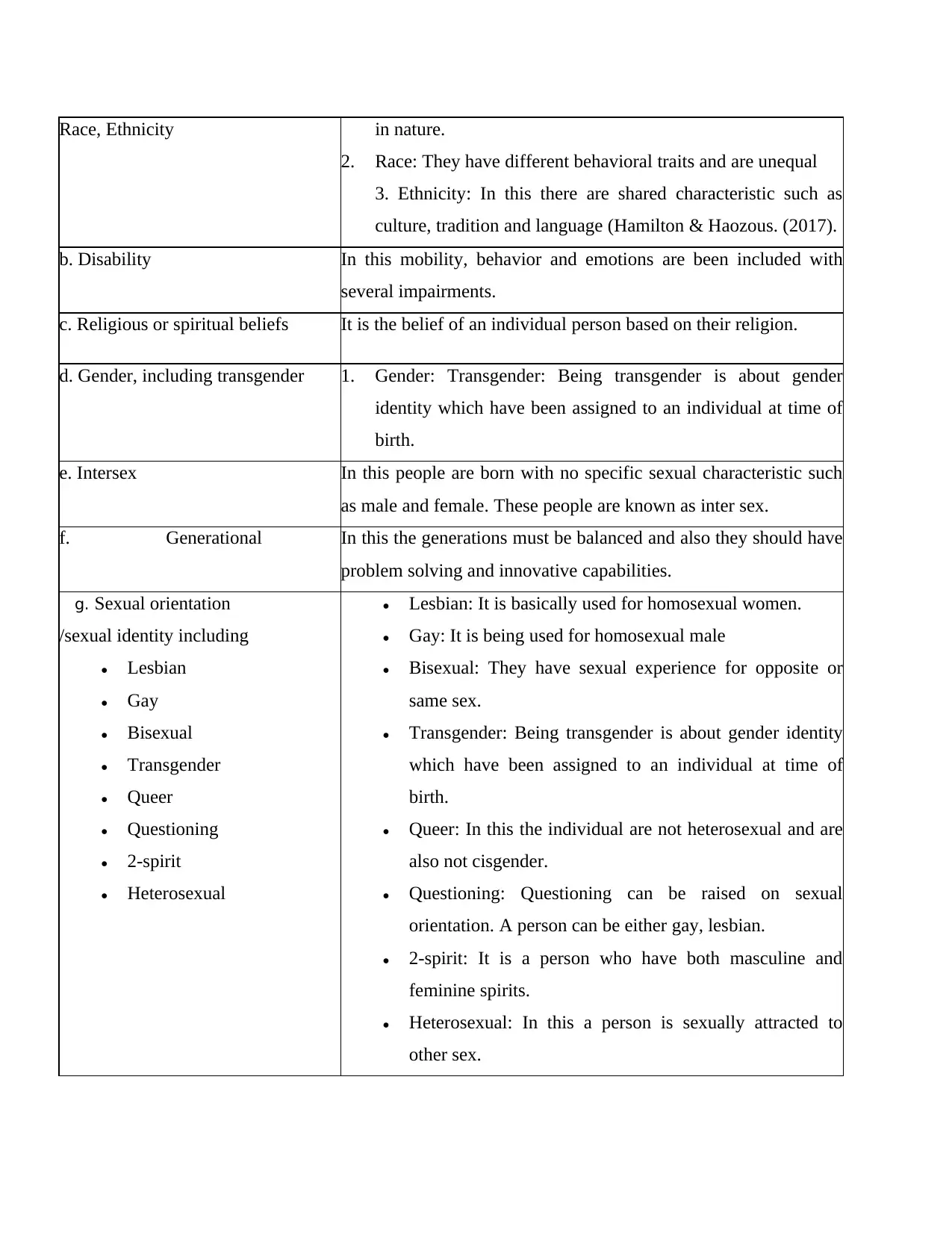
Race, Ethnicity
2.
in nature.
Race: They have different behavioral traits and are unequal
3. Ethnicity: In this there are shared characteristic such as
culture, tradition and language (Hamilton & Haozous. (2017).
b. Disability In this mobility, behavior and emotions are been included with
several impairments.
c. Religious or spiritual beliefs It is the belief of an individual person based on their religion.
d. Gender, including transgender 1. Gender: Transgender: Being transgender is about gender
identity which have been assigned to an individual at time of
birth.
e. Intersex In this people are born with no specific sexual characteristic such
as male and female. These people are known as inter sex.
f. Generational In this the generations must be balanced and also they should have
problem solving and innovative capabilities.
g. Sexual orientation
/sexual identity including
● Lesbian
● Gay
● Bisexual
● Transgender
● Queer
● Questioning
● 2-spirit
● Heterosexual
● Lesbian: It is basically used for homosexual women.
● Gay: It is being used for homosexual male
● Bisexual: They have sexual experience for opposite or
same sex.
● Transgender: Being transgender is about gender identity
which have been assigned to an individual at time of
birth.
● Queer: In this the individual are not heterosexual and are
also not cisgender.
● Questioning: Questioning can be raised on sexual
orientation. A person can be either gay, lesbian.
● 2-spirit: It is a person who have both masculine and
feminine spirits.
● Heterosexual: In this a person is sexually attracted to
other sex.
2.
in nature.
Race: They have different behavioral traits and are unequal
3. Ethnicity: In this there are shared characteristic such as
culture, tradition and language (Hamilton & Haozous. (2017).
b. Disability In this mobility, behavior and emotions are been included with
several impairments.
c. Religious or spiritual beliefs It is the belief of an individual person based on their religion.
d. Gender, including transgender 1. Gender: Transgender: Being transgender is about gender
identity which have been assigned to an individual at time of
birth.
e. Intersex In this people are born with no specific sexual characteristic such
as male and female. These people are known as inter sex.
f. Generational In this the generations must be balanced and also they should have
problem solving and innovative capabilities.
g. Sexual orientation
/sexual identity including
● Lesbian
● Gay
● Bisexual
● Transgender
● Queer
● Questioning
● 2-spirit
● Heterosexual
● Lesbian: It is basically used for homosexual women.
● Gay: It is being used for homosexual male
● Bisexual: They have sexual experience for opposite or
same sex.
● Transgender: Being transgender is about gender identity
which have been assigned to an individual at time of
birth.
● Queer: In this the individual are not heterosexual and are
also not cisgender.
● Questioning: Questioning can be raised on sexual
orientation. A person can be either gay, lesbian.
● 2-spirit: It is a person who have both masculine and
feminine spirits.
● Heterosexual: In this a person is sexually attracted to
other sex.
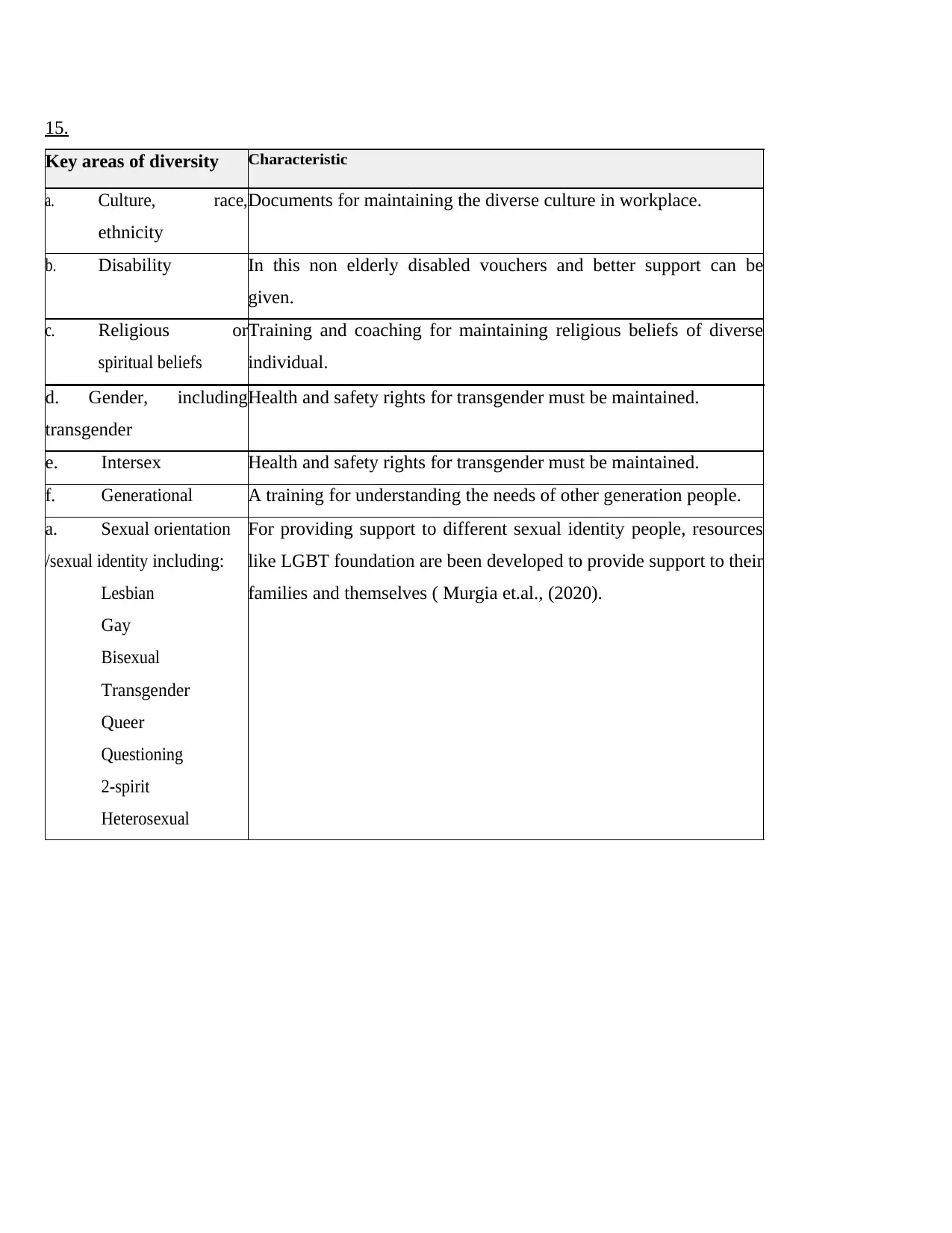
15.
Key areas of diversity Characteristic
a. Culture, race,
ethnicity
Documents for maintaining the diverse culture in workplace.
b. Disability In this non elderly disabled vouchers and better support can be
given.
c. Religious or
spiritual beliefs
Training and coaching for maintaining religious beliefs of diverse
individual.
d. Gender, including
transgender
Health and safety rights for transgender must be maintained.
e. Intersex Health and safety rights for transgender must be maintained.
f. Generational A training for understanding the needs of other generation people.
a. Sexual orientation
/sexual identity including:
Lesbian
Gay
Bisexual
Transgender
Queer
Questioning
2-spirit
Heterosexual
For providing support to different sexual identity people, resources
like LGBT foundation are been developed to provide support to their
families and themselves ( Murgia et.al., (2020).
Key areas of diversity Characteristic
a. Culture, race,
ethnicity
Documents for maintaining the diverse culture in workplace.
b. Disability In this non elderly disabled vouchers and better support can be
given.
c. Religious or
spiritual beliefs
Training and coaching for maintaining religious beliefs of diverse
individual.
d. Gender, including
transgender
Health and safety rights for transgender must be maintained.
e. Intersex Health and safety rights for transgender must be maintained.
f. Generational A training for understanding the needs of other generation people.
a. Sexual orientation
/sexual identity including:
Lesbian
Gay
Bisexual
Transgender
Queer
Questioning
2-spirit
Heterosexual
For providing support to different sexual identity people, resources
like LGBT foundation are been developed to provide support to their
families and themselves ( Murgia et.al., (2020).
⊘ This is a preview!⊘
Do you want full access?
Subscribe today to unlock all pages.
Trusted by 1+ million students worldwide

1 out of 17


Related Documents


Your All-in-One AI-Powered Toolkit for Academic Success.
+13062052269
info@desklib.com
Available 24*7 on WhatsApp / Email
![[object Object]](/_next/static/media/star-bottom.7253800d.svg)
Unlock your academic potential
Copyright © 2020–2026 A2Z Services. All Rights Reserved. Developed and managed by ZUCOL.