Call for Tender: Research on Cultural Impact on Biodiversity - COHABIT
VerifiedAdded on 2021/06/15
|8
|2005
|32
Report
AI Summary
This research report, submitted as a tender proposal, explores the cultural impact on biodiversity, focusing on the relationship between cultural practices and deforestation. Commissioned by COHABIT and the Department of Forestry and Natural Resource Conservation, the study aims to evaluate how cultural activities affect biodiversity, proposing solutions for sustainable growth and environmental responsibility. The research framework includes a longitudinal study with a two-year duration, guided by research questions exploring the role of culture in environmental awareness, traditional conservation techniques, and the development of a conservative culture. The report emphasizes the need for conservation in light of deforestation's impact, offering insights into developing policies and incentives to protect the environment, and the role of urban and rural cultures. The research will also cover how to develop a conservative culture, and how to implement effective policies and principles. The report seeks to identify ways to mitigate the negative impacts of cultural practices on biodiversity and promote sustainable environmental practices, with a total funding of $50,000.
Running head: CALL FOR TENDER FOR RESEARCH ON CULTURAL IMPACT ON
BIODIVERSITY 1
Call For A Tender For A Research On Cultural Impact On Biodiversity
Student Name:
Course:
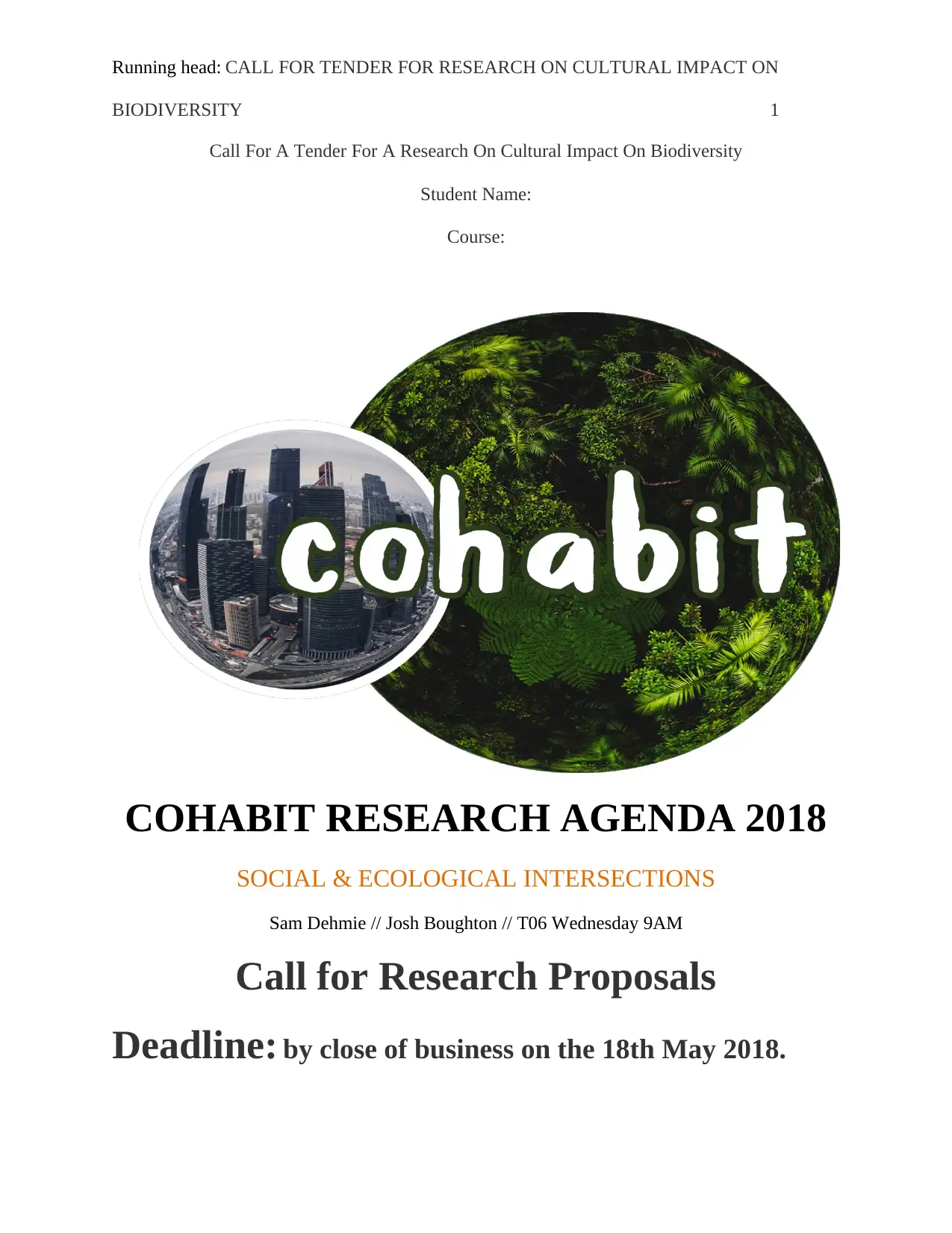
COHABIT RESEARCH AGENDA 2018
SOCIAL & ECOLOGICAL INTERSECTIONS
Sam Dehmie // Josh Boughton // T06 Wednesday 9AM
Call for Research Proposals
Deadline: by close of business on the 18th May 2018.
BIODIVERSITY 1
Call For A Tender For A Research On Cultural Impact On Biodiversity
Student Name:
Course:
COHABIT RESEARCH AGENDA 2018
SOCIAL & ECOLOGICAL INTERSECTIONS
Sam Dehmie // Josh Boughton // T06 Wednesday 9AM
Call for Research Proposals
Deadline: by close of business on the 18th May 2018.
Paraphrase This Document
Need a fresh take? Get an instant paraphrase of this document with our AI Paraphraser

CALL FOR TENDER FOR RESEARCH ON CULTURAL IMPACT ON BIODIVERSITY 2
Cohabit is pleased to call for a tender for a research to establish the cultural impact on
biodiversity. The research is aimed at establishing the effects of cultural activities of individuals,
the community as well as regional activities on biodiversity and come up with a viable solution
that will ease cultural impact on biodiversity and forester sustainable growth.
Cultural impact on biodiversity
The primary objective of the research is to evaluate the cultural impact on biodiversity
and come up with co-operative and collaborative actions which the organization should take to
effectively equip members of the community with the necessary information and tools required
to help reduce impact of humanity on the environment and ensure sustainable growth (McBeath
& Leng, 2006).
Background to the proposal
Cohabit is working in partnership with the Department of Forestry and Natural Resource
Conservation to evaluate the relationship between cultural practices and deforestation. The study
will be conducted in neighborhoods, schools as well as in the department of Forestry and Natural
Resource conservation to evaluate how culture can enhance a sense of environmental
responsibility as well as what can be done to ensure the development of a conservative culture
that will ensure environmental sustainability (Rajesh, 2016). Similarly, the research is meant to
come up with necessary measures and policies that should be put in place to protect the
environment.
Just as the earth is large, so are our impacts. Human beings are not the sole occupants nor
are they the most important species on earth. Cultural activities of individuals, communities as
Cohabit is pleased to call for a tender for a research to establish the cultural impact on
biodiversity. The research is aimed at establishing the effects of cultural activities of individuals,
the community as well as regional activities on biodiversity and come up with a viable solution
that will ease cultural impact on biodiversity and forester sustainable growth.
Cultural impact on biodiversity
The primary objective of the research is to evaluate the cultural impact on biodiversity
and come up with co-operative and collaborative actions which the organization should take to
effectively equip members of the community with the necessary information and tools required
to help reduce impact of humanity on the environment and ensure sustainable growth (McBeath
& Leng, 2006).
Background to the proposal
Cohabit is working in partnership with the Department of Forestry and Natural Resource
Conservation to evaluate the relationship between cultural practices and deforestation. The study
will be conducted in neighborhoods, schools as well as in the department of Forestry and Natural
Resource conservation to evaluate how culture can enhance a sense of environmental
responsibility as well as what can be done to ensure the development of a conservative culture
that will ensure environmental sustainability (Rajesh, 2016). Similarly, the research is meant to
come up with necessary measures and policies that should be put in place to protect the
environment.
Just as the earth is large, so are our impacts. Human beings are not the sole occupants nor
are they the most important species on earth. Cultural activities of individuals, communities as

CALL FOR TENDER FOR RESEARCH ON CULTURAL IMPACT ON BIODIVERSITY 3
well as regions have diverse effects on biodiversity. For instance, both human beings and other
species such as animals depend on forests for their survival (Ormsby, 2013). As a result,
deforestation affects not only man but also other species some of which cannot survive amidst
changes in their natural habitats (Parotta, et al. 2016). Therefore, as much as human beings cut
down trees for economic benefits, there is need for them to learn ways of limiting destruction as
well as promoting diversity. This way, all species occupying the earth will learn to cohabit.
Culture plays a significant role in the protection of forests. Ancient cultural practices
viewed forests as being sacred and used them as shrines and therefore had in place forest
protection policies not just due to scientific knowledge. As a result, culture emphasized on the
need to protect forests hence protection of biodiversity. According to Rajesh (2016), protection
of biodiversity is essential in ensuring long-term sustainability. Parotta et al (2016) point out that
the rural cultures still value the protection of forests due to the role the forests play in the cultural
practices. Nonetheless, they point out that urban cultures engage in activities which negatively
impacts forests due to their cultures which do not value the need of forest protection. For
instance, urban dwellers have cultures such as cooking habits which encourage the use of forest
products such as charcoal.
Similarly, various industrial activities in the urban areas lead to the release of harmful
wastes such as greenhouse gases which contribute to forest fires. As a result, culture has a
significant impact on biodiversity (Gueze, 2015). Therefore, the research should evaluate the
impacts of culture on the sense of environmental sustainability. Similarly, due to the threat to
biodiversity caused by the rising rate of urbanization, the research should evaluate how a
conservative culture can be developed in the present cultural context to promote environmental
well as regions have diverse effects on biodiversity. For instance, both human beings and other
species such as animals depend on forests for their survival (Ormsby, 2013). As a result,
deforestation affects not only man but also other species some of which cannot survive amidst
changes in their natural habitats (Parotta, et al. 2016). Therefore, as much as human beings cut
down trees for economic benefits, there is need for them to learn ways of limiting destruction as
well as promoting diversity. This way, all species occupying the earth will learn to cohabit.
Culture plays a significant role in the protection of forests. Ancient cultural practices
viewed forests as being sacred and used them as shrines and therefore had in place forest
protection policies not just due to scientific knowledge. As a result, culture emphasized on the
need to protect forests hence protection of biodiversity. According to Rajesh (2016), protection
of biodiversity is essential in ensuring long-term sustainability. Parotta et al (2016) point out that
the rural cultures still value the protection of forests due to the role the forests play in the cultural
practices. Nonetheless, they point out that urban cultures engage in activities which negatively
impacts forests due to their cultures which do not value the need of forest protection. For
instance, urban dwellers have cultures such as cooking habits which encourage the use of forest
products such as charcoal.
Similarly, various industrial activities in the urban areas lead to the release of harmful
wastes such as greenhouse gases which contribute to forest fires. As a result, culture has a
significant impact on biodiversity (Gueze, 2015). Therefore, the research should evaluate the
impacts of culture on the sense of environmental sustainability. Similarly, due to the threat to
biodiversity caused by the rising rate of urbanization, the research should evaluate how a
conservative culture can be developed in the present cultural context to promote environmental
⊘ This is a preview!⊘
Do you want full access?
Subscribe today to unlock all pages.

Trusted by 1+ million students worldwide

CALL FOR TENDER FOR RESEARCH ON CULTURAL IMPACT ON BIODIVERSITY 4
sustainability. Furthermore, the research should come up with conservative purposes as well as
rules and policies which will be used in ensuring the protection of the environment.
Research Framework and Approach
Despite the fact that deforestation has positive economic value to the life of human
beings such as the revenue raised from the sale of trees and their products such as charcoal and
wood, it is essential to ensure control of deforestation for the benefit of biodiversity. Not only
human beings rely on trees for their survival but also other specifies such as wild animals (Steg,
2009). In fact, unlike human beings, there are species relying entirely on forests and therefore the
loss of biodiversity threatens the existence of such species. Therefore, the main aim of this
research is to evaluate the cultural impact on biodiversity by evaluating how culture can enhance
the sense of environmental sustainability and offer viable solutions that will lead to the
development of an environmentally conservative culture (Young, et al. 2010).
Similarly, this research intents to develop conservative purposes as well as policies which
will be used in the protection of the environment. The main phenomena under study in this
research are deforestation, cultural causes of deforestation, as well as the impacts of
deforestation on biodiversity.
To enable effective study of the issue of cultural impacts on biodiversity and come up
with viable solutions to the problems of biodiversity, the research will be conducted as a
longitudinal study covering a minimum duration of two years (Ucci, 2010). Similarly, to ensure
collection of adequate information and come up with viable results, a small project team with
representatives from major stakeholders will be put in place to assist in overseeing how the study
progresses as well as to ensure that all required resources and information are availed in time for
sustainability. Furthermore, the research should come up with conservative purposes as well as
rules and policies which will be used in ensuring the protection of the environment.
Research Framework and Approach
Despite the fact that deforestation has positive economic value to the life of human
beings such as the revenue raised from the sale of trees and their products such as charcoal and
wood, it is essential to ensure control of deforestation for the benefit of biodiversity. Not only
human beings rely on trees for their survival but also other specifies such as wild animals (Steg,
2009). In fact, unlike human beings, there are species relying entirely on forests and therefore the
loss of biodiversity threatens the existence of such species. Therefore, the main aim of this
research is to evaluate the cultural impact on biodiversity by evaluating how culture can enhance
the sense of environmental sustainability and offer viable solutions that will lead to the
development of an environmentally conservative culture (Young, et al. 2010).
Similarly, this research intents to develop conservative purposes as well as policies which
will be used in the protection of the environment. The main phenomena under study in this
research are deforestation, cultural causes of deforestation, as well as the impacts of
deforestation on biodiversity.
To enable effective study of the issue of cultural impacts on biodiversity and come up
with viable solutions to the problems of biodiversity, the research will be conducted as a
longitudinal study covering a minimum duration of two years (Ucci, 2010). Similarly, to ensure
collection of adequate information and come up with viable results, a small project team with
representatives from major stakeholders will be put in place to assist in overseeing how the study
progresses as well as to ensure that all required resources and information are availed in time for
Paraphrase This Document
Need a fresh take? Get an instant paraphrase of this document with our AI Paraphraser

CALL FOR TENDER FOR RESEARCH ON CULTURAL IMPACT ON BIODIVERSITY 5
effective research (Brockington & Duffy, 2011). The research will be guided by the following
research questions in the collection of essential data.
How culture can enhance the sense of environmental responsibility?
Use of cultural practices to promote environmental awareness.
Traditional techniques and principles used in the ancient times and which have remained
relevant to society without posing any threat to the environment.
Conservation policies used by the ancient cultures and which are more than scientific
knowledge to ensure environmental sustainability.
The distinct views of different cultures regarding the protection of the natural resources
and ensuring environmental sustainability.
Sensitizing populations on the importance of planting trees and on the roles which trees
play in their lives as away of making them take the initiative of protecting the forests.
Encouraging the population to take up the initiative of preserving the environment by
giving them tree seedlings as well as loans to purchase trees for planting.
In the present context, how a conservative culture can be developed?
Shortcomings in the implementation of the available conservative rules and purposes
used in the protection of the environment.
Recommended improvements on the available conservative purposes and rules to make
them effective in ensuring environmental sustainability.
Available conservative rules and purposes used in ensuring environmental sustainability
Sensitization of the urban population on the importance of cultural diversity.
effective research (Brockington & Duffy, 2011). The research will be guided by the following
research questions in the collection of essential data.
How culture can enhance the sense of environmental responsibility?
Use of cultural practices to promote environmental awareness.
Traditional techniques and principles used in the ancient times and which have remained
relevant to society without posing any threat to the environment.
Conservation policies used by the ancient cultures and which are more than scientific
knowledge to ensure environmental sustainability.
The distinct views of different cultures regarding the protection of the natural resources
and ensuring environmental sustainability.
Sensitizing populations on the importance of planting trees and on the roles which trees
play in their lives as away of making them take the initiative of protecting the forests.
Encouraging the population to take up the initiative of preserving the environment by
giving them tree seedlings as well as loans to purchase trees for planting.
In the present context, how a conservative culture can be developed?
Shortcomings in the implementation of the available conservative rules and purposes
used in the protection of the environment.
Recommended improvements on the available conservative purposes and rules to make
them effective in ensuring environmental sustainability.
Available conservative rules and purposes used in ensuring environmental sustainability
Sensitization of the urban population on the importance of cultural diversity.

CALL FOR TENDER FOR RESEARCH ON CULTURAL IMPACT ON BIODIVERSITY 6
Coming up with incentives for people who play significant roles in the society to ensure
protection of the environment.
How conservative purposes and rules can be used to protect the environment?
To implement effective policies and principles, evaluate the role which culture plays in
the preservation of biodiversity conservation as well as how important cultural practices can be
used to assist in protecting the environment and reducing the risk of biodiversity faced in the
modern era. In order to come up with conservative purposes and rules that can be used in the
protection of the environment and ensuring biodiversity, it is essential to reflect back at the
traditional principles as well as techniques (Stern, 2000).
Consider how to copy the traditional principles which have been used successfully
without posing threats to the environment. Consider the possibility of implementing such
principles and passing them to the current generation while at the same time put in place policies
that will promote the use of traditional cultural principles in protecting the environment for
centuries to come.
The funding available
A total amount of $50,000 plus GST is available to fund the research. Payment will be
made in two stages: $25,000 upon the signing of the contract; and $25,000 upon receipt of a final
report.
Timeframe
The successful applicant will be required to commence work on the project by the 1st
July 2018. The project should be completed within a year of commencement.
Coming up with incentives for people who play significant roles in the society to ensure
protection of the environment.
How conservative purposes and rules can be used to protect the environment?
To implement effective policies and principles, evaluate the role which culture plays in
the preservation of biodiversity conservation as well as how important cultural practices can be
used to assist in protecting the environment and reducing the risk of biodiversity faced in the
modern era. In order to come up with conservative purposes and rules that can be used in the
protection of the environment and ensuring biodiversity, it is essential to reflect back at the
traditional principles as well as techniques (Stern, 2000).
Consider how to copy the traditional principles which have been used successfully
without posing threats to the environment. Consider the possibility of implementing such
principles and passing them to the current generation while at the same time put in place policies
that will promote the use of traditional cultural principles in protecting the environment for
centuries to come.
The funding available
A total amount of $50,000 plus GST is available to fund the research. Payment will be
made in two stages: $25,000 upon the signing of the contract; and $25,000 upon receipt of a final
report.
Timeframe
The successful applicant will be required to commence work on the project by the 1st
July 2018. The project should be completed within a year of commencement.
⊘ This is a preview!⊘
Do you want full access?
Subscribe today to unlock all pages.

Trusted by 1+ million students worldwide

CALL FOR TENDER FOR RESEARCH ON CULTURAL IMPACT ON BIODIVERSITY 7
Deliverables
The final research output will be a research report submitted on completion of the
research. A brief progress report will be required part way through the project. Applicants should
also specify how the results will be communicated to other stakeholders (including research
participants).
Submission requirements
Applications are invited from social science researchers at tertiary institutions or other
research organizations with relevant substantive and methodological expertise. Proposals should
clearly contain the following information: 1) the suggested research approach, including research
methods; 2) the relevant expertise of the proposed research team (a one-page CV of each
investigator should be appended to the application; 3) a detailed research budget specifying how
the available funds will be used. Applications should be submitted to the Director, Research,
Innovation and Development Department, [Name of organization] by close of business on the
18th May 2018.
Deliverables
The final research output will be a research report submitted on completion of the
research. A brief progress report will be required part way through the project. Applicants should
also specify how the results will be communicated to other stakeholders (including research
participants).
Submission requirements
Applications are invited from social science researchers at tertiary institutions or other
research organizations with relevant substantive and methodological expertise. Proposals should
clearly contain the following information: 1) the suggested research approach, including research
methods; 2) the relevant expertise of the proposed research team (a one-page CV of each
investigator should be appended to the application; 3) a detailed research budget specifying how
the available funds will be used. Applications should be submitted to the Director, Research,
Innovation and Development Department, [Name of organization] by close of business on the
18th May 2018.
Paraphrase This Document
Need a fresh take? Get an instant paraphrase of this document with our AI Paraphraser

CALL FOR TENDER FOR RESEARCH ON CULTURAL IMPACT ON BIODIVERSITY 8
References
Brockington, D., & Duffy, R. (2011). Capitalism and Conservation. John Wiley & Sons.
Guèze, M. L.-G.-M.-G. (2015). Shifts in indigenous culture relate to forest tree diversity: a case
study from the Tsimane’, Bolivian Amazon. Biological Conservation, 186, 251–259.
McBeath, G.A., &Leng, T. (2006). Governance of Biodiversity Conservation in China and
Taiwan. Edward Elgar Publishing.
Ormsby, A. (2013). Analysis of local attitudes toward the sacred groves of Meghalaya and
Karnataka, India. Conservation and Society, 11(2):187-197.
Parotta, J., Yeo-Chang, Y., & Camacho, L. (2016). Traditional knowledge for sustainable forest
management and provision of ecosystem services. International journal of biodiversity
science and ecosystem services management, 12(1-2):1-4.
Rajesh, B. (2016). Sacred Groves: Floristic Diversity and their Role in Conservation of Nature. .
Forest Research, 5:161.
Steg L, Vlek C. 2009. Encouraging pro-environmental behaviour: an integrative review and
research agenda. Journal of Environmental Psychology 29: 309 – 317.
Stern P. 2000. Toward a coherent theory of environmentally significant behavior. Journal of
Social Issues 56 (3): 407 – 424.
Ucci M. 2010. Sustainable buildings, pro-environmental behaviour and building occupants: a
challenge or an opportunity? Journal of Retail Leisure Property 9 (3): 4.
Young W, Hwang K, McDonald S, Oates CJ. 2010. Sustainable consumption: green consumer
behaviour when purchasing products. Sustainable Development 18 (1): 20 – 31.
References
Brockington, D., & Duffy, R. (2011). Capitalism and Conservation. John Wiley & Sons.
Guèze, M. L.-G.-M.-G. (2015). Shifts in indigenous culture relate to forest tree diversity: a case
study from the Tsimane’, Bolivian Amazon. Biological Conservation, 186, 251–259.
McBeath, G.A., &Leng, T. (2006). Governance of Biodiversity Conservation in China and
Taiwan. Edward Elgar Publishing.
Ormsby, A. (2013). Analysis of local attitudes toward the sacred groves of Meghalaya and
Karnataka, India. Conservation and Society, 11(2):187-197.
Parotta, J., Yeo-Chang, Y., & Camacho, L. (2016). Traditional knowledge for sustainable forest
management and provision of ecosystem services. International journal of biodiversity
science and ecosystem services management, 12(1-2):1-4.
Rajesh, B. (2016). Sacred Groves: Floristic Diversity and their Role in Conservation of Nature. .
Forest Research, 5:161.
Steg L, Vlek C. 2009. Encouraging pro-environmental behaviour: an integrative review and
research agenda. Journal of Environmental Psychology 29: 309 – 317.
Stern P. 2000. Toward a coherent theory of environmentally significant behavior. Journal of
Social Issues 56 (3): 407 – 424.
Ucci M. 2010. Sustainable buildings, pro-environmental behaviour and building occupants: a
challenge or an opportunity? Journal of Retail Leisure Property 9 (3): 4.
Young W, Hwang K, McDonald S, Oates CJ. 2010. Sustainable consumption: green consumer
behaviour when purchasing products. Sustainable Development 18 (1): 20 – 31.
1 out of 8
Related Documents
Your All-in-One AI-Powered Toolkit for Academic Success.
+13062052269
info@desklib.com
Available 24*7 on WhatsApp / Email
Unlock your academic potential
Copyright © 2020–2025 A2Z Services. All Rights Reserved. Developed and managed by ZUCOL.