Analyzing Middle Eastern and Chinese Influence on the Gown
VerifiedAdded on 2022/09/08
|11
|1788
|18
Report
AI Summary
This report examines the significant influence of Middle Eastern and Chinese cultures on the design and evolution of the gown, commonly known as the banyan in the West. The study traces the origins of the gown, highlighting its roots in various cultural exchanges, including Portuguese, Arabic, and Gujarati influences. The report delves into the impact of the Middle East, particularly its traditional Muslim attire and the use of fabrics like silk and cotton. It also explores the influence of Chinese garments like the qipao (for women) and Changshan (for men), analyzing their impact on gown patterns, fabrics, and embroidery. The analysis considers how these cultural elements have shaped the gown's design, construction, and historical significance, demonstrating the dynamic and evolving nature of fashion as a reflection of cross-cultural interactions and societal changes. The report also provides visual references through figures and images to support the analysis. The conclusion summarizes the findings, emphasizing the interconnectedness of global fashion trends and the lasting impact of these cultural exchanges on the garment.
Running Head: MIDDLE EASTERN AND CHINESE INFLUENCE ON GOWN
Middle Eastern and Chinese Influence on Gown
Name of the Student:
Name of the University:
Author Note
Middle Eastern and Chinese Influence on Gown
Name of the Student:
Name of the University:
Author Note

Paraphrase This Document
Need a fresh take? Get an instant paraphrase of this document with our AI Paraphraser
1
MIDDLE EASTERN AND CHINESE INFLUENCE ON GOWN
Introduction
The origin of the word can be attributed to Portuguese, Arabic and Gujarati influence.
The merchants around the 17th century had adopted it and till the beginning of 18th century,
the garment was in fashion. It is believed to have Japanese influences, however, Chinese
influence on the dress is also very prominent and similarities can be found in the style gowns
are being worn by Middle Eastern people. The aim of this paper is to analyze the impact of
middle east which itself went through the course of a lot of evolution. How multicultural
influences from two different geographical domain of the world comes together to shape the
current form will be the primary concern of the researcher.
Origin of ‘Banyan’ or Men Dressing Gown
The name of the garment, ‘banyan’ can be attributed to the people who used to wear.
The word means ‘merchant’. The dress is believed to have been influenced by the Japanese
concept of kimono, however, the idea stepped its foot in the Europe with the East India
company residing in Netherlands. The term ‘banyan’ has experienced a shift in its meaning,
where the term is being used in India as vest and as singlet between American English. The
banyan is loosely shaped, inspired from Kimono (Cheang, 2018).
MIDDLE EASTERN AND CHINESE INFLUENCE ON GOWN
Introduction
The origin of the word can be attributed to Portuguese, Arabic and Gujarati influence.
The merchants around the 17th century had adopted it and till the beginning of 18th century,
the garment was in fashion. It is believed to have Japanese influences, however, Chinese
influence on the dress is also very prominent and similarities can be found in the style gowns
are being worn by Middle Eastern people. The aim of this paper is to analyze the impact of
middle east which itself went through the course of a lot of evolution. How multicultural
influences from two different geographical domain of the world comes together to shape the
current form will be the primary concern of the researcher.
Origin of ‘Banyan’ or Men Dressing Gown
The name of the garment, ‘banyan’ can be attributed to the people who used to wear.
The word means ‘merchant’. The dress is believed to have been influenced by the Japanese
concept of kimono, however, the idea stepped its foot in the Europe with the East India
company residing in Netherlands. The term ‘banyan’ has experienced a shift in its meaning,
where the term is being used in India as vest and as singlet between American English. The
banyan is loosely shaped, inspired from Kimono (Cheang, 2018).
2
MIDDLE EASTERN AND CHINESE INFLUENCE ON GOWN
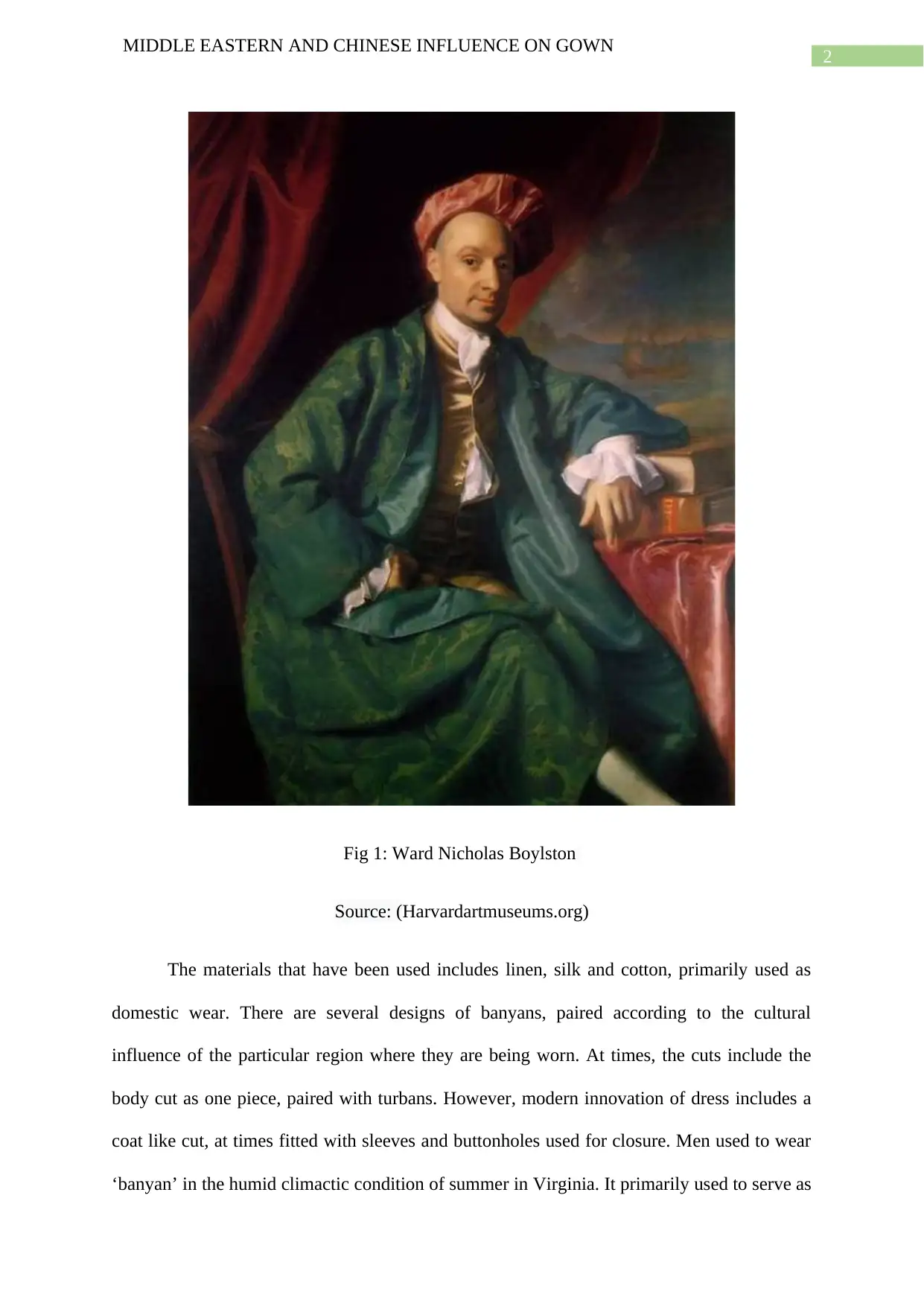
Fig 1: Ward Nicholas Boylston
Source: (Harvardartmuseums.org)
The materials that have been used includes linen, silk and cotton, primarily used as
domestic wear. There are several designs of banyans, paired according to the cultural
influence of the particular region where they are being worn. At times, the cuts include the
body cut as one piece, paired with turbans. However, modern innovation of dress includes a
coat like cut, at times fitted with sleeves and buttonholes used for closure. Men used to wear
‘banyan’ in the humid climactic condition of summer in Virginia. It primarily used to serve as
MIDDLE EASTERN AND CHINESE INFLUENCE ON GOWN
Fig 1: Ward Nicholas Boylston
Source: (Harvardartmuseums.org)
The materials that have been used includes linen, silk and cotton, primarily used as
domestic wear. There are several designs of banyans, paired according to the cultural
influence of the particular region where they are being worn. At times, the cuts include the
body cut as one piece, paired with turbans. However, modern innovation of dress includes a
coat like cut, at times fitted with sleeves and buttonholes used for closure. Men used to wear
‘banyan’ in the humid climactic condition of summer in Virginia. It primarily used to serve as
⊘ This is a preview!⊘
Do you want full access?
Subscribe today to unlock all pages.

Trusted by 1+ million students worldwide
3
MIDDLE EASTERN AND CHINESE INFLUENCE ON GOWN
the purpose of street wear. According to the general perception, as it has been depicted in the
paintings sice time immemorial. The general image of philosophers or great thinkers and
intellectuals are the ones with long gown like dress. The spacious nature of the dresses
according to Benjamin Rush provided the one wearing it with a space to disperse their
thinking. James Thornhill has depicted Sir Isaac Newton in a gown with a t shaped cut.
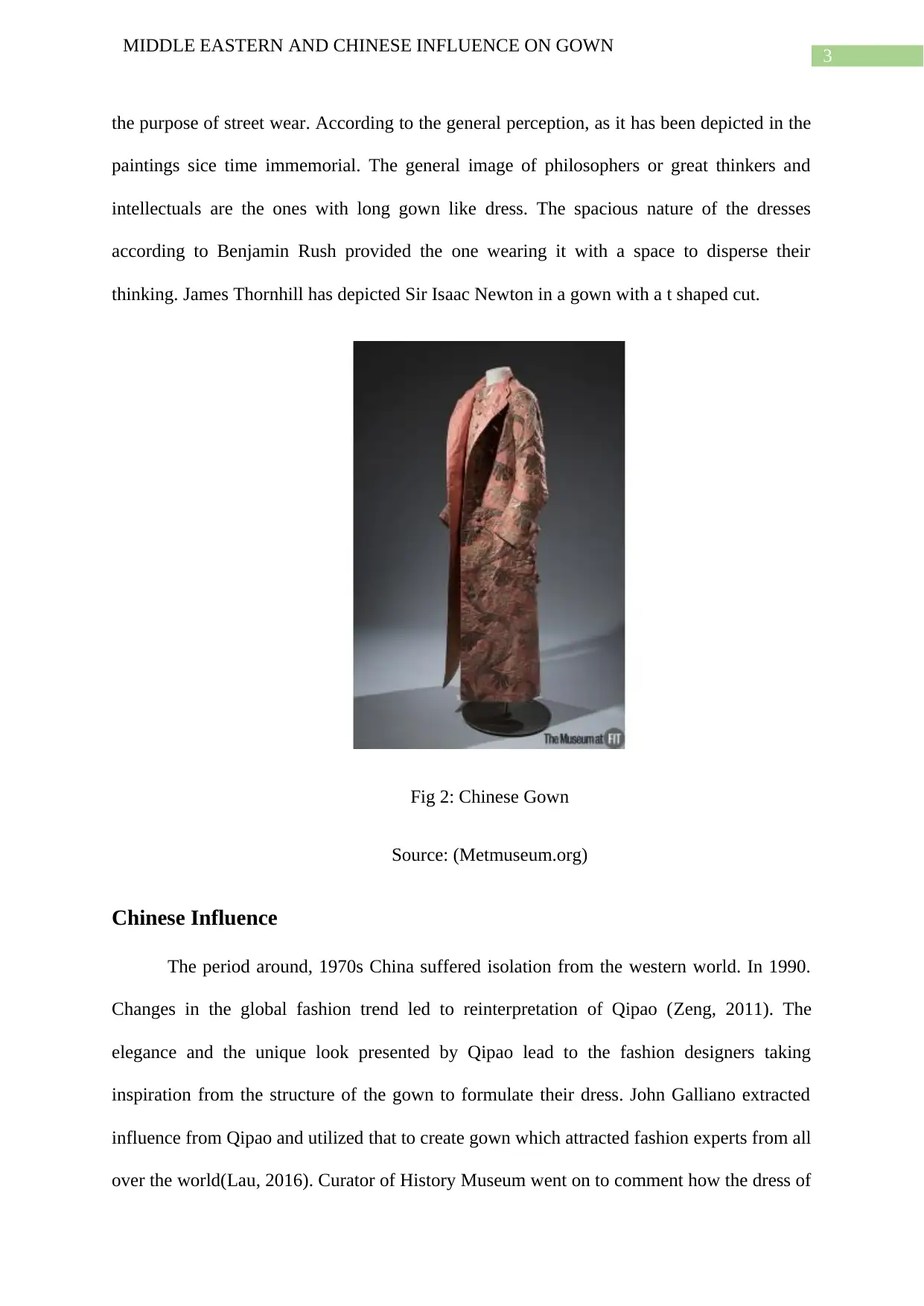
Fig 2: Chinese Gown
Source: (Metmuseum.org)
Chinese Influence
The period around, 1970s China suffered isolation from the western world. In 1990.
Changes in the global fashion trend led to reinterpretation of Qipao (Zeng, 2011). The
elegance and the unique look presented by Qipao lead to the fashion designers taking
inspiration from the structure of the gown to formulate their dress. John Galliano extracted
influence from Qipao and utilized that to create gown which attracted fashion experts from all
over the world(Lau, 2016). Curator of History Museum went on to comment how the dress of
MIDDLE EASTERN AND CHINESE INFLUENCE ON GOWN
the purpose of street wear. According to the general perception, as it has been depicted in the
paintings sice time immemorial. The general image of philosophers or great thinkers and
intellectuals are the ones with long gown like dress. The spacious nature of the dresses
according to Benjamin Rush provided the one wearing it with a space to disperse their
thinking. James Thornhill has depicted Sir Isaac Newton in a gown with a t shaped cut.
Fig 2: Chinese Gown
Source: (Metmuseum.org)
Chinese Influence
The period around, 1970s China suffered isolation from the western world. In 1990.
Changes in the global fashion trend led to reinterpretation of Qipao (Zeng, 2011). The
elegance and the unique look presented by Qipao lead to the fashion designers taking
inspiration from the structure of the gown to formulate their dress. John Galliano extracted
influence from Qipao and utilized that to create gown which attracted fashion experts from all
over the world(Lau, 2016). Curator of History Museum went on to comment how the dress of
Paraphrase This Document
Need a fresh take? Get an instant paraphrase of this document with our AI Paraphraser
4
MIDDLE EASTERN AND CHINESE INFLUENCE ON GOWN
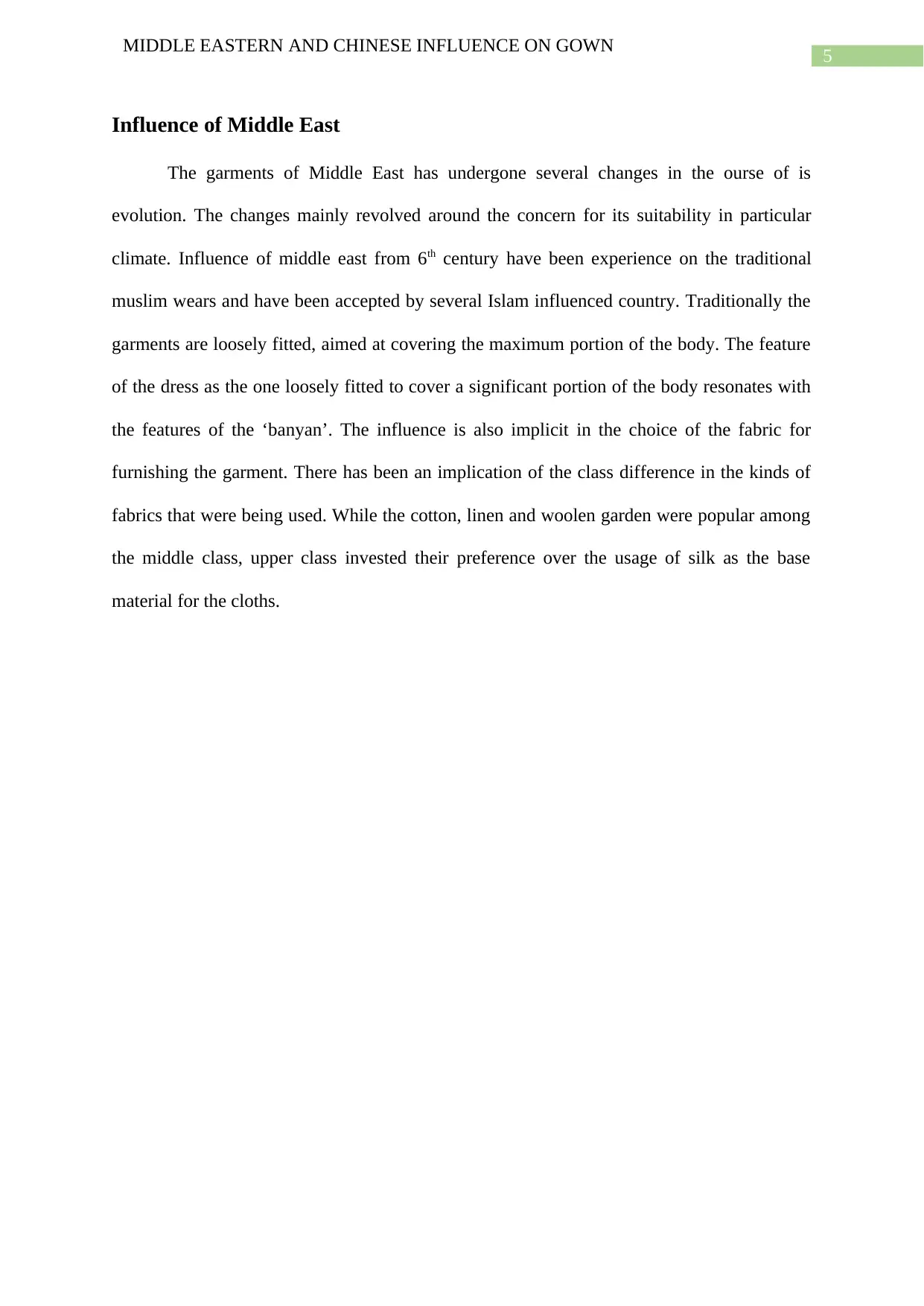
Qipao has undergone several changes along the course of time. In this context it needs to be
discussed that while qipao influenced the female wear, Changshan went on to influence the
dress worn by men (Chen, 2016).
Fig 3: Chinese Gown
Source: (Metmuseum.org)
The influence was not confined within the pattern of the dress but went on to expand
its domain to the area of influencing the embroidery that have been used. As the embroidery
were done manually it resulted in the short scale production of the garments. Resultant
outcome were the lesser frequency of the garment as it has been seen in the Chinese qipao
and European Haute couture gown. However, the gown appeared in the life of common
people on seldom occasion. The Chinese influence on several patterns of gowns are very
prominent in terms of its pattern and the fabrics used (Fashioningtheearlymodern.ac.uk,
2019).
MIDDLE EASTERN AND CHINESE INFLUENCE ON GOWN
Qipao has undergone several changes along the course of time. In this context it needs to be
discussed that while qipao influenced the female wear, Changshan went on to influence the
dress worn by men (Chen, 2016).
Fig 3: Chinese Gown
Source: (Metmuseum.org)
The influence was not confined within the pattern of the dress but went on to expand
its domain to the area of influencing the embroidery that have been used. As the embroidery
were done manually it resulted in the short scale production of the garments. Resultant
outcome were the lesser frequency of the garment as it has been seen in the Chinese qipao
and European Haute couture gown. However, the gown appeared in the life of common
people on seldom occasion. The Chinese influence on several patterns of gowns are very
prominent in terms of its pattern and the fabrics used (Fashioningtheearlymodern.ac.uk,
2019).
5
MIDDLE EASTERN AND CHINESE INFLUENCE ON GOWN
Influence of Middle East
The garments of Middle East has undergone several changes in the ourse of is
evolution. The changes mainly revolved around the concern for its suitability in particular
climate. Influence of middle east from 6th century have been experience on the traditional
muslim wears and have been accepted by several Islam influenced country. Traditionally the
garments are loosely fitted, aimed at covering the maximum portion of the body. The feature
of the dress as the one loosely fitted to cover a significant portion of the body resonates with
the features of the ‘banyan’. The influence is also implicit in the choice of the fabric for
furnishing the garment. There has been an implication of the class difference in the kinds of
fabrics that were being used. While the cotton, linen and woolen garden were popular among
the middle class, upper class invested their preference over the usage of silk as the base
material for the cloths.
MIDDLE EASTERN AND CHINESE INFLUENCE ON GOWN
Influence of Middle East
The garments of Middle East has undergone several changes in the ourse of is
evolution. The changes mainly revolved around the concern for its suitability in particular
climate. Influence of middle east from 6th century have been experience on the traditional
muslim wears and have been accepted by several Islam influenced country. Traditionally the
garments are loosely fitted, aimed at covering the maximum portion of the body. The feature
of the dress as the one loosely fitted to cover a significant portion of the body resonates with
the features of the ‘banyan’. The influence is also implicit in the choice of the fabric for
furnishing the garment. There has been an implication of the class difference in the kinds of
fabrics that were being used. While the cotton, linen and woolen garden were popular among
the middle class, upper class invested their preference over the usage of silk as the base
material for the cloths.
⊘ This is a preview!⊘
Do you want full access?
Subscribe today to unlock all pages.
Trusted by 1+ million students worldwide
6
MIDDLE EASTERN AND CHINESE INFLUENCE ON GOWN
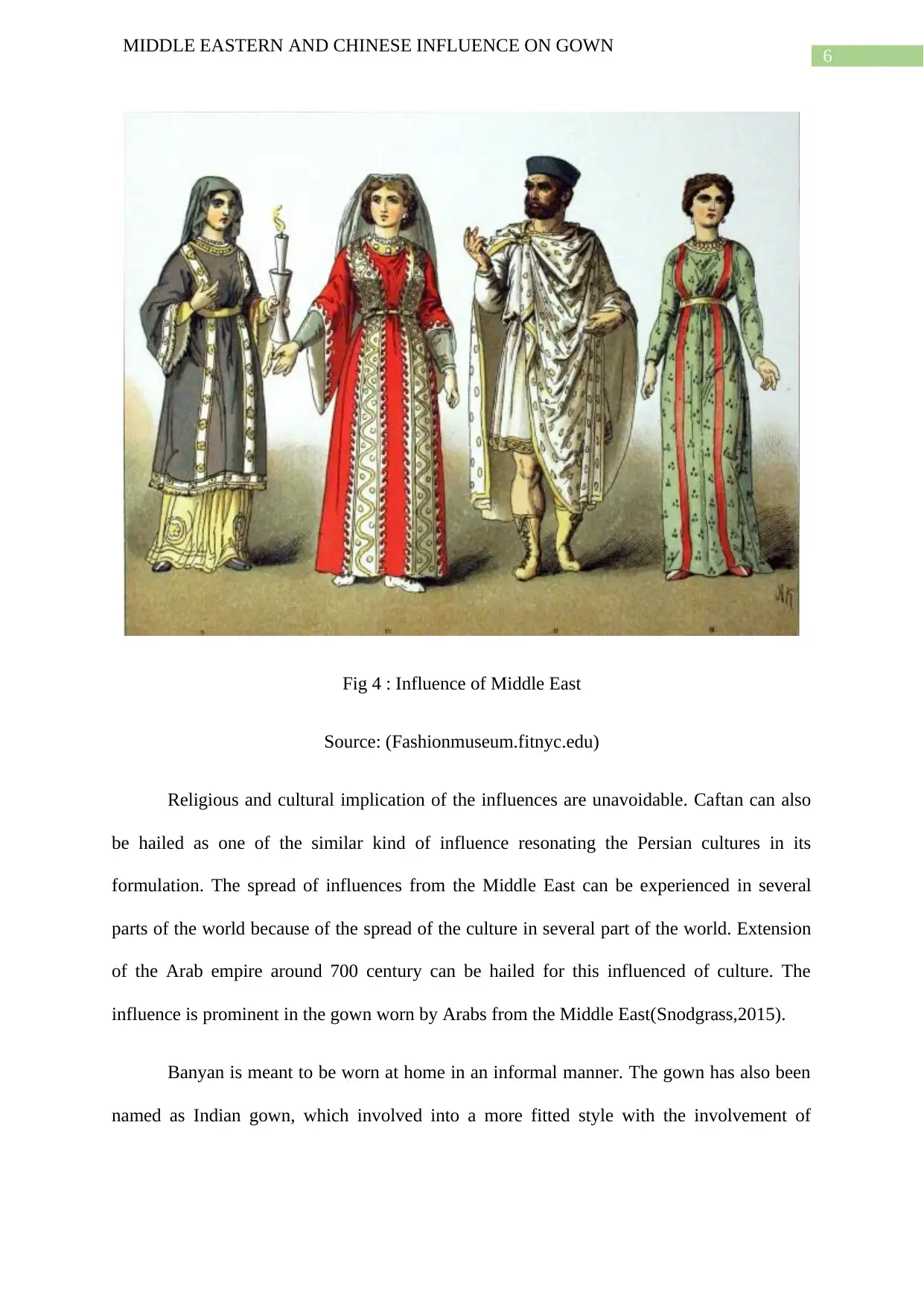
Fig 4 : Influence of Middle East
Source: (Fashionmuseum.fitnyc.edu)
Religious and cultural implication of the influences are unavoidable. Caftan can also
be hailed as one of the similar kind of influence resonating the Persian cultures in its
formulation. The spread of influences from the Middle East can be experienced in several
parts of the world because of the spread of the culture in several part of the world. Extension
of the Arab empire around 700 century can be hailed for this influenced of culture. The
influence is prominent in the gown worn by Arabs from the Middle East(Snodgrass,2015).
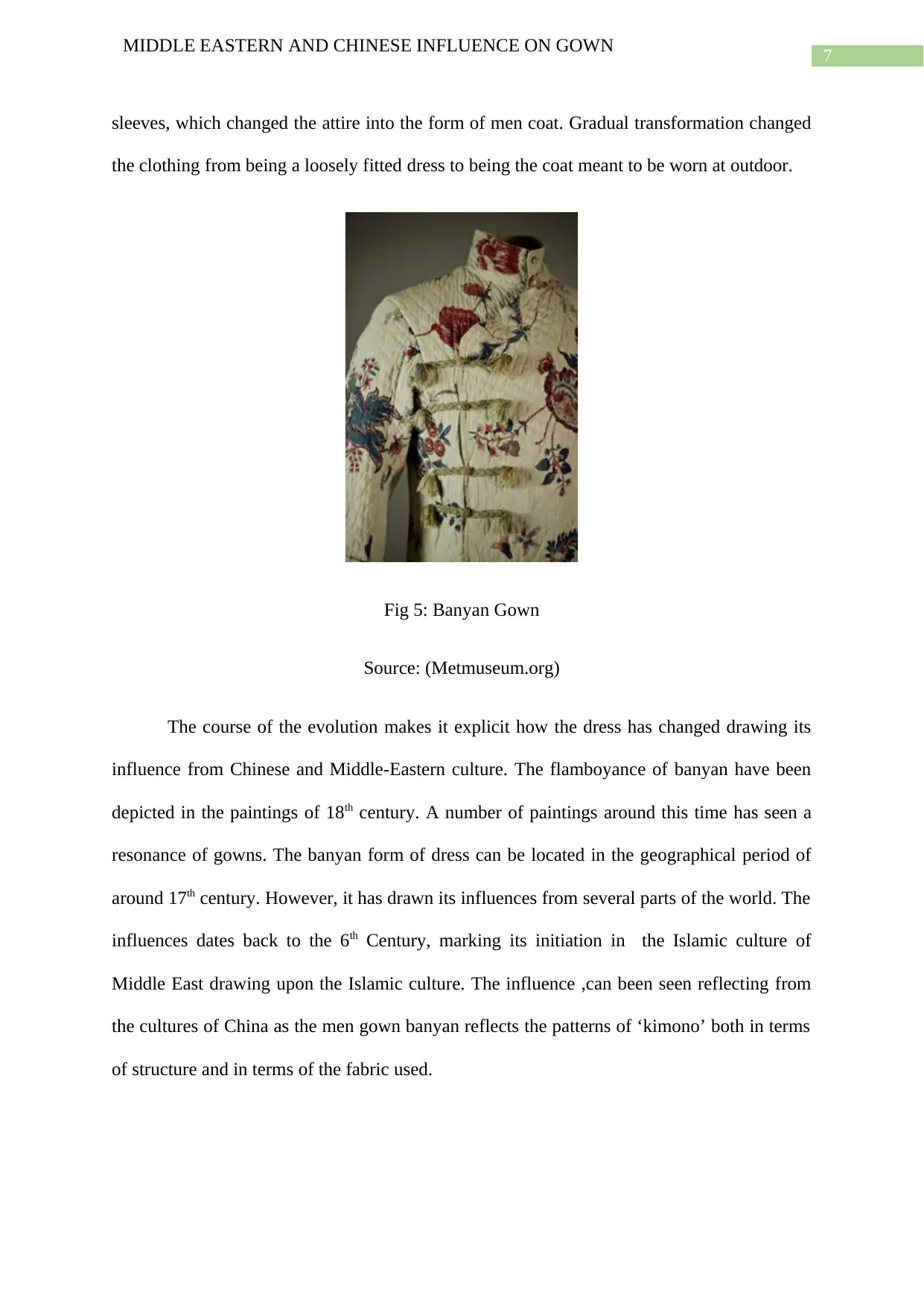
Banyan is meant to be worn at home in an informal manner. The gown has also been
named as Indian gown, which involved into a more fitted style with the involvement of
MIDDLE EASTERN AND CHINESE INFLUENCE ON GOWN
Fig 4 : Influence of Middle East
Source: (Fashionmuseum.fitnyc.edu)
Religious and cultural implication of the influences are unavoidable. Caftan can also
be hailed as one of the similar kind of influence resonating the Persian cultures in its
formulation. The spread of influences from the Middle East can be experienced in several
parts of the world because of the spread of the culture in several part of the world. Extension
of the Arab empire around 700 century can be hailed for this influenced of culture. The
influence is prominent in the gown worn by Arabs from the Middle East(Snodgrass,2015).
Banyan is meant to be worn at home in an informal manner. The gown has also been
named as Indian gown, which involved into a more fitted style with the involvement of
Paraphrase This Document
Need a fresh take? Get an instant paraphrase of this document with our AI Paraphraser
7
MIDDLE EASTERN AND CHINESE INFLUENCE ON GOWN
sleeves, which changed the attire into the form of men coat. Gradual transformation changed
the clothing from being a loosely fitted dress to being the coat meant to be worn at outdoor.
Fig 5: Banyan Gown
Source: (Metmuseum.org)
The course of the evolution makes it explicit how the dress has changed drawing its
influence from Chinese and Middle-Eastern culture. The flamboyance of banyan have been
depicted in the paintings of 18th century. A number of paintings around this time has seen a
resonance of gowns. The banyan form of dress can be located in the geographical period of
around 17th century. However, it has drawn its influences from several parts of the world. The
influences dates back to the 6th Century, marking its initiation in the Islamic culture of
Middle East drawing upon the Islamic culture. The influence ,can been seen reflecting from
the cultures of China as the men gown banyan reflects the patterns of ‘kimono’ both in terms
of structure and in terms of the fabric used.
MIDDLE EASTERN AND CHINESE INFLUENCE ON GOWN
sleeves, which changed the attire into the form of men coat. Gradual transformation changed
the clothing from being a loosely fitted dress to being the coat meant to be worn at outdoor.
Fig 5: Banyan Gown
Source: (Metmuseum.org)
The course of the evolution makes it explicit how the dress has changed drawing its
influence from Chinese and Middle-Eastern culture. The flamboyance of banyan have been
depicted in the paintings of 18th century. A number of paintings around this time has seen a
resonance of gowns. The banyan form of dress can be located in the geographical period of
around 17th century. However, it has drawn its influences from several parts of the world. The
influences dates back to the 6th Century, marking its initiation in the Islamic culture of
Middle East drawing upon the Islamic culture. The influence ,can been seen reflecting from
the cultures of China as the men gown banyan reflects the patterns of ‘kimono’ both in terms
of structure and in terms of the fabric used.
8
MIDDLE EASTERN AND CHINESE INFLUENCE ON GOWN
Conclusion
The aim of the paper was to trace the influence of Chinese and Middle-East culture on
the western garment of Banyan, commonly known as gown. The gown had experienced its
birth during the time of colonization. It is evident in the naming of the garment as banyan,
which refers to merchants. The influence of gown was prominent in its Portuguese origin;
however dwelling into the cultures from different geographical domains makes it pretty
evident that the dress has drawn in from the traditional attire of China as well as from the
Islamic aspect in the parts of Middle Eastern. While the Chinese influences can be narrowed
down to qipao, worn by female and Changshan, which were worn by male. The influence
from Middle East dates back to the 6th century as the cultures of Middle East spread over
several portion of the world. The influence are very prominent and times ambiguous. The
nature of the influence are not static but dynamic, which went on modification in the due
course of time. Fashion is a sector that is culturally depended. Certain minor changes in the
culture impact the factors that can be noted in the visual outcomes of the garments through
different time period and over different geographical location.
MIDDLE EASTERN AND CHINESE INFLUENCE ON GOWN
Conclusion
The aim of the paper was to trace the influence of Chinese and Middle-East culture on
the western garment of Banyan, commonly known as gown. The gown had experienced its
birth during the time of colonization. It is evident in the naming of the garment as banyan,
which refers to merchants. The influence of gown was prominent in its Portuguese origin;
however dwelling into the cultures from different geographical domains makes it pretty
evident that the dress has drawn in from the traditional attire of China as well as from the
Islamic aspect in the parts of Middle Eastern. While the Chinese influences can be narrowed
down to qipao, worn by female and Changshan, which were worn by male. The influence
from Middle East dates back to the 6th century as the cultures of Middle East spread over
several portion of the world. The influence are very prominent and times ambiguous. The
nature of the influence are not static but dynamic, which went on modification in the due
course of time. Fashion is a sector that is culturally depended. Certain minor changes in the
culture impact the factors that can be noted in the visual outcomes of the garments through
different time period and over different geographical location.
⊘ This is a preview!⊘
Do you want full access?
Subscribe today to unlock all pages.
Trusted by 1+ million students worldwide
9
MIDDLE EASTERN AND CHINESE INFLUENCE ON GOWN
Works Cited
Cheang, Sarah. "Fashion, Chinoiserie, and the Transnational: Material Translations between
China, Japan and Britain." Beyond Chinoiserie. BRILL, 2018. 235-267.
Chen, Yugang. "The influence of Chinese folk embroidery of modern fashion design." 4th
International Conference on Management Science, Education Technology, Arts,
Social Science and Economics 2016. Atlantis Press, 2016.
Fashioningtheearlymodern.ac.uk. "Fashioning The Early Modern » Man’S
Banyan". Fashioningtheearlymodern.Ac.Uk, 2019,
http://www.fashioningtheearlymodern.ac.uk/object-in-focus/mans-banyan/.
Lau, Joyce. "History Of A Dress, Chinese Style". Nytimes.Com, 2019,
https://www.nytimes.com/2010/08/31/fashion/31iht-FDRESS.html.
SHAW, MADELYN. "Exoticism in Fashion: From British North America to the United
States." GLOBAL TEXTILE ENCOUNTERS: 177.
Snodgrass, Mary Ellen. World clothing and fashion: An encyclopedia of history, culture, and
social influence. Routledge, 2015.
Zeng, Yao. "Chinese Influence On Western Women 'S Dress In American Vogue Magazine,
1960-2009". Pdfs.Semanticscholar.Org, 2011,
https://pdfs.semanticscholar.org/a0c6/83d624d973c26d4e572af3efec2c1f64da1c.pdf.
MIDDLE EASTERN AND CHINESE INFLUENCE ON GOWN
Works Cited
Cheang, Sarah. "Fashion, Chinoiserie, and the Transnational: Material Translations between
China, Japan and Britain." Beyond Chinoiserie. BRILL, 2018. 235-267.
Chen, Yugang. "The influence of Chinese folk embroidery of modern fashion design." 4th
International Conference on Management Science, Education Technology, Arts,
Social Science and Economics 2016. Atlantis Press, 2016.
Fashioningtheearlymodern.ac.uk. "Fashioning The Early Modern » Man’S
Banyan". Fashioningtheearlymodern.Ac.Uk, 2019,
http://www.fashioningtheearlymodern.ac.uk/object-in-focus/mans-banyan/.
Lau, Joyce. "History Of A Dress, Chinese Style". Nytimes.Com, 2019,
https://www.nytimes.com/2010/08/31/fashion/31iht-FDRESS.html.
SHAW, MADELYN. "Exoticism in Fashion: From British North America to the United
States." GLOBAL TEXTILE ENCOUNTERS: 177.
Snodgrass, Mary Ellen. World clothing and fashion: An encyclopedia of history, culture, and
social influence. Routledge, 2015.
Zeng, Yao. "Chinese Influence On Western Women 'S Dress In American Vogue Magazine,
1960-2009". Pdfs.Semanticscholar.Org, 2011,
https://pdfs.semanticscholar.org/a0c6/83d624d973c26d4e572af3efec2c1f64da1c.pdf.
Paraphrase This Document
Need a fresh take? Get an instant paraphrase of this document with our AI Paraphraser
10
MIDDLE EASTERN AND CHINESE INFLUENCE ON GOWN
Bibliography
Metmuseum.org. Metmuseum.Org, 2019,
https://www.metmuseum.org/art/collection/search/88088?
searchField=All&sortBy=Relevance&where=China&what=Dresses&ft=*&offs
et=0&rpp=20&pos=6.
Fashion-history.lovetoknow.com. Fashion-History.Lovetoknow.Com, 2019, https://fashion-
history.lovetoknow.com/fashion-history-eras/europe-america-history-dress-400-1900-c-e.
Fashionmuseum.fitnyc.edu. "The Museum At FIT - Online
Collections". Fashionmuseum.Fitnyc.Edu, 2019,
http://fashionmuseum.fitnyc.edu/view/objects/aslist/770?t:state:flow=6e28b5b5-1d11-4393-b4d5-
f8419863297f.
Harvardartmuseums.org. "From The Harvard Art Museums’ Collections Nicholas Boylston
(1716-1771)". Harvardartmuseums.Org, 2019,
https://www.harvardartmuseums.org/art/299949.
MIDDLE EASTERN AND CHINESE INFLUENCE ON GOWN
Bibliography
Metmuseum.org. Metmuseum.Org, 2019,
https://www.metmuseum.org/art/collection/search/88088?
searchField=All&sortBy=Relevance&where=China&what=Dresses&ft=*&offs
et=0&rpp=20&pos=6.
Fashion-history.lovetoknow.com. Fashion-History.Lovetoknow.Com, 2019, https://fashion-
history.lovetoknow.com/fashion-history-eras/europe-america-history-dress-400-1900-c-e.
Fashionmuseum.fitnyc.edu. "The Museum At FIT - Online
Collections". Fashionmuseum.Fitnyc.Edu, 2019,
http://fashionmuseum.fitnyc.edu/view/objects/aslist/770?t:state:flow=6e28b5b5-1d11-4393-b4d5-
f8419863297f.
Harvardartmuseums.org. "From The Harvard Art Museums’ Collections Nicholas Boylston
(1716-1771)". Harvardartmuseums.Org, 2019,
https://www.harvardartmuseums.org/art/299949.

1 out of 11


Your All-in-One AI-Powered Toolkit for Academic Success.
+13062052269
info@desklib.com
Available 24*7 on WhatsApp / Email
![[object Object]](/_next/static/media/star-bottom.7253800d.svg)
Unlock your academic potential
Copyright © 2020–2026 A2Z Services. All Rights Reserved. Developed and managed by ZUCOL.