Human Behavior in Organization: DMCM and Cultural Competency Report
VerifiedAdded on 2022/08/26
|10
|2069
|29
Report
AI Summary
This report analyzes human behavior within the context of the Victorian Energy Industry in Australia, focusing on the cultural diversity competencies of managers. The study utilizes the Diversity Management Competency Model (DMCM) and explores the application of cultural intelligence, based on Turnbull's theory and the Cultural Intelligence Scale (CQS). The research involves semi-structured interviews with 30 managers, examining their self-awareness, understanding of others, workplace analysis, and application of cultural competence. Findings reveal moderate self-awareness but low competency in other areas, indicating a need for improved cultural intelligence training and development within the industry. The report also discusses limitations, such as the qualitative approach and specific industry focus, and suggests avenues for future research, including quantitative analysis and broader industry scope.
Running head: HUMAN BEHAVIOR IN ORGANIZATION
Human Behavior in Organization
Name of the Student:
Name of the University:
Author Note:
Human Behavior in Organization
Name of the Student:
Name of the University:
Author Note:

Paraphrase This Document
Need a fresh take? Get an instant paraphrase of this document with our AI Paraphraser
1HUMAN BEHAVIOR IN ORGANIZATION
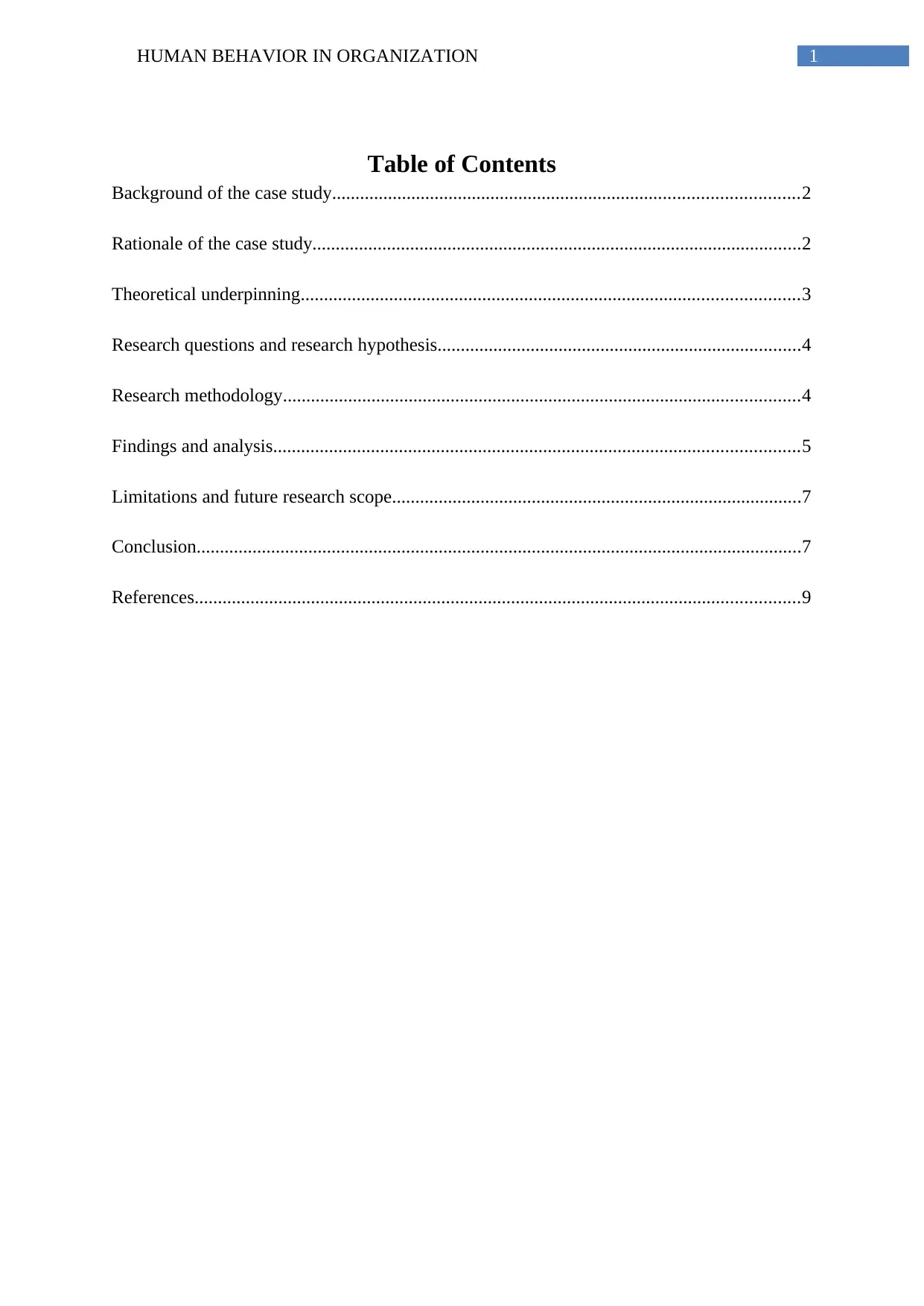
Table of Contents
Background of the case study....................................................................................................2
Rationale of the case study.........................................................................................................2
Theoretical underpinning...........................................................................................................3
Research questions and research hypothesis..............................................................................4
Research methodology...............................................................................................................4
Findings and analysis.................................................................................................................5
Limitations and future research scope........................................................................................7
Conclusion..................................................................................................................................7
References..................................................................................................................................9
Table of Contents
Background of the case study....................................................................................................2
Rationale of the case study.........................................................................................................2
Theoretical underpinning...........................................................................................................3
Research questions and research hypothesis..............................................................................4
Research methodology...............................................................................................................4
Findings and analysis.................................................................................................................5
Limitations and future research scope........................................................................................7
Conclusion..................................................................................................................................7
References..................................................................................................................................9
2HUMAN BEHAVIOR IN ORGANIZATION
Background of the case study
Australia has a unique position when it comes to diversity. They have extremely
diverse culture where about 27% of the people come from outside Australia (Dalton, D'Netto
and Bhanugopan 2015). The industries in Australia thus have similarly diversity workforce
that needs special considerations when it comes to their management. Manager’s role and
responsibilities has changed over time. The business environment has become dynamic where
they need to consider both cultural and human rights approaches while performing their job.
In order to manage teams that are culturally diverse, it is evident that managers will need
cultural competencies, cultural intelligence and emotional intelligence to manage the
culturally diverse workplaces successfully.
Researchers have opined that competencies have become one of the focus while
preparing individuals for managerial roles. Competency, which has been popularly defined as
performance standards, skills and knowledge, behavior and quality of the individual, is an
amalgamation of personal straits and developed capabilities that create the best composition
for successful management.
Rationale of the case study
The study intends to develop an original model for managing culturally diverse
workplaces for assisting the managers in their work. The case study is conducted on the
Victorian Energy Industry, Australia. The Australia with its unique cultural composition need
to focus on cultural management models and methods yet, Australian organizations do not
show much development or promise for any such initiative. In the past years there had been
little to no development in the areas of cultural competency development. The model that the
study proposes is Diversity Management Competency Model (DMCM) (Dalton, D'Netto and
Background of the case study
Australia has a unique position when it comes to diversity. They have extremely
diverse culture where about 27% of the people come from outside Australia (Dalton, D'Netto
and Bhanugopan 2015). The industries in Australia thus have similarly diversity workforce
that needs special considerations when it comes to their management. Manager’s role and
responsibilities has changed over time. The business environment has become dynamic where
they need to consider both cultural and human rights approaches while performing their job.
In order to manage teams that are culturally diverse, it is evident that managers will need
cultural competencies, cultural intelligence and emotional intelligence to manage the
culturally diverse workplaces successfully.
Researchers have opined that competencies have become one of the focus while
preparing individuals for managerial roles. Competency, which has been popularly defined as
performance standards, skills and knowledge, behavior and quality of the individual, is an
amalgamation of personal straits and developed capabilities that create the best composition
for successful management.
Rationale of the case study
The study intends to develop an original model for managing culturally diverse
workplaces for assisting the managers in their work. The case study is conducted on the
Victorian Energy Industry, Australia. The Australia with its unique cultural composition need
to focus on cultural management models and methods yet, Australian organizations do not
show much development or promise for any such initiative. In the past years there had been
little to no development in the areas of cultural competency development. The model that the
study proposes is Diversity Management Competency Model (DMCM) (Dalton, D'Netto and
⊘ This is a preview!⊘
Do you want full access?
Subscribe today to unlock all pages.

Trusted by 1+ million students worldwide
3HUMAN BEHAVIOR IN ORGANIZATION
Bhanugopan 2015). The model intends to investigate the mindset of the managers on cultural
competency and their view of the extent to which they are culturally competent. The aim of
the development of the model is to offer tangible benefits for Australian organizations as the
model that it develops can be used for preparing individuals for the managerial roles.
Theoretical underpinning
The model that the research develops is based on two theories. The first theory is
Turnbull’s theory of cultural intelligence. Cultural intelligence can be defined as an
individual’s ability to relate to other cultures and their ability to work with culturally diverse
workforce. The second theory is the Cultural Intelligence Scale (CQS) that classifies
competencies. The Turnbull theory of cultural intelligence concerns itself with organization,
team and individual cultural intelligence as its part. The model that the study proposes does
not include the organizational or team competencies as a whole but some components has
been included as they have been considered applicable and relevant to individual cultural
competencies.
The Cultural Intelligence Scale (CQS) is a tool for determining global leadership
capabilities. This tool to include certain characteristics that are not relevant to the current
research scope and thus, has been excluded from the proposed model. The components that
have been included are common to both the theories and are truly relevant for the research
scope. There are four quadrants of the proposed model. The first two, Understanding Self and
Understanding Others are set at “Individual Level” and the other two Workplace Analysis
and Workplace Application are set the at a “Workplace Level” (Dalton, D'Netto and
Bhanugopan 2015). The idea of the model is constructed on alliance formation across
different cultures, which echoes the basis of the Australian workforce. The DMCM can assist
Bhanugopan 2015). The model intends to investigate the mindset of the managers on cultural
competency and their view of the extent to which they are culturally competent. The aim of
the development of the model is to offer tangible benefits for Australian organizations as the
model that it develops can be used for preparing individuals for the managerial roles.
Theoretical underpinning
The model that the research develops is based on two theories. The first theory is
Turnbull’s theory of cultural intelligence. Cultural intelligence can be defined as an
individual’s ability to relate to other cultures and their ability to work with culturally diverse
workforce. The second theory is the Cultural Intelligence Scale (CQS) that classifies
competencies. The Turnbull theory of cultural intelligence concerns itself with organization,
team and individual cultural intelligence as its part. The model that the study proposes does
not include the organizational or team competencies as a whole but some components has
been included as they have been considered applicable and relevant to individual cultural
competencies.
The Cultural Intelligence Scale (CQS) is a tool for determining global leadership
capabilities. This tool to include certain characteristics that are not relevant to the current
research scope and thus, has been excluded from the proposed model. The components that
have been included are common to both the theories and are truly relevant for the research
scope. There are four quadrants of the proposed model. The first two, Understanding Self and
Understanding Others are set at “Individual Level” and the other two Workplace Analysis
and Workplace Application are set the at a “Workplace Level” (Dalton, D'Netto and
Bhanugopan 2015). The idea of the model is constructed on alliance formation across
different cultures, which echoes the basis of the Australian workforce. The DMCM can assist
Paraphrase This Document
Need a fresh take? Get an instant paraphrase of this document with our AI Paraphraser
4HUMAN BEHAVIOR IN ORGANIZATION
the managers working in workplaces that have diverse culture to ascertain their development
of cultural competence throughout their work life.
Research questions and research hypothesis
The primary research question that arises in the study comes from the analysis of
cultural intelligence, which seeks to find the extent to which the managers of the Victorian
Energy Industry believe to have developed the competencies that have been accounted in the
DMCM. Four secondary research questions arise from each of the quadrants. The first
quadrant leads to the question of the extent to which the managers of the Victorian Energy
Industry have developed the competencies of “Understanding self”. The second quadrant
leads to the question of the extent of the competencies of the managers at Victorian Energy
Industry regarding “Understanding others”. The third quadrant leads to the question as to the
extent of the understanding of “Workplace analysis” by the managers of Victorian Energy
Industry and the forth quadrant, similarly leads to the question of the extent of their
understanding of “Workplace Application” by the managers of the Victorian Energy Industry
(Dalton, D'Netto and Bhanugopan 2015).
The research is based on the hypothesis that the managers of the electricity industry in
Victoria, Australia do not have the necessary cultural competency needed to manage the
workforces of a culturally diverse company. It is also taken as a hypothesis that the
competencies mentioned in the four quadrants of the DMCM are not considered by the
managers of the industry.
Research methodology
The study involves a sample size of 30 managers working in the Victorian Energy
Industry. The method of data collection adopted is interview. The sample collection was done
the managers working in workplaces that have diverse culture to ascertain their development
of cultural competence throughout their work life.
Research questions and research hypothesis
The primary research question that arises in the study comes from the analysis of
cultural intelligence, which seeks to find the extent to which the managers of the Victorian
Energy Industry believe to have developed the competencies that have been accounted in the
DMCM. Four secondary research questions arise from each of the quadrants. The first
quadrant leads to the question of the extent to which the managers of the Victorian Energy
Industry have developed the competencies of “Understanding self”. The second quadrant
leads to the question of the extent of the competencies of the managers at Victorian Energy
Industry regarding “Understanding others”. The third quadrant leads to the question as to the
extent of the understanding of “Workplace analysis” by the managers of Victorian Energy
Industry and the forth quadrant, similarly leads to the question of the extent of their
understanding of “Workplace Application” by the managers of the Victorian Energy Industry
(Dalton, D'Netto and Bhanugopan 2015).
The research is based on the hypothesis that the managers of the electricity industry in
Victoria, Australia do not have the necessary cultural competency needed to manage the
workforces of a culturally diverse company. It is also taken as a hypothesis that the
competencies mentioned in the four quadrants of the DMCM are not considered by the
managers of the industry.
Research methodology
The study involves a sample size of 30 managers working in the Victorian Energy
Industry. The method of data collection adopted is interview. The sample collection was done
5HUMAN BEHAVIOR IN ORGANIZATION
through extensive network of personal contact and with snowballing process. The sample of
the managers include representatives from diverse departments like generator and retail so
that the relevancy of the hypothesis could be tested. The managers that were included in the
research were functional managers, human resource managers, procurement and finance
managers. The reason for such sampling was to ensure that input from all over the industry
could be gained. The managers who were responsible for handling a large number of people
were chosen for the research. The interviews were either telephonic or face-to-face. Before
the interview, the voluntary participation of the managers were confirmed.
The data collection method involved semi-structured interview. The interview
questions involved the managers answering questions regarding cultural competence as
defined by the four quadrants. The managers provided their insight and personal life and
work experiences and behavioral instances, which they thought constituted cultural
competency. The data analysis method adopted in the case study is Thematic analysis
(Dalton, D'Netto and Bhanugopan 2015). The thematic analysis of data involved
identification of patterns in the collected data. The analysis included a deductive approach
where specific themes related to the research questions were sorted from the collected data
and conclusions were drawn from them. In order to ensure validation of the collected data
and subsequent conclusions, an independent reviewer proficient with cross-cultural diversity
as well as qualitative research methods was used to review the transcripts of the interview
and the themes that have been drawn from them.
Findings and analysis
The findings of the study suggests that the managers’ competency in the first quadrant
was moderate which means that most of respondents had moderate understanding of their
self. The results of the other three quadrants can be best described as low, which indicates
through extensive network of personal contact and with snowballing process. The sample of
the managers include representatives from diverse departments like generator and retail so
that the relevancy of the hypothesis could be tested. The managers that were included in the
research were functional managers, human resource managers, procurement and finance
managers. The reason for such sampling was to ensure that input from all over the industry
could be gained. The managers who were responsible for handling a large number of people
were chosen for the research. The interviews were either telephonic or face-to-face. Before
the interview, the voluntary participation of the managers were confirmed.
The data collection method involved semi-structured interview. The interview
questions involved the managers answering questions regarding cultural competence as
defined by the four quadrants. The managers provided their insight and personal life and
work experiences and behavioral instances, which they thought constituted cultural
competency. The data analysis method adopted in the case study is Thematic analysis
(Dalton, D'Netto and Bhanugopan 2015). The thematic analysis of data involved
identification of patterns in the collected data. The analysis included a deductive approach
where specific themes related to the research questions were sorted from the collected data
and conclusions were drawn from them. In order to ensure validation of the collected data
and subsequent conclusions, an independent reviewer proficient with cross-cultural diversity
as well as qualitative research methods was used to review the transcripts of the interview
and the themes that have been drawn from them.
Findings and analysis
The findings of the study suggests that the managers’ competency in the first quadrant
was moderate which means that most of respondents had moderate understanding of their
self. The results of the other three quadrants can be best described as low, which indicates
⊘ This is a preview!⊘
Do you want full access?
Subscribe today to unlock all pages.
Trusted by 1+ million students worldwide
6HUMAN BEHAVIOR IN ORGANIZATION
that they did not have the necessary cultural competence when it comes to understanding
others or any of the workplace approaches. Thus, the answer to primary research question
was found. For the second research question, it was found that in this context the participants
of the study believed that they had the ability understand their own beliefs and the way their
beliefs are likely to affect their personal and professional life. Thus, results of this quadrant is
moderate.
The answer to the third research question pertaining to the second quadrant shows that
seventy three percent of the participants did not have the competency to understand others
and thus the score here is “low”. The fourth research question focusing on the third quadrant
shows that more than forty percent of the participants did not show any competency for
workplace analysis and thus the score here is low as well. The fifth research question
pertaining to the fourth quadrant shows that here too, the managers that participated in the
study could not cite proper examples or instances related to workplace application of cultural
competence and thus the score is low.
The results of the study are clearly indicative of the problems that the Australian
industries have when it comes to cultural intelligence. The managers though understand
cultural competence is necessary for the global organizations, they are unable to understand
the implications of non-work experience and the way they can increase their cultural
competence. While they have a moderately clear view of their own cultural beliefs and their
significance, they do not have much idea about the other people that they are working with
and how that limited understanding can hinder their work. They also do not have necessary
intervention for improving their cultural competence. The industry, it seems do not provide
the managers the necessary knowledge about non-work activities that increases cultural
intelligence (Dalton, D'Netto and Bhanugopan 2015).
that they did not have the necessary cultural competence when it comes to understanding
others or any of the workplace approaches. Thus, the answer to primary research question
was found. For the second research question, it was found that in this context the participants
of the study believed that they had the ability understand their own beliefs and the way their
beliefs are likely to affect their personal and professional life. Thus, results of this quadrant is
moderate.
The answer to the third research question pertaining to the second quadrant shows that
seventy three percent of the participants did not have the competency to understand others
and thus the score here is “low”. The fourth research question focusing on the third quadrant
shows that more than forty percent of the participants did not show any competency for
workplace analysis and thus the score here is low as well. The fifth research question
pertaining to the fourth quadrant shows that here too, the managers that participated in the
study could not cite proper examples or instances related to workplace application of cultural
competence and thus the score is low.
The results of the study are clearly indicative of the problems that the Australian
industries have when it comes to cultural intelligence. The managers though understand
cultural competence is necessary for the global organizations, they are unable to understand
the implications of non-work experience and the way they can increase their cultural
competence. While they have a moderately clear view of their own cultural beliefs and their
significance, they do not have much idea about the other people that they are working with
and how that limited understanding can hinder their work. They also do not have necessary
intervention for improving their cultural competence. The industry, it seems do not provide
the managers the necessary knowledge about non-work activities that increases cultural
intelligence (Dalton, D'Netto and Bhanugopan 2015).
Paraphrase This Document
Need a fresh take? Get an instant paraphrase of this document with our AI Paraphraser
7HUMAN BEHAVIOR IN ORGANIZATION
The managers also had severe language barrier and resistance to learn about new
cultures as they felt that they did not interest them. It is easily indicated through the study that
the development of cultural competence or rather the underdeveloped nature of it is not only
due to the resistance of the managers but is mostly because of the stagnancy of the industry
itself. When cultural competency becomes a part of their reward system or organizations
provide training for cultural intelligence, the managers will be able to understand the
importance of these aspects.
Limitations and future research scope
There are certain limitations that emerge from the case study. The participants all
belonged to the high or middle managers of the same industry. Thus, random sampling, that
enables much more relevant data could not be achieved. The research only uses qualitative
data which limits the universality of the research. The research is also based on one specific
industry and thus is shows limited data. The results could be symptomatic of the particular
industry.
Future research can perform a quantitative analysis conducted on a larger sample.
Questionnaires and survey can be used for larger data collection. The future researchers can
also focus on other industries to find out the universality of the model. The later researchers
can also include global aspects in their research as countries like United States, Canada and
United Kingdom also are extremely culturally diverse (Dalton, D'Netto and Bhanugopan
2015).
Conclusion
The contribution of the study is immense on the global management. The study
increases the understanding and awareness of the managers when it comes to cultural
The managers also had severe language barrier and resistance to learn about new
cultures as they felt that they did not interest them. It is easily indicated through the study that
the development of cultural competence or rather the underdeveloped nature of it is not only
due to the resistance of the managers but is mostly because of the stagnancy of the industry
itself. When cultural competency becomes a part of their reward system or organizations
provide training for cultural intelligence, the managers will be able to understand the
importance of these aspects.
Limitations and future research scope
There are certain limitations that emerge from the case study. The participants all
belonged to the high or middle managers of the same industry. Thus, random sampling, that
enables much more relevant data could not be achieved. The research only uses qualitative
data which limits the universality of the research. The research is also based on one specific
industry and thus is shows limited data. The results could be symptomatic of the particular
industry.
Future research can perform a quantitative analysis conducted on a larger sample.
Questionnaires and survey can be used for larger data collection. The future researchers can
also focus on other industries to find out the universality of the model. The later researchers
can also include global aspects in their research as countries like United States, Canada and
United Kingdom also are extremely culturally diverse (Dalton, D'Netto and Bhanugopan
2015).
Conclusion
The contribution of the study is immense on the global management. The study
increases the understanding and awareness of the managers when it comes to cultural
8HUMAN BEHAVIOR IN ORGANIZATION
intelligence. The research provides and insight into the Australian industry scenario and
proves without doubt that the cultural competence is extremely low there. It also shows a
positive window as the participants showed much interest in understanding the aspects
relayed in the model. This gives the organizations an opportunity to initiate cultural training
so that the mangers can become culturally competent. Finally, it can be said that the DMCM
model that has been created can be used globally to train the managers in future.
intelligence. The research provides and insight into the Australian industry scenario and
proves without doubt that the cultural competence is extremely low there. It also shows a
positive window as the participants showed much interest in understanding the aspects
relayed in the model. This gives the organizations an opportunity to initiate cultural training
so that the mangers can become culturally competent. Finally, it can be said that the DMCM
model that has been created can be used globally to train the managers in future.
⊘ This is a preview!⊘
Do you want full access?
Subscribe today to unlock all pages.
Trusted by 1+ million students worldwide
9HUMAN BEHAVIOR IN ORGANIZATION
References
Dalton, L., D'Netto, B. and Bhanugopan, R., 2015. Cultural diversity competencies of
managers in the Australian energy industry. The Journal of Developing Areas, 49(6), pp.387-
394.
References
Dalton, L., D'Netto, B. and Bhanugopan, R., 2015. Cultural diversity competencies of
managers in the Australian energy industry. The Journal of Developing Areas, 49(6), pp.387-
394.

1 out of 10


Related Documents


Your All-in-One AI-Powered Toolkit for Academic Success.
+13062052269
info@desklib.com
Available 24*7 on WhatsApp / Email
![[object Object]](/_next/static/media/star-bottom.7253800d.svg)
Unlock your academic potential
Copyright © 2020–2026 A2Z Services. All Rights Reserved. Developed and managed by ZUCOL.