Cross Cultural Management Report: Leadership in a Tanzanian Project
VerifiedAdded on 2022/08/12
|9
|2163
|32
Report
AI Summary
This report analyzes a cross-cultural management case study involving Brett Jones and Hydro Generation's dam project in Tanzania. It examines leadership challenges, including the integration of expatriate managers, cultural differences, and the impact of Jones's management style on project execution. The report highlights concerns regarding Jones's approach to local business practices, his sense of urgency, and his hiring techniques. It discusses the importance of cross-cultural intelligence, effective change management, and appropriate reward systems for project success. The student's reflection includes an evaluation of the team's work, identification of challenges in information gathering, and recommendations for future improvements. The report emphasizes the need for enhanced leadership skills, particularly in managing cultural differences and promoting ethical business practices within an international context.
Running head: CROSS CULTURAL MANAGEMENT
Cross Cultural Management
Name of the Student
Name of the University
Author Note
Cross Cultural Management
Name of the Student
Name of the University
Author Note

Paraphrase This Document
Need a fresh take? Get an instant paraphrase of this document with our AI Paraphraser
1CROSS CULTURAL MANAGEMENT
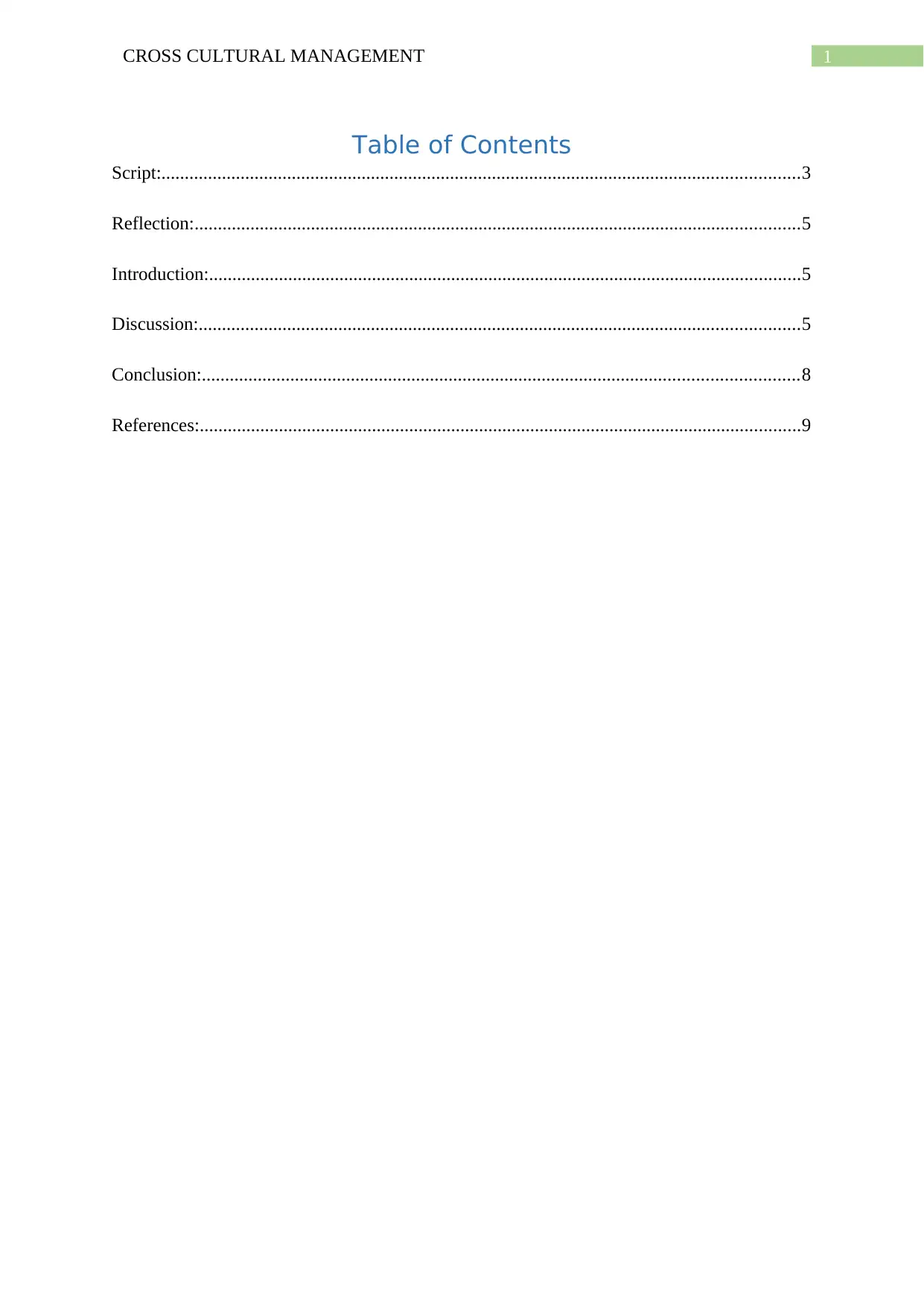
Table of Contents
Script:.........................................................................................................................................3
Reflection:..................................................................................................................................5
Introduction:...............................................................................................................................5
Discussion:.................................................................................................................................5
Conclusion:................................................................................................................................8
References:.................................................................................................................................9
Table of Contents
Script:.........................................................................................................................................3
Reflection:..................................................................................................................................5
Introduction:...............................................................................................................................5
Discussion:.................................................................................................................................5
Conclusion:................................................................................................................................8
References:.................................................................................................................................9
2CROSS CULTURAL MANAGEMENT
Script:
With a detailed focus on the case of Brett Jones and the United States based Hydro
Generation, it is understandable that the main concern for the company is related to the
leadership of the company. Brett Jones was recruited in Tanzania for the management of the
operation phase of a major dam project of the selected company by Graham Steinberg, the
vice president of the US based Hydro Generation. In order to implement the dam project, the
company had the necessity of convincing the local parties and the people regarding the
necessity of the dam and at the same time, they had the requirement of persuading regarding
the excellence of the compensation package that the selected company was providing to
them. As a group project, the organization had the necessity to send expatriates led by Brett
Jones to Tanzania. However, the inappropriate integration of the managerial position holders
was seen to be a major point of concern for the company.
Brett Jones had tremendous challenges in getting integrated with the life styles and
preferences that the western managers of the company had. Brett felt that the company had
the necessity to build a strong rapport with the natives of the region and that influenced the
leader to adopt a general life style and on the other hand, the western leaders and the workers
were seen to isolate themselves from the expatriate ghettos and stayed in capital’s first class
hotels. As a result, the inappropriate acknowledge to the culture and people of Tanzania from
the part of the leaders of the company was a spot of bother in implementing the project in a
professional manner. Other than this, an important concern for the company was the lack of
urgency of the Brett Jones. With a close look at the business practices of Brett Jones, Graham
Steinberg identified that a lot of developmental actions in the Tanzania project was taking
substantially long time. Brett Jones’ poor sense of urgency and the lack of skills to get the job
done in a quick manner was the main concern for the vice president when it comes to the
Script:
With a detailed focus on the case of Brett Jones and the United States based Hydro
Generation, it is understandable that the main concern for the company is related to the
leadership of the company. Brett Jones was recruited in Tanzania for the management of the
operation phase of a major dam project of the selected company by Graham Steinberg, the
vice president of the US based Hydro Generation. In order to implement the dam project, the
company had the necessity of convincing the local parties and the people regarding the
necessity of the dam and at the same time, they had the requirement of persuading regarding
the excellence of the compensation package that the selected company was providing to
them. As a group project, the organization had the necessity to send expatriates led by Brett
Jones to Tanzania. However, the inappropriate integration of the managerial position holders
was seen to be a major point of concern for the company.
Brett Jones had tremendous challenges in getting integrated with the life styles and
preferences that the western managers of the company had. Brett felt that the company had
the necessity to build a strong rapport with the natives of the region and that influenced the
leader to adopt a general life style and on the other hand, the western leaders and the workers
were seen to isolate themselves from the expatriate ghettos and stayed in capital’s first class
hotels. As a result, the inappropriate acknowledge to the culture and people of Tanzania from
the part of the leaders of the company was a spot of bother in implementing the project in a
professional manner. Other than this, an important concern for the company was the lack of
urgency of the Brett Jones. With a close look at the business practices of Brett Jones, Graham
Steinberg identified that a lot of developmental actions in the Tanzania project was taking
substantially long time. Brett Jones’ poor sense of urgency and the lack of skills to get the job
done in a quick manner was the main concern for the vice president when it comes to the
⊘ This is a preview!⊘
Do you want full access?
Subscribe today to unlock all pages.

Trusted by 1+ million students worldwide
3CROSS CULTURAL MANAGEMENT
delivery of the supply, issuance of operating license and the installation of inventory. Apart
from this, two of the business practices of Brett Jones also raised certain eyebrows of Graham
Steinberg.
Brett Jones followed a practice to speed up the business actions and that was handing
out tips in advance. Though it worked like a high power catalyst for getting a number of jobs
done, however, it created a wrong benchmark. The people associated with the project
internally and externally could have also started expecting incentives for even the smaller
services of them and as a result, it could have not only harmed the reputation of the company
but also was on the verge of affecting the financial stability of the company in a negative
manner. Other than this, Brett Jones followed a hiring technique where preferences on the
selection of individuals having strong connection with the heavyweights of the society was
preferred. This was done to ensure that the company gets the clearances in Tanzania on their
project in an efficient manner, however, being a US based company, it violated their promise
of fair work and placed the company towards unethical business activities. Other than this,
the employment relations of the company was seen to be inaccurately managed and was
prominent with the high rate of employee turnover.
Under such situation Graham Steinberg is facing the need of increasing the number of
expatriates to Tanzania, however, the vice president was clueless on their ability to manage
the cultural change in Tanzania and the support of Brett Jones will be sufficient and suitable
or not. From the identified challenges, it is understandable that the main challenge of the
company in executing the project is associated with the leadership. The problems such as
inaccurate integration of the other leaders with the culture of Tanzania, the inaccurate
methods of getting job done, the inappropriate hiring practice, the employee turnover along
with the lack of urgency in Brett Jones, clearly shows the fault of the leadership in managing
them in professional manner. As a result, the enhancement of the cross cultural intelligence of
delivery of the supply, issuance of operating license and the installation of inventory. Apart
from this, two of the business practices of Brett Jones also raised certain eyebrows of Graham
Steinberg.
Brett Jones followed a practice to speed up the business actions and that was handing
out tips in advance. Though it worked like a high power catalyst for getting a number of jobs
done, however, it created a wrong benchmark. The people associated with the project
internally and externally could have also started expecting incentives for even the smaller
services of them and as a result, it could have not only harmed the reputation of the company
but also was on the verge of affecting the financial stability of the company in a negative
manner. Other than this, Brett Jones followed a hiring technique where preferences on the
selection of individuals having strong connection with the heavyweights of the society was
preferred. This was done to ensure that the company gets the clearances in Tanzania on their
project in an efficient manner, however, being a US based company, it violated their promise
of fair work and placed the company towards unethical business activities. Other than this,
the employment relations of the company was seen to be inaccurately managed and was
prominent with the high rate of employee turnover.
Under such situation Graham Steinberg is facing the need of increasing the number of
expatriates to Tanzania, however, the vice president was clueless on their ability to manage
the cultural change in Tanzania and the support of Brett Jones will be sufficient and suitable
or not. From the identified challenges, it is understandable that the main challenge of the
company in executing the project is associated with the leadership. The problems such as
inaccurate integration of the other leaders with the culture of Tanzania, the inaccurate
methods of getting job done, the inappropriate hiring practice, the employee turnover along
with the lack of urgency in Brett Jones, clearly shows the fault of the leadership in managing
them in professional manner. As a result, the enhancement of the cross cultural intelligence of
Paraphrase This Document
Need a fresh take? Get an instant paraphrase of this document with our AI Paraphraser
4CROSS CULTURAL MANAGEMENT
the mangers, enhancement of the sense of urgency in getting job done, professionally
managing the employment relations, managing the hiring practices in an unbiased manner,
developing a justified and appropriate rewards plan are much required interventions for the
improvement of the condition of the organization in implementing the major dam project.
Reflection:
Introduction:
As per the comments of Cottrell (2017), the reflection is regarded as one of the most
suitable form of elaborating the experiences of an event or incident. Reynolds and Vince
(2017), claimed that the reflective practices is considered to be the most cost and time
efficient way of learning as it provides the scope of learning from the experiences of other
individuals. The reflective practices not only provides better understanding of the information
but also it plays a crucial role in understanding the positives and negatives (Baldwin 2016).
As a result, the reflective practices not only delivers the scope of building on the positives but
also plays a massive role in enhancing the ability of the individuals in tackling the negatives
in their future assignments. The study is a reflection of my learning from the practice. In
addition, it also delivers an important understanding regarding the application of the theory to
the identified issues. Other than this, the study informs regarding the positives and the
negatives of the group project as well.
Discussion:
During the group project, we were able to understand the possible challenges that
Hydro Generation faced in Tanzania. From literature sources on the business expansion, we
found that it is considerably important for the companies to develop strong connection with
the local people of the region to ensure improved sustainability of their business expansion.
the mangers, enhancement of the sense of urgency in getting job done, professionally
managing the employment relations, managing the hiring practices in an unbiased manner,
developing a justified and appropriate rewards plan are much required interventions for the
improvement of the condition of the organization in implementing the major dam project.
Reflection:
Introduction:
As per the comments of Cottrell (2017), the reflection is regarded as one of the most
suitable form of elaborating the experiences of an event or incident. Reynolds and Vince
(2017), claimed that the reflective practices is considered to be the most cost and time
efficient way of learning as it provides the scope of learning from the experiences of other
individuals. The reflective practices not only provides better understanding of the information
but also it plays a crucial role in understanding the positives and negatives (Baldwin 2016).
As a result, the reflective practices not only delivers the scope of building on the positives but
also plays a massive role in enhancing the ability of the individuals in tackling the negatives
in their future assignments. The study is a reflection of my learning from the practice. In
addition, it also delivers an important understanding regarding the application of the theory to
the identified issues. Other than this, the study informs regarding the positives and the
negatives of the group project as well.
Discussion:
During the group project, we were able to understand the possible challenges that
Hydro Generation faced in Tanzania. From literature sources on the business expansion, we
found that it is considerably important for the companies to develop strong connection with
the local people of the region to ensure improved sustainability of their business expansion.
5CROSS CULTURAL MANAGEMENT
Along with that, we understood from literature that the necessity of the companies such as
Hydro Generation which has the expertise of managing the projects like the major dam
project in Tanzania, in connecting with the people of the region is considerably high in
comparison to the companies operating in other industries. As the development of a strong
connection of the company with the natives of the region has the possibility of enhancing the
ease of the managers in convincing and avoiding the opposition of the local people in
implementing the major dam project, it was one of the top most priority for the company.
However, with an in depth understanding of the tendency and urge of majority of the western
managers in staying isolated from the local culture, the apathy of the managers in developing
a strong rapport with the natives of the region is pretty prominent. As a result, we understood
that the mentioned challenge is a classic example of the ignorance of the managers towards
the management of the cultural differences or the cultural and social integration. As a result,
we understood that the enhancement of the cross cultural intelligence of the leaders is one of
the important intervention for the success of the company in executing their project.
Other than this, we evaluated various change management models such as Kotter’s
change model or Lewin’s change model and team development theories such as Tuckman’s
model and Belbin’s model (Pollack and Pollack 2015). With a close look at the above
mentioned theories, we understood the importance of the strong sense of urgency for a leader
in managing the organizational change in a professional manner. Having said that, we
observed that Jones who was responsible for the project implementation in Tanzania, was
considerably slow in getting things done and the substantial amount of time consumed for
managing the delivery of supplies, issuance of the license and the installation of the inventory
was clear reflection of the lack of urgency of the leaders of the company. Hence, we
understood that, the enhancement of the sense of urgency of Jones was much required for
increasing the speed of implementing the project. In addition this, the literature search
Along with that, we understood from literature that the necessity of the companies such as
Hydro Generation which has the expertise of managing the projects like the major dam
project in Tanzania, in connecting with the people of the region is considerably high in
comparison to the companies operating in other industries. As the development of a strong
connection of the company with the natives of the region has the possibility of enhancing the
ease of the managers in convincing and avoiding the opposition of the local people in
implementing the major dam project, it was one of the top most priority for the company.
However, with an in depth understanding of the tendency and urge of majority of the western
managers in staying isolated from the local culture, the apathy of the managers in developing
a strong rapport with the natives of the region is pretty prominent. As a result, we understood
that the mentioned challenge is a classic example of the ignorance of the managers towards
the management of the cultural differences or the cultural and social integration. As a result,
we understood that the enhancement of the cross cultural intelligence of the leaders is one of
the important intervention for the success of the company in executing their project.
Other than this, we evaluated various change management models such as Kotter’s
change model or Lewin’s change model and team development theories such as Tuckman’s
model and Belbin’s model (Pollack and Pollack 2015). With a close look at the above
mentioned theories, we understood the importance of the strong sense of urgency for a leader
in managing the organizational change in a professional manner. Having said that, we
observed that Jones who was responsible for the project implementation in Tanzania, was
considerably slow in getting things done and the substantial amount of time consumed for
managing the delivery of supplies, issuance of the license and the installation of the inventory
was clear reflection of the lack of urgency of the leaders of the company. Hence, we
understood that, the enhancement of the sense of urgency of Jones was much required for
increasing the speed of implementing the project. In addition this, the literature search
⊘ This is a preview!⊘
Do you want full access?
Subscribe today to unlock all pages.
Trusted by 1+ million students worldwide
6CROSS CULTURAL MANAGEMENT
enabled us to gain important insights regarding the impact of the speedy management of the
operational activities for implementing a project on the costing of the same. Apart from this,
we evaluated the motivational theories such as Maslow’s hierarchy of needs and Herzberg
two factor theory and that enhanced our knowledge regarding the suitable and appropriate
forms of rewards (Soni and Soni 2016). We understood the necessity of proportionate
rewards for the enhancement of the level of the performances of the employees and we also
understood the significance of financial feasibility associated with the rewards plan. With
such an understanding, we identified the approach of Jones to be not only financially
unfeasible but also capable of damaging the strong reputation and transparent corporate
image of the company. Hence, we came to conclusion that this was a major leadership fault
from the part of Jones and requires necessary intervention. Considering the opinion of other
researchers on the motivational theories, we understood that the company requires to develop
a proportionate and monetarily feasible rewarding plan that aligns with the demands of the
employees for motivating the employees in a suitable and professional manner.
With a close look at the employment legislations of United States and Tanzania, we
thought that the company made a massive mistake with the biased hiring policy and it can
affect the company in a substantial manner with reputational damage as they are violating the
provisions of fair work and also it can increase the scope of the company in receiving
financial penalizations (Iclg.com 2020). Hence, we consulted on the topic and thought that
the compliance of the company with the legislative framework of Tanzania and establishment
of the fair work to be most suitable course of action for the company to get rid of the
situation. Other than this, our evaluation of the literature on the topic of employment relations
enhanced our knowledge regarding the necessity of developing a suitable employee
management policy with the inclusion of appropriate work time and wage characteristics,
enabled us to gain important insights regarding the impact of the speedy management of the
operational activities for implementing a project on the costing of the same. Apart from this,
we evaluated the motivational theories such as Maslow’s hierarchy of needs and Herzberg
two factor theory and that enhanced our knowledge regarding the suitable and appropriate
forms of rewards (Soni and Soni 2016). We understood the necessity of proportionate
rewards for the enhancement of the level of the performances of the employees and we also
understood the significance of financial feasibility associated with the rewards plan. With
such an understanding, we identified the approach of Jones to be not only financially
unfeasible but also capable of damaging the strong reputation and transparent corporate
image of the company. Hence, we came to conclusion that this was a major leadership fault
from the part of Jones and requires necessary intervention. Considering the opinion of other
researchers on the motivational theories, we understood that the company requires to develop
a proportionate and monetarily feasible rewarding plan that aligns with the demands of the
employees for motivating the employees in a suitable and professional manner.
With a close look at the employment legislations of United States and Tanzania, we
thought that the company made a massive mistake with the biased hiring policy and it can
affect the company in a substantial manner with reputational damage as they are violating the
provisions of fair work and also it can increase the scope of the company in receiving
financial penalizations (Iclg.com 2020). Hence, we consulted on the topic and thought that
the compliance of the company with the legislative framework of Tanzania and establishment
of the fair work to be most suitable course of action for the company to get rid of the
situation. Other than this, our evaluation of the literature on the topic of employment relations
enhanced our knowledge regarding the necessity of developing a suitable employee
management policy with the inclusion of appropriate work time and wage characteristics,
Paraphrase This Document
Need a fresh take? Get an instant paraphrase of this document with our AI Paraphraser
7CROSS CULTURAL MANAGEMENT
rewards plan, provision of training and developmental activities, workplace health and safety
for the better management of the company and the execution of the major dam project.
Conclusion:
On a concluding note, I think, we have done well in evaluating the literature as a
team. However, I do think that we faced considerable amount of difficulty in identifying and
assessing the authentic and important information for the evaluation of the condition of the
organization. As a result, we would like to work on the mentioned aspect for ensuring our
better performances in the future assignments.
rewards plan, provision of training and developmental activities, workplace health and safety
for the better management of the company and the execution of the major dam project.
Conclusion:
On a concluding note, I think, we have done well in evaluating the literature as a
team. However, I do think that we faced considerable amount of difficulty in identifying and
assessing the authentic and important information for the evaluation of the condition of the
organization. As a result, we would like to work on the mentioned aspect for ensuring our
better performances in the future assignments.
8CROSS CULTURAL MANAGEMENT
References:
Baldwin, M., 2016. Social work, critical reflection and the learning organization. Routledge.
Cottrell, S., 2017. Critical thinking skills: Effective analysis, argument and reflection.
Macmillan International Higher Education.
Iclg.com 2020. International Comparative Legal Guides International Business Reports.
Employment & Labour Law 2019 | Tanzania | ICLG. [online] Available at:
<https://iclg.com/practice-areas/employment-and-labour-laws-and-regulations/tanzania>
Pollack, J. and Pollack, R., 2015. Using Kotter’s eight stage process to manage an
organisational change program: Presentation and practice. Systemic Practice and Action
Research, 28(1), pp.51-66.
Reynolds, M. and Vince, R., 2017. Organizing reflection: An introduction. In Organizing
reflection (pp. 15-28). Routledge.
Soni, B. and Soni, R., 2016, July. Enhancing Maslow's Hierarchy of Needs for effective
leadership. In Competition Forum (Vol. 14, No. 2, p. 259). American Society for
Competitiveness.
References:
Baldwin, M., 2016. Social work, critical reflection and the learning organization. Routledge.
Cottrell, S., 2017. Critical thinking skills: Effective analysis, argument and reflection.
Macmillan International Higher Education.
Iclg.com 2020. International Comparative Legal Guides International Business Reports.
Employment & Labour Law 2019 | Tanzania | ICLG. [online] Available at:
<https://iclg.com/practice-areas/employment-and-labour-laws-and-regulations/tanzania>
Pollack, J. and Pollack, R., 2015. Using Kotter’s eight stage process to manage an
organisational change program: Presentation and practice. Systemic Practice and Action
Research, 28(1), pp.51-66.
Reynolds, M. and Vince, R., 2017. Organizing reflection: An introduction. In Organizing
reflection (pp. 15-28). Routledge.
Soni, B. and Soni, R., 2016, July. Enhancing Maslow's Hierarchy of Needs for effective
leadership. In Competition Forum (Vol. 14, No. 2, p. 259). American Society for
Competitiveness.
⊘ This is a preview!⊘
Do you want full access?
Subscribe today to unlock all pages.
Trusted by 1+ million students worldwide

1 out of 9


Related Documents


Your All-in-One AI-Powered Toolkit for Academic Success.
+13062052269
info@desklib.com
Available 24*7 on WhatsApp / Email
![[object Object]](/_next/static/media/star-bottom.7253800d.svg)
Unlock your academic potential
Copyright © 2020–2026 A2Z Services. All Rights Reserved. Developed and managed by ZUCOL.