Cultural Safety in Healthcare for Aboriginal Australians: Report
VerifiedAdded on 2020/04/15
|12
|2279
|36
Report
AI Summary
This report delves into the critical aspects of Aboriginal cultural safety within the context of healthcare, examining the impacts of historical and ongoing discrimination, the importance of traditional laws, kinship systems, and Aboriginal languages. It addresses the devastating effects of European settlement and the persistent challenges of racial vilification on Aboriginal communities' health and wellbeing, including inequitable access to healthcare and the influence of socio-economic and political power dynamics. The report identifies key factors affecting health outcomes, such as discrimination, health behaviors, and health literacy, while also analyzing the impact of trauma on decision-making, communication, understanding, and information retention. It proposes strategies for patient-centered care, the involvement of aged community members, and effective communication, including addressing linguistic barriers and ensuring cultural safety. Finally, it outlines strategies for professional partnerships and lists valuable resources for promoting cultural safety in healthcare settings, such as the Aboriginal Cultural Heritage Act 2003.
Running head: ABORIGINAL CULTURAL SAFETY
Aboriginal cultural safety
Name of the student:
Name of the university:
Author note:
Aboriginal cultural safety
Name of the student:
Name of the university:
Author note:

Paraphrase This Document
Need a fresh take? Get an instant paraphrase of this document with our AI Paraphraser
1ABORIGINAL CULTURAL SAFETY
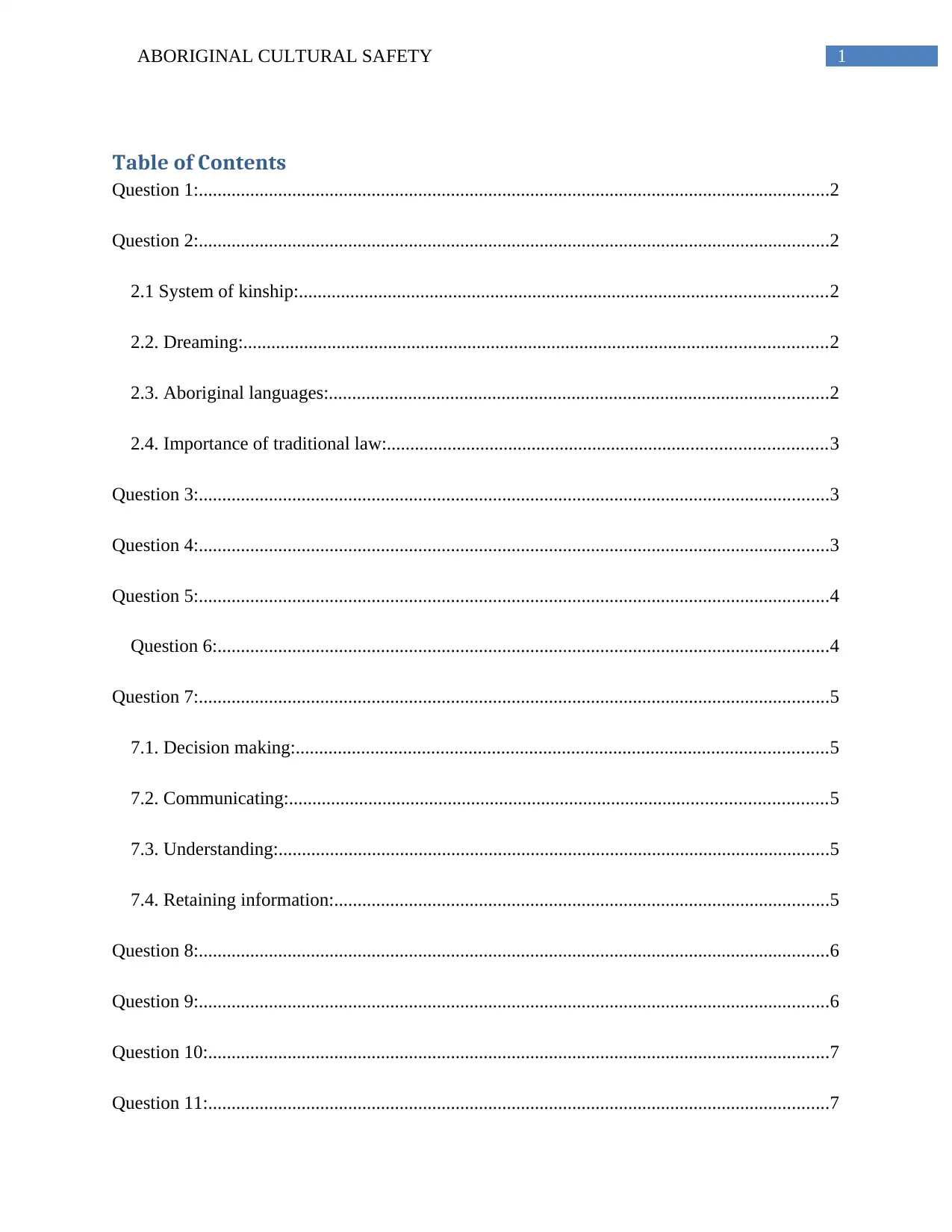
Table of Contents
Question 1:.......................................................................................................................................2
Question 2:.......................................................................................................................................2
2.1 System of kinship:.................................................................................................................2
2.2. Dreaming:.............................................................................................................................2
2.3. Aboriginal languages:...........................................................................................................2
2.4. Importance of traditional law:..............................................................................................3
Question 3:.......................................................................................................................................3
Question 4:.......................................................................................................................................3
Question 5:.......................................................................................................................................4
Question 6:...................................................................................................................................4
Question 7:.......................................................................................................................................5
7.1. Decision making:..................................................................................................................5
7.2. Communicating:...................................................................................................................5
7.3. Understanding:......................................................................................................................5
7.4. Retaining information:..........................................................................................................5
Question 8:.......................................................................................................................................6
Question 9:.......................................................................................................................................6
Question 10:.....................................................................................................................................7
Question 11:.....................................................................................................................................7
Table of Contents
Question 1:.......................................................................................................................................2
Question 2:.......................................................................................................................................2
2.1 System of kinship:.................................................................................................................2
2.2. Dreaming:.............................................................................................................................2
2.3. Aboriginal languages:...........................................................................................................2
2.4. Importance of traditional law:..............................................................................................3
Question 3:.......................................................................................................................................3
Question 4:.......................................................................................................................................3
Question 5:.......................................................................................................................................4
Question 6:...................................................................................................................................4
Question 7:.......................................................................................................................................5
7.1. Decision making:..................................................................................................................5
7.2. Communicating:...................................................................................................................5
7.3. Understanding:......................................................................................................................5
7.4. Retaining information:..........................................................................................................5
Question 8:.......................................................................................................................................6
Question 9:.......................................................................................................................................6
Question 10:.....................................................................................................................................7
Question 11:.....................................................................................................................................7
2ABORIGINAL CULTURAL SAFETY
Question 12:.....................................................................................................................................7
Question 13:.....................................................................................................................................8
Question 14:.....................................................................................................................................8
References:......................................................................................................................................9
Question 12:.....................................................................................................................................7
Question 13:.....................................................................................................................................8
Question 14:.....................................................................................................................................8
References:......................................................................................................................................9
⊘ This is a preview!⊘
Do you want full access?
Subscribe today to unlock all pages.

Trusted by 1+ million students worldwide
3ABORIGINAL CULTURAL SAFETY
Question 1:
The legislative piece of framework that applies to the concern of cultural safety for the
aboriginals and the Torres state islanders can be the Aboriginal Cultural Heritage Act 2003. The
primary objective of this act has been to establish a legal or statutory duty of care for each and
every citizen to respect, value, and protect the cultural heritage of the aboriginals. This act
ensures cultural safety restored and maintained at all costs by facilitating prosecution and
considerable fines in case anyone does not comply with the legal requirements of respecting and
restoring the cultural heritage of the aboriginals (Freeman et al. 2014).
Question 2:
2.1 System of kinship:
The system of kinship can be defined as the social organization and family relationship in
the aboriginal culture all over the central states of Australia. This is a complex social
organization system that determines the organization of the roles, responsibilities, and
obligations of the aboriginals to the rest of the community concerning to ceremonial business and
land related issues (Freeman et al. 2014).
2.2. Dreaming:
Dreaming is a term used by the aboriginals in order to describe the spiritual connections
that they bear with their ancestors, along with the natural and moral element of the world.
2.3. Aboriginal languages:
In the 18th century, there have been more than 250 aboriginal social groupings reported
and there have been a linguistic diversity in the aboriginal culture in accordance with it. In the
Question 1:
The legislative piece of framework that applies to the concern of cultural safety for the
aboriginals and the Torres state islanders can be the Aboriginal Cultural Heritage Act 2003. The
primary objective of this act has been to establish a legal or statutory duty of care for each and
every citizen to respect, value, and protect the cultural heritage of the aboriginals. This act
ensures cultural safety restored and maintained at all costs by facilitating prosecution and
considerable fines in case anyone does not comply with the legal requirements of respecting and
restoring the cultural heritage of the aboriginals (Freeman et al. 2014).
Question 2:
2.1 System of kinship:
The system of kinship can be defined as the social organization and family relationship in
the aboriginal culture all over the central states of Australia. This is a complex social
organization system that determines the organization of the roles, responsibilities, and
obligations of the aboriginals to the rest of the community concerning to ceremonial business and
land related issues (Freeman et al. 2014).
2.2. Dreaming:
Dreaming is a term used by the aboriginals in order to describe the spiritual connections
that they bear with their ancestors, along with the natural and moral element of the world.
2.3. Aboriginal languages:
In the 18th century, there have been more than 250 aboriginal social groupings reported
and there have been a linguistic diversity in the aboriginal culture in accordance with it. In the
Paraphrase This Document
Need a fresh take? Get an instant paraphrase of this document with our AI Paraphraser
4ABORIGINAL CULTURAL SAFETY
current age, 150 aboriginal languages are still in use and 137 among them are still being
reportedly transferred across generations (Freeman et al. 2014).
2.4. Importance of traditional law:
The traditional laws within the aboriginal communities are very distinct from the general
Australian national laws and they hold extreme importance to the aboriginals in respect of social
or community issues, land related conflict, or interpersonal issues.
Question 3:
European settlement on the aboriginal lands had a devastating effect on the wellbeing of
the aboriginal communities. The dispossession of their lands affected the communities by the
means of exposure to communicable disease outbreaks, violent conflict, and bloodshed which
inevitably led to a vast number of deaths from the aboriginal communities (Altman and Hinkson
2010).
Question 4:
The aboriginal communities continue to face extreme racial vilification even in the
current age, and the impact of the discrimination is manifested across different social and
personal sectors of human life. For instance, the aboriginals encounter inequitable and reduced
access to health care, unequal exposure to various health adversity risk factors, elevated stress
levels and impaired cognitive health, and social rejection and withdrawal (Smye, Josewski and
Kendall 2010).
current age, 150 aboriginal languages are still in use and 137 among them are still being
reportedly transferred across generations (Freeman et al. 2014).
2.4. Importance of traditional law:
The traditional laws within the aboriginal communities are very distinct from the general
Australian national laws and they hold extreme importance to the aboriginals in respect of social
or community issues, land related conflict, or interpersonal issues.
Question 3:
European settlement on the aboriginal lands had a devastating effect on the wellbeing of
the aboriginal communities. The dispossession of their lands affected the communities by the
means of exposure to communicable disease outbreaks, violent conflict, and bloodshed which
inevitably led to a vast number of deaths from the aboriginal communities (Altman and Hinkson
2010).
Question 4:
The aboriginal communities continue to face extreme racial vilification even in the
current age, and the impact of the discrimination is manifested across different social and
personal sectors of human life. For instance, the aboriginals encounter inequitable and reduced
access to health care, unequal exposure to various health adversity risk factors, elevated stress
levels and impaired cognitive health, and social rejection and withdrawal (Smye, Josewski and
Kendall 2010).
5ABORIGINAL CULTURAL SAFETY
Question 5:
The socio-economic and political power relationship and power gradient have been
developing in the aboriginal communities and society since the early phases of colonization and
is still continuing even after 40 years of empowerment and recognition of the aboriginal
communities. There is a distinct emphasis of political power and association in the aboriginal
communities to form the social gradients and as a result there has been a significant
manifestation of a gradient pattern in the socio-economic status of the aboriginals in terms of
social acceptance and privileges (Herring et al. 2013).
Question 6:
The three factors that affect the health and wellbeing of the aboriginals and Torres Strait
islanders can be the discrimination, predominant health behavior and the lack of health literacy.
For instance, the discrimination on the basis of ethnicity, cultural background, race and socio-
economic status affects the health outcomes of the aboriginals drastically by the means of
lifestyle standards and income patterns. Along with that the discrimination often propels the
aboriginals within the poverty levels as they are not allowed the most of social benefits.
Although, the predominant health behaviors in aboriginals is also a key concern in terms of
health risk factors. For instance smoking and inclination towards spiritual healing and sedentary
lifestyle can be considered influential risk factors for coronary heart diseases and diabetes in the
aboriginals, however the impact of these factors are minimal in respect to discrimination.
Although the impact of lack of health literacy imparts a significant detrimental effect on the
health and well being of the aboriginals in terms of communicable outbreaks and other related
health adversities. Therefore, all the three mentioned factors impart a disproportionate effect on
Question 5:
The socio-economic and political power relationship and power gradient have been
developing in the aboriginal communities and society since the early phases of colonization and
is still continuing even after 40 years of empowerment and recognition of the aboriginal
communities. There is a distinct emphasis of political power and association in the aboriginal
communities to form the social gradients and as a result there has been a significant
manifestation of a gradient pattern in the socio-economic status of the aboriginals in terms of
social acceptance and privileges (Herring et al. 2013).
Question 6:
The three factors that affect the health and wellbeing of the aboriginals and Torres Strait
islanders can be the discrimination, predominant health behavior and the lack of health literacy.
For instance, the discrimination on the basis of ethnicity, cultural background, race and socio-
economic status affects the health outcomes of the aboriginals drastically by the means of
lifestyle standards and income patterns. Along with that the discrimination often propels the
aboriginals within the poverty levels as they are not allowed the most of social benefits.
Although, the predominant health behaviors in aboriginals is also a key concern in terms of
health risk factors. For instance smoking and inclination towards spiritual healing and sedentary
lifestyle can be considered influential risk factors for coronary heart diseases and diabetes in the
aboriginals, however the impact of these factors are minimal in respect to discrimination.
Although the impact of lack of health literacy imparts a significant detrimental effect on the
health and well being of the aboriginals in terms of communicable outbreaks and other related
health adversities. Therefore, all the three mentioned factors impart a disproportionate effect on
⊘ This is a preview!⊘
Do you want full access?
Subscribe today to unlock all pages.
Trusted by 1+ million students worldwide
6ABORIGINAL CULTURAL SAFETY
the health outcomes of the aboriginals, discrimination with the highest, lack of health literacy
with intermediate and health behavior with minimal impact (Williamson and Harrison 2010).
Question 7:
7.1. Decision making:
Trauma can significantly affect the decision making power of an individual by
considerable pattern by affecting the reasonable and critical analytical thinking capability of an
individual. A traumatized person might not interpret the severity of the situation correctly and
will inevitably end up making wrong decisions and judgments (Taylor and Guerin 2010).
7.2. Communicating:
The impact of trauma is exponential on the communication skills of the individuals as
well. Trauma often affects the cognitive health and wellbeing of the victim and the resultant lack
of self esteem and confidence might affect the communicational prowess of the individual.
7.3. Understanding:
Trauma often affects the understanding power of the victim as well, it has to be
understood that the cognitive health and wellbeing of the individuals exponentially. Although the
impact on the cognitive abilities depends on the severity of the trauma, however, depression,
paranoia and anxiety often clouds the understanding abilities of trauma victims (Smye, Josewski
and Kendall 2010).
7.4. Retaining information:
As mentioned above the impact of trauma is exponential on the cognitive abilities, and as
a result the memorizing and retention power of the individuals. It has to be understood that the
the health outcomes of the aboriginals, discrimination with the highest, lack of health literacy
with intermediate and health behavior with minimal impact (Williamson and Harrison 2010).
Question 7:
7.1. Decision making:
Trauma can significantly affect the decision making power of an individual by
considerable pattern by affecting the reasonable and critical analytical thinking capability of an
individual. A traumatized person might not interpret the severity of the situation correctly and
will inevitably end up making wrong decisions and judgments (Taylor and Guerin 2010).
7.2. Communicating:
The impact of trauma is exponential on the communication skills of the individuals as
well. Trauma often affects the cognitive health and wellbeing of the victim and the resultant lack
of self esteem and confidence might affect the communicational prowess of the individual.
7.3. Understanding:
Trauma often affects the understanding power of the victim as well, it has to be
understood that the cognitive health and wellbeing of the individuals exponentially. Although the
impact on the cognitive abilities depends on the severity of the trauma, however, depression,
paranoia and anxiety often clouds the understanding abilities of trauma victims (Smye, Josewski
and Kendall 2010).
7.4. Retaining information:
As mentioned above the impact of trauma is exponential on the cognitive abilities, and as
a result the memorizing and retention power of the individuals. It has to be understood that the
Paraphrase This Document
Need a fresh take? Get an instant paraphrase of this document with our AI Paraphraser
7ABORIGINAL CULTURAL SAFETY
trauma victims are often depressed, anxious and live through a constant state of fear and
paranoia, and hence forgetfulness is a common and somewhat inevitable consequence (Rigby et
al. 2011).
Question 8:
Patient centered care is the core structural element under which the patents get the ability
to voice their own preferences and grievances when it comes to health care planning and
delivery. One way to ensure the aboriginals to participate in the care planning procedure is to
develop a mutually respectful therapeutic relationship with the patients so that they feel
comfortable to voice their opinion in the care planning context. Another very beneficial
technique is to employ a cultural liaison executive or linguistic assistance s that communication
can be simplified between the patients and the care professionals. Lastly, aboriginals feel dearly
for the traditional healing culture, incorporating traditional healing techniques in the care
planning will not only facilitate cultural safety but also will ensure involvement from the patient
(Rigby et al. 2011).
Question 9:
The aged members of the aboriginal communities play a pivotal role in the upbringing of
their grandchildren o great grandchildren. As they are emotionally connected to their
grandchildren and are extremely dependent on their company, the distance from them in the
health care facility can facilitate agitation, depression, anxiety and non-cooperation in the patient
which will hinder the care planning and delivery (Kildea et al. 2010).
trauma victims are often depressed, anxious and live through a constant state of fear and
paranoia, and hence forgetfulness is a common and somewhat inevitable consequence (Rigby et
al. 2011).
Question 8:
Patient centered care is the core structural element under which the patents get the ability
to voice their own preferences and grievances when it comes to health care planning and
delivery. One way to ensure the aboriginals to participate in the care planning procedure is to
develop a mutually respectful therapeutic relationship with the patients so that they feel
comfortable to voice their opinion in the care planning context. Another very beneficial
technique is to employ a cultural liaison executive or linguistic assistance s that communication
can be simplified between the patients and the care professionals. Lastly, aboriginals feel dearly
for the traditional healing culture, incorporating traditional healing techniques in the care
planning will not only facilitate cultural safety but also will ensure involvement from the patient
(Rigby et al. 2011).
Question 9:
The aged members of the aboriginal communities play a pivotal role in the upbringing of
their grandchildren o great grandchildren. As they are emotionally connected to their
grandchildren and are extremely dependent on their company, the distance from them in the
health care facility can facilitate agitation, depression, anxiety and non-cooperation in the patient
which will hinder the care planning and delivery (Kildea et al. 2010).
8ABORIGINAL CULTURAL SAFETY
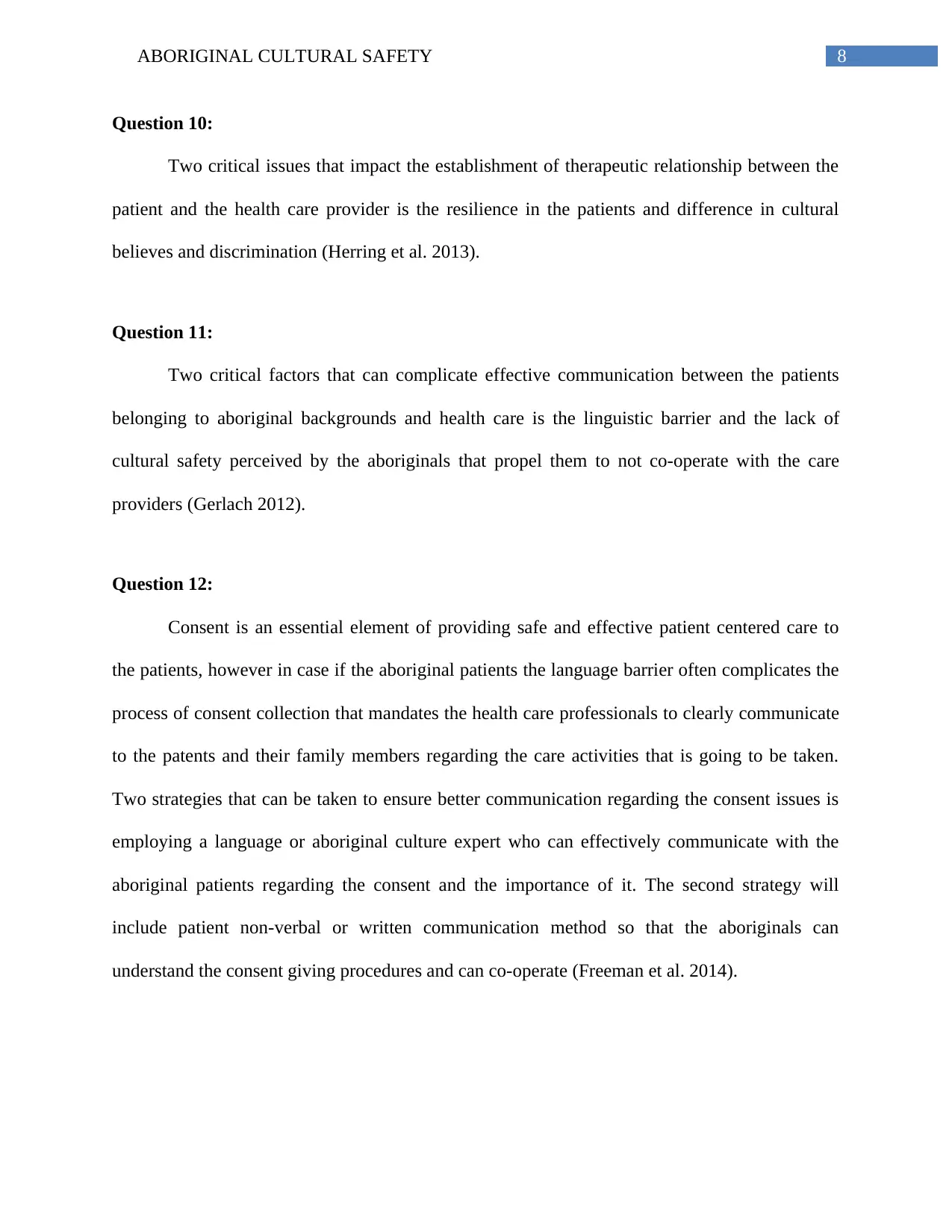
Question 10:
Two critical issues that impact the establishment of therapeutic relationship between the
patient and the health care provider is the resilience in the patients and difference in cultural
believes and discrimination (Herring et al. 2013).
Question 11:
Two critical factors that can complicate effective communication between the patients
belonging to aboriginal backgrounds and health care is the linguistic barrier and the lack of
cultural safety perceived by the aboriginals that propel them to not co-operate with the care
providers (Gerlach 2012).
Question 12:
Consent is an essential element of providing safe and effective patient centered care to
the patients, however in case if the aboriginal patients the language barrier often complicates the
process of consent collection that mandates the health care professionals to clearly communicate
to the patents and their family members regarding the care activities that is going to be taken.
Two strategies that can be taken to ensure better communication regarding the consent issues is
employing a language or aboriginal culture expert who can effectively communicate with the
aboriginal patients regarding the consent and the importance of it. The second strategy will
include patient non-verbal or written communication method so that the aboriginals can
understand the consent giving procedures and can co-operate (Freeman et al. 2014).
Question 10:
Two critical issues that impact the establishment of therapeutic relationship between the
patient and the health care provider is the resilience in the patients and difference in cultural
believes and discrimination (Herring et al. 2013).
Question 11:
Two critical factors that can complicate effective communication between the patients
belonging to aboriginal backgrounds and health care is the linguistic barrier and the lack of
cultural safety perceived by the aboriginals that propel them to not co-operate with the care
providers (Gerlach 2012).
Question 12:
Consent is an essential element of providing safe and effective patient centered care to
the patients, however in case if the aboriginal patients the language barrier often complicates the
process of consent collection that mandates the health care professionals to clearly communicate
to the patents and their family members regarding the care activities that is going to be taken.
Two strategies that can be taken to ensure better communication regarding the consent issues is
employing a language or aboriginal culture expert who can effectively communicate with the
aboriginal patients regarding the consent and the importance of it. The second strategy will
include patient non-verbal or written communication method so that the aboriginals can
understand the consent giving procedures and can co-operate (Freeman et al. 2014).
⊘ This is a preview!⊘
Do you want full access?
Subscribe today to unlock all pages.
Trusted by 1+ million students worldwide
9ABORIGINAL CULTURAL SAFETY
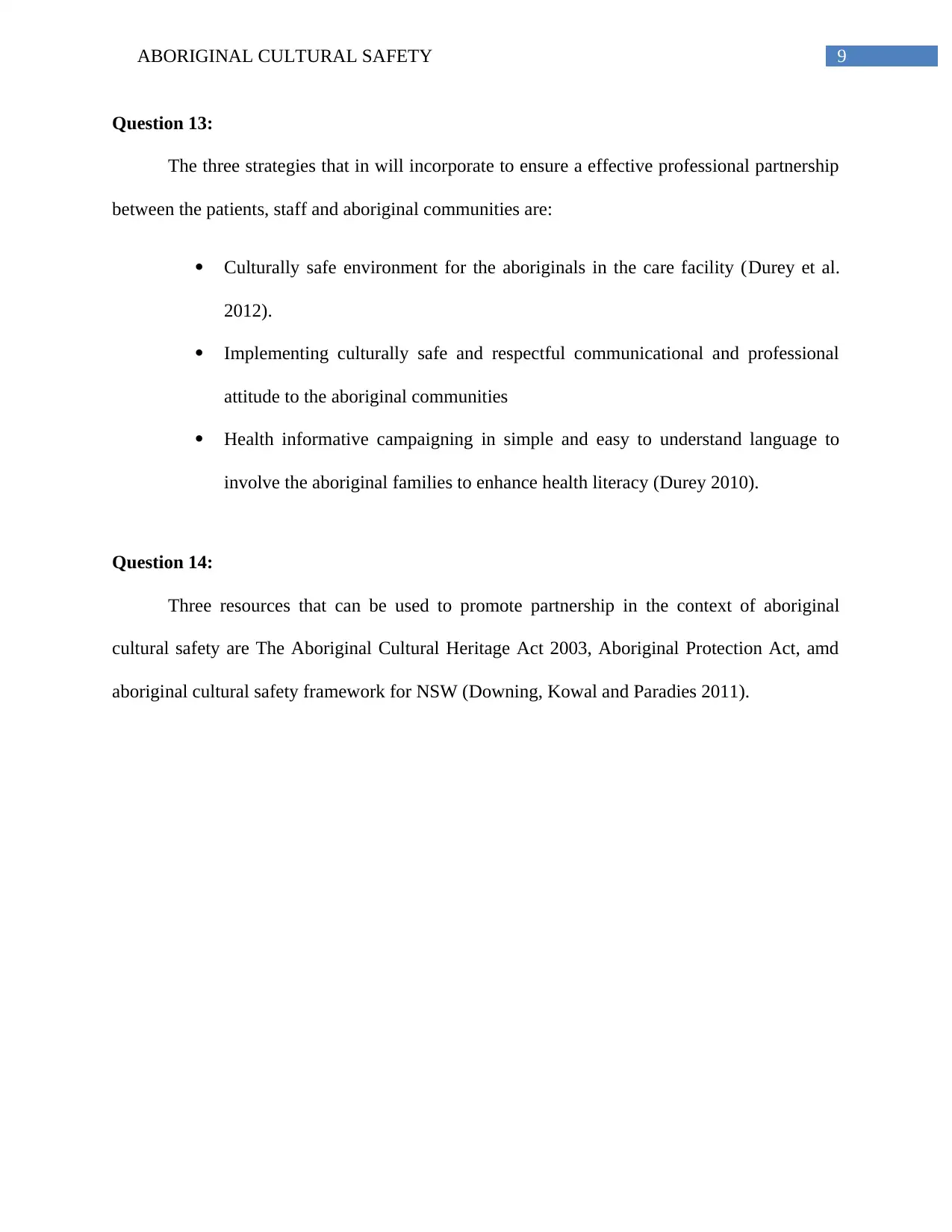
Question 13:
The three strategies that in will incorporate to ensure a effective professional partnership
between the patients, staff and aboriginal communities are:
Culturally safe environment for the aboriginals in the care facility (Durey et al.
2012).
Implementing culturally safe and respectful communicational and professional
attitude to the aboriginal communities
Health informative campaigning in simple and easy to understand language to
involve the aboriginal families to enhance health literacy (Durey 2010).
Question 14:
Three resources that can be used to promote partnership in the context of aboriginal
cultural safety are The Aboriginal Cultural Heritage Act 2003, Aboriginal Protection Act, amd
aboriginal cultural safety framework for NSW (Downing, Kowal and Paradies 2011).
Question 13:
The three strategies that in will incorporate to ensure a effective professional partnership
between the patients, staff and aboriginal communities are:
Culturally safe environment for the aboriginals in the care facility (Durey et al.
2012).
Implementing culturally safe and respectful communicational and professional
attitude to the aboriginal communities
Health informative campaigning in simple and easy to understand language to
involve the aboriginal families to enhance health literacy (Durey 2010).
Question 14:
Three resources that can be used to promote partnership in the context of aboriginal
cultural safety are The Aboriginal Cultural Heritage Act 2003, Aboriginal Protection Act, amd
aboriginal cultural safety framework for NSW (Downing, Kowal and Paradies 2011).
Paraphrase This Document
Need a fresh take? Get an instant paraphrase of this document with our AI Paraphraser
10ABORIGINAL CULTURAL SAFETY
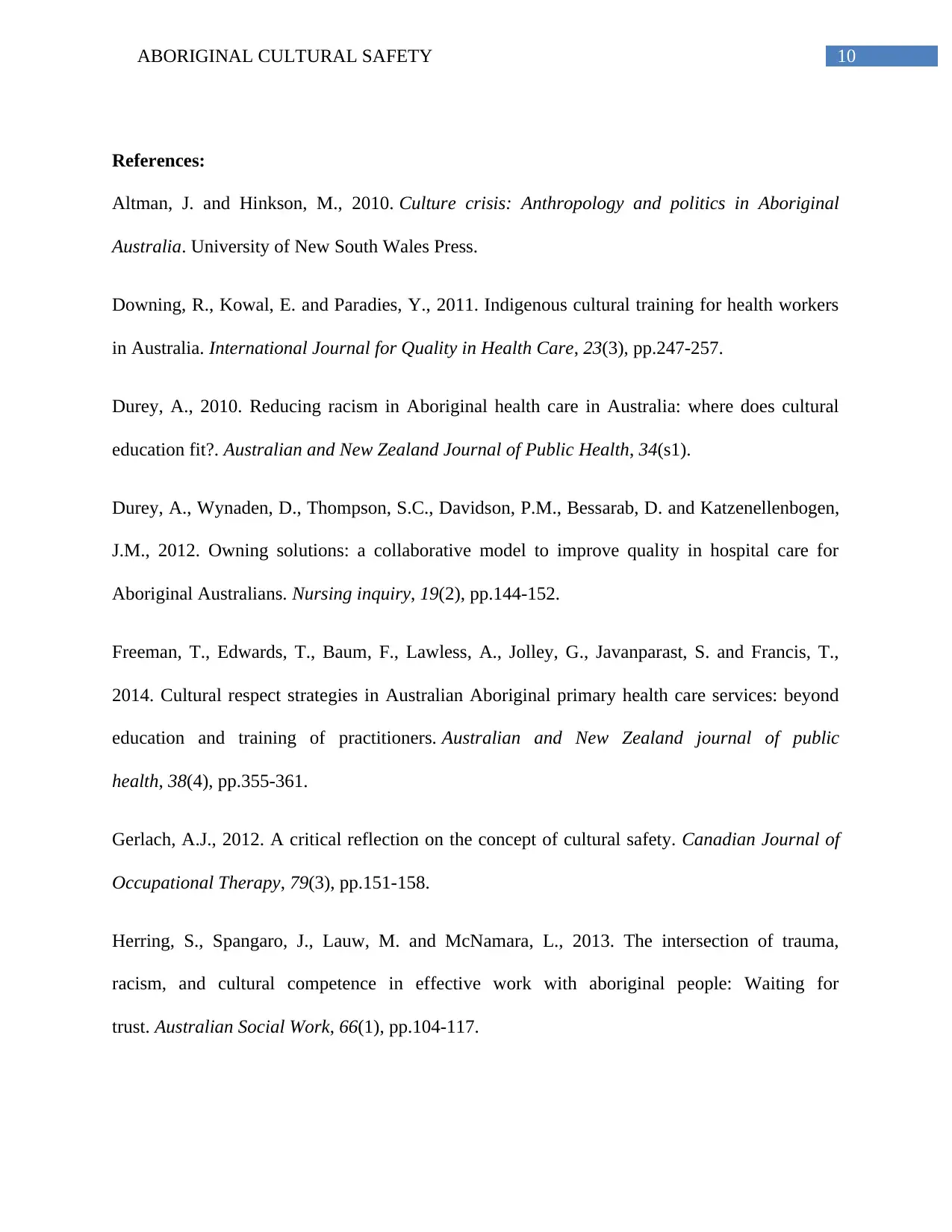
References:
Altman, J. and Hinkson, M., 2010. Culture crisis: Anthropology and politics in Aboriginal
Australia. University of New South Wales Press.
Downing, R., Kowal, E. and Paradies, Y., 2011. Indigenous cultural training for health workers
in Australia. International Journal for Quality in Health Care, 23(3), pp.247-257.
Durey, A., 2010. Reducing racism in Aboriginal health care in Australia: where does cultural
education fit?. Australian and New Zealand Journal of Public Health, 34(s1).
Durey, A., Wynaden, D., Thompson, S.C., Davidson, P.M., Bessarab, D. and Katzenellenbogen,
J.M., 2012. Owning solutions: a collaborative model to improve quality in hospital care for
Aboriginal Australians. Nursing inquiry, 19(2), pp.144-152.
Freeman, T., Edwards, T., Baum, F., Lawless, A., Jolley, G., Javanparast, S. and Francis, T.,
2014. Cultural respect strategies in Australian Aboriginal primary health care services: beyond
education and training of practitioners. Australian and New Zealand journal of public
health, 38(4), pp.355-361.
Gerlach, A.J., 2012. A critical reflection on the concept of cultural safety. Canadian Journal of
Occupational Therapy, 79(3), pp.151-158.
Herring, S., Spangaro, J., Lauw, M. and McNamara, L., 2013. The intersection of trauma,
racism, and cultural competence in effective work with aboriginal people: Waiting for
trust. Australian Social Work, 66(1), pp.104-117.
References:
Altman, J. and Hinkson, M., 2010. Culture crisis: Anthropology and politics in Aboriginal
Australia. University of New South Wales Press.
Downing, R., Kowal, E. and Paradies, Y., 2011. Indigenous cultural training for health workers
in Australia. International Journal for Quality in Health Care, 23(3), pp.247-257.
Durey, A., 2010. Reducing racism in Aboriginal health care in Australia: where does cultural
education fit?. Australian and New Zealand Journal of Public Health, 34(s1).
Durey, A., Wynaden, D., Thompson, S.C., Davidson, P.M., Bessarab, D. and Katzenellenbogen,
J.M., 2012. Owning solutions: a collaborative model to improve quality in hospital care for
Aboriginal Australians. Nursing inquiry, 19(2), pp.144-152.
Freeman, T., Edwards, T., Baum, F., Lawless, A., Jolley, G., Javanparast, S. and Francis, T.,
2014. Cultural respect strategies in Australian Aboriginal primary health care services: beyond
education and training of practitioners. Australian and New Zealand journal of public
health, 38(4), pp.355-361.
Gerlach, A.J., 2012. A critical reflection on the concept of cultural safety. Canadian Journal of
Occupational Therapy, 79(3), pp.151-158.
Herring, S., Spangaro, J., Lauw, M. and McNamara, L., 2013. The intersection of trauma,
racism, and cultural competence in effective work with aboriginal people: Waiting for
trust. Australian Social Work, 66(1), pp.104-117.
11ABORIGINAL CULTURAL SAFETY
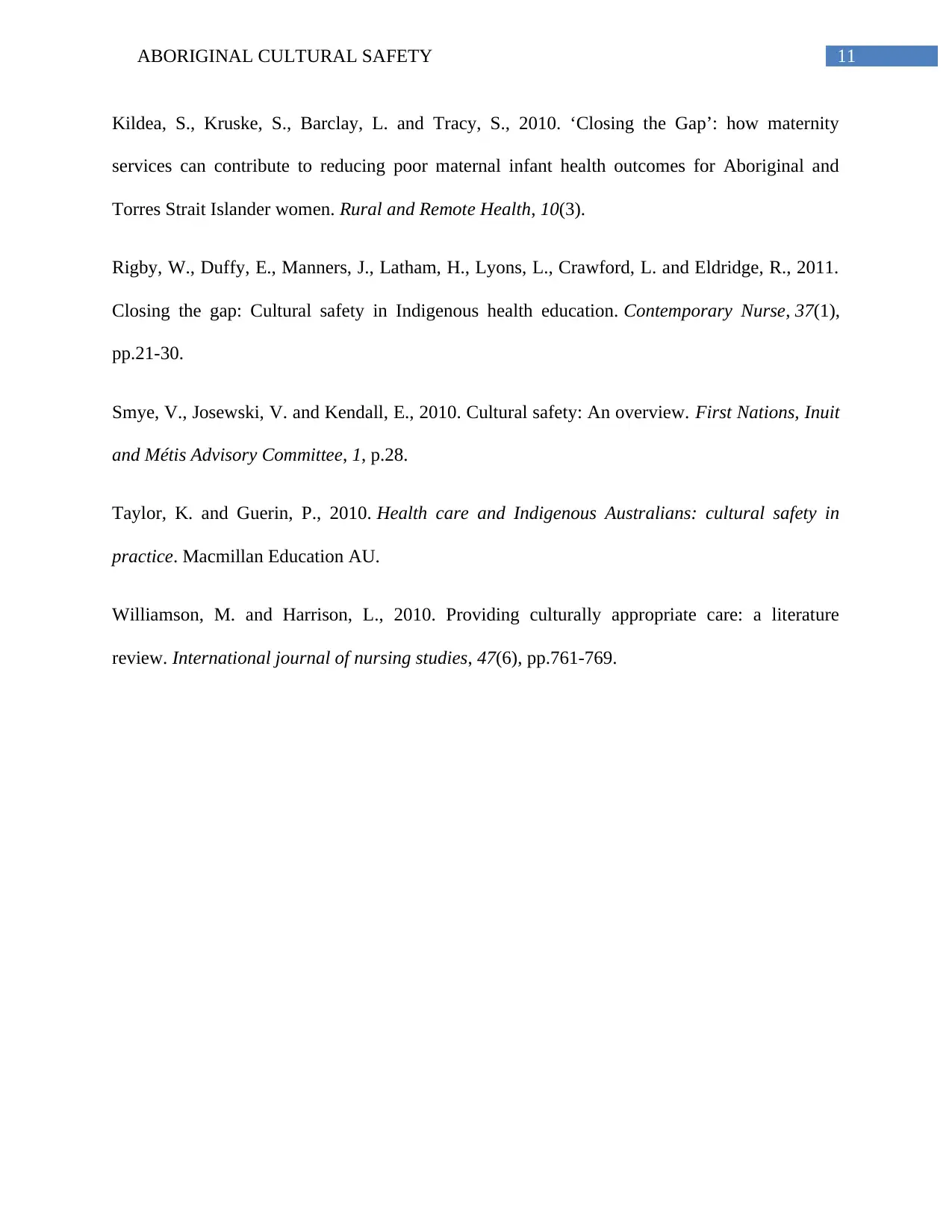
Kildea, S., Kruske, S., Barclay, L. and Tracy, S., 2010. ‘Closing the Gap’: how maternity
services can contribute to reducing poor maternal infant health outcomes for Aboriginal and
Torres Strait Islander women. Rural and Remote Health, 10(3).
Rigby, W., Duffy, E., Manners, J., Latham, H., Lyons, L., Crawford, L. and Eldridge, R., 2011.
Closing the gap: Cultural safety in Indigenous health education. Contemporary Nurse, 37(1),
pp.21-30.
Smye, V., Josewski, V. and Kendall, E., 2010. Cultural safety: An overview. First Nations, Inuit
and Métis Advisory Committee, 1, p.28.
Taylor, K. and Guerin, P., 2010. Health care and Indigenous Australians: cultural safety in
practice. Macmillan Education AU.
Williamson, M. and Harrison, L., 2010. Providing culturally appropriate care: a literature
review. International journal of nursing studies, 47(6), pp.761-769.
Kildea, S., Kruske, S., Barclay, L. and Tracy, S., 2010. ‘Closing the Gap’: how maternity
services can contribute to reducing poor maternal infant health outcomes for Aboriginal and
Torres Strait Islander women. Rural and Remote Health, 10(3).
Rigby, W., Duffy, E., Manners, J., Latham, H., Lyons, L., Crawford, L. and Eldridge, R., 2011.
Closing the gap: Cultural safety in Indigenous health education. Contemporary Nurse, 37(1),
pp.21-30.
Smye, V., Josewski, V. and Kendall, E., 2010. Cultural safety: An overview. First Nations, Inuit
and Métis Advisory Committee, 1, p.28.
Taylor, K. and Guerin, P., 2010. Health care and Indigenous Australians: cultural safety in
practice. Macmillan Education AU.
Williamson, M. and Harrison, L., 2010. Providing culturally appropriate care: a literature
review. International journal of nursing studies, 47(6), pp.761-769.
⊘ This is a preview!⊘
Do you want full access?
Subscribe today to unlock all pages.
Trusted by 1+ million students worldwide

1 out of 12


Related Documents


Your All-in-One AI-Powered Toolkit for Academic Success.
+13062052269
info@desklib.com
Available 24*7 on WhatsApp / Email
![[object Object]](/_next/static/media/star-bottom.7253800d.svg)
Unlock your academic potential
Copyright © 2020–2026 A2Z Services. All Rights Reserved. Developed and managed by ZUCOL.