Implementing Cultural Safety in Nursing: Action Plan Report

Verified

Added on  2023/02/01

|9
|2272
|83
Report
AI Summary
This report presents a personal action plan developed by a nursing student to implement the principles of cultural safety in their practice. The plan focuses on enhancing health literacy and understanding the cultural nuances of the patient population, particularly Indigenous communities. It outlines specific goals, such as improving communication and incorporating cultural beliefs into healthcare services. The report details objectives, including identifying relevant cultural safety principles and understanding the local language and culture. It also identifies necessary resources like cultural safety training modules, interpreters, and language trainers. The plan anticipates challenges, such as language barriers and cultural differences within subgroups, and proposes strategies to overcome these, like hiring personal trainers and fostering partnerships within the community. The report further justifies the need for the plan, emphasizing its importance in providing quality care and avoiding cultural insensitivity. It details implementation strategies, including building relationships with community healthcare workers and recruiting language translators, and concludes with a monitoring and evaluation plan, including weekly tests and a cultural safety evaluation panel to assess progress and impact on patient outcomes. The report is based on the course HSC230 Cultural Safety in Healthcare and includes a detailed literature review.
Document Page
Running head: HEALTH LITERACY 1
HEALTH LITERACY
Name of Student
Institution Affiliation
tabler-icon-diamond-filled.svg

Paraphrase This Document

Need a fresh take? Get an instant paraphrase of this document with our AI Paraphraser
Document Page
HEALTH LITERACY PAGE2
Introduction
Health literacy is very crucial in providing quality healthcare to patients globally.
Health literacy goes further than the ability to read and understand health and disease
but also encompasses cultural and conceptual knowledge of the environment in which
a health practitioner is working (Singleton & Krause, 2009). Cultural literacy can be
described as the ability to recognize and use general beliefs, customs, world-view, and
social identity to interpret and act on the information to provide better healthcare
(Muise, 2018). Any healthcare worker needs to understand the culture of the people
that they are serving as well as understand their language. This helps in ensuring that
the community being served feels that their culture is being respected. It also helps a
nurse understand the health challenges that people are facing and hence make it easy
to solve the challenges (Gerlach, 2012). This report prepares a personal action plan on
how a nurse should implement the principles of cultural safety in the work
environment. The second section is a justification for the personal action plan. It
discusses the significance of the plan, how the plan will be implemented as well as the
resources required to implement the plan.
Part One
Goals
The goal of this plan is to identify techniques and methods that I will use working
as a nurse to implement the basic principles of cultural safety.
Objectives
Identify the principles of cultural safety that are relevant in the nursing
profession.
To help understand the language of the local people
Document Page
HEALTH LITERACY PAGE2
To help understand the culture of the people to offer them higher quality
healthcare services which incorporate their cultural believes and practices.
To create an opportunity for patients to provide feedback.
Ensure that all health information and data is at the relevant level of health
literacy.
Resources or additional training required
As a nurse working among the Aboriginal and Torrents, I need a variety of
resources which will help me understand the language and culture of the people. One
of the primary resources required is cultural safety training module (Durey, 2010).
This will guide may on the important and relevant aspects that I need to learn about
the culture and language of the local community. The other resources include; an
interpreter, a personal computer, notebook and pen and projector.
Potential challenges
It may take a little longer to learn the new language. The strategy I will use to
overcome this barrier is hiring a personal trainer apart from the one provided by the
program to offer additional training (Baker & Giles, 2012). I will also make friends
within the community by joining various social groups.
There may be differences in culture in different subgroups within the
community and hence making it challenging to apply the principles accordingly
(Browne, Varcoe, Smye, V., ReimerKirkham, Lynam & Wong, 2009). The strategy
to overcome this challenge is to develop interests to learn the cultures of all groups
within the community
Inadequate time to undertake training. Hire a personal trainer.
Document Page
HEALTH LITERACY PAGE2
Hostility by the locals due to their cultural background and my inability to
communicate well in their language. This will be overcome by creating partnerships
with healthcare workers from the community .
Task 2
Need for the plan
The personal action plan on the implementation of the cultural safety principles is
crucial in learning and understanding the culture and the language of the community
with which a nurse is working. This is critical to achieving optimum care outcomes,
especially among indigenous people. This is informed by the fact that where a
practitioner does not understand the culture and language of the people, they may
view them as disrespectful, racists and may feel culturally unsafe (Müller-Leonhardt,
Mitchell, Vogt & Schürmann, 2014). This may in turn significantly reduce adherence
to treatment or complete disengagement with the patient.
Implementing cultural safety principles also helps in avoiding communication
breakdown and in understanding the cultural factors that impact on the health of
locals. This helps in making highly informed clinical decisions and hence better
health outcomes. For example, understanding communication between a deaf person
who has no training on language would be almost impossible. But through this
processes, It is possible to get interpretation from a qualified translator. The translator
can offer training and this will eventually help to improve health outcomes for the
disadvantaged groups.
How the plan will be implemented
It is important to identify ways in which the plan will be implemented to ensure
that the goals and objectives are achieved. For the plan to work, it is important to
appreciate the culture and social life of the indigenous people (Ringer, 2017). This is
tabler-icon-diamond-filled.svg

Paraphrase This Document

Need a fresh take? Get an instant paraphrase of this document with our AI Paraphraser
Document Page
HEALTH LITERACY PAGE2
crucial in developing a positive attitude which is critical for quick learning. Co-
workers at the health facility who have a deep understanding of the communities
culture and language. It is critical to creating a strong friendship and professional
relations especially with the health workers who come from the community. This
begins by recognizing and valuing the role that they play in offering health services to
the local community. The workers can help me to learn faster and to implement this
plan accordingly.
The plan will also be implemented by encouraging partnerships. Collaborative
practice will help to ensure that those who seek medical help are welcomed into a
joint problem solving approach. Major partners in healthcare within the community
will be involved in implementation of the plan.
To implement this plan, I will need to recruit a translator who will be teaching me
the language six hours every week. I will also need to organize all the other resources
which will be required in implementing this plan. I will keep practicing the things that
were taught so that I can be able to internalize them quickly.
To implement the personal plan, I will need additional training on the principles
that govern cultural safety. I also need a highly experienced translator who will assist
in translations when serving patients who cannot communicate in English (Steuten &
Buxton, 2010). I also need to enroll in a training program on the culture and language
of the Aboriginals and Torrent Islanders.
By hiring a professional expert, I will be able to learn the local language much
more quickly. This is because I will spare one hour after work and on weekends to try
and learn the language. This will offer me a great advantage because I will learn both
from the trainer paid by the facility as well as during my spare time.
Document Page
HEALTH LITERACY PAGE2
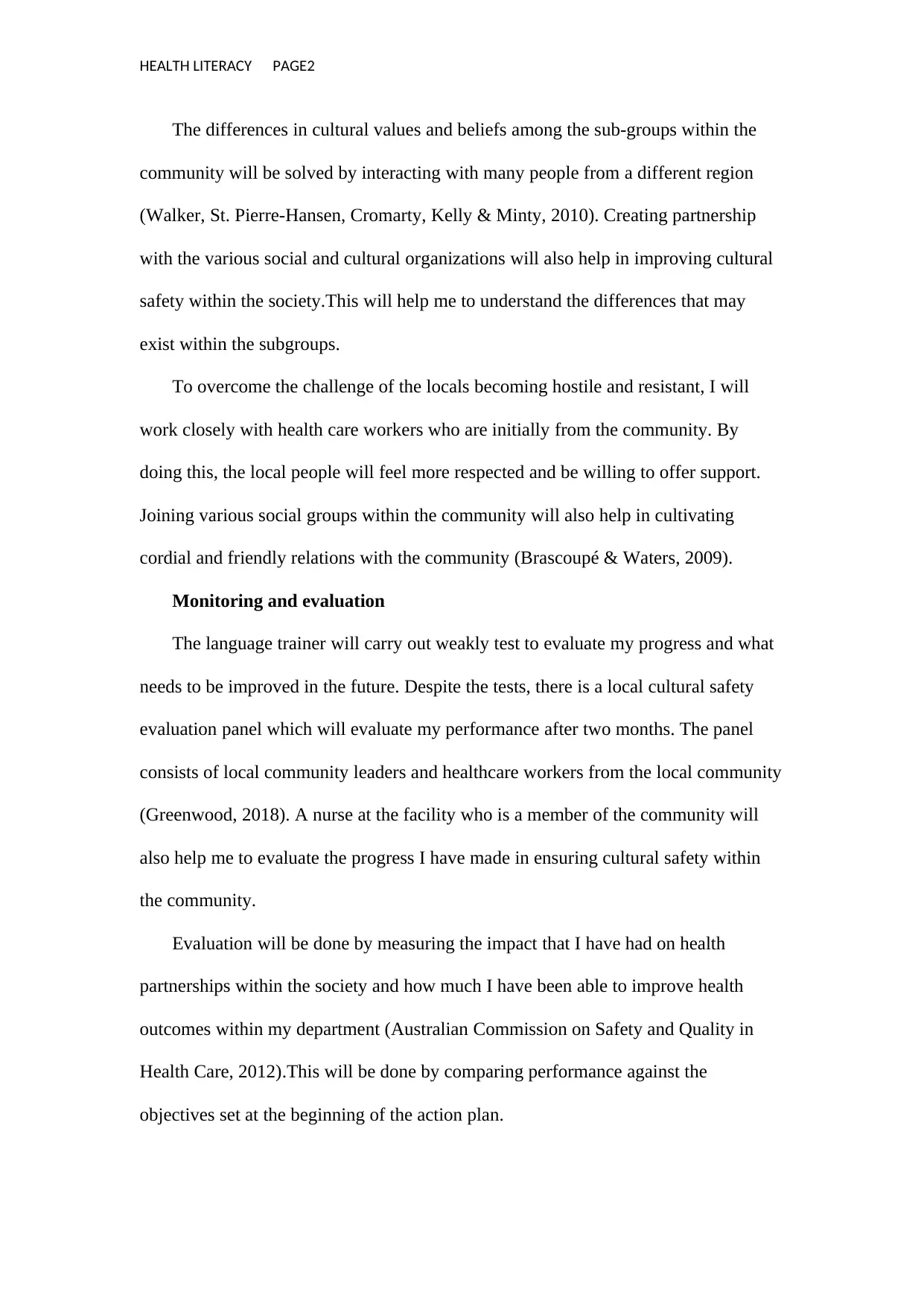
The differences in cultural values and beliefs among the sub-groups within the
community will be solved by interacting with many people from a different region
(Walker, St. Pierre-Hansen, Cromarty, Kelly & Minty, 2010). Creating partnership
with the various social and cultural organizations will also help in improving cultural
safety within the society.This will help me to understand the differences that may
exist within the subgroups.
To overcome the challenge of the locals becoming hostile and resistant, I will
work closely with health care workers who are initially from the community. By
doing this, the local people will feel more respected and be willing to offer support.
Joining various social groups within the community will also help in cultivating
cordial and friendly relations with the community (Brascoupé & Waters, 2009).
Monitoring and evaluation
The language trainer will carry out weakly test to evaluate my progress and what
needs to be improved in the future. Despite the tests, there is a local cultural safety
evaluation panel which will evaluate my performance after two months. The panel
consists of local community leaders and healthcare workers from the local community
(Greenwood, 2018). A nurse at the facility who is a member of the community will
also help me to evaluate the progress I have made in ensuring cultural safety within
the community.
Evaluation will be done by measuring the impact that I have had on health
partnerships within the society and how much I have been able to improve health
outcomes within my department (Australian Commission on Safety and Quality in
Health Care, 2012).This will be done by comparing performance against the
objectives set at the beginning of the action plan.
Document Page
HEALTH LITERACY PAGE2
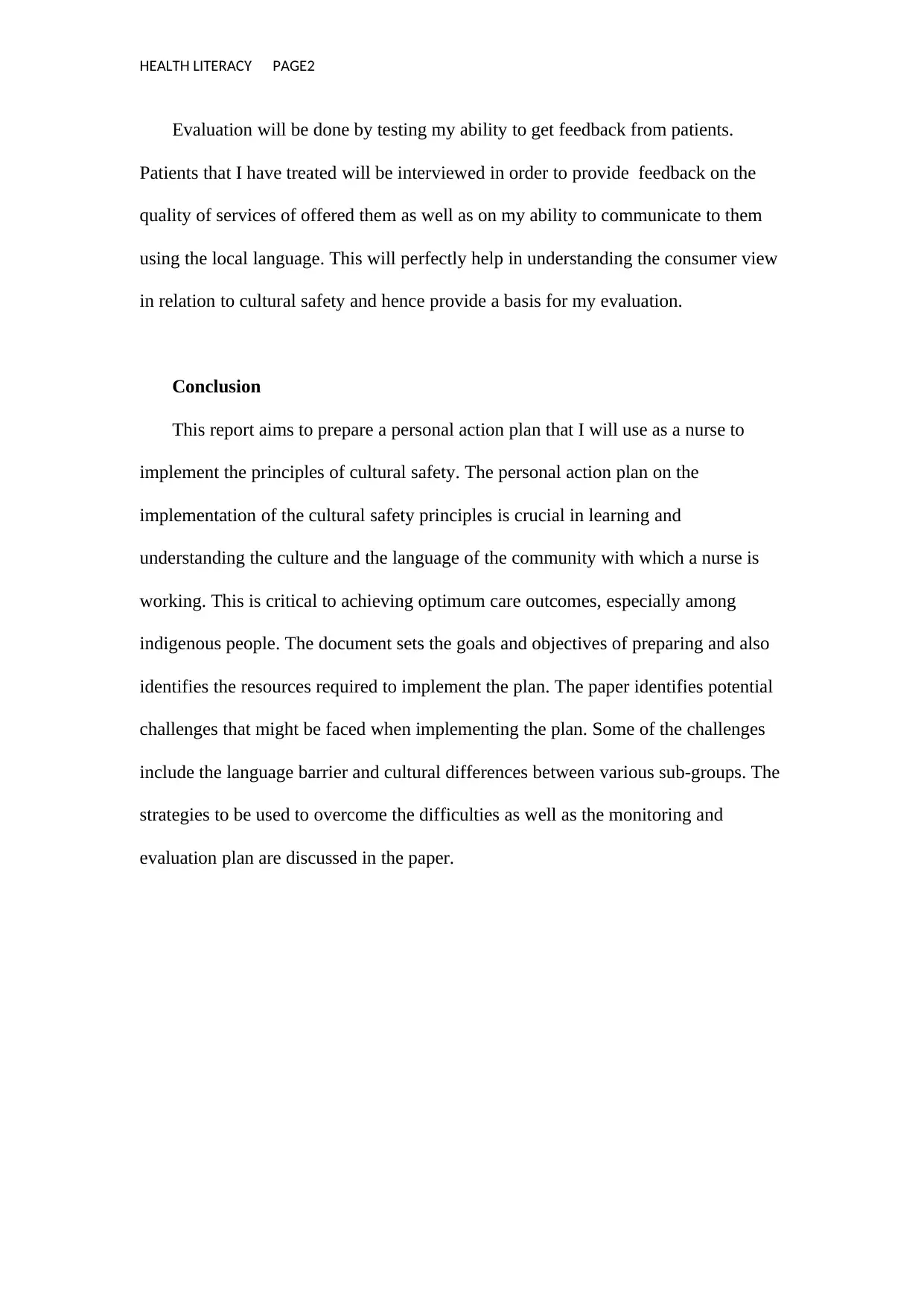
Evaluation will be done by testing my ability to get feedback from patients.
Patients that I have treated will be interviewed in order to provide feedback on the
quality of services of offered them as well as on my ability to communicate to them
using the local language. This will perfectly help in understanding the consumer view
in relation to cultural safety and hence provide a basis for my evaluation.
Conclusion
This report aims to prepare a personal action plan that I will use as a nurse to
implement the principles of cultural safety. The personal action plan on the
implementation of the cultural safety principles is crucial in learning and
understanding the culture and the language of the community with which a nurse is
working. This is critical to achieving optimum care outcomes, especially among
indigenous people. The document sets the goals and objectives of preparing and also
identifies the resources required to implement the plan. The paper identifies potential
challenges that might be faced when implementing the plan. Some of the challenges
include the language barrier and cultural differences between various sub-groups. The
strategies to be used to overcome the difficulties as well as the monitoring and
evaluation plan are discussed in the paper.
tabler-icon-diamond-filled.svg

Paraphrase This Document

Need a fresh take? Get an instant paraphrase of this document with our AI Paraphraser
Document Page
HEALTH LITERACY PAGE2
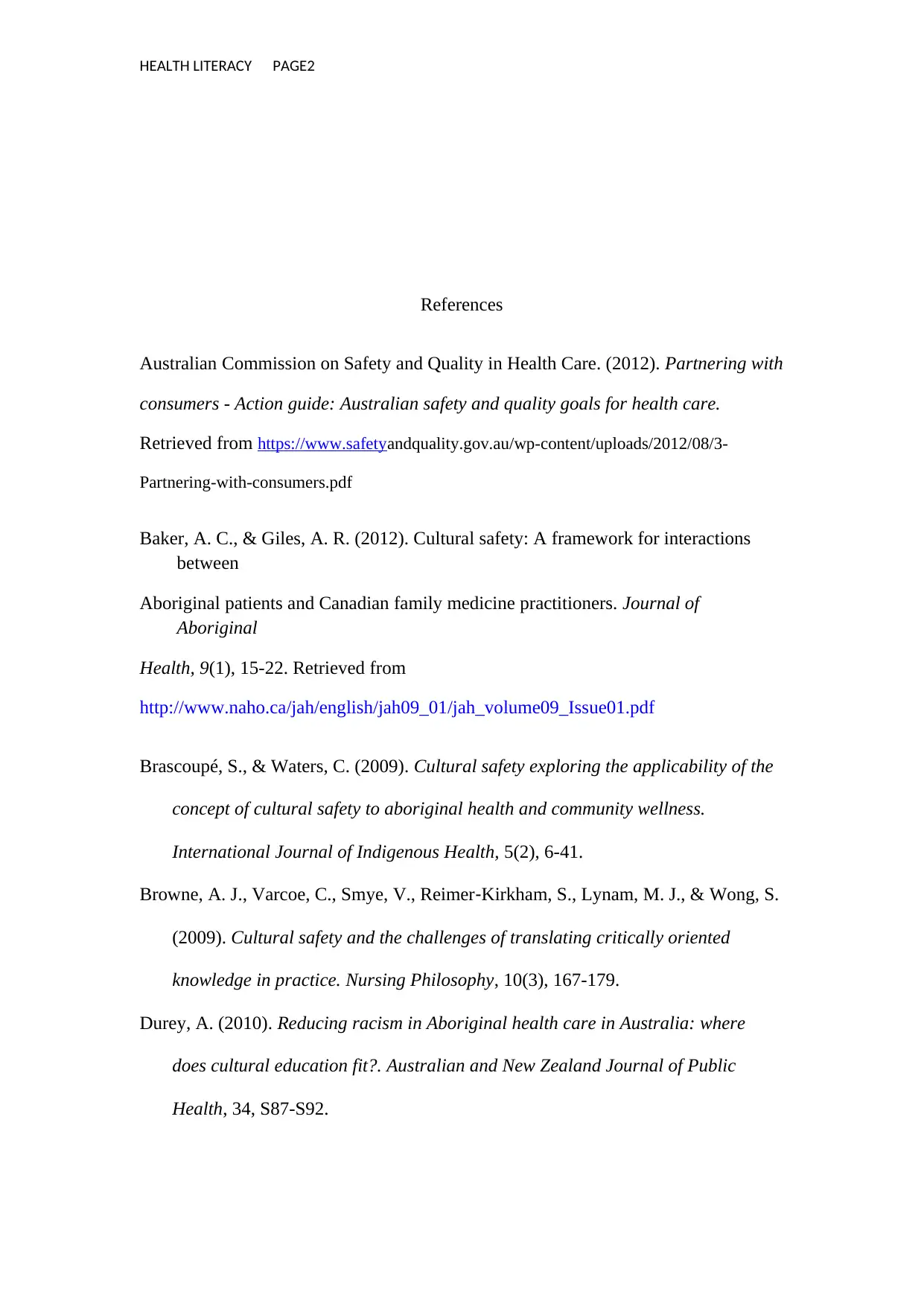
References
Australian Commission on Safety and Quality in Health Care. (2012). Partnering with
consumers - Action guide: Australian safety and quality goals for health care.
Retrieved from https://www.safetyandquality.gov.au/wp-content/uploads/2012/08/3-
Partnering-with-consumers.pdf
Baker, A. C., & Giles, A. R. (2012). Cultural safety: A framework for interactions
between
Aboriginal patients and Canadian family medicine practitioners. Journal of
Aboriginal
Health, 9(1), 15-22. Retrieved from
http://www.naho.ca/jah/english/jah09_01/jah_volume09_Issue01.pdf
Brascoupé, S., & Waters, C. (2009). Cultural safety exploring the applicability of the
concept of cultural safety to aboriginal health and community wellness.
International Journal of Indigenous Health, 5(2), 6-41.
Browne, A. J., Varcoe, C., Smye, V., ReimerKirkham, S., Lynam, M. J., & Wong, S.
(2009). Cultural safety and the challenges of translating critically oriented
knowledge in practice. Nursing Philosophy, 10(3), 167-179.
Durey, A. (2010). Reducing racism in Aboriginal health care in Australia: where
does cultural education fit?. Australian and New Zealand Journal of Public
Health, 34, S87-S92.
Document Page
HEALTH LITERACY PAGE2
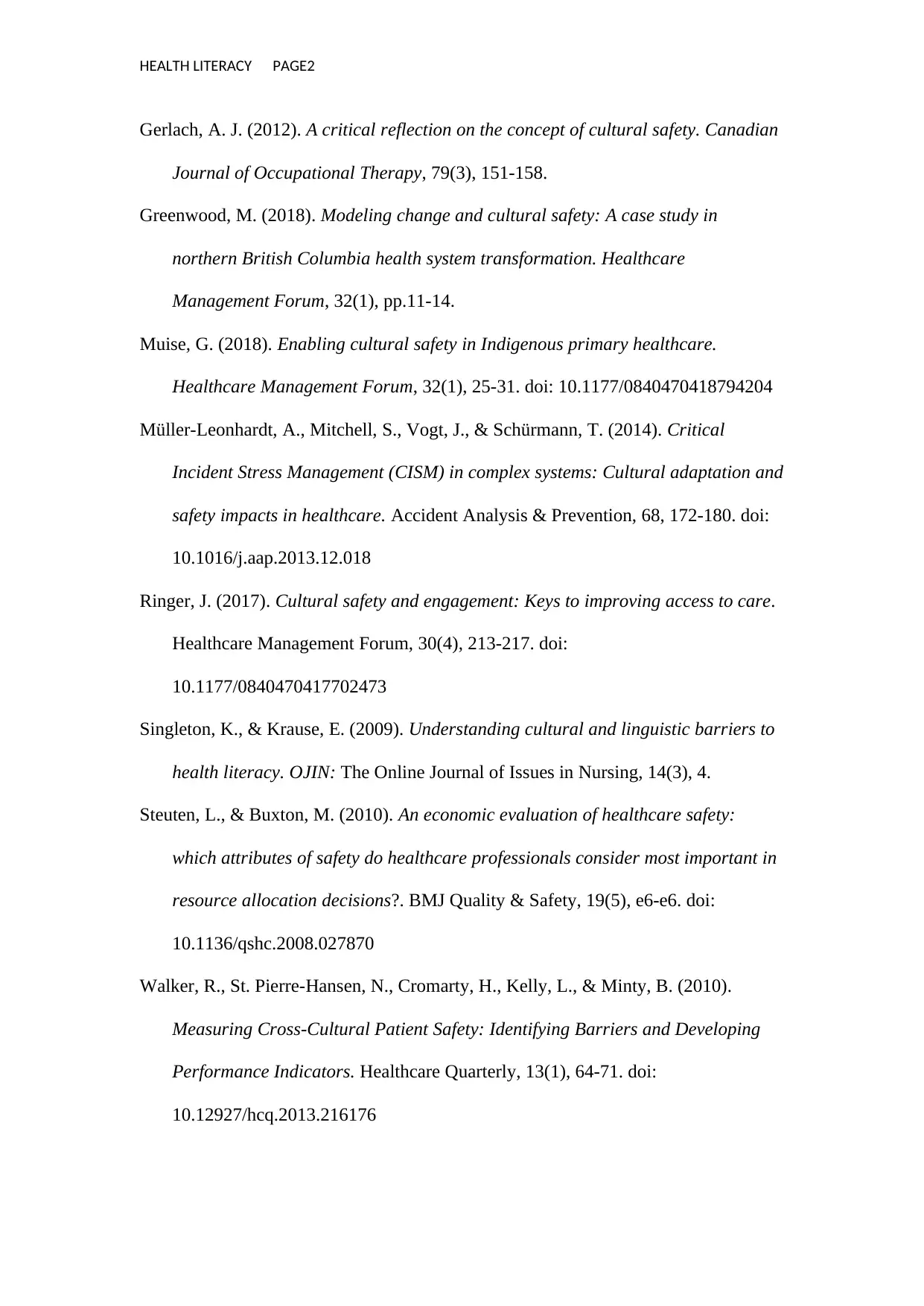
Gerlach, A. J. (2012). A critical reflection on the concept of cultural safety. Canadian
Journal of Occupational Therapy, 79(3), 151-158.
Greenwood, M. (2018). Modeling change and cultural safety: A case study in
northern British Columbia health system transformation. Healthcare
Management Forum, 32(1), pp.11-14.
Muise, G. (2018). Enabling cultural safety in Indigenous primary healthcare.
Healthcare Management Forum, 32(1), 25-31. doi: 10.1177/0840470418794204
Müller-Leonhardt, A., Mitchell, S., Vogt, J., & Schürmann, T. (2014). Critical
Incident Stress Management (CISM) in complex systems: Cultural adaptation and
safety impacts in healthcare. Accident Analysis & Prevention, 68, 172-180. doi:
10.1016/j.aap.2013.12.018
Ringer, J. (2017). Cultural safety and engagement: Keys to improving access to care.
Healthcare Management Forum, 30(4), 213-217. doi:
10.1177/0840470417702473
Singleton, K., & Krause, E. (2009). Understanding cultural and linguistic barriers to
health literacy. OJIN: The Online Journal of Issues in Nursing, 14(3), 4.
Steuten, L., & Buxton, M. (2010). An economic evaluation of healthcare safety:
which attributes of safety do healthcare professionals consider most important in
resource allocation decisions?. BMJ Quality & Safety, 19(5), e6-e6. doi:
10.1136/qshc.2008.027870
Walker, R., St. Pierre-Hansen, N., Cromarty, H., Kelly, L., & Minty, B. (2010).
Measuring Cross-Cultural Patient Safety: Identifying Barriers and Developing
Performance Indicators. Healthcare Quarterly, 13(1), 64-71. doi:
10.12927/hcq.2013.216176
chevron_up_icon
1 out of 9
circle_padding
hide_on_mobile
zoom_out_icon
[object Object]