Business Plan for Cultural Retreat: Tourism and Travel
VerifiedAdded on 2022/08/16
|13
|963
|16
Project
AI Summary
The Cultural Retreat business plan outlines a startup designed to offer global travelers a unique experience of local village life combined with premium services. The plan details the company's introduction, target market (travelers seeking cultural immersion and a break from routine), and competitor analysis, highlighting technological innovation, unique hotel designs, and specialized services as key differentiators. The marketing strategy encompasses product, pricing, placing, and promotional strategies, with a focus on social media marketing. Financial considerations include securing funding through loans and partnerships. The plan concludes by emphasizing the innovative approach of Cultural Retreat in providing accommodation and services that cater to the global traveler's desire for authentic cultural experiences. References support the business plan's concepts and strategies.
Cultural Retreat
Business Plan
Business Plan
Paraphrase This Document
Need a fresh take? Get an instant paraphrase of this document with our AI Paraphraser

Serving
customers
with
travelling
and
tourism.
customers
with
travelling
and
tourism.

Executive
Summary
• Cultural Retreat is a company that refers
to a start-up for provisioning the global
travelers with the allowance to live and
taste the life of a local village stayer.
• The company also has been provisioning
with various premium services along with
free services to the travelers enjoying and
paying for their services.
• This presentation also states the various
sources from which the funds have been
collected.
3
Summary
• Cultural Retreat is a company that refers
to a start-up for provisioning the global
travelers with the allowance to live and
taste the life of a local village stayer.
• The company also has been provisioning
with various premium services along with
free services to the travelers enjoying and
paying for their services.
• This presentation also states the various
sources from which the funds have been
collected.
3
⊘ This is a preview!⊘
Do you want full access?
Subscribe today to unlock all pages.

Trusted by 1+ million students worldwide

4
Introduction
• Cultural Retreat refers to an innovate
start-up within the field of tourism
providing the customers with
assistance to travel.
o The company provides a village
experience introducing all of the global
travelers with the taste of localized
culture (Marasco et al. 2018).
• Hence, Cultural Retreat puts forward a
mix of local culture with premium
services in terms of hotel as well as
travel assistance.
Introduction
• Cultural Retreat refers to an innovate
start-up within the field of tourism
providing the customers with
assistance to travel.
o The company provides a village
experience introducing all of the global
travelers with the taste of localized
culture (Marasco et al. 2018).
• Hence, Cultural Retreat puts forward a
mix of local culture with premium
services in terms of hotel as well as
travel assistance.
Paraphrase This Document
Need a fresh take? Get an instant paraphrase of this document with our AI Paraphraser

5
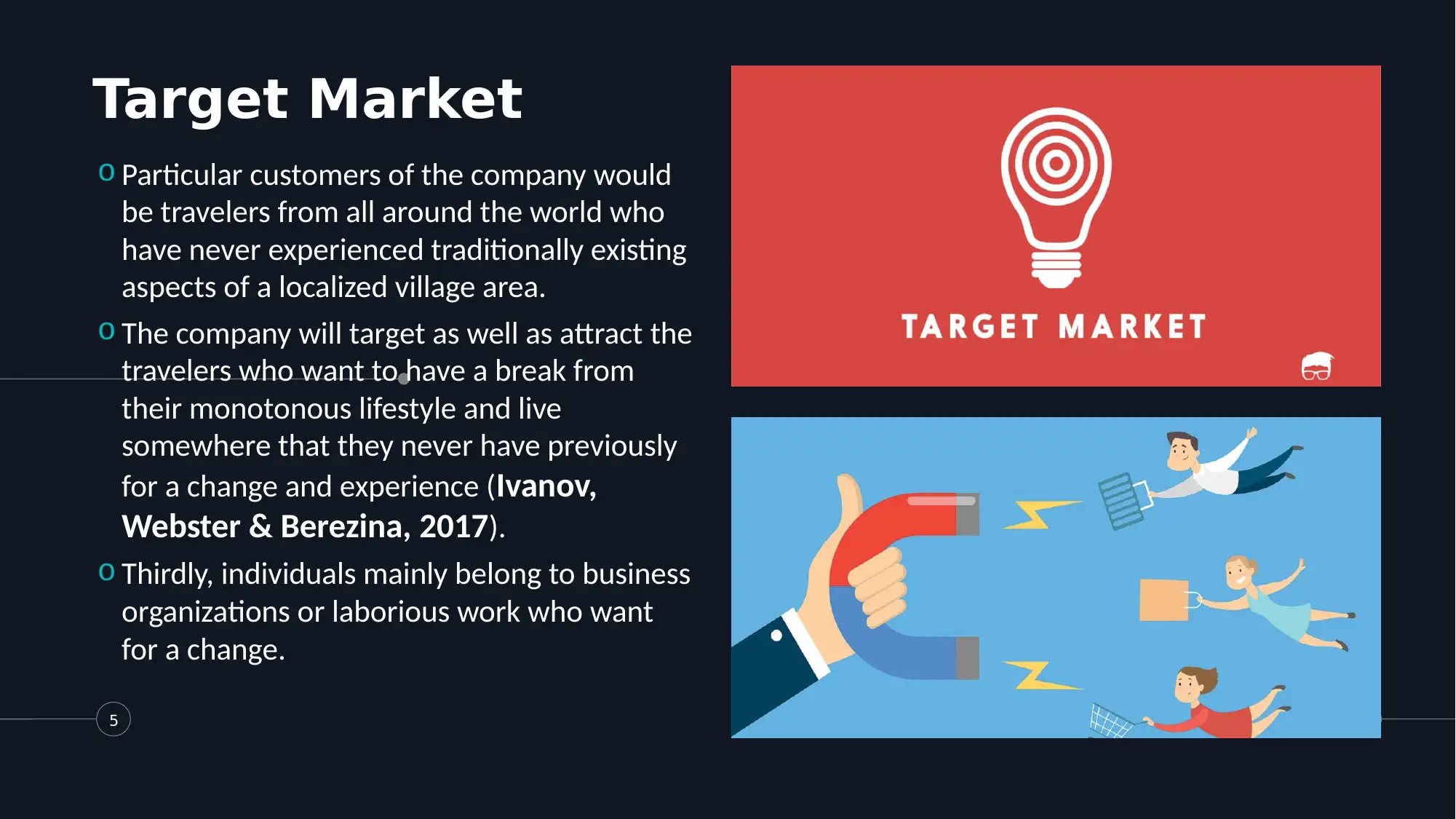
Target Market
o Particular customers of the company would
be travelers from all around the world who
have never experienced traditionally existing
aspects of a localized village area.
o The company will target as well as attract the
travelers who want to have a break from
their monotonous lifestyle and live
somewhere that they never have previously
for a change and experience (Ivanov,
Webster & Berezina, 2017).
o Thirdly, individuals mainly belong to business
organizations or laborious work who want
for a change.
Target Market
o Particular customers of the company would
be travelers from all around the world who
have never experienced traditionally existing
aspects of a localized village area.
o The company will target as well as attract the
travelers who want to have a break from
their monotonous lifestyle and live
somewhere that they never have previously
for a change and experience (Ivanov,
Webster & Berezina, 2017).
o Thirdly, individuals mainly belong to business
organizations or laborious work who want
for a change.

6
Competitor
Analysis
• Technological innovation- the company will
have the basic inclusion of digitalized
services such as online booking, website
check-in, digital approachability as well as
personalization services to get past the
competitors within the same field (Tung &
Law 2017).
• Unique design- the hotels shall be designed
in such a way to get ahead of the
competitors such as traditionally reforming
the localized area along with culturally
designing the interior of the hotel.
Competitor
Analysis
• Technological innovation- the company will
have the basic inclusion of digitalized
services such as online booking, website
check-in, digital approachability as well as
personalization services to get past the
competitors within the same field (Tung &
Law 2017).
• Unique design- the hotels shall be designed
in such a way to get ahead of the
competitors such as traditionally reforming
the localized area along with culturally
designing the interior of the hotel.
⊘ This is a preview!⊘
Do you want full access?
Subscribe today to unlock all pages.

Trusted by 1+ million students worldwide

7
Competitor Analysis
(contd.)
• Specialized services- other existing
services to get ahead of the competitors
within the same field is the like of
service spa, unique techniques for
adoption of local culture and massage
(Ivanov & Webster, 2017).
• In addition to this, inclusion of a gift
shop as well as shopping services within
the hotel will be an advantage for the
tourists.
Competitor Analysis
(contd.)
• Specialized services- other existing
services to get ahead of the competitors
within the same field is the like of
service spa, unique techniques for
adoption of local culture and massage
(Ivanov & Webster, 2017).
• In addition to this, inclusion of a gift
shop as well as shopping services within
the hotel will be an advantage for the
tourists.
Paraphrase This Document
Need a fresh take? Get an instant paraphrase of this document with our AI Paraphraser

8
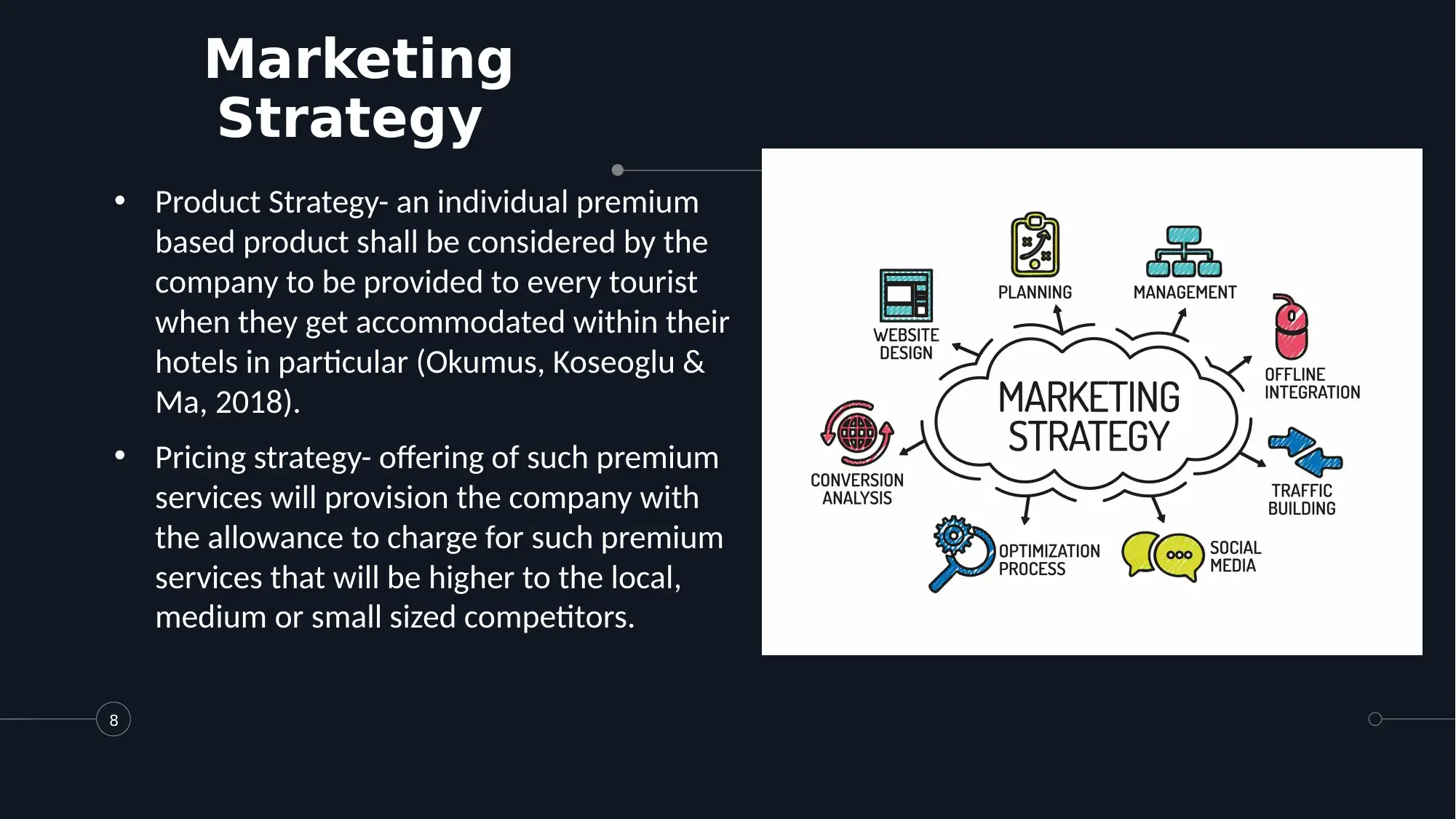
Marketing
Strategy
• Product Strategy- an individual premium
based product shall be considered by the
company to be provided to every tourist
when they get accommodated within their
hotels in particular (Okumus, Koseoglu &
Ma, 2018).
• Pricing strategy- offering of such premium
services will provision the company with
the allowance to charge for such premium
services that will be higher to the local,
medium or small sized competitors.
Marketing
Strategy
• Product Strategy- an individual premium
based product shall be considered by the
company to be provided to every tourist
when they get accommodated within their
hotels in particular (Okumus, Koseoglu &
Ma, 2018).
• Pricing strategy- offering of such premium
services will provision the company with
the allowance to charge for such premium
services that will be higher to the local,
medium or small sized competitors.

9
Marketing Strategy
(contd.)
• Placing Strategy- an unique location will be
selected by the company as a part of this strategy
to signify as well as reflect the local culture
belonging to the respective city as well as the
culture (Gursoy & Sandstrom, 2016).
• Promotional strategy- the currently existing
promotional strategy that shall be implemented
by the company is social media marketing. This
strategy also has the existence of video
promotional services upon popular social media
platforms such as the likes of Facebook,
snapchat, Twitter as well as Instagram.
Marketing Strategy
(contd.)
• Placing Strategy- an unique location will be
selected by the company as a part of this strategy
to signify as well as reflect the local culture
belonging to the respective city as well as the
culture (Gursoy & Sandstrom, 2016).
• Promotional strategy- the currently existing
promotional strategy that shall be implemented
by the company is social media marketing. This
strategy also has the existence of video
promotional services upon popular social media
platforms such as the likes of Facebook,
snapchat, Twitter as well as Instagram.
⊘ This is a preview!⊘
Do you want full access?
Subscribe today to unlock all pages.

Trusted by 1+ million students worldwide

10
Financial
considerations
• For Cultural Retreat, the primary funding
source would be loans as a part of debt
from financial banks as well as companies.
• The company also aims at having
partnerships with different sources for
money working within the same field of
hospitality (Buhalis et al., 2019).
Financial
considerations
• For Cultural Retreat, the primary funding
source would be loans as a part of debt
from financial banks as well as companies.
• The company also aims at having
partnerships with different sources for
money working within the same field of
hospitality (Buhalis et al., 2019).
Paraphrase This Document
Need a fresh take? Get an instant paraphrase of this document with our AI Paraphraser

11
Conclusion
• Cultural Retreat refers to an innovative
idea from an entrepreneur for providing
with accommodation for the global
travelers towards the localized culture.
• Apart from accommodation services,
other products as well as services shall
be provisioned to the same as well.
• Various funding sources have been
supporting the start-up in financial
ways.
Conclusion
• Cultural Retreat refers to an innovative
idea from an entrepreneur for providing
with accommodation for the global
travelers towards the localized culture.
• Apart from accommodation services,
other products as well as services shall
be provisioned to the same as well.
• Various funding sources have been
supporting the start-up in financial
ways.

12
References
Buhalis, D., Harwood, T., Bogicevic, V., Viglia, G., Beldona, S., &
Hofacker, C. (2019). Technological disruptions in services: lessons from
tourism and hospitality. Journal of Service Management.
Gursoy, D., & Sandstrom, J. K. (2016). An updated ranking of hospitality
and tourism journals. Journal of Hospitality & Tourism Research, 40(1),
3-18.
Ivanov, S. H., & Webster, C. (2017). Adoption of robots, artificial
intelligence and service automation by travel, tourism and hospitality
companies–a cost-benefit analysis. Artificial Intelligence and Service
Automation by Travel, Tourism and Hospitality Companies–A Cost-
Benefit Analysis.
Ivanov, S. H., Webster, C., & Berezina, K. (2017). Adoption of robots
and service automation by tourism and hospitality companies. Revista
Turismo & Desenvolvimento, 27(28), 1501-1517.
Marasco, A., De Martino, M., Magnotti, F., & Morvillo, A. (2018).
Collaborative innovation in tourism and hospitality: A systematic
review of the literature. International Journal of Contemporary
Hospitality Management.
Okumus, B., Koseoglu, M. A., & Ma, F. (2018). Food and gastronomy
research in tourism and hospitality: A bibliometric analysis.
International Journal of Hospitality Management, 73, 64-74.
Tung, V. W. S., & Law, R. (2017). The potential for tourism and
hospitality experience research in human-robot interactions.
International Journal of Contemporary Hospitality Management.
References
Buhalis, D., Harwood, T., Bogicevic, V., Viglia, G., Beldona, S., &
Hofacker, C. (2019). Technological disruptions in services: lessons from
tourism and hospitality. Journal of Service Management.
Gursoy, D., & Sandstrom, J. K. (2016). An updated ranking of hospitality
and tourism journals. Journal of Hospitality & Tourism Research, 40(1),
3-18.
Ivanov, S. H., & Webster, C. (2017). Adoption of robots, artificial
intelligence and service automation by travel, tourism and hospitality
companies–a cost-benefit analysis. Artificial Intelligence and Service
Automation by Travel, Tourism and Hospitality Companies–A Cost-
Benefit Analysis.
Ivanov, S. H., Webster, C., & Berezina, K. (2017). Adoption of robots
and service automation by tourism and hospitality companies. Revista
Turismo & Desenvolvimento, 27(28), 1501-1517.
Marasco, A., De Martino, M., Magnotti, F., & Morvillo, A. (2018).
Collaborative innovation in tourism and hospitality: A systematic
review of the literature. International Journal of Contemporary
Hospitality Management.
Okumus, B., Koseoglu, M. A., & Ma, F. (2018). Food and gastronomy
research in tourism and hospitality: A bibliometric analysis.
International Journal of Hospitality Management, 73, 64-74.
Tung, V. W. S., & Law, R. (2017). The potential for tourism and
hospitality experience research in human-robot interactions.
International Journal of Contemporary Hospitality Management.
⊘ This is a preview!⊘
Do you want full access?
Subscribe today to unlock all pages.

Trusted by 1+ million students worldwide
1 out of 13
Related Documents
Your All-in-One AI-Powered Toolkit for Academic Success.
+13062052269
info@desklib.com
Available 24*7 on WhatsApp / Email
Unlock your academic potential
Copyright © 2020–2025 A2Z Services. All Rights Reserved. Developed and managed by ZUCOL.