A Report on the Cultural Values of Hinduism in Healthcare

Verified

Added on  2023/06/04

|5
|1136
|156
Report
AI Summary
This report delves into the cultural values of Hinduism and their profound implications for healthcare, drawing on multiple sources to provide a comprehensive overview. The report examines key concepts such as karma, reincarnation, and the significance of a 'good death' within the Hindu faith. It explores how these beliefs influence dietary practices, attitudes toward pain and suffering, and preferences regarding end-of-life care. The analysis highlights the importance of understanding these cultural nuances to provide culturally sensitive and patient-centered care, including the role of family support and religious coping mechanisms. The report also discusses potential biases and the need for healthcare professionals to be aware of and responsive to the spiritual needs and preferences of Hindu patients, particularly in palliative care settings. The report emphasizes the importance of a person-centered approach in nursing, acknowledging the patient as an individual and being responsive in nursing practice to remove any biases. The report also covers the rituals and practices associated with death in Hinduism, the role of family members, and gender biases in the society.
Document Page
Running head: CULTURAL VALUES OF HINDUISM
Cultural Values of Hinduism
Name of the student
Name of the University
Author note
tabler-icon-diamond-filled.svg

Paraphrase This Document

Need a fresh take? Get an instant paraphrase of this document with our AI Paraphraser
Document Page
1CULTURAL VALUES OF HINDUISM
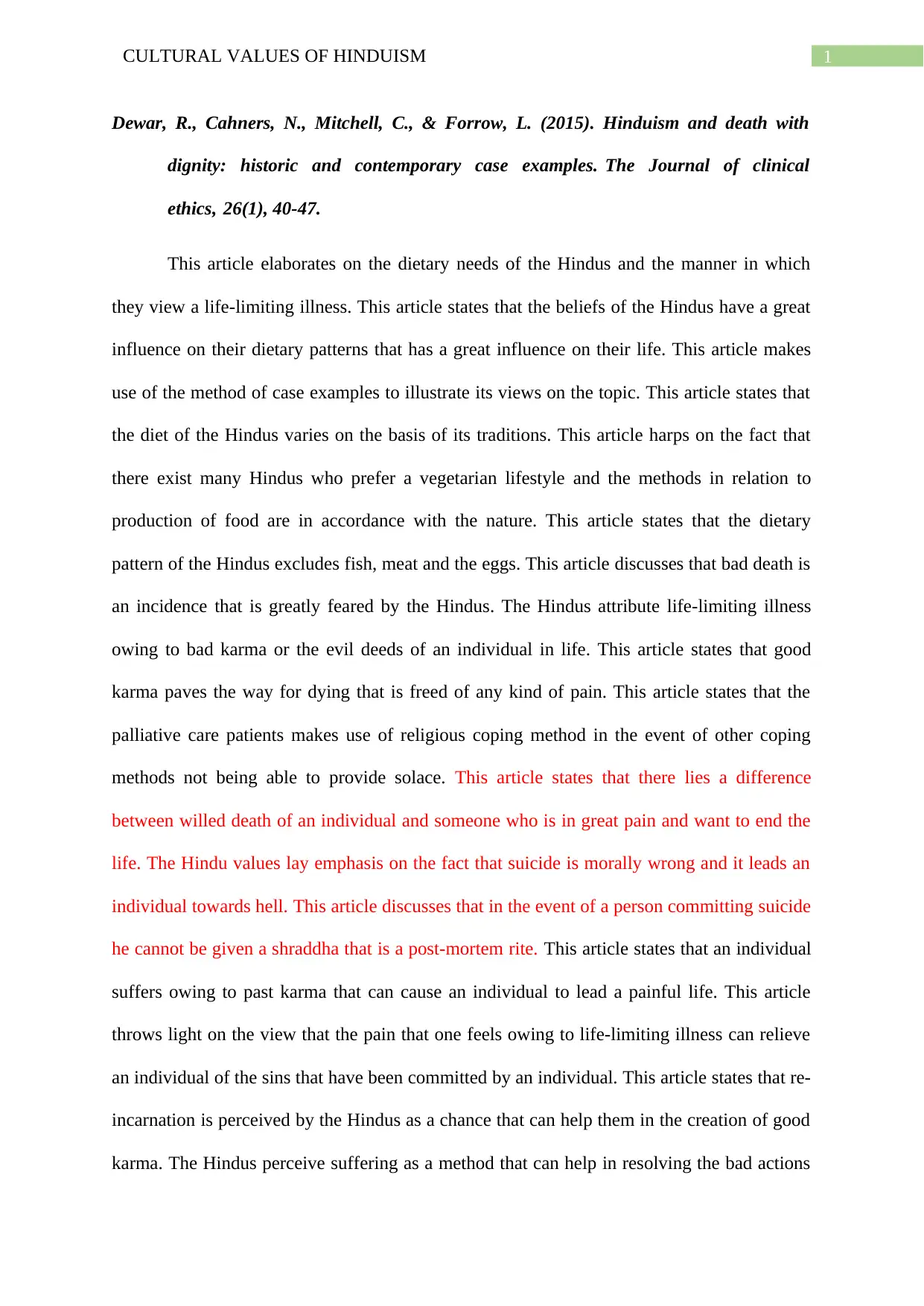
Dewar, R., Cahners, N., Mitchell, C., & Forrow, L. (2015). Hinduism and death with
dignity: historic and contemporary case examples. The Journal of clinical
ethics, 26(1), 40-47.
This article elaborates on the dietary needs of the Hindus and the manner in which
they view a life-limiting illness. This article states that the beliefs of the Hindus have a great
influence on their dietary patterns that has a great influence on their life. This article makes
use of the method of case examples to illustrate its views on the topic. This article states that
the diet of the Hindus varies on the basis of its traditions. This article harps on the fact that
there exist many Hindus who prefer a vegetarian lifestyle and the methods in relation to
production of food are in accordance with the nature. This article states that the dietary
pattern of the Hindus excludes fish, meat and the eggs. This article discusses that bad death is
an incidence that is greatly feared by the Hindus. The Hindus attribute life-limiting illness
owing to bad karma or the evil deeds of an individual in life. This article states that good
karma paves the way for dying that is freed of any kind of pain. This article states that the
palliative care patients makes use of religious coping method in the event of other coping
methods not being able to provide solace. This article states that there lies a difference
between willed death of an individual and someone who is in great pain and want to end the
life. The Hindu values lay emphasis on the fact that suicide is morally wrong and it leads an
individual towards hell. This article discusses that in the event of a person committing suicide
he cannot be given a shraddha that is a post-mortem rite. This article states that an individual
suffers owing to past karma that can cause an individual to lead a painful life. This article
throws light on the view that the pain that one feels owing to life-limiting illness can relieve
an individual of the sins that have been committed by an individual. This article states that re-
incarnation is perceived by the Hindus as a chance that can help them in the creation of good
karma. The Hindus perceive suffering as a method that can help in resolving the bad actions
Document Page
2CULTURAL VALUES OF HINDUISM
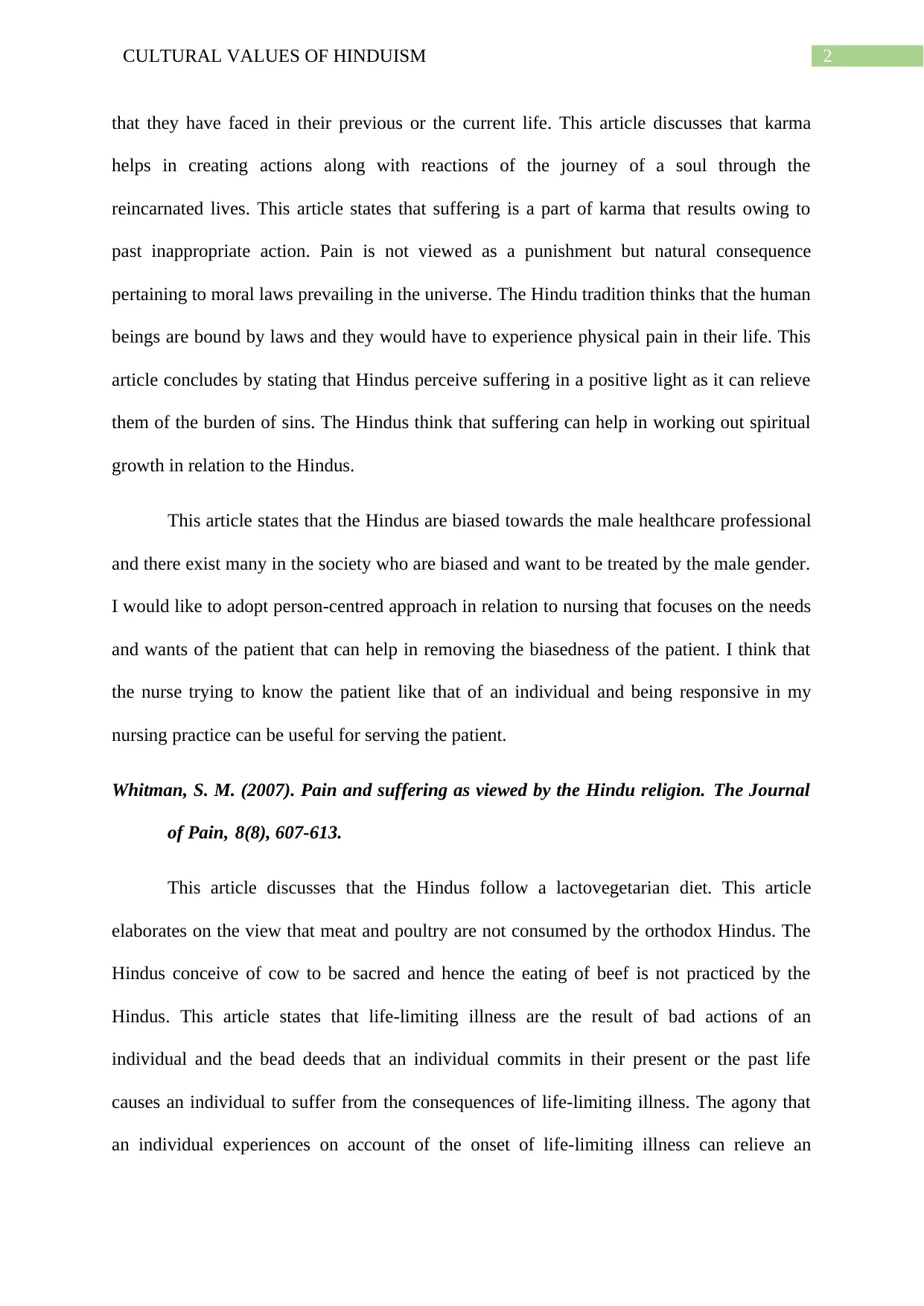
that they have faced in their previous or the current life. This article discusses that karma
helps in creating actions along with reactions of the journey of a soul through the
reincarnated lives. This article states that suffering is a part of karma that results owing to
past inappropriate action. Pain is not viewed as a punishment but natural consequence
pertaining to moral laws prevailing in the universe. The Hindu tradition thinks that the human
beings are bound by laws and they would have to experience physical pain in their life. This
article concludes by stating that Hindus perceive suffering in a positive light as it can relieve
them of the burden of sins. The Hindus think that suffering can help in working out spiritual
growth in relation to the Hindus.
This article states that the Hindus are biased towards the male healthcare professional
and there exist many in the society who are biased and want to be treated by the male gender.
I would like to adopt person-centred approach in relation to nursing that focuses on the needs
and wants of the patient that can help in removing the biasedness of the patient. I think that
the nurse trying to know the patient like that of an individual and being responsive in my
nursing practice can be useful for serving the patient.
Whitman, S. M. (2007). Pain and suffering as viewed by the Hindu religion. The Journal
of Pain, 8(8), 607-613.
This article discusses that the Hindus follow a lactovegetarian diet. This article
elaborates on the view that meat and poultry are not consumed by the orthodox Hindus. The
Hindus conceive of cow to be sacred and hence the eating of beef is not practiced by the
Hindus. This article states that life-limiting illness are the result of bad actions of an
individual and the bead deeds that an individual commits in their present or the past life
causes an individual to suffer from the consequences of life-limiting illness. The agony that
an individual experiences on account of the onset of life-limiting illness can relieve an
Document Page
3CULTURAL VALUES OF HINDUISM
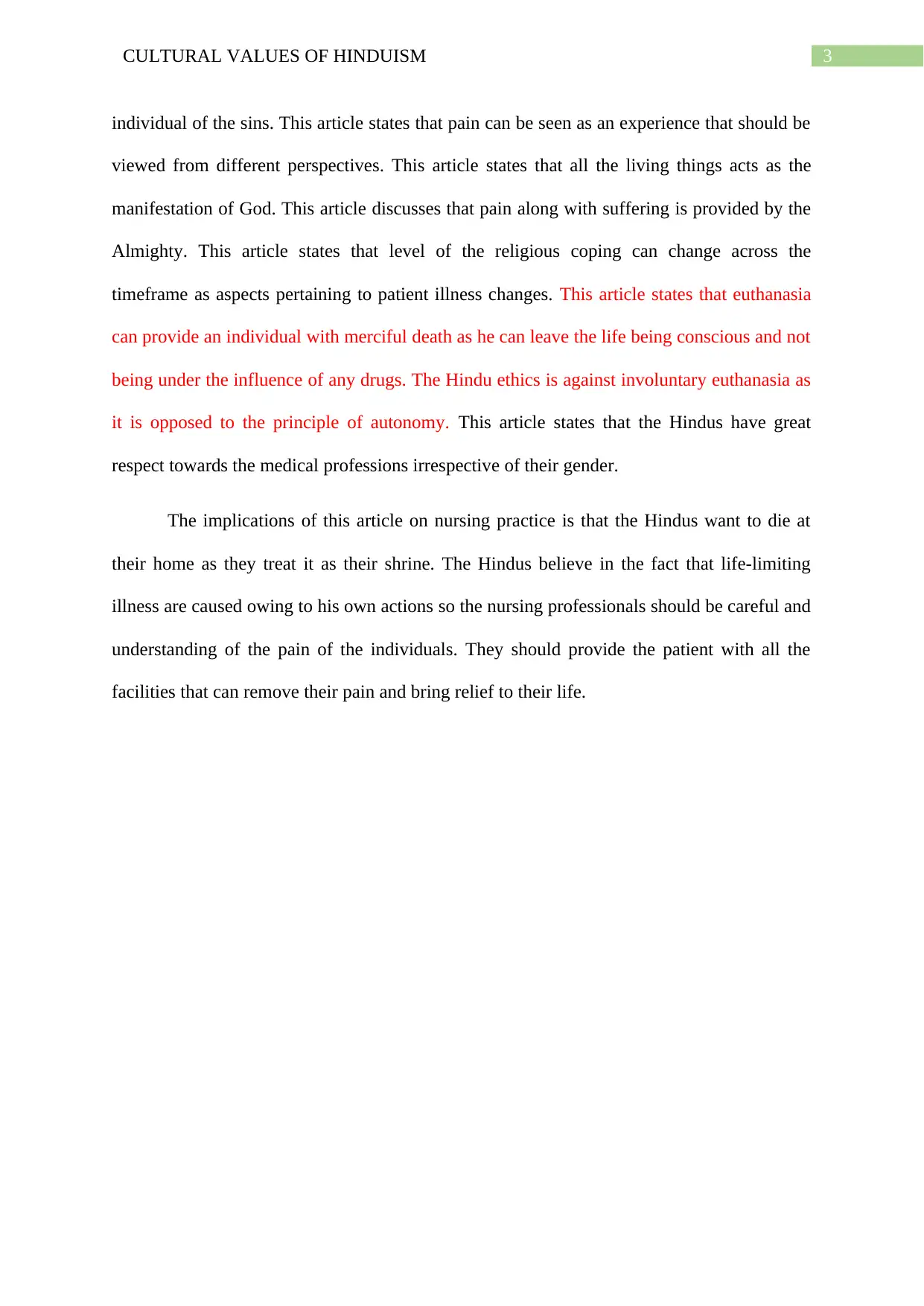
individual of the sins. This article states that pain can be seen as an experience that should be
viewed from different perspectives. This article states that all the living things acts as the
manifestation of God. This article discusses that pain along with suffering is provided by the
Almighty. This article states that level of the religious coping can change across the
timeframe as aspects pertaining to patient illness changes. This article states that euthanasia
can provide an individual with merciful death as he can leave the life being conscious and not
being under the influence of any drugs. The Hindu ethics is against involuntary euthanasia as
it is opposed to the principle of autonomy. This article states that the Hindus have great
respect towards the medical professions irrespective of their gender.
The implications of this article on nursing practice is that the Hindus want to die at
their home as they treat it as their shrine. The Hindus believe in the fact that life-limiting
illness are caused owing to his own actions so the nursing professionals should be careful and
understanding of the pain of the individuals. They should provide the patient with all the
facilities that can remove their pain and bring relief to their life.
tabler-icon-diamond-filled.svg

Paraphrase This Document

Need a fresh take? Get an instant paraphrase of this document with our AI Paraphraser
Document Page
4CULTURAL VALUES OF HINDUISM
Bibliography
Dewar, R., Cahners, N., Mitchell, C., & Forrow, L. (2015). Hinduism and death with dignity:
historic and contemporary case examples. The Journal of clinical ethics, 26(1), 40-47.
Whitman, S. M. (2007). Pain and suffering as viewed by the Hindu religion. The Journal of
Pain, 8(8), 607-613.
chevron_up_icon
1 out of 5
circle_padding
hide_on_mobile
zoom_out_icon
[object Object]