Nursing Report: Discharge Planning for Jim and Family in Hobart
VerifiedAdded on 2020/05/16
|11
|2735
|88
Report
AI Summary
This nursing report focuses on the discharge planning process for Jim, a mentally ill individual, and his family, emphasizing the importance of culturally safe care. The report explores various home care packages, domestic support, and mental health referral services available to Jim through programs like Anglicare and the Commonwealth Home Support Program. It highlights the application of strength-based techniques and the need for ethical and legal considerations, including informed consent and the sharing of healthcare data. The report also discusses the benefits of culturally safe care, family-centered approaches, and the use of technology, such as the Let's Go Greek app, to facilitate communication. Ultimately, the goal is to empower Jim to become an autonomous driver in his healthcare journey and to support both him and his family during the transition period.
Nursing 1
ASSESSMENT TASK ON NURSING
Student’s Name
Instructor
Institution
Location of Institution
Course
Date
ASSESSMENT TASK ON NURSING
Student’s Name
Instructor
Institution
Location of Institution
Course
Date

Paraphrase This Document
Need a fresh take? Get an instant paraphrase of this document with our AI Paraphraser
Nursing 2
Nursing
The transition period is a significant period for the mentally ill individuals such as Jim,
and this is especially after the discharge period. With the help of the Parish Priest of the Holy
Trinity Greek Orthodox in Hobart, the services which will be mentioned in the report will be
researched by the author with the aim of ensuring that a culturally safe care is enforced.
(Gonçalves‐Bradley et al.2016 p.1). With such services, individuals such as Jim will be
empowered to become an autonomous driver, especially in the healthcare journey. Consequently,
the services will allow for the identification of the key strengths of Jim and also elevating the
stressors. Such a goal will be attained through the provision of support to Jim and his family. The
primary focus of the report will be on the discharge of services which applies to the case of Jim.
It will also highlight on the vital elements which include culturally safe care, strength-based
techniques, ethical and legal considerations and the transfer care which should all be taken into
account in discharge process as will be instructed by nurses of Jim.
Planning of Discharge for Jim and Family,
When coordinating the services which are to be offered to the Jim and family, there are
certain elements which are considered such as expert opinion, patient-centered and strength
based movements (Ulin et al.2016 p.20). The potential services which will be enforced during
the discharge of Jim as indicated below by the subheadings. Before the provision of such
services, there should be a discussion held with Jim including the family members and Amara.
Such a discussion will help ensure that a partnership which is collaborative is formed and this is
especially with the society and hospital team services.
Nursing
The transition period is a significant period for the mentally ill individuals such as Jim,
and this is especially after the discharge period. With the help of the Parish Priest of the Holy
Trinity Greek Orthodox in Hobart, the services which will be mentioned in the report will be
researched by the author with the aim of ensuring that a culturally safe care is enforced.
(Gonçalves‐Bradley et al.2016 p.1). With such services, individuals such as Jim will be
empowered to become an autonomous driver, especially in the healthcare journey. Consequently,
the services will allow for the identification of the key strengths of Jim and also elevating the
stressors. Such a goal will be attained through the provision of support to Jim and his family. The
primary focus of the report will be on the discharge of services which applies to the case of Jim.
It will also highlight on the vital elements which include culturally safe care, strength-based
techniques, ethical and legal considerations and the transfer care which should all be taken into
account in discharge process as will be instructed by nurses of Jim.
Planning of Discharge for Jim and Family,
When coordinating the services which are to be offered to the Jim and family, there are
certain elements which are considered such as expert opinion, patient-centered and strength
based movements (Ulin et al.2016 p.20). The potential services which will be enforced during
the discharge of Jim as indicated below by the subheadings. Before the provision of such
services, there should be a discussion held with Jim including the family members and Amara.
Such a discussion will help ensure that a partnership which is collaborative is formed and this is
especially with the society and hospital team services.
Nursing 3
Packages of Home Care
The eligibility of the services offered to Jim is ascertained using a comprehensive
evaluation process. To meet the daily care needs of various persons to enable them to be at
home, the subsequent and evaluation services are made in such a manner that they offer
coordinated and suited services (Boletsis, McCallum and Landmark, 2015 p.20).
After the approval of such services, a selection will be made by both Amara and Jim on
the type of care provider, and this will be based on the mentioned services. Consequently, Jim
will be relieved from the all the pressure to allow him to shift his concentration to care for
Amara. Jim would not want any other person to care for his wife, and this, therefore, implies that
Jim's preferences will be respected since all the house chores will be done and at the same time
being offered certain additional support (Pang et al.2015 p.100). Often, there are usually certain
delays during the approval process such as waiting for up to twelve months dated from the date
of application. Such a delay has been associated with the high demand for home care packages. It
will thus be necessary to consider the short term services for both Amara and Jim.
Domestic Support and Personal Care
According to Liu (2019 p.130), through Anglicare, both Jim and Amara will have access
to the short term services which offers personal and domestic care as well as preparation of a
meal. Furthermore, the lifestyle packages of the two are considered as the cheapest option which
requires no funding, and this is based on the discussion with the helpline services. The access to
Anglicare will be charged for 5$ per day and a cap for 10$ per week for the elderly aged above
65 years. Additionally, they access pension (Harris and White, 2018 p.10). However much of the
services will be offered by the personal care packages which will help care for Amara in the
absence of Jim to help with the care needs of the wife.
Packages of Home Care
The eligibility of the services offered to Jim is ascertained using a comprehensive
evaluation process. To meet the daily care needs of various persons to enable them to be at
home, the subsequent and evaluation services are made in such a manner that they offer
coordinated and suited services (Boletsis, McCallum and Landmark, 2015 p.20).
After the approval of such services, a selection will be made by both Amara and Jim on
the type of care provider, and this will be based on the mentioned services. Consequently, Jim
will be relieved from the all the pressure to allow him to shift his concentration to care for
Amara. Jim would not want any other person to care for his wife, and this, therefore, implies that
Jim's preferences will be respected since all the house chores will be done and at the same time
being offered certain additional support (Pang et al.2015 p.100). Often, there are usually certain
delays during the approval process such as waiting for up to twelve months dated from the date
of application. Such a delay has been associated with the high demand for home care packages. It
will thus be necessary to consider the short term services for both Amara and Jim.
Domestic Support and Personal Care
According to Liu (2019 p.130), through Anglicare, both Jim and Amara will have access
to the short term services which offers personal and domestic care as well as preparation of a
meal. Furthermore, the lifestyle packages of the two are considered as the cheapest option which
requires no funding, and this is based on the discussion with the helpline services. The access to
Anglicare will be charged for 5$ per day and a cap for 10$ per week for the elderly aged above
65 years. Additionally, they access pension (Harris and White, 2018 p.10). However much of the
services will be offered by the personal care packages which will help care for Amara in the
absence of Jim to help with the care needs of the wife.
⊘ This is a preview!⊘
Do you want full access?
Subscribe today to unlock all pages.

Trusted by 1+ million students worldwide
Nursing 4
Commonwealth Home Support Program and Greek Community Care Services
Through the funding originating from Commonwealth Home Support program and Greek
Community Care Services, Amara and Jim will typically have access to the culturally safe in-
home support (Morse and Lau, 2018 p.10). Some of the key services include washing and
ironing, home cleaning and the general household support such as paying of bills as well as
preparation of meals. The customers who are recuperating from the acute episode will be
provided for two hours per week especially for short term assistance (Phillipson, Garvis, and
Richards, 2018 p.30). However, the other customers who are eligible can be assisted for a
duration of fifty three hours which is to be done either on a weekly basis or after every two
weeks.
Mental Health Referral for Jim
With the consent of the particular patient, the mental health referral can be done by the
health professionals. The eligibility is ascertained by the services through the support from the
society teams, and this will be in accordance with the day centers and zones found in the south
(Pasch et al.2016 p.212). Additionally, Jim and his family can have access to advice through the
helpline service, and this is as well as access to the home visits when necessary. The report will
later discuss the consent made by Jim regarding the issue.
Angela and Her Son’s Referral
The primary aim of the referral is to offer support and individualized care for the
individuals with a disability. With such a referral, there would be a vast support network to
Angela as well as Jim. The many responsibilities which entailed offering support and care to the
family generally affected the mental health of Jim. At the same time, the enormous demands
caused by the autistic son of Angela resulted in her being unable to assist the father (Olsø et al.,
Commonwealth Home Support Program and Greek Community Care Services
Through the funding originating from Commonwealth Home Support program and Greek
Community Care Services, Amara and Jim will typically have access to the culturally safe in-
home support (Morse and Lau, 2018 p.10). Some of the key services include washing and
ironing, home cleaning and the general household support such as paying of bills as well as
preparation of meals. The customers who are recuperating from the acute episode will be
provided for two hours per week especially for short term assistance (Phillipson, Garvis, and
Richards, 2018 p.30). However, the other customers who are eligible can be assisted for a
duration of fifty three hours which is to be done either on a weekly basis or after every two
weeks.
Mental Health Referral for Jim
With the consent of the particular patient, the mental health referral can be done by the
health professionals. The eligibility is ascertained by the services through the support from the
society teams, and this will be in accordance with the day centers and zones found in the south
(Pasch et al.2016 p.212). Additionally, Jim and his family can have access to advice through the
helpline service, and this is as well as access to the home visits when necessary. The report will
later discuss the consent made by Jim regarding the issue.
Angela and Her Son’s Referral
The primary aim of the referral is to offer support and individualized care for the
individuals with a disability. With such a referral, there would be a vast support network to
Angela as well as Jim. The many responsibilities which entailed offering support and care to the
family generally affected the mental health of Jim. At the same time, the enormous demands
caused by the autistic son of Angela resulted in her being unable to assist the father (Olsø et al.,
Paraphrase This Document
Need a fresh take? Get an instant paraphrase of this document with our AI Paraphraser
Nursing 5
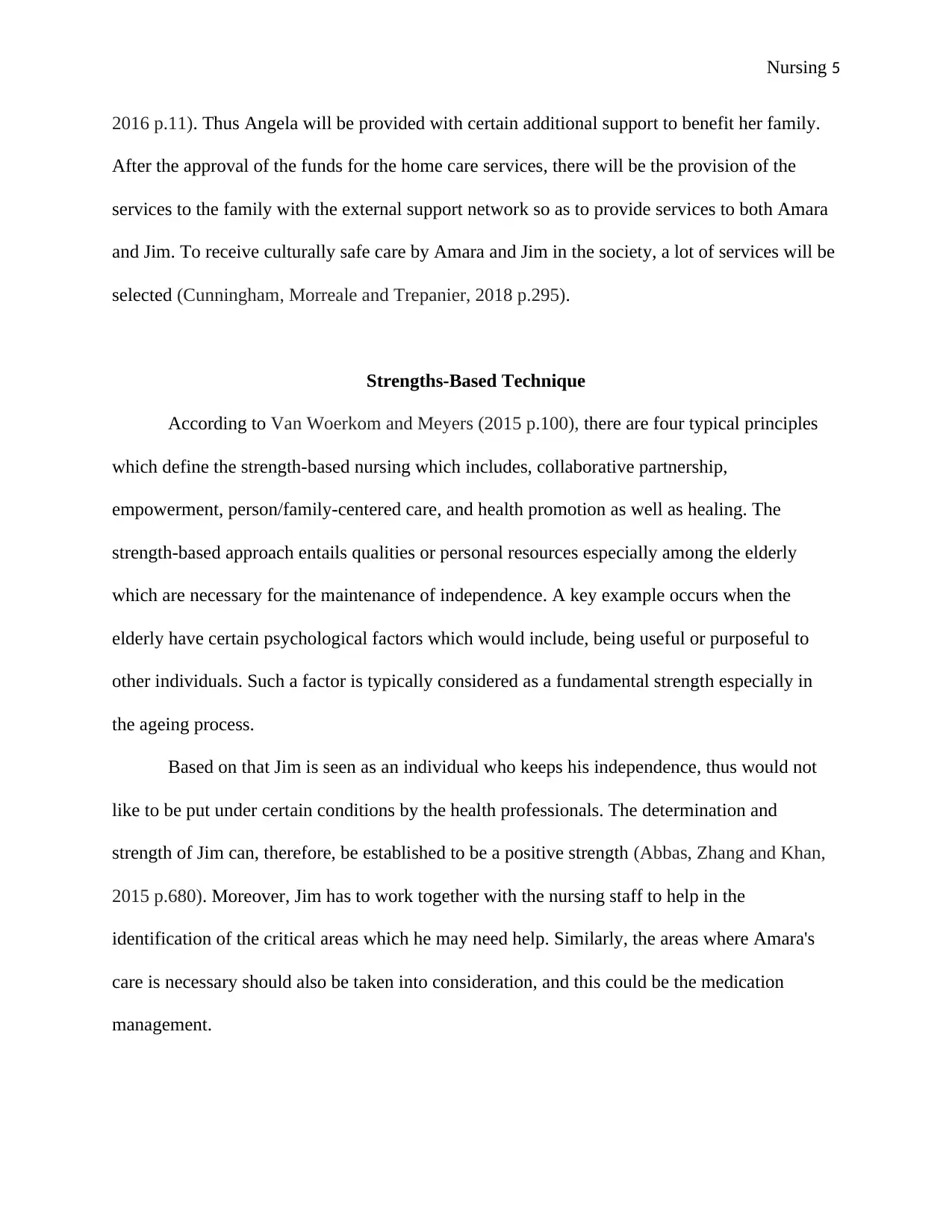
2016 p.11). Thus Angela will be provided with certain additional support to benefit her family.
After the approval of the funds for the home care services, there will be the provision of the
services to the family with the external support network so as to provide services to both Amara
and Jim. To receive culturally safe care by Amara and Jim in the society, a lot of services will be
selected (Cunningham, Morreale and Trepanier, 2018 p.295).
Strengths-Based Technique
According to Van Woerkom and Meyers (2015 p.100), there are four typical principles
which define the strength-based nursing which includes, collaborative partnership,
empowerment, person/family-centered care, and health promotion as well as healing. The
strength-based approach entails qualities or personal resources especially among the elderly
which are necessary for the maintenance of independence. A key example occurs when the
elderly have certain psychological factors which would include, being useful or purposeful to
other individuals. Such a factor is typically considered as a fundamental strength especially in
the ageing process.
Based on that Jim is seen as an individual who keeps his independence, thus would not
like to be put under certain conditions by the health professionals. The determination and
strength of Jim can, therefore, be established to be a positive strength (Abbas, Zhang and Khan,
2015 p.680). Moreover, Jim has to work together with the nursing staff to help in the
identification of the critical areas which he may need help. Similarly, the areas where Amara's
care is necessary should also be taken into consideration, and this could be the medication
management.
2016 p.11). Thus Angela will be provided with certain additional support to benefit her family.
After the approval of the funds for the home care services, there will be the provision of the
services to the family with the external support network so as to provide services to both Amara
and Jim. To receive culturally safe care by Amara and Jim in the society, a lot of services will be
selected (Cunningham, Morreale and Trepanier, 2018 p.295).
Strengths-Based Technique
According to Van Woerkom and Meyers (2015 p.100), there are four typical principles
which define the strength-based nursing which includes, collaborative partnership,
empowerment, person/family-centered care, and health promotion as well as healing. The
strength-based approach entails qualities or personal resources especially among the elderly
which are necessary for the maintenance of independence. A key example occurs when the
elderly have certain psychological factors which would include, being useful or purposeful to
other individuals. Such a factor is typically considered as a fundamental strength especially in
the ageing process.
Based on that Jim is seen as an individual who keeps his independence, thus would not
like to be put under certain conditions by the health professionals. The determination and
strength of Jim can, therefore, be established to be a positive strength (Abbas, Zhang and Khan,
2015 p.680). Moreover, Jim has to work together with the nursing staff to help in the
identification of the critical areas which he may need help. Similarly, the areas where Amara's
care is necessary should also be taken into consideration, and this could be the medication
management.
Nursing 6
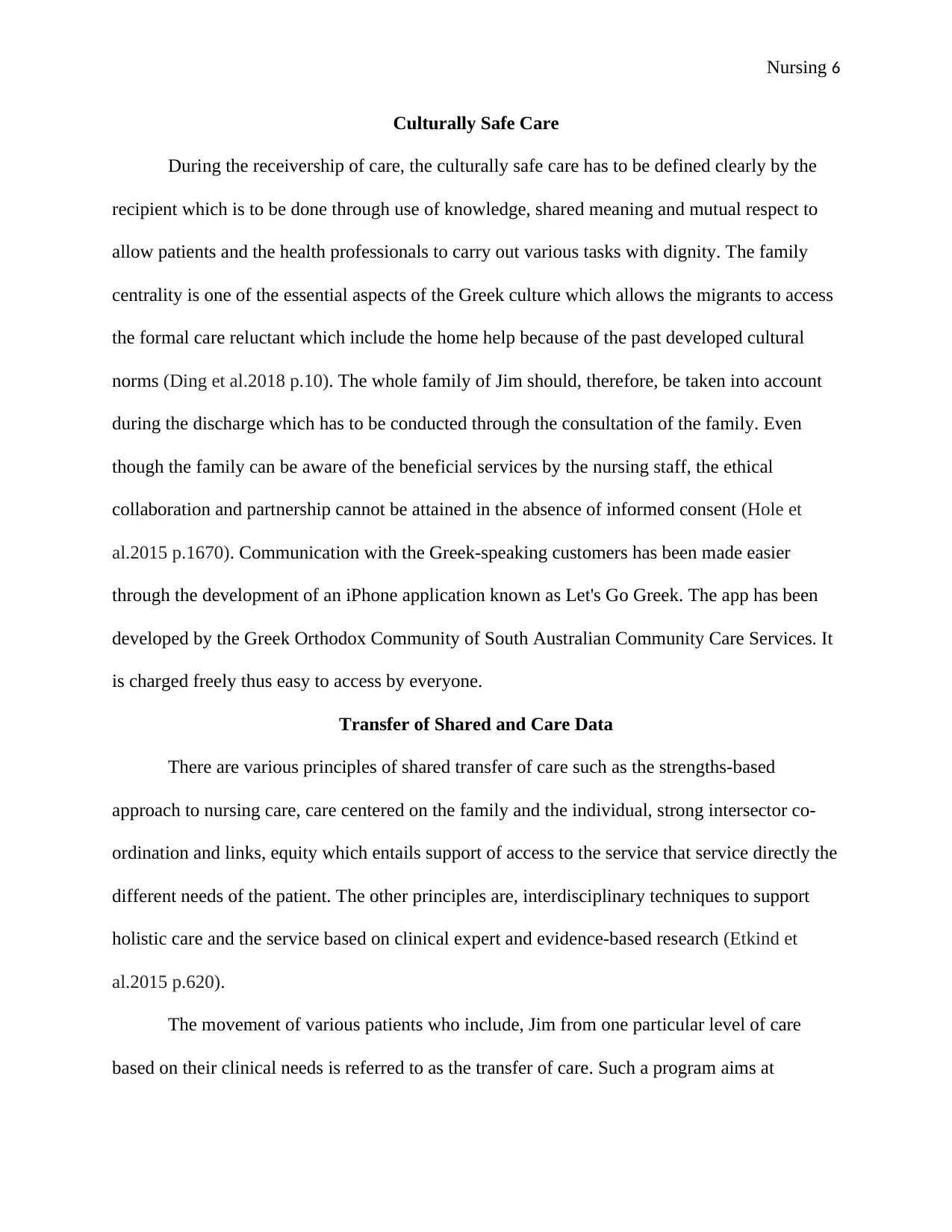
Culturally Safe Care
During the receivership of care, the culturally safe care has to be defined clearly by the
recipient which is to be done through use of knowledge, shared meaning and mutual respect to
allow patients and the health professionals to carry out various tasks with dignity. The family
centrality is one of the essential aspects of the Greek culture which allows the migrants to access
the formal care reluctant which include the home help because of the past developed cultural
norms (Ding et al.2018 p.10). The whole family of Jim should, therefore, be taken into account
during the discharge which has to be conducted through the consultation of the family. Even
though the family can be aware of the beneficial services by the nursing staff, the ethical
collaboration and partnership cannot be attained in the absence of informed consent (Hole et
al.2015 p.1670). Communication with the Greek-speaking customers has been made easier
through the development of an iPhone application known as Let's Go Greek. The app has been
developed by the Greek Orthodox Community of South Australian Community Care Services. It
is charged freely thus easy to access by everyone.
Transfer of Shared and Care Data
There are various principles of shared transfer of care such as the strengths-based
approach to nursing care, care centered on the family and the individual, strong intersector co-
ordination and links, equity which entails support of access to the service that service directly the
different needs of the patient. The other principles are, interdisciplinary techniques to support
holistic care and the service based on clinical expert and evidence-based research (Etkind et
al.2015 p.620).
The movement of various patients who include, Jim from one particular level of care
based on their clinical needs is referred to as the transfer of care. Such a program aims at
Culturally Safe Care
During the receivership of care, the culturally safe care has to be defined clearly by the
recipient which is to be done through use of knowledge, shared meaning and mutual respect to
allow patients and the health professionals to carry out various tasks with dignity. The family
centrality is one of the essential aspects of the Greek culture which allows the migrants to access
the formal care reluctant which include the home help because of the past developed cultural
norms (Ding et al.2018 p.10). The whole family of Jim should, therefore, be taken into account
during the discharge which has to be conducted through the consultation of the family. Even
though the family can be aware of the beneficial services by the nursing staff, the ethical
collaboration and partnership cannot be attained in the absence of informed consent (Hole et
al.2015 p.1670). Communication with the Greek-speaking customers has been made easier
through the development of an iPhone application known as Let's Go Greek. The app has been
developed by the Greek Orthodox Community of South Australian Community Care Services. It
is charged freely thus easy to access by everyone.
Transfer of Shared and Care Data
There are various principles of shared transfer of care such as the strengths-based
approach to nursing care, care centered on the family and the individual, strong intersector co-
ordination and links, equity which entails support of access to the service that service directly the
different needs of the patient. The other principles are, interdisciplinary techniques to support
holistic care and the service based on clinical expert and evidence-based research (Etkind et
al.2015 p.620).
The movement of various patients who include, Jim from one particular level of care
based on their clinical needs is referred to as the transfer of care. Such a program aims at
⊘ This is a preview!⊘
Do you want full access?
Subscribe today to unlock all pages.
Trusted by 1+ million students worldwide
Nursing 7
providing supportive care to the carers, patients as well as their family in their discharge plan.
Consequently, the communication can be enhanced through the shared clinical data which is
conducted across the care settings Brown, 2018 p.374). Such a communication process, however,
has to be done with much collaboration all over the healthcare sectors which include the
community settings and acute care. At the same time, the various principles of shared transfer of
care should be taken into account.
In the case of Jim which presents a complex situation, ethical dilemmas can emerge, and
this is in relation to the confidentiality and sharing of healthcare data. Jim’s welfare can,
therefore, be protected by educating him on the key benefits of the services regarding his
diagnosis and symptoms, thus enabling him to make informed decisions about the discharge
(Unroe et al.2015, p.165).
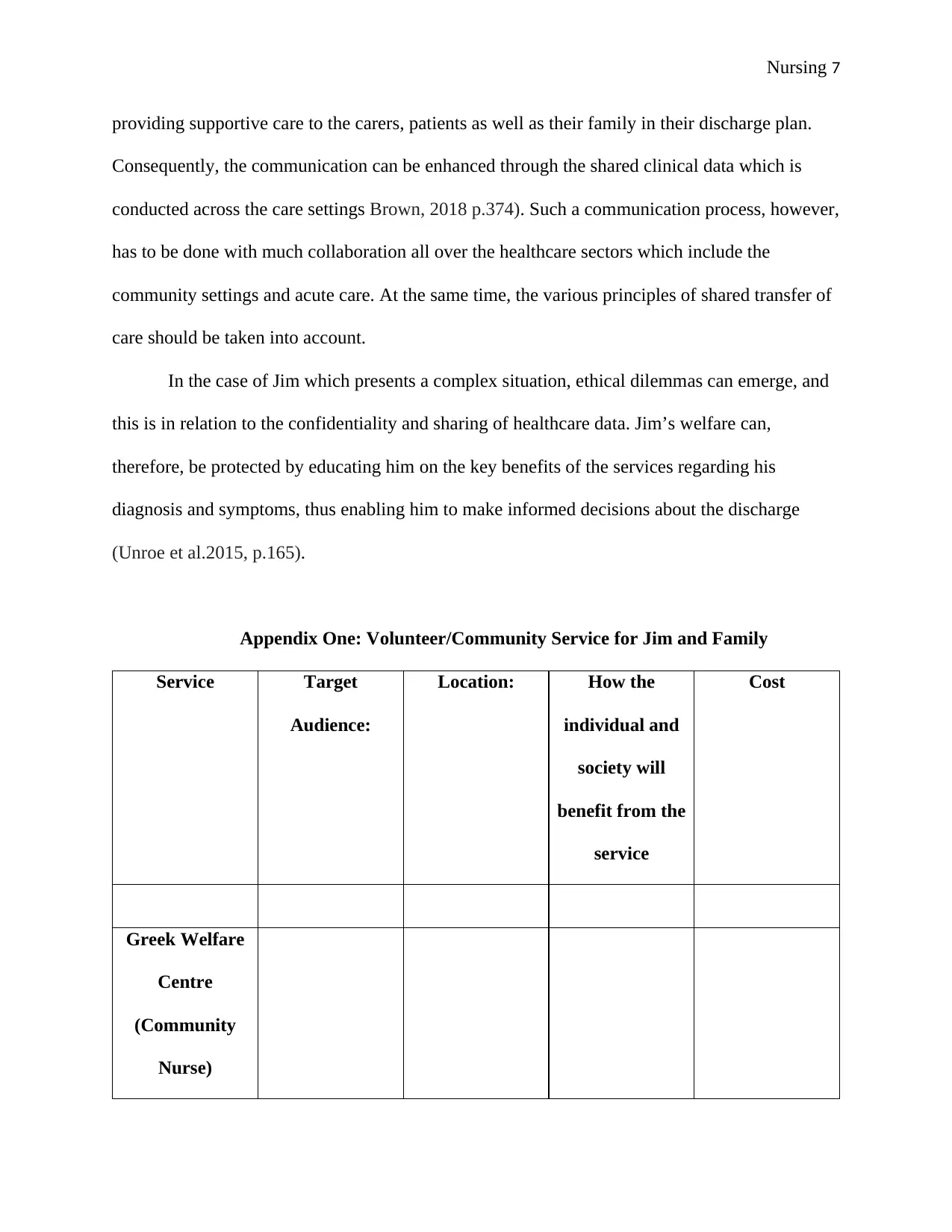
Appendix One: Volunteer/Community Service for Jim and Family
Service Target
Audience:
Location: How the
individual and
society will
benefit from the
service
Cost
Greek Welfare
Centre
(Community
Nurse)
providing supportive care to the carers, patients as well as their family in their discharge plan.
Consequently, the communication can be enhanced through the shared clinical data which is
conducted across the care settings Brown, 2018 p.374). Such a communication process, however,
has to be done with much collaboration all over the healthcare sectors which include the
community settings and acute care. At the same time, the various principles of shared transfer of
care should be taken into account.
In the case of Jim which presents a complex situation, ethical dilemmas can emerge, and
this is in relation to the confidentiality and sharing of healthcare data. Jim’s welfare can,
therefore, be protected by educating him on the key benefits of the services regarding his
diagnosis and symptoms, thus enabling him to make informed decisions about the discharge
(Unroe et al.2015, p.165).
Appendix One: Volunteer/Community Service for Jim and Family
Service Target
Audience:
Location: How the
individual and
society will
benefit from the
service
Cost
Greek Welfare
Centre
(Community
Nurse)
Paraphrase This Document
Need a fresh take? Get an instant paraphrase of this document with our AI Paraphraser

Nursing 8
(Department of
Health)
(Department of
Health)
Nursing 9
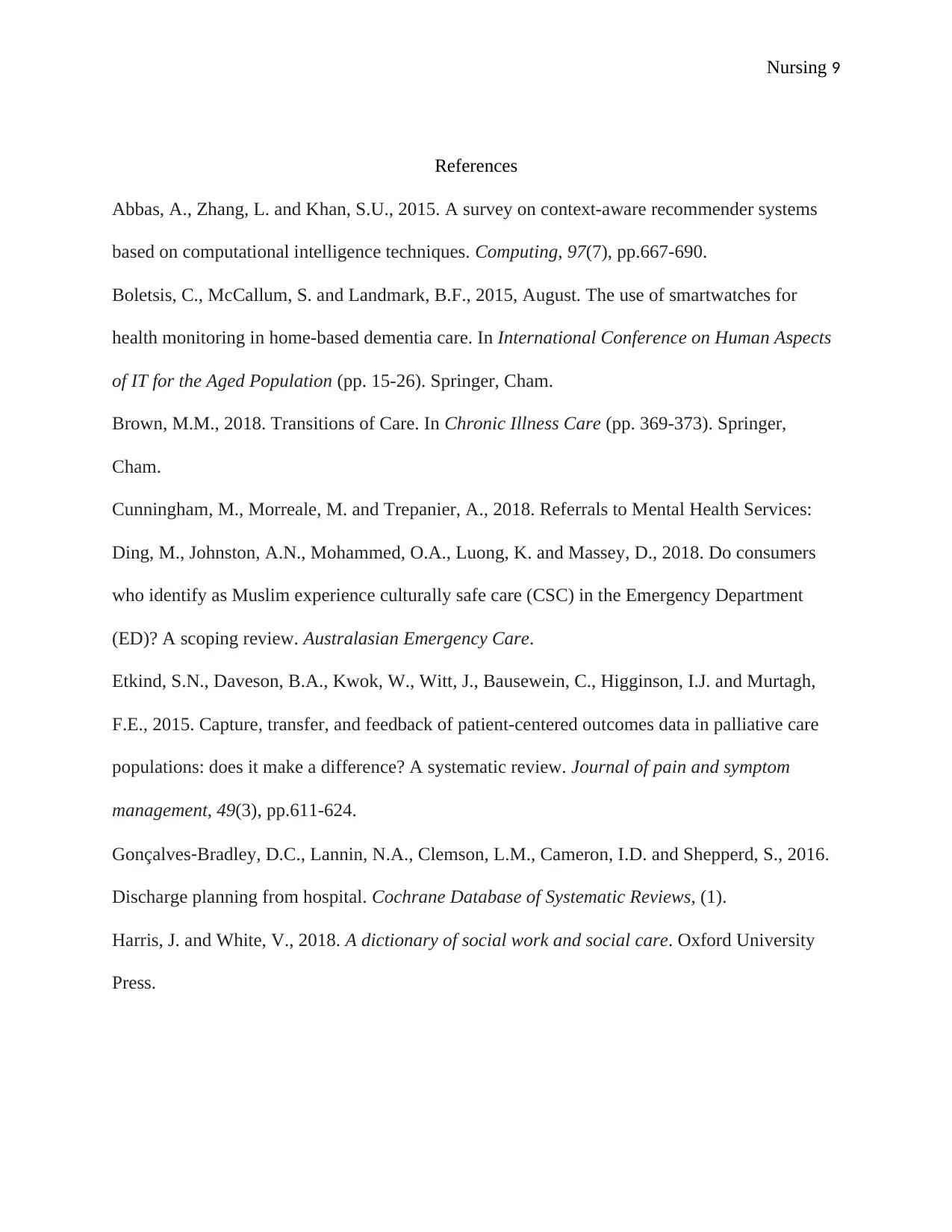
References
Abbas, A., Zhang, L. and Khan, S.U., 2015. A survey on context-aware recommender systems
based on computational intelligence techniques. Computing, 97(7), pp.667-690.
Boletsis, C., McCallum, S. and Landmark, B.F., 2015, August. The use of smartwatches for
health monitoring in home-based dementia care. In International Conference on Human Aspects
of IT for the Aged Population (pp. 15-26). Springer, Cham.
Brown, M.M., 2018. Transitions of Care. In Chronic Illness Care (pp. 369-373). Springer,
Cham.
Cunningham, M., Morreale, M. and Trepanier, A., 2018. Referrals to Mental Health Services:
Ding, M., Johnston, A.N., Mohammed, O.A., Luong, K. and Massey, D., 2018. Do consumers
who identify as Muslim experience culturally safe care (CSC) in the Emergency Department
(ED)? A scoping review. Australasian Emergency Care.
Etkind, S.N., Daveson, B.A., Kwok, W., Witt, J., Bausewein, C., Higginson, I.J. and Murtagh,
F.E., 2015. Capture, transfer, and feedback of patient-centered outcomes data in palliative care
populations: does it make a difference? A systematic review. Journal of pain and symptom
management, 49(3), pp.611-624.
Gonçalves‐Bradley, D.C., Lannin, N.A., Clemson, L.M., Cameron, I.D. and Shepperd, S., 2016.
Discharge planning from hospital. Cochrane Database of Systematic Reviews, (1).
Harris, J. and White, V., 2018. A dictionary of social work and social care. Oxford University
Press.
References
Abbas, A., Zhang, L. and Khan, S.U., 2015. A survey on context-aware recommender systems
based on computational intelligence techniques. Computing, 97(7), pp.667-690.
Boletsis, C., McCallum, S. and Landmark, B.F., 2015, August. The use of smartwatches for
health monitoring in home-based dementia care. In International Conference on Human Aspects
of IT for the Aged Population (pp. 15-26). Springer, Cham.
Brown, M.M., 2018. Transitions of Care. In Chronic Illness Care (pp. 369-373). Springer,
Cham.
Cunningham, M., Morreale, M. and Trepanier, A., 2018. Referrals to Mental Health Services:
Ding, M., Johnston, A.N., Mohammed, O.A., Luong, K. and Massey, D., 2018. Do consumers
who identify as Muslim experience culturally safe care (CSC) in the Emergency Department
(ED)? A scoping review. Australasian Emergency Care.
Etkind, S.N., Daveson, B.A., Kwok, W., Witt, J., Bausewein, C., Higginson, I.J. and Murtagh,
F.E., 2015. Capture, transfer, and feedback of patient-centered outcomes data in palliative care
populations: does it make a difference? A systematic review. Journal of pain and symptom
management, 49(3), pp.611-624.
Gonçalves‐Bradley, D.C., Lannin, N.A., Clemson, L.M., Cameron, I.D. and Shepperd, S., 2016.
Discharge planning from hospital. Cochrane Database of Systematic Reviews, (1).
Harris, J. and White, V., 2018. A dictionary of social work and social care. Oxford University
Press.
⊘ This is a preview!⊘
Do you want full access?
Subscribe today to unlock all pages.
Trusted by 1+ million students worldwide
Nursing 10
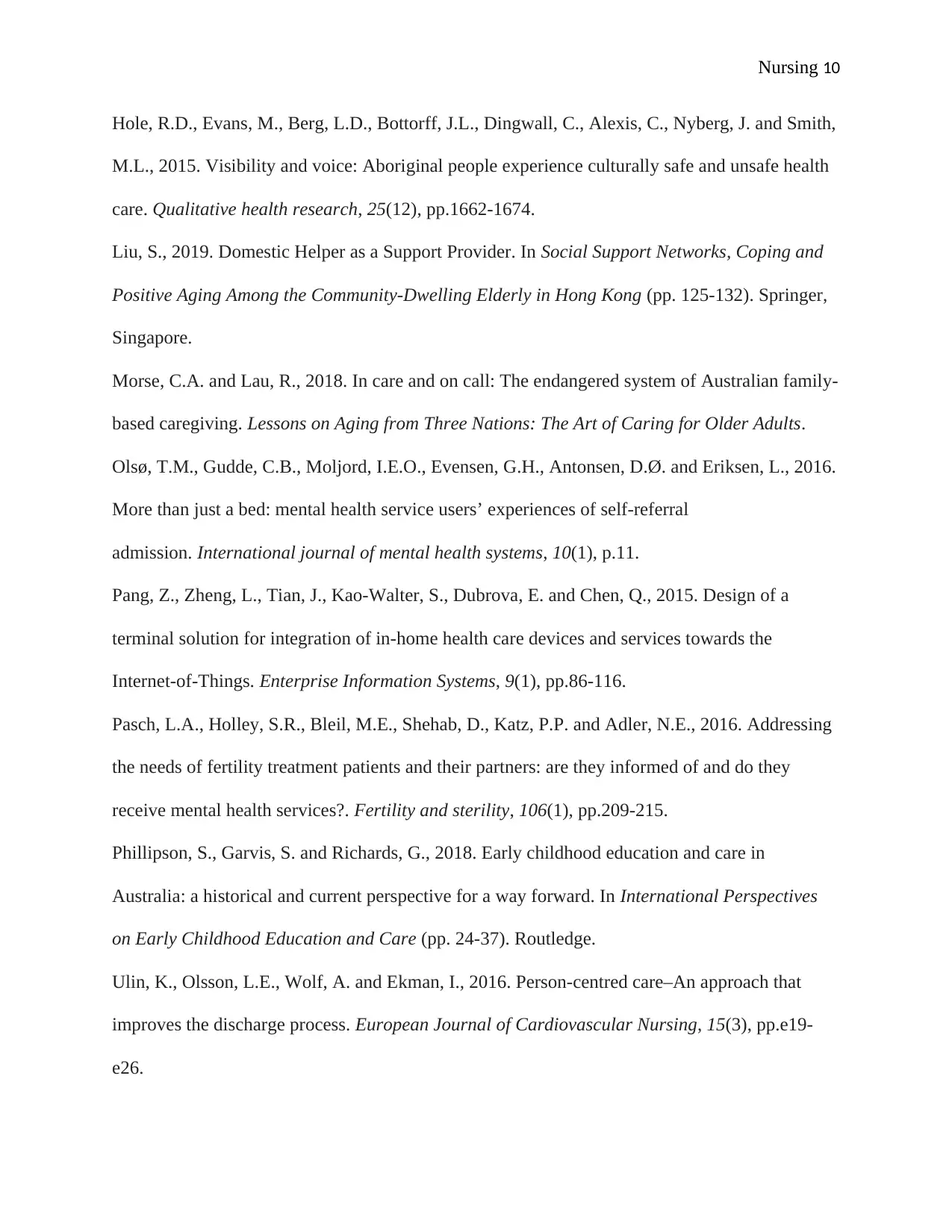
Hole, R.D., Evans, M., Berg, L.D., Bottorff, J.L., Dingwall, C., Alexis, C., Nyberg, J. and Smith,
M.L., 2015. Visibility and voice: Aboriginal people experience culturally safe and unsafe health
care. Qualitative health research, 25(12), pp.1662-1674.
Liu, S., 2019. Domestic Helper as a Support Provider. In Social Support Networks, Coping and
Positive Aging Among the Community-Dwelling Elderly in Hong Kong (pp. 125-132). Springer,
Singapore.
Morse, C.A. and Lau, R., 2018. In care and on call: The endangered system of Australian family-
based caregiving. Lessons on Aging from Three Nations: The Art of Caring for Older Adults.
Olsø, T.M., Gudde, C.B., Moljord, I.E.O., Evensen, G.H., Antonsen, D.Ø. and Eriksen, L., 2016.
More than just a bed: mental health service users’ experiences of self-referral
admission. International journal of mental health systems, 10(1), p.11.
Pang, Z., Zheng, L., Tian, J., Kao-Walter, S., Dubrova, E. and Chen, Q., 2015. Design of a
terminal solution for integration of in-home health care devices and services towards the
Internet-of-Things. Enterprise Information Systems, 9(1), pp.86-116.
Pasch, L.A., Holley, S.R., Bleil, M.E., Shehab, D., Katz, P.P. and Adler, N.E., 2016. Addressing
the needs of fertility treatment patients and their partners: are they informed of and do they
receive mental health services?. Fertility and sterility, 106(1), pp.209-215.
Phillipson, S., Garvis, S. and Richards, G., 2018. Early childhood education and care in
Australia: a historical and current perspective for a way forward. In International Perspectives
on Early Childhood Education and Care (pp. 24-37). Routledge.
Ulin, K., Olsson, L.E., Wolf, A. and Ekman, I., 2016. Person-centred care–An approach that
improves the discharge process. European Journal of Cardiovascular Nursing, 15(3), pp.e19-
e26.
Hole, R.D., Evans, M., Berg, L.D., Bottorff, J.L., Dingwall, C., Alexis, C., Nyberg, J. and Smith,
M.L., 2015. Visibility and voice: Aboriginal people experience culturally safe and unsafe health
care. Qualitative health research, 25(12), pp.1662-1674.
Liu, S., 2019. Domestic Helper as a Support Provider. In Social Support Networks, Coping and
Positive Aging Among the Community-Dwelling Elderly in Hong Kong (pp. 125-132). Springer,
Singapore.
Morse, C.A. and Lau, R., 2018. In care and on call: The endangered system of Australian family-
based caregiving. Lessons on Aging from Three Nations: The Art of Caring for Older Adults.
Olsø, T.M., Gudde, C.B., Moljord, I.E.O., Evensen, G.H., Antonsen, D.Ø. and Eriksen, L., 2016.
More than just a bed: mental health service users’ experiences of self-referral
admission. International journal of mental health systems, 10(1), p.11.
Pang, Z., Zheng, L., Tian, J., Kao-Walter, S., Dubrova, E. and Chen, Q., 2015. Design of a
terminal solution for integration of in-home health care devices and services towards the
Internet-of-Things. Enterprise Information Systems, 9(1), pp.86-116.
Pasch, L.A., Holley, S.R., Bleil, M.E., Shehab, D., Katz, P.P. and Adler, N.E., 2016. Addressing
the needs of fertility treatment patients and their partners: are they informed of and do they
receive mental health services?. Fertility and sterility, 106(1), pp.209-215.
Phillipson, S., Garvis, S. and Richards, G., 2018. Early childhood education and care in
Australia: a historical and current perspective for a way forward. In International Perspectives
on Early Childhood Education and Care (pp. 24-37). Routledge.
Ulin, K., Olsson, L.E., Wolf, A. and Ekman, I., 2016. Person-centred care–An approach that
improves the discharge process. European Journal of Cardiovascular Nursing, 15(3), pp.e19-
e26.
Paraphrase This Document
Need a fresh take? Get an instant paraphrase of this document with our AI Paraphraser
Nursing 11
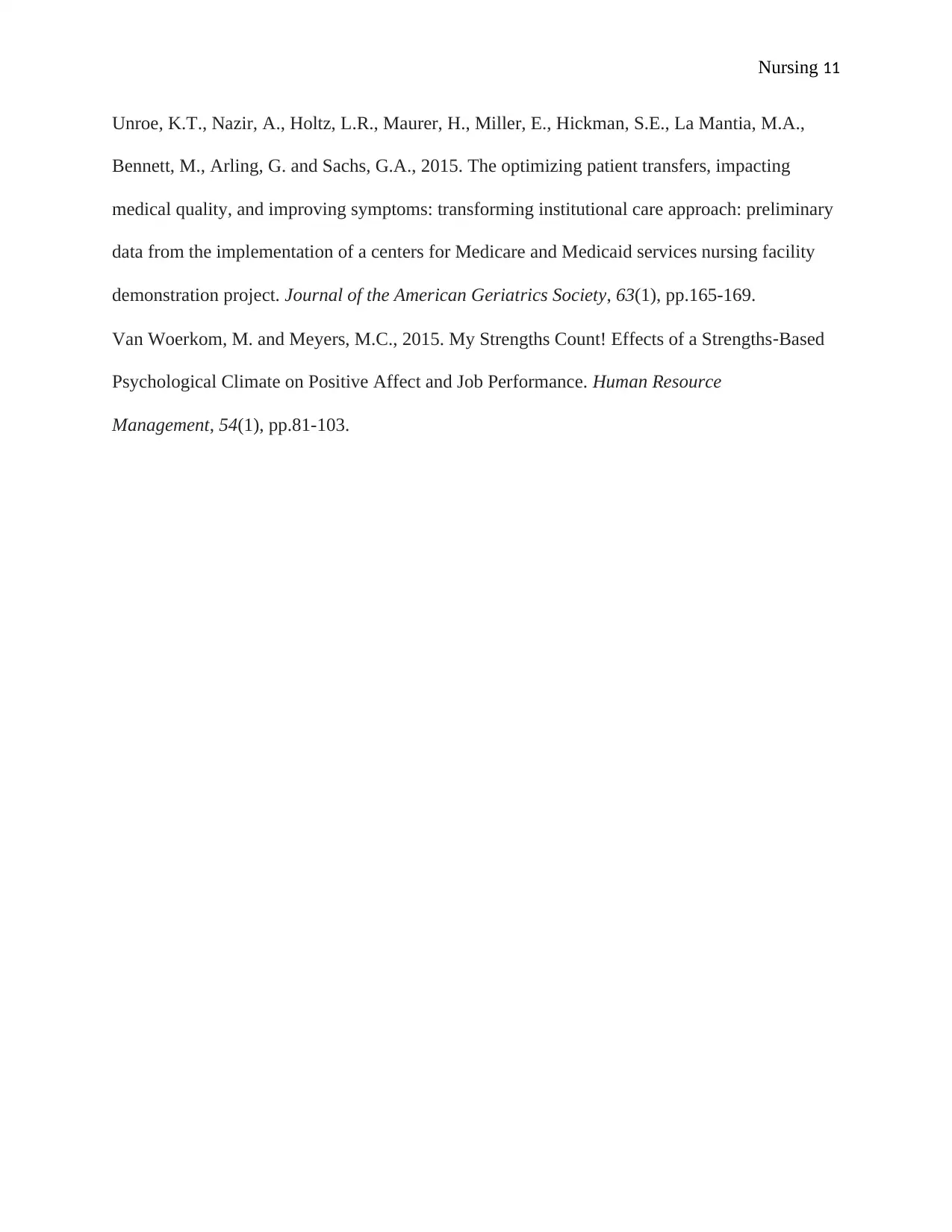
Unroe, K.T., Nazir, A., Holtz, L.R., Maurer, H., Miller, E., Hickman, S.E., La Mantia, M.A.,
Bennett, M., Arling, G. and Sachs, G.A., 2015. The optimizing patient transfers, impacting
medical quality, and improving symptoms: transforming institutional care approach: preliminary
data from the implementation of a centers for Medicare and Medicaid services nursing facility
demonstration project. Journal of the American Geriatrics Society, 63(1), pp.165-169.
Van Woerkom, M. and Meyers, M.C., 2015. My Strengths Count! Effects of a Strengths‐Based
Psychological Climate on Positive Affect and Job Performance. Human Resource
Management, 54(1), pp.81-103.
Unroe, K.T., Nazir, A., Holtz, L.R., Maurer, H., Miller, E., Hickman, S.E., La Mantia, M.A.,
Bennett, M., Arling, G. and Sachs, G.A., 2015. The optimizing patient transfers, impacting
medical quality, and improving symptoms: transforming institutional care approach: preliminary
data from the implementation of a centers for Medicare and Medicaid services nursing facility
demonstration project. Journal of the American Geriatrics Society, 63(1), pp.165-169.
Van Woerkom, M. and Meyers, M.C., 2015. My Strengths Count! Effects of a Strengths‐Based
Psychological Climate on Positive Affect and Job Performance. Human Resource
Management, 54(1), pp.81-103.

1 out of 11


Related Documents


Your All-in-One AI-Powered Toolkit for Academic Success.
+13062052269
info@desklib.com
Available 24*7 on WhatsApp / Email
![[object Object]](/_next/static/media/star-bottom.7253800d.svg)
Unlock your academic potential
Copyright © 2020–2026 A2Z Services. All Rights Reserved. Developed and managed by ZUCOL.