Larissa's Education: Cultural Sensitivity and Support Strategies
VerifiedAdded on 2023/04/22
|7
|1623
|397
Essay
AI Summary
This assignment explores the influence of cultural, language, and family backgrounds on a student's learning, using the case study of Larissa. It discusses how understanding a student's home environment and developmental levels can assist teachers in providing appropriate educational services and support. Furthermore, it outlines steps a teacher can take to build a collaborative relationship with the student and their family, taking into account their unique circumstances. The assignment also examines low-tech and high-tech assistive technologies that can support the student's learning, and suggests ways for a teacher to learn more about the student's cultural background. The assignment also touches upon the importance of cultural responsiveness in meeting the needs of diverse students and emphasizes the role of faith and cultural understanding in educational settings, highlighting the commitment to diversity and inclusion. The Grand Canyon University's approach to Christian values and their impact on student engagement and diversity is also discussed.

Running head: QUESTION AND ANSWER
Question and Answer
Name of the Student:
Name of the University:
Author Note
Question and Answer
Name of the Student:
Name of the University:
Author Note
Paraphrase This Document
Need a fresh take? Get an instant paraphrase of this document with our AI Paraphraser

1QUESTION AND ANSWER
i) Three ways in which cultural, language, and family background could influence Larissa’s
learning
The colloquial language, actions and behaviour of most foreign students vary as it is highly
influenced by the society and family one comes from. For most students coping with an
atmosphere that they are unfamiliar with must be challenging. In Larissa’s case, it is the
same. The below points reflects the negative influences it might have on a student’s
education.
Not familiar to a particular language can lead to student not able to follow and
understand what is being taught in class.
Not being accepted in the school by classmates or teachers as coming from a
diverse culture, may lead to depressing or violent measure to gain attention.
Having an atmosphere of domestic violence at home may reflect in the studies
of the student (Li, 2013).
ii) How will understanding Larissa's home environment and her developmental levels assist
her teachers in providing appropriate educational services and support?
Ans) When Larissa’s teacher, Mr. Fleming, came to know about the separation of her parents
and about the judges restrain order against Larisa’s father from Larissa, her teacher notified
about the order to other school authorities so that they are aware of the fact, and can take
necessary action if required against her father. In order to maintain confidentiality about the
separation issue, Mr. Fleming, never disclosed it. Further the institution that Larissa studies
respects diversity and believes in transparency between school authorities and student’s
family so that they can assist and provide guidance to students when situation demands. As
all these factors were present in Larissa’s scenario it helped her teachers a lot to assist her .
(Alkharusiet al.2014).
i) Three ways in which cultural, language, and family background could influence Larissa’s
learning
The colloquial language, actions and behaviour of most foreign students vary as it is highly
influenced by the society and family one comes from. For most students coping with an
atmosphere that they are unfamiliar with must be challenging. In Larissa’s case, it is the
same. The below points reflects the negative influences it might have on a student’s
education.
Not familiar to a particular language can lead to student not able to follow and
understand what is being taught in class.
Not being accepted in the school by classmates or teachers as coming from a
diverse culture, may lead to depressing or violent measure to gain attention.
Having an atmosphere of domestic violence at home may reflect in the studies
of the student (Li, 2013).
ii) How will understanding Larissa's home environment and her developmental levels assist
her teachers in providing appropriate educational services and support?
Ans) When Larissa’s teacher, Mr. Fleming, came to know about the separation of her parents
and about the judges restrain order against Larisa’s father from Larissa, her teacher notified
about the order to other school authorities so that they are aware of the fact, and can take
necessary action if required against her father. In order to maintain confidentiality about the
separation issue, Mr. Fleming, never disclosed it. Further the institution that Larissa studies
respects diversity and believes in transparency between school authorities and student’s
family so that they can assist and provide guidance to students when situation demands. As
all these factors were present in Larissa’s scenario it helped her teachers a lot to assist her .
(Alkharusiet al.2014).

2QUESTION AND ANSWER
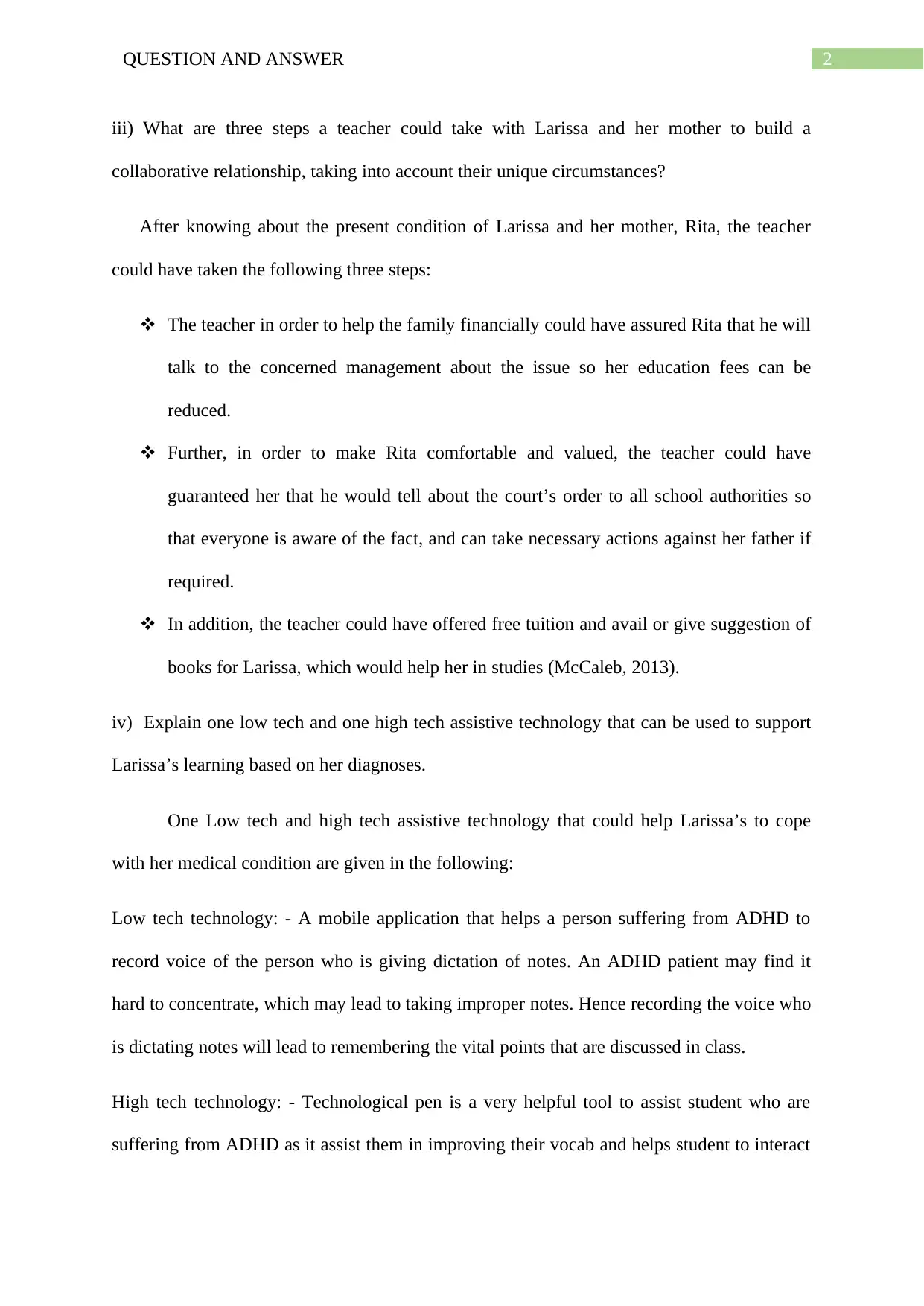
iii) What are three steps a teacher could take with Larissa and her mother to build a
collaborative relationship, taking into account their unique circumstances?
After knowing about the present condition of Larissa and her mother, Rita, the teacher
could have taken the following three steps:
The teacher in order to help the family financially could have assured Rita that he will
talk to the concerned management about the issue so her education fees can be
reduced.
Further, in order to make Rita comfortable and valued, the teacher could have
guaranteed her that he would tell about the court’s order to all school authorities so
that everyone is aware of the fact, and can take necessary actions against her father if
required.
In addition, the teacher could have offered free tuition and avail or give suggestion of
books for Larissa, which would help her in studies (McCaleb, 2013).
iv) Explain one low tech and one high tech assistive technology that can be used to support
Larissa’s learning based on her diagnoses.
One Low tech and high tech assistive technology that could help Larissa’s to cope
with her medical condition are given in the following:
Low tech technology: - A mobile application that helps a person suffering from ADHD to
record voice of the person who is giving dictation of notes. An ADHD patient may find it
hard to concentrate, which may lead to taking improper notes. Hence recording the voice who
is dictating notes will lead to remembering the vital points that are discussed in class.
High tech technology: - Technological pen is a very helpful tool to assist student who are
suffering from ADHD as it assist them in improving their vocab and helps student to interact
iii) What are three steps a teacher could take with Larissa and her mother to build a
collaborative relationship, taking into account their unique circumstances?
After knowing about the present condition of Larissa and her mother, Rita, the teacher
could have taken the following three steps:
The teacher in order to help the family financially could have assured Rita that he will
talk to the concerned management about the issue so her education fees can be
reduced.
Further, in order to make Rita comfortable and valued, the teacher could have
guaranteed her that he would tell about the court’s order to all school authorities so
that everyone is aware of the fact, and can take necessary actions against her father if
required.
In addition, the teacher could have offered free tuition and avail or give suggestion of
books for Larissa, which would help her in studies (McCaleb, 2013).
iv) Explain one low tech and one high tech assistive technology that can be used to support
Larissa’s learning based on her diagnoses.
One Low tech and high tech assistive technology that could help Larissa’s to cope
with her medical condition are given in the following:
Low tech technology: - A mobile application that helps a person suffering from ADHD to
record voice of the person who is giving dictation of notes. An ADHD patient may find it
hard to concentrate, which may lead to taking improper notes. Hence recording the voice who
is dictating notes will lead to remembering the vital points that are discussed in class.
High tech technology: - Technological pen is a very helpful tool to assist student who are
suffering from ADHD as it assist them in improving their vocab and helps student to interact
⊘ This is a preview!⊘
Do you want full access?
Subscribe today to unlock all pages.

Trusted by 1+ million students worldwide

3QUESTION AND ANSWER
with their teachers and classmate. Prime feature of the pen is that it helps student to scan a
line of text or word and narrates it, which helps in fluency of reading. This software also
shows spelling, synonyms and definition of the scanned text and translates the same in other
languages (Bouck, 2016).
v) What can a teacher do for learning more on Larissa’s El Salvadorian background? Why is
it important for a teacher to learn about the cultural backgrounds of his students?
Indulging in one-to-one discussions with Larissa would help the teachers in gaining
knowledge about Larissa’s El Salvadorian background. She needs to be assured that her
responses would be kept confidential, which would help her to produce the answers without
any hesitation. In between interruptions would aggravate the complexities in speech.
Therefore, the teacher needs to take care of letting her finish and then proposing another
question (Li, 2013). Referring to similar case studies would enrich the knowledge of the
teachers about providing proper care, treatment and education to students like Larissa.
In a classroom, the students belong to different socio-cultural backgrounds. The
teachers and the professors need to possess sound knowledge of these backgrounds for
respecting the individual rights and sentiments of the students. As per the arguments of
McCaleb, (2013), proper knowledge of the cultural backgrounds is also crucial for the
teachers in terms of preventing the instances of conflicts, discrimination and harassments.
vi) What opportunities could a teacher seek to continue to grow and become more culturally
responsive to meet the needs of the students?
According to (Alkharusi et al., (2014), blend of socio-cultural realities within the
lecture notes is fruitful for enhancing the cultural diversity of the classroom. This approach
reflects the initiative towards providing assistance, aid and support to the community students
in terms of gaining academic establishment. On the other hand, (Bouck, 2016) is of the view
with their teachers and classmate. Prime feature of the pen is that it helps student to scan a
line of text or word and narrates it, which helps in fluency of reading. This software also
shows spelling, synonyms and definition of the scanned text and translates the same in other
languages (Bouck, 2016).
v) What can a teacher do for learning more on Larissa’s El Salvadorian background? Why is
it important for a teacher to learn about the cultural backgrounds of his students?
Indulging in one-to-one discussions with Larissa would help the teachers in gaining
knowledge about Larissa’s El Salvadorian background. She needs to be assured that her
responses would be kept confidential, which would help her to produce the answers without
any hesitation. In between interruptions would aggravate the complexities in speech.
Therefore, the teacher needs to take care of letting her finish and then proposing another
question (Li, 2013). Referring to similar case studies would enrich the knowledge of the
teachers about providing proper care, treatment and education to students like Larissa.
In a classroom, the students belong to different socio-cultural backgrounds. The
teachers and the professors need to possess sound knowledge of these backgrounds for
respecting the individual rights and sentiments of the students. As per the arguments of
McCaleb, (2013), proper knowledge of the cultural backgrounds is also crucial for the
teachers in terms of preventing the instances of conflicts, discrimination and harassments.
vi) What opportunities could a teacher seek to continue to grow and become more culturally
responsive to meet the needs of the students?
According to (Alkharusi et al., (2014), blend of socio-cultural realities within the
lecture notes is fruitful for enhancing the cultural diversity of the classroom. This approach
reflects the initiative towards providing assistance, aid and support to the community students
in terms of gaining academic establishment. On the other hand, (Bouck, 2016) is of the view
Paraphrase This Document
Need a fresh take? Get an instant paraphrase of this document with our AI Paraphraser

4QUESTION AND ANSWER
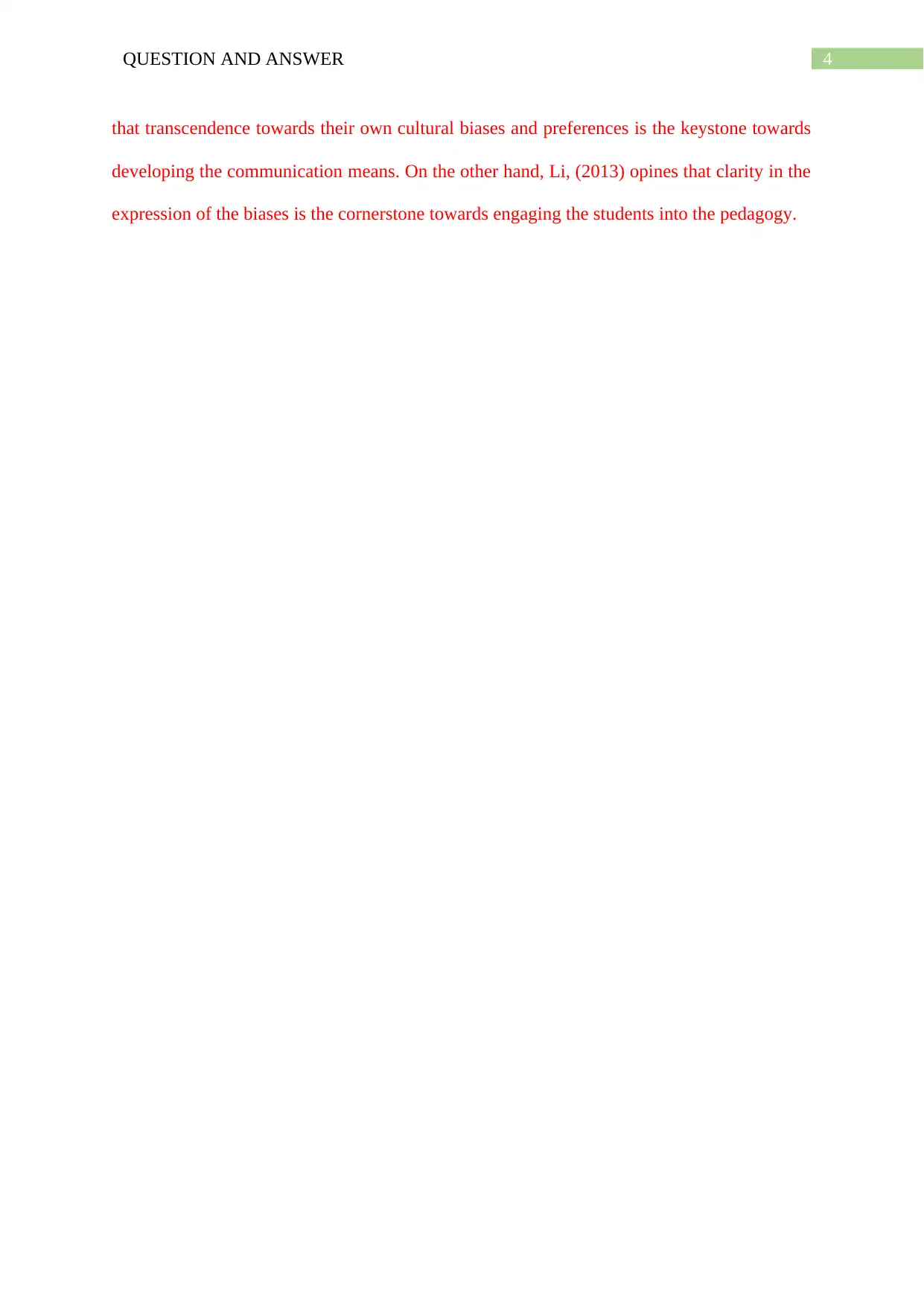
that transcendence towards their own cultural biases and preferences is the keystone towards
developing the communication means. On the other hand, Li, (2013) opines that clarity in the
expression of the biases is the cornerstone towards engaging the students into the pedagogy.
that transcendence towards their own cultural biases and preferences is the keystone towards
developing the communication means. On the other hand, Li, (2013) opines that clarity in the
expression of the biases is the cornerstone towards engaging the students into the pedagogy.

5QUESTION AND ANSWER
Part 2
The personnel at Grand Canyon University, believes that adherence to right doctrine
is essential for preserving the core values. Commitment towards complying with the beliefs
enhances the standards and quality of the Christian ideology (Gcu.edu, 2019). Within this,
focus is placed on living faith, which projects the radical transformation of the individuals
and communities in terms of serving the humankind. Therefore, I feel that capability in
generating faith among the students result in the achievement of trust, loyalty and
dependence. If the students’s needs are met, their involvement to the services would be more.
This involvement enhances the diversity, as the clients from different socio-cultural
backgrounds would invest in the service of the education institutions.
I also feel that intercultural studies has diversified the management of pedagogies in
the academic settings. Typical evidence of this management is the development of
competencies, which results in the creation of knowledge based societies. I also think that
legislative requirements of multiculturalism is an initiative towards averting the instances of
instances of conflicts, discriminations and harassments in the educational settings. For this,
sound knowledge of various cultural backgrounds is crucial (Banks, 2015). Therefore,
according to me, tactful lesson planning is beneficial in terms of catering to the individual
needs of the students.
Special care of the language barriers preserves the faith within the students regarding
the services of the educational services. Initiatives towards developing channels for
communicating relates with cultural liaisons to understand the culture of the family and their
queries (Gay, 2013). This understanding approach upgrades the standards and quality of
education within multicultural ambience.
Part 2
The personnel at Grand Canyon University, believes that adherence to right doctrine
is essential for preserving the core values. Commitment towards complying with the beliefs
enhances the standards and quality of the Christian ideology (Gcu.edu, 2019). Within this,
focus is placed on living faith, which projects the radical transformation of the individuals
and communities in terms of serving the humankind. Therefore, I feel that capability in
generating faith among the students result in the achievement of trust, loyalty and
dependence. If the students’s needs are met, their involvement to the services would be more.
This involvement enhances the diversity, as the clients from different socio-cultural
backgrounds would invest in the service of the education institutions.
I also feel that intercultural studies has diversified the management of pedagogies in
the academic settings. Typical evidence of this management is the development of
competencies, which results in the creation of knowledge based societies. I also think that
legislative requirements of multiculturalism is an initiative towards averting the instances of
instances of conflicts, discriminations and harassments in the educational settings. For this,
sound knowledge of various cultural backgrounds is crucial (Banks, 2015). Therefore,
according to me, tactful lesson planning is beneficial in terms of catering to the individual
needs of the students.
Special care of the language barriers preserves the faith within the students regarding
the services of the educational services. Initiatives towards developing channels for
communicating relates with cultural liaisons to understand the culture of the family and their
queries (Gay, 2013). This understanding approach upgrades the standards and quality of
education within multicultural ambience.
⊘ This is a preview!⊘
Do you want full access?
Subscribe today to unlock all pages.

Trusted by 1+ million students worldwide

6QUESTION AND ANSWER
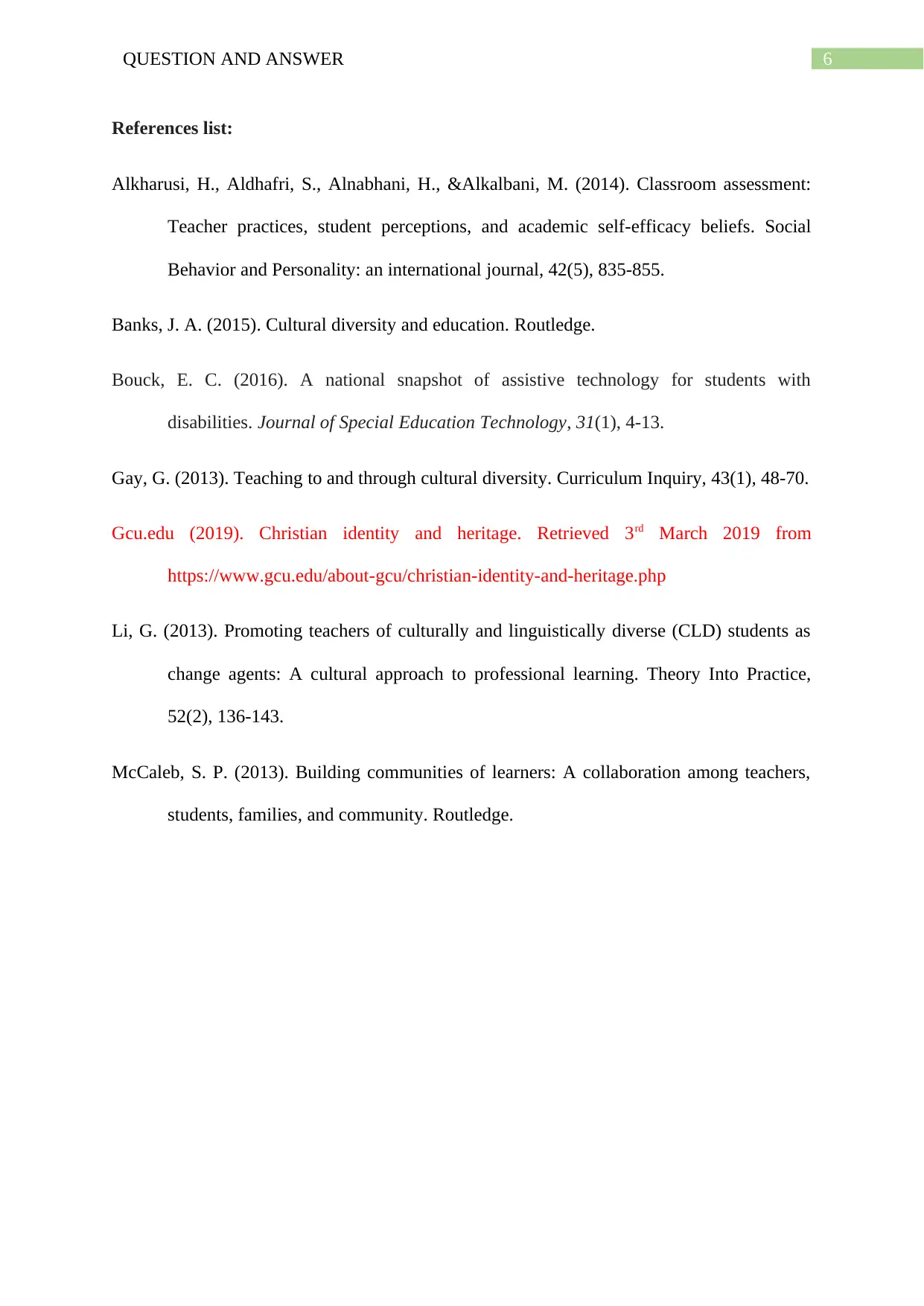
References list:
Alkharusi, H., Aldhafri, S., Alnabhani, H., &Alkalbani, M. (2014). Classroom assessment:
Teacher practices, student perceptions, and academic self-efficacy beliefs. Social
Behavior and Personality: an international journal, 42(5), 835-855.
Banks, J. A. (2015). Cultural diversity and education. Routledge.
Bouck, E. C. (2016). A national snapshot of assistive technology for students with
disabilities. Journal of Special Education Technology, 31(1), 4-13.
Gay, G. (2013). Teaching to and through cultural diversity. Curriculum Inquiry, 43(1), 48-70.
Gcu.edu (2019). Christian identity and heritage. Retrieved 3rd March 2019 from
https://www.gcu.edu/about-gcu/christian-identity-and-heritage.php
Li, G. (2013). Promoting teachers of culturally and linguistically diverse (CLD) students as
change agents: A cultural approach to professional learning. Theory Into Practice,
52(2), 136-143.
McCaleb, S. P. (2013). Building communities of learners: A collaboration among teachers,
students, families, and community. Routledge.
References list:
Alkharusi, H., Aldhafri, S., Alnabhani, H., &Alkalbani, M. (2014). Classroom assessment:
Teacher practices, student perceptions, and academic self-efficacy beliefs. Social
Behavior and Personality: an international journal, 42(5), 835-855.
Banks, J. A. (2015). Cultural diversity and education. Routledge.
Bouck, E. C. (2016). A national snapshot of assistive technology for students with
disabilities. Journal of Special Education Technology, 31(1), 4-13.
Gay, G. (2013). Teaching to and through cultural diversity. Curriculum Inquiry, 43(1), 48-70.
Gcu.edu (2019). Christian identity and heritage. Retrieved 3rd March 2019 from
https://www.gcu.edu/about-gcu/christian-identity-and-heritage.php
Li, G. (2013). Promoting teachers of culturally and linguistically diverse (CLD) students as
change agents: A cultural approach to professional learning. Theory Into Practice,
52(2), 136-143.
McCaleb, S. P. (2013). Building communities of learners: A collaboration among teachers,
students, families, and community. Routledge.
1 out of 7
Related Documents
Your All-in-One AI-Powered Toolkit for Academic Success.
+13062052269
info@desklib.com
Available 24*7 on WhatsApp / Email
Unlock your academic potential
Copyright © 2020–2026 A2Z Services. All Rights Reserved. Developed and managed by ZUCOL.