Reflecting on Culture and Buddhism: Shaping Worldviews Essay

Verified

Added on  2022/10/03

|5
|758
|3
Essay
AI Summary
This essay presents a student's reflection on culture and Buddhism, utilizing the Gibbs Reflective Cycle to explore the influence of cultural lenses on personal values, beliefs, and worldviews. The reflection begins by defining culture and acknowledging the student's own cultural identity, leading to an examination of how this cultural lens shapes their feelings and thoughts. The essay delves into the positive and negative impacts of culture on human behavior, emphasizing the development of compassion, patience, and wisdom. Through analysis, the student discusses Buddhism's tolerance and its role in fostering individual belief systems. The reflection concludes with an action plan, highlighting the importance of understanding and differentiating cultural aspects while promoting acceptance of diverse cultural differences. The essay references academic sources to support its exploration of culture, Buddhism, and personal growth.
Document Page
Running head: CULTURE AND BUDDHISM
REFLECTION ON CULTURE AND BUDDHISM
Name of the student
Name of the university
Author note
tabler-icon-diamond-filled.svg

Paraphrase This Document

Need a fresh take? Get an instant paraphrase of this document with our AI Paraphraser
Document Page
1CULTURE AND BUDDHISM
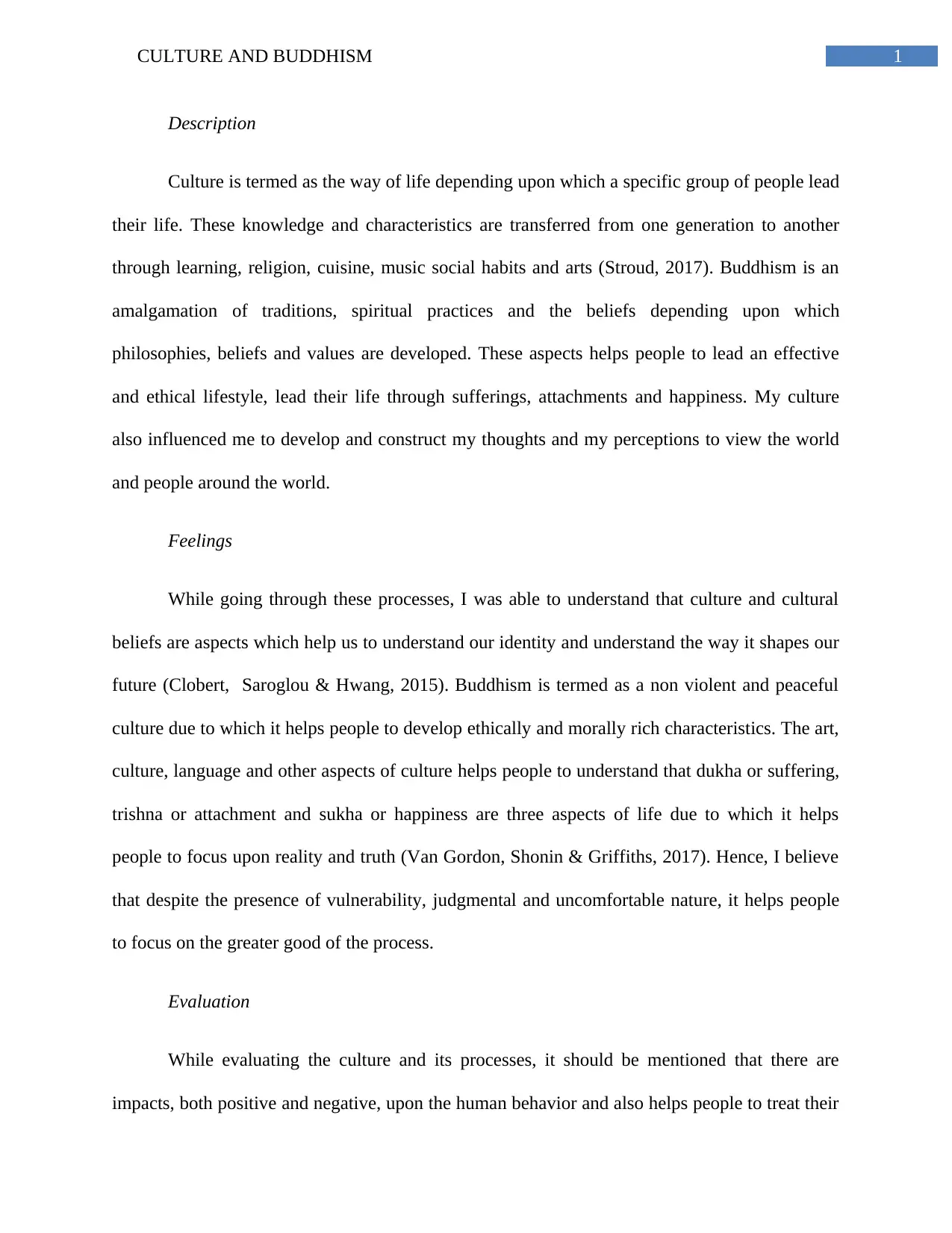
Description
Culture is termed as the way of life depending upon which a specific group of people lead
their life. These knowledge and characteristics are transferred from one generation to another
through learning, religion, cuisine, music social habits and arts (Stroud, 2017). Buddhism is an
amalgamation of traditions, spiritual practices and the beliefs depending upon which
philosophies, beliefs and values are developed. These aspects helps people to lead an effective
and ethical lifestyle, lead their life through sufferings, attachments and happiness. My culture
also influenced me to develop and construct my thoughts and my perceptions to view the world
and people around the world.
Feelings
While going through these processes, I was able to understand that culture and cultural
beliefs are aspects which help us to understand our identity and understand the way it shapes our
future (Clobert, Saroglou & Hwang, 2015). Buddhism is termed as a non violent and peaceful
culture due to which it helps people to develop ethically and morally rich characteristics. The art,
culture, language and other aspects of culture helps people to understand that dukha or suffering,
trishna or attachment and sukha or happiness are three aspects of life due to which it helps
people to focus upon reality and truth (Van Gordon, Shonin & Griffiths, 2017). Hence, I believe
that despite the presence of vulnerability, judgmental and uncomfortable nature, it helps people
to focus on the greater good of the process.
Evaluation
While evaluating the culture and its processes, it should be mentioned that there are
impacts, both positive and negative, upon the human behavior and also helps people to treat their
Document Page
2CULTURE AND BUDDHISM
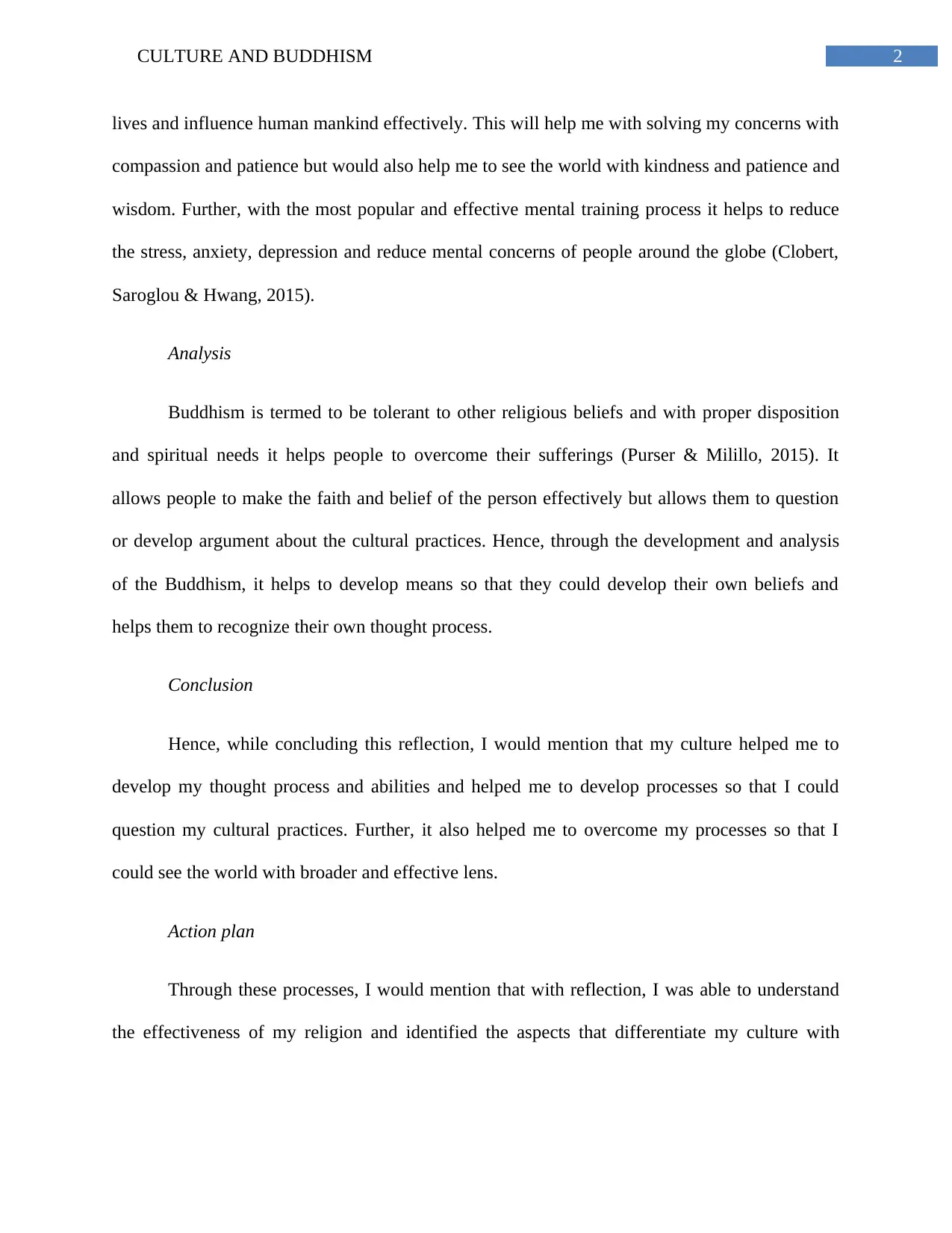
lives and influence human mankind effectively. This will help me with solving my concerns with
compassion and patience but would also help me to see the world with kindness and patience and
wisdom. Further, with the most popular and effective mental training process it helps to reduce
the stress, anxiety, depression and reduce mental concerns of people around the globe (Clobert,
Saroglou & Hwang, 2015).
Analysis
Buddhism is termed to be tolerant to other religious beliefs and with proper disposition
and spiritual needs it helps people to overcome their sufferings (Purser & Milillo, 2015). It
allows people to make the faith and belief of the person effectively but allows them to question
or develop argument about the cultural practices. Hence, through the development and analysis
of the Buddhism, it helps to develop means so that they could develop their own beliefs and
helps them to recognize their own thought process.
Conclusion
Hence, while concluding this reflection, I would mention that my culture helped me to
develop my thought process and abilities and helped me to develop processes so that I could
question my cultural practices. Further, it also helped me to overcome my processes so that I
could see the world with broader and effective lens.
Action plan
Through these processes, I would mention that with reflection, I was able to understand
the effectiveness of my religion and identified the aspects that differentiate my culture with
Document Page
3CULTURE AND BUDDHISM
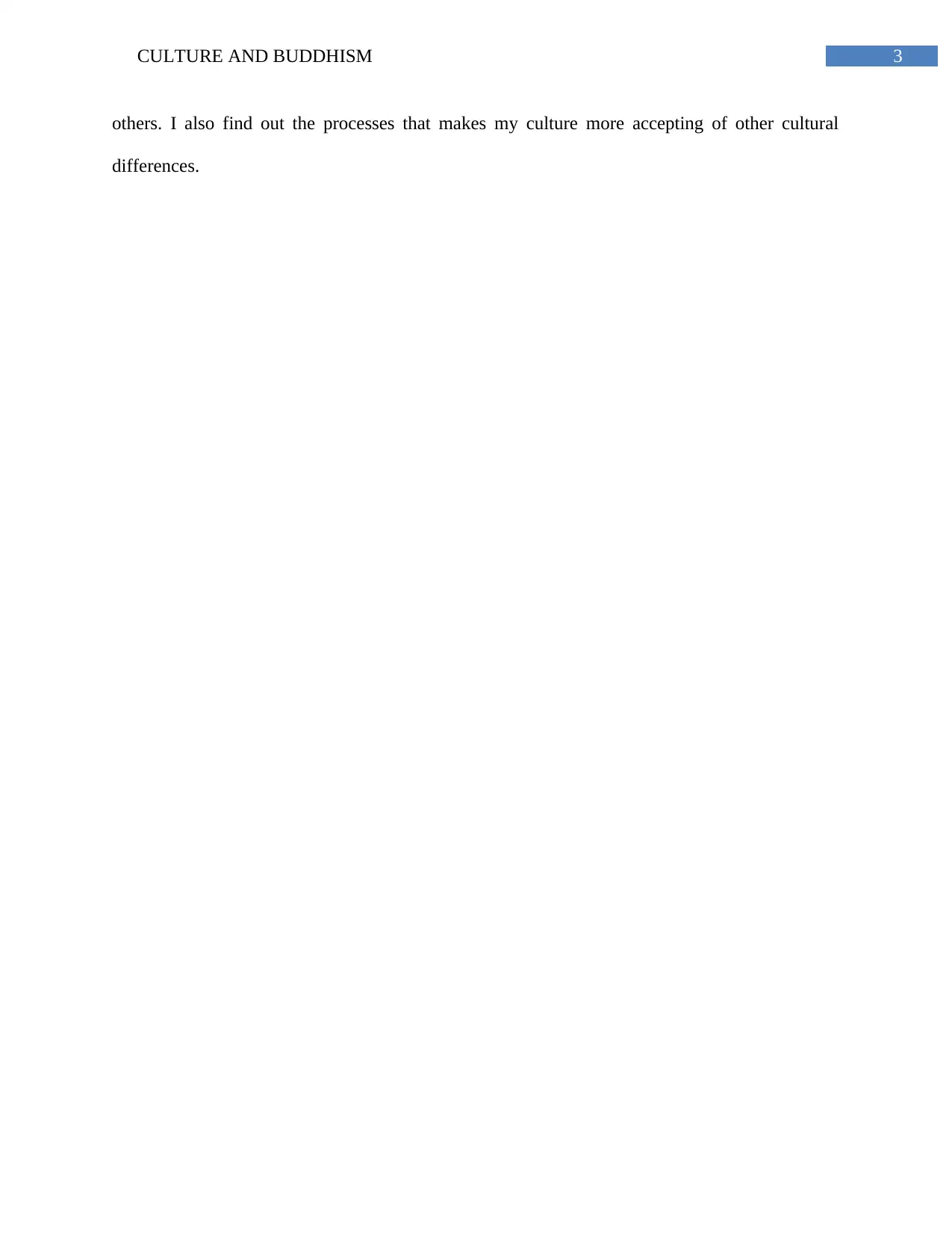
others. I also find out the processes that makes my culture more accepting of other cultural
differences.
tabler-icon-diamond-filled.svg

Paraphrase This Document

Need a fresh take? Get an instant paraphrase of this document with our AI Paraphraser
Document Page
4CULTURE AND BUDDHISM
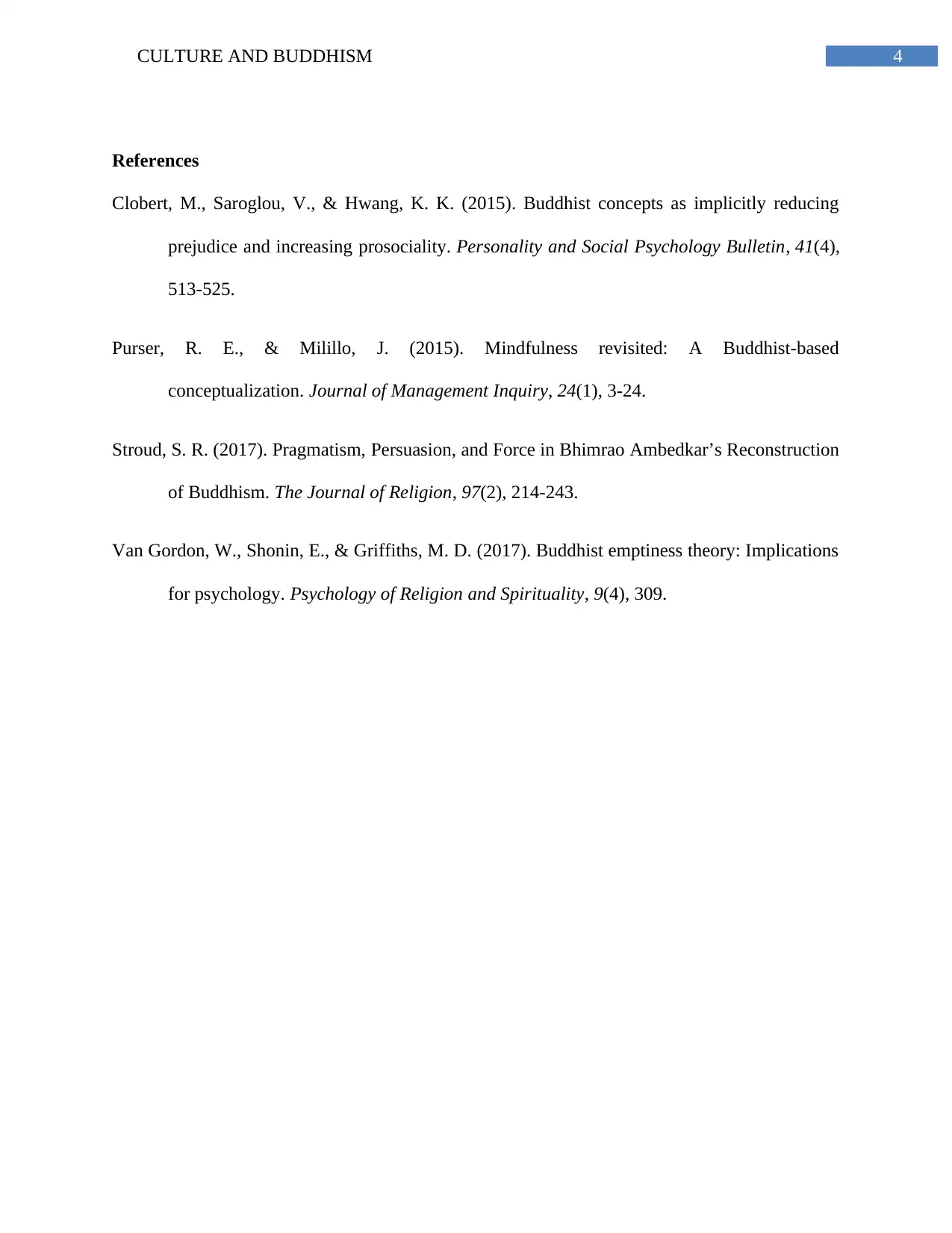
References
Clobert, M., Saroglou, V., & Hwang, K. K. (2015). Buddhist concepts as implicitly reducing
prejudice and increasing prosociality. Personality and Social Psychology Bulletin, 41(4),
513-525.
Purser, R. E., & Milillo, J. (2015). Mindfulness revisited: A Buddhist-based
conceptualization. Journal of Management Inquiry, 24(1), 3-24.
Stroud, S. R. (2017). Pragmatism, Persuasion, and Force in Bhimrao Ambedkar’s Reconstruction
of Buddhism. The Journal of Religion, 97(2), 214-243.
Van Gordon, W., Shonin, E., & Griffiths, M. D. (2017). Buddhist emptiness theory: Implications
for psychology. Psychology of Religion and Spirituality, 9(4), 309.
chevron_up_icon
1 out of 5
circle_padding
hide_on_mobile
zoom_out_icon
[object Object]