Investigating Organizational Culture's Effect on Performance

Verified

Added on  2023/03/21

|4
|582
|75
Homework Assignment
AI Summary
This assignment includes a summary of the article "Do consistent corporate cultures have better business performance? Exploring the interaction effects," which discusses the relationship between consistent corporate cultures and business performance, highlighting the impact of cultural traits on performance outcomes. The assignment also suggests a research method, incorporating quantitative and descriptive analysis, to study how aspects of an organization's culture influence performance measurement within the organization, considering factors like teamwork, innovation, and management style and their effects on financial, internal processes, customer satisfaction, and organizational capacity.

Document Page
RESEARCH
1
tabler-icon-diamond-filled.svg

Paraphrase This Document

Need a fresh take? Get an instant paraphrase of this document with our AI Paraphraser
Document Page
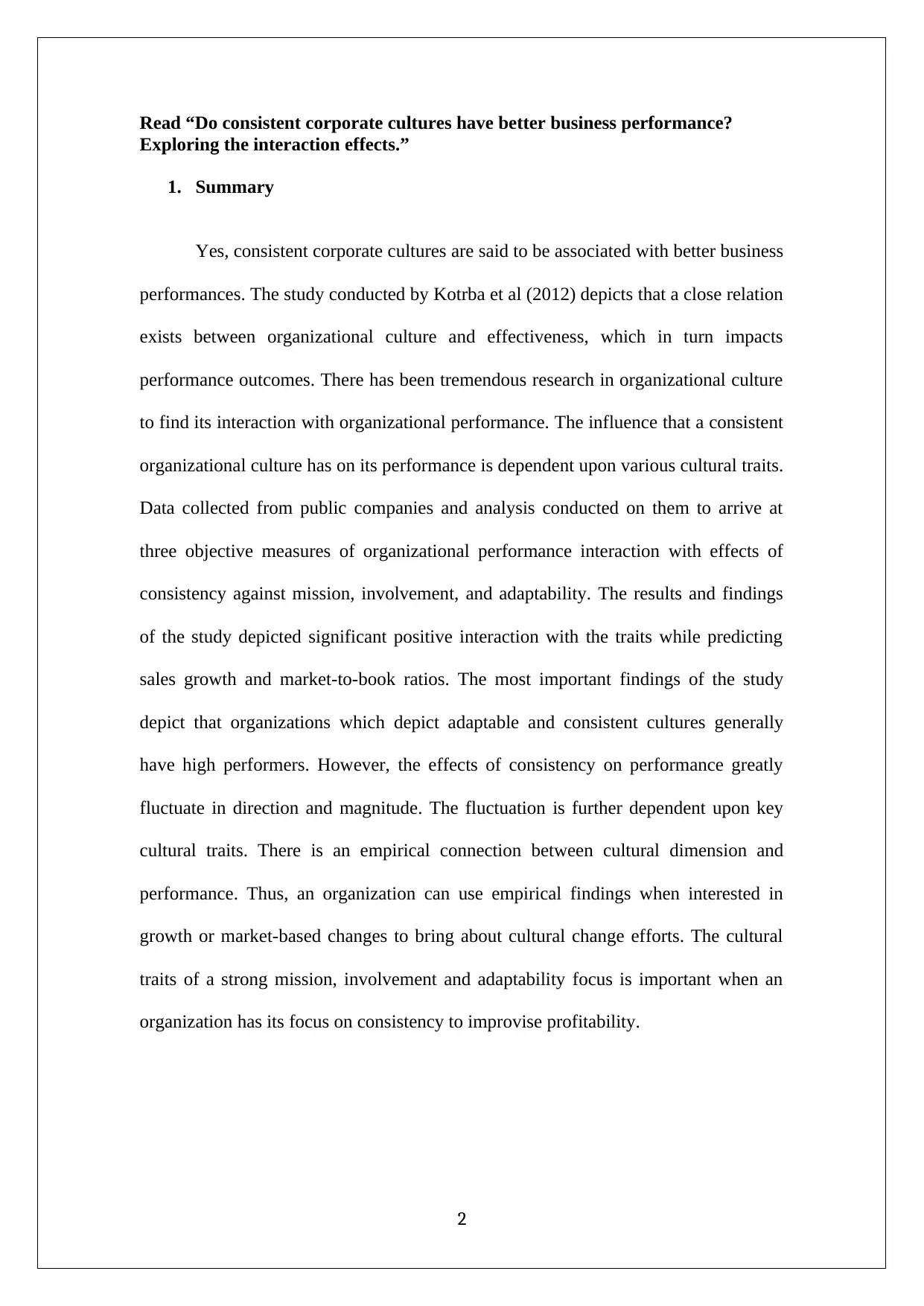
Read “Do consistent corporate cultures have better business performance?
Exploring the interaction effects.”
1. Summary
Yes, consistent corporate cultures are said to be associated with better business
performances. The study conducted by Kotrba et al (2012) depicts that a close relation
exists between organizational culture and effectiveness, which in turn impacts
performance outcomes. There has been tremendous research in organizational culture
to find its interaction with organizational performance. The influence that a consistent
organizational culture has on its performance is dependent upon various cultural traits.
Data collected from public companies and analysis conducted on them to arrive at
three objective measures of organizational performance interaction with effects of
consistency against mission, involvement, and adaptability. The results and findings
of the study depicted significant positive interaction with the traits while predicting
sales growth and market-to-book ratios. The most important findings of the study
depict that organizations which depict adaptable and consistent cultures generally
have high performers. However, the effects of consistency on performance greatly
fluctuate in direction and magnitude. The fluctuation is further dependent upon key
cultural traits. There is an empirical connection between cultural dimension and
performance. Thus, an organization can use empirical findings when interested in
growth or market-based changes to bring about cultural change efforts. The cultural
traits of a strong mission, involvement and adaptability focus is important when an
organization has its focus on consistency to improvise profitability.
2
Document Page
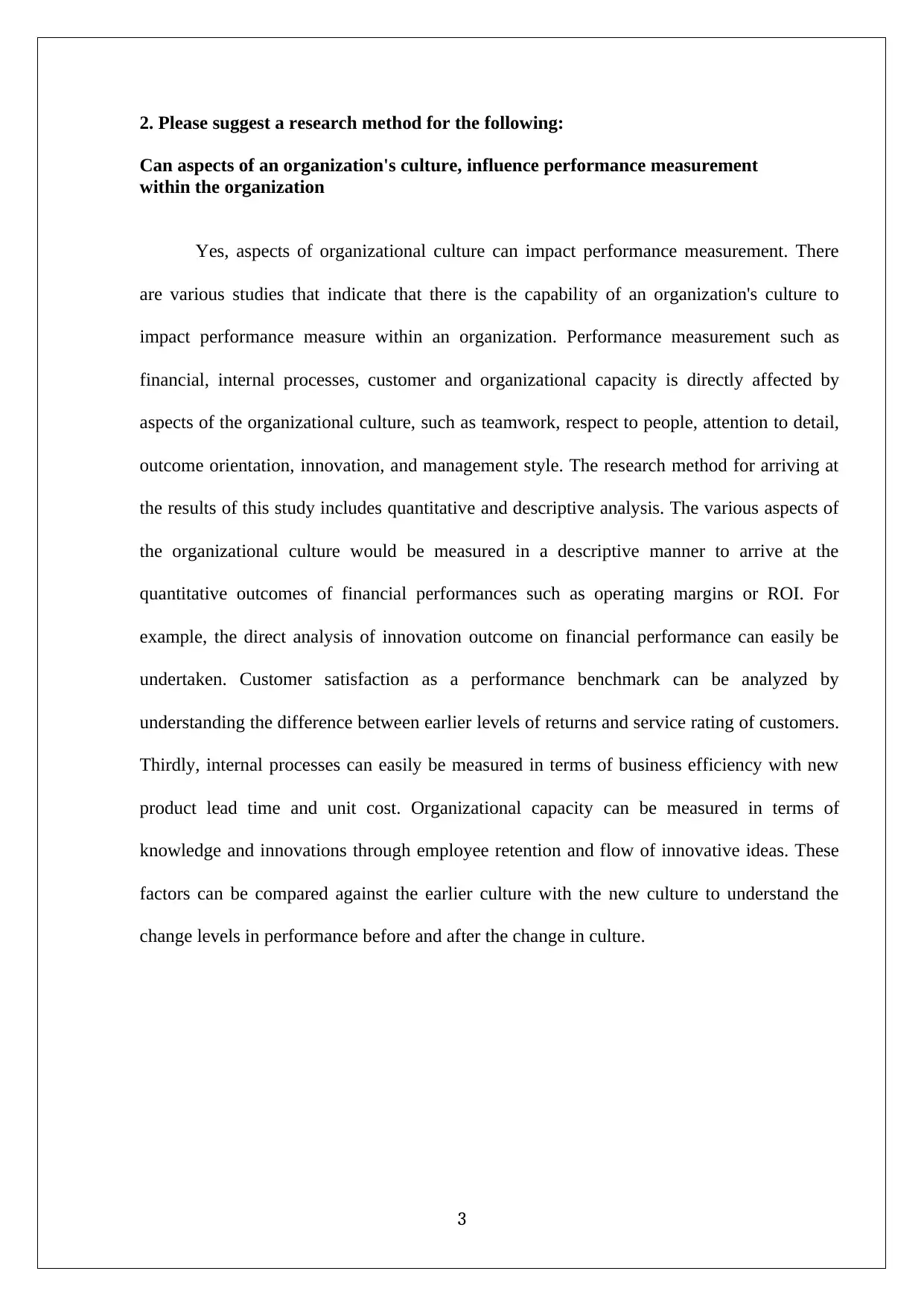
2. Please suggest a research method for the following:
Can aspects of an organization's culture, influence performance measurement
within the organization
Yes, aspects of organizational culture can impact performance measurement. There
are various studies that indicate that there is the capability of an organization's culture to
impact performance measure within an organization. Performance measurement such as
financial, internal processes, customer and organizational capacity is directly affected by
aspects of the organizational culture, such as teamwork, respect to people, attention to detail,
outcome orientation, innovation, and management style. The research method for arriving at
the results of this study includes quantitative and descriptive analysis. The various aspects of
the organizational culture would be measured in a descriptive manner to arrive at the
quantitative outcomes of financial performances such as operating margins or ROI. For
example, the direct analysis of innovation outcome on financial performance can easily be
undertaken. Customer satisfaction as a performance benchmark can be analyzed by
understanding the difference between earlier levels of returns and service rating of customers.
Thirdly, internal processes can easily be measured in terms of business efficiency with new
product lead time and unit cost. Organizational capacity can be measured in terms of
knowledge and innovations through employee retention and flow of innovative ideas. These
factors can be compared against the earlier culture with the new culture to understand the
change levels in performance before and after the change in culture.
3
Document Page
Reference
Kotrba, L. M., Gillespie, M. A., Schmidt, A. M., Smerek, R. E., Ritchie, S. A., &
Denison, D. R. (2012). Do consistent corporate cultures have better business
performance? Exploring the interaction effects. Human relations, 65(2), 241-
262.
4
chevron_up_icon
1 out of 4
circle_padding
hide_on_mobile
zoom_out_icon
[object Object]