International Management Assessment Plan: Culture & Global Business

Verified

Added on  2023/06/05

|2
|904
|452
Report
AI Summary
This international management assessment plan outlines the key themes and literature required to critically evaluate the impact of culture on global business operations. It highlights the significance of understanding cultural nuances, including aesthetics and language, in shaping business policies and functions across different geographical locations. The plan emphasizes the importance of analyzing both national and organizational culture, with a focus on how headquarters' culture influences branches in various countries. Key themes include defining culture, exploring its various aspects, and understanding personal culture. The document also provides a structure for the assessment, including an introduction, body, and conclusion, with suggested word count distribution. Academic sources are referenced to support the analysis.
Document Page
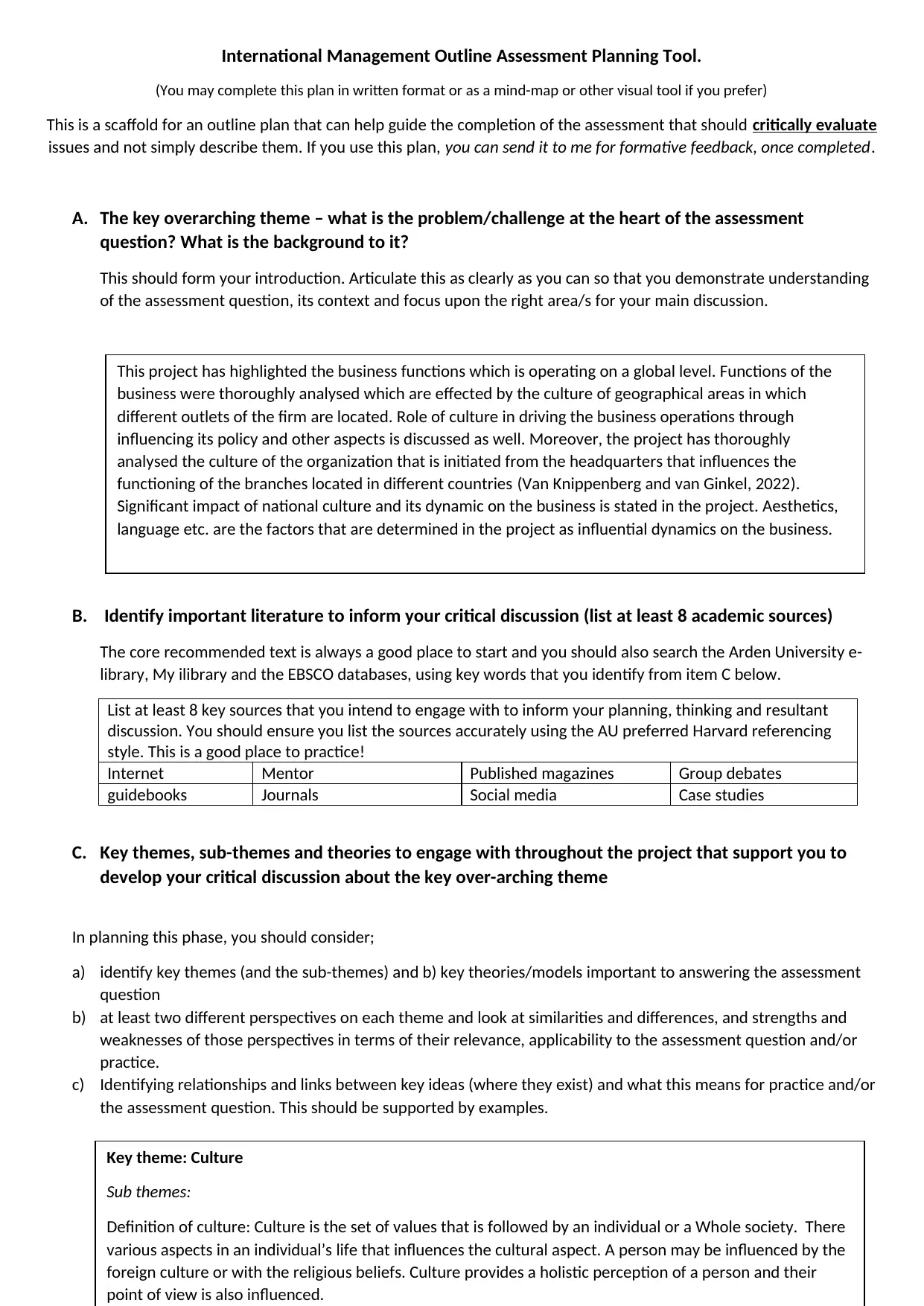
International Management Outline Assessment Planning Tool.
(You may complete this plan in written format or as a mind-map or other visual tool if you prefer)
This is a scaffold for an outline plan that can help guide the completion of the assessment that should critically evaluate
issues and not simply describe them. If you use this plan, you can send it to me for formative feedback, once completed.
A. The key overarching theme – what is the problem/challenge at the heart of the assessment
question? What is the background to it?
This should form your introduction. Articulate this as clearly as you can so that you demonstrate understanding
of the assessment question, its context and focus upon the right area/s for your main discussion.
B. Identify important literature to inform your critical discussion (list at least 8 academic sources)
The core recommended text is always a good place to start and you should also search the Arden University e-
library, My ilibrary and the EBSCO databases, using key words that you identify from item C below.
List at least 8 key sources that you intend to engage with to inform your planning, thinking and resultant
discussion. You should ensure you list the sources accurately using the AU preferred Harvard referencing
style. This is a good place to practice!
Internet Mentor Published magazines Group debates
guidebooks Journals Social media Case studies
C. Key themes, sub-themes and theories to engage with throughout the project that support you to
develop your critical discussion about the key over-arching theme
In planning this phase, you should consider;
a) identify key themes (and the sub-themes) and b) key theories/models important to answering the assessment
question
b) at least two different perspectives on each theme and look at similarities and differences, and strengths and
weaknesses of those perspectives in terms of their relevance, applicability to the assessment question and/or
practice.
c) Identifying relationships and links between key ideas (where they exist) and what this means for practice and/or
the assessment question. This should be supported by examples.
This project has highlighted the business functions which is operating on a global level. Functions of the
business were thoroughly analysed which are effected by the culture of geographical areas in which
different outlets of the firm are located. Role of culture in driving the business operations through
influencing its policy and other aspects is discussed as well. Moreover, the project has thoroughly
analysed the culture of the organization that is initiated from the headquarters that influences the
functioning of the branches located in different countries (Van Knippenberg and van Ginkel, 2022).
Significant impact of national culture and its dynamic on the business is stated in the project. Aesthetics,
language etc. are the factors that are determined in the project as influential dynamics on the business.
Key theme: Culture
Sub themes:
Definition of culture: Culture is the set of values that is followed by an individual or a Whole society. There
various aspects in an individual’s life that influences the cultural aspect. A person may be influenced by the
foreign culture or with the religious beliefs. Culture provides a holistic perception of a person and their
point of view is also influenced.
tabler-icon-diamond-filled.svg

Paraphrase This Document

Need a fresh take? Get an instant paraphrase of this document with our AI Paraphraser
Document Page
D. Outline how you might distribute your word count – the structure of your assessment (this is just
an initial guide, so that you consider how you will structure your work)
E.g. *Introduction (e.g. 15% of words) The introduction should set the background to the key theme to be
discussed and set your discussion in context.
*Body of your work (you can also consider how you will split this section up into sub headings) (e.g. 70% of
words) This is where your discussion of the key assessment question will take place.
*Conclusion (e.g. 15% words) This is where you should summarise the discussion you have developed and
lead to a clear conclusion.
NB: While planning your response to the assessment question, you will also find it helpful to look at the mini
skills modules within My Study Skills (accessed through ilearn) that provide detailed guidance on academic
writing.
References
Books and journals
Shuffler, M.L. and Cronin, M.A., 2019. The challenges of working with “real” teams: Challenges, needs, and
opportunities. Organizational Psychology Review. 9(4). pp.211-218.
Stratone, M.E. and et.al., 2022. Filling Knowledge Gaps: Communication Characteristics in Traditional Versus Virtual
Teams. In Proceedings of the International Conference on Business Excellence (Vol. 16, No. 1, pp. 109-120).
Van Knippenberg, D. and van Ginkel, W.P., 2022. A diversity mindset perspective on inclusive leadership. Group &
Organization Management. 47(4). pp.779-797.
Personal culture: personal culture is one which pertains in the personality of an individual and influence
chevron_up_icon
1 out of 2
circle_padding
hide_on_mobile
zoom_out_icon
[object Object]