Report on Current Challenges of Tendering
VerifiedAdded on 2020/02/05
|12
|3935
|149
Report
AI Summary
This report discusses the current challenges faced in the tendering process, including types of tendering, specific challenges at each step, and recommendations for overcoming these issues. It highlights the importance of effective communication, legal frameworks, and maintaining quality in procurement to enhance business development.
STUDENT NAME:
STUDENT ID:
SUBJECT CODE:
ASSIGNMENT TITLE: REPORT ON CURRENT CHALLENGES
OF TENDERING
STUDENT ID:
SUBJECT CODE:
ASSIGNMENT TITLE: REPORT ON CURRENT CHALLENGES
OF TENDERING

Paraphrase This Document
Need a fresh take? Get an instant paraphrase of this document with our AI Paraphraser
Executive summary
The project includes an introductory section where the essentialities of the project have been
discussed. The steps in the tendering process have also been investigated during the process. An
understanding of the challenges faced during the process has also been portrayed here and
discussed in details, which has been done in accordance to the three process of tendering which
has been discussed, in terms of registration of interest, preparation of tender proposal,
preparation of tender proposal, Challenges of payment terms, Requesting of a debriefing. In
addition to that the cost related problems and unavailability of suppliers have also been discussed
in addition to other. Finally findings and analysis along with conclusion and recommendation
have been provided for the project based on the challenges faced in the procedure of tendering.
2
The project includes an introductory section where the essentialities of the project have been
discussed. The steps in the tendering process have also been investigated during the process. An
understanding of the challenges faced during the process has also been portrayed here and
discussed in details, which has been done in accordance to the three process of tendering which
has been discussed, in terms of registration of interest, preparation of tender proposal,
preparation of tender proposal, Challenges of payment terms, Requesting of a debriefing. In
addition to that the cost related problems and unavailability of suppliers have also been discussed
in addition to other. Finally findings and analysis along with conclusion and recommendation
have been provided for the project based on the challenges faced in the procedure of tendering.
2
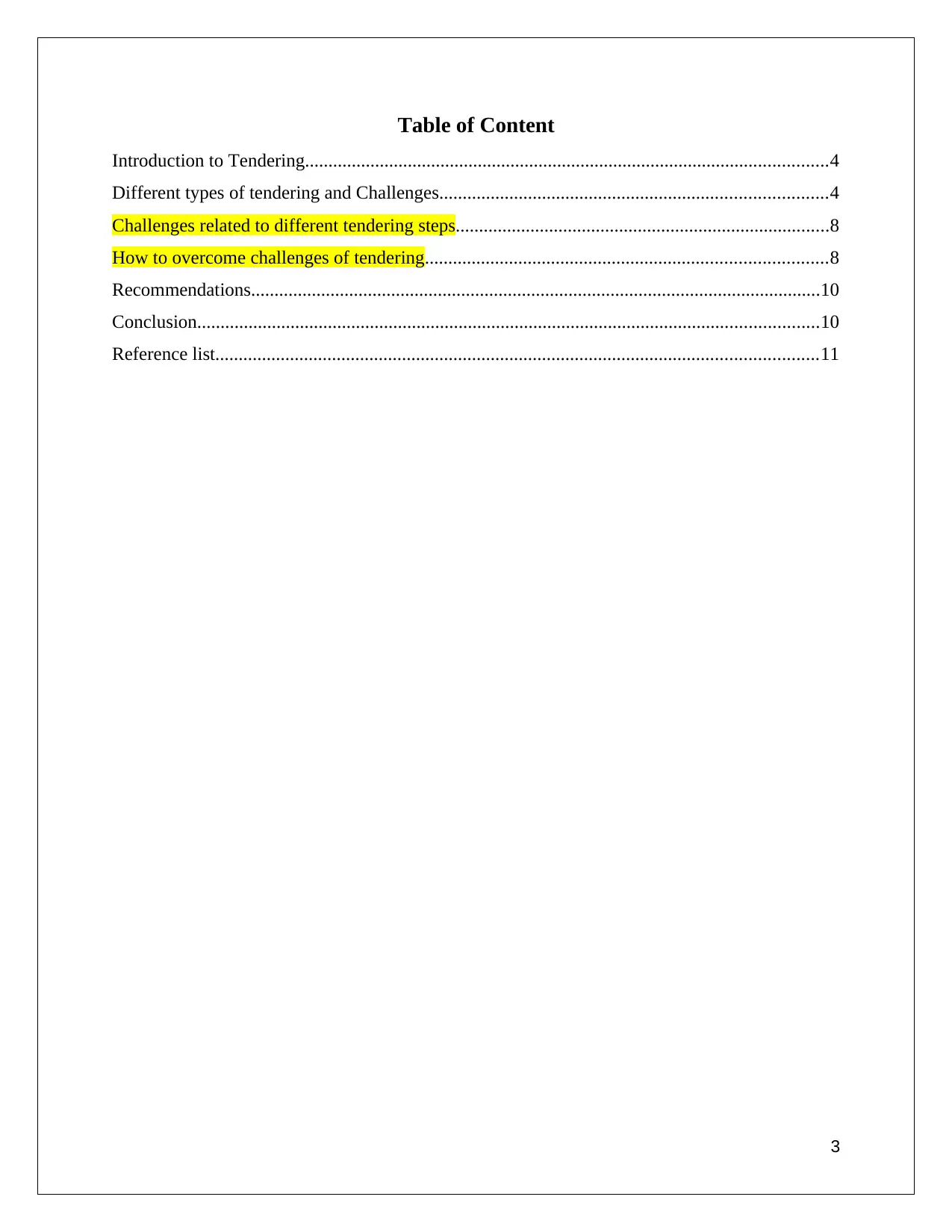
Table of Content
Introduction to Tendering................................................................................................................4
Different types of tendering and Challenges...................................................................................4
Challenges related to different tendering steps................................................................................8
How to overcome challenges of tendering......................................................................................8
Recommendations..........................................................................................................................10
Conclusion.....................................................................................................................................10
Reference list.................................................................................................................................11
3
Introduction to Tendering................................................................................................................4
Different types of tendering and Challenges...................................................................................4
Challenges related to different tendering steps................................................................................8
How to overcome challenges of tendering......................................................................................8
Recommendations..........................................................................................................................10
Conclusion.....................................................................................................................................10
Reference list.................................................................................................................................11
3
⊘ This is a preview!⊘
Do you want full access?
Subscribe today to unlock all pages.

Trusted by 1+ million students worldwide
Introduction to Tendering
Definition of Tender: Every financial institution has a well defined process of tendering in order
to select right vendor for the procurement of projects. In every business organisation tender is
considered as an integral aspect through which various large projects can be submitted within its
finite deadline appropriately. In this regard it should have to be considered that every tender
process must be ensured that the selection of technique is transparent and accurate effectively
and efficiently. In this regard the company can publish a report on the terms and conditions of
tender kits regarding meeting the particular requirements by the company with financial
information and capabilities appropriately. The problem statement of the study is to evaluate the
role of tendering in the economic development with its process and challenges arising from
tendering in an efficient manner. Identification of recommendations to remove such challenges
should have to be drawn appropriately in this study.
Information required for tendering: Every business organisation in order to run their business
operations in an efficient manner should require purchasing to meet customer satisfaction that
can lead to gain competitive advantages and marketing capabilities through procurement or
process of purchasing in a professional manner. In supply management and purchasing Tender is
considered as integral aspects of long term agreements can be met by the process of tendering
(Mouwen and van Ommeren, 2016, p.79). In this regard at the time of processing of tendering
companies should have the data base of tendering products and nature, trading name with
address, group of products, company’s financial performance and supply management with
profitability and turnover respectively (Flynn and Davis, 2016, p.265).
Different types of tendering and Challenges
Tendering is a technique through which various bidding prices are invited to the interested
contractors in order to carry out certain packages of construction task with key values of
accountability, fairness, simplicity and clarity. It is an effective and efficient process to examine
whether a business organisation have the best suppliers available to meet their particular
requirements. In this context certain benefits that a company can enjoy to go for tendering should
have to be evaluated to point out the challenges. An organisation can compete in the marketplace
to gain competitive advantages and marketing capabilities to create brand loyalty through
tendering (Liu et al. 2016, p.713). Tendering is relevant for the public companies and
4
Definition of Tender: Every financial institution has a well defined process of tendering in order
to select right vendor for the procurement of projects. In every business organisation tender is
considered as an integral aspect through which various large projects can be submitted within its
finite deadline appropriately. In this regard it should have to be considered that every tender
process must be ensured that the selection of technique is transparent and accurate effectively
and efficiently. In this regard the company can publish a report on the terms and conditions of
tender kits regarding meeting the particular requirements by the company with financial
information and capabilities appropriately. The problem statement of the study is to evaluate the
role of tendering in the economic development with its process and challenges arising from
tendering in an efficient manner. Identification of recommendations to remove such challenges
should have to be drawn appropriately in this study.
Information required for tendering: Every business organisation in order to run their business
operations in an efficient manner should require purchasing to meet customer satisfaction that
can lead to gain competitive advantages and marketing capabilities through procurement or
process of purchasing in a professional manner. In supply management and purchasing Tender is
considered as integral aspects of long term agreements can be met by the process of tendering
(Mouwen and van Ommeren, 2016, p.79). In this regard at the time of processing of tendering
companies should have the data base of tendering products and nature, trading name with
address, group of products, company’s financial performance and supply management with
profitability and turnover respectively (Flynn and Davis, 2016, p.265).
Different types of tendering and Challenges
Tendering is a technique through which various bidding prices are invited to the interested
contractors in order to carry out certain packages of construction task with key values of
accountability, fairness, simplicity and clarity. It is an effective and efficient process to examine
whether a business organisation have the best suppliers available to meet their particular
requirements. In this context certain benefits that a company can enjoy to go for tendering should
have to be evaluated to point out the challenges. An organisation can compete in the marketplace
to gain competitive advantages and marketing capabilities to create brand loyalty through
tendering (Liu et al. 2016, p.713). Tendering is relevant for the public companies and
4
Paraphrase This Document
Need a fresh take? Get an instant paraphrase of this document with our AI Paraphraser
governmental organisations with regulatory norms and compliance and legislative obligations.
There are three types of tendering such as open tendering, Selective tendering and Negotiated
tendering and challenges are related to every field. However, there are some specified
champagnes if tendering regarding operations. All of those challenges are as follow
Challenges of open tendering: Open tendering process is also known as the process of Open
tendering bidding process which is considered to be used for the acquiring of infrastructure,
services and goods and for invitation to tender. It is a transparent technique for which
arrangement are made to advertise tender documents in the journals, newspapers (Huka, 2016,
p.329). This tendering process can attract large number of suppliers in pre qualification process.
Advantages from open tendering process are to be evaluated in this regard in order to interpret
and remove the challenges of tendering process. In this process people can apply to purchase
tender for a company or in other terms everyone can apply to purchase this type of tender. As the
price of these tenders are very high, it is not possible for the new firms to enter and capture the
market, open tendering can help small contractors to expand their business operations as they can
get new customers for tender. Basic challenges of open tendering include lesser participation of
suppliers, timely procurement of event, strict operational practice and so on.
Challenges of selective tendering: In case of selective tendering, according to the past financial
performance and financial position a list of companies are selected for tendering and according
to the integrity, ability to compete in the market and profitability pattern certain companies are
invited to tender effectively and efficiently. These tender contractors do not advertise about their
tender products in newspaper and journals and as a result other contractors and bidders available
in the marketplace unable to know their price for which lowest bidder price contractor can win
the market in this regard . Selective tendering tends to choose selective buyers and suppliers.
Therefore, a procurer has to follow strict guidelines. Sometimes charges and cost are fixed by
suppliers to gain marginal profit. All these are challenges of selective tendering.
Negotiated tendering challenges: In the negotiated tendering process principal agent or
customer can approach the contractor in order to submit tender for completion of the work
project in which the pricing procedures are usually left with the contractor according to the
quantities of bills of services during the negotiation of the tendering process. Reasons for
selecting this type of tendering process are mainly that in this case the tendering can allow
certain time as technicalities (Kavanagh, 2016, p.314). Design, improvements and developments
5
There are three types of tendering such as open tendering, Selective tendering and Negotiated
tendering and challenges are related to every field. However, there are some specified
champagnes if tendering regarding operations. All of those challenges are as follow
Challenges of open tendering: Open tendering process is also known as the process of Open
tendering bidding process which is considered to be used for the acquiring of infrastructure,
services and goods and for invitation to tender. It is a transparent technique for which
arrangement are made to advertise tender documents in the journals, newspapers (Huka, 2016,
p.329). This tendering process can attract large number of suppliers in pre qualification process.
Advantages from open tendering process are to be evaluated in this regard in order to interpret
and remove the challenges of tendering process. In this process people can apply to purchase
tender for a company or in other terms everyone can apply to purchase this type of tender. As the
price of these tenders are very high, it is not possible for the new firms to enter and capture the
market, open tendering can help small contractors to expand their business operations as they can
get new customers for tender. Basic challenges of open tendering include lesser participation of
suppliers, timely procurement of event, strict operational practice and so on.
Challenges of selective tendering: In case of selective tendering, according to the past financial
performance and financial position a list of companies are selected for tendering and according
to the integrity, ability to compete in the market and profitability pattern certain companies are
invited to tender effectively and efficiently. These tender contractors do not advertise about their
tender products in newspaper and journals and as a result other contractors and bidders available
in the marketplace unable to know their price for which lowest bidder price contractor can win
the market in this regard . Selective tendering tends to choose selective buyers and suppliers.
Therefore, a procurer has to follow strict guidelines. Sometimes charges and cost are fixed by
suppliers to gain marginal profit. All these are challenges of selective tendering.
Negotiated tendering challenges: In the negotiated tendering process principal agent or
customer can approach the contractor in order to submit tender for completion of the work
project in which the pricing procedures are usually left with the contractor according to the
quantities of bills of services during the negotiation of the tendering process. Reasons for
selecting this type of tendering process are mainly that in this case the tendering can allow
certain time as technicalities (Kavanagh, 2016, p.314). Design, improvements and developments
5
are required for the contractor effectively and efficiently. A management team of a business
organisation should have to take and implement various decisions regarding increasing
profitability and revenue with expansion of business operations appropriately. In this regard
managers have to negotiate large projects and should have to select particular team of
professional by which the project can be completed effectively.
Unavailability of leading suppliers: Tendering means transaction of products and definitely in
a publicly manner. Purchaser does not only mean to chase other attendees, but they also wish to
have quality products. Therefore, it is important to manage leading suppliers of product. If
leading suppliers cannot be managed for an auction or tendering event, purchasers are bound to
achieve mediocre goods and it is a challenge for advanced tender making organisations. On the
other hand, availability of leading suppliers for small organisations is truly a challenge (Kale,
2016, p.410). In most of the terms, leading suppliers are bound to support authorised
organisations. This challenge leads to threat new organisations to have an entry in the tendering
process. Availability of leading suppliers tend to gather average rated products and bidding gets
congested within a specified margin because having a higher price of mediocre goods may
reduce reputed buyers and purchasers.
Communication glitches: Communication is another challenge in the advanced tender market.
It may possible that small tender organizing firms get quality and high rated products sometimes,
but they fail to communicate quality purchasers. It leads to less gathering of resourceful buyers.
From practical evidences in UK and especially Australia, some quality products are bound to be
sold in an average cost (Okello and Richu, 2016, p.167). All these consequences lead to
communication challenges. Likewise the issue of least suppliers, sometimes bidding
professionals fail to communicate purchasers as quality buyers always make participations in
giant auction halls and authorised organisations. For new entrants and small bidding firms,
communication is an advanced challenge.
Cost crisis: Cost crisis is a greater challenge for procurers. Suppliers always tend to get a profit
making deal and for the same products get lesser stress of quality and even labour engagement
scarcity. This leads to a result of poor quality products. Suppliers are bound to maintain product
price according to market or tender standard, but somehow product quality gets lower. Procurer
tries to avoid some leading suppliers than supply of products gets hampered (Ibem and Laryea,
2016, p19). This is greater challenge for procurers and there is possibility that by transacting
6
organisation should have to take and implement various decisions regarding increasing
profitability and revenue with expansion of business operations appropriately. In this regard
managers have to negotiate large projects and should have to select particular team of
professional by which the project can be completed effectively.
Unavailability of leading suppliers: Tendering means transaction of products and definitely in
a publicly manner. Purchaser does not only mean to chase other attendees, but they also wish to
have quality products. Therefore, it is important to manage leading suppliers of product. If
leading suppliers cannot be managed for an auction or tendering event, purchasers are bound to
achieve mediocre goods and it is a challenge for advanced tender making organisations. On the
other hand, availability of leading suppliers for small organisations is truly a challenge (Kale,
2016, p.410). In most of the terms, leading suppliers are bound to support authorised
organisations. This challenge leads to threat new organisations to have an entry in the tendering
process. Availability of leading suppliers tend to gather average rated products and bidding gets
congested within a specified margin because having a higher price of mediocre goods may
reduce reputed buyers and purchasers.
Communication glitches: Communication is another challenge in the advanced tender market.
It may possible that small tender organizing firms get quality and high rated products sometimes,
but they fail to communicate quality purchasers. It leads to less gathering of resourceful buyers.
From practical evidences in UK and especially Australia, some quality products are bound to be
sold in an average cost (Okello and Richu, 2016, p.167). All these consequences lead to
communication challenges. Likewise the issue of least suppliers, sometimes bidding
professionals fail to communicate purchasers as quality buyers always make participations in
giant auction halls and authorised organisations. For new entrants and small bidding firms,
communication is an advanced challenge.
Cost crisis: Cost crisis is a greater challenge for procurers. Suppliers always tend to get a profit
making deal and for the same products get lesser stress of quality and even labour engagement
scarcity. This leads to a result of poor quality products. Suppliers are bound to maintain product
price according to market or tender standard, but somehow product quality gets lower. Procurer
tries to avoid some leading suppliers than supply of products gets hampered (Ibem and Laryea,
2016, p19). This is greater challenge for procurers and there is possibility that by transacting
6
⊘ This is a preview!⊘
Do you want full access?
Subscribe today to unlock all pages.
Trusted by 1+ million students worldwide
poor products in a higher cost, a respective organisation may lose an established reputation.
Handling all of these products seems to be a challenge for advanced tender event organising
firms and professionals.
Safety regards: Safety standards are important factors for procurers as well as suppliers, but
somehow safety measures are avoided for cost crisis. Practically, it is not a crisis, but it's a
business perspective. Suppliers always tend to make least expenditure for a product. Therefore,
packaging and transportation get lower importance (Nawi et al. 2016, p.254). Following the
same, there is possibility that rich buyers get poor products in exchange of higher price. This is
another cause that a respective firm may lose reputation.
Lower profit margin: The lower profit margin is the main challenges to the organisations, in the
tendering processes of organisations. This is because the tenders are awarded to the organisation
which offers products at the lowest prices keeping the quality constraints fixed. In doing so the
profit margins of the firms are eaten away or dissipated, making them unwilling to supply at the
lesser profit margin which affects the overall supply of the product. In the tendering process the
increasing cost of resources are not considered which makes it further difficult to continue with
the procedure. Here in this case it can be stated that this eats away the profit further for the firms
supplying in the process.
Gaps of contractors and owners: There are gaps in the process of tendering among the
contractors and the owners of the firm. Here in this case it is often evident that the owners of
certain industries and hoses tender their requirement to the contractors for the supply of material
or certain activity. As the tender is offered to the agent who offers lowest price for the product,
the gap in this process among the contractor and the owner or the custodian appears in terms of
quality of the product and the time in which it has to be completed. In the tendering process as
the profit is minimal and minimised the contractors often compromise on the quality from try in
the time to keep the cost low on the contracting firm and at times it is also unintentional. This
happens mainly due to the gaps in between the contractors and the owners of business and
enterprise that they fail to communicate the problem that they are facing or the present condition
of the market which is making them unable to continue with the quality offered for the timeline
within which it has to be completed. These are the gaps between the contractors and the owners
which hamper the tendering process (Hall et al. 2016, p.10).
7
Handling all of these products seems to be a challenge for advanced tender event organising
firms and professionals.
Safety regards: Safety standards are important factors for procurers as well as suppliers, but
somehow safety measures are avoided for cost crisis. Practically, it is not a crisis, but it's a
business perspective. Suppliers always tend to make least expenditure for a product. Therefore,
packaging and transportation get lower importance (Nawi et al. 2016, p.254). Following the
same, there is possibility that rich buyers get poor products in exchange of higher price. This is
another cause that a respective firm may lose reputation.
Lower profit margin: The lower profit margin is the main challenges to the organisations, in the
tendering processes of organisations. This is because the tenders are awarded to the organisation
which offers products at the lowest prices keeping the quality constraints fixed. In doing so the
profit margins of the firms are eaten away or dissipated, making them unwilling to supply at the
lesser profit margin which affects the overall supply of the product. In the tendering process the
increasing cost of resources are not considered which makes it further difficult to continue with
the procedure. Here in this case it can be stated that this eats away the profit further for the firms
supplying in the process.
Gaps of contractors and owners: There are gaps in the process of tendering among the
contractors and the owners of the firm. Here in this case it is often evident that the owners of
certain industries and hoses tender their requirement to the contractors for the supply of material
or certain activity. As the tender is offered to the agent who offers lowest price for the product,
the gap in this process among the contractor and the owner or the custodian appears in terms of
quality of the product and the time in which it has to be completed. In the tendering process as
the profit is minimal and minimised the contractors often compromise on the quality from try in
the time to keep the cost low on the contracting firm and at times it is also unintentional. This
happens mainly due to the gaps in between the contractors and the owners of business and
enterprise that they fail to communicate the problem that they are facing or the present condition
of the market which is making them unable to continue with the quality offered for the timeline
within which it has to be completed. These are the gaps between the contractors and the owners
which hamper the tendering process (Hall et al. 2016, p.10).
7
Paraphrase This Document
Need a fresh take? Get an instant paraphrase of this document with our AI Paraphraser
Challenges of maintaining legal frameworks: Maintaining the legal frameworks and the
ethical consideration in regards to any activity is important and for the tendering process is not
an exception. In this case the maintaining the legal framework is essential to avoid penal action
and compensation from both the contracting parties and the tendering party which includes
additional cost. Not complying with the legal framework for the tendering party can be massive
on its business as the tender would have to pay for the compensation in addition to that the
tendered would also have to pay in fines to the regulatory authorities or the government (Kirama
and Mayo, 2016, p.199).
Challenges related to different tendering steps
Tendering is considered as a procurement process of purchasing goods and services including the
process of business operations, infrastructures, water supply, acquisition and recognition of
operations and bidding process of such products and services is the process of tendering. In
decision making process of management team in an organisation accountability and transparency
is the two objectives that should have to be met effectively and efficiently and in this regard in
order to completion of big projects these two main objectives are to be ensured for competing in
the market. Steps of tendering should have to be evaluated to understand the challenges of
tendering process. Such steps are discussed as follows-
Registration of interest: The purchasing company at first should have to go through the tender
documents and other important instructions regarding tender in order to register their interest
whether to purchase such tender or not at prescribed or predetermined prices. In this way the
organisation who offers tender, has to follow typical legal procedure and negotiation headaches.
Challenges of payment terms: Purchasing agent must aware of the payment terms and
conditions regarding tender and payment schedules can be varied from different agents if the
tenders are offered by government and payments schedules are also different that should have to
be understood in an appropriate manner (Mohd et al. 2016, p.266).
How to overcome challenges of tendering
Here in this project it has been evident that the registering of interest by the tendering company
has appeared to be of primal importance and this interest is reflected when the company applies
to participate in the tendering process. It also appears that the decision to participate in the
tendering process is not easy for the firms as the profit rates are minimal for organisations and in
8
ethical consideration in regards to any activity is important and for the tendering process is not
an exception. In this case the maintaining the legal framework is essential to avoid penal action
and compensation from both the contracting parties and the tendering party which includes
additional cost. Not complying with the legal framework for the tendering party can be massive
on its business as the tender would have to pay for the compensation in addition to that the
tendered would also have to pay in fines to the regulatory authorities or the government (Kirama
and Mayo, 2016, p.199).
Challenges related to different tendering steps
Tendering is considered as a procurement process of purchasing goods and services including the
process of business operations, infrastructures, water supply, acquisition and recognition of
operations and bidding process of such products and services is the process of tendering. In
decision making process of management team in an organisation accountability and transparency
is the two objectives that should have to be met effectively and efficiently and in this regard in
order to completion of big projects these two main objectives are to be ensured for competing in
the market. Steps of tendering should have to be evaluated to understand the challenges of
tendering process. Such steps are discussed as follows-
Registration of interest: The purchasing company at first should have to go through the tender
documents and other important instructions regarding tender in order to register their interest
whether to purchase such tender or not at prescribed or predetermined prices. In this way the
organisation who offers tender, has to follow typical legal procedure and negotiation headaches.
Challenges of payment terms: Purchasing agent must aware of the payment terms and
conditions regarding tender and payment schedules can be varied from different agents if the
tenders are offered by government and payments schedules are also different that should have to
be understood in an appropriate manner (Mohd et al. 2016, p.266).
How to overcome challenges of tendering
Here in this project it has been evident that the registering of interest by the tendering company
has appeared to be of primal importance and this interest is reflected when the company applies
to participate in the tendering process. It also appears that the decision to participate in the
tendering process is not easy for the firms as the profit rates are minimal for organisations and in
8
addition there are legal norms, quality and time specifications that has to be maintained which
adds up cost. In this further analysis of the procedure it appears that the gap of communication
and understanding between the different agents in the process creates impediments in this path.
Supply constraints in this regard also creates impediments in the path of the process and keeping
the cost low which has been evident from earlier analysis. It has been also been evident from this
analysis that all agents involved in the process is that all the agents try to draw as much surplus
or profit as possible to themselves this create problem the procedure. It has also been evident that
tendering is one of the most effective ways of keeping cost low for firms and in this legal
preserving the legalities both helps the contracting firm and the tendering firm.
Here in this regard in overcoming challenges and barriers to tendering formulating and writing
down policies help in reducing the problem by a great deal. In this regard it has been evident that
agreement among internal stake holders is required, which enables in assuming cost before
finalising them and switch suppliers if required. Defining the supplier regarding the specific need
and the cost that the tendering firm is able to pay for the resources help in procuring appropriate
resources at the specified cost, which enables in keeping the cost to a manageable level and carry
on with the project and in maintaining the promised quality of the product of service, which is
often problem due to rising cost.
Making decisions regarding tender offer including planning refining and drafting of tender and in
this context the tender information, structure should have to be specific and appropriate based on
certain key proposition (Zhang et al. 2016, p.522). Review, examine and evaluating the criteria’s
for tender should have to be understood properly, otherwise there will be lesser possibilities of
success. Debriefing is considered as an important aspect of tender, the tender of the government
organisation cannot sell successfully or cannot bid successfully as per the tender requirements
and guidelines should have to be evaluated appropriately. . It is not an opportunity for making of
complaints or the purchasing agent should not discuss any other tender offer of supplier to the
contractor. In this regard evaluation and understanding of the tender offer are based on feedback,
improvement of tender price are possible to prepare for next tender offer (Okello and Richu,
2016, p.167). In terms of selective tendering it appears that it would be better to set proper
parameter fort the supplier, procurer and buyer which helps in reducing the dilemma present in
the system bring efficiency into it. On the other hand, pricing is an important factor. At times,
negotiated tendering seems to be tough due to availability of cheap products. In this regard,
9
adds up cost. In this further analysis of the procedure it appears that the gap of communication
and understanding between the different agents in the process creates impediments in this path.
Supply constraints in this regard also creates impediments in the path of the process and keeping
the cost low which has been evident from earlier analysis. It has been also been evident from this
analysis that all agents involved in the process is that all the agents try to draw as much surplus
or profit as possible to themselves this create problem the procedure. It has also been evident that
tendering is one of the most effective ways of keeping cost low for firms and in this legal
preserving the legalities both helps the contracting firm and the tendering firm.
Here in this regard in overcoming challenges and barriers to tendering formulating and writing
down policies help in reducing the problem by a great deal. In this regard it has been evident that
agreement among internal stake holders is required, which enables in assuming cost before
finalising them and switch suppliers if required. Defining the supplier regarding the specific need
and the cost that the tendering firm is able to pay for the resources help in procuring appropriate
resources at the specified cost, which enables in keeping the cost to a manageable level and carry
on with the project and in maintaining the promised quality of the product of service, which is
often problem due to rising cost.
Making decisions regarding tender offer including planning refining and drafting of tender and in
this context the tender information, structure should have to be specific and appropriate based on
certain key proposition (Zhang et al. 2016, p.522). Review, examine and evaluating the criteria’s
for tender should have to be understood properly, otherwise there will be lesser possibilities of
success. Debriefing is considered as an important aspect of tender, the tender of the government
organisation cannot sell successfully or cannot bid successfully as per the tender requirements
and guidelines should have to be evaluated appropriately. . It is not an opportunity for making of
complaints or the purchasing agent should not discuss any other tender offer of supplier to the
contractor. In this regard evaluation and understanding of the tender offer are based on feedback,
improvement of tender price are possible to prepare for next tender offer (Okello and Richu,
2016, p.167). In terms of selective tendering it appears that it would be better to set proper
parameter fort the supplier, procurer and buyer which helps in reducing the dilemma present in
the system bring efficiency into it. On the other hand, pricing is an important factor. At times,
negotiated tendering seems to be tough due to availability of cheap products. In this regard,
9
⊘ This is a preview!⊘
Do you want full access?
Subscribe today to unlock all pages.
Trusted by 1+ million students worldwide
suppliers have to be more careful regarding quality and standard of supply. If a respective
procurer can manage a better reputation in the market, there will be fewer issues of negotiation
and transactions. Maintaining the legal framework for the tenderer is also important so that the
contracting parties cannot cheat or dishonour the tendering firm in terms of payments or other
promises. Here it could be stated that in such case the firms can also take legal help if the validity
of the law is preserved.
Recommendations
In overcoming the problems faced in the tendering process this could be stated that a complete
and well formulated structure are needed to be followed by the companies which would lead to
resolving of problems in this regard. Maintenance of well formulated mechanism in terms of
tendering procedure helps in following the requirements and resolving of situation in accordance
to the issue that has cropped up as for example increased cost, or others which could hamper the
tendering procedures could be resolved in this manner. As already in this project it has been
identified that the procedures of tendering are cluttered and complex this in some ways or they
would help in resolving the situation. In this regard another favourable recommendation is the
maintaining of the legalities and the laws in the countries of operations which also reduces the
risk of malfunction and problems by a great deal.
Conclusion
Here in this project in the introductory section the definition of tendering and the information
required in the tendering process have been discussed and analysed in the following section the
different types of tenders in evaluating the effectiveness of tendering have also been discussed
and analysed. Which includes issues like selective and negotiated tendering process along with
other tendering processes, steps of tendering have also been evaluated for the purpose her in this
project. In the final section the barriers and challenges in the process have been discussed and
finding have stated on the above project basing on this.
10
procurer can manage a better reputation in the market, there will be fewer issues of negotiation
and transactions. Maintaining the legal framework for the tenderer is also important so that the
contracting parties cannot cheat or dishonour the tendering firm in terms of payments or other
promises. Here it could be stated that in such case the firms can also take legal help if the validity
of the law is preserved.
Recommendations
In overcoming the problems faced in the tendering process this could be stated that a complete
and well formulated structure are needed to be followed by the companies which would lead to
resolving of problems in this regard. Maintenance of well formulated mechanism in terms of
tendering procedure helps in following the requirements and resolving of situation in accordance
to the issue that has cropped up as for example increased cost, or others which could hamper the
tendering procedures could be resolved in this manner. As already in this project it has been
identified that the procedures of tendering are cluttered and complex this in some ways or they
would help in resolving the situation. In this regard another favourable recommendation is the
maintaining of the legalities and the laws in the countries of operations which also reduces the
risk of malfunction and problems by a great deal.
Conclusion
Here in this project in the introductory section the definition of tendering and the information
required in the tendering process have been discussed and analysed in the following section the
different types of tenders in evaluating the effectiveness of tendering have also been discussed
and analysed. Which includes issues like selective and negotiated tendering process along with
other tendering processes, steps of tendering have also been evaluated for the purpose her in this
project. In the final section the barriers and challenges in the process have been discussed and
finding have stated on the above project basing on this.
10
Paraphrase This Document
Need a fresh take? Get an instant paraphrase of this document with our AI Paraphraser
Reference list
Flynn, A. and Davis, P., 2016. Investigating the effect of tendering capabilities on SME activity
and performance in public contract competitions. International Small Business Journal, p. 265
Hall, P., Löfgren, K. and Peters, G., 2016. Greening the street-level procurer: challenges in the
strongly decentralized Swedish system. Journal of Consumer Policy, 39(4), pp.467-483.
Huka, H.A., 2016. Contribution of Public Procurement to the Success of Small and Medium
Enterprises: A Case of SMEs in Moshi Municipality. The International Journal of Business &
Management, 4(3), p.146.
Ibem, E.O. and Laryea, S., 2016. E-tendering in the South African construction industry.
International Journal of Construction Management, pp.1-19.
Kale, R.D., 2016. Challenges in Developing Indigenous Technology. In The Mind of an
Engineer (pp. 409-413). Springer Singapore.
Kavanagh, P., 2016. A case for negotiated performance-based contracting rather than
competitive tendering in government public transport (bus) service procurement. Research in
Transportation Economics, 59, pp.313-322.
Kirama, A. and Mayo, A.W., 2016. Challenges and prospects of private sector participation in
solid waste management in Dar es Salaam City, Tanzania. Habitat International, 53, pp.195-205.
Liu, T., Wang, Y. and Wilkinson, S., 2016. Identifying critical factors affecting the effectiveness
and efficiency of tendering processes in Public–Private Partnerships (PPPs): A comparative
analysis of Australia and China. International Journal of Project Management, 34(4), pp.701-
716.
Mohd, H., Robie, M.A.M., Baharom, F., Darus, N.M., Saip, M.A. and Yasin, A., 2016, August.
Adapting Rational Unified Process (RUP) approach in designing a secure e-Tendering model. In
F.A.A. Nifa, M.N.M. Nawi and A. Hussain eds.,, AIP Conference Proceedings (Vol. 1761, No.
1, p. 266). AIP Publishing.
Mouwen, A. and van Ommeren, J., 2016. The effect of contract renewal and competitive
tendering on public transport costs, subsidies and ridership. Transportation Research Part A:
Policy and Practice, 87, pp.78-89.
11
Flynn, A. and Davis, P., 2016. Investigating the effect of tendering capabilities on SME activity
and performance in public contract competitions. International Small Business Journal, p. 265
Hall, P., Löfgren, K. and Peters, G., 2016. Greening the street-level procurer: challenges in the
strongly decentralized Swedish system. Journal of Consumer Policy, 39(4), pp.467-483.
Huka, H.A., 2016. Contribution of Public Procurement to the Success of Small and Medium
Enterprises: A Case of SMEs in Moshi Municipality. The International Journal of Business &
Management, 4(3), p.146.
Ibem, E.O. and Laryea, S., 2016. E-tendering in the South African construction industry.
International Journal of Construction Management, pp.1-19.
Kale, R.D., 2016. Challenges in Developing Indigenous Technology. In The Mind of an
Engineer (pp. 409-413). Springer Singapore.
Kavanagh, P., 2016. A case for negotiated performance-based contracting rather than
competitive tendering in government public transport (bus) service procurement. Research in
Transportation Economics, 59, pp.313-322.
Kirama, A. and Mayo, A.W., 2016. Challenges and prospects of private sector participation in
solid waste management in Dar es Salaam City, Tanzania. Habitat International, 53, pp.195-205.
Liu, T., Wang, Y. and Wilkinson, S., 2016. Identifying critical factors affecting the effectiveness
and efficiency of tendering processes in Public–Private Partnerships (PPPs): A comparative
analysis of Australia and China. International Journal of Project Management, 34(4), pp.701-
716.
Mohd, H., Robie, M.A.M., Baharom, F., Darus, N.M., Saip, M.A. and Yasin, A., 2016, August.
Adapting Rational Unified Process (RUP) approach in designing a secure e-Tendering model. In
F.A.A. Nifa, M.N.M. Nawi and A. Hussain eds.,, AIP Conference Proceedings (Vol. 1761, No.
1, p. 266). AIP Publishing.
Mouwen, A. and van Ommeren, J., 2016. The effect of contract renewal and competitive
tendering on public transport costs, subsidies and ridership. Transportation Research Part A:
Policy and Practice, 87, pp.78-89.
11
Nawi, M.N.M., Roslan, S., Salleh, N.A., Zulhumadi, F. and Harun, A.N., 2016. The Benefits and
Challenges of E-procurement Implementation: A Case Study of Malaysian Company.
International Journal of Economics and Financial Issues, 6(7S).
Okello, B. and Richu, S., 2016. Does Tendering Processing Enhance Organizational
Performance? Analysis of Kenya Wildlife Service. The International Journal of Business &
Management, 4(4), p.167.
Walters, J. and Manamela, L., 2016. Challenges faced by small-bus operators in participating in
the formal public transport system: original research. Journal of Transport and Supply Chain
Management, 10(1), pp.1-11.
Zhang, B., Le, Y., Xia, B. and Skitmore, M., 2016. Causes of Business-to-Government
Corruption in the Tendering Process in China. Journal of Management in Engineering, p.522.
12
Challenges of E-procurement Implementation: A Case Study of Malaysian Company.
International Journal of Economics and Financial Issues, 6(7S).
Okello, B. and Richu, S., 2016. Does Tendering Processing Enhance Organizational
Performance? Analysis of Kenya Wildlife Service. The International Journal of Business &
Management, 4(4), p.167.
Walters, J. and Manamela, L., 2016. Challenges faced by small-bus operators in participating in
the formal public transport system: original research. Journal of Transport and Supply Chain
Management, 10(1), pp.1-11.
Zhang, B., Le, Y., Xia, B. and Skitmore, M., 2016. Causes of Business-to-Government
Corruption in the Tendering Process in China. Journal of Management in Engineering, p.522.
12
⊘ This is a preview!⊘
Do you want full access?
Subscribe today to unlock all pages.
Trusted by 1+ million students worldwide

1 out of 12


Related Documents


Your All-in-One AI-Powered Toolkit for Academic Success.
+13062052269
info@desklib.com
Available 24*7 on WhatsApp / Email
![[object Object]](/_next/static/media/star-bottom.7253800d.svg)
Unlock your academic potential
Copyright © 2020–2026 A2Z Services. All Rights Reserved. Developed and managed by ZUCOL.