ELP 1102: Curriculum and Material Design in Sinhala Government School
VerifiedAdded on 2023/06/10
|18
|5414
|200
Report
AI Summary
This report presents a comprehensive analysis of curriculum and material design within a Sinhala Medium Government School in Sri Lanka, conducted as part of the ELP 1102 course. It includes a needs analysis of students' linguistic expectations, a detailed report on the findings, and a critical review of the textbook used for teaching English. The needs analysis explores the challenges faced by students in accessing English language education due to socio-economic factors and disparities in school resources. The report highlights the limitations of current curriculum reforms and recommends strategies such as activity-based oral English introduction, bilingual teaching, and alternative English syllabuses to improve English learning standards. It emphasizes the importance of addressing both socio-economic issues and educational standards to achieve meaningful improvements in student outcomes. The study uses evidence-based research and APA referencing to support its findings and recommendations.
Running head: CURRICULUM AND MATERIAL DESIGNING
Curriculum and Material Designing
[Sinhala Medium Government School]
Name of the student:
Name of the university:
Author note:
Curriculum and Material Designing
[Sinhala Medium Government School]
Name of the student:
Name of the university:
Author note:

Paraphrase This Document
Need a fresh take? Get an instant paraphrase of this document with our AI Paraphraser
1CURRICULUM AND MATERIAL DESIGNING
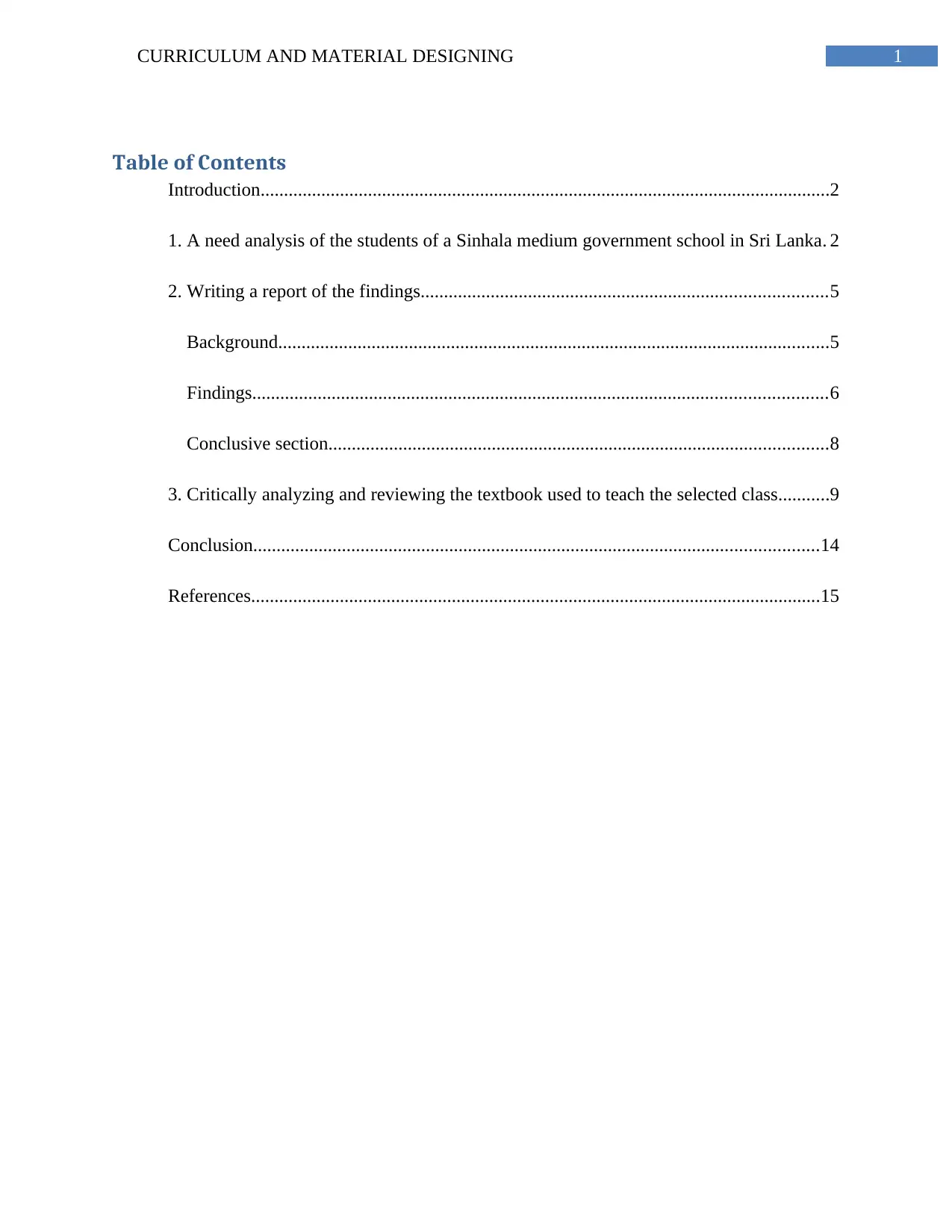
Table of Contents
Introduction..........................................................................................................................2
1. A need analysis of the students of a Sinhala medium government school in Sri Lanka. 2
2. Writing a report of the findings.......................................................................................5
Background......................................................................................................................5
Findings...........................................................................................................................6
Conclusive section...........................................................................................................8
3. Critically analyzing and reviewing the textbook used to teach the selected class...........9
Conclusion.........................................................................................................................14
References..........................................................................................................................15
Table of Contents
Introduction..........................................................................................................................2
1. A need analysis of the students of a Sinhala medium government school in Sri Lanka. 2
2. Writing a report of the findings.......................................................................................5
Background......................................................................................................................5
Findings...........................................................................................................................6
Conclusive section...........................................................................................................8
3. Critically analyzing and reviewing the textbook used to teach the selected class...........9
Conclusion.........................................................................................................................14
References..........................................................................................................................15
2CURRICULUM AND MATERIAL DESIGNING
Introduction
The purpose of this study is to investigate the impact of the study curriculum which the
teachers in the Sinhala Medium Government School in Sri Lanka use. To serve the purpose and
to progress with the study, students in the Sinhala School have been chosen. The purpose is
being achieved in a structured manner that has elements like a need analysis of the students in
the Sinhala School, report writing on the findings and a review of the material which is used to
teach English to the students.
1. A need analysis of the students of a Sinhala medium government school in Sri Lanka
Background
The population for the English Language Learners (ELL) is growing in Sri Lanka. This is
due to the efforts of the Sri Lankan government which is aimed at raising the standard of
schooling and the education system in Sri Lanka (Walisundara & Hettiarachchi, 2016). Such
thought process has boosted the number of foreign students coming to the country. This is due to
the reason that demands for teachers and curriculum reforms are growing. There are demands for
teachers who can potentially harness and manage the development of English Language
Learning linguistically and culturally. In a similar way, there is a need for a potential study
curriculum, so that, the stress involved in imparting the teaching is reduced (Agbatogun, 2017).
These are two of the reasons which make “need analysis of the students’ expectations” an
important part of the educational system. A need analysis helps to know the future needs which
the students learning the English language will require.
In Sri Lanka, the improvement of the English teaching standard is now one of the
priorities. The Sri Lankan government and the institutions want to create and provide ample of
Introduction
The purpose of this study is to investigate the impact of the study curriculum which the
teachers in the Sinhala Medium Government School in Sri Lanka use. To serve the purpose and
to progress with the study, students in the Sinhala School have been chosen. The purpose is
being achieved in a structured manner that has elements like a need analysis of the students in
the Sinhala School, report writing on the findings and a review of the material which is used to
teach English to the students.
1. A need analysis of the students of a Sinhala medium government school in Sri Lanka
Background
The population for the English Language Learners (ELL) is growing in Sri Lanka. This is
due to the efforts of the Sri Lankan government which is aimed at raising the standard of
schooling and the education system in Sri Lanka (Walisundara & Hettiarachchi, 2016). Such
thought process has boosted the number of foreign students coming to the country. This is due to
the reason that demands for teachers and curriculum reforms are growing. There are demands for
teachers who can potentially harness and manage the development of English Language
Learning linguistically and culturally. In a similar way, there is a need for a potential study
curriculum, so that, the stress involved in imparting the teaching is reduced (Agbatogun, 2017).
These are two of the reasons which make “need analysis of the students’ expectations” an
important part of the educational system. A need analysis helps to know the future needs which
the students learning the English language will require.
In Sri Lanka, the improvement of the English teaching standard is now one of the
priorities. The Sri Lankan government and the institutions want to create and provide ample of
⊘ This is a preview!⊘
Do you want full access?
Subscribe today to unlock all pages.

Trusted by 1+ million students worldwide
3CURRICULUM AND MATERIAL DESIGNING
opportunities for students to access to English for both comprehension and the communication.
Accessing to the English language has always remained a top most priority of the ESL program.
However, it appears that it has so far failed in enabling students to access the English language.
The real challenge that the program faces is to bring every single student on the similar platform
(Buragohain, 2018).
Needs
There is a need for looking at the probable prospect like the curriculum reforms and the
recruitment of teachers with better tracks in linguistically and culturally handling of students.
Curriculum reforms must include a few changes to touch the requirements of students who are
not yet benefitted from the ESL program. Every single student is not yet benefitted from the ESL
program. This is due to their socio-economic background and also the availability of resources.
Curriculum reforms should not just be based upon the syllabus but also the books’ and materials’
contents. Additionally, there is a need to give emphasis on improving the teaching objectives and
also the teaching methodology.
A Need Analysis
For the need analysis section, students of “Grade 3” of a Sinhala Medium Schools are
being considered. The chosen textbook to assess the students’ needs is “Whriting Practis G3 E”.
The textbook is equipped with materials designed in an engaging pattern, so that, students feel
connected to it and love it as well. To understand whether the innovation used to design the
textbook is fulfilling the students' needs or the curriculum reforms is the only thing which is
required to improve the educational needs of students.
opportunities for students to access to English for both comprehension and the communication.
Accessing to the English language has always remained a top most priority of the ESL program.
However, it appears that it has so far failed in enabling students to access the English language.
The real challenge that the program faces is to bring every single student on the similar platform
(Buragohain, 2018).
Needs
There is a need for looking at the probable prospect like the curriculum reforms and the
recruitment of teachers with better tracks in linguistically and culturally handling of students.
Curriculum reforms must include a few changes to touch the requirements of students who are
not yet benefitted from the ESL program. Every single student is not yet benefitted from the ESL
program. This is due to their socio-economic background and also the availability of resources.
Curriculum reforms should not just be based upon the syllabus but also the books’ and materials’
contents. Additionally, there is a need to give emphasis on improving the teaching objectives and
also the teaching methodology.
A Need Analysis
For the need analysis section, students of “Grade 3” of a Sinhala Medium Schools are
being considered. The chosen textbook to assess the students’ needs is “Whriting Practis G3 E”.
The textbook is equipped with materials designed in an engaging pattern, so that, students feel
connected to it and love it as well. To understand whether the innovation used to design the
textbook is fulfilling the students' needs or the curriculum reforms is the only thing which is
required to improve the educational needs of students.
Paraphrase This Document
Need a fresh take? Get an instant paraphrase of this document with our AI Paraphraser
4CURRICULUM AND MATERIAL DESIGNING
To serve the purpose it would be better to compare the history of performances with
curriculum reforms. Moreover, this will give an idea of whether the curriculum reforms are a
good thing to continue with. Notably, curriculum reforms in the past have struggled to make an
impact on the English learning standard. According to Department of Examination Statistics,
approximately around 75% of school students fail every year at the GCE (O/L) examination
(Cirocki, Tennekoon & Calvo, 2014). However, it does not mean that 25% of students in a
Sinhala Medium Government School and in other schools in Sri Lanka pass the GCE (O/L)
exam. Actually, the rate of students passing the GCE (O/L) exam is different in different districts
of Sri Lanka. The differences are quite a huge as it happened in 1998 when approximately 65
percent of students passed the exam in the Colombo whereas only 15 percent could only pass in
Polonnaruwa (Cirocki, Tennekoon & Calvo, 2014). Additionally, there were schools in Colombo
where not even a single student had passed the exam despite the fact that Colombo had high rates
of students passing the GCE (O/L) exam. Such differences just indicate that the curriculum
reforms are not only sufficient to change the level of English learning in Sri Lankan schools
specifically in the Sinhala Medium Schools. These statistics just suggest that curriculum reforms
do not make a much of a difference to the examination results.
Curriculum reforms are not only the necessity for school students specifically for students
studying in a Sinhala Medium School. If this is the only need that students of a Sinhala Medium
School want, there would not have been such struggles for students. The one very prominent
reason for the issue looks like to be the disparity between schools in terms of the availability of
resources and the socio-economic background of students. There are students who cannot access
textbooks and important materials as they cannot afford the expenses. The unavailability of
resources is the other thing which creates additional worries for such students (DelliCarpini &
To serve the purpose it would be better to compare the history of performances with
curriculum reforms. Moreover, this will give an idea of whether the curriculum reforms are a
good thing to continue with. Notably, curriculum reforms in the past have struggled to make an
impact on the English learning standard. According to Department of Examination Statistics,
approximately around 75% of school students fail every year at the GCE (O/L) examination
(Cirocki, Tennekoon & Calvo, 2014). However, it does not mean that 25% of students in a
Sinhala Medium Government School and in other schools in Sri Lanka pass the GCE (O/L)
exam. Actually, the rate of students passing the GCE (O/L) exam is different in different districts
of Sri Lanka. The differences are quite a huge as it happened in 1998 when approximately 65
percent of students passed the exam in the Colombo whereas only 15 percent could only pass in
Polonnaruwa (Cirocki, Tennekoon & Calvo, 2014). Additionally, there were schools in Colombo
where not even a single student had passed the exam despite the fact that Colombo had high rates
of students passing the GCE (O/L) exam. Such differences just indicate that the curriculum
reforms are not only sufficient to change the level of English learning in Sri Lankan schools
specifically in the Sinhala Medium Schools. These statistics just suggest that curriculum reforms
do not make a much of a difference to the examination results.
Curriculum reforms are not only the necessity for school students specifically for students
studying in a Sinhala Medium School. If this is the only need that students of a Sinhala Medium
School want, there would not have been such struggles for students. The one very prominent
reason for the issue looks like to be the disparity between schools in terms of the availability of
resources and the socio-economic background of students. There are students who cannot access
textbooks and important materials as they cannot afford the expenses. The unavailability of
resources is the other thing which creates additional worries for such students (DelliCarpini &
5CURRICULUM AND MATERIAL DESIGNING
Gulla, 2016). It means that such students lack the access to important textbooks and the materials
as well. It also means that one of the objectives of the curriculum reforms to bring every single
student on the similar platform has not yet achieved. One of the reasons for the failure could be
that similar problems have so far been viewed with similar perspectives. However, the
improvement in the English learning standard requires different perspectives and approaches for
different schools such as for a Sinhala Medium School.
Recommendations based on the needs
Introduction of the activity-based oral English for students in Grade One and Two in the
school will be the first recommendation addressing the needs addressed as above. A large
number of teachers must be trained on the required skills. Formal English should be taught from
Grade Three. There must also be the bilingual teaching of the chosen subjects probably at the
Junior Secondary Level. At Grades Ten and Eleven, there is a need for introducing the
Alternative English syllabuses. Two years optional English must also be introduced focussing
the improvement in the comprehension and communication of English (Durán, 2016). The Sri
Lankan government’s role in raising the educational standard of schools in different districts that
are average in performance will be the things to watch. The challenge would be to improve the
socio-economic background of people and also equipping the entire schools with necessary
resources. This is time-consuming and yet there is no surety of whether the recommended moves
will work (Economidou-Kogetsidis, 2015).
2. Writing a report of the findings
Background
Gulla, 2016). It means that such students lack the access to important textbooks and the materials
as well. It also means that one of the objectives of the curriculum reforms to bring every single
student on the similar platform has not yet achieved. One of the reasons for the failure could be
that similar problems have so far been viewed with similar perspectives. However, the
improvement in the English learning standard requires different perspectives and approaches for
different schools such as for a Sinhala Medium School.
Recommendations based on the needs
Introduction of the activity-based oral English for students in Grade One and Two in the
school will be the first recommendation addressing the needs addressed as above. A large
number of teachers must be trained on the required skills. Formal English should be taught from
Grade Three. There must also be the bilingual teaching of the chosen subjects probably at the
Junior Secondary Level. At Grades Ten and Eleven, there is a need for introducing the
Alternative English syllabuses. Two years optional English must also be introduced focussing
the improvement in the comprehension and communication of English (Durán, 2016). The Sri
Lankan government’s role in raising the educational standard of schools in different districts that
are average in performance will be the things to watch. The challenge would be to improve the
socio-economic background of people and also equipping the entire schools with necessary
resources. This is time-consuming and yet there is no surety of whether the recommended moves
will work (Economidou-Kogetsidis, 2015).
2. Writing a report of the findings
Background
⊘ This is a preview!⊘
Do you want full access?
Subscribe today to unlock all pages.
Trusted by 1+ million students worldwide
6CURRICULUM AND MATERIAL DESIGNING
The section of the study covers the findings of the ‘Need Analysis’ conducted in the first
section of the study. The purpose for collecting the information in the form of finding is to
support the English learning standard in a Sinhala Medium School in Sri Lanka. The section is
indeed very critical from the perspectives of students learning in Sinhala Medium Schools and
the Sri Lankan government as well. This is critical for students as there are many schools in the
different districts of Sri Lanka where students are still struggling to learn the English language. It
is critical as well for the Sri Lankan government because their efforts have not paid off yet and
are still finding the clues on how to improve the English teaching standard.
Findings
The needs analysis section has produced a lot of useful information regarding the current
English educational systems in Sri Lanka especially in Sinhala Medium Schools. The section has
covered a historical evolution of curriculum reforms in different grades in Sri Lankan schools.
The assessment was done by comparing the Grade 3 syllabus for the English language and the
historical performance of curriculum reforms. It was found that the innovation used in designing
the curriculum had failed so far to deliver the expected results (Raju, 2017). There are still
differences in the performance of students studying in different schools and in the different
districts of Sri Lanka. The differences are quite bigger as few of districts like Colombo has high
numbers of students performed well than Polonnaruwa. Additionally, not all the schools in
Colombo have equally performed. There are average performing schools also. The differences in
results in between the different districts of Sri Lanka and also the schools just suggest that
curriculum reforms are not alone the needs of students. To improve the English learning system,
other factors like quality of teachers, the teaching standards and the teaching methodologies
should also be focussed upon (Prasangani, 2015).
The section of the study covers the findings of the ‘Need Analysis’ conducted in the first
section of the study. The purpose for collecting the information in the form of finding is to
support the English learning standard in a Sinhala Medium School in Sri Lanka. The section is
indeed very critical from the perspectives of students learning in Sinhala Medium Schools and
the Sri Lankan government as well. This is critical for students as there are many schools in the
different districts of Sri Lanka where students are still struggling to learn the English language. It
is critical as well for the Sri Lankan government because their efforts have not paid off yet and
are still finding the clues on how to improve the English teaching standard.
Findings
The needs analysis section has produced a lot of useful information regarding the current
English educational systems in Sri Lanka especially in Sinhala Medium Schools. The section has
covered a historical evolution of curriculum reforms in different grades in Sri Lankan schools.
The assessment was done by comparing the Grade 3 syllabus for the English language and the
historical performance of curriculum reforms. It was found that the innovation used in designing
the curriculum had failed so far to deliver the expected results (Raju, 2017). There are still
differences in the performance of students studying in different schools and in the different
districts of Sri Lanka. The differences are quite bigger as few of districts like Colombo has high
numbers of students performed well than Polonnaruwa. Additionally, not all the schools in
Colombo have equally performed. There are average performing schools also. The differences in
results in between the different districts of Sri Lanka and also the schools just suggest that
curriculum reforms are not alone the needs of students. To improve the English learning system,
other factors like quality of teachers, the teaching standards and the teaching methodologies
should also be focussed upon (Prasangani, 2015).
Paraphrase This Document
Need a fresh take? Get an instant paraphrase of this document with our AI Paraphraser
7CURRICULUM AND MATERIAL DESIGNING
In addition to the teaching standards and the methodologies, the socio-economic
background of students is also important. These students are not able to access the books and
materials like the other students with the better socio-economic state do. In addition to this, such
children are into schools that are not equipped with better curriculum and the advanced teaching
standards (Naseem & Stöber, 2014). The socio-economic background is letting these students
down and they are not able to be in schools that are performing better. Now, the question arises
about what to do with such students. The Sri Lankan government has two ways to head for such
as the one to improve the socio-economic state of the affected people or to improve the
educational standard of averagely performing schools. The socio-economic state is a time
consuming process. On the other hand, educational standards can be raised; however, it also
requires a huge planning and implementation of robust strategies. Both of the ways are time
consuming and full of challenges as well. This would not be advisable to focus on just the one
part of the issue. It is rather advisable to consider both of the issues and address these with
effective strategies (Han, 2015).
The socio-economic state is related to the country's economic development. Sri Lanka
needs to focus on promoting investments in businesses, attracting foreign direct investments
(FDI), spending on the R&D, supporting the technological advancement and focussing on the
infrastructural development. These are the few things which improve the employment condition
and the per capita income as well.
The educational system as recommended in the need analysis section must consider
certain changes to the educational pattern to create a difference to the productivity. An oral based
activity must be introduced to the Grade 1 and Grade 2 students. Professional English must be
taught to students in Grade 3 and above. English must be made an alternative subject for students
In addition to the teaching standards and the methodologies, the socio-economic
background of students is also important. These students are not able to access the books and
materials like the other students with the better socio-economic state do. In addition to this, such
children are into schools that are not equipped with better curriculum and the advanced teaching
standards (Naseem & Stöber, 2014). The socio-economic background is letting these students
down and they are not able to be in schools that are performing better. Now, the question arises
about what to do with such students. The Sri Lankan government has two ways to head for such
as the one to improve the socio-economic state of the affected people or to improve the
educational standard of averagely performing schools. The socio-economic state is a time
consuming process. On the other hand, educational standards can be raised; however, it also
requires a huge planning and implementation of robust strategies. Both of the ways are time
consuming and full of challenges as well. This would not be advisable to focus on just the one
part of the issue. It is rather advisable to consider both of the issues and address these with
effective strategies (Han, 2015).
The socio-economic state is related to the country's economic development. Sri Lanka
needs to focus on promoting investments in businesses, attracting foreign direct investments
(FDI), spending on the R&D, supporting the technological advancement and focussing on the
infrastructural development. These are the few things which improve the employment condition
and the per capita income as well.
The educational system as recommended in the need analysis section must consider
certain changes to the educational pattern to create a difference to the productivity. An oral based
activity must be introduced to the Grade 1 and Grade 2 students. Professional English must be
taught to students in Grade 3 and above. English must be made an alternative subject for students
8CURRICULUM AND MATERIAL DESIGNING
in Grade 10 and Grade 11. Additionally, a comprehension and communication of English must
also be given an importance for students in Grade 10 and Grade 11 (Husin & Ariffin, 2017). A
restructuring of the educational system in this way does not hold any guarantee for a huge
improvement in the outcomes. The changed format must also be accompanied with the
curriculum reforms and an improved teaching standard. Teaching methodologies and the study
curriculum do affect the outcomes. Study curriculum must be engaging; however, it should also
be coverable within the maximum time limit allowed for each term. Study curriculum if not
covered within each term this will certainly put pressure on students and the teachers as well.
Teachers will then be in hurries to wrap up the syllabus without at all caring for the quality of
teaching being imparted to (Ibrahim et al., 2015).
Conclusive section
Based on the findings, this can be said that students in Sri Lankan schools especially in a
Sinhala Medium School must be provided with a changed pattern for education, teaching
methodologies and the curriculum reforms. The changed pattern should consider an inclusion of
oral base activity for Grade 1 and Grade 2 students. From Grade 3 onwards students must be
introduced to professional English learning. Students at Grades 10 and 11 must be encouraged to
select English as the alternative subject. A comprehension and communication of English must
also be made optional to those students. Curriculum reforms must continue; however, it should
not put an unnecessary burden on students and the teachers. A syllabus should be in this way that
it is coverable within the maximum allowed time for each unit. Teachers must not just continue
teaching rather they must put an emphasis on innovating with techniques to teach in an effective
manner.
in Grade 10 and Grade 11. Additionally, a comprehension and communication of English must
also be given an importance for students in Grade 10 and Grade 11 (Husin & Ariffin, 2017). A
restructuring of the educational system in this way does not hold any guarantee for a huge
improvement in the outcomes. The changed format must also be accompanied with the
curriculum reforms and an improved teaching standard. Teaching methodologies and the study
curriculum do affect the outcomes. Study curriculum must be engaging; however, it should also
be coverable within the maximum time limit allowed for each term. Study curriculum if not
covered within each term this will certainly put pressure on students and the teachers as well.
Teachers will then be in hurries to wrap up the syllabus without at all caring for the quality of
teaching being imparted to (Ibrahim et al., 2015).
Conclusive section
Based on the findings, this can be said that students in Sri Lankan schools especially in a
Sinhala Medium School must be provided with a changed pattern for education, teaching
methodologies and the curriculum reforms. The changed pattern should consider an inclusion of
oral base activity for Grade 1 and Grade 2 students. From Grade 3 onwards students must be
introduced to professional English learning. Students at Grades 10 and 11 must be encouraged to
select English as the alternative subject. A comprehension and communication of English must
also be made optional to those students. Curriculum reforms must continue; however, it should
not put an unnecessary burden on students and the teachers. A syllabus should be in this way that
it is coverable within the maximum allowed time for each unit. Teachers must not just continue
teaching rather they must put an emphasis on innovating with techniques to teach in an effective
manner.
⊘ This is a preview!⊘
Do you want full access?
Subscribe today to unlock all pages.
Trusted by 1+ million students worldwide
9CURRICULUM AND MATERIAL DESIGNING
3. Critically analyzing and reviewing the textbook used to teach the selected class
The chosen textbook to review is "Whriting Practis G3 E". The book is taught to students
to make them able to identify the different alphabets. The learning in this book is designed in
such a way that it becomes quite engaging for students in Grade 3. A lot of diagrams and
sketching have been used in the practice book, so that, students in the lower classes feel
connected to this. This is basically a foundation course book that prepares students in Grade 3 for
an active oral based presentation. Such things as mentioned in the finding section of this study
must be kept confined to syllabus followed for Grade 1 and 2. Grade 3 students must be taught
formal English, so that, they find this easier in Grade 4 and onwards. The types of assessment
factor as according to Naseem & Stöber (2014) do really affect the implementation of the
syllabus. Marks allocation is yet a very complicated thing to continue with. Test papers are
designed and prepared by teachers of the selected departments. Teachers consider the number of
units in the Pupil’s Book to frame the test paper. Marks allocation is done differently for junior
secondary classes and the higher grades. Students in junior secondary classes are also required to
appear in the “speech test” which carries 10% of the total marks. However, students with higher
grades are tested on their written abilities only (Cirocki, Tennekoon & Calvo, 2014).
The test pattern mentioned as above does only test students on their knowledge for the
English language. However, tests should have been more focussed on examining the students on
their understanding and the ability to use the English language. It means that there are issues in
the assessment pattern. The chosen textbook is actually giving importance to understand the
English; however, the assessment styles are not speaking the same words. Students at the junior
secondary levels should also be made equipped with skills to understand and use English as a
language. Kim (2015) identified the assessment problem as one of the challenges to the
3. Critically analyzing and reviewing the textbook used to teach the selected class
The chosen textbook to review is "Whriting Practis G3 E". The book is taught to students
to make them able to identify the different alphabets. The learning in this book is designed in
such a way that it becomes quite engaging for students in Grade 3. A lot of diagrams and
sketching have been used in the practice book, so that, students in the lower classes feel
connected to this. This is basically a foundation course book that prepares students in Grade 3 for
an active oral based presentation. Such things as mentioned in the finding section of this study
must be kept confined to syllabus followed for Grade 1 and 2. Grade 3 students must be taught
formal English, so that, they find this easier in Grade 4 and onwards. The types of assessment
factor as according to Naseem & Stöber (2014) do really affect the implementation of the
syllabus. Marks allocation is yet a very complicated thing to continue with. Test papers are
designed and prepared by teachers of the selected departments. Teachers consider the number of
units in the Pupil’s Book to frame the test paper. Marks allocation is done differently for junior
secondary classes and the higher grades. Students in junior secondary classes are also required to
appear in the “speech test” which carries 10% of the total marks. However, students with higher
grades are tested on their written abilities only (Cirocki, Tennekoon & Calvo, 2014).
The test pattern mentioned as above does only test students on their knowledge for the
English language. However, tests should have been more focussed on examining the students on
their understanding and the ability to use the English language. It means that there are issues in
the assessment pattern. The chosen textbook is actually giving importance to understand the
English; however, the assessment styles are not speaking the same words. Students at the junior
secondary levels should also be made equipped with skills to understand and use English as a
language. Kim (2015) identified the assessment problem as one of the challenges to the
Paraphrase This Document
Need a fresh take? Get an instant paraphrase of this document with our AI Paraphraser
10CURRICULUM AND MATERIAL DESIGNING
implementation of a new syllabus or the curriculum reforms. As opined by Obeiah & Bataineh
(2016), materials writing team and the governing bodies are questionable for the varied inputs
that they bring to one subject. Testing experts may have questions like how to test the skills and
English development standards of students from so many things included in just one book. There
should rather be the quality inputs in place of a large number of things.
The chosen book “Whriting Practis G3 E” is designed to teach students the capital and
small alphabets in an innovative and engaging manner. The book is mainly based on activities
that cover tracing and drawing of alphabets and others. The book looks like being designed for
students to make them well equipped with activities for oral based tests. However, the
importance of professional English and the types of test assessment were already being identified
in the aforesaid sections. On the other hand, the chosen book which is taught to “Grade 3”
students is just not meeting the identified needs. Such books should not have been the part of the
class. These kinds of books must be excluded from the syllabus for Grade 3 and above (Pishol &
Kaur, 2015). The syllabus thus must be revised for Grade 3 and above students. However, this
should also be kept in mind that the changed syllabus is not loaded with too many things in it.
The change is advised just to improve the contents; however, the contest should not be made
problematic for teachers and the students. Contents would become problematic and unproductive
as well if it has a lot of thing in it. As stated earlier, teachers will not be able to cover the entire
thing from within each unit. On a similar note, students will also not get enough time to
understand English as a language. They will rather be focussed on scoring marks rather than
understanding English as a language (Pollock, 2018).
The importance of points being raised about the chosen textbook will be explained in this
section. It was raised that the textbook should not longer be a part of Grade 3 class. It is
implementation of a new syllabus or the curriculum reforms. As opined by Obeiah & Bataineh
(2016), materials writing team and the governing bodies are questionable for the varied inputs
that they bring to one subject. Testing experts may have questions like how to test the skills and
English development standards of students from so many things included in just one book. There
should rather be the quality inputs in place of a large number of things.
The chosen book “Whriting Practis G3 E” is designed to teach students the capital and
small alphabets in an innovative and engaging manner. The book is mainly based on activities
that cover tracing and drawing of alphabets and others. The book looks like being designed for
students to make them well equipped with activities for oral based tests. However, the
importance of professional English and the types of test assessment were already being identified
in the aforesaid sections. On the other hand, the chosen book which is taught to “Grade 3”
students is just not meeting the identified needs. Such books should not have been the part of the
class. These kinds of books must be excluded from the syllabus for Grade 3 and above (Pishol &
Kaur, 2015). The syllabus thus must be revised for Grade 3 and above students. However, this
should also be kept in mind that the changed syllabus is not loaded with too many things in it.
The change is advised just to improve the contents; however, the contest should not be made
problematic for teachers and the students. Contents would become problematic and unproductive
as well if it has a lot of thing in it. As stated earlier, teachers will not be able to cover the entire
thing from within each unit. On a similar note, students will also not get enough time to
understand English as a language. They will rather be focussed on scoring marks rather than
understanding English as a language (Pollock, 2018).
The importance of points being raised about the chosen textbook will be explained in this
section. It was raised that the textbook should not longer be a part of Grade 3 class. It is
11CURRICULUM AND MATERIAL DESIGNING
absolutely fine with Grade 1 and Grade 2 but not for Grade 3 & above. Grade 3 and above
classes must be equipped with a syllabus which focuses a lot on improving the English learning
standard of students. The quality of the textbook must necessarily be of high quality, so that, it
becomes utilisable. Textbooks are like a universal element of teaching. There are many essential
elements of ESL; however, instruction materials and textbooks are the important parts of it
(Sardareh, 2016). This means that textbooks must have contains which is both informative and
easy to grab. Contents are really a concern for novice teachers. It acts as a guide to novice
teachers. If textbooks are contained with many things, novice teachers in particular will struggle
to understand the portion to cover (Uba et al., 2017). They may just try to wrap up the entire
textbook which will not fulfil the purpose as identified in this study. Teaching and learning
sessions can never be completed if the syllabus textbooks are not relevant to the needs.
Textbooks unless and until contained with any supplement material will simply not be a
satisfactory move for meeting the students’ needs. This is rather more realistic for teachers to be
confined just to maintain a balance between textbooks and their instructions (Vasu, Ling &
Nimehchisalem, 2016).
The importance of textbooks’ materials is required more to novice teachers but not for
good and experienced teachers. Good teachers know how to deal with textbooks and to make
these impactful. However, even those teachers would struggle to make the difference and fulfil
the needs if textbooks’ materials keep on following the repeated things (Naseem & Stöber,
2014). The chosen textbook does not look competitive and appropriately equipped with materials
needed to serve the English learning needs of students in Sri Lanka. The ESL program in Sri
Lanka is largely unsuccessful in terms of its productivity. Students in higher grades in the
number of districts are not up to the expectations. Districts with good performance rates have
absolutely fine with Grade 1 and Grade 2 but not for Grade 3 & above. Grade 3 and above
classes must be equipped with a syllabus which focuses a lot on improving the English learning
standard of students. The quality of the textbook must necessarily be of high quality, so that, it
becomes utilisable. Textbooks are like a universal element of teaching. There are many essential
elements of ESL; however, instruction materials and textbooks are the important parts of it
(Sardareh, 2016). This means that textbooks must have contains which is both informative and
easy to grab. Contents are really a concern for novice teachers. It acts as a guide to novice
teachers. If textbooks are contained with many things, novice teachers in particular will struggle
to understand the portion to cover (Uba et al., 2017). They may just try to wrap up the entire
textbook which will not fulfil the purpose as identified in this study. Teaching and learning
sessions can never be completed if the syllabus textbooks are not relevant to the needs.
Textbooks unless and until contained with any supplement material will simply not be a
satisfactory move for meeting the students’ needs. This is rather more realistic for teachers to be
confined just to maintain a balance between textbooks and their instructions (Vasu, Ling &
Nimehchisalem, 2016).
The importance of textbooks’ materials is required more to novice teachers but not for
good and experienced teachers. Good teachers know how to deal with textbooks and to make
these impactful. However, even those teachers would struggle to make the difference and fulfil
the needs if textbooks’ materials keep on following the repeated things (Naseem & Stöber,
2014). The chosen textbook does not look competitive and appropriately equipped with materials
needed to serve the English learning needs of students in Sri Lanka. The ESL program in Sri
Lanka is largely unsuccessful in terms of its productivity. Students in higher grades in the
number of districts are not up to the expectations. Districts with good performance rates have
⊘ This is a preview!⊘
Do you want full access?
Subscribe today to unlock all pages.
Trusted by 1+ million students worldwide

1 out of 18


Related Documents


Your All-in-One AI-Powered Toolkit for Academic Success.
+13062052269
info@desklib.com
Available 24*7 on WhatsApp / Email
![[object Object]](/_next/static/media/star-bottom.7253800d.svg)
Unlock your academic potential
Copyright © 2020–2026 A2Z Services. All Rights Reserved. Developed and managed by ZUCOL.