An Analysis of Curriculum Development Process: Modern, Postmodern, ANT

Verified

Added on  2023/01/23

|7
|2280
|75
Essay
AI Summary
This essay provides an analysis of the curriculum development process, exploring three key theoretical models: modern, postmodern, and actor-network theory (ANT). The essay begins by defining curriculum and its impact on society, emphasizing the power dynamics inherent in the process. It then delves into each theory, starting with modernism, which is characterized by standardization and centralized power, leading to a learner-oriented approach. The essay then contrasts this with postmodernism, which promotes multiple truths, decentralized power, and flexibility in the curriculum. Finally, the essay examines actor-network theory, which views curriculum as a network of relationships and processes, highlighting the interdependence of actors and the constant flow of power dynamics. The analysis incorporates the ideas of various scholars, including Diana Cheng-Man Lau, Hargreaves, Bullock, Doll, and Latour, offering a comprehensive understanding of the complex interplay of social, economic, and political factors shaping curriculum development. The essay concludes by emphasizing how different approaches to curriculum development are the results of unequal power distributions within society.
Document Page
Running head: Analysis of an article
Analysis of an article
Name of the Student
Name of the University
Authors Note
tabler-icon-diamond-filled.svg

Paraphrase This Document

Need a fresh take? Get an instant paraphrase of this document with our AI Paraphraser
Document Page
Running head: Analysis of an article
Analysing the curriculum development process: three models by Diana Cheng-Man Lau
The article explains the curriculum development process by using three models like
modern model, postmodern model and actor-network theory. Curriculum is an integral part of
our education system. Curriculum has an overall impact over the societies, this will be
explained using the respective theories that are modern, post-modern and actor-network
theory. The basic force that underpins all these process in the power dynamic in which
individual are embedded. For understanding the impact of the curriculum it is important to
define the term curriculum. Curriculum is not an entity that starts and ends in a definite time.
Curriculum is the process, which is enmeshed in the living reality of one’s life. The effect of
Curriculum is not just limited to the overall development of the child but it also produces a
certain ideology, which is mostly mainstream. Therefore, the style of ideology can help to
reproduce social dimensions of power relations. This kind of social reproduction accounts for
the ways in which social relations or identity is shaped. In this essay, the effects of
curriculum will be discussed premised on three theory, respectively, modernity, postmodern
theory and actor network theory.
Actor-network theory is a theoretical and methodological approach that explains the
constantly shifting network relationship (Law and Hassard 1999). The purpose of this theory
is to show how structures are being constructed and it aims to provide an analytical tool for
understanding this process. This theory is a form of constructivism that rejects the idea of
social determination of scientific knowledge. As defined by Hargreaves (1994), modernity is
characterised by transformation of joint family into nuclear family, owing to the rational
production of the factory system on the political note, large bureaucratic organization where
the work pattern were segmented because the centre of power. In this context, schools with
immense potential failed to engages with the emotions of the students. This was because
modernity were based on the understanding of the standardisation. The standards would only
Document Page
Running head: Analysis of an article
come with clearly laid out plan and objectives that will be used to guide the proceedings of
the practical social institutions.
The major problem in this modern approach is that, the power is taken away from the
teachers and students. Knowledge is considered as valid only when it is certified the by one
who are powerful. The one who are financially wealthy exerts the influence over every
sphere like education, medicine and sometime in the government. The situational agency of
the powerless cannot exert their voice due to lack of economical resources. In this entire
process, the teacher and student become the instrument in the hands of the rich wealthy
individual. In this entire process the ultimate purpose of the education falls because they do
not have any independent existence. They become objectified in this entire process and the
objective are politically correct. Therefore the curriculum development is actually a reflection
of the power distribution, because the course of the action is being decided by the one who
the economically more powerful. In this way, it shift from the work-oriented curricula instead
of learner-oriented curriculum.
Post-modernism is a counter refection of modernist approach. According to this
philosophy, there are existence of multiple truth and the power is de-centralised. The
postmodern philosophy garners to the liquid structure, where power do not follow an one
single direction. Thus, this concept is still evolving. As stated by Bullock, “it is still
amorphous body of developments and directions marked by eclecticism, pluri-culturalism,
and often a post-industrial, hi-etch frame of reference coupled with a sceptical view of
technical progress”. This age is characterised by decline of the mass production because they
are able to experience the digital world. Everything is digitally communicated as the tertiary
sector is on rise. People experience the change for atomic world to the digital world.
According to this concept work has become more flexible, worker do not have run by the
tyranny of the clock. They are working in a flexible pattern where every worker has become
Document Page
Running head: Analysis of an article
highly responsive about their work responsibility. Moreover, the notion around the concept of
work is changing because, unlike traditional societies, people are not solely engaged in single
work. There is rise of multi-work, were every person is engaged more than single work.
Interestingly the work in postmodern concept is short lived because there is a rise of
contractual work system. Permanent long termed work is dying out, as people are more
engaged with short-termed job. Therefore, an individual can constantly exercise their will of
thought, post modernity advocates on empowerment. Post-modernization is a harbinger of
globalization, which is also facilitated by the rapid development transport and
communication. This kind of advancement in science and technology de-distanciated, and
allowed internationalization, where countries are no longer limited to their border. “Global
village” as said Mclluhan, there is shrinkage of distance and space, because people are
interacting in time. Thus post-modern ensures empowerment and fluidity. However, it is
important to understand the difference between globalization and internationalization,
because the former refers to the functional integration in large scale and later refer to
geographical integration. Internationalization being an old phenomenon is not same as
globalization because globalization emerged in the 20th century. Thus, the post-modern period
is enshrined with uncertainty, fluidity, flexibility and empowerment, which are the dominant
themes as discussed above.
Owing to this kind of situation, educationists are looking for ways and means to
improvise the situation of the curriculum. Post modernism will not formulate a simple
solution to improvise the situation of the curriculum; rather it will try to understand the
complex curriculum changes with the linkage to the social, economic, political and historical
analysis keeping in mind the various levels of aspirations, imagination and beliefs of the
people (Hutcheon 2003). The pillars laid down by the UNESCO sets out the principles that
aid the foundation of post-modernist curriculum development (Lau 2001). They are as
tabler-icon-diamond-filled.svg

Paraphrase This Document

Need a fresh take? Get an instant paraphrase of this document with our AI Paraphraser
Document Page
Running head: Analysis of an article
follows: learning to know; learning to do; learning to live together; and learning to be. These
principles are too simple to identify the complex nature of the social reality. Most
importantly, they did not take any effort to define what is knowledge, and what can be the
desired skills to acquire that, what kind experience should one undergo and mostly important
what personality should one develop. Therefore, the principle, which are also playing the role
of goals, are partially defined. Too much reliance of fluidity makes it very uncertain, the
goals remains very unpredictable, due the dynamic nature reality. Therefore, it is very
important to narrow down the aims and applying them by leaning about their specificities.
The pillars that has been laid down are much generalised and may not fit across geographical
platforms. Dolls in his analysis focuses on the content if the curriculum system rather than the
structure of it (Doll 2015). He emphasises the interaction pattern, which is crux of the teacher
student relations structured in the larger curriculum. The richness, recursion, relationship, and
rigor are the four essential elements that influences the pattern of interaction. Richness of the
interactional process between a teacher and a student will be determined by the context of it,
recursion is more about the interactive nature of the teacher and learner. Thus learning period
is not time bound process. Relationship covers two dimension that includes the pedagogical
relationship and cultural relationship. Pedagogical relationship emphasises interactions
among the curriculum structure and cultural relationship influences the interactions among
the curriculum with local as well as global context. Rigor deals with the nature of continuity
of interaction among the concepts and theories. Thus he specifies the nature of curriculum
which is depended on the nature of interaction. According to this theory Dolls did not
analysed the nature of were distribution, in his argument power is something that needs to be
redistributed from the planners at the top, which from the teachers to the learners. On the
similar note, post-modernist cannot deny the facts that they can escape from the power
struggle reality.
Document Page
Running head: Analysis of an article
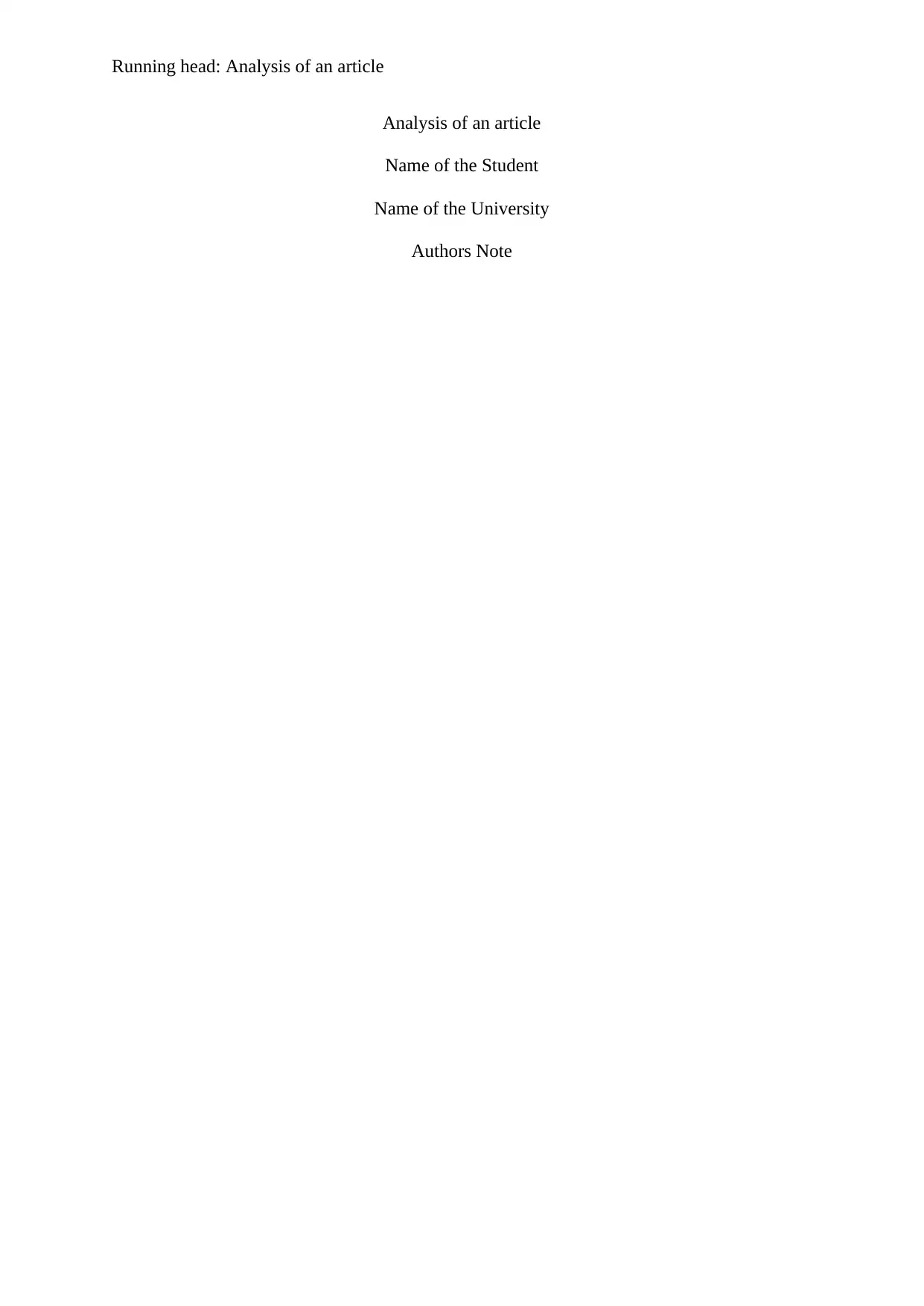
The discussion shows that different approaches of curriculum development are results
of the unequal distribution of power embedded in the society. The actor-network theory was
developed by French theorists Callon (1986) and Latour (1988), it was an analytical tool thst
will help to examine the heterogeneous process of the social and the technical change that is
occurring in the society. This theory helps to the ease the tension between the debate of
agency and the structure. According to this curriculum is not a definite entity but it is a
network of relationships or processes. Therefore it curriculum cannot be seen as a package as
defined by modernist theory. The members within the curriculum are not fixed but they keep
on changing, persons change however, the position remains. Running on the same principles
laid down in the modernist theory, the post-modern theory resonates the same points.
According to Doll, even though curriculum does refer to the pre-determined package
However, it is through interaction that they head towards that position. Curriculum is
embedded in the social environment and it cannot be explained only through interaction.
Analysts must understand the presence of different forces that are responsible for emergence
of such pattern of interaction. Social reality is pervasive and analysts need to understand that
studies cannot be conducted in its strict sense academic boundaries. This is because the
boundary are rather arbitrary and studying things in disjunction can result lead to false
results. All the elements are tied in an network, and understanding the curriculum pattern will
require a holistic knowledge.
Since curriculum is not an entity it is a process it is not a homogenous network that
consists only of human beings. Machines, money, ecology texts and so on are also included
in the analysis of the curriculum. Therefore, Callon has systematically coined the term actor,
which is not limited to the human beings but also it represents different properties, be it
human or non-human. Heterogeneous networks become stabilised, when the actors realises
the interrelations between, because inter-relations results in inter-dependence. The most
Document Page
Running head: Analysis of an article
important aspect identified by actor-network theory is that power is a relative because it
keeps on changing with the place of position. Therefore, power is bestowed in fixed position
it is movable, as Latour suggests that, “domination is never a capital that can be stored in the
bank. It has to be deployed, black boxed, repaired and maintained”. According to them
power is borrowed by their agents and it is shaped by their own thoughts. Thus power
dynamics are in a constant flow within the social structure, which is not definite but a effects
of the system. Curriculum is no exception here.
Owing to this understanding of actor-network theory, curriculum as defined by the
modernist school of thought is acceptable because it addresses the robust network it has in the
society. However, under this process the actors do not have any control over the knowledge
production. This is because the resourceful person dominates the entire network, resources in
terms of economic gains. Stemming from this logic the post-modern approach, it also
conceptualises the pattern of interaction but in the preconceived notion of power. According
to actor-network theory, curriculum is an effect and there is constant flow of power
dynamics. Since it is not an entity it allows the play of actor regardless of their human nature,
thus it effectively portrays a holistic picture. This theory also propounds the importance of
inter-dependence, as it analyses the inter-relations between the actors.
References
Doll Jr, W.E., 2015. A post-modern perspective on curriculum. Teachers College Press.
Hutcheon, L., 2003. The politics of postmodernism. Routledge.
Lau, D.C.M., 2001. Analysing the curriculum development process: three models. Pedagogy,
culture and society, 9(1), pp.29-44.
Law, J. and Hassard, J., 1999. Actor network theory and after.
chevron_up_icon
1 out of 7
circle_padding
hide_on_mobile
zoom_out_icon
[object Object]