University Curriculum Evaluation: CIPP Model for Workplace
VerifiedAdded on 2021/06/17
|15
|4358
|84
Report
AI Summary
This report evaluates a workplace curriculum for teaching English to year 8 students in an Australian school, focusing on the CIPP (Context, Input, Process, Product) evaluation model. The student identifies the need for continuous improvement and assesses the curriculum set by the Australian School Curriculum and Standards Authority, highlighting the importance of understanding student needs and adapting teaching strategies. The report describes the CIPP model, justifying its selection for evaluating the curriculum's effectiveness in terms of language interaction and community dialects. It proposes implementing the CIPP model to assess the curriculum's context, inputs, processes, and products, emphasizing the importance of teacher planning, student needs assessment, and the alignment with SCSA standards. The report also discusses how visual presentations and addressing student challenges can enhance the learning experience, aiming to improve the overall educational outcomes.

Running head: WORKPLACE CURRICULUM EVALUATION
WORKPLACE CURRICULUM EVALUATION
Name of the student
Name of the university
Author note
WORKPLACE CURRICULUM EVALUATION
Name of the student
Name of the university
Author note

Paraphrase This Document
Need a fresh take? Get an instant paraphrase of this document with our AI Paraphraser
1WORKPLACE CURRICULUM EVALUATION
Part A
The identification of the needs of the organization to bring in continuous improvements is
supported through the formulation of a curriculum that helps the organization in empowering the
interests of the people concerned. I have been working in a school, in Australia for the past two
years where I have been teaching English to the year 8 students. The curriculum that was set by
the Australian School Curriculum and Standards Authority has helped in the evaluation of the
healthy practices of the teachers and the manner they took steps to introduce the texts to the
students (SCSA., 2018). The formulation of the curriculum for the pre-primary to year 12 has
helped in segmentation of the study materials based on the identification of the capabilities of the
students to adapt themselves to the topic. The major attributes of the change in the structure is
based on the understanding of the needs of the students and the manner in which the teachers can
take steps to enhance the understanding of the students (SCSA., 2018).
The key focus of the assessment is based on the understanding the language for
interacting while identifying the different levels of conventions of speech adopted by
communities (Khalid, Ashraf & Rehman, 2012). The curriculum outlines the different changes
in the strategies undertaken by the teachers for making the students aware of the different
conventions and the language that is used by the people in different communities. The
identification of the languages of the communities through the activities of the teachers helps in
facilitating the understanding of the students who face difficulty in understanding the English
dialects (Gardner, 2014). The specific actions that are undertaken by the teachers as per the
identification of the needs of the students are through providing examples of the social contexts
to the students of the origin of the speeches (SCSA., 2018). The identification of the needs of the
Part A
The identification of the needs of the organization to bring in continuous improvements is
supported through the formulation of a curriculum that helps the organization in empowering the
interests of the people concerned. I have been working in a school, in Australia for the past two
years where I have been teaching English to the year 8 students. The curriculum that was set by
the Australian School Curriculum and Standards Authority has helped in the evaluation of the
healthy practices of the teachers and the manner they took steps to introduce the texts to the
students (SCSA., 2018). The formulation of the curriculum for the pre-primary to year 12 has
helped in segmentation of the study materials based on the identification of the capabilities of the
students to adapt themselves to the topic. The major attributes of the change in the structure is
based on the understanding of the needs of the students and the manner in which the teachers can
take steps to enhance the understanding of the students (SCSA., 2018).
The key focus of the assessment is based on the understanding the language for
interacting while identifying the different levels of conventions of speech adopted by
communities (Khalid, Ashraf & Rehman, 2012). The curriculum outlines the different changes
in the strategies undertaken by the teachers for making the students aware of the different
conventions and the language that is used by the people in different communities. The
identification of the languages of the communities through the activities of the teachers helps in
facilitating the understanding of the students who face difficulty in understanding the English
dialects (Gardner, 2014). The specific actions that are undertaken by the teachers as per the
identification of the needs of the students are through providing examples of the social contexts
to the students of the origin of the speeches (SCSA., 2018). The identification of the needs of the
2WORKPLACE CURRICULUM EVALUATION
students is facilitated through the delineation of the Australian standards for bringing in changes
in the systems and the processes of teaching.
The report is aimed at evaluating the curriculum for the 8years of the in the light of CIPP
evaluation model. It will help in identifying the different prospects of the success factors of the
curriculum and the manner in which it will be fitting into the purpose of enriching the study
experience for the students.
Part B
1. Description of the model
The CIPP model is a program evaluation model, which helps in the identification of the
varied aspects of the Context, Input, Process and Product. Daniel Stufflebeam developed the
model in the year 1960, which is focused on understanding the different aspects of the value of a
program that reflects integrated planning and execution of the ideas for positive outcomes. The
model helps in designing the proper functioning of the programs and thereby predicts the
outcomes of the activities that are undertaken by the authorities (Usmani et al., 2012). The proper
design of the programs contributes to its success factors as per the needs of the authorities to
derive the positive outcomes. The design of the programs and the manner in which the processes
are framed helps in maintaining the understanding of the success factors of the outcome that is
planned by the authorities through the event (SCSA., 2018). The model facilitates the utilization
of the different sources of activities through systematic planning and execution that helps the
authorities to bring out positive results of the program that is undertaken.
students is facilitated through the delineation of the Australian standards for bringing in changes
in the systems and the processes of teaching.
The report is aimed at evaluating the curriculum for the 8years of the in the light of CIPP
evaluation model. It will help in identifying the different prospects of the success factors of the
curriculum and the manner in which it will be fitting into the purpose of enriching the study
experience for the students.
Part B
1. Description of the model
The CIPP model is a program evaluation model, which helps in the identification of the
varied aspects of the Context, Input, Process and Product. Daniel Stufflebeam developed the
model in the year 1960, which is focused on understanding the different aspects of the value of a
program that reflects integrated planning and execution of the ideas for positive outcomes. The
model helps in designing the proper functioning of the programs and thereby predicts the
outcomes of the activities that are undertaken by the authorities (Usmani et al., 2012). The proper
design of the programs contributes to its success factors as per the needs of the authorities to
derive the positive outcomes. The design of the programs and the manner in which the processes
are framed helps in maintaining the understanding of the success factors of the outcome that is
planned by the authorities through the event (SCSA., 2018). The model facilitates the utilization
of the different sources of activities through systematic planning and execution that helps the
authorities to bring out positive results of the program that is undertaken.
⊘ This is a preview!⊘
Do you want full access?
Subscribe today to unlock all pages.

Trusted by 1+ million students worldwide
3WORKPLACE CURRICULUM EVALUATION
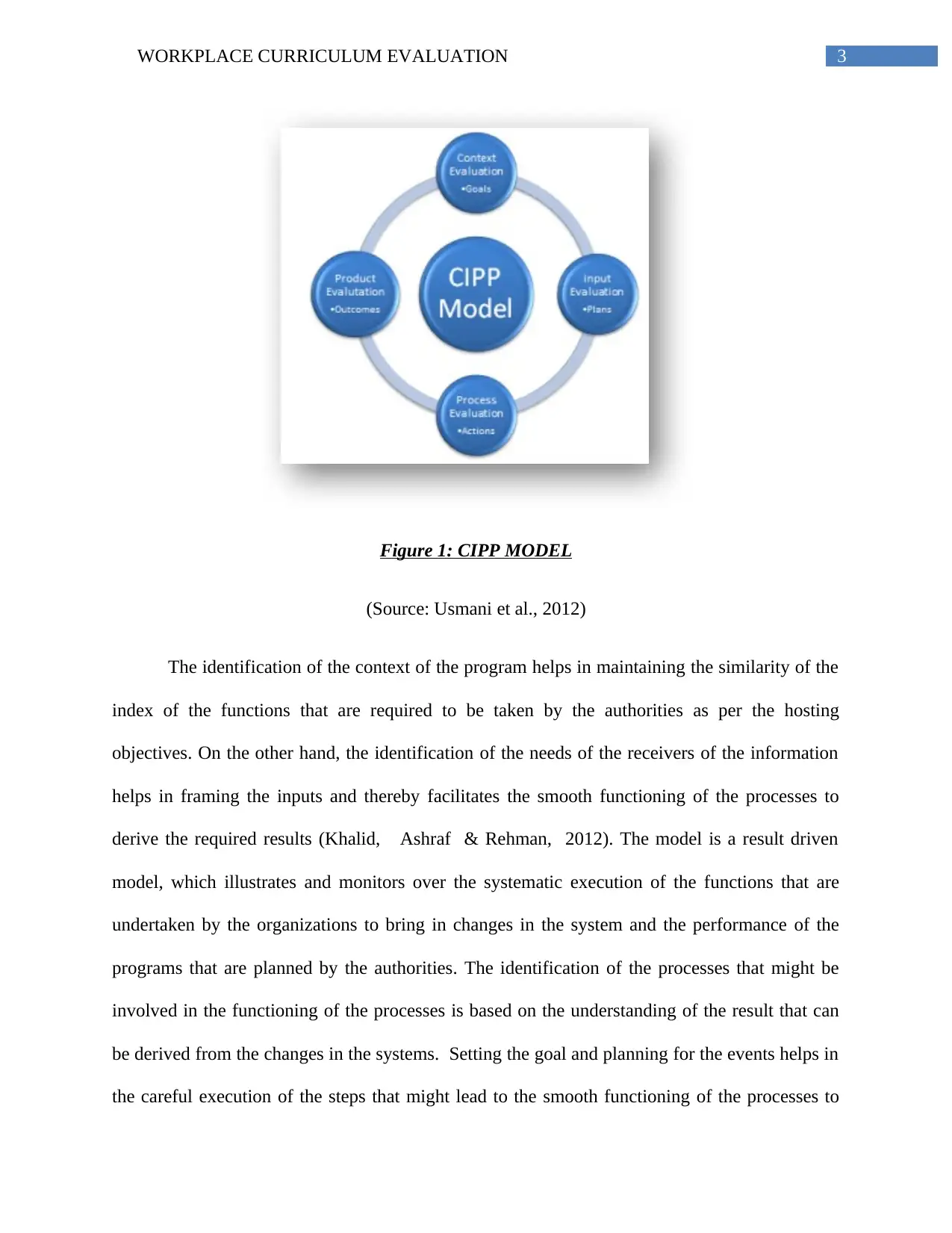
Figure 1: CIPP MODEL
(Source: Usmani et al., 2012)
The identification of the context of the program helps in maintaining the similarity of the
index of the functions that are required to be taken by the authorities as per the hosting
objectives. On the other hand, the identification of the needs of the receivers of the information
helps in framing the inputs and thereby facilitates the smooth functioning of the processes to
derive the required results (Khalid, Ashraf & Rehman, 2012). The model is a result driven
model, which illustrates and monitors over the systematic execution of the functions that are
undertaken by the organizations to bring in changes in the system and the performance of the
programs that are planned by the authorities. The identification of the processes that might be
involved in the functioning of the processes is based on the understanding of the result that can
be derived from the changes in the systems. Setting the goal and planning for the events helps in
the careful execution of the steps that might lead to the smooth functioning of the processes to
Figure 1: CIPP MODEL
(Source: Usmani et al., 2012)
The identification of the context of the program helps in maintaining the similarity of the
index of the functions that are required to be taken by the authorities as per the hosting
objectives. On the other hand, the identification of the needs of the receivers of the information
helps in framing the inputs and thereby facilitates the smooth functioning of the processes to
derive the required results (Khalid, Ashraf & Rehman, 2012). The model is a result driven
model, which illustrates and monitors over the systematic execution of the functions that are
undertaken by the organizations to bring in changes in the system and the performance of the
programs that are planned by the authorities. The identification of the processes that might be
involved in the functioning of the processes is based on the understanding of the result that can
be derived from the changes in the systems. Setting the goal and planning for the events helps in
the careful execution of the steps that might lead to the smooth functioning of the processes to
Paraphrase This Document
Need a fresh take? Get an instant paraphrase of this document with our AI Paraphraser
4WORKPLACE CURRICULUM EVALUATION
bring out positive outcomes. The different aspects of the change in the approach are dependent
on the understanding of needs of the organization to bring in changes in the systems and thereby
determine the manner in which the program appeals to the receiver or audiences.
2. Justification for selecting the model
The selection of the models is based on the understanding of the needs of the teachers to
assess the outcomes of the activities and the steps that are undertaken by the same to make the
students understand the contexts. The central part of the curriculum stated by School
Curriculum and Standards Authority is language for interacting, which facilitates the students
with the understanding of the evolution of the language and the manner in which the dialect is
nurtured through community involvement. The CIPP model will be helping to evaluate the
different terms of actions and their individual outcomes, which would be helping the teachers to
understand and plan their course of activities based on the identification of the needs of the
students (Majdalawieh & Marks, 2018). The identification of the model will be helping the
teachers to understand the needs of the students and thereby bring in changes in their techniques
of teaching. It will be facilitating the needs of the students as per the Australian standards of
education.
3. Proposal for curriculum evaluation
The implementation of the CIPP model on the current curriculum is facilitated through
the understanding of the need of the students to identify the key resources that are delivered to
them. The different steps that might be taken by the instructor are based on the understanding of
the needs of the student based on the identification of their capabilities to get a grab on the topics
(Khalid, Ashraf & Rehman, 2012). The identification of the needs of the students will be
helping the teacher to bring in changes in their teaching styles through systematic planning and
bring out positive outcomes. The different aspects of the change in the approach are dependent
on the understanding of needs of the organization to bring in changes in the systems and thereby
determine the manner in which the program appeals to the receiver or audiences.
2. Justification for selecting the model
The selection of the models is based on the understanding of the needs of the teachers to
assess the outcomes of the activities and the steps that are undertaken by the same to make the
students understand the contexts. The central part of the curriculum stated by School
Curriculum and Standards Authority is language for interacting, which facilitates the students
with the understanding of the evolution of the language and the manner in which the dialect is
nurtured through community involvement. The CIPP model will be helping to evaluate the
different terms of actions and their individual outcomes, which would be helping the teachers to
understand and plan their course of activities based on the identification of the needs of the
students (Majdalawieh & Marks, 2018). The identification of the model will be helping the
teachers to understand the needs of the students and thereby bring in changes in their techniques
of teaching. It will be facilitating the needs of the students as per the Australian standards of
education.
3. Proposal for curriculum evaluation
The implementation of the CIPP model on the current curriculum is facilitated through
the understanding of the need of the students to identify the key resources that are delivered to
them. The different steps that might be taken by the instructor are based on the understanding of
the needs of the student based on the identification of their capabilities to get a grab on the topics
(Khalid, Ashraf & Rehman, 2012). The identification of the needs of the students will be
helping the teacher to bring in changes in their teaching styles through systematic planning and
5WORKPLACE CURRICULUM EVALUATION
segmentation of the course materials. On the other hand, the identification of the understanding
levels and the capabilities of the students help the instructors in planning their teaching process
more effectively. It helps the instructors to adhere to the SCSA without compromising on the
needs of the students to understand the topic. The identification of the needs of the students
relating to the teaching of the English language based on the curriculum has helped in
maintaining the paradox of the change as per the standards (SCSA., 2018). The proper design of
the curriculum facilitates the understanding of the capabilities of the student and thereby
assigning them with the required understanding of the data through different examples from the
contemporary society. The major attributes of the change in the learning outcome is measured
through the efficiency of the lesson planning that is undertaken by the teacher to suit the purpose
of the student. Identifying the need of the individual students and making them understand the
subject material of the Language structure and the dialects depends on the systematic functions
of the teacher.
The identification of the CIPP model and implementing the same while teaching the
students will be helping the teacher to bring in changes in the outcome. The identification of
Inputs or the context of the topic and assimilating the required information on the same will be
helping the teacher to bring in changes in the systems of teaching the students as per the
capabilities of the same (Khalid, Ashraf & Rehman, 2012). On the other hand, the
identification of the inputs or the raw data on Language for Interaction helps in segmenting the
information based on the topics that will be focused by the teacher while teaching the students on
the topic. The identification of the context will be helping to enhance the structure and the
functioning of the learning program and thereby yield to the requirements of understanding of
the topic of the students. On the other hand, matching the context with the mental growth of the
segmentation of the course materials. On the other hand, the identification of the understanding
levels and the capabilities of the students help the instructors in planning their teaching process
more effectively. It helps the instructors to adhere to the SCSA without compromising on the
needs of the students to understand the topic. The identification of the needs of the students
relating to the teaching of the English language based on the curriculum has helped in
maintaining the paradox of the change as per the standards (SCSA., 2018). The proper design of
the curriculum facilitates the understanding of the capabilities of the student and thereby
assigning them with the required understanding of the data through different examples from the
contemporary society. The major attributes of the change in the learning outcome is measured
through the efficiency of the lesson planning that is undertaken by the teacher to suit the purpose
of the student. Identifying the need of the individual students and making them understand the
subject material of the Language structure and the dialects depends on the systematic functions
of the teacher.
The identification of the CIPP model and implementing the same while teaching the
students will be helping the teacher to bring in changes in the outcome. The identification of
Inputs or the context of the topic and assimilating the required information on the same will be
helping the teacher to bring in changes in the systems of teaching the students as per the
capabilities of the same (Khalid, Ashraf & Rehman, 2012). On the other hand, the
identification of the inputs or the raw data on Language for Interaction helps in segmenting the
information based on the topics that will be focused by the teacher while teaching the students on
the topic. The identification of the context will be helping to enhance the structure and the
functioning of the learning program and thereby yield to the requirements of understanding of
the topic of the students. On the other hand, matching the context with the mental growth of the
⊘ This is a preview!⊘
Do you want full access?
Subscribe today to unlock all pages.
Trusted by 1+ million students worldwide
6WORKPLACE CURRICULUM EVALUATION
pupils will be helping the teacher to identify different procedures that might be taken by them to
assert the information and make them applicable to the education needs of the student.
On the other hand, planning the context is an important step that must be undertaken by
the instructor to bring in changes in the performance of the students through the facilitation of
the understanding of the key concepts and theories that beholds the interaction objectives of the
language. The teacher must take steps to plan their curriculum to suit the purpose of the students
to bring in changes in the programs through the understanding of the capabilities of the students.
Adherence to the SCSA standards that are enforced by the Australian government and the boards
of the education has helped the teachers in undertaking segmentation of the topic after the
identification of the mental capabilities of the students. Usmani et al. (2012) stated that the
identification of the needs of the students helps in identifying the varied issues that are faced by
the students while engulfing the topic. Planning the curriculum has helped in detailing the
actions that might be taken by the teacher while educating the students (Khalid, Ashraf &
Rehman, 2012). The segmentation of the Language related topics to assimilate the outcome has
helped in understanding the different levels of the change in the structure and the performance of
students. The identification of the capabilities of the students and the issues that might be faced
by the same helps the teacher in undertaking the planning process. The teacher might take steps
to create visual presentation to help the students to have a hold on the topics that are being taught
as a part of the curriculum (Hafner, 2014). Identification of the issues that are faced by the
students helps the teacher in asserting the best treatment to the pupils.
The identification of the relevant process helps in bringing forth changes in the teaching
profession. This stage helps the teacher in implementing the different aspects of the change in
their initiatives to teach the students. The identification of the different issues that are faced by
pupils will be helping the teacher to identify different procedures that might be taken by them to
assert the information and make them applicable to the education needs of the student.
On the other hand, planning the context is an important step that must be undertaken by
the instructor to bring in changes in the performance of the students through the facilitation of
the understanding of the key concepts and theories that beholds the interaction objectives of the
language. The teacher must take steps to plan their curriculum to suit the purpose of the students
to bring in changes in the programs through the understanding of the capabilities of the students.
Adherence to the SCSA standards that are enforced by the Australian government and the boards
of the education has helped the teachers in undertaking segmentation of the topic after the
identification of the mental capabilities of the students. Usmani et al. (2012) stated that the
identification of the needs of the students helps in identifying the varied issues that are faced by
the students while engulfing the topic. Planning the curriculum has helped in detailing the
actions that might be taken by the teacher while educating the students (Khalid, Ashraf &
Rehman, 2012). The segmentation of the Language related topics to assimilate the outcome has
helped in understanding the different levels of the change in the structure and the performance of
students. The identification of the capabilities of the students and the issues that might be faced
by the same helps the teacher in undertaking the planning process. The teacher might take steps
to create visual presentation to help the students to have a hold on the topics that are being taught
as a part of the curriculum (Hafner, 2014). Identification of the issues that are faced by the
students helps the teacher in asserting the best treatment to the pupils.
The identification of the relevant process helps in bringing forth changes in the teaching
profession. This stage helps the teacher in implementing the different aspects of the change in
their initiatives to teach the students. The identification of the different issues that are faced by
Paraphrase This Document
Need a fresh take? Get an instant paraphrase of this document with our AI Paraphraser
7WORKPLACE CURRICULUM EVALUATION
the student related to the understanding of the topic is facilitated through the planning of the
processes and thereby implementing them while undertaking steps to bring in changes in the
systems. The major issues that are faced by the students relating to the study of the language is
based on the understanding of the origins of the language and the impacts of the invasions that
modified the language (Henderson, Selwyn & Aston, 2017). The understanding of the simple
linguistics and framing the same through simple examples will be helping the teacher to bring in
changes in the systems of teaching as per the cognitive abilities of the students. The
identification of the process and the systematic and controlled functioning of the teacher will be
helping to enhance the learning experience of the students. Identification of the needs of the
students and thereby deliberately bringing in changes in the systems of the learning is based on
the understanding the mentality of the students of the year 8. SCSA standards asserted by the
Australian Board of Education has clearly enumerated the functions of the teacher to bring forth
changes in the systems and the functioning that the teacher is required to follow to bring in the
changes in the learning attributes (SCSA., 2018). The identification of the standards and the
norms that are imposed by the government has helped in assigning texts and sessions to improve
the Language for interactions. The teacher must take steps to cite simple examples from different
situations through interactive session based on the study of the origin of metaphors and other
literary devices and the manner in which the elements came into existence. The emphasis on the
different factors of the change is based on understanding of the needs of students to attain the
education. The key attributes for the change, as stated by Usmani et al. (2012), is dependent on
the identification of the different issues that are faced by the students relating to their
understanding of the topic. The major key elements of the change in the approach of the teachers
are based on making the students aware of the lessons and thereby bring in improvements in the
the student related to the understanding of the topic is facilitated through the planning of the
processes and thereby implementing them while undertaking steps to bring in changes in the
systems. The major issues that are faced by the students relating to the study of the language is
based on the understanding of the origins of the language and the impacts of the invasions that
modified the language (Henderson, Selwyn & Aston, 2017). The understanding of the simple
linguistics and framing the same through simple examples will be helping the teacher to bring in
changes in the systems of teaching as per the cognitive abilities of the students. The
identification of the process and the systematic and controlled functioning of the teacher will be
helping to enhance the learning experience of the students. Identification of the needs of the
students and thereby deliberately bringing in changes in the systems of the learning is based on
the understanding the mentality of the students of the year 8. SCSA standards asserted by the
Australian Board of Education has clearly enumerated the functions of the teacher to bring forth
changes in the systems and the functioning that the teacher is required to follow to bring in the
changes in the learning attributes (SCSA., 2018). The identification of the standards and the
norms that are imposed by the government has helped in assigning texts and sessions to improve
the Language for interactions. The teacher must take steps to cite simple examples from different
situations through interactive session based on the study of the origin of metaphors and other
literary devices and the manner in which the elements came into existence. The emphasis on the
different factors of the change is based on understanding of the needs of students to attain the
education. The key attributes for the change, as stated by Usmani et al. (2012), is dependent on
the identification of the different issues that are faced by the students relating to their
understanding of the topic. The major key elements of the change in the approach of the teachers
are based on making the students aware of the lessons and thereby bring in improvements in the
8WORKPLACE CURRICULUM EVALUATION
cognitive abilities (Vähäsantanen, 2015). The systematic functioning of the processes of the
teacher helps in the proper assimilation of the ideas facilitates the needs of the students to bring
in modifications in the learning process.
The product or the outcome of the processes that are planned and executed by the teacher
is an important factor, which influences the applicability of the model on the situation. The
model, being goal centric in nature has helped the teachers in bringing forth changes in the
systems of teaching as per the identification of the issues faced by the students. The
identification of the issues has helped in maintaining the different levels of improvements in the
outcomes. The output helps in understanding the effectiveness of the processes that are planned
by the teacher. The identification of the different elements of the change in the processes is
facilitated through the understanding of different factors that affects the functioning of the
teacher. Ahsan, Sharma and Deppeler (2012) stated that the identification of the need of the
students and resolving them through proper planning and implementation of the plans helps in
yielding positive results. On the other hand, Luke (2018) stated that the application of the CIPP
model helps in identifying the goals of the teacher to reach out to the students through the
different processes that are applicable based on the varied mentality and the cognitive ability of
the pupils. The identification of the psychological trends of the students helps the teachers in
identifying the various issues that are faced by the student while taking the lessons. The
identification of the psychological trends and the capabilities of the students have helped the
teachers to maintain a balance in their functions and thereby focus on the goals.
As per the SCSA, year 8 students’ curriculum includes a total of nine courses – The Arts,
Technologies, Humanities and Social Science, Health and Physical Education, English,
Mathematics, Science, History and Languages. Now, associating the courses with the CIPP
cognitive abilities (Vähäsantanen, 2015). The systematic functioning of the processes of the
teacher helps in the proper assimilation of the ideas facilitates the needs of the students to bring
in modifications in the learning process.
The product or the outcome of the processes that are planned and executed by the teacher
is an important factor, which influences the applicability of the model on the situation. The
model, being goal centric in nature has helped the teachers in bringing forth changes in the
systems of teaching as per the identification of the issues faced by the students. The
identification of the issues has helped in maintaining the different levels of improvements in the
outcomes. The output helps in understanding the effectiveness of the processes that are planned
by the teacher. The identification of the different elements of the change in the processes is
facilitated through the understanding of different factors that affects the functioning of the
teacher. Ahsan, Sharma and Deppeler (2012) stated that the identification of the need of the
students and resolving them through proper planning and implementation of the plans helps in
yielding positive results. On the other hand, Luke (2018) stated that the application of the CIPP
model helps in identifying the goals of the teacher to reach out to the students through the
different processes that are applicable based on the varied mentality and the cognitive ability of
the pupils. The identification of the psychological trends of the students helps the teachers in
identifying the various issues that are faced by the student while taking the lessons. The
identification of the psychological trends and the capabilities of the students have helped the
teachers to maintain a balance in their functions and thereby focus on the goals.
As per the SCSA, year 8 students’ curriculum includes a total of nine courses – The Arts,
Technologies, Humanities and Social Science, Health and Physical Education, English,
Mathematics, Science, History and Languages. Now, associating the courses with the CIPP
⊘ This is a preview!⊘
Do you want full access?
Subscribe today to unlock all pages.
Trusted by 1+ million students worldwide
9WORKPLACE CURRICULUM EVALUATION
model it would be easy to justify the relevance of the model with the curriculum of year 8
students ("The CIPP evaluation model", 2018).
The Arts course has been designed to help students learn the rules and principles of
common media type, its genre and style. Students are assessed based on their skills to work in a
group and produce a media product like television commercial. Evaluating the Context of the
course, it is related to other courses like the Humanities and Social Science, History and
Language. on one hand, these courses help students learn about the culture of medieval Europe,
learn different languages and have an understanding of the Japanese history and its culture and
on the other hand, media studies helps them incorporate these knowledge into their production.
Further, Technologies course help the students to develop skills to prepare plans and create
projects, which is an essential part of media studies. The Arts course would be helpful for
students establish their career in the field of media.
After the evaluation of the context, the inputs of the courses developed for year 8 students
should also be analyzed. While developing the courses, the SCSA committee had scrutinized the
ability of the students to understand the courses. In addition, the curriculum aims to understand
the potential and progress of the students during the course. The students have developed capable
learning skills after the year 7 and hence the year 8 curriculum aims to analyze further their
competencies.
The next element of the CIPP model is the Process. This includes the workload of the
students, their participation, and the problems they face and so on. In the SCSA curriculum for
year 8, the students are involved not just in learning the theoretical aspects of the courses such as
The Arts and others but also participating actively in activities that tests their theoretical
model it would be easy to justify the relevance of the model with the curriculum of year 8
students ("The CIPP evaluation model", 2018).
The Arts course has been designed to help students learn the rules and principles of
common media type, its genre and style. Students are assessed based on their skills to work in a
group and produce a media product like television commercial. Evaluating the Context of the
course, it is related to other courses like the Humanities and Social Science, History and
Language. on one hand, these courses help students learn about the culture of medieval Europe,
learn different languages and have an understanding of the Japanese history and its culture and
on the other hand, media studies helps them incorporate these knowledge into their production.
Further, Technologies course help the students to develop skills to prepare plans and create
projects, which is an essential part of media studies. The Arts course would be helpful for
students establish their career in the field of media.
After the evaluation of the context, the inputs of the courses developed for year 8 students
should also be analyzed. While developing the courses, the SCSA committee had scrutinized the
ability of the students to understand the courses. In addition, the curriculum aims to understand
the potential and progress of the students during the course. The students have developed capable
learning skills after the year 7 and hence the year 8 curriculum aims to analyze further their
competencies.
The next element of the CIPP model is the Process. This includes the workload of the
students, their participation, and the problems they face and so on. In the SCSA curriculum for
year 8, the students are involved not just in learning the theoretical aspects of the courses such as
The Arts and others but also participating actively in activities that tests their theoretical
Paraphrase This Document
Need a fresh take? Get an instant paraphrase of this document with our AI Paraphraser
10WORKPLACE CURRICULUM EVALUATION
knowledge and personal abilities. Students through real-time activities apply the knowledge
gained in these courses. To provide an instance, in the Humanities and Social Sciences course,
students first learn about the various facets of Medieval Europe life and then assume the role of a
museum curator and explore the life in Medieval Europe.
The Product element of CIPP model refers to the knowledge gained by the students
throughout the curriculum and its application. Year 8 students are assessed at the end of the year
after they have successfully completed the tasks allotted to them during the course of the
curriculum. Students are required to sit for an examination at the end of each semester and the
results are reported by the schools to parents or carers. In addition to that, students of Year 8 are
also assessed based on their practical ability to input knowledge they gained in given situations.
It can thus be seen that the CIPP model is aligned with the curriculum planning for the
Year 8 students under the SCSA.
Part C
The identification of the different processes and the techniques by the teacher is
dependent on the understanding of the needs of the students based on their cognitive abilities
(Calvert & Sheen, 2015). The identification of the issues that are faced by the students has
helped the teachers in bringing in changes in their teaching methodologies. The changes in the
teaching attributes have helped the teachers in quantifying their goal to make the subject matter
more valid to the student’s line of understanding. The teacher utilizes the different sources of
data and incorporates them with a picturesque example to create a visual impact at the mind of
the students. Identification of the issues that are faced by the students and understanding the
needs of the changes in the structure of the processes through proper planning has helped in
knowledge and personal abilities. Students through real-time activities apply the knowledge
gained in these courses. To provide an instance, in the Humanities and Social Sciences course,
students first learn about the various facets of Medieval Europe life and then assume the role of a
museum curator and explore the life in Medieval Europe.
The Product element of CIPP model refers to the knowledge gained by the students
throughout the curriculum and its application. Year 8 students are assessed at the end of the year
after they have successfully completed the tasks allotted to them during the course of the
curriculum. Students are required to sit for an examination at the end of each semester and the
results are reported by the schools to parents or carers. In addition to that, students of Year 8 are
also assessed based on their practical ability to input knowledge they gained in given situations.
It can thus be seen that the CIPP model is aligned with the curriculum planning for the
Year 8 students under the SCSA.
Part C
The identification of the different processes and the techniques by the teacher is
dependent on the understanding of the needs of the students based on their cognitive abilities
(Calvert & Sheen, 2015). The identification of the issues that are faced by the students has
helped the teachers in bringing in changes in their teaching methodologies. The changes in the
teaching attributes have helped the teachers in quantifying their goal to make the subject matter
more valid to the student’s line of understanding. The teacher utilizes the different sources of
data and incorporates them with a picturesque example to create a visual impact at the mind of
the students. Identification of the issues that are faced by the students and understanding the
needs of the changes in the structure of the processes through proper planning has helped in
11WORKPLACE CURRICULUM EVALUATION
enhancing the goal centric approach. CIPP model has helped in boosting the education systems
as mentioned under SCSA. Identification of the needs of the students and thereby providing them
with the knowledge of the vast linguistics will be helping the teacher to make the students aware
of the changes in the structure of the language. On the other hand, the enumeration of the ideas
after proper planning has helped in enhancing the learning experience of the students. The
identification of the different issues that are faced by the students and the mitigation of the same
through the proper planning of the strategies like undertaking interactions has helped in
enhancing the functions of the teachers.
The curriculum stated that the teachers are required to cite examples of the society to
enhance the proper understanding of the students relating to the subject. Therefore, the proper
planning attribute of the CIPP model is achieved. On the other hand, implementation of the plans
while educating the students has helped in enhancing the outcomes. The utilization of the goal
centric model, which emphasizes on the functions and their planning to achieve the objective,
has helped in bringing forth modifications in the systems of the teaching profession (SCSA.,
2018). The adherence to the SCSA criteria will be helping the teachers to bring in changes in
the education systems through the identification of the issues that are faced by the students and
thereby planning the teaching streams to suit the cognitive abilities of the students. On the other
hand, the identification of the needs of the students and the young learners is facilitated by the
changes in the systems and the functioning of the teaching systems. The idea of the changes in
the curriculum is supported through the different initiatives that are undertaken by the teacher
based on the understanding of the needs of the students. The identification of the different factors
that governs the applicability of the model in the scenario is based on the understanding of the
issues that are faced by the students.
enhancing the goal centric approach. CIPP model has helped in boosting the education systems
as mentioned under SCSA. Identification of the needs of the students and thereby providing them
with the knowledge of the vast linguistics will be helping the teacher to make the students aware
of the changes in the structure of the language. On the other hand, the enumeration of the ideas
after proper planning has helped in enhancing the learning experience of the students. The
identification of the different issues that are faced by the students and the mitigation of the same
through the proper planning of the strategies like undertaking interactions has helped in
enhancing the functions of the teachers.
The curriculum stated that the teachers are required to cite examples of the society to
enhance the proper understanding of the students relating to the subject. Therefore, the proper
planning attribute of the CIPP model is achieved. On the other hand, implementation of the plans
while educating the students has helped in enhancing the outcomes. The utilization of the goal
centric model, which emphasizes on the functions and their planning to achieve the objective,
has helped in bringing forth modifications in the systems of the teaching profession (SCSA.,
2018). The adherence to the SCSA criteria will be helping the teachers to bring in changes in
the education systems through the identification of the issues that are faced by the students and
thereby planning the teaching streams to suit the cognitive abilities of the students. On the other
hand, the identification of the needs of the students and the young learners is facilitated by the
changes in the systems and the functioning of the teaching systems. The idea of the changes in
the curriculum is supported through the different initiatives that are undertaken by the teacher
based on the understanding of the needs of the students. The identification of the different factors
that governs the applicability of the model in the scenario is based on the understanding of the
issues that are faced by the students.
⊘ This is a preview!⊘
Do you want full access?
Subscribe today to unlock all pages.
Trusted by 1+ million students worldwide

1 out of 15


Related Documents


Your All-in-One AI-Powered Toolkit for Academic Success.
+13062052269
info@desklib.com
Available 24*7 on WhatsApp / Email
![[object Object]](/_next/static/media/star-bottom.7253800d.svg)
Unlock your academic potential
Copyright © 2020–2026 A2Z Services. All Rights Reserved. Developed and managed by ZUCOL.