Evaluation Techniques and Student Learning in Business Studies
VerifiedAdded on 2021/06/17
|10
|2164
|602
Report
AI Summary
This report investigates various curriculum evaluation techniques and their implementation within academic institutions, specifically focusing on Business Studies. The paper explores the definition of curriculum evaluation, its significance in understanding the strengths and weaknesses of a curriculum, and the necessity of adapting curricula to reflect current developments. It reviews diverse evaluation methods, including interviews, questionnaires, and observation techniques, along with diagnostic, formative, and summative assessments. The study highlights the importance of continuous assessment, emphasizing its positive effects on student learning achievements, self-confidence, and the ability to understand concepts. The findings reveal that curriculum evaluation is essential for developing up-to-date curricula and improving student learning outcomes, with recommendations for teacher training and continuous assessment of both students and teachers. The report concludes that effective curriculum evaluation significantly influences student learning in Business Studies, fostering self-confidence and enhancing learning skills.
Curriculum evaluation
techniques and effective
implementation regarding
students learning
achievements in Business
Studies
0 | P a g e
techniques and effective
implementation regarding
students learning
achievements in Business
Studies
0 | P a g e

Paraphrase This Document
Need a fresh take? Get an instant paraphrase of this document with our AI Paraphraser
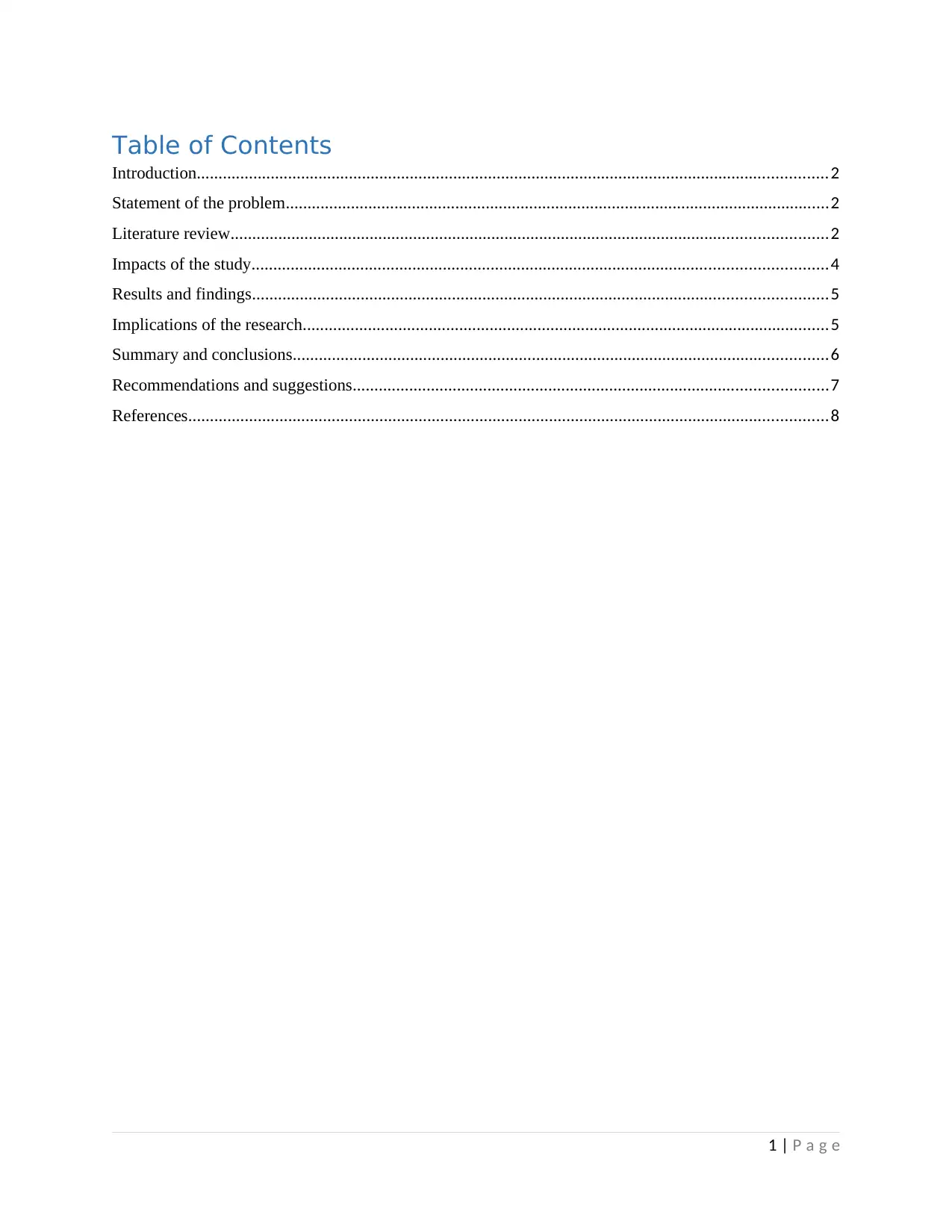
Table of Contents
Introduction.................................................................................................................................................2
Statement of the problem.............................................................................................................................2
Literature review.........................................................................................................................................2
Impacts of the study....................................................................................................................................4
Results and findings....................................................................................................................................5
Implications of the research.........................................................................................................................5
Summary and conclusions...........................................................................................................................6
Recommendations and suggestions.............................................................................................................7
References...................................................................................................................................................8
1 | P a g e
Introduction.................................................................................................................................................2
Statement of the problem.............................................................................................................................2
Literature review.........................................................................................................................................2
Impacts of the study....................................................................................................................................4
Results and findings....................................................................................................................................5
Implications of the research.........................................................................................................................5
Summary and conclusions...........................................................................................................................6
Recommendations and suggestions.............................................................................................................7
References...................................................................................................................................................8
1 | P a g e
Introduction
The purpose of this paper is to study different curriculum evaluation techniques and their
implementation in academic institutes. Furthermore, this paper will also explain the impacts of
this evaluation on learning achievement of students in Business Studies.
Statement of the problem
“Improper implementation and evaluation of alternative methods to assess the curriculum, as
opposed to continuous assessment. Lack of explanation on how curriculum evaluation techniques
can impact the learning achievement of students in other fields except for Business Studies.”
Literature review
According to Romiszowski, (2016), curriculum evaluation process is defined as a process by
which the authorities of an educational institution collects feedback about the curriculum to
understand its impacts on the students. The evaluation helps in understanding the strengths and
weaknesses of the curriculum and also to devise new ways to improve it. It is conducted to
answer the concerns of the teachers and students about whether the curriculum is able to fulfill
its purpose or not. Lack in implementing of the curriculum valuation techniques critically
increases the issues regarding the learnings in business studies. In the words of Asgedom,
(2017), the concept of curriculum evaluation is needed to understand whether the curriculum is
up-to-date with the recent developments in the specific field. After the evaluation, the curriculum
is modified for the improvement of the students. The evaluation of technique needs to be
conducted before the development of a new curriculum, understand the impacts of the
curriculum and update the curriculum according to the requirements. The purpose of business
study is to enable students to understand the concept of business like finance, accounting,
international business, and entrepreneurship. Various curriculum evaluation techniques can be
applied to understand if the curriculum of Business Studies is fulfilling its purpose or not. As per
Boulmetis and Dutwin, (2014), the outcomes of the curriculum can be observed with the help of
interviews and questionnaires.
In the words of Barrow, (2015), the method of observation is used to gather correct information
about the curriculum of Business Studies is implemented in a controlled environment like
classrooms. The behavior of the students can be observed with the help of technology or the
2 | P a g e
The purpose of this paper is to study different curriculum evaluation techniques and their
implementation in academic institutes. Furthermore, this paper will also explain the impacts of
this evaluation on learning achievement of students in Business Studies.
Statement of the problem
“Improper implementation and evaluation of alternative methods to assess the curriculum, as
opposed to continuous assessment. Lack of explanation on how curriculum evaluation techniques
can impact the learning achievement of students in other fields except for Business Studies.”
Literature review
According to Romiszowski, (2016), curriculum evaluation process is defined as a process by
which the authorities of an educational institution collects feedback about the curriculum to
understand its impacts on the students. The evaluation helps in understanding the strengths and
weaknesses of the curriculum and also to devise new ways to improve it. It is conducted to
answer the concerns of the teachers and students about whether the curriculum is able to fulfill
its purpose or not. Lack in implementing of the curriculum valuation techniques critically
increases the issues regarding the learnings in business studies. In the words of Asgedom,
(2017), the concept of curriculum evaluation is needed to understand whether the curriculum is
up-to-date with the recent developments in the specific field. After the evaluation, the curriculum
is modified for the improvement of the students. The evaluation of technique needs to be
conducted before the development of a new curriculum, understand the impacts of the
curriculum and update the curriculum according to the requirements. The purpose of business
study is to enable students to understand the concept of business like finance, accounting,
international business, and entrepreneurship. Various curriculum evaluation techniques can be
applied to understand if the curriculum of Business Studies is fulfilling its purpose or not. As per
Boulmetis and Dutwin, (2014), the outcomes of the curriculum can be observed with the help of
interviews and questionnaires.
In the words of Barrow, (2015), the method of observation is used to gather correct information
about the curriculum of Business Studies is implemented in a controlled environment like
classrooms. The behavior of the students can be observed with the help of technology or the
2 | P a g e
⊘ This is a preview!⊘
Do you want full access?
Subscribe today to unlock all pages.

Trusted by 1+ million students worldwide
teacher can observe the outcomes of the lesson plan himself. Students studying the subjects can
be interviewed to understand if the students are having any difficulty to understand the concepts
of the subject. Questionnaires provide a flexible way to collect information from students
without any pressure. Each of this observation techniques has its own kinds of advantages and
disadvantages. To further understand the outcomes of the curriculum various tests like diagnostic
test can be conducted. As per Skager and Dave, (2014), on the basis of the specific category,
these tests can be divided into several categories like formal and informal, formative and
summative, continuous and terminal assessments etc. Students and teachers are the most
important sources of information regarding the evaluation of the curriculum of Business Studies.
Students can provide feedback regarding the relevance of Business Studies and how the course is
implemented in the classrooms. Teachers also provide specific information about how the
students are learning the core concepts of Business Studies curriculum.
The curriculum of Business Studies is first pre-tested before its implementation in classrooms.
After the implementation of the curriculum, a post testing approach is taken. These tests are
conducted to evaluate the behavior of students before and after the implementation of the
curriculum. The course of Business Studies is evaluated with the help of formative evaluation
process. In the words of Bryman and Bell, (2015), this method is generally implemented at the
beginning of the implementation of the curriculum of Business Studies. This method consists of
process evaluation level and product evaluation level. Process evaluation deals with the
evaluation of how the curriculum is implemented within the classroom. It allows the curriculum
makers to modify the contents of the curriculum according to the developments in the field of
Business Studies. According to Anderson et al., (2016), product evaluation allows the curriculum
makers to evaluate how students are able to understand the concepts of the curriculum. It
provides them an opportunity to improve and modify the concepts of the course. Formative
evaluation of the Business Studies curriculum has enabled the teachers to incorporate the use of
technology in their lesson plans. They have used technology to record video and audio lessons so
that the students can access these lectures at any time and learn the course materials at their own
pace. In the words of Kubiszyn and Borich, (2015), the evaluation is conducted with the help of
some tests to evaluate the objectivity of the course. Feedback is collected from the students
regarding their difficulty to learn the concepts of the Business Studies curriculum. As per Norris,
3 | P a g e
be interviewed to understand if the students are having any difficulty to understand the concepts
of the subject. Questionnaires provide a flexible way to collect information from students
without any pressure. Each of this observation techniques has its own kinds of advantages and
disadvantages. To further understand the outcomes of the curriculum various tests like diagnostic
test can be conducted. As per Skager and Dave, (2014), on the basis of the specific category,
these tests can be divided into several categories like formal and informal, formative and
summative, continuous and terminal assessments etc. Students and teachers are the most
important sources of information regarding the evaluation of the curriculum of Business Studies.
Students can provide feedback regarding the relevance of Business Studies and how the course is
implemented in the classrooms. Teachers also provide specific information about how the
students are learning the core concepts of Business Studies curriculum.
The curriculum of Business Studies is first pre-tested before its implementation in classrooms.
After the implementation of the curriculum, a post testing approach is taken. These tests are
conducted to evaluate the behavior of students before and after the implementation of the
curriculum. The course of Business Studies is evaluated with the help of formative evaluation
process. In the words of Bryman and Bell, (2015), this method is generally implemented at the
beginning of the implementation of the curriculum of Business Studies. This method consists of
process evaluation level and product evaluation level. Process evaluation deals with the
evaluation of how the curriculum is implemented within the classroom. It allows the curriculum
makers to modify the contents of the curriculum according to the developments in the field of
Business Studies. According to Anderson et al., (2016), product evaluation allows the curriculum
makers to evaluate how students are able to understand the concepts of the curriculum. It
provides them an opportunity to improve and modify the concepts of the course. Formative
evaluation of the Business Studies curriculum has enabled the teachers to incorporate the use of
technology in their lesson plans. They have used technology to record video and audio lessons so
that the students can access these lectures at any time and learn the course materials at their own
pace. In the words of Kubiszyn and Borich, (2015), the evaluation is conducted with the help of
some tests to evaluate the objectivity of the course. Feedback is collected from the students
regarding their difficulty to learn the concepts of the Business Studies curriculum. As per Norris,
3 | P a g e
Paraphrase This Document
Need a fresh take? Get an instant paraphrase of this document with our AI Paraphraser
(2016), evaluation is conducted during implementation of the curriculum, after the teachers are
educated to properly implement the course within the classroom.
According to Wadsworth, (2016), after the evaluation is completely conducted in all phases, the
whole curriculum can be developed according to the specific requirements of the field.
Continuous evaluation of the curriculum does have a significant effect on learning achievements
of the students. The curriculum of Business Studies is continuously modified to incorporate the
latest developments in the field. Continuous evaluation does have a positive effect on the
learning achievement of students. This evaluation informs both students and their teachers about
their improvement thus increasing the effectiveness of the curriculum. In the words of (Barkley
and Major, (2015), focusing on improving the concepts of Business Studies allows the teachers
to implement the concepts of the curriculum in a much effective way. According to the students,
continuous assessment of the curriculum have helped them to understand the Business Studies
concepts in a better way. It acts as a motivation for the students and their teachers and it
improves the self-confidence of the students. It encourages the students to learn the course
materials and achieve its learning outcomes. Positive and negative feedback can be used
constructively to further develop and modify the curriculum of Business Studies. Continues
assessment enables the students to gain firsthand knowledge about various misconceptions of the
curriculum and be aware of them.
In the word of (Schauber et al., (2015), continuous assessment of course materials also allows
them to learn the concepts of Business Studies at their own pace and their own time. The
students are able to achieve high academic scores as they are able to understand the concepts
rather than memorizing the subject materials. It has the capacity to motivate students to focus on
the concepts of the subject. The continuous assessment does produce a better effect on both high
and low performing students of the institution. The teachers are able to understand the learning
needs of the students thus further facilitating their learning achievement. It allows both the
teachers and their students to self-evaluate their capacities and improve these capacities.
Impacts of the study
This study is conducted to understand the impacts various curriculum evaluation techniques and
their implementation on learning achievement of the students. This study mainly focuses on the
students who are studying the subject of Business Studies. This study will have a significant
4 | P a g e
educated to properly implement the course within the classroom.
According to Wadsworth, (2016), after the evaluation is completely conducted in all phases, the
whole curriculum can be developed according to the specific requirements of the field.
Continuous evaluation of the curriculum does have a significant effect on learning achievements
of the students. The curriculum of Business Studies is continuously modified to incorporate the
latest developments in the field. Continuous evaluation does have a positive effect on the
learning achievement of students. This evaluation informs both students and their teachers about
their improvement thus increasing the effectiveness of the curriculum. In the words of (Barkley
and Major, (2015), focusing on improving the concepts of Business Studies allows the teachers
to implement the concepts of the curriculum in a much effective way. According to the students,
continuous assessment of the curriculum have helped them to understand the Business Studies
concepts in a better way. It acts as a motivation for the students and their teachers and it
improves the self-confidence of the students. It encourages the students to learn the course
materials and achieve its learning outcomes. Positive and negative feedback can be used
constructively to further develop and modify the curriculum of Business Studies. Continues
assessment enables the students to gain firsthand knowledge about various misconceptions of the
curriculum and be aware of them.
In the word of (Schauber et al., (2015), continuous assessment of course materials also allows
them to learn the concepts of Business Studies at their own pace and their own time. The
students are able to achieve high academic scores as they are able to understand the concepts
rather than memorizing the subject materials. It has the capacity to motivate students to focus on
the concepts of the subject. The continuous assessment does produce a better effect on both high
and low performing students of the institution. The teachers are able to understand the learning
needs of the students thus further facilitating their learning achievement. It allows both the
teachers and their students to self-evaluate their capacities and improve these capacities.
Impacts of the study
This study is conducted to understand the impacts various curriculum evaluation techniques and
their implementation on learning achievement of the students. This study mainly focuses on the
students who are studying the subject of Business Studies. This study will have a significant
4 | P a g e
impact on education, as the curriculum makers will develop up-to-date curriculum with the help
of curriculum evaluation techniques. The students will able to increase their learning capacity
and achieve high academic score due to the continuous assessment of the curriculum of Business
Studies. It will allow the students to increase their confidence and their self-evaluation
capacities.
Results and findings
The results of this study show that evaluation of the curriculum is necessary to understand the
strengths and weaknesses of the curriculum of Business Studies. It also allows the curriculum
makers to develop a curriculum to develop a modified curriculum according to the developments
in the specific field. The primary objective of this evaluation is to collect feedback to understand
the impacts of the curriculum on the learning achievements of the students. Student and their
teachers are the primary sources of the reliable data needed to accurately conduct this evaluation.
It is found that continuous assessment of the curriculum motivates students to achieve the
learning outcomes of the curriculum.
Implications of the research
The primary purpose of this study is to understand the role of curriculum evaluation techniques
on leaning achieves students of Business Studies. According to this study, teachers, students and
curriculum makers play a significant role in developing a modernized and improved curriculum
of Business Studies. Continuous assessment allows both the students and the teachers to self-
evaluate and increase their self-confidence. Similar research can be conducted in the future in a
same or different field to understand this topic in details. Further research can be conducted to
develop more advanced curriculum evaluation techniques to evaluate the relevance of the
curriculum.
5 | P a g e
of curriculum evaluation techniques. The students will able to increase their learning capacity
and achieve high academic score due to the continuous assessment of the curriculum of Business
Studies. It will allow the students to increase their confidence and their self-evaluation
capacities.
Results and findings
The results of this study show that evaluation of the curriculum is necessary to understand the
strengths and weaknesses of the curriculum of Business Studies. It also allows the curriculum
makers to develop a curriculum to develop a modified curriculum according to the developments
in the specific field. The primary objective of this evaluation is to collect feedback to understand
the impacts of the curriculum on the learning achievements of the students. Student and their
teachers are the primary sources of the reliable data needed to accurately conduct this evaluation.
It is found that continuous assessment of the curriculum motivates students to achieve the
learning outcomes of the curriculum.
Implications of the research
The primary purpose of this study is to understand the role of curriculum evaluation techniques
on leaning achieves students of Business Studies. According to this study, teachers, students and
curriculum makers play a significant role in developing a modernized and improved curriculum
of Business Studies. Continuous assessment allows both the students and the teachers to self-
evaluate and increase their self-confidence. Similar research can be conducted in the future in a
same or different field to understand this topic in details. Further research can be conducted to
develop more advanced curriculum evaluation techniques to evaluate the relevance of the
curriculum.
5 | P a g e
⊘ This is a preview!⊘
Do you want full access?
Subscribe today to unlock all pages.
Trusted by 1+ million students worldwide
Summary and conclusions
This paper concludes that curriculum evaluation techniques have a critical role in influencing the
learning achievement of students in Business Studies. It evaluates the relevance of the
curriculum and encourages the curriculum makers to develop an up-to-date plan. It can also be
summarized that continuous assessment encourages the students to build their self-confidence
and their learning skills.
6 | P a g e
This paper concludes that curriculum evaluation techniques have a critical role in influencing the
learning achievement of students in Business Studies. It evaluates the relevance of the
curriculum and encourages the curriculum makers to develop an up-to-date plan. It can also be
summarized that continuous assessment encourages the students to build their self-confidence
and their learning skills.
6 | P a g e
Paraphrase This Document
Need a fresh take? Get an instant paraphrase of this document with our AI Paraphraser
Recommendations and suggestions
It is recommended to provide proper training to the teachers before implementation of the
curriculum to achieve better results. Proper implementation of the curriculum will encourage
students to engage with their subjects. It is also suggested that continuous assessment of both
students and the teachers must be conducted to fully evaluate the relevance of the curriculum.
7 | P a g e
It is recommended to provide proper training to the teachers before implementation of the
curriculum to achieve better results. Proper implementation of the curriculum will encourage
students to engage with their subjects. It is also suggested that continuous assessment of both
students and the teachers must be conducted to fully evaluate the relevance of the curriculum.
7 | P a g e
References
Anderson, E., Smith, R. and Hammick, M., 2016. Evaluating an interprofessional education
curriculum: a theory-informed approach. Medical teacher, 38(4), pp.385-394.
Asgedom, A., 2017. Content analysis methodology and applications to curriculum
evaluation. IER FLAMBEAU, 6(1), pp.1-14.
Barkley, E.F. and Major, C.H., 2015. Learning assessment techniques: A handbook for college
faculty. John Wiley & Sons.
Barrow, R., 2015. Giving teaching back to teachers: A critical introduction to curriculum theory.
Routledge. Skager, R. and Dave, R.H. eds., 2014. Curriculum evaluation for lifelong education:
developing criteria and procedures for the evaluation of school curricula in the perspective of
lifelong education: a multinational study (Vol. 2). Elsevier.
Boulmetis, J. and Dutwin, P., 2014. The ABCs of evaluation: Timeless techniques for program
and project managers (Vol. 56). John Wiley & Sons.
Bryman, A. and Bell, E., 2015. Business research methods. Oxford University Press, USA.
Kubiszyn, T. and Borich, G., 2015. Educational testing and measurement. John Wiley & Sons
Incorporated.
Norris, J.M., 2016. Language program evaluation. The Modern Language Journal, 100(S1),
pp.169-189.
Romiszowski, A.J., 2016. Designing instructional systems: Decision making in course planning
and curriculum design. Routledge.
Schauber, S.K., Hecht, M., Nouns, Z.M., Kuhlmey, A. and Dettmer, S., 2015. The role of
environmental and individual characteristics in the development of student achievement: a
comparison between a traditional and a problem-based-learning curriculum. Advances in health
sciences education, 20(4), pp.1033-1052.
Skager, R. and Dave, R.H. eds., 2014. Curriculum evaluation for lifelong education: developing
criteria and procedures for the evaluation of school curricula in the perspective of lifelong
education: a multinational study (Vol. 2). Elsevier.
8 | P a g e
Anderson, E., Smith, R. and Hammick, M., 2016. Evaluating an interprofessional education
curriculum: a theory-informed approach. Medical teacher, 38(4), pp.385-394.
Asgedom, A., 2017. Content analysis methodology and applications to curriculum
evaluation. IER FLAMBEAU, 6(1), pp.1-14.
Barkley, E.F. and Major, C.H., 2015. Learning assessment techniques: A handbook for college
faculty. John Wiley & Sons.
Barrow, R., 2015. Giving teaching back to teachers: A critical introduction to curriculum theory.
Routledge. Skager, R. and Dave, R.H. eds., 2014. Curriculum evaluation for lifelong education:
developing criteria and procedures for the evaluation of school curricula in the perspective of
lifelong education: a multinational study (Vol. 2). Elsevier.
Boulmetis, J. and Dutwin, P., 2014. The ABCs of evaluation: Timeless techniques for program
and project managers (Vol. 56). John Wiley & Sons.
Bryman, A. and Bell, E., 2015. Business research methods. Oxford University Press, USA.
Kubiszyn, T. and Borich, G., 2015. Educational testing and measurement. John Wiley & Sons
Incorporated.
Norris, J.M., 2016. Language program evaluation. The Modern Language Journal, 100(S1),
pp.169-189.
Romiszowski, A.J., 2016. Designing instructional systems: Decision making in course planning
and curriculum design. Routledge.
Schauber, S.K., Hecht, M., Nouns, Z.M., Kuhlmey, A. and Dettmer, S., 2015. The role of
environmental and individual characteristics in the development of student achievement: a
comparison between a traditional and a problem-based-learning curriculum. Advances in health
sciences education, 20(4), pp.1033-1052.
Skager, R. and Dave, R.H. eds., 2014. Curriculum evaluation for lifelong education: developing
criteria and procedures for the evaluation of school curricula in the perspective of lifelong
education: a multinational study (Vol. 2). Elsevier.
8 | P a g e
⊘ This is a preview!⊘
Do you want full access?
Subscribe today to unlock all pages.
Trusted by 1+ million students worldwide

Wadsworth, Y., 2016. Everyday evaluation on the run. Routledge.
9 | P a g e
9 | P a g e

1 out of 10


Related Documents


Your All-in-One AI-Powered Toolkit for Academic Success.
+13062052269
info@desklib.com
Available 24*7 on WhatsApp / Email
![[object Object]](/_next/static/media/star-bottom.7253800d.svg)
Unlock your academic potential
Copyright © 2020–2026 A2Z Services. All Rights Reserved. Developed and managed by ZUCOL.