Curriculum Analysis & Draft Redesign Plan - Health Professions
VerifiedAdded on 2023/05/28
|15
|5008
|351
Report
AI Summary
This report presents a curriculum analysis and proposes a redesign plan for a health professions education program. The current curriculum, based on the Wheeler model, is found to be time-consuming and struggles to adapt to external changes. The proposed redesign incorporates the SPICES model (Student-centered learning, Problem-based learning, Inter-professional learning, Community-based education, Elective studies, and Systematic approach) to foster innovative teaching and learning. The report justifies the adoption of the SPICES model, highlighting its benefits for students, teachers, and the institution, such as promoting ambulatory patient care, reducing clinical problems, and encouraging student-centered learning. While the current curriculum shows strengths in systematic planning and elective studies, improvements are needed in student-centered learning, problem-based learning, inter-professional learning, and community-based education. The report outlines strategies to enhance these dimensions, such as utilizing structured logbooks, study guides, and integrating system-sensitive volunteer patients. The ultimate goal is to shift the institution towards a more student-centered, problem-based, and community-oriented approach to health professions education.
Running Head: ASSIGNMENT 1
ASSIGNMENT 1: CURRICULUM ANALYSIS & DRAFT PLAN FOR A
REDESIGN
Student’s Name:
Student’s ID:
Module Code:
Module Name:
Lecturer’s Name:
(Name of the University)
(Date)
ASSIGNMENT 1: CURRICULUM ANALYSIS & DRAFT PLAN FOR A
REDESIGN
Student’s Name:
Student’s ID:
Module Code:
Module Name:
Lecturer’s Name:
(Name of the University)
(Date)

Paraphrase This Document
Need a fresh take? Get an instant paraphrase of this document with our AI Paraphraser
2ASSIGNMENT 1
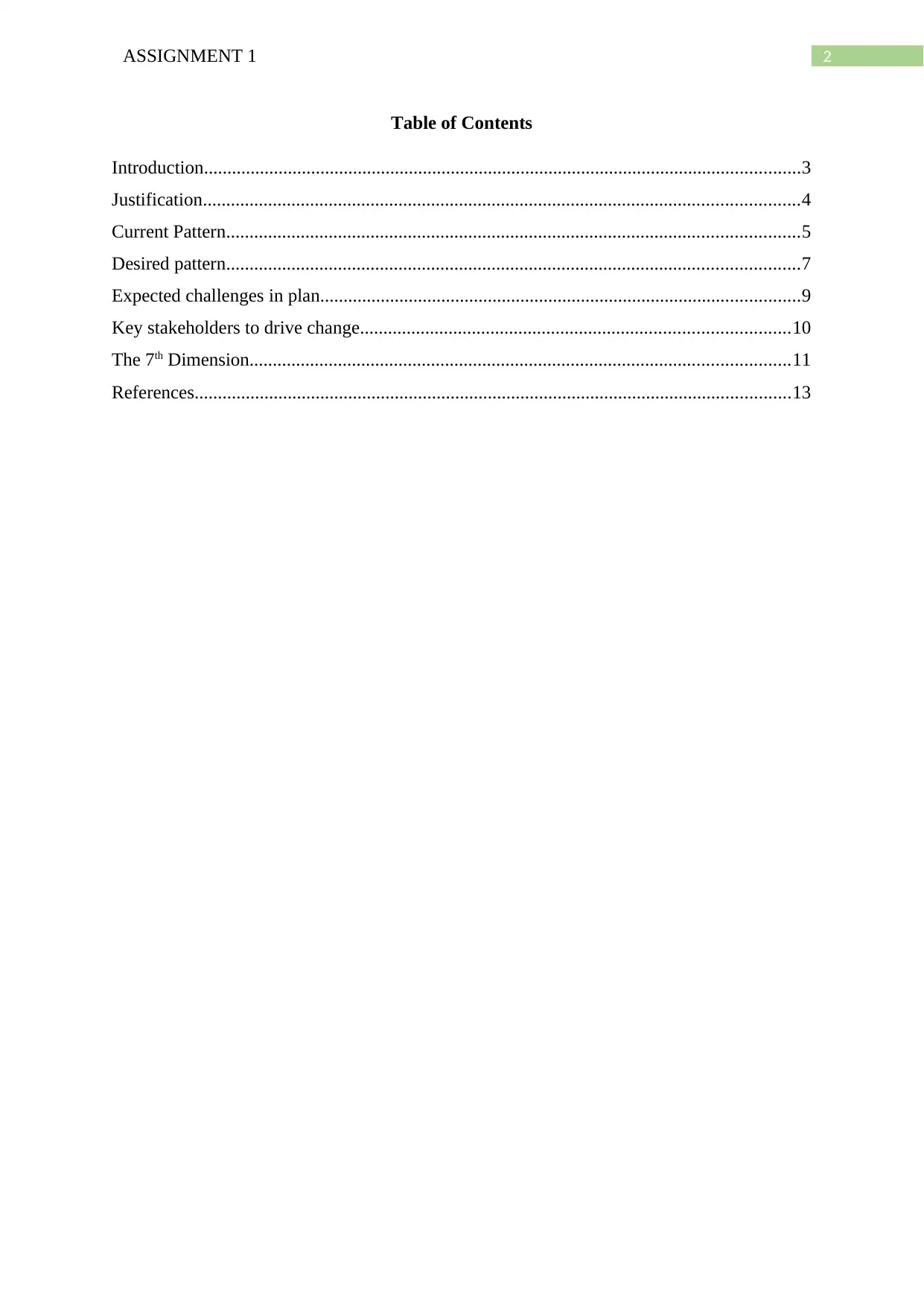
Table of Contents
Introduction................................................................................................................................3
Justification................................................................................................................................4
Current Pattern...........................................................................................................................5
Desired pattern...........................................................................................................................7
Expected challenges in plan.......................................................................................................9
Key stakeholders to drive change............................................................................................10
The 7th Dimension....................................................................................................................11
References................................................................................................................................13
Table of Contents
Introduction................................................................................................................................3
Justification................................................................................................................................4
Current Pattern...........................................................................................................................5
Desired pattern...........................................................................................................................7
Expected challenges in plan.......................................................................................................9
Key stakeholders to drive change............................................................................................10
The 7th Dimension....................................................................................................................11
References................................................................................................................................13
3ASSIGNMENT 1
Introduction
Curriculum is the collectivity of academic content and lessons that are taught in a
specific course, or an institution, or in school. Generally, a curriculum is referred to the
courses that are taught in a school. It is to the curriculum that the students acquire the skills
that are needed for their future. According to Carollo & Mason (2017) curriculum is a
founding element in effective teaching and schooling and thus, it is quite often subject to
reforms. Most of these are intended broadly to encourage or mandate a more complex
curricular standardization across schools, grade levels and states.
In order to form a proper curriculum for the Institute, it is important to base it on a
curriculum model. Schools form a curriculum guide that is a framework detailing how, when
and what instructions occur. There are some models or formats of a curriculum guide.
Tronsmo & Nerland (2018) stated a curriculum model could be said to be the tool for helping
the person in charge to both write and develop the curriculum of an institution. The choices
made while teaching is backed by the reasons that are provided by a curriculum model.
The model that is currently followed by the institution is the Wheeler model of
curriculum development (1967) also known as the Cyclic Model (Macik et al. 2017). This
model is based on the idea that the curriculum must be a continued cycle being responsive
towards the changes that occur inside the education sector. It also makes adjustments that are
suitable for accounting for the changes. This model targets situational analysis that is it places
importance on the context within which the decisions about the curriculum is taken.
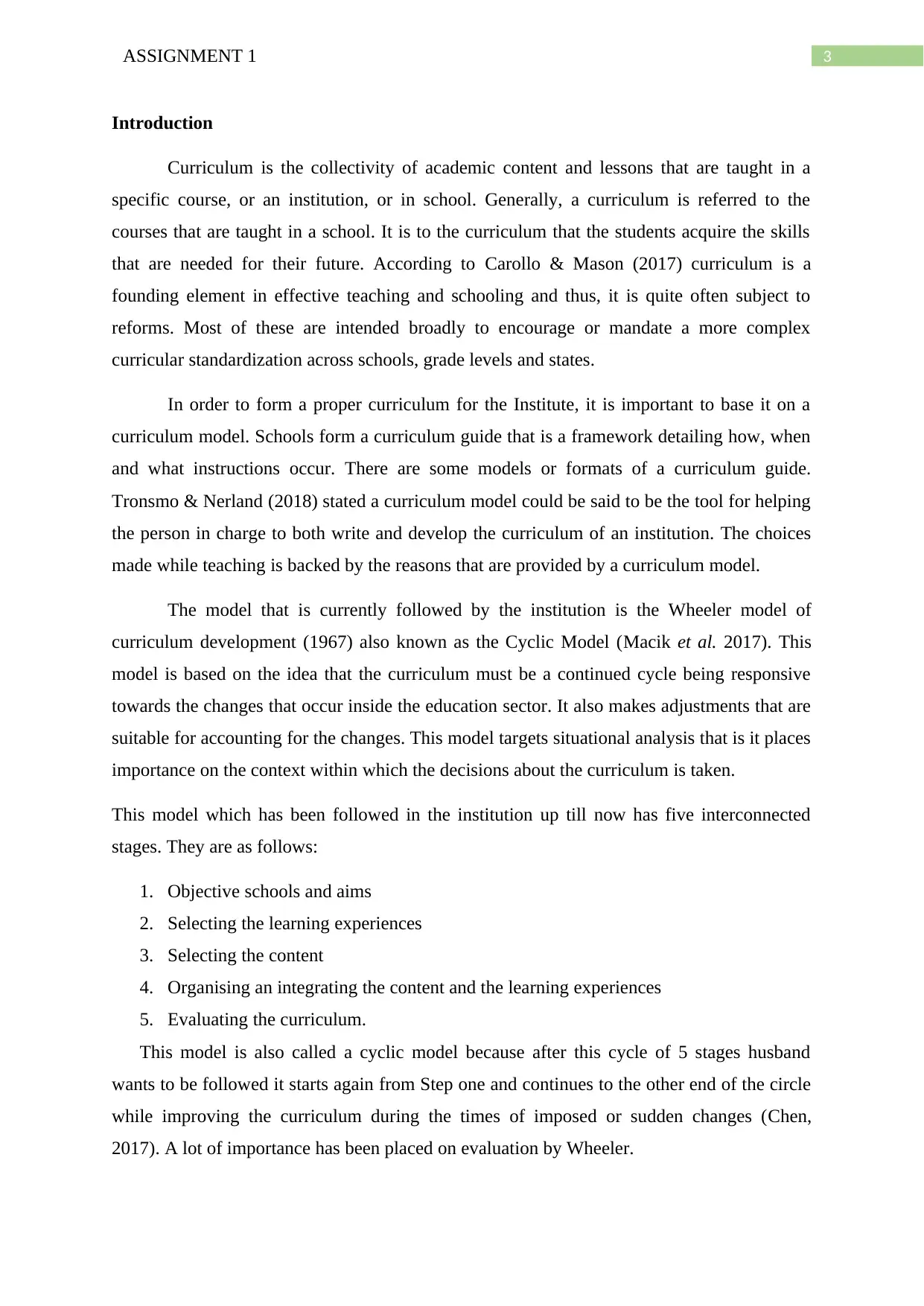
This model which has been followed in the institution up till now has five interconnected
stages. They are as follows:
1. Objective schools and aims
2. Selecting the learning experiences
3. Selecting the content
4. Organising an integrating the content and the learning experiences
5. Evaluating the curriculum.
This model is also called a cyclic model because after this cycle of 5 stages husband
wants to be followed it starts again from Step one and continues to the other end of the circle
while improving the curriculum during the times of imposed or sudden changes (Chen,
2017). A lot of importance has been placed on evaluation by Wheeler.
Introduction
Curriculum is the collectivity of academic content and lessons that are taught in a
specific course, or an institution, or in school. Generally, a curriculum is referred to the
courses that are taught in a school. It is to the curriculum that the students acquire the skills
that are needed for their future. According to Carollo & Mason (2017) curriculum is a
founding element in effective teaching and schooling and thus, it is quite often subject to
reforms. Most of these are intended broadly to encourage or mandate a more complex
curricular standardization across schools, grade levels and states.
In order to form a proper curriculum for the Institute, it is important to base it on a
curriculum model. Schools form a curriculum guide that is a framework detailing how, when
and what instructions occur. There are some models or formats of a curriculum guide.
Tronsmo & Nerland (2018) stated a curriculum model could be said to be the tool for helping
the person in charge to both write and develop the curriculum of an institution. The choices
made while teaching is backed by the reasons that are provided by a curriculum model.
The model that is currently followed by the institution is the Wheeler model of
curriculum development (1967) also known as the Cyclic Model (Macik et al. 2017). This
model is based on the idea that the curriculum must be a continued cycle being responsive
towards the changes that occur inside the education sector. It also makes adjustments that are
suitable for accounting for the changes. This model targets situational analysis that is it places
importance on the context within which the decisions about the curriculum is taken.
This model which has been followed in the institution up till now has five interconnected
stages. They are as follows:
1. Objective schools and aims
2. Selecting the learning experiences
3. Selecting the content
4. Organising an integrating the content and the learning experiences
5. Evaluating the curriculum.
This model is also called a cyclic model because after this cycle of 5 stages husband
wants to be followed it starts again from Step one and continues to the other end of the circle
while improving the curriculum during the times of imposed or sudden changes (Chen,
2017). A lot of importance has been placed on evaluation by Wheeler.
⊘ This is a preview!⊘
Do you want full access?
Subscribe today to unlock all pages.

Trusted by 1+ million students worldwide
4ASSIGNMENT 1
Evaluation helps us to compare the expected outcome and the actual outcome. As a
result, it is possible to calculate till how far the objectives have been realised through the
curriculum. The simple and effective curriculum has been followed in the institution for a
long time but, it has now become difficult to cope up with the external changes without
changing the present curriculum. Paesani (2017) mentioned that it is very time-consuming to
make a detailed analysis of a situation following Wheeler's model. Such a time-consuming
process can be hectic to be utilized in modern educational practice.
Justification
As a health professions educator to develop the teaching methods in the institution, I
have chosen to advise the teachers to follow the SPICES model of teaching and learning. In
my opinion, the SPICES model is a useful framework which will allow my institution to
receive Innovative teaching and learning methods which can be used on both graduate and
undergraduate students (Sutton, 2015). There are many positives to take for the students,
teachers and the whole of the institution by using the SPICES model. One of the benefits that
the institution gains are that it reduces the in-patient stay to encourage patient care that is
more ambulatory.
Moreover, traditional teaching in hospitals helps in reducing the core clinical
problems which can be helpful for the institution. One important reason for me to choose the
SPICES model as a method for innovative teaching and learning is that an ambulatory care
education is uniquely suited to meet the necessities of the students, the professors and also the
patients when it is implemented in a proper way (Kugler, Gogineni & Garavalia, 2018).
Dedicated programs and teaching spaces have been used by many medical schools in the
past, and it was effective for most of them. SPICES model is more likely to provide
encouragement to the institution to deliver programs that are more student-centred with a
very systematic approach by using volunteer patients that are system-sensitive. This helps the
students to integrate their learnings with the information they gather from outside.
Using the SPICES model will bring about more benefits to the students as they are
provided more of problem-based learning which they encounter in a community-based setting
as it also provides opportunities for the students to choose their elective studies. Students will
be interested in selecting their subject of interest for inspiration and the push to study better.
According to Quintero (2014) using the SPICES model in order to promote innovative
Evaluation helps us to compare the expected outcome and the actual outcome. As a
result, it is possible to calculate till how far the objectives have been realised through the
curriculum. The simple and effective curriculum has been followed in the institution for a
long time but, it has now become difficult to cope up with the external changes without
changing the present curriculum. Paesani (2017) mentioned that it is very time-consuming to
make a detailed analysis of a situation following Wheeler's model. Such a time-consuming
process can be hectic to be utilized in modern educational practice.
Justification
As a health professions educator to develop the teaching methods in the institution, I
have chosen to advise the teachers to follow the SPICES model of teaching and learning. In
my opinion, the SPICES model is a useful framework which will allow my institution to
receive Innovative teaching and learning methods which can be used on both graduate and
undergraduate students (Sutton, 2015). There are many positives to take for the students,
teachers and the whole of the institution by using the SPICES model. One of the benefits that
the institution gains are that it reduces the in-patient stay to encourage patient care that is
more ambulatory.
Moreover, traditional teaching in hospitals helps in reducing the core clinical
problems which can be helpful for the institution. One important reason for me to choose the
SPICES model as a method for innovative teaching and learning is that an ambulatory care
education is uniquely suited to meet the necessities of the students, the professors and also the
patients when it is implemented in a proper way (Kugler, Gogineni & Garavalia, 2018).
Dedicated programs and teaching spaces have been used by many medical schools in the
past, and it was effective for most of them. SPICES model is more likely to provide
encouragement to the institution to deliver programs that are more student-centred with a
very systematic approach by using volunteer patients that are system-sensitive. This helps the
students to integrate their learnings with the information they gather from outside.
Using the SPICES model will bring about more benefits to the students as they are
provided more of problem-based learning which they encounter in a community-based setting
as it also provides opportunities for the students to choose their elective studies. Students will
be interested in selecting their subject of interest for inspiration and the push to study better.
According to Quintero (2014) using the SPICES model in order to promote innovative
Paraphrase This Document
Need a fresh take? Get an instant paraphrase of this document with our AI Paraphraser
5ASSIGNMENT 1
teaching and learning also helps innovate teaching and learning methods in a different new
place. As there are multiple problems in my institution that I need to look after, it is easier to
use the SPICES model to situate my institution in the SPICES spectrum in order to
understand the position of my institute (Remesh, 2017). Moreover, learning in a student-
centred approach will inspire the institute to meet the needs of the students and also the
professors. It is obvious that the SPICES model is a useful approach which can be used for
the overall development of a student and inspire innovative learning in the institution.
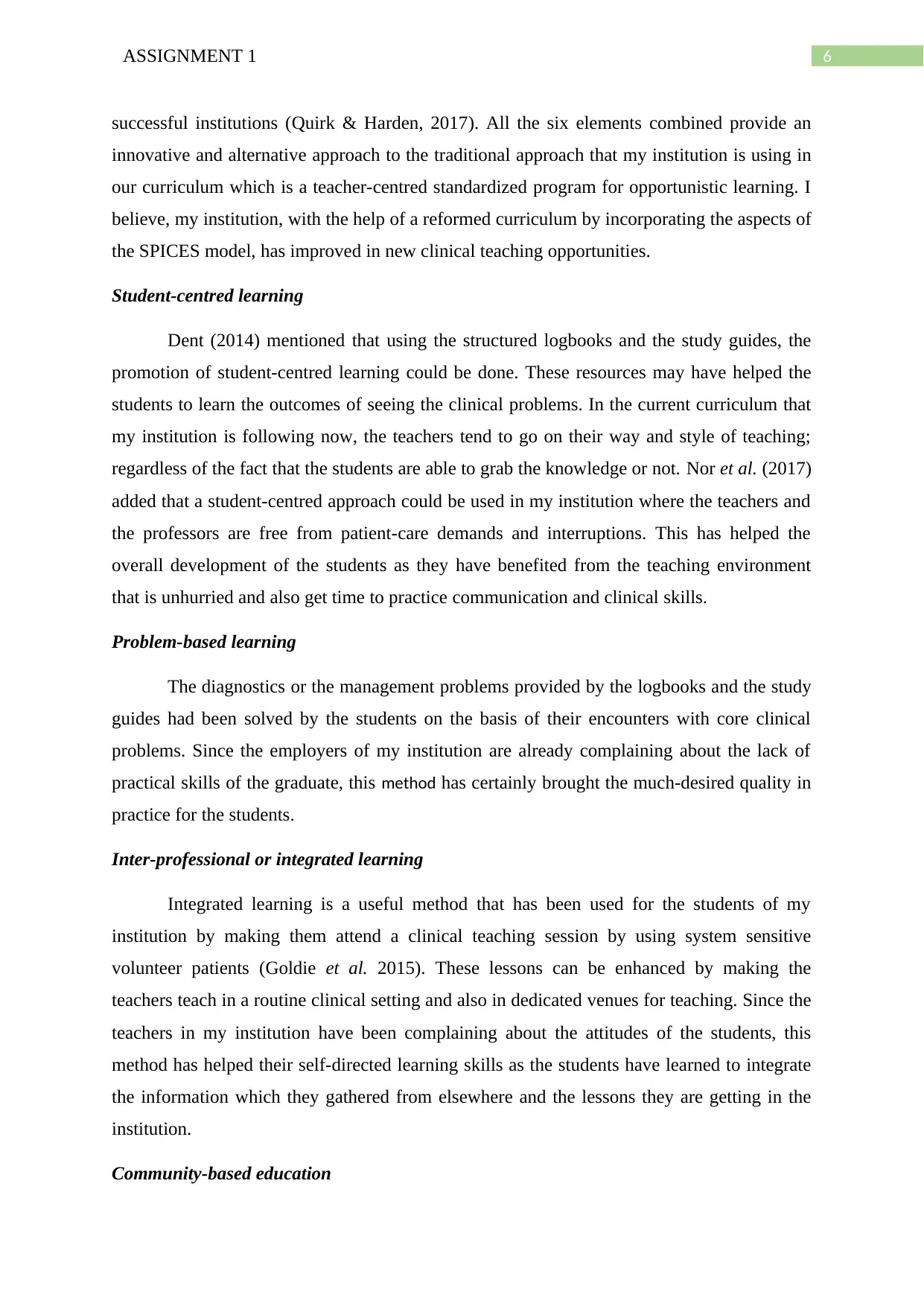
Figure 1: Elements of SPICES model framework
(Source: Self-authored)
Current Pattern
Even after 30 years of its original description, the SPICES model is still one of the
most important educational strategies that can be used as a tool for organizing and reforming
an undergraduate medical curriculum of an institution. There are six key elements or
dimensions that have been promoted while using the SPICES model framework for
enhancing the teaching experience of the professors and the learning experience for the
students. These dimensions are Student-centred learning, Problem based learning, integrated
teaching or inter-professional teaching, Community based education, Elective studies and a
systematic and planned approach as these are widely projected and accepted in most of the
S- Student-centred learning
P- Problem-based learning
I- Inter-professional or integrated learning
C- Community-based education
E- Elective studies
S- Systematic or planned approach
teaching and learning also helps innovate teaching and learning methods in a different new
place. As there are multiple problems in my institution that I need to look after, it is easier to
use the SPICES model to situate my institution in the SPICES spectrum in order to
understand the position of my institute (Remesh, 2017). Moreover, learning in a student-
centred approach will inspire the institute to meet the needs of the students and also the
professors. It is obvious that the SPICES model is a useful approach which can be used for
the overall development of a student and inspire innovative learning in the institution.
Figure 1: Elements of SPICES model framework
(Source: Self-authored)
Current Pattern
Even after 30 years of its original description, the SPICES model is still one of the
most important educational strategies that can be used as a tool for organizing and reforming
an undergraduate medical curriculum of an institution. There are six key elements or
dimensions that have been promoted while using the SPICES model framework for
enhancing the teaching experience of the professors and the learning experience for the
students. These dimensions are Student-centred learning, Problem based learning, integrated
teaching or inter-professional teaching, Community based education, Elective studies and a
systematic and planned approach as these are widely projected and accepted in most of the
S- Student-centred learning
P- Problem-based learning
I- Inter-professional or integrated learning
C- Community-based education
E- Elective studies
S- Systematic or planned approach
6ASSIGNMENT 1
successful institutions (Quirk & Harden, 2017). All the six elements combined provide an
innovative and alternative approach to the traditional approach that my institution is using in
our curriculum which is a teacher-centred standardized program for opportunistic learning. I
believe, my institution, with the help of a reformed curriculum by incorporating the aspects of
the SPICES model, has improved in new clinical teaching opportunities.
Student-centred learning
Dent (2014) mentioned that using the structured logbooks and the study guides, the
promotion of student-centred learning could be done. These resources may have helped the
students to learn the outcomes of seeing the clinical problems. In the current curriculum that
my institution is following now, the teachers tend to go on their way and style of teaching;
regardless of the fact that the students are able to grab the knowledge or not. Nor et al. (2017)
added that a student-centred approach could be used in my institution where the teachers and
the professors are free from patient-care demands and interruptions. This has helped the
overall development of the students as they have benefited from the teaching environment
that is unhurried and also get time to practice communication and clinical skills.
Problem-based learning
The diagnostics or the management problems provided by the logbooks and the study
guides had been solved by the students on the basis of their encounters with core clinical
problems. Since the employers of my institution are already complaining about the lack of
practical skills of the graduate, this method has certainly brought the much-desired quality in
practice for the students.
Inter-professional or integrated learning
Integrated learning is a useful method that has been used for the students of my
institution by making them attend a clinical teaching session by using system sensitive
volunteer patients (Goldie et al. 2015). These lessons can be enhanced by making the
teachers teach in a routine clinical setting and also in dedicated venues for teaching. Since the
teachers in my institution have been complaining about the attitudes of the students, this
method has helped their self-directed learning skills as the students have learned to integrate
the information which they gathered from elsewhere and the lessons they are getting in the
institution.
Community-based education
successful institutions (Quirk & Harden, 2017). All the six elements combined provide an
innovative and alternative approach to the traditional approach that my institution is using in
our curriculum which is a teacher-centred standardized program for opportunistic learning. I
believe, my institution, with the help of a reformed curriculum by incorporating the aspects of
the SPICES model, has improved in new clinical teaching opportunities.
Student-centred learning
Dent (2014) mentioned that using the structured logbooks and the study guides, the
promotion of student-centred learning could be done. These resources may have helped the
students to learn the outcomes of seeing the clinical problems. In the current curriculum that
my institution is following now, the teachers tend to go on their way and style of teaching;
regardless of the fact that the students are able to grab the knowledge or not. Nor et al. (2017)
added that a student-centred approach could be used in my institution where the teachers and
the professors are free from patient-care demands and interruptions. This has helped the
overall development of the students as they have benefited from the teaching environment
that is unhurried and also get time to practice communication and clinical skills.
Problem-based learning
The diagnostics or the management problems provided by the logbooks and the study
guides had been solved by the students on the basis of their encounters with core clinical
problems. Since the employers of my institution are already complaining about the lack of
practical skills of the graduate, this method has certainly brought the much-desired quality in
practice for the students.
Inter-professional or integrated learning
Integrated learning is a useful method that has been used for the students of my
institution by making them attend a clinical teaching session by using system sensitive
volunteer patients (Goldie et al. 2015). These lessons can be enhanced by making the
teachers teach in a routine clinical setting and also in dedicated venues for teaching. Since the
teachers in my institution have been complaining about the attitudes of the students, this
method has helped their self-directed learning skills as the students have learned to integrate
the information which they gathered from elsewhere and the lessons they are getting in the
institution.
Community-based education
⊘ This is a preview!⊘
Do you want full access?
Subscribe today to unlock all pages.
Trusted by 1+ million students worldwide
7ASSIGNMENT 1
The students have been allowed to gain more experience in a wider, more distinct
range of problems related to common healthcare if the student teaching is moved to different
venues that are in the wider community such as community child development clinics or
DTC (Taghipour & Javdani, 2017). This method has been very useful for the students of my
institution as they are currently learning in a teaching hospital. Moreover, updating the
curriculum of my institution with this method has developed the learning and teaching
experience based on core competence.
Elective studies
Students have been given an opportunity to make their choice of study based on their
interest if my institution moves away from the standardized teaching and learning programs
by introducing student elective studies opportunities (Rizvi & Tanzil, 2017). This method has
also provided more enthusiasm and willingness in the students to learn more about their
preferred area of subjects. According to the current evaluation, the current curriculum focuses
too much on knowledge in a certain area; but the use of elective studies will generate more
interest within the students to study different subjects of their choice which should promote
innovative learning.
Systematic or planned approach
The key to delivering a systematic or structured approach to medical teaching for my
institution is the use of structured logbooks. These logbooks have helped the students in
focusing on the objectives of appropriate learning by making them see the required range of
core problems that are clinical. Students of my institution often asked for better preparation
when it comes to dealing with patients in a clinical setting. Hopefully, this method has
provided the much-needed education and practice for the students to flourish under different
circumstances. Achike (2016) justified a systematic and planned approach is essential to
develop a sound teaching and learning method.
Desired pattern
From the above discussion the current pattern for the university where recognized
with respect to the six dimensions on the SPICES model. The systematic or planed approach
and the elective studies I found to be satisfied with their present curriculum. However other
four of the dimension of the SPICES framework need improvements which are described in
The students have been allowed to gain more experience in a wider, more distinct
range of problems related to common healthcare if the student teaching is moved to different
venues that are in the wider community such as community child development clinics or
DTC (Taghipour & Javdani, 2017). This method has been very useful for the students of my
institution as they are currently learning in a teaching hospital. Moreover, updating the
curriculum of my institution with this method has developed the learning and teaching
experience based on core competence.
Elective studies
Students have been given an opportunity to make their choice of study based on their
interest if my institution moves away from the standardized teaching and learning programs
by introducing student elective studies opportunities (Rizvi & Tanzil, 2017). This method has
also provided more enthusiasm and willingness in the students to learn more about their
preferred area of subjects. According to the current evaluation, the current curriculum focuses
too much on knowledge in a certain area; but the use of elective studies will generate more
interest within the students to study different subjects of their choice which should promote
innovative learning.
Systematic or planned approach
The key to delivering a systematic or structured approach to medical teaching for my
institution is the use of structured logbooks. These logbooks have helped the students in
focusing on the objectives of appropriate learning by making them see the required range of
core problems that are clinical. Students of my institution often asked for better preparation
when it comes to dealing with patients in a clinical setting. Hopefully, this method has
provided the much-needed education and practice for the students to flourish under different
circumstances. Achike (2016) justified a systematic and planned approach is essential to
develop a sound teaching and learning method.
Desired pattern
From the above discussion the current pattern for the university where recognized
with respect to the six dimensions on the SPICES model. The systematic or planed approach
and the elective studies I found to be satisfied with their present curriculum. However other
four of the dimension of the SPICES framework need improvements which are described in
Paraphrase This Document
Need a fresh take? Get an instant paraphrase of this document with our AI Paraphraser
8ASSIGNMENT 1
the following. As there are multiple weaknesses in the current curriculum of my institution, I
have been given sufficient funding to improve upon the ongoing ways of teaching and
learning experience in my institution. I have decided to use the four specific dimension of the
SPICES model to bring about this wanted change in the teaching and learning curriculum in
order to promote innovative learning.
Student centred learning
By utilizing the organized logbooks and the investigation directs, the advancement of
student-focused learning should be possible. These assets may assist the understudies with
learning the results of seeing the clinical issues (Cleland & Durning, 2017). In the present
educational modules that my organization is following now, the educators will, in general, go
without anyone else way and style of instructing; paying little mind to the way that the
understudies have the capacity to snatch the information or not. At the institutional level, this
requires completing instructive projects orchestrating rehearses, instructional strategy and
evaluation procedures that assist the student-driven approach learning. In the classroom,
teachers make direction and apply advancement in a way that best serves each student’s
learning adventure. Quintero et al. (2016) added right when students expect risk for their
learning; they will be advancing toward getting to be explorers prepared for using their
enthusiasm to deal with authentic issues. Student centred learning can be utilized where the
educators and teachers are free from patient-care requests and interferences. This will help
the general advancement of the understudies as they will profit by the instructing condition
that is unhurried and furthermore inspire time to rehearse correspondence and clinical
abilities.
Problem-based learning
The diagnostics or the administration issues given by the logbooks and the
examination aides will be explained by the understudies based on their experiences with
centre clinical issues. Since the businesses of my establishment are as of now grumbling
about the absence of functional aptitudes of the alumni, this technique will acquire the much-
wanted quality practice for the understudies (Arja et al. 2018). In classrooms where teachers
use dynamic learning methods, students chatting with each other, not through the instructor,
and they begin and manage their one of a kind critical number activities. In these classes, the
teacher fills in as a manual for getting the hang of, offering space to understudies to extend
their self-rule and manufacture their special creative ability.
the following. As there are multiple weaknesses in the current curriculum of my institution, I
have been given sufficient funding to improve upon the ongoing ways of teaching and
learning experience in my institution. I have decided to use the four specific dimension of the
SPICES model to bring about this wanted change in the teaching and learning curriculum in
order to promote innovative learning.
Student centred learning
By utilizing the organized logbooks and the investigation directs, the advancement of
student-focused learning should be possible. These assets may assist the understudies with
learning the results of seeing the clinical issues (Cleland & Durning, 2017). In the present
educational modules that my organization is following now, the educators will, in general, go
without anyone else way and style of instructing; paying little mind to the way that the
understudies have the capacity to snatch the information or not. At the institutional level, this
requires completing instructive projects orchestrating rehearses, instructional strategy and
evaluation procedures that assist the student-driven approach learning. In the classroom,
teachers make direction and apply advancement in a way that best serves each student’s
learning adventure. Quintero et al. (2016) added right when students expect risk for their
learning; they will be advancing toward getting to be explorers prepared for using their
enthusiasm to deal with authentic issues. Student centred learning can be utilized where the
educators and teachers are free from patient-care requests and interferences. This will help
the general advancement of the understudies as they will profit by the instructing condition
that is unhurried and furthermore inspire time to rehearse correspondence and clinical
abilities.
Problem-based learning
The diagnostics or the administration issues given by the logbooks and the
examination aides will be explained by the understudies based on their experiences with
centre clinical issues. Since the businesses of my establishment are as of now grumbling
about the absence of functional aptitudes of the alumni, this technique will acquire the much-
wanted quality practice for the understudies (Arja et al. 2018). In classrooms where teachers
use dynamic learning methods, students chatting with each other, not through the instructor,
and they begin and manage their one of a kind critical number activities. In these classes, the
teacher fills in as a manual for getting the hang of, offering space to understudies to extend
their self-rule and manufacture their special creative ability.
9ASSIGNMENT 1
Inter professional or integrated learning
According to Chen (2017), integrated learning is a helpful technique that can be
utilized for the understudies of my organization by influencing them to go to a clinical
showing session by utilizing framework touchy volunteer patients. These exercises can be
improved by making the instructors educate in a routine clinical setting and furthermore in
devoted scenes for instructing. The changing human administrations condition and
advancement toward gathering based thought are contemporary challenges facing prosperity
capable guidance. Sutton (2015) opined that the basic thought workforce must be set up with
progressing national inter-professional capacities to practice and lead in this advancing
condition. Since the educators in my organization have been grumbling about the demeanours
of the students, this technique will help their self-coordinated learning abilities as the
understudies will figure out how to incorporate the data which they assembled from
somewhere else and the exercises they are getting in the foundation.
Network-based training
The students will be permitted to acquire involvement in a more extensive,
increasingly particular scope of issues identified with regular medicinal services if the
understudy educating is moved to various scenes that are in the more extensive network. This
technique will be exceptionally helpful for the understudies of my foundation as they are at
present learning in an educating doctor's facility (Remesh, 2017). In addition, refreshing the
educational programs of my organization with this strategy will build up the learning and
training knowledge dependent on centre fitness.
Expected challenges in the plan
There are several factors which are perceived as possible obstruction while planning
and implementing a curriculum plan. They are more often adopted from the research-based
practices which also help in determining a possible solution to overcome those challenges.
The expected challenges are as follows:
Lack of good leadership is the most possible barrier that is expected to arise within
the plan (Dent, 2014). The vision set out in the new design of the curriculum plan can
only be expressed effectively if a leader is competent in developing strategies in a
clear way. A leader is expected to inspire the students and make them cooperate for
Inter professional or integrated learning
According to Chen (2017), integrated learning is a helpful technique that can be
utilized for the understudies of my organization by influencing them to go to a clinical
showing session by utilizing framework touchy volunteer patients. These exercises can be
improved by making the instructors educate in a routine clinical setting and furthermore in
devoted scenes for instructing. The changing human administrations condition and
advancement toward gathering based thought are contemporary challenges facing prosperity
capable guidance. Sutton (2015) opined that the basic thought workforce must be set up with
progressing national inter-professional capacities to practice and lead in this advancing
condition. Since the educators in my organization have been grumbling about the demeanours
of the students, this technique will help their self-coordinated learning abilities as the
understudies will figure out how to incorporate the data which they assembled from
somewhere else and the exercises they are getting in the foundation.
Network-based training
The students will be permitted to acquire involvement in a more extensive,
increasingly particular scope of issues identified with regular medicinal services if the
understudy educating is moved to various scenes that are in the more extensive network. This
technique will be exceptionally helpful for the understudies of my foundation as they are at
present learning in an educating doctor's facility (Remesh, 2017). In addition, refreshing the
educational programs of my organization with this strategy will build up the learning and
training knowledge dependent on centre fitness.
Expected challenges in the plan
There are several factors which are perceived as possible obstruction while planning
and implementing a curriculum plan. They are more often adopted from the research-based
practices which also help in determining a possible solution to overcome those challenges.
The expected challenges are as follows:
Lack of good leadership is the most possible barrier that is expected to arise within
the plan (Dent, 2014). The vision set out in the new design of the curriculum plan can
only be expressed effectively if a leader is competent in developing strategies in a
clear way. A leader is expected to inspire the students and make them cooperate for
⊘ This is a preview!⊘
Do you want full access?
Subscribe today to unlock all pages.
Trusted by 1+ million students worldwide
10ASSIGNMENT 1
building the new design into success within the medical field. Leaders need to be
constant motivators who are more responsible for tackling common barriers in
effective planning.
The time is a challenging factor which might be short than required. Goldie et al.
(2015) stated learning about new strategies and redesigning the curriculum courses
involves a lot of research activities. Any distraction further amplifies the time
shortage produce a significant barrier to effective planning. Consequently, an
effective planning system will need to consider every other factors and component in
the present curriculum activities. Many nonessential materials get involved while
prosecuting a plan which means by every minute of curriculum time are not utilized
properly (Achike, 2016). Moreover, it is expected the curriculum would only focus on
the most crucial skills that are required to be streamlined.
According to Tronsmo & Nerland (2018), there will be concerns for ensuring the
student are consuming the most important and relevant content. The concerns
regarding students' reaction to the unfamiliar curriculum method and thereby
impacting the course evaluations of the students. Taghipour & Javdani (2017)
mentioned unavailability of the required resources is a major challenge for the
designed curriculum to act as a success. Acquiring the right system, information and
resources to support the plan is something to care about before designing the plan
since lack of system will bring the effectiveness of the designed plan drastically.
Additionally, it is also feared that a different strategy will not function or give output
as expected which will harm the tenure or reputation of the medical institution
(Carollo & Mason, 2017). Here lack of training or adequate knowledge and
understanding of the specific events or planning factors would lead to a failure. Some
strategies would need a skilled man force which could implement the new generation
plan and convey the new curriculum of the institute to be more attractive and
interesting for the student.
Key stakeholders to drive change
There are multiple stakeholders in my health and social care institution who are able
to drive changes in the curriculum and other aspects of the institution. There are stakeholders
like deans, committees, external bodies and quality units who are more than capable of
building the new design into success within the medical field. Leaders need to be
constant motivators who are more responsible for tackling common barriers in
effective planning.
The time is a challenging factor which might be short than required. Goldie et al.
(2015) stated learning about new strategies and redesigning the curriculum courses
involves a lot of research activities. Any distraction further amplifies the time
shortage produce a significant barrier to effective planning. Consequently, an
effective planning system will need to consider every other factors and component in
the present curriculum activities. Many nonessential materials get involved while
prosecuting a plan which means by every minute of curriculum time are not utilized
properly (Achike, 2016). Moreover, it is expected the curriculum would only focus on
the most crucial skills that are required to be streamlined.
According to Tronsmo & Nerland (2018), there will be concerns for ensuring the
student are consuming the most important and relevant content. The concerns
regarding students' reaction to the unfamiliar curriculum method and thereby
impacting the course evaluations of the students. Taghipour & Javdani (2017)
mentioned unavailability of the required resources is a major challenge for the
designed curriculum to act as a success. Acquiring the right system, information and
resources to support the plan is something to care about before designing the plan
since lack of system will bring the effectiveness of the designed plan drastically.
Additionally, it is also feared that a different strategy will not function or give output
as expected which will harm the tenure or reputation of the medical institution
(Carollo & Mason, 2017). Here lack of training or adequate knowledge and
understanding of the specific events or planning factors would lead to a failure. Some
strategies would need a skilled man force which could implement the new generation
plan and convey the new curriculum of the institute to be more attractive and
interesting for the student.
Key stakeholders to drive change
There are multiple stakeholders in my health and social care institution who are able
to drive changes in the curriculum and other aspects of the institution. There are stakeholders
like deans, committees, external bodies and quality units who are more than capable of
Paraphrase This Document
Need a fresh take? Get an instant paraphrase of this document with our AI Paraphraser
11ASSIGNMENT 1
driving changes in my institution (Rizvi & Tanzil, 2017). These stakeholders can directly or
indirectly force and generate changes in the institution to enhance the quality of teaching and
learning. The general role of a dean varies from one institute to another, but the overall
responsibilities of a dean are very similar. Deans are very much involved in the central issues
of the institution like budget, curriculum, strategic planning and so on. Marei et al. (2017)
discussed convening strategic intellect with the faculty, teachers and the students is also a
role that is played by the dean of the institution.
Moreover, the dean is the key participant in the external relations of my institution
that includes fundraising, economic development and public relations. The dean of my
institution is also responsible for engaging discussions about all the important issues related
to the institution. According to Taghipour & Javdani (2017), the dean of the institution is one
of the most important stakeholders to force a change in not just the curriculum of the
institution but also the economy by being the force to raise funds for scholarships,
professorships, various facilities and other programs that the institution needs.
Apart from the dean himself, there are multiple other stakeholders who are more than
capable of driving changes in the curriculum of the health and social care institution. There
are other stakeholders such as students, staff, faculty, quality units and external bodies who
can just as easily drive changes in the educational curriculum. Cleland & Durning (2017)
opined the community in which the institution is located in could also be a major stakeholder
in order to drive changes in the institution too. These stakeholders are responsible for playing
important roles in the aspects of program review, accreditation and various other processes
that are important for the overall development of the institution. Stakeholders are also
responsible for hiring staff that are highly experienced and are able to take actions according
to the changes prescribed by the stakeholders. As participants in a wide range of institutional
decision making and discussions the stakeholders assure coordination of all the aspects about
the institution such as different departments, economic development, and graduate and
undergraduate academic programs.
The 7th Dimension
The SPICES model have six dimensions which is discussed in the above discussion. The 7th
dimension that may be considered for implementing within the curriculum planning is
behaviour centred approach. The value and its implications are discussed as follows:
driving changes in my institution (Rizvi & Tanzil, 2017). These stakeholders can directly or
indirectly force and generate changes in the institution to enhance the quality of teaching and
learning. The general role of a dean varies from one institute to another, but the overall
responsibilities of a dean are very similar. Deans are very much involved in the central issues
of the institution like budget, curriculum, strategic planning and so on. Marei et al. (2017)
discussed convening strategic intellect with the faculty, teachers and the students is also a
role that is played by the dean of the institution.
Moreover, the dean is the key participant in the external relations of my institution
that includes fundraising, economic development and public relations. The dean of my
institution is also responsible for engaging discussions about all the important issues related
to the institution. According to Taghipour & Javdani (2017), the dean of the institution is one
of the most important stakeholders to force a change in not just the curriculum of the
institution but also the economy by being the force to raise funds for scholarships,
professorships, various facilities and other programs that the institution needs.
Apart from the dean himself, there are multiple other stakeholders who are more than
capable of driving changes in the curriculum of the health and social care institution. There
are other stakeholders such as students, staff, faculty, quality units and external bodies who
can just as easily drive changes in the educational curriculum. Cleland & Durning (2017)
opined the community in which the institution is located in could also be a major stakeholder
in order to drive changes in the institution too. These stakeholders are responsible for playing
important roles in the aspects of program review, accreditation and various other processes
that are important for the overall development of the institution. Stakeholders are also
responsible for hiring staff that are highly experienced and are able to take actions according
to the changes prescribed by the stakeholders. As participants in a wide range of institutional
decision making and discussions the stakeholders assure coordination of all the aspects about
the institution such as different departments, economic development, and graduate and
undergraduate academic programs.
The 7th Dimension
The SPICES model have six dimensions which is discussed in the above discussion. The 7th
dimension that may be considered for implementing within the curriculum planning is
behaviour centred approach. The value and its implications are discussed as follows:
12ASSIGNMENT 1
Behaviour approach
Many studies have confirmed that behaviour based learning curriculum is an effective
way to produce teaching to the medical students. Behaviour centred approaches anticipate
research through own experiences and learning that shape curriculum programming (Achike,
2016). Distinctive research methods purposely recognize social determinants, help elucidate
gathering of spectators setting, and spotlight on emotive parts that affect rehearses. This
investigation may be exceptional or disclosures associated from past, pertinent research. Here
the behaviours of the students were even more studied deliberately at examination
approaches, for instance, Trials of Improved Practices (TIPs), calling attention to that current
data and information, together with the assignment made bits of learning, are essential to plan
thorough lead change strategies that help to steer through a learning process. Cleland &
Durning (2017) justified that by conducting focused methodologies for behaviour approach
teaching method expect research to shape programming. Different research strategies
efficiently recognize social determinants, help comprehend gathering of people setting, and
sharpen on the emotive components that impact practices.
Behaviour centred approaches oblige appropriate social choices, starting from one's
present setting or mastermind and organizing close to nothing, practical redesigns toward
flawless educational practices. A single fundamental theory underpins the behaviours centred
design which is also termed as reinforcement learning (Paesani, 2017). Reinforcement
learning procedure is expected to produce a different kind of behavioural responses to a
situation which is going to be based on the goal of a behaviour change efforts. With the
initiation of reinforcement, the learning occurs through interacting with the environment or
trial and error method which is about to view a maximizing performance competency form
the students.
There are times when an understudy's behaviour can influence learning and limit
flourishing for both the understudy and for individuals around them. Keefe (2017) mentioned
as behaviour, learning, and success are inseparable, this approach takes a gander at planning
the learning condition and its structure with understudy adjusting necessities, premiums, and
characteristics. It also considers the expression of each student during different situation and
impact of the responses to support their self-regulation and self-advocacy. The Stages of
Change theory and Small Doable Action also consider this approach for leading a change in
the planning process. The contemplations are creating out of Science of Habit Formation
Behaviour approach
Many studies have confirmed that behaviour based learning curriculum is an effective
way to produce teaching to the medical students. Behaviour centred approaches anticipate
research through own experiences and learning that shape curriculum programming (Achike,
2016). Distinctive research methods purposely recognize social determinants, help elucidate
gathering of spectators setting, and spotlight on emotive parts that affect rehearses. This
investigation may be exceptional or disclosures associated from past, pertinent research. Here
the behaviours of the students were even more studied deliberately at examination
approaches, for instance, Trials of Improved Practices (TIPs), calling attention to that current
data and information, together with the assignment made bits of learning, are essential to plan
thorough lead change strategies that help to steer through a learning process. Cleland &
Durning (2017) justified that by conducting focused methodologies for behaviour approach
teaching method expect research to shape programming. Different research strategies
efficiently recognize social determinants, help comprehend gathering of people setting, and
sharpen on the emotive components that impact practices.
Behaviour centred approaches oblige appropriate social choices, starting from one's
present setting or mastermind and organizing close to nothing, practical redesigns toward
flawless educational practices. A single fundamental theory underpins the behaviours centred
design which is also termed as reinforcement learning (Paesani, 2017). Reinforcement
learning procedure is expected to produce a different kind of behavioural responses to a
situation which is going to be based on the goal of a behaviour change efforts. With the
initiation of reinforcement, the learning occurs through interacting with the environment or
trial and error method which is about to view a maximizing performance competency form
the students.
There are times when an understudy's behaviour can influence learning and limit
flourishing for both the understudy and for individuals around them. Keefe (2017) mentioned
as behaviour, learning, and success are inseparable, this approach takes a gander at planning
the learning condition and its structure with understudy adjusting necessities, premiums, and
characteristics. It also considers the expression of each student during different situation and
impact of the responses to support their self-regulation and self-advocacy. The Stages of
Change theory and Small Doable Action also consider this approach for leading a change in
the planning process. The contemplations are creating out of Science of Habit Formation
⊘ This is a preview!⊘
Do you want full access?
Subscribe today to unlock all pages.
Trusted by 1+ million students worldwide

1 out of 15


Related Documents


Your All-in-One AI-Powered Toolkit for Academic Success.
+13062052269
info@desklib.com
Available 24*7 on WhatsApp / Email
![[object Object]](/_next/static/media/star-bottom.7253800d.svg)
Unlock your academic potential
Copyright © 2020–2026 A2Z Services. All Rights Reserved. Developed and managed by ZUCOL.