Registered Nurse: Leadership, Teamwork & Dementia Care Plan - Curtin
VerifiedAdded on 2023/06/11
|9
|2059
|479
Report
AI Summary
This report delves into the application of leadership qualities within nursing, specifically in the context of dementia care. Using the case study of a 65-year-old woman with multiple health issues, including dementia symptoms, the assignment explores the development of a nursing care plan. It highlights key leadership traits such as effective decision-making, client-centered approaches, interprofessional communication, and conflict resolution. The report evaluates therapeutic team interactions, emphasizing the importance of evidence-based tools like ISOBAR for patient handover and the utilization of communication skills in care plan development. Furthermore, it reflects on the importance of leadership training, mentorship, and continuous skill improvement for nursing professionals, concluding with an action plan for enhancing interprofessional skills, problem-solving abilities, and the application of evidence-based practices.
Running head: REGISTERED NURSE
Registered Nurse
Name of the student
University name
Author’s note
Registered Nurse
Name of the student
University name
Author’s note

Paraphrase This Document
Need a fresh take? Get an instant paraphrase of this document with our AI Paraphraser
1
REGISTERED NURSE
Table of Contents
Introduction................................................................................................................................2
Background:...............................................................................................................................2
Discussion of leadership traits...................................................................................................2
Development of leadership qualities..........................................................................................3
Evaluation of therapeutic team interactions...............................................................................4
The utilisation of communication skills in the development of care plan.................................5
Conclusion..................................................................................................................................6
Action plan.................................................................................................................................6
References..................................................................................................................................7
REGISTERED NURSE
Table of Contents
Introduction................................................................................................................................2
Background:...............................................................................................................................2
Discussion of leadership traits...................................................................................................2
Development of leadership qualities..........................................................................................3
Evaluation of therapeutic team interactions...............................................................................4
The utilisation of communication skills in the development of care plan.................................5
Conclusion..................................................................................................................................6
Action plan.................................................................................................................................6
References..................................................................................................................................7
2
REGISTERED NURSE
Introduction
The current assignment focuses upon leadership qualities in nursing. Some of these
have been discussed with respect to individuals, groups and the inter-professional relations.
One of the main aspects of working effectively within a group is practising and implementing
effective communication approaches (Ennis, Happell & Reid‐Searl, 2015).
Background:
In the current study, the case study of Shirley had been used who is a 65 years old
woman living with her daughter Christine and had recently been presented to the doctor with
a number of clinical complications. Some of the issues presently faced by the patient were
osteoarthritis, urinary tract infections, hyperlipidemia etc. However, recently the patient had
been presenting symptoms such as confusion in thought process and difficulty in
remembering things. Therefore, based upon these a nursing care plan has been developed for
the patient. Additionally, the leadership qualities discussed handling and management of the
patient Shirley.
Discussion of leadership traits
Some of the leadership traits which could be discussed over here for the condition
management of the patient Shirley are- effective decision making, practising client centred
approach, implementing effective interprofessional communication within the team,
negotiation and conflict resolution skills.
Therefore, as a nursing student, my team and I were responsible for the development
of a nursing care plan for the student. Working as a part of a team a number of professional
skills are required. The skills are required at the individual as well as at the group level. I
REGISTERED NURSE
Introduction
The current assignment focuses upon leadership qualities in nursing. Some of these
have been discussed with respect to individuals, groups and the inter-professional relations.
One of the main aspects of working effectively within a group is practising and implementing
effective communication approaches (Ennis, Happell & Reid‐Searl, 2015).
Background:
In the current study, the case study of Shirley had been used who is a 65 years old
woman living with her daughter Christine and had recently been presented to the doctor with
a number of clinical complications. Some of the issues presently faced by the patient were
osteoarthritis, urinary tract infections, hyperlipidemia etc. However, recently the patient had
been presenting symptoms such as confusion in thought process and difficulty in
remembering things. Therefore, based upon these a nursing care plan has been developed for
the patient. Additionally, the leadership qualities discussed handling and management of the
patient Shirley.
Discussion of leadership traits
Some of the leadership traits which could be discussed over here for the condition
management of the patient Shirley are- effective decision making, practising client centred
approach, implementing effective interprofessional communication within the team,
negotiation and conflict resolution skills.
Therefore, as a nursing student, my team and I were responsible for the development
of a nursing care plan for the student. Working as a part of a team a number of professional
skills are required. The skills are required at the individual as well as at the group level. I
⊘ This is a preview!⊘
Do you want full access?
Subscribe today to unlock all pages.

Trusted by 1+ million students worldwide
3
REGISTERED NURSE
think all my team members have applied appropriate decision making skill in deciding
priority based nursing care for Miss Shirley. During the workshop, decisions were made both
at the individual level and also at the group level. I have personally felt that the aspect of
decision making within groups could help in boosting inter-professional communication. I
have found that some of my peer registered nurses have applied appropriate client centred
approach where they had emphasised upon disseminating sufficient amount of knowledge to
the patient and their respective families regarding dementia car before moving them in an
actual care unit. This view had been approved by two members of the team –Karen and
Kristine and displays effective team bonding and appreciation for each other’s opinion. As
stated by Jayanthi additional funds generated can facilitate comprehensive health care
management of the patient by providing them with proper infrastructure and support.
Therefore, as a registered nurse, Jayanthi had depicted effective resource management skills
over here.
I personally think that exposure to a practical situation had helped me in enchasing
my clinical skills further. For example, working as part of a multidisciplinary care team,
helped me in honing my problem solving and decision-making skills.
Development of leadership qualities
The development of leadership qualities in nursing plays a very important role in
providing effective and quality care. In this respect, provision of leadership training can help
in promoting effective judgement and decision making skills (Delgado & Mitchell, 2016). As
mentioned by AL-Dossary (2017), the nursing leadership approaches have placed the
importance upon relationship skills. The nursing relationship skills are mostly dependent
upon the approaches of therapeutic communication (Wong, 2015). Some of the core aspects
of nursing which could be applied over her in order to promote effective leadership skills are
REGISTERED NURSE
think all my team members have applied appropriate decision making skill in deciding
priority based nursing care for Miss Shirley. During the workshop, decisions were made both
at the individual level and also at the group level. I have personally felt that the aspect of
decision making within groups could help in boosting inter-professional communication. I
have found that some of my peer registered nurses have applied appropriate client centred
approach where they had emphasised upon disseminating sufficient amount of knowledge to
the patient and their respective families regarding dementia car before moving them in an
actual care unit. This view had been approved by two members of the team –Karen and
Kristine and displays effective team bonding and appreciation for each other’s opinion. As
stated by Jayanthi additional funds generated can facilitate comprehensive health care
management of the patient by providing them with proper infrastructure and support.
Therefore, as a registered nurse, Jayanthi had depicted effective resource management skills
over here.
I personally think that exposure to a practical situation had helped me in enchasing
my clinical skills further. For example, working as part of a multidisciplinary care team,
helped me in honing my problem solving and decision-making skills.
Development of leadership qualities
The development of leadership qualities in nursing plays a very important role in
providing effective and quality care. In this respect, provision of leadership training can help
in promoting effective judgement and decision making skills (Delgado & Mitchell, 2016). As
mentioned by AL-Dossary (2017), the nursing leadership approaches have placed the
importance upon relationship skills. The nursing relationship skills are mostly dependent
upon the approaches of therapeutic communication (Wong, 2015). Some of the core aspects
of nursing which could be applied over her in order to promote effective leadership skills are
Paraphrase This Document
Need a fresh take? Get an instant paraphrase of this document with our AI Paraphraser
4
REGISTERED NURSE
–critical thinking, communication approaches, resource management, ability to apply ethics
into decision making (Fleiszer et al., 2016).
I think exposure to a practical clinical scenario can help in the acquiring of leadership
potential and skills. As mentioned by Démeh & Rosengren (2015), application of solution-
focused nursing approaches can help in the provision of a balanced care. Therefore,
mentorship facilities and sufficient learning opportunities can also help to supervise and
access staff within a clinical setup (Backman et al., 2018). The effective clinical guidelines
provided by the supervisors also play an effective role in the improvement of skills within the
nursing profession. The loopholes identified by the clinical supervisor could be used by the
nursing professionals for the betterment of skills. I have personally felt that including the
group in the planning of an effective nursing care plan for the patient had helped to initiate
various group discussions and debate. Additionally, the sharing of knowledge as part of the
multidisciplinary team helped in honing and improvement of individual skills (Park, 2015).
Evaluation of therapeutic team interactions
In order to provide assisted care to the patient, a care plan had been designed by
negotiation between different team members. In this respect, a series of discussion post had
been provided which had been had been supported by individual rationale. The discussion
mainly centred on patient centred care, as the goal was to involve the patient in the care
planning process (Li & Wang, 2017). For example, the discussion was initiated by Catalina
who mentioned safe and effective patient handling practices were not conducted. She
suggested that appropriate handover techniques should have been followed using evidence-
based approaches such as ISOBAR which takes into consideration –identity, situations,
observations, background, agreed plan, read back. This view had been seconded by the peer
REGISTERED NURSE
–critical thinking, communication approaches, resource management, ability to apply ethics
into decision making (Fleiszer et al., 2016).
I think exposure to a practical clinical scenario can help in the acquiring of leadership
potential and skills. As mentioned by Démeh & Rosengren (2015), application of solution-
focused nursing approaches can help in the provision of a balanced care. Therefore,
mentorship facilities and sufficient learning opportunities can also help to supervise and
access staff within a clinical setup (Backman et al., 2018). The effective clinical guidelines
provided by the supervisors also play an effective role in the improvement of skills within the
nursing profession. The loopholes identified by the clinical supervisor could be used by the
nursing professionals for the betterment of skills. I have personally felt that including the
group in the planning of an effective nursing care plan for the patient had helped to initiate
various group discussions and debate. Additionally, the sharing of knowledge as part of the
multidisciplinary team helped in honing and improvement of individual skills (Park, 2015).
Evaluation of therapeutic team interactions
In order to provide assisted care to the patient, a care plan had been designed by
negotiation between different team members. In this respect, a series of discussion post had
been provided which had been had been supported by individual rationale. The discussion
mainly centred on patient centred care, as the goal was to involve the patient in the care
planning process (Li & Wang, 2017). For example, the discussion was initiated by Catalina
who mentioned safe and effective patient handling practices were not conducted. She
suggested that appropriate handover techniques should have been followed using evidence-
based approaches such as ISOBAR which takes into consideration –identity, situations,
observations, background, agreed plan, read back. This view had been seconded by the peer
5
REGISTERED NURSE
nurses as following an evidence-based tool such as ISOBAR could help in identification of
the history of the patient.
The proposition had been further reflected upon and added to by the peer nurses like
on the nurses had highlighted that the A&E nurse failed to check the vital signs of the patient.
It was stated that an MSU examination was conducted for the patient, which confirmed the
presence of urinary tract infections. However, no specific antibiotic plan had been designed
for the patient. It had been pointed out by some of the peers in my group that during handover
of the patient no past history of medication or allergies had been taken. The lack of effective
note taking and negligence in administering the right medication to the patient could result in
lethal consequences. During the course of the conversation, it had been repeatedly
highlighted that the patient should have been involved in the handover process as the patient
has the right to information regarding the health and support care services provided to her
(Bentley, Stirling, Robinson & Minstrell, 2016).
During the course of the discussion, it had been highlighted by my peer registered
nurses that s the handover nurse had completely ignored some of the necessary details of the
patient Shirley such as tachycardia and the presence of fever. In this case, the fever may be
due to urinary tract infection.
The utilisation of communication skills in the development of care plan
The communication from used over here was written form of communication where
each member of the nursing care team had to present individual care issues identified and
back it up with a rationale. The rationale provided helped in the understanding the various
benefits of using an evidence-based tool for in conducting a nursing handover.
REGISTERED NURSE
nurses as following an evidence-based tool such as ISOBAR could help in identification of
the history of the patient.
The proposition had been further reflected upon and added to by the peer nurses like
on the nurses had highlighted that the A&E nurse failed to check the vital signs of the patient.
It was stated that an MSU examination was conducted for the patient, which confirmed the
presence of urinary tract infections. However, no specific antibiotic plan had been designed
for the patient. It had been pointed out by some of the peers in my group that during handover
of the patient no past history of medication or allergies had been taken. The lack of effective
note taking and negligence in administering the right medication to the patient could result in
lethal consequences. During the course of the conversation, it had been repeatedly
highlighted that the patient should have been involved in the handover process as the patient
has the right to information regarding the health and support care services provided to her
(Bentley, Stirling, Robinson & Minstrell, 2016).
During the course of the discussion, it had been highlighted by my peer registered
nurses that s the handover nurse had completely ignored some of the necessary details of the
patient Shirley such as tachycardia and the presence of fever. In this case, the fever may be
due to urinary tract infection.
The utilisation of communication skills in the development of care plan
The communication from used over here was written form of communication where
each member of the nursing care team had to present individual care issues identified and
back it up with a rationale. The rationale provided helped in the understanding the various
benefits of using an evidence-based tool for in conducting a nursing handover.
⊘ This is a preview!⊘
Do you want full access?
Subscribe today to unlock all pages.
Trusted by 1+ million students worldwide
6
REGISTERED NURSE
The arguments and counterarguments provided through the posts could help a nursing student
improve their individual source of knowledge. However, a face to face discussion would
have helped in enhancing interpersonal professional skills such as communication (Bae x&
Park, 2015).
Conclusion
The current assignment provides an overview of the different leadership approaches
which c could be implemented within a nursing care and practice. Few of these have been
discussed with respect to a present case scenario. The use of effective interpersonal
communication skills along with use of evidence-based tools or approaches for conducting
the handover of the patient had been highlighted over here. It has been found that using
evidence-based approaches could help in minimising the risk associated with medical
negligence.
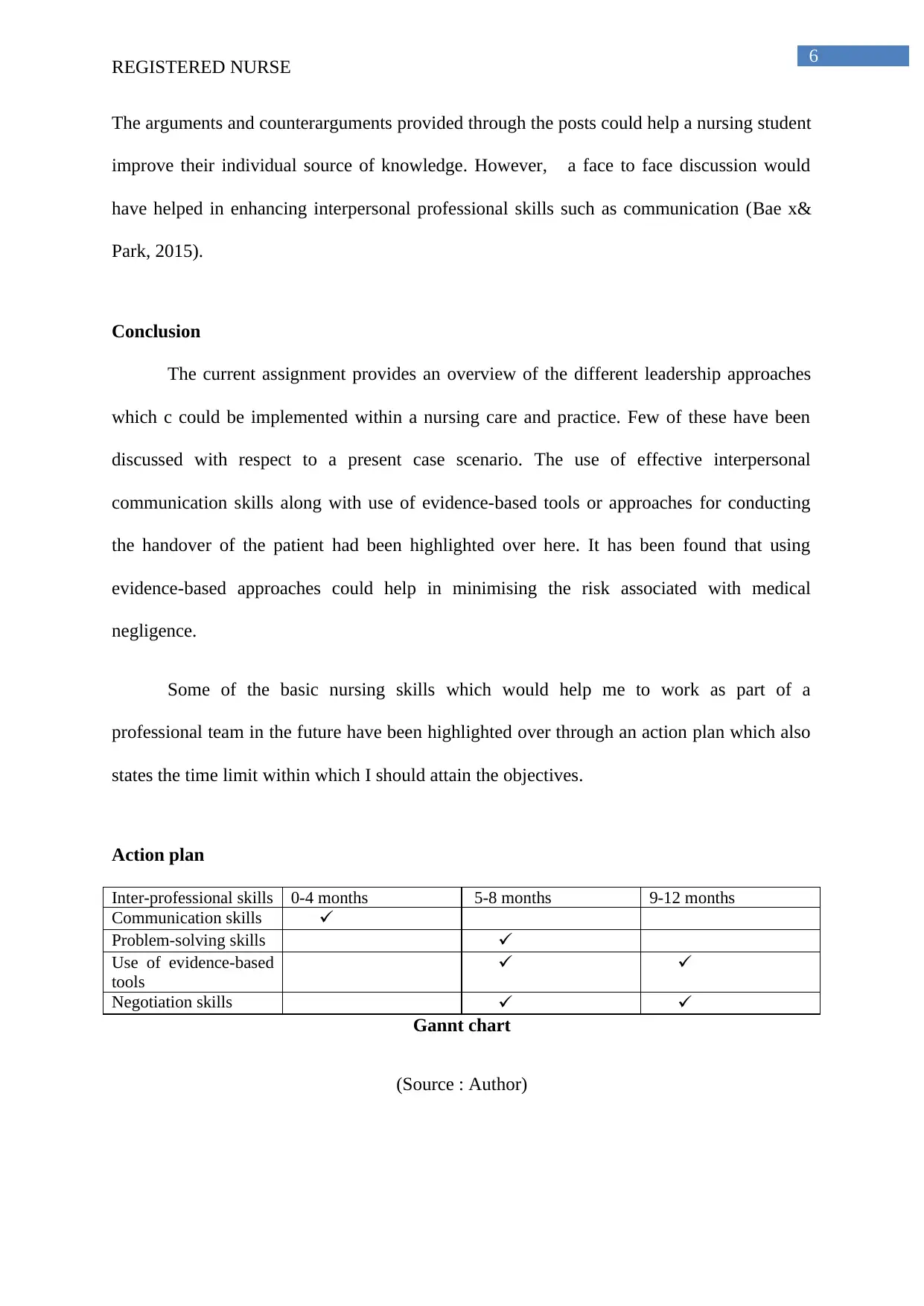
Some of the basic nursing skills which would help me to work as part of a
professional team in the future have been highlighted over through an action plan which also
states the time limit within which I should attain the objectives.
Action plan
Inter-professional skills 0-4 months 5-8 months 9-12 months
Communication skills
Problem-solving skills
Use of evidence-based
tools
Negotiation skills
Gannt chart
(Source : Author)
REGISTERED NURSE
The arguments and counterarguments provided through the posts could help a nursing student
improve their individual source of knowledge. However, a face to face discussion would
have helped in enhancing interpersonal professional skills such as communication (Bae x&
Park, 2015).
Conclusion
The current assignment provides an overview of the different leadership approaches
which c could be implemented within a nursing care and practice. Few of these have been
discussed with respect to a present case scenario. The use of effective interpersonal
communication skills along with use of evidence-based tools or approaches for conducting
the handover of the patient had been highlighted over here. It has been found that using
evidence-based approaches could help in minimising the risk associated with medical
negligence.
Some of the basic nursing skills which would help me to work as part of a
professional team in the future have been highlighted over through an action plan which also
states the time limit within which I should attain the objectives.
Action plan
Inter-professional skills 0-4 months 5-8 months 9-12 months
Communication skills
Problem-solving skills
Use of evidence-based
tools
Negotiation skills
Gannt chart
(Source : Author)
Paraphrase This Document
Need a fresh take? Get an instant paraphrase of this document with our AI Paraphraser
7
REGISTERED NURSE
References
AL-Dossary, R. N. (2017). Leadership in Nursing. In Contemporary Leadership Challenges.
InTech. DOI: 10.5772/65308
Backman, A., Ahnlund, P., Sjögren, K., Lövheim, H., McGilton, K. S., & Edvardsson, D.
(2018). Leading towards person-centred care–Nursing home managers' experiences of
leading person-centred care in highly person-centred Swedish nursing homes.
Retrieved at : http://www.diva-portal.org/smash/record.jsf?
pid=diva2%3A1196756&dswid=5682
Bae, S. H., & Park, J. S. (2015). Development and evaluation of extracurricular coaching
programs for improving communication skills and leadership among nursing
students. The Journal of Korean Academic Society of Nursing Education, 21(2), 202-
214. DOI : 10.5977/jkasne.2015.21.2.202
Bentley, M., Stirling, C., Robinson, A., & Minstrell, M. (2016). The nurse practitioner-client
therapeutic encounter: An integrative review of interaction in aged and primary care
settings. Journal of advanced nursing, 72(9), 1991-2002. Retrieved at :
https://doi.org/10.1111/jan.12929
Delgado, C., & Mitchell, M. M. (2016). A survey of current valued academic leadership
qualities in nursing. Nursing education perspectives, 37(1), 10-15. doi: 10.5480/14-
1496
Démeh, W., & Rosengren, K. (2015). The visualisation of clinical leadership in the content of
nursing education—a qualitative study of nursing students' experiences. Nurse
education today, 35(7), 888-893. DOI: Retrieved at :
https://doi.org/10.1016/j.nedt.2015.02.020
REGISTERED NURSE
References
AL-Dossary, R. N. (2017). Leadership in Nursing. In Contemporary Leadership Challenges.
InTech. DOI: 10.5772/65308
Backman, A., Ahnlund, P., Sjögren, K., Lövheim, H., McGilton, K. S., & Edvardsson, D.
(2018). Leading towards person-centred care–Nursing home managers' experiences of
leading person-centred care in highly person-centred Swedish nursing homes.
Retrieved at : http://www.diva-portal.org/smash/record.jsf?
pid=diva2%3A1196756&dswid=5682
Bae, S. H., & Park, J. S. (2015). Development and evaluation of extracurricular coaching
programs for improving communication skills and leadership among nursing
students. The Journal of Korean Academic Society of Nursing Education, 21(2), 202-
214. DOI : 10.5977/jkasne.2015.21.2.202
Bentley, M., Stirling, C., Robinson, A., & Minstrell, M. (2016). The nurse practitioner-client
therapeutic encounter: An integrative review of interaction in aged and primary care
settings. Journal of advanced nursing, 72(9), 1991-2002. Retrieved at :
https://doi.org/10.1111/jan.12929
Delgado, C., & Mitchell, M. M. (2016). A survey of current valued academic leadership
qualities in nursing. Nursing education perspectives, 37(1), 10-15. doi: 10.5480/14-
1496
Démeh, W., & Rosengren, K. (2015). The visualisation of clinical leadership in the content of
nursing education—a qualitative study of nursing students' experiences. Nurse
education today, 35(7), 888-893. DOI: Retrieved at :
https://doi.org/10.1016/j.nedt.2015.02.020
8
REGISTERED NURSE
Ennis, G., Happell, B., & Reid‐Searl, K. (2015). Enabling professional development in
mental health nursing: the role of clinical leadership. Journal of psychiatric and
mental health nursing, 22(8), 616-622. Retrieved at :
https://doi.org/10.1111/jpm.12221
Fleiszer, A. R., Semenic, S. E., Ritchie, J. A., Richer, M. C., & Denis, J. L. (2016). Nursing
unit leaders' influence on the long‐term sustainability of evidence‐based practice
improvements. Journal of nursing management, 24(3), 309-318. Retrieved at :
https://doi.org/10.1111/jonm.12320
Li, Y. C., & Wang, H. H. (2016). The influences of authentic leadership in nursing: A
systematic reviews. Retrieved at :
http://www.nursinglibrary.org/vhl/handle/10755/601655
Park, H. J. (2015). Correlations among nursing professionalism, critical thinking disposition
and self-leadership in nursing students. Journal of Korean Academic Society of
Nursing Education, 21(2), 227-236. Retrieved at :
https://doi.org/10.5977/jkasne.2015.21.2.227
Wong, C. A. (2015). Connecting nursing leadership and patient outcomes: state of the
science. Journal of nursing management, 23(3), 275-278. Retrieved at :
https://doi.org/10.1111/jonm.12307
REGISTERED NURSE
Ennis, G., Happell, B., & Reid‐Searl, K. (2015). Enabling professional development in
mental health nursing: the role of clinical leadership. Journal of psychiatric and
mental health nursing, 22(8), 616-622. Retrieved at :
https://doi.org/10.1111/jpm.12221
Fleiszer, A. R., Semenic, S. E., Ritchie, J. A., Richer, M. C., & Denis, J. L. (2016). Nursing
unit leaders' influence on the long‐term sustainability of evidence‐based practice
improvements. Journal of nursing management, 24(3), 309-318. Retrieved at :
https://doi.org/10.1111/jonm.12320
Li, Y. C., & Wang, H. H. (2016). The influences of authentic leadership in nursing: A
systematic reviews. Retrieved at :
http://www.nursinglibrary.org/vhl/handle/10755/601655
Park, H. J. (2015). Correlations among nursing professionalism, critical thinking disposition
and self-leadership in nursing students. Journal of Korean Academic Society of
Nursing Education, 21(2), 227-236. Retrieved at :
https://doi.org/10.5977/jkasne.2015.21.2.227
Wong, C. A. (2015). Connecting nursing leadership and patient outcomes: state of the
science. Journal of nursing management, 23(3), 275-278. Retrieved at :
https://doi.org/10.1111/jonm.12307
⊘ This is a preview!⊘
Do you want full access?
Subscribe today to unlock all pages.
Trusted by 1+ million students worldwide

1 out of 9


Related Documents


Your All-in-One AI-Powered Toolkit for Academic Success.
+13062052269
info@desklib.com
Available 24*7 on WhatsApp / Email
![[object Object]](/_next/static/media/star-bottom.7253800d.svg)
Unlock your academic potential
Copyright © 2020–2026 A2Z Services. All Rights Reserved. Developed and managed by ZUCOL.