Customer Care at All Floors UK: Work Experience Reflective Report
VerifiedAdded on 2023/01/07
|10
|3239
|48
Report
AI Summary
This report delves into the author's work experience as a Customer Care and Credit Control Clerk at All Floors UK. It begins with an introduction outlining the importance of work experience and the report's objectives, which include examining personal career opportunities and developing essential skills. The report covers various aspects of the job role, including cash handling, credit control, customer query resolution, and invoice management. It highlights the application of negotiation skills and the recognition of business constraints, such as lack of training and coordination issues. A personal and vocational skill audit is conducted, identifying strengths in IT, numeracy, communication, and organization, while also pointing out areas for improvement like analytical and problem-solving skills. The report presents a detailed career plan, including self-assessment, CV updates, goal setting, and action planning, and it outlines both short-term and long-term goals. Challenges faced in the workplace, such as coordination problems and resource issues, are discussed. Finally, the report emphasizes the importance of performance evaluation and suggests methods to enhance productivity and improve the overall work experience.

CUSTOMER CARE AT ALL
FLOORS
FLOORS

Paraphrase This Document
Need a fresh take? Get an instant paraphrase of this document with our AI Paraphraser
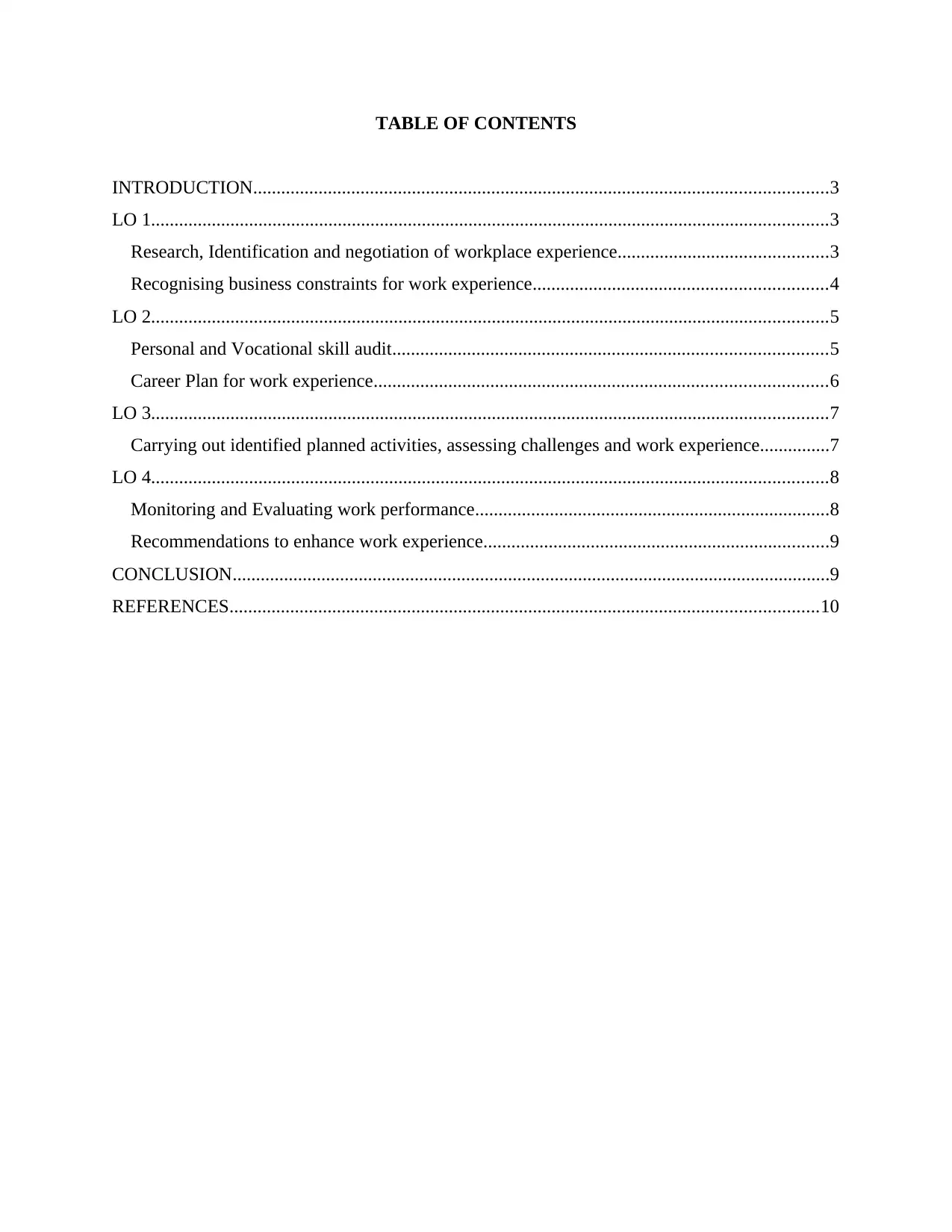
TABLE OF CONTENTS
INTRODUCTION...........................................................................................................................3
LO 1.................................................................................................................................................3
Research, Identification and negotiation of workplace experience.............................................3
Recognising business constraints for work experience...............................................................4
LO 2.................................................................................................................................................5
Personal and Vocational skill audit.............................................................................................5
Career Plan for work experience.................................................................................................6
LO 3.................................................................................................................................................7
Carrying out identified planned activities, assessing challenges and work experience...............7
LO 4.................................................................................................................................................8
Monitoring and Evaluating work performance............................................................................8
Recommendations to enhance work experience..........................................................................9
CONCLUSION................................................................................................................................9
REFERENCES..............................................................................................................................10
INTRODUCTION...........................................................................................................................3
LO 1.................................................................................................................................................3
Research, Identification and negotiation of workplace experience.............................................3
Recognising business constraints for work experience...............................................................4
LO 2.................................................................................................................................................5
Personal and Vocational skill audit.............................................................................................5
Career Plan for work experience.................................................................................................6
LO 3.................................................................................................................................................7
Carrying out identified planned activities, assessing challenges and work experience...............7
LO 4.................................................................................................................................................8
Monitoring and Evaluating work performance............................................................................8
Recommendations to enhance work experience..........................................................................9
CONCLUSION................................................................................................................................9
REFERENCES..............................................................................................................................10
INTRODUCTION
Work Experience is a significant aspect in the career of an individual. An individual
learns about the practical aspects of studies, organisational work culture and learning experience.
It is a platform where the individual can utilise skills and learn about job roles and
responsibilities which helps in getting a real sense of the industry (Mortimer Finch and
Maruyama, 2019). My chosen career is of Customer Care and Credit control clerk at All Floors
UK. The organisation provides carpet and flooring options to customers across UK. The aim of
this reflective report is to examine my personal career opportunities, assessing my strengths,
weaknesses, required skill sets and develop negotiation and planning skills, carrying out
activities and understand its importance. This report will also identify challenges and
opportunities I can have in the organisation and developing effective plan for work experience,
performance monitoring and recommendations for improvement.
LO 1
Research, Identification and negotiation of workplace experience
My job role at the organisation All Floors in UK is of customer care and credit control
clerk. This field has always interested me and I have worked towards acquiring relevant skills to
gain successful work experience.
The basic job role for the work is:
Cash handling, performing activities of credit and collection for the accounts adhering to the
founded policies, procedures and practices, leading and supporting credit control team, solving
queries of customers, paying invoices and producing invoices, paying employees and suppliers
(Sutherland and et.al., 2020).
My work experience extensively included:
Collecting Past-Due Receivables
Issuing timely reminders and phone collections as per needs
Handling the credit limits by undertaking a credit analysis review
Taking appropriate action on collection irregularities including pricing errors, payment
discrepancies and unearned discounts
Following credit policies and procedures and with the assistance of supervisors handling
non-routine credit correspondence and inquiries.
3
Work Experience is a significant aspect in the career of an individual. An individual
learns about the practical aspects of studies, organisational work culture and learning experience.
It is a platform where the individual can utilise skills and learn about job roles and
responsibilities which helps in getting a real sense of the industry (Mortimer Finch and
Maruyama, 2019). My chosen career is of Customer Care and Credit control clerk at All Floors
UK. The organisation provides carpet and flooring options to customers across UK. The aim of
this reflective report is to examine my personal career opportunities, assessing my strengths,
weaknesses, required skill sets and develop negotiation and planning skills, carrying out
activities and understand its importance. This report will also identify challenges and
opportunities I can have in the organisation and developing effective plan for work experience,
performance monitoring and recommendations for improvement.
LO 1
Research, Identification and negotiation of workplace experience
My job role at the organisation All Floors in UK is of customer care and credit control
clerk. This field has always interested me and I have worked towards acquiring relevant skills to
gain successful work experience.
The basic job role for the work is:
Cash handling, performing activities of credit and collection for the accounts adhering to the
founded policies, procedures and practices, leading and supporting credit control team, solving
queries of customers, paying invoices and producing invoices, paying employees and suppliers
(Sutherland and et.al., 2020).
My work experience extensively included:
Collecting Past-Due Receivables
Issuing timely reminders and phone collections as per needs
Handling the credit limits by undertaking a credit analysis review
Taking appropriate action on collection irregularities including pricing errors, payment
discrepancies and unearned discounts
Following credit policies and procedures and with the assistance of supervisors handling
non-routine credit correspondence and inquiries.
3
⊘ This is a preview!⊘
Do you want full access?
Subscribe today to unlock all pages.

Trusted by 1+ million students worldwide
Reconciliation of accounts and un-allotted cash
Processing Refund requests from customers
Identifying Disputed Invoices which can cause potential risks
Updating and maintaining bank notifications and details
I had to do all the tasks on time and meet the targets on appropriate deadlines, I had to multitask
many times for various activities like handling customer queries along with producing invoices
for the suppliers. At times I had to work individually by taking initiatives as well as in team. I
also had to efficiently learn the ERP or Enterprise Resource Planning software established in the
organisation (Waters, 2018).
My work experience was enhanced by application of negotiation skills in the work when
I had to negotiate with my supervisor. In the organisation, I had to forge an agreement between
multiple parties like employees, colleagues, supervisors, third parties and even customers from
time to time Although I initially faced issues as I was not able to comprehend tasks with clarity,
but I started learning how to compromise on work premises for mutual agreement y effective
communication, listening properly, exploring possibilities, considering my goals and available
alternatives. My negotiation skills have considerably improved as a credit control clerk in the
organisation (Belanich, Moses and Lall, 2016).
Recognising business constraints for work experience
There are many business constraints that I faced as a consumer care employee in the
organisation. Primarily, there are no certification courses or appropriate educational or training
procedure of the nature of my work, that is no documentation on the process (Ashworth and
Saxton, 2020). The only training, I had to go through was on-the-job training where I learned and
acquired the required procedures of working. This can be a major problem if the supervisor is not
effective in mentoring. Other constraints I faced were no proper coordination in the team, if the
sales team accepts bad orders, the problems of late payments or overtrading became a major
issue which I had to sort out. I also faced hierarchical issues due to evasive managers and
directors as they are in charge of payment of bills and if they are unreachable during a due
payment process, it created problems for me. Other business constraint in respect to dealing with
customers was of invoice disappearance, where I send invoices through email or post but the
4
Processing Refund requests from customers
Identifying Disputed Invoices which can cause potential risks
Updating and maintaining bank notifications and details
I had to do all the tasks on time and meet the targets on appropriate deadlines, I had to multitask
many times for various activities like handling customer queries along with producing invoices
for the suppliers. At times I had to work individually by taking initiatives as well as in team. I
also had to efficiently learn the ERP or Enterprise Resource Planning software established in the
organisation (Waters, 2018).
My work experience was enhanced by application of negotiation skills in the work when
I had to negotiate with my supervisor. In the organisation, I had to forge an agreement between
multiple parties like employees, colleagues, supervisors, third parties and even customers from
time to time Although I initially faced issues as I was not able to comprehend tasks with clarity,
but I started learning how to compromise on work premises for mutual agreement y effective
communication, listening properly, exploring possibilities, considering my goals and available
alternatives. My negotiation skills have considerably improved as a credit control clerk in the
organisation (Belanich, Moses and Lall, 2016).
Recognising business constraints for work experience
There are many business constraints that I faced as a consumer care employee in the
organisation. Primarily, there are no certification courses or appropriate educational or training
procedure of the nature of my work, that is no documentation on the process (Ashworth and
Saxton, 2020). The only training, I had to go through was on-the-job training where I learned and
acquired the required procedures of working. This can be a major problem if the supervisor is not
effective in mentoring. Other constraints I faced were no proper coordination in the team, if the
sales team accepts bad orders, the problems of late payments or overtrading became a major
issue which I had to sort out. I also faced hierarchical issues due to evasive managers and
directors as they are in charge of payment of bills and if they are unreachable during a due
payment process, it created problems for me. Other business constraint in respect to dealing with
customers was of invoice disappearance, where I send invoices through email or post but the
4
Paraphrase This Document
Need a fresh take? Get an instant paraphrase of this document with our AI Paraphraser
customer claim of not receiving it which means sending another invoice and delay in the
payment process.
LO 2
Personal and Vocational skill audit
A personal and vocational skill audit can be used for self-assessment and evaluating the
competency needs of the industry. It can help me in identifying my strengths and weaknesses,
requirement of improving weak areas and developing new skills required in the industry
(Jackson and Wilton, 2017).
The major skills for the job role of customer care/credit control clerk are as follows:
Technical skills
IT skills /Knowledge of ERP: A credit control clerk are based inside the work premises or office
and need to use databases and operating systems in order to record decision, access details,
communicate, record and account payments. I had to work across multiple systems depending
upon customers. Specific software is used to check credit records, maintain customer files,
setting up records, input and export data (Jimei, Ruohui and Yanbin, 2018). The organisations’
ERP software was oracle which I learned through on-the-job training, although I could have
done a certification course priorly. This skill can be classified as a strength.
Analytical skills: These skills refer to my ability to collect and analyse information and to come
up with decisions. This is used in every aspect from credit control and cash management. I can
classify this as a moderate competency with need for further improvements (Mortimer, 2019).
Numeracy/ Accountancy skills: I have to deal with finances of customers on a daily basis that is
why efficiency in numbers is needed. Posing questions to consumers, solving queries, processing
payments, explain customers the terms of credit and negotiation of payment plans require a
strong numeric ability. For the whole accountancy and banking process involved in my job role,
I need basic banking knowledge. I have acquired this trait via a level 2 functional skills in
Maths. This can be termed as my strength (Roux, 2019).
Data Entry: As per the clerical nature of the job, I have to possess proficiency in error free
typing skills, fast typing competency, software knowledge, attention to details and concentration.
This can be termed as my strength (Aasheim and Williams, 2019).
5
payment process.
LO 2
Personal and Vocational skill audit
A personal and vocational skill audit can be used for self-assessment and evaluating the
competency needs of the industry. It can help me in identifying my strengths and weaknesses,
requirement of improving weak areas and developing new skills required in the industry
(Jackson and Wilton, 2017).
The major skills for the job role of customer care/credit control clerk are as follows:
Technical skills
IT skills /Knowledge of ERP: A credit control clerk are based inside the work premises or office
and need to use databases and operating systems in order to record decision, access details,
communicate, record and account payments. I had to work across multiple systems depending
upon customers. Specific software is used to check credit records, maintain customer files,
setting up records, input and export data (Jimei, Ruohui and Yanbin, 2018). The organisations’
ERP software was oracle which I learned through on-the-job training, although I could have
done a certification course priorly. This skill can be classified as a strength.
Analytical skills: These skills refer to my ability to collect and analyse information and to come
up with decisions. This is used in every aspect from credit control and cash management. I can
classify this as a moderate competency with need for further improvements (Mortimer, 2019).
Numeracy/ Accountancy skills: I have to deal with finances of customers on a daily basis that is
why efficiency in numbers is needed. Posing questions to consumers, solving queries, processing
payments, explain customers the terms of credit and negotiation of payment plans require a
strong numeric ability. For the whole accountancy and banking process involved in my job role,
I need basic banking knowledge. I have acquired this trait via a level 2 functional skills in
Maths. This can be termed as my strength (Roux, 2019).
Data Entry: As per the clerical nature of the job, I have to possess proficiency in error free
typing skills, fast typing competency, software knowledge, attention to details and concentration.
This can be termed as my strength (Aasheim and Williams, 2019).
5
Generic skills
Communication: I am well versed with communalisation skills and apply it effectively in
workplace. The job requires me to talk to customers and often chase them for payments. I need
to understand whether the people stick to their word, lend a sympathetic ear, initiate
conversations towards appropriate conclusion. I have to be an improved negotiator, make rapport
with suppliers and consumers, speak to various people in different mood to successfully
accomplish my tasks and targets. This can be termed moderate; I need to update the skills and
increase language proficiency(Korenková, 2017).
Organisation skills: The skills help making and meeting deadlines, in collaborating with team
members, planning and strategizing, delegation etc. This skill is a strength but needs updation
and enhancement.
Problem Solving: Along with cash management, the job requires me to deal with late paying
customers, building strong relationships, creation of rapport in order to address their queries and
problems and come up with effective solutions. I have to navigate through tough conversations,
answer complex queries, assess risks therefore I need to stay calm while solving problems.
Team work: There is constant requirement to work along with assigned teams and colleagues and
I need to build strong amiable and formal relations with the members, use leadership skills
effectively, coordinate, cooperate and communicate effectively.
Ability to work under pressure: the job is all about dealing with deadlines, aggressive customers,
hard situations, therefore I need to remain calm and check everything thoroughly by trusting my
knowledge.
Career Plan for work experience
To enhance my skills, improve my efficiency, future prospects and work experience I can
follow a career plan:
1. Self-assessment of my vocational and personal skills and addressing to my strengths and
weaknesses. The major strengths are my technical skills like IT skills and numeracy as
well as communication, team work and organisation skills. I need to improve my problem
solving, analytical skills etc.
6
Communication: I am well versed with communalisation skills and apply it effectively in
workplace. The job requires me to talk to customers and often chase them for payments. I need
to understand whether the people stick to their word, lend a sympathetic ear, initiate
conversations towards appropriate conclusion. I have to be an improved negotiator, make rapport
with suppliers and consumers, speak to various people in different mood to successfully
accomplish my tasks and targets. This can be termed moderate; I need to update the skills and
increase language proficiency(Korenková, 2017).
Organisation skills: The skills help making and meeting deadlines, in collaborating with team
members, planning and strategizing, delegation etc. This skill is a strength but needs updation
and enhancement.
Problem Solving: Along with cash management, the job requires me to deal with late paying
customers, building strong relationships, creation of rapport in order to address their queries and
problems and come up with effective solutions. I have to navigate through tough conversations,
answer complex queries, assess risks therefore I need to stay calm while solving problems.
Team work: There is constant requirement to work along with assigned teams and colleagues and
I need to build strong amiable and formal relations with the members, use leadership skills
effectively, coordinate, cooperate and communicate effectively.
Ability to work under pressure: the job is all about dealing with deadlines, aggressive customers,
hard situations, therefore I need to remain calm and check everything thoroughly by trusting my
knowledge.
Career Plan for work experience
To enhance my skills, improve my efficiency, future prospects and work experience I can
follow a career plan:
1. Self-assessment of my vocational and personal skills and addressing to my strengths and
weaknesses. The major strengths are my technical skills like IT skills and numeracy as
well as communication, team work and organisation skills. I need to improve my problem
solving, analytical skills etc.
6
⊘ This is a preview!⊘
Do you want full access?
Subscribe today to unlock all pages.
Trusted by 1+ million students worldwide
2. Organising and updating my CV according to the industry skills, technical skills and
generic skills which I have acquired via work experience and certifications. This can help
me in addressing what other skills I need to obtain in the dynamic work environment,
3. Making Short-term and Long-term goals which I need to accomplish in the established
time period and come out will acknowledgeable experience to grab future opportunities.
4. Prioritizing goals and making choices to step forward in appropriate direction and start
working towards it.
5. Creating career action plan to pin down what actions and activities have to be done in
order to achieve my goals.
6. Performance management, audit and upgrading knowledge with changing job
requirements.
LO 3
Carrying out identified planned activities, assessing challenges and work experience
Short term goals can include improving knowledge of technical nature through various
educational courses, improving existing skills, learning new skills etc. to improve y productivity
at the workplace.
Long term goals include successful graduation in business management, handling a high
job position with new responsibilities in All floors.
In order to carry out my short term goals, I can take up an additional course on
accountancy, learn and upgrade my knowledge of ERP systems by earning widely used ERPs
like Oracle through online courses, Enhance language proficiency or improve communication
through effective reading, listening and speaking methods, dealing with customers and get their
feedback to address my existing issues in communication and work towards it. I can learn new
skills like banking methods, management skills, time-management skills or even a new
accounting software. To achieve my long-term goals, I have to learn more about the carpet
business and the industry of my organisation, successfully complete my university with
distinction in the field of business management, aim at getting promotions and incentives in the
long term in the organisation. To carry out this action plan effectively, I can create a Gantt chart
which will list all the activities systematically (Goetsch and et.al., 2017).
7
generic skills which I have acquired via work experience and certifications. This can help
me in addressing what other skills I need to obtain in the dynamic work environment,
3. Making Short-term and Long-term goals which I need to accomplish in the established
time period and come out will acknowledgeable experience to grab future opportunities.
4. Prioritizing goals and making choices to step forward in appropriate direction and start
working towards it.
5. Creating career action plan to pin down what actions and activities have to be done in
order to achieve my goals.
6. Performance management, audit and upgrading knowledge with changing job
requirements.
LO 3
Carrying out identified planned activities, assessing challenges and work experience
Short term goals can include improving knowledge of technical nature through various
educational courses, improving existing skills, learning new skills etc. to improve y productivity
at the workplace.
Long term goals include successful graduation in business management, handling a high
job position with new responsibilities in All floors.
In order to carry out my short term goals, I can take up an additional course on
accountancy, learn and upgrade my knowledge of ERP systems by earning widely used ERPs
like Oracle through online courses, Enhance language proficiency or improve communication
through effective reading, listening and speaking methods, dealing with customers and get their
feedback to address my existing issues in communication and work towards it. I can learn new
skills like banking methods, management skills, time-management skills or even a new
accounting software. To achieve my long-term goals, I have to learn more about the carpet
business and the industry of my organisation, successfully complete my university with
distinction in the field of business management, aim at getting promotions and incentives in the
long term in the organisation. To carry out this action plan effectively, I can create a Gantt chart
which will list all the activities systematically (Goetsch and et.al., 2017).
7
Paraphrase This Document
Need a fresh take? Get an instant paraphrase of this document with our AI Paraphraser
Understanding specific requirements of the industry, I have addressed the skills I need to
inculcate while working. I have to aim at fulfilling specific requirements of the workplace
according to the code of conduct and practice. All the ethical, legal and organisational values and
regulations have to be adhered to. The major challenges experienced at the organisation are:
A common challenge I face at the work is no proper coordination in the team, if the sales team
accepts bad orders, the problems of late payments or overtrading became a major issue which I
had to sort out. Installation problems of flooring can lead to issues in payments and overdue of
accounts. Resource issues, hierarchical issues and communication issues within the team are
major challenges and business constraints. The organisation doesn’t follow the deadlines
properly, no documentation of issues which can arise problems in future (Salas-Molina, Pla-
Santamaria and Rodriguez-Aguilar, 2018).
LO 4
Monitoring and Evaluating work performance
The important aspect of work experience is to evaluate and measure performance and
improve and enhance productivity accordingly. No employee is perfect, effective feedback and
appraisals can help in me in knowing my flaws in the work operations and incorporate new
methods to improve efficiency. In order to evaluate performance, I need to monitor my progress
in accordance with relevant standards of work and original proposal. Quantifiable methods like
360˚ Appraisal, Management by objectives, Behaviourally Anchored Rating, Rating scales etc.
can be used by supervisors to evaluate my efficiency and provide me feedback. Behaviourally
Anchored Rating can be used to assess communication, organisation skills, appropriate
invoicing, team work, IT abilities, cash management etc. is being performed according to
required standards of the company. According to the feedback and self-assessment techniques, I
have performed exceptionally well in handling and organising data while I need further
improvements in dealing with customers and suppliers (DeNisi and Murphy, 2017).
The major things that I have learned in the organisation are how to effectively deal with
angry customers, improving my linguistic capabilities, how to manage multitasking, time
management, delegation of tasks and negotiation skills, problem solving, attention to detail
which producing invoices, error management and data entry, dealing with issues by taking
authoritative responsibilities at times etc. I have improved my various generic skills and learned
8
inculcate while working. I have to aim at fulfilling specific requirements of the workplace
according to the code of conduct and practice. All the ethical, legal and organisational values and
regulations have to be adhered to. The major challenges experienced at the organisation are:
A common challenge I face at the work is no proper coordination in the team, if the sales team
accepts bad orders, the problems of late payments or overtrading became a major issue which I
had to sort out. Installation problems of flooring can lead to issues in payments and overdue of
accounts. Resource issues, hierarchical issues and communication issues within the team are
major challenges and business constraints. The organisation doesn’t follow the deadlines
properly, no documentation of issues which can arise problems in future (Salas-Molina, Pla-
Santamaria and Rodriguez-Aguilar, 2018).
LO 4
Monitoring and Evaluating work performance
The important aspect of work experience is to evaluate and measure performance and
improve and enhance productivity accordingly. No employee is perfect, effective feedback and
appraisals can help in me in knowing my flaws in the work operations and incorporate new
methods to improve efficiency. In order to evaluate performance, I need to monitor my progress
in accordance with relevant standards of work and original proposal. Quantifiable methods like
360˚ Appraisal, Management by objectives, Behaviourally Anchored Rating, Rating scales etc.
can be used by supervisors to evaluate my efficiency and provide me feedback. Behaviourally
Anchored Rating can be used to assess communication, organisation skills, appropriate
invoicing, team work, IT abilities, cash management etc. is being performed according to
required standards of the company. According to the feedback and self-assessment techniques, I
have performed exceptionally well in handling and organising data while I need further
improvements in dealing with customers and suppliers (DeNisi and Murphy, 2017).
The major things that I have learned in the organisation are how to effectively deal with
angry customers, improving my linguistic capabilities, how to manage multitasking, time
management, delegation of tasks and negotiation skills, problem solving, attention to detail
which producing invoices, error management and data entry, dealing with issues by taking
authoritative responsibilities at times etc. I have improved my various generic skills and learned
8
technical skills on the work premises. I learnt the practicality of work nature and application of
my skills and knowledge at appropriate places.
Recommendations to enhance work experience
I am quite satisfied with the work operations of the company and I learned a lot of things
which improved my work and practical experience. However, the firm could improve its
business operations and practices. The business should have a more standardised, organised and
clear approach and guidelines for daily work operations. Hierarchical issues, reporting to
multiple supervisors, dependence on higher authority of major task decisions and delegation
problems should be addressed by the company. The human resource department should
coordinate with other departments on order to make things easier for new joiners. Proper
documentation of the steps and guidelines for employees is needed. Communication with the
employees should be improved and employees should be updated and informed about major
decisions and requirements such as a new skill beforehand (Owusu, 2020).
CONCLUSION
The work experience at All floors UK was full of learning opportunities and networking
with people. I got a practical insight on how company works and how industry operates. I got to
learn about the differences in theoretical knowledge and practical application on ground. My job
position made me more accountable, responsible, and improved my soft and hard skills. The self-
evaluation of my skills in context to the company has made me recognise hidden potential and
needs for improvement. I also understood the challenges, business constraints, work methods and
requirements, expectation of the supervisors etc. I understood that performance evaluation and
monitoring help in improving productivity. I also established a career plan and identified
recommendations to enhance my work experience.
9
my skills and knowledge at appropriate places.
Recommendations to enhance work experience
I am quite satisfied with the work operations of the company and I learned a lot of things
which improved my work and practical experience. However, the firm could improve its
business operations and practices. The business should have a more standardised, organised and
clear approach and guidelines for daily work operations. Hierarchical issues, reporting to
multiple supervisors, dependence on higher authority of major task decisions and delegation
problems should be addressed by the company. The human resource department should
coordinate with other departments on order to make things easier for new joiners. Proper
documentation of the steps and guidelines for employees is needed. Communication with the
employees should be improved and employees should be updated and informed about major
decisions and requirements such as a new skill beforehand (Owusu, 2020).
CONCLUSION
The work experience at All floors UK was full of learning opportunities and networking
with people. I got a practical insight on how company works and how industry operates. I got to
learn about the differences in theoretical knowledge and practical application on ground. My job
position made me more accountable, responsible, and improved my soft and hard skills. The self-
evaluation of my skills in context to the company has made me recognise hidden potential and
needs for improvement. I also understood the challenges, business constraints, work methods and
requirements, expectation of the supervisors etc. I understood that performance evaluation and
monitoring help in improving productivity. I also established a career plan and identified
recommendations to enhance my work experience.
9
⊘ This is a preview!⊘
Do you want full access?
Subscribe today to unlock all pages.
Trusted by 1+ million students worldwide
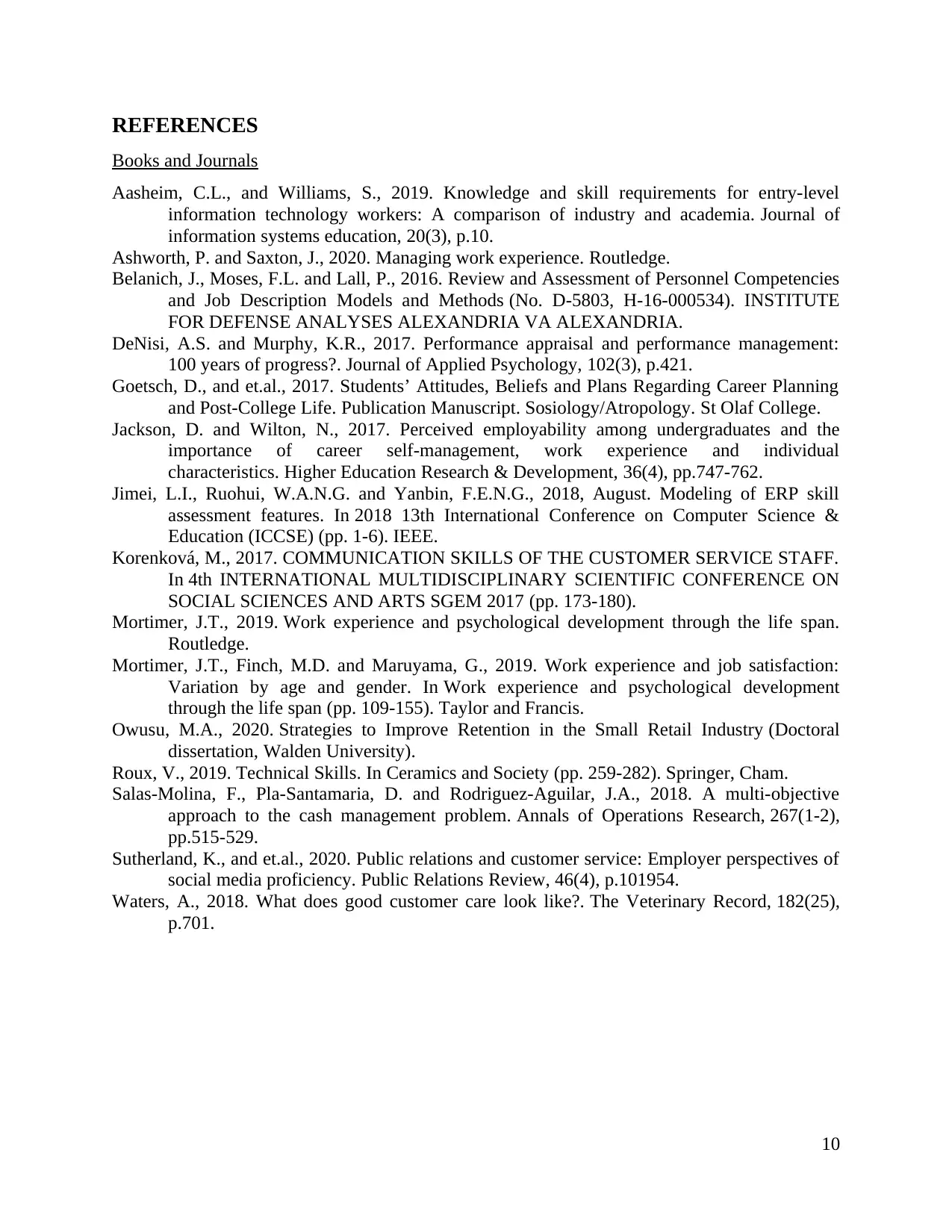
REFERENCES
Books and Journals
Aasheim, C.L., and Williams, S., 2019. Knowledge and skill requirements for entry-level
information technology workers: A comparison of industry and academia. Journal of
information systems education, 20(3), p.10.
Ashworth, P. and Saxton, J., 2020. Managing work experience. Routledge.
Belanich, J., Moses, F.L. and Lall, P., 2016. Review and Assessment of Personnel Competencies
and Job Description Models and Methods (No. D-5803, H-16-000534). INSTITUTE
FOR DEFENSE ANALYSES ALEXANDRIA VA ALEXANDRIA.
DeNisi, A.S. and Murphy, K.R., 2017. Performance appraisal and performance management:
100 years of progress?. Journal of Applied Psychology, 102(3), p.421.
Goetsch, D., and et.al., 2017. Students’ Attitudes, Beliefs and Plans Regarding Career Planning
and Post-College Life. Publication Manuscript. Sosiology/Atropology. St Olaf College.
Jackson, D. and Wilton, N., 2017. Perceived employability among undergraduates and the
importance of career self-management, work experience and individual
characteristics. Higher Education Research & Development, 36(4), pp.747-762.
Jimei, L.I., Ruohui, W.A.N.G. and Yanbin, F.E.N.G., 2018, August. Modeling of ERP skill
assessment features. In 2018 13th International Conference on Computer Science &
Education (ICCSE) (pp. 1-6). IEEE.
Korenková, M., 2017. COMMUNICATION SKILLS OF THE CUSTOMER SERVICE STAFF.
In 4th INTERNATIONAL MULTIDISCIPLINARY SCIENTIFIC CONFERENCE ON
SOCIAL SCIENCES AND ARTS SGEM 2017 (pp. 173-180).
Mortimer, J.T., 2019. Work experience and psychological development through the life span.
Routledge.
Mortimer, J.T., Finch, M.D. and Maruyama, G., 2019. Work experience and job satisfaction:
Variation by age and gender. In Work experience and psychological development
through the life span (pp. 109-155). Taylor and Francis.
Owusu, M.A., 2020. Strategies to Improve Retention in the Small Retail Industry (Doctoral
dissertation, Walden University).
Roux, V., 2019. Technical Skills. In Ceramics and Society (pp. 259-282). Springer, Cham.
Salas-Molina, F., Pla-Santamaria, D. and Rodriguez-Aguilar, J.A., 2018. A multi-objective
approach to the cash management problem. Annals of Operations Research, 267(1-2),
pp.515-529.
Sutherland, K., and et.al., 2020. Public relations and customer service: Employer perspectives of
social media proficiency. Public Relations Review, 46(4), p.101954.
Waters, A., 2018. What does good customer care look like?. The Veterinary Record, 182(25),
p.701.
10
Books and Journals
Aasheim, C.L., and Williams, S., 2019. Knowledge and skill requirements for entry-level
information technology workers: A comparison of industry and academia. Journal of
information systems education, 20(3), p.10.
Ashworth, P. and Saxton, J., 2020. Managing work experience. Routledge.
Belanich, J., Moses, F.L. and Lall, P., 2016. Review and Assessment of Personnel Competencies
and Job Description Models and Methods (No. D-5803, H-16-000534). INSTITUTE
FOR DEFENSE ANALYSES ALEXANDRIA VA ALEXANDRIA.
DeNisi, A.S. and Murphy, K.R., 2017. Performance appraisal and performance management:
100 years of progress?. Journal of Applied Psychology, 102(3), p.421.
Goetsch, D., and et.al., 2017. Students’ Attitudes, Beliefs and Plans Regarding Career Planning
and Post-College Life. Publication Manuscript. Sosiology/Atropology. St Olaf College.
Jackson, D. and Wilton, N., 2017. Perceived employability among undergraduates and the
importance of career self-management, work experience and individual
characteristics. Higher Education Research & Development, 36(4), pp.747-762.
Jimei, L.I., Ruohui, W.A.N.G. and Yanbin, F.E.N.G., 2018, August. Modeling of ERP skill
assessment features. In 2018 13th International Conference on Computer Science &
Education (ICCSE) (pp. 1-6). IEEE.
Korenková, M., 2017. COMMUNICATION SKILLS OF THE CUSTOMER SERVICE STAFF.
In 4th INTERNATIONAL MULTIDISCIPLINARY SCIENTIFIC CONFERENCE ON
SOCIAL SCIENCES AND ARTS SGEM 2017 (pp. 173-180).
Mortimer, J.T., 2019. Work experience and psychological development through the life span.
Routledge.
Mortimer, J.T., Finch, M.D. and Maruyama, G., 2019. Work experience and job satisfaction:
Variation by age and gender. In Work experience and psychological development
through the life span (pp. 109-155). Taylor and Francis.
Owusu, M.A., 2020. Strategies to Improve Retention in the Small Retail Industry (Doctoral
dissertation, Walden University).
Roux, V., 2019. Technical Skills. In Ceramics and Society (pp. 259-282). Springer, Cham.
Salas-Molina, F., Pla-Santamaria, D. and Rodriguez-Aguilar, J.A., 2018. A multi-objective
approach to the cash management problem. Annals of Operations Research, 267(1-2),
pp.515-529.
Sutherland, K., and et.al., 2020. Public relations and customer service: Employer perspectives of
social media proficiency. Public Relations Review, 46(4), p.101954.
Waters, A., 2018. What does good customer care look like?. The Veterinary Record, 182(25),
p.701.
10

1 out of 10


Related Documents


Your All-in-One AI-Powered Toolkit for Academic Success.
+13062052269
info@desklib.com
Available 24*7 on WhatsApp / Email
![[object Object]](/_next/static/media/star-bottom.7253800d.svg)
Unlock your academic potential
Copyright © 2020–2026 A2Z Services. All Rights Reserved. Developed and managed by ZUCOL.