E-Business Critical Analysis: Customer-Centric Approaches
VerifiedAdded on 2021/04/17
|7
|1679
|82
Report
AI Summary
This report offers a critical analysis of e-business, emphasizing customer-centric strategies and their impact on e-commerce. It explores the evolution of e-business, highlighting the importance of customer relationships and the shift towards customer profitability. The report examines various aspects, including e-manufacturing, the role of e-commerce platforms, and the application of McCarthy’s marketing mix. It discusses the significance of customer centricity, considering both broad and targeted customer approaches. The analysis also covers the impact of e-marketing, the importance of aligning marketing and sales strategies, and the role of innovation technologies. The report references several studies to support its arguments, ultimately concluding with the significance of customer-centric methods in shaping e-business strategies.

Running head: E-BUSINESS CRITICAL ANALYSIS
E-BUSINESS CRITICAL ANALYSIS
Name of the Student
Name of the University
Author Note
E-BUSINESS CRITICAL ANALYSIS
Name of the Student
Name of the University
Author Note
Paraphrase This Document
Need a fresh take? Get an instant paraphrase of this document with our AI Paraphraser

1
E-BUSINESS CRITICAL ANALYSIS
Introduction
Customer centricity is an approach that creates value for the business and companies are
providing their products from the core heart of business so that emotional touch remains with the
product. Customers’ need and satisfaction through products and the relationship between the
customers and the company enhance the financial performance of the company (Hemel and
Rademakers 2016). This comparing argument justifies the fact that customer relationship and
centralized customers establishment can strengthen the unique customer relationship. The impact
of this relationship in E-business process is important in that case (Gerow et al. 2014). E-
commerce is changing the nation's economy. The process is so much easy for customers that
companies are labeling their products in e-commerce section so that most of the people can see
the product and can know the features of the product (Eid and El-Gohary 2013). Some of the
brands are comparatively new, and they are promoting their market through e-commerce. Some
of the companies are still not making their place through e-commerce process, and some
companies are progressive in this business (Salehi et al. 2012). In this modern time, many e-
business companies are focusing on the attractiveness of business promotion. E-business
companies are no focusing on the customer thrust rather they are shifting their focus in case of
customer profitability.
Discussion
As stated by Qin et al. (2008), a customer-centric process in e-manufacturing in the
industry is the key factor of these valuing customers and provides them with the innovative
process of facilities that encourage their attractiveness and trust their value. In case of Customer-
Centric Strategy for E-Manufacturing in Apparel Industry, Modern custom tailoring is the
unique process introduced in the apparel company that can change the dimension of the apparel
E-BUSINESS CRITICAL ANALYSIS
Introduction
Customer centricity is an approach that creates value for the business and companies are
providing their products from the core heart of business so that emotional touch remains with the
product. Customers’ need and satisfaction through products and the relationship between the
customers and the company enhance the financial performance of the company (Hemel and
Rademakers 2016). This comparing argument justifies the fact that customer relationship and
centralized customers establishment can strengthen the unique customer relationship. The impact
of this relationship in E-business process is important in that case (Gerow et al. 2014). E-
commerce is changing the nation's economy. The process is so much easy for customers that
companies are labeling their products in e-commerce section so that most of the people can see
the product and can know the features of the product (Eid and El-Gohary 2013). Some of the
brands are comparatively new, and they are promoting their market through e-commerce. Some
of the companies are still not making their place through e-commerce process, and some
companies are progressive in this business (Salehi et al. 2012). In this modern time, many e-
business companies are focusing on the attractiveness of business promotion. E-business
companies are no focusing on the customer thrust rather they are shifting their focus in case of
customer profitability.
Discussion
As stated by Qin et al. (2008), a customer-centric process in e-manufacturing in the
industry is the key factor of these valuing customers and provides them with the innovative
process of facilities that encourage their attractiveness and trust their value. In case of Customer-
Centric Strategy for E-Manufacturing in Apparel Industry, Modern custom tailoring is the
unique process introduced in the apparel company that can change the dimension of the apparel

2
E-BUSINESS CRITICAL ANALYSIS
industry. Customization is dress is ubiquitous in the modern market. There are some e-commerce
platforms like Flipkart, Myntra, Snapdeal, Amazon, Lime store, Zovi, and Nykaa all these
companies are holding the trade of e-business and showcase all brands of products and deliver
some discounts over them. Some of the electrical products are making their market through cost-
to-cost business relationships with customers. The process of customer centricity has come to
that state. From the production system, there is some interactive medium allocated for the
business, and these are the stimulation that virtually produces a chain of supply of product.
The in-depth chain process of product progression is the major fact highlighted by Qin et
al. (2008). The customer-centric process is for all, and the segregation is not offered radically in
this prospect. On contradicting this thought, Azadi and Rahimzadeh (2012), consider the
customer centricity process applies to a section of customers. All the customers are not affording
such price, in that case, customer centralization is needed. Increased business can be only
attainable by choosing the target market and by choosing the centralized customers. The paper
provides the competitive market opportunities and product diversities that will segregate trough
the price, place and promoting the product. In many cases, promotional issues are so strong that
helps the increased value of the material. The increased profit is also related to the fact.
McCarthy’s four marketing mix used by the authors and that shows the e-commerce affordability
in price, place, product, and promotion. E-commerce strategies are the new age trending
strategies that help in marketing and business cases. The development strategies are focusing on
the online markets only; this is the reason product alternation and distribution process is rather
easy for the suppliers and customers respectively.
For the market-centric allocation in business, Developing marketing strategy for
electronic business by using McCarthy’s four marketing mix model and Porter's five
E-BUSINESS CRITICAL ANALYSIS
industry. Customization is dress is ubiquitous in the modern market. There are some e-commerce
platforms like Flipkart, Myntra, Snapdeal, Amazon, Lime store, Zovi, and Nykaa all these
companies are holding the trade of e-business and showcase all brands of products and deliver
some discounts over them. Some of the electrical products are making their market through cost-
to-cost business relationships with customers. The process of customer centricity has come to
that state. From the production system, there is some interactive medium allocated for the
business, and these are the stimulation that virtually produces a chain of supply of product.
The in-depth chain process of product progression is the major fact highlighted by Qin et
al. (2008). The customer-centric process is for all, and the segregation is not offered radically in
this prospect. On contradicting this thought, Azadi and Rahimzadeh (2012), consider the
customer centricity process applies to a section of customers. All the customers are not affording
such price, in that case, customer centralization is needed. Increased business can be only
attainable by choosing the target market and by choosing the centralized customers. The paper
provides the competitive market opportunities and product diversities that will segregate trough
the price, place and promoting the product. In many cases, promotional issues are so strong that
helps the increased value of the material. The increased profit is also related to the fact.
McCarthy’s four marketing mix used by the authors and that shows the e-commerce affordability
in price, place, product, and promotion. E-commerce strategies are the new age trending
strategies that help in marketing and business cases. The development strategies are focusing on
the online markets only; this is the reason product alternation and distribution process is rather
easy for the suppliers and customers respectively.
For the market-centric allocation in business, Developing marketing strategy for
electronic business by using McCarthy’s four marketing mix model and Porter's five
⊘ This is a preview!⊘
Do you want full access?
Subscribe today to unlock all pages.

Trusted by 1+ million students worldwide

3
E-BUSINESS CRITICAL ANALYSIS
competitive forces, this journal has highlighted the portion of a niche market, as this is the core
value of product strategy that is not possible for general public to purchase as the price is very
high. The strategic pull of customers and customization of products are the main factors and that
way the product market will move in the innovative direction of selling. E-business market is one
of that markets simply taking the competitive advantage of the physical market cost and
providing low-cost products to the customers. The promotional markets are not designed as a
traditional market rather building customer loyalties in the traditional market are diminished in
the sluggish formation, and people are coming in the online product structure. There is an
argumentation from Hemel and Redemakers (2016), as there is ahuge number of companies
who are not penetrating the market of online business and customer-centric form is not properly
delivered by them. The argumentation is quite clear as all organizations do not have this set up to
formulate their product in e-commerce. Customer centricity process is needed to be indulged in
that case. The shaping factor of customer centricity process in manufacturing is always impacted
in a right manner. In some cases, product development is needed in a right way, so that
marketplace factors are implemented in a right way.
The clear indication of customer-centric behavior is there that justify the factors and
barriers to business in e-commerce sections as well. This positioning of online business as one
part of an incorporated, e-business loom of a customer-centered organization complements that
preceding accent in VET of stimulating the implementation of online business by radically
improving proportioning of business. The attempted work of "Building Customer-centric
Organizations: Shaping Factors and Barriers” infrastructural system and valuing the customers
are the main aspect of this journal and that executed in the form of marketing enhancement and
culture. The same e-business strategies may not exertion for all internet or e-commerce
E-BUSINESS CRITICAL ANALYSIS
competitive forces, this journal has highlighted the portion of a niche market, as this is the core
value of product strategy that is not possible for general public to purchase as the price is very
high. The strategic pull of customers and customization of products are the main factors and that
way the product market will move in the innovative direction of selling. E-business market is one
of that markets simply taking the competitive advantage of the physical market cost and
providing low-cost products to the customers. The promotional markets are not designed as a
traditional market rather building customer loyalties in the traditional market are diminished in
the sluggish formation, and people are coming in the online product structure. There is an
argumentation from Hemel and Redemakers (2016), as there is ahuge number of companies
who are not penetrating the market of online business and customer-centric form is not properly
delivered by them. The argumentation is quite clear as all organizations do not have this set up to
formulate their product in e-commerce. Customer centricity process is needed to be indulged in
that case. The shaping factor of customer centricity process in manufacturing is always impacted
in a right manner. In some cases, product development is needed in a right way, so that
marketplace factors are implemented in a right way.
The clear indication of customer-centric behavior is there that justify the factors and
barriers to business in e-commerce sections as well. This positioning of online business as one
part of an incorporated, e-business loom of a customer-centered organization complements that
preceding accent in VET of stimulating the implementation of online business by radically
improving proportioning of business. The attempted work of "Building Customer-centric
Organizations: Shaping Factors and Barriers” infrastructural system and valuing the customers
are the main aspect of this journal and that executed in the form of marketing enhancement and
culture. The same e-business strategies may not exertion for all internet or e-commerce
Paraphrase This Document
Need a fresh take? Get an instant paraphrase of this document with our AI Paraphraser

4
E-BUSINESS CRITICAL ANALYSIS
companies. For example, development of its product aid by advertising personal computers may
be successful for Amazon.com, whose business centered has enthused from selling books to
delivering suitable online shopping for a huge diversity of products. All the aspects of supply
chain, productivity are aligned with the e-commerce, and that evaluate the industry changes
culture as well (Bordonaba-Juste, Lucia-Palacios and Polo-Redondo 2012). In case of supporting
information and innovation technologies e-commerce business has changed their path and
provides more efficiency in case of providing customer preference.
The customer preference scenario is the major issue over there, and that impacted the
workflow process and invests in the companies that are allocated in e-business range. There are
numerous e-business platforms are available, and those will provide huge options for customers.
They choose their products from that. As commented by Salehi et al. (2012), the customer-
centric organizations are important in that case, and these will reduce the transactional cost of the
product, and that will help in case of promoting the product at its range. Identify the focal
customers is the main aspect of this business, on the contradictory aspect more accurate
estimation of customer equity is the significant process of understanding. From another view of
Eid and El-Gohary (2013) align marketing, and sales strategies are essential for the e-commerce
and e-business belts to perform the process in a right way. Companies, those are investing their
money in e-commerce is significantly created a link between them and that knowledge of
customer-centric process helps to differentiate products.
Conclusion
Therefore, it can be concluded from the argumentation regarding e-business process that
different aspects of e-marketing and customer behavioral thoughts can be evolved. However, all
the aspects are not correct as another author has provided augmented view against that. The
E-BUSINESS CRITICAL ANALYSIS
companies. For example, development of its product aid by advertising personal computers may
be successful for Amazon.com, whose business centered has enthused from selling books to
delivering suitable online shopping for a huge diversity of products. All the aspects of supply
chain, productivity are aligned with the e-commerce, and that evaluate the industry changes
culture as well (Bordonaba-Juste, Lucia-Palacios and Polo-Redondo 2012). In case of supporting
information and innovation technologies e-commerce business has changed their path and
provides more efficiency in case of providing customer preference.
The customer preference scenario is the major issue over there, and that impacted the
workflow process and invests in the companies that are allocated in e-business range. There are
numerous e-business platforms are available, and those will provide huge options for customers.
They choose their products from that. As commented by Salehi et al. (2012), the customer-
centric organizations are important in that case, and these will reduce the transactional cost of the
product, and that will help in case of promoting the product at its range. Identify the focal
customers is the main aspect of this business, on the contradictory aspect more accurate
estimation of customer equity is the significant process of understanding. From another view of
Eid and El-Gohary (2013) align marketing, and sales strategies are essential for the e-commerce
and e-business belts to perform the process in a right way. Companies, those are investing their
money in e-commerce is significantly created a link between them and that knowledge of
customer-centric process helps to differentiate products.
Conclusion
Therefore, it can be concluded from the argumentation regarding e-business process that
different aspects of e-marketing and customer behavioral thoughts can be evolved. However, all
the aspects are not correct as another author has provided augmented view against that. The

5
E-BUSINESS CRITICAL ANALYSIS
process of argumentation and business loyalty will emerge the new business process, considering
as customer-centric method and this method will help to segment all products in a certain range.
E-BUSINESS CRITICAL ANALYSIS
process of argumentation and business loyalty will emerge the new business process, considering
as customer-centric method and this method will help to segment all products in a certain range.
⊘ This is a preview!⊘
Do you want full access?
Subscribe today to unlock all pages.

Trusted by 1+ million students worldwide

6
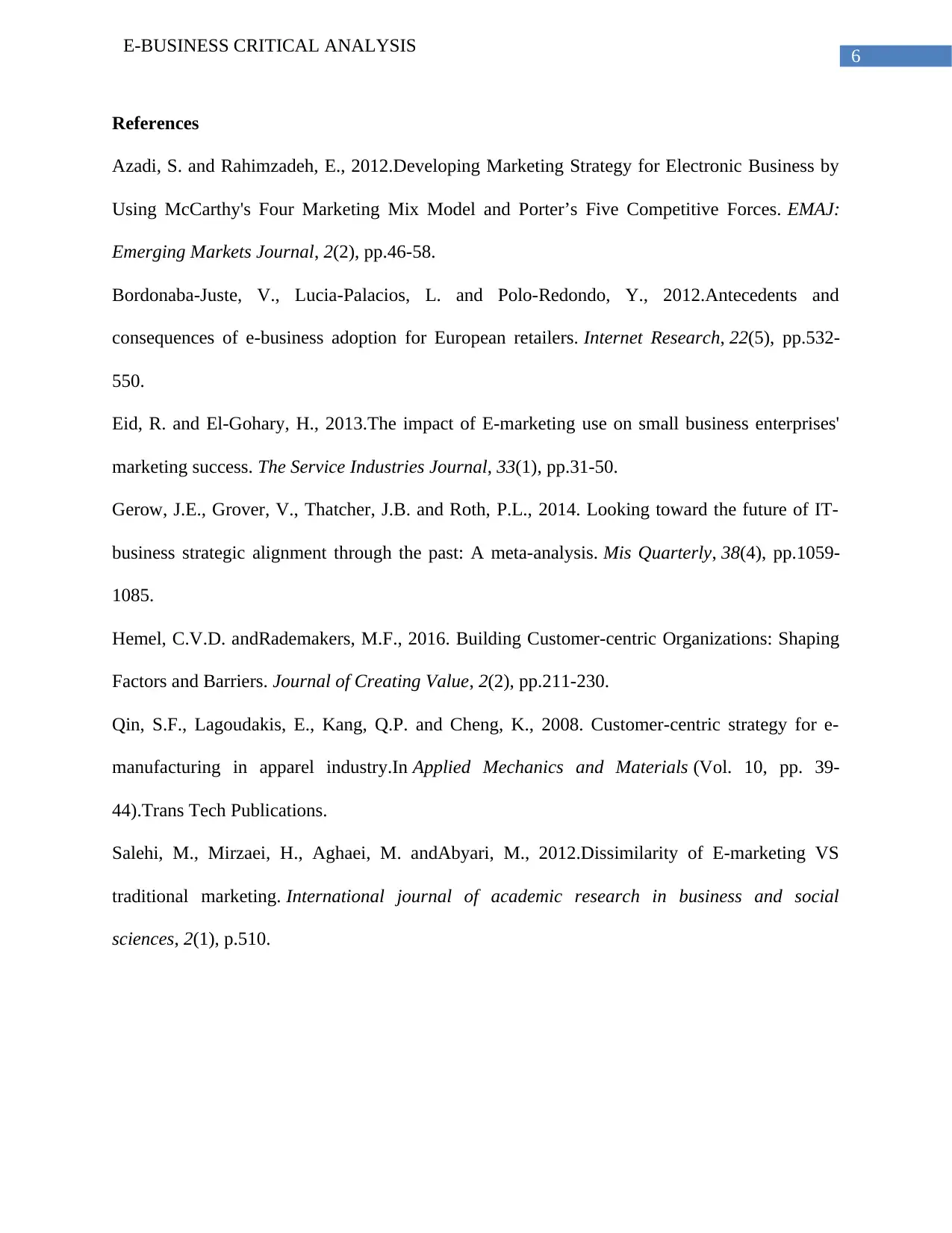
E-BUSINESS CRITICAL ANALYSIS
References
Azadi, S. and Rahimzadeh, E., 2012.Developing Marketing Strategy for Electronic Business by
Using McCarthy's Four Marketing Mix Model and Porter’s Five Competitive Forces. EMAJ:
Emerging Markets Journal, 2(2), pp.46-58.
Bordonaba-Juste, V., Lucia-Palacios, L. and Polo-Redondo, Y., 2012.Antecedents and
consequences of e-business adoption for European retailers. Internet Research, 22(5), pp.532-
550.
Eid, R. and El-Gohary, H., 2013.The impact of E-marketing use on small business enterprises'
marketing success. The Service Industries Journal, 33(1), pp.31-50.
Gerow, J.E., Grover, V., Thatcher, J.B. and Roth, P.L., 2014. Looking toward the future of IT-
business strategic alignment through the past: A meta-analysis. Mis Quarterly, 38(4), pp.1059-
1085.
Hemel, C.V.D. andRademakers, M.F., 2016. Building Customer-centric Organizations: Shaping
Factors and Barriers. Journal of Creating Value, 2(2), pp.211-230.
Qin, S.F., Lagoudakis, E., Kang, Q.P. and Cheng, K., 2008. Customer-centric strategy for e-
manufacturing in apparel industry.In Applied Mechanics and Materials (Vol. 10, pp. 39-
44).Trans Tech Publications.
Salehi, M., Mirzaei, H., Aghaei, M. andAbyari, M., 2012.Dissimilarity of E-marketing VS
traditional marketing. International journal of academic research in business and social
sciences, 2(1), p.510.
E-BUSINESS CRITICAL ANALYSIS
References
Azadi, S. and Rahimzadeh, E., 2012.Developing Marketing Strategy for Electronic Business by
Using McCarthy's Four Marketing Mix Model and Porter’s Five Competitive Forces. EMAJ:
Emerging Markets Journal, 2(2), pp.46-58.
Bordonaba-Juste, V., Lucia-Palacios, L. and Polo-Redondo, Y., 2012.Antecedents and
consequences of e-business adoption for European retailers. Internet Research, 22(5), pp.532-
550.
Eid, R. and El-Gohary, H., 2013.The impact of E-marketing use on small business enterprises'
marketing success. The Service Industries Journal, 33(1), pp.31-50.
Gerow, J.E., Grover, V., Thatcher, J.B. and Roth, P.L., 2014. Looking toward the future of IT-
business strategic alignment through the past: A meta-analysis. Mis Quarterly, 38(4), pp.1059-
1085.
Hemel, C.V.D. andRademakers, M.F., 2016. Building Customer-centric Organizations: Shaping
Factors and Barriers. Journal of Creating Value, 2(2), pp.211-230.
Qin, S.F., Lagoudakis, E., Kang, Q.P. and Cheng, K., 2008. Customer-centric strategy for e-
manufacturing in apparel industry.In Applied Mechanics and Materials (Vol. 10, pp. 39-
44).Trans Tech Publications.
Salehi, M., Mirzaei, H., Aghaei, M. andAbyari, M., 2012.Dissimilarity of E-marketing VS
traditional marketing. International journal of academic research in business and social
sciences, 2(1), p.510.
1 out of 7
Related Documents
Your All-in-One AI-Powered Toolkit for Academic Success.
+13062052269
info@desklib.com
Available 24*7 on WhatsApp / Email
Unlock your academic potential
Copyright © 2020–2025 A2Z Services. All Rights Reserved. Developed and managed by ZUCOL.