LSBF CRM Report: Analysis of Apple's Customer Relationship Management
VerifiedAdded on 2022/08/12
|16
|4570
|13
Report
AI Summary
This report provides an in-depth analysis of Apple's Customer Relationship Management (CRM) strategies. It begins with an introduction to CRM and reviews key CRM models such as IDIC, Payne & Frow’s Five-step Process Model, and QCI Model, highlighting their applications. The report then explores the concept of Customer Lifetime Value (CLV) and its significance in CRM. A detailed examination of Apple's CRM model follows, emphasizing its customer-centric approach, including the use of Apple ID and the focus on customer satisfaction through innovative services and face-to-face interactions. The report also discusses Apple's CSR strategies and their impact on customer engagement, emphasizing ethical data usage. Furthermore, the analysis covers the use of automation in Apple's CRM, its advantages, and disadvantages. The report concludes with recommendations for an effective CRM program. Overall, the report provides a comprehensive overview of Apple's CRM practices, offering valuable insights into its customer relationship management.
RUNNING HEAD: Customer Relationship Management
Kevin Patrick
Customer Relationship Management
Kevin Patrick
Customer Relationship Management

Paraphrase This Document
Need a fresh take? Get an instant paraphrase of this document with our AI Paraphraser
Customer Relationship Management 1
Contents
Introduction......................................................................................................................................2
Review of CRM Models..............................................................................................................2
Application of CLV.....................................................................................................................6
CRM Model used by Company.......................................................................................................7
CSR Strategies of Apple for Customer Engagement...................................................................8
Analysis of Automation utilized by Company................................................................................9
Advantages & Drawbacks of utilized Automation....................................................................10
Recommended CRM Programme..................................................................................................11
Conclusion.....................................................................................................................................12
References......................................................................................................................................13
Contents
Introduction......................................................................................................................................2
Review of CRM Models..............................................................................................................2
Application of CLV.....................................................................................................................6
CRM Model used by Company.......................................................................................................7
CSR Strategies of Apple for Customer Engagement...................................................................8
Analysis of Automation utilized by Company................................................................................9
Advantages & Drawbacks of utilized Automation....................................................................10
Recommended CRM Programme..................................................................................................11
Conclusion.....................................................................................................................................12
References......................................................................................................................................13
Customer Relationship Management 2
Introduction
The aim of the paper is to enlighten the reader with the information about the company Apple
and its customer relationship management strategies. Customer relationship management (CRM)
refers to the approach that is implemented by organizations to manage the interest of customers
in the business and to draw interest of potential customers as well. The customer relationship
management strategy makes use of information and then analyse of the customer activities and
helps the business to improve their position in the market. Use of customer relationship
management strategy helps the organization to specifically focus on customer retention activities
and drive sales and productivity for the company. (Das, and Mishra 2019).
Further, this paper will highlight the details about the customer relationship management
approaches applied by company Apple and the ways through which this strategy influences their
relationship with CSR activities and customer engagement. Advantages and disadvantages of
automation are also discussed in the report to help the company analyse effectiveness of the
CRM functions. The latter part of the paper provides recommendations to the organization to
implement effective strategies for smooth functioning.
Review of CRM Models
Customer relationship management involves the process of conducting the business functions by
making use of customer information in such a way that allows the business to fulfil the needs of
customer in a better way. There are three main types of CRM present which are strategic CRM,
operational CRM and analytical CRM. Strategic CRM is a core customer centric business
strategy that focuses on keeping the profitable customers in the business. This strategy focuses
on winning the right type of customers. (Charoensukmongkol, and Sasatanun 2017). Operational
CRM emphasize on automation of customer-facing actions such as marketing, customer service
and selling. Analytical CRM is the process where companies alter customer related information
into actions that is beneficial for the business.
The below is a list of the three CRM models majorly used by companies:
Introduction
The aim of the paper is to enlighten the reader with the information about the company Apple
and its customer relationship management strategies. Customer relationship management (CRM)
refers to the approach that is implemented by organizations to manage the interest of customers
in the business and to draw interest of potential customers as well. The customer relationship
management strategy makes use of information and then analyse of the customer activities and
helps the business to improve their position in the market. Use of customer relationship
management strategy helps the organization to specifically focus on customer retention activities
and drive sales and productivity for the company. (Das, and Mishra 2019).
Further, this paper will highlight the details about the customer relationship management
approaches applied by company Apple and the ways through which this strategy influences their
relationship with CSR activities and customer engagement. Advantages and disadvantages of
automation are also discussed in the report to help the company analyse effectiveness of the
CRM functions. The latter part of the paper provides recommendations to the organization to
implement effective strategies for smooth functioning.
Review of CRM Models
Customer relationship management involves the process of conducting the business functions by
making use of customer information in such a way that allows the business to fulfil the needs of
customer in a better way. There are three main types of CRM present which are strategic CRM,
operational CRM and analytical CRM. Strategic CRM is a core customer centric business
strategy that focuses on keeping the profitable customers in the business. This strategy focuses
on winning the right type of customers. (Charoensukmongkol, and Sasatanun 2017). Operational
CRM emphasize on automation of customer-facing actions such as marketing, customer service
and selling. Analytical CRM is the process where companies alter customer related information
into actions that is beneficial for the business.
The below is a list of the three CRM models majorly used by companies:
⊘ This is a preview!⊘
Do you want full access?
Subscribe today to unlock all pages.

Trusted by 1+ million students worldwide
Customer Relationship Management 3
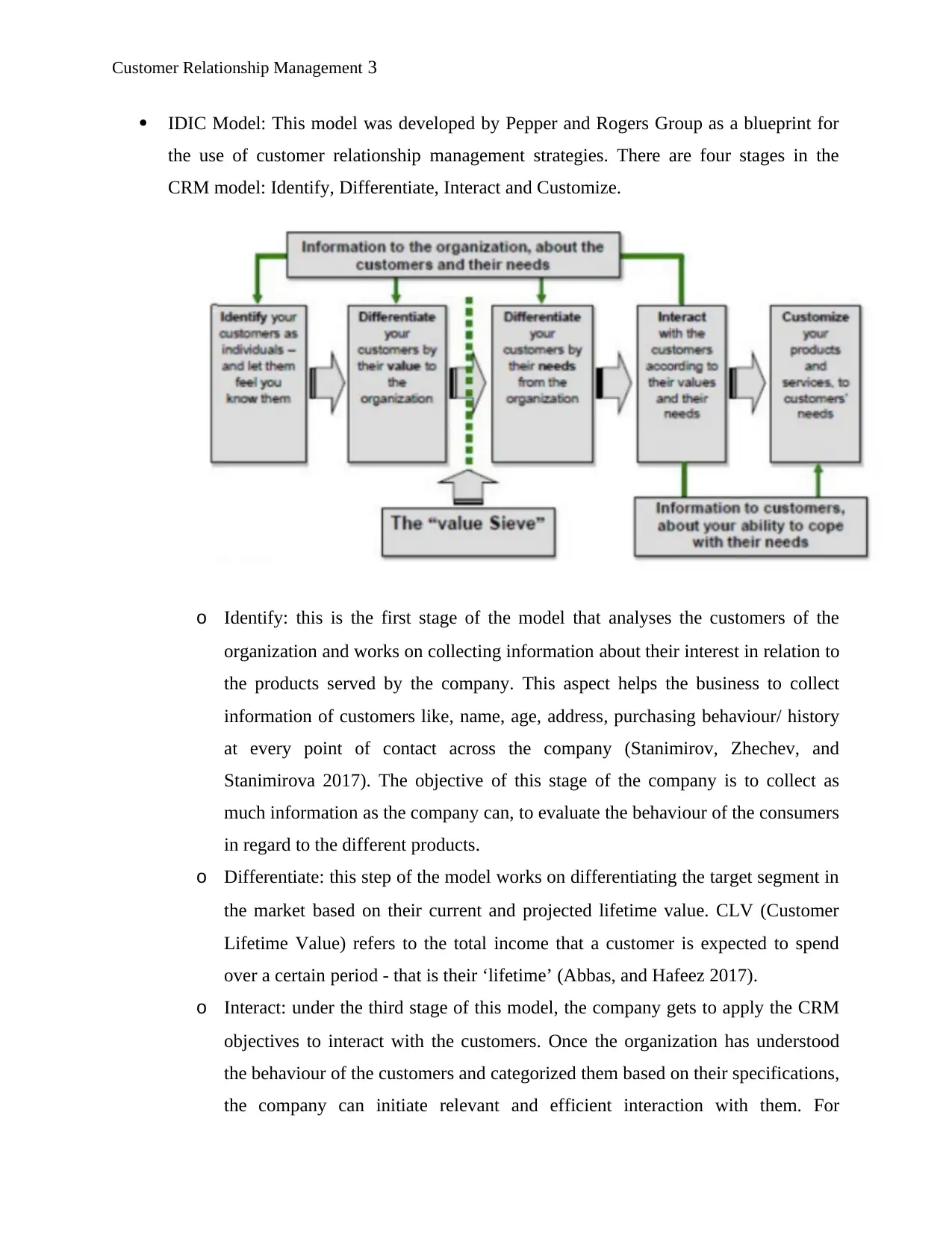
IDIC Model: This model was developed by Pepper and Rogers Group as a blueprint for
the use of customer relationship management strategies. There are four stages in the
CRM model: Identify, Differentiate, Interact and Customize.
o Identify: this is the first stage of the model that analyses the customers of the
organization and works on collecting information about their interest in relation to
the products served by the company. This aspect helps the business to collect
information of customers like, name, age, address, purchasing behaviour/ history
at every point of contact across the company (Stanimirov, Zhechev, and
Stanimirova 2017). The objective of this stage of the company is to collect as
much information as the company can, to evaluate the behaviour of the consumers
in regard to the different products.
o Differentiate: this step of the model works on differentiating the target segment in
the market based on their current and projected lifetime value. CLV (Customer
Lifetime Value) refers to the total income that a customer is expected to spend
over a certain period - that is their ‘lifetime’ (Abbas, and Hafeez 2017).
o Interact: under the third stage of this model, the company gets to apply the CRM
objectives to interact with the customers. Once the organization has understood
the behaviour of the customers and categorized them based on their specifications,
the company can initiate relevant and efficient interaction with them. For
IDIC Model: This model was developed by Pepper and Rogers Group as a blueprint for
the use of customer relationship management strategies. There are four stages in the
CRM model: Identify, Differentiate, Interact and Customize.
o Identify: this is the first stage of the model that analyses the customers of the
organization and works on collecting information about their interest in relation to
the products served by the company. This aspect helps the business to collect
information of customers like, name, age, address, purchasing behaviour/ history
at every point of contact across the company (Stanimirov, Zhechev, and
Stanimirova 2017). The objective of this stage of the company is to collect as
much information as the company can, to evaluate the behaviour of the consumers
in regard to the different products.
o Differentiate: this step of the model works on differentiating the target segment in
the market based on their current and projected lifetime value. CLV (Customer
Lifetime Value) refers to the total income that a customer is expected to spend
over a certain period - that is their ‘lifetime’ (Abbas, and Hafeez 2017).
o Interact: under the third stage of this model, the company gets to apply the CRM
objectives to interact with the customers. Once the organization has understood
the behaviour of the customers and categorized them based on their specifications,
the company can initiate relevant and efficient interaction with them. For
Paraphrase This Document
Need a fresh take? Get an instant paraphrase of this document with our AI Paraphraser
Customer Relationship Management 4
example, Apple provide Apple Care+ services to the customers for the protection
of their premium quality Apple products (Leligdon, Quinn, and Briggs 2015).
o Customize: this is the last phase where the companies implement services based
on customers in the market. Once interaction is initiated at the third stage, the
organization can start to understand what their customers expectation from the
brand is and this results in the business being able to customize it’s offering
depending on the type of customer (Shukla, and Pattnaik 2019). For example
Apple have different versions of their iPhone for different markets at different
price points to cater for different types (based on disposable income and
competition) of customers.
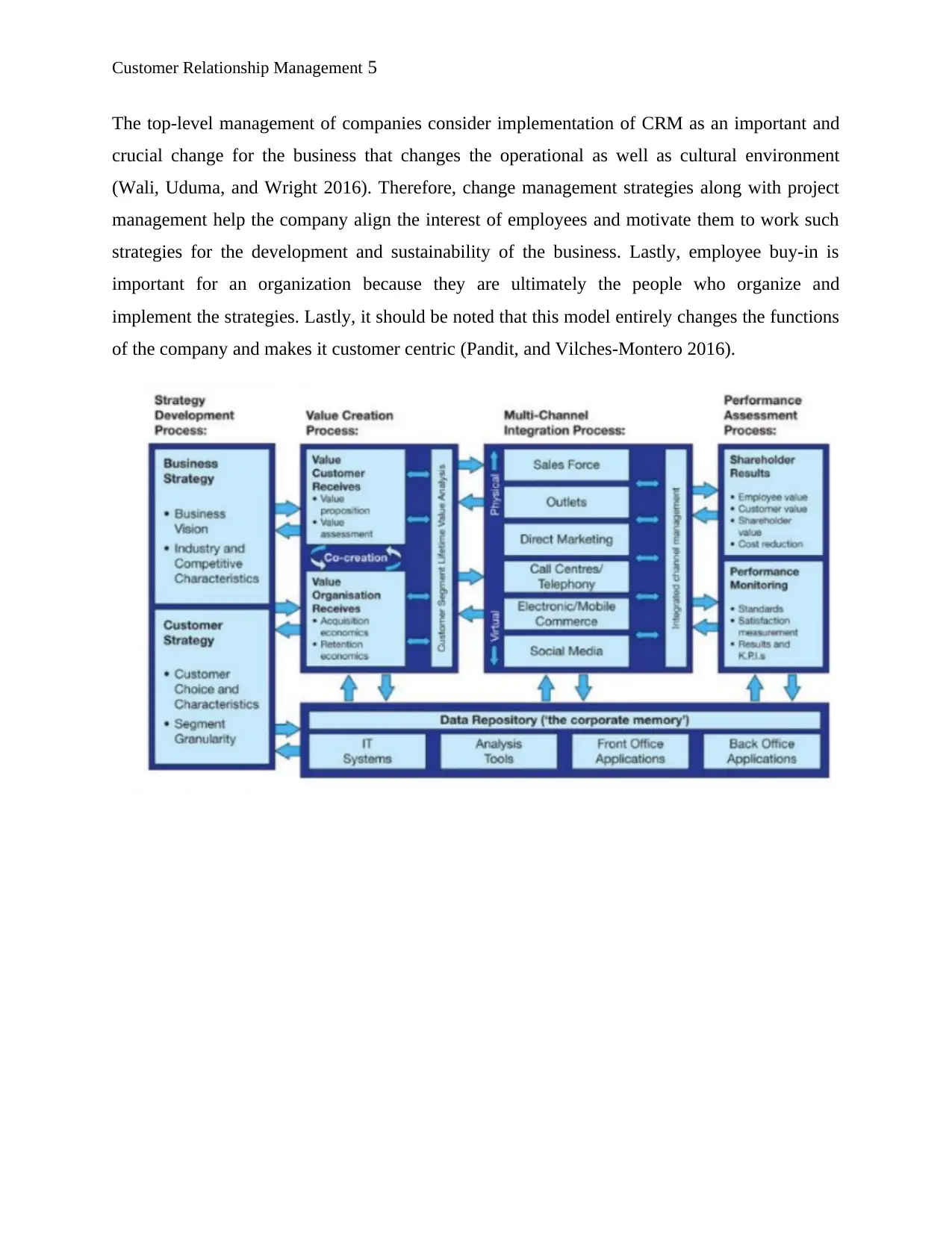
Payne & Frow’s Five-step Process Model: this model was developed by Adrian Payne
and Pennie Frow. This process of CRM focuses on the cross functional approach of
organizations to implement effective CRM. Two major components of this process are
cross-functional CRM processes and CRM implementation. While working on this
process, the company needs to conduct CRM readiness assessment to analyze the
preparation of the company to initiate new CRM process (Shaon, and Rahman 2015).
There are 5 segments in the model:
o Strategy Development
o Multichannel Integration
o Information Management
o Value Creation
o Performance Assessment
There are 4 key elements that are important for the successful application of CRM:
o CRM readiness
o CRM change management
o Employee management
o CRM project management
example, Apple provide Apple Care+ services to the customers for the protection
of their premium quality Apple products (Leligdon, Quinn, and Briggs 2015).
o Customize: this is the last phase where the companies implement services based
on customers in the market. Once interaction is initiated at the third stage, the
organization can start to understand what their customers expectation from the
brand is and this results in the business being able to customize it’s offering
depending on the type of customer (Shukla, and Pattnaik 2019). For example
Apple have different versions of their iPhone for different markets at different
price points to cater for different types (based on disposable income and
competition) of customers.
Payne & Frow’s Five-step Process Model: this model was developed by Adrian Payne
and Pennie Frow. This process of CRM focuses on the cross functional approach of
organizations to implement effective CRM. Two major components of this process are
cross-functional CRM processes and CRM implementation. While working on this
process, the company needs to conduct CRM readiness assessment to analyze the
preparation of the company to initiate new CRM process (Shaon, and Rahman 2015).
There are 5 segments in the model:
o Strategy Development
o Multichannel Integration
o Information Management
o Value Creation
o Performance Assessment
There are 4 key elements that are important for the successful application of CRM:
o CRM readiness
o CRM change management
o Employee management
o CRM project management
Customer Relationship Management 5
The top-level management of companies consider implementation of CRM as an important and
crucial change for the business that changes the operational as well as cultural environment
(Wali, Uduma, and Wright 2016). Therefore, change management strategies along with project
management help the company align the interest of employees and motivate them to work such
strategies for the development and sustainability of the business. Lastly, employee buy-in is
important for an organization because they are ultimately the people who organize and
implement the strategies. Lastly, it should be noted that this model entirely changes the functions
of the company and makes it customer centric (Pandit, and Vilches-Montero 2016).
The top-level management of companies consider implementation of CRM as an important and
crucial change for the business that changes the operational as well as cultural environment
(Wali, Uduma, and Wright 2016). Therefore, change management strategies along with project
management help the company align the interest of employees and motivate them to work such
strategies for the development and sustainability of the business. Lastly, employee buy-in is
important for an organization because they are ultimately the people who organize and
implement the strategies. Lastly, it should be noted that this model entirely changes the functions
of the company and makes it customer centric (Pandit, and Vilches-Montero 2016).
⊘ This is a preview!⊘
Do you want full access?
Subscribe today to unlock all pages.
Trusted by 1+ million students worldwide
Customer Relationship Management 6
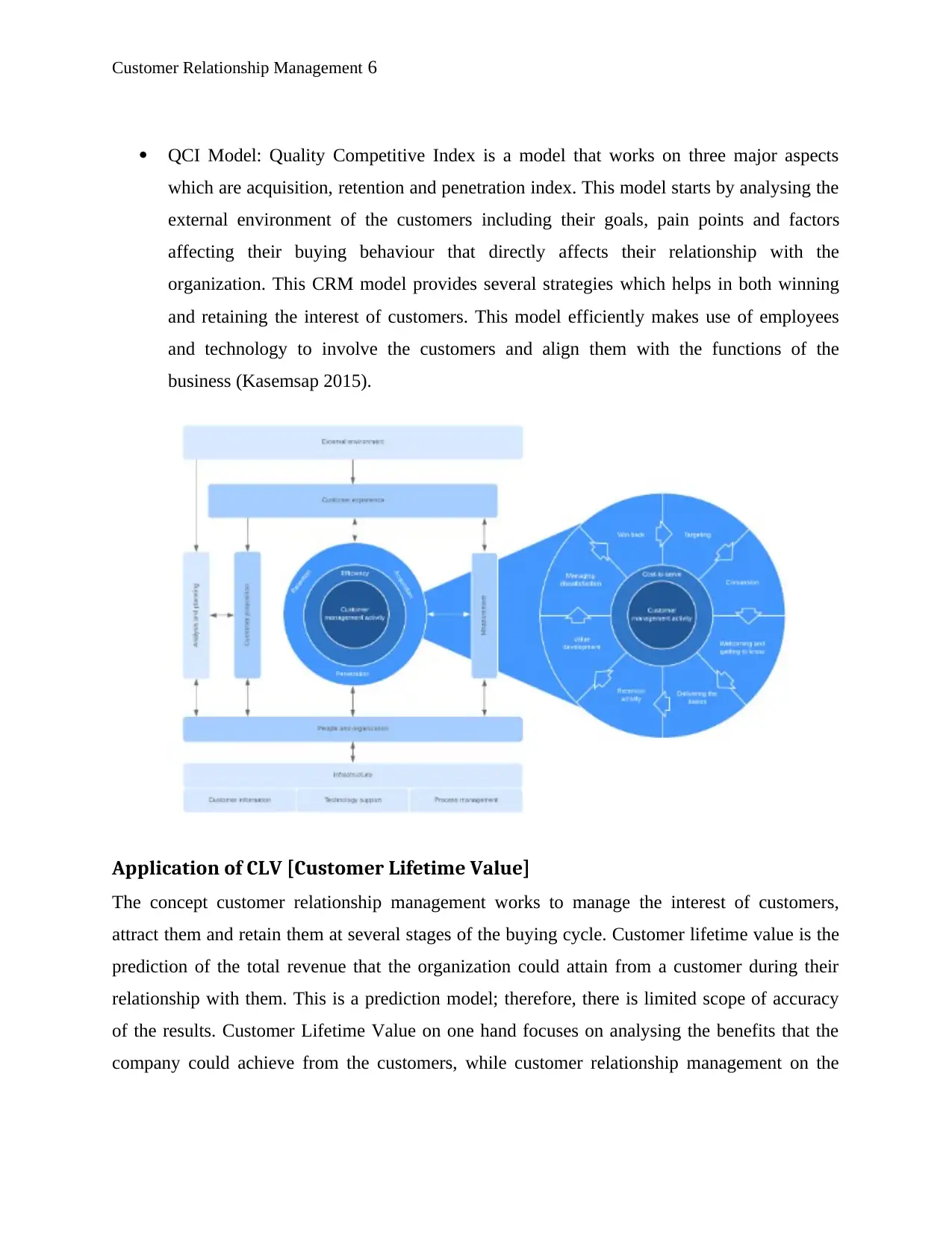
QCI Model: Quality Competitive Index is a model that works on three major aspects
which are acquisition, retention and penetration index. This model starts by analysing the
external environment of the customers including their goals, pain points and factors
affecting their buying behaviour that directly affects their relationship with the
organization. This CRM model provides several strategies which helps in both winning
and retaining the interest of customers. This model efficiently makes use of employees
and technology to involve the customers and align them with the functions of the
business (Kasemsap 2015).
Application of CLV [Customer Lifetime Value]
The concept customer relationship management works to manage the interest of customers,
attract them and retain them at several stages of the buying cycle. Customer lifetime value is the
prediction of the total revenue that the organization could attain from a customer during their
relationship with them. This is a prediction model; therefore, there is limited scope of accuracy
of the results. Customer Lifetime Value on one hand focuses on analysing the benefits that the
company could achieve from the customers, while customer relationship management on the
QCI Model: Quality Competitive Index is a model that works on three major aspects
which are acquisition, retention and penetration index. This model starts by analysing the
external environment of the customers including their goals, pain points and factors
affecting their buying behaviour that directly affects their relationship with the
organization. This CRM model provides several strategies which helps in both winning
and retaining the interest of customers. This model efficiently makes use of employees
and technology to involve the customers and align them with the functions of the
business (Kasemsap 2015).
Application of CLV [Customer Lifetime Value]
The concept customer relationship management works to manage the interest of customers,
attract them and retain them at several stages of the buying cycle. Customer lifetime value is the
prediction of the total revenue that the organization could attain from a customer during their
relationship with them. This is a prediction model; therefore, there is limited scope of accuracy
of the results. Customer Lifetime Value on one hand focuses on analysing the benefits that the
company could achieve from the customers, while customer relationship management on the
Paraphrase This Document
Need a fresh take? Get an instant paraphrase of this document with our AI Paraphraser
Customer Relationship Management 7
other hand works on maintaining adequate relationship with the customers so that the
organization could actually make the CLV accurate (Jain, and Patel 2016).
Customer relationship management helps the business in defining the appropriate course of
action for the marketing activities to aid the business in achieving CLV. CLV is a marketing
metric that allows the organization to measure the impact of organization’s CRM and tactics on
the employees (Das, Mishra, and Mohanty 2018). To put this into an example for Apple, the fact
that Apple’s products can ‘communicate’ with one another i.e. iPhone and iMac which can be
assumed was created to make customer experience very pleasant and enjoyable also means more
revenue and CLV from one customer. In addition by having a ‘family’ of Apple products the
chances of a customer replacing it with a competitor product is very small instead the customer
will upgrade and therefore the CLV will increase.
Understanding the application of CLV in acquiring and retaining the customer, it should be noted
that until an organization has and can maintain an effective CRM strategy, it is very hard for a
business to attain an accurate CLV. CRM is a plan that supports the business in understanding
the behaviour of the people and letting the employees work on the strategies accordingly.
Therefore, it can be said that CRM holds a close relationship with CLV because it derives
benefits to the organization from customers and CRM define strategies in such a way that the
company could attain the predicted CLV (Siriwardana, and Dissanayake 2018).
CRM Model used by Company
Apple is one of the most renowned organizations present in the innovation and technology
industry that works efficiently to provide premium quality products and services to its customers.
The company is one of the 4 largest technology companies in the world. Therefore, it is clear to
say that the organization makes use of best CRM practices in the industry because once a
customer purchases an Apple product, the company retains them to the maximum level to attain
CLV for the business (Bukhari, and Kazi 2016).
It can be said that Apple’s CRM is one of the best sources that help the organization to retain its
customers and provide them with adequate services as well. The company focuses on treating the
customers at an extremely high level so that they love and stick to the brand. Everything from the
other hand works on maintaining adequate relationship with the customers so that the
organization could actually make the CLV accurate (Jain, and Patel 2016).
Customer relationship management helps the business in defining the appropriate course of
action for the marketing activities to aid the business in achieving CLV. CLV is a marketing
metric that allows the organization to measure the impact of organization’s CRM and tactics on
the employees (Das, Mishra, and Mohanty 2018). To put this into an example for Apple, the fact
that Apple’s products can ‘communicate’ with one another i.e. iPhone and iMac which can be
assumed was created to make customer experience very pleasant and enjoyable also means more
revenue and CLV from one customer. In addition by having a ‘family’ of Apple products the
chances of a customer replacing it with a competitor product is very small instead the customer
will upgrade and therefore the CLV will increase.
Understanding the application of CLV in acquiring and retaining the customer, it should be noted
that until an organization has and can maintain an effective CRM strategy, it is very hard for a
business to attain an accurate CLV. CRM is a plan that supports the business in understanding
the behaviour of the people and letting the employees work on the strategies accordingly.
Therefore, it can be said that CRM holds a close relationship with CLV because it derives
benefits to the organization from customers and CRM define strategies in such a way that the
company could attain the predicted CLV (Siriwardana, and Dissanayake 2018).
CRM Model used by Company
Apple is one of the most renowned organizations present in the innovation and technology
industry that works efficiently to provide premium quality products and services to its customers.
The company is one of the 4 largest technology companies in the world. Therefore, it is clear to
say that the organization makes use of best CRM practices in the industry because once a
customer purchases an Apple product, the company retains them to the maximum level to attain
CLV for the business (Bukhari, and Kazi 2016).
It can be said that Apple’s CRM is one of the best sources that help the organization to retain its
customers and provide them with adequate services as well. The company focuses on treating the
customers at an extremely high level so that they love and stick to the brand. Everything from the
Customer Relationship Management 8
shops, to the packaging, creates excitement for customers and making themselves feel good for
having Apple products. The company provides an Apple ID to every customer who makes use of
their products and services. Thus, synchronization of the unique ID with the products helps them
to understand their behaviour and differential taste as well for every customer. Therefore, it
becomes convenient for the organization to exactly understand the preferences of the customers
and their impression about the products of Apple. Resulting in which, this data set helps the
organization to effortlessly target the audience and provide the relevant products and services via
various marketing channels (Buttle, and Stan 2015).
Another differentiating CRM strategy that was implemented by Apple was that they do not
concentrate on motivating the customers to purchase Apple products directly, but instead focus
on teaching their customers to appreciate and love the products so that that they share loyalty
towards the brand. It is the core CRM strategy of Apple; therefore, the customers do not change
their Apple products regularly but when they do, the company makes sure that they purchase a
newer version from Apple (Santouridis, and Veraki 2017).
Furthermore, to improve the satisfaction of customers, the organization works with tech support
to drive innovation that gives additional services to the clients. For example, the process of the
company allows customers to book and meet face to face with the technicians (in Apple
showrooms at the ‘Genius’ bar) of the company and solve their problems. The technicians also
assist the organization in showcasing additional features present in their products and services to
the users resulting in higher usage and increased customer satisfaction. The face to face
interaction also helps the business in building brand awareness and building genuine customer
relationships, especially in a technology ‘heavy’ environment.
CSR Strategies of Apple for Customer Engagement
The CRM strategies of Apple are efficient enough that helps the organization to ethically drive
data about the customers and then makes use of them in such a way that the company attains
CLV. Considering the relation of CRM strategies of Apple with its CSR strategies, it should be
noted that the company does not disrespect the privacy of customers while making use of
information for their marketing activities (Jaber, and Simkin 2017). It is an undeniable fact that
shops, to the packaging, creates excitement for customers and making themselves feel good for
having Apple products. The company provides an Apple ID to every customer who makes use of
their products and services. Thus, synchronization of the unique ID with the products helps them
to understand their behaviour and differential taste as well for every customer. Therefore, it
becomes convenient for the organization to exactly understand the preferences of the customers
and their impression about the products of Apple. Resulting in which, this data set helps the
organization to effortlessly target the audience and provide the relevant products and services via
various marketing channels (Buttle, and Stan 2015).
Another differentiating CRM strategy that was implemented by Apple was that they do not
concentrate on motivating the customers to purchase Apple products directly, but instead focus
on teaching their customers to appreciate and love the products so that that they share loyalty
towards the brand. It is the core CRM strategy of Apple; therefore, the customers do not change
their Apple products regularly but when they do, the company makes sure that they purchase a
newer version from Apple (Santouridis, and Veraki 2017).
Furthermore, to improve the satisfaction of customers, the organization works with tech support
to drive innovation that gives additional services to the clients. For example, the process of the
company allows customers to book and meet face to face with the technicians (in Apple
showrooms at the ‘Genius’ bar) of the company and solve their problems. The technicians also
assist the organization in showcasing additional features present in their products and services to
the users resulting in higher usage and increased customer satisfaction. The face to face
interaction also helps the business in building brand awareness and building genuine customer
relationships, especially in a technology ‘heavy’ environment.
CSR Strategies of Apple for Customer Engagement
The CRM strategies of Apple are efficient enough that helps the organization to ethically drive
data about the customers and then makes use of them in such a way that the company attains
CLV. Considering the relation of CRM strategies of Apple with its CSR strategies, it should be
noted that the company does not disrespect the privacy of customers while making use of
information for their marketing activities (Jaber, and Simkin 2017). It is an undeniable fact that
⊘ This is a preview!⊘
Do you want full access?
Subscribe today to unlock all pages.
Trusted by 1+ million students worldwide
Customer Relationship Management 9
the organization makes use of data presented to them about their customers and induce that in the
marketing strategies to provide a high degree of satisfaction and relevancy. However, Apple’s
CSR strategies explain that the intent of Apple to use customer data is positive and the
organization makes use of general information only that cannot affect the customers negatively.
The main objective of CSR strategies at Apple is to satisfy the investors, customers and other
stakeholders through their efficient and ethical services (Kumar 2015).
CSR activities of Apple involve managing high degree of risk, saving brand equity, managing
legal licensing, enhancing brand reputation, managing governmental regulations and effectively
making use of available resources presented within the company. The CSR activities of Apple
also works on maintaining strong relationship with the investors and partners so they can gain
trust in the various functions of the business (Yoon, and Sims 2016).
The company has developed as a unique brand along with innovation in such a way that they
protect the interest of stakeholders in the business functions. The company has adopted the triple
bottom line technique of CSR to assist the employees to perform right functions that increase the
satisfaction of stakeholders in the market (Zaby, and Wilde 2018). The employees are satisfied
by CSR activities of Apple because people are their top priority.
Analysis of Automation utilized by Company
Apple Inc. is one of the most tech-savvy companies in the world has introduced several
automation to satisfy their customers. The company introduced Mac CRM to manage customer
interaction of the organization and is designed for current as well as future customers of the
company who are working on desktop computers and iOS devices. This application is cloud-
based that is built by Apple’s programming language. This tool helps the organization to
organize, automate and harmonize sales through marketing, technical support and customer
services (Goldenberg 2015).
The role of this automation introduced by the company was to increase effectiveness in the
services and follow up strategies so that the customer’s satisfaction level rises. This is the most
authentic system that helps the organization to generate leads in the market by attracting
customers and using their information. The information gained through this application helps the
the organization makes use of data presented to them about their customers and induce that in the
marketing strategies to provide a high degree of satisfaction and relevancy. However, Apple’s
CSR strategies explain that the intent of Apple to use customer data is positive and the
organization makes use of general information only that cannot affect the customers negatively.
The main objective of CSR strategies at Apple is to satisfy the investors, customers and other
stakeholders through their efficient and ethical services (Kumar 2015).
CSR activities of Apple involve managing high degree of risk, saving brand equity, managing
legal licensing, enhancing brand reputation, managing governmental regulations and effectively
making use of available resources presented within the company. The CSR activities of Apple
also works on maintaining strong relationship with the investors and partners so they can gain
trust in the various functions of the business (Yoon, and Sims 2016).
The company has developed as a unique brand along with innovation in such a way that they
protect the interest of stakeholders in the business functions. The company has adopted the triple
bottom line technique of CSR to assist the employees to perform right functions that increase the
satisfaction of stakeholders in the market (Zaby, and Wilde 2018). The employees are satisfied
by CSR activities of Apple because people are their top priority.
Analysis of Automation utilized by Company
Apple Inc. is one of the most tech-savvy companies in the world has introduced several
automation to satisfy their customers. The company introduced Mac CRM to manage customer
interaction of the organization and is designed for current as well as future customers of the
company who are working on desktop computers and iOS devices. This application is cloud-
based that is built by Apple’s programming language. This tool helps the organization to
organize, automate and harmonize sales through marketing, technical support and customer
services (Goldenberg 2015).
The role of this automation introduced by the company was to increase effectiveness in the
services and follow up strategies so that the customer’s satisfaction level rises. This is the most
authentic system that helps the organization to generate leads in the market by attracting
customers and using their information. The information gained through this application helps the
Paraphrase This Document
Need a fresh take? Get an instant paraphrase of this document with our AI Paraphraser
Customer Relationship Management 10
organization to manage the customer portfolio in addition to providing a very customized and
unique service for its customers (Kumar, and Reinartz 2018).
Apple Inc. has also associated with Salesforce to optimize their CRM tool that would
successfully help other organizations in maintaining relationship with customers. The product of
this association would help companies to build their applications with the ease of Apple and
power of Salesforce. Although, Mac CRM is an expensive resource for Apple they must use it in
the business because it is one of the most important sources that help them to analyse the
functioning of their products and details about the customers along with their satisfaction level
(Alagoa 2016). Any action implemented by Apple extremely affects the economy at large
because the company is present in one of the most important industries that are information
technology and holds a share in GDP of the nation as well. The profitability of the nation
increases the flow of technology in the environment and upraise the economic conditions as well.
Advantages & Drawbacks of utilized Automation
Advantages
Availability of Data: this automation helps Apple Inc. to attain more enhanced information of the
customers along with prospective clients for the organization. This type of automation helps the
organization to attain information, synchronize them and segregate them accordingly for better
use of the company. The organization does not need to look for particular information about the
client as the cloud-based service easily organizes the data of the customers and present it to the
employees when required (Demo, and Guanabara 2015).
Improved CRM: it is evident that the use of automatic increases the efficiency of CRM activities
of the business. The CRM facilities of Apple increases which mean that the organization gets to
target the clients in a better way. Any organization could attain success by satisfying the
customers present in society. Thus, CRM techniques of Apple successfully help the organization
to offer valuable services to customers and then increase organizational profitability in long run
(Margiotta, and Crmpact Inc, 2018).
Disadvantages
organization to manage the customer portfolio in addition to providing a very customized and
unique service for its customers (Kumar, and Reinartz 2018).
Apple Inc. has also associated with Salesforce to optimize their CRM tool that would
successfully help other organizations in maintaining relationship with customers. The product of
this association would help companies to build their applications with the ease of Apple and
power of Salesforce. Although, Mac CRM is an expensive resource for Apple they must use it in
the business because it is one of the most important sources that help them to analyse the
functioning of their products and details about the customers along with their satisfaction level
(Alagoa 2016). Any action implemented by Apple extremely affects the economy at large
because the company is present in one of the most important industries that are information
technology and holds a share in GDP of the nation as well. The profitability of the nation
increases the flow of technology in the environment and upraise the economic conditions as well.
Advantages & Drawbacks of utilized Automation
Advantages
Availability of Data: this automation helps Apple Inc. to attain more enhanced information of the
customers along with prospective clients for the organization. This type of automation helps the
organization to attain information, synchronize them and segregate them accordingly for better
use of the company. The organization does not need to look for particular information about the
client as the cloud-based service easily organizes the data of the customers and present it to the
employees when required (Demo, and Guanabara 2015).
Improved CRM: it is evident that the use of automatic increases the efficiency of CRM activities
of the business. The CRM facilities of Apple increases which mean that the organization gets to
target the clients in a better way. Any organization could attain success by satisfying the
customers present in society. Thus, CRM techniques of Apple successfully help the organization
to offer valuable services to customers and then increase organizational profitability in long run
(Margiotta, and Crmpact Inc, 2018).
Disadvantages
Customer Relationship Management 11
Costing: one of the biggest disadvantages of this automation introduced by Apple is high degree
of cost that increases regular expenditure of the organization. Mac CRM is a software that helps
the organization attain details about the customers or prospective clients. This software was
formed by different composition and efficient technology. This resource of the business is
valuable, rare and non-imitable by competitors; therefore, it is an expensive resource for the
organization. The company needs to make effective use of this tool to overcome the expense
incurred for optimizing this tool (Hua 2019).
Lack of Understanding by Employees: not every employee in the organization gains the
proficiency to use high technology-induced tools present at the workplace. Resulting in which,
the inefficiency of the employees to make proper use of the given tools makes it difficult for the
organization to achieve desired objectives. If the organization starts providing training to the
employees, then the organization would be able to make better use of resources and automation
presented in the environment (Macnish, and Inguanzo 2019).
Recommended CRM Programme
As mentioned above that the company Apple has formed a CRM format for the business,
therefore, the organization should keep on using same platform. However, below mentioned are
few recommendations provided to the company that they should use to attract the customers in
better ways:
Social CRM: the company should introduce the practices of social CRM. Social CRM is
related to CSR practices implemented for the benefits of customers. Social CRM refers to
the modern way of reaching out to customers through social media platforms. This
technique would help Apple Inc. to be present at the platforms where target customers are
already present as engagement is high on such platforms. On such social media
platforms, the company should start circulating information about the CSR practices
implemented by Apple. This type of CRM would also let the customer approach towards
the company in the real-world environment.
Strengthen the relationship with suppliers: the company should also focus on
strengthening their bond with the suppliers of the business. Suppliers form a part of
stakeholders of the organization; therefore, Apple needs to form strong ties with the
Costing: one of the biggest disadvantages of this automation introduced by Apple is high degree
of cost that increases regular expenditure of the organization. Mac CRM is a software that helps
the organization attain details about the customers or prospective clients. This software was
formed by different composition and efficient technology. This resource of the business is
valuable, rare and non-imitable by competitors; therefore, it is an expensive resource for the
organization. The company needs to make effective use of this tool to overcome the expense
incurred for optimizing this tool (Hua 2019).
Lack of Understanding by Employees: not every employee in the organization gains the
proficiency to use high technology-induced tools present at the workplace. Resulting in which,
the inefficiency of the employees to make proper use of the given tools makes it difficult for the
organization to achieve desired objectives. If the organization starts providing training to the
employees, then the organization would be able to make better use of resources and automation
presented in the environment (Macnish, and Inguanzo 2019).
Recommended CRM Programme
As mentioned above that the company Apple has formed a CRM format for the business,
therefore, the organization should keep on using same platform. However, below mentioned are
few recommendations provided to the company that they should use to attract the customers in
better ways:
Social CRM: the company should introduce the practices of social CRM. Social CRM is
related to CSR practices implemented for the benefits of customers. Social CRM refers to
the modern way of reaching out to customers through social media platforms. This
technique would help Apple Inc. to be present at the platforms where target customers are
already present as engagement is high on such platforms. On such social media
platforms, the company should start circulating information about the CSR practices
implemented by Apple. This type of CRM would also let the customer approach towards
the company in the real-world environment.
Strengthen the relationship with suppliers: the company should also focus on
strengthening their bond with the suppliers of the business. Suppliers form a part of
stakeholders of the organization; therefore, Apple needs to form strong ties with the
⊘ This is a preview!⊘
Do you want full access?
Subscribe today to unlock all pages.
Trusted by 1+ million students worldwide

1 out of 16


Related Documents


Your All-in-One AI-Powered Toolkit for Academic Success.
+13062052269
info@desklib.com
Available 24*7 on WhatsApp / Email
![[object Object]](/_next/static/media/star-bottom.7253800d.svg)
Unlock your academic potential
Copyright © 2020–2026 A2Z Services. All Rights Reserved. Developed and managed by ZUCOL.