Report on Customer Satisfaction Research: Objectives, Validation
VerifiedAdded on 2021/06/18
|7
|2981
|68
Report
AI Summary
This report provides a comprehensive overview of customer satisfaction research, emphasizing its critical role in assessing business performance. It explores the objectives of such research, including assessing customer satisfaction levels and identifying areas for improvement. The report delves into two key methodologies: Importance-Performance Analysis and Gap Analysis (Servqual), detailing how they can be used to evaluate service quality and manage customer expectations. It examines the knowledge, policy, delivery, and communication gaps that can arise, offering solutions such as market research, employee training, and realistic advertising. The report also highlights considerations for data collection, including bias and validation, and discusses limitations of gap analysis, such as its static nature and the need to consider market trends and competitor analysis. The report stresses the importance of continuous improvement and adaptation in the dynamic business environment.

NAME :
STUDENT ID :
STUDENT ID :

Paraphrase This Document
Need a fresh take? Get an instant paraphrase of this document with our AI Paraphraser
Introduction:
Customer satisfaction research is one of the most integral parts of assessing how well a business is
running, be it a very large corporation or your local flower shop. Surely in this age of data we can
predict quite a lot about the consumers based on buying patterns and such. However these are not
comprehensive and often fail to take into account the human element of doing business. After all,
the customer is always right! With that there is also the very tangible advantage of having better
customer retention if the data can be channelled and processed properly, With that it also helps to
foster loyalty among the customers and employees and also to lower turnover.
In this report we would be taking a structured look into what could be the objectives of taking on
such a research and the business validation of it. We would also be looking into the shortcomings of
this method and what the imagers should always be cautious about when taking such a survey into
consideration.
Objectives of the research :
The main objective of the research is to correctly assess the level of satisfaction of the customers of
the business and to take remediation wherever there exists a mismatch between the expected and the
actual. Also, to recognise where the approach we are taking might be failing and to be on the
lookout for that. Two of the many ways this can be addressed is :
1. Importance- Performance Analysis in which we is a two-dimensional grid based on customer
perceived importance of service attributes and attribute performance. Depending on the
interplay of these two dimensions, strategies can be derived ( Lin, 2012). Thus we can mention
that Importance Performance Information is a very useful tool for customer satisfaction
evaluation (Geng & Chu, 2012).
2. Gap Analysis approach: Servqual is a way of assessing service quality and managing customer
expectation. Gap analysis is a part of this approach which deals with why customers get
products of lower quality than what is expected. Customer satisfaction is one of the most ideal
ways to use this tool as it also includes service quality and other aspects related to customer
satisfaction with physical products and extended/expanded products (in the marketing sense).
Within this approach we will specifically be looking into the various gaps that occurs. Precisely
the knowledge gap, the policy gap, the delivery gap and the communication gap. More
information on these are provided in the following section(El-Adly, 2012).
Information required to fulfil the research:
The knowledge gap pertains to the difference in what the consumer is expecting and how the
management of the businesses perceives this i.e. their knowledge of this gap is not complete. This
results in there being a gap between the service provided and what kind of service the customer is
expecting. The existence of this means that the companies are not looking to meet the correct needs.
This means that the allocation of resources is not efficient as these resources could have been better
used elsewhere. In retail and most other customer facing businesses it is extremely important to
minimise this gap. One of the best ways to solve this is by doing extensive market research
including customer satisfaction surveys (Matzler, Sauerwein & Heischmidt, 2003).
We would be looking to find what it is specifically that the person likes in this store and what he or
she did not. It would also be wise to make a note of what kind of alternative things they were
expecting in the points they did not like about the store and the products. With this, a manager may
be better able to reassess his or her decision of the various aspects of the store. Another thing that
would be a big help would be to is to find what it is driving the customers to shop at this store tinted
Customer satisfaction research is one of the most integral parts of assessing how well a business is
running, be it a very large corporation or your local flower shop. Surely in this age of data we can
predict quite a lot about the consumers based on buying patterns and such. However these are not
comprehensive and often fail to take into account the human element of doing business. After all,
the customer is always right! With that there is also the very tangible advantage of having better
customer retention if the data can be channelled and processed properly, With that it also helps to
foster loyalty among the customers and employees and also to lower turnover.
In this report we would be taking a structured look into what could be the objectives of taking on
such a research and the business validation of it. We would also be looking into the shortcomings of
this method and what the imagers should always be cautious about when taking such a survey into
consideration.
Objectives of the research :
The main objective of the research is to correctly assess the level of satisfaction of the customers of
the business and to take remediation wherever there exists a mismatch between the expected and the
actual. Also, to recognise where the approach we are taking might be failing and to be on the
lookout for that. Two of the many ways this can be addressed is :
1. Importance- Performance Analysis in which we is a two-dimensional grid based on customer
perceived importance of service attributes and attribute performance. Depending on the
interplay of these two dimensions, strategies can be derived ( Lin, 2012). Thus we can mention
that Importance Performance Information is a very useful tool for customer satisfaction
evaluation (Geng & Chu, 2012).
2. Gap Analysis approach: Servqual is a way of assessing service quality and managing customer
expectation. Gap analysis is a part of this approach which deals with why customers get
products of lower quality than what is expected. Customer satisfaction is one of the most ideal
ways to use this tool as it also includes service quality and other aspects related to customer
satisfaction with physical products and extended/expanded products (in the marketing sense).
Within this approach we will specifically be looking into the various gaps that occurs. Precisely
the knowledge gap, the policy gap, the delivery gap and the communication gap. More
information on these are provided in the following section(El-Adly, 2012).
Information required to fulfil the research:
The knowledge gap pertains to the difference in what the consumer is expecting and how the
management of the businesses perceives this i.e. their knowledge of this gap is not complete. This
results in there being a gap between the service provided and what kind of service the customer is
expecting. The existence of this means that the companies are not looking to meet the correct needs.
This means that the allocation of resources is not efficient as these resources could have been better
used elsewhere. In retail and most other customer facing businesses it is extremely important to
minimise this gap. One of the best ways to solve this is by doing extensive market research
including customer satisfaction surveys (Matzler, Sauerwein & Heischmidt, 2003).
We would be looking to find what it is specifically that the person likes in this store and what he or
she did not. It would also be wise to make a note of what kind of alternative things they were
expecting in the points they did not like about the store and the products. With this, a manager may
be better able to reassess his or her decision of the various aspects of the store. Another thing that
would be a big help would be to is to find what it is driving the customers to shop at this store tinted
of the competitors. The management may be better focus on these so as to be able to retain the
customers. Distinguishing between one time customers and loyal customers is also extremely
important and should have different kind of policies directed at both.
The policy gap refers to when there is a conflict between the rules and regulations for the
employees as directed by the management and the service policy. Even though the areas in which
customers expect them to improve is clear to these people it is not very easy for the management of
these companies to translate them into rules all the employees can easily follow. This again leads to
poorly designed service systems. Also there is the added issue of them not being able to maintain
and also update their provision for customer service. This also leads to a lack of standardisation
across the store, in that someone might be able to better role out the expected service but another
employee might not. This often leads the customer to seek the similar service with a competitor
with better service delivery. This is again directly related to the gap that is created due to different
perceptions of the delivery of the product.
Gap in delivery is one which relates to the gap which is born out of what the mandated standard of
service delivery is and what is actually being carried out in these stores. This often occurs when the
employees are not trained to the market standard even though they do have good procedures and
processes in place and the there is no monitoring to see if they are maintains the required standard
for service delivery. This is also born when the employees do not have sufficient knowledge about
the product and are not able to help the customers as and when needed regarding this and are not
able to properly clear up the queries of the customers. This is also often the result of poor human
resource teams which do not take the pains to make sure that all the employees doing the service
delivery are up to standard. Teams also have an impact in that there should be intra and inter team
clarity about the work. For the customer satisfaction questions should be asked about he service of
the employees and if they have met the standards the customer expects them to. The customer can
grade what it is and how much it is that he or she liked about the various aspects of the service
delivery it is in these stores and the management can the see if this matches what they were going
for originally. If there exists a huge gap it might be useful to get the employees up to speed in the
areas they are lacking in with trainings and targeted programs.
The last one is the communications gap which exists when the company is not able to meet with the
expectations set up by advertisements and other forms of media in the minds of the customers. In
order to entice customer these advertisements often promise over and above what would be actually
be able to be provided so customers often walk in to be disappointed. Thus might just drive them to
seek products where the product actually being advertised is close to the item in the stores. In a
customer satisfaction survey it is possible to collect data regarding where the customer would have
heard about the store and also about certain products if the store is such that it sells only a variety of
products. If the customer had heard about this from advertisements run in the media and
communication it might do well to further drill down so as to find out if the customers expectation
of the product that was set from the advertisement has matched with what was found in the stores.
If not then this information is to be collated and escalated to the relevant people so that the
advertisements of the product or the store are more realistic so a stop keep customer
confidence(Kaur, Sharma & Kapoor, 2012).
Considerations in the research process:
When collecting the data the manager should keep in mind the pitfalls that come in with any kind of
data collection. That is the information furnished might not be correct and is subject to bias from the
customers. Distinguishing between one time customers and loyal customers is also extremely
important and should have different kind of policies directed at both.
The policy gap refers to when there is a conflict between the rules and regulations for the
employees as directed by the management and the service policy. Even though the areas in which
customers expect them to improve is clear to these people it is not very easy for the management of
these companies to translate them into rules all the employees can easily follow. This again leads to
poorly designed service systems. Also there is the added issue of them not being able to maintain
and also update their provision for customer service. This also leads to a lack of standardisation
across the store, in that someone might be able to better role out the expected service but another
employee might not. This often leads the customer to seek the similar service with a competitor
with better service delivery. This is again directly related to the gap that is created due to different
perceptions of the delivery of the product.
Gap in delivery is one which relates to the gap which is born out of what the mandated standard of
service delivery is and what is actually being carried out in these stores. This often occurs when the
employees are not trained to the market standard even though they do have good procedures and
processes in place and the there is no monitoring to see if they are maintains the required standard
for service delivery. This is also born when the employees do not have sufficient knowledge about
the product and are not able to help the customers as and when needed regarding this and are not
able to properly clear up the queries of the customers. This is also often the result of poor human
resource teams which do not take the pains to make sure that all the employees doing the service
delivery are up to standard. Teams also have an impact in that there should be intra and inter team
clarity about the work. For the customer satisfaction questions should be asked about he service of
the employees and if they have met the standards the customer expects them to. The customer can
grade what it is and how much it is that he or she liked about the various aspects of the service
delivery it is in these stores and the management can the see if this matches what they were going
for originally. If there exists a huge gap it might be useful to get the employees up to speed in the
areas they are lacking in with trainings and targeted programs.
The last one is the communications gap which exists when the company is not able to meet with the
expectations set up by advertisements and other forms of media in the minds of the customers. In
order to entice customer these advertisements often promise over and above what would be actually
be able to be provided so customers often walk in to be disappointed. Thus might just drive them to
seek products where the product actually being advertised is close to the item in the stores. In a
customer satisfaction survey it is possible to collect data regarding where the customer would have
heard about the store and also about certain products if the store is such that it sells only a variety of
products. If the customer had heard about this from advertisements run in the media and
communication it might do well to further drill down so as to find out if the customers expectation
of the product that was set from the advertisement has matched with what was found in the stores.
If not then this information is to be collated and escalated to the relevant people so that the
advertisements of the product or the store are more realistic so a stop keep customer
confidence(Kaur, Sharma & Kapoor, 2012).
Considerations in the research process:
When collecting the data the manager should keep in mind the pitfalls that come in with any kind of
data collection. That is the information furnished might not be correct and is subject to bias from the
⊘ This is a preview!⊘
Do you want full access?
Subscribe today to unlock all pages.

Trusted by 1+ million students worldwide
individual. It might be subject to individual bias as well as specification bias. Also steps should be
taken to validate the answers furnished by the individuals by providing checkpoints at certain
intervals.
As has been highlighted uphill now gap analysis is a very useful method to structure more useful
customer satisfaction surveys and be able to better read data from there and use it for tactical
purposes (Davis, Misra & van Auken, 2002). It is an extremely good way to look into the untapped
potential of a business and use resources specially in the service delivery section optimally. This
model is however static, in that it focuses on the performance of the business at a single point of
time but does not consider how the business might be evolving in conjecture with the current
market needs. It only took at the profit that might be generated by better customer service intros
case but does not take into account how the company or the customer service industry might change
as whole due to market trends. We would be taking further look into some of the limitations of this
type of analysis when we are looking into making decisions based of this approach or adopting
certain policies.
1. The gap analysis as previously mentioned helps tap into what could be the business with the best
resource allocation in the most efficient way. It tells you what are the drawbacks but does not
provide any information on how to work towards not having these drawbacks anymore. Hence they
help in defining what potential the business has but does not provide a framework of how the
business should actually grow (McMullen, 2018). So this type of analysis is taken as to be only the
introductory step when defining what the problem with a business could be. There is always need
for further research so as to pinpoint the path the business needs to take in order to actually grow
better to what the gap analysis approach says it can. Questions about what kind of investments it
would take, in precisely which sectors to reach the potential the company has and to make it at par
with expectations, will there need to be dedicated teams for further research and development, how
to better the customer service so as to remain at par with the market or to reach above the average
do not find easy answers in the research conducted to carry on this approach and are things the
manager taking the decision should ahem to ask on his own.
2. Though the ideal is that every business sis unique such that it faces no completion in the goods
that it sells we very well know that in the real world this is a myth. Though possible for more
quirkier item, things such a retail stores, clothing and accessories stores have to compete with one
another for customers and often in the same location since mustily of such stores are found with the
confines of malls and shopping complexes. For such businesses there always comes a question of
competitors who might have been able to perform market capture if they are aware f new things
which might potentially help the business when the the store under consideration is not. Though
some idea can be gauged from customer service surveys a full idea is not possible and a manager
should always try to stay on top of the market in terms of potential innovation and always keep in
mind that there are multiple competitors to compete with.
3. Another important one to always remember is the technological aspect of it. It is very much
possible that the business is making technological advances that are known to the company itself
but are not known to the public hence they offer it up as a solution and this is highlighted as a gap.
Care should be taken to not take such things into consideration. Another side effect is that
customers might want things the technology to provide for which is still not advanced enough.
Another case might be that such advances is dependant on the advances of external technologies as
taken to validate the answers furnished by the individuals by providing checkpoints at certain
intervals.
As has been highlighted uphill now gap analysis is a very useful method to structure more useful
customer satisfaction surveys and be able to better read data from there and use it for tactical
purposes (Davis, Misra & van Auken, 2002). It is an extremely good way to look into the untapped
potential of a business and use resources specially in the service delivery section optimally. This
model is however static, in that it focuses on the performance of the business at a single point of
time but does not consider how the business might be evolving in conjecture with the current
market needs. It only took at the profit that might be generated by better customer service intros
case but does not take into account how the company or the customer service industry might change
as whole due to market trends. We would be taking further look into some of the limitations of this
type of analysis when we are looking into making decisions based of this approach or adopting
certain policies.
1. The gap analysis as previously mentioned helps tap into what could be the business with the best
resource allocation in the most efficient way. It tells you what are the drawbacks but does not
provide any information on how to work towards not having these drawbacks anymore. Hence they
help in defining what potential the business has but does not provide a framework of how the
business should actually grow (McMullen, 2018). So this type of analysis is taken as to be only the
introductory step when defining what the problem with a business could be. There is always need
for further research so as to pinpoint the path the business needs to take in order to actually grow
better to what the gap analysis approach says it can. Questions about what kind of investments it
would take, in precisely which sectors to reach the potential the company has and to make it at par
with expectations, will there need to be dedicated teams for further research and development, how
to better the customer service so as to remain at par with the market or to reach above the average
do not find easy answers in the research conducted to carry on this approach and are things the
manager taking the decision should ahem to ask on his own.
2. Though the ideal is that every business sis unique such that it faces no completion in the goods
that it sells we very well know that in the real world this is a myth. Though possible for more
quirkier item, things such a retail stores, clothing and accessories stores have to compete with one
another for customers and often in the same location since mustily of such stores are found with the
confines of malls and shopping complexes. For such businesses there always comes a question of
competitors who might have been able to perform market capture if they are aware f new things
which might potentially help the business when the the store under consideration is not. Though
some idea can be gauged from customer service surveys a full idea is not possible and a manager
should always try to stay on top of the market in terms of potential innovation and always keep in
mind that there are multiple competitors to compete with.
3. Another important one to always remember is the technological aspect of it. It is very much
possible that the business is making technological advances that are known to the company itself
but are not known to the public hence they offer it up as a solution and this is highlighted as a gap.
Care should be taken to not take such things into consideration. Another side effect is that
customers might want things the technology to provide for which is still not advanced enough.
Another case might be that such advances is dependant on the advances of external technologies as
Paraphrase This Document
Need a fresh take? Get an instant paraphrase of this document with our AI Paraphraser
well. The manager is to take this into account and manage customer expectations and his own
policies accordingly. None of this information is provided by the gap analysis approach.
4. There might be data rivals laws and other such restriction from the government regarding what
information can be freely collected from the public. This brings into account the expensive and
extensive work of data storage and data warehousing base don the rues and regulations set by the
government. This is a cost specific angle and takes away from profits. Thus surveys are actually a
very costly business and must be made so that they can very well target the main causes of the
concerns of the business. Gap analysis also might point out that the gap would be met if the
company expanded but that might not be within the rights and might be an anti-trust practice.
5. Using specific numbers, or benchmarking, performance of products using quantifiable data is an
excellent way to perform a gap analysis, but numbers can sometimes be deceiving. Businesses often
go through cyclical changes due to external factors like the time of year, disposable income of
consumers around the holidays, or ever changing fashion trends. It is important to use a series of
numbers or average numbers when performing a gap analysis. The gap may be unusually large if
the growth potential of a business is judged against a predictable slow season (Ledford, 2018).
Conclusion :
Gap analysis is a part of this approach which deals with why customers get products of lower
quality than what is expected (Moon, 1996). To assess the satisfaction of customers is one of the
most useful ways of using this tool. It provides a clear insight into what are the various kinds of
gaps that might be existing within the company and specially in the terms of service delivery
(Yeung, Cheng & Chan, 2004). It helps to visualise what the business would look like in its full
potential and helps identify the shortcomings. However , this tool does not provide the way to get to
that utopia, just on hat are the things manager can focus on while going there. To conclude gap
analysis specially in the context of customer satisfaction is a very good decision making tool as long
as one is aware of its shortcomings.
policies accordingly. None of this information is provided by the gap analysis approach.
4. There might be data rivals laws and other such restriction from the government regarding what
information can be freely collected from the public. This brings into account the expensive and
extensive work of data storage and data warehousing base don the rues and regulations set by the
government. This is a cost specific angle and takes away from profits. Thus surveys are actually a
very costly business and must be made so that they can very well target the main causes of the
concerns of the business. Gap analysis also might point out that the gap would be met if the
company expanded but that might not be within the rights and might be an anti-trust practice.
5. Using specific numbers, or benchmarking, performance of products using quantifiable data is an
excellent way to perform a gap analysis, but numbers can sometimes be deceiving. Businesses often
go through cyclical changes due to external factors like the time of year, disposable income of
consumers around the holidays, or ever changing fashion trends. It is important to use a series of
numbers or average numbers when performing a gap analysis. The gap may be unusually large if
the growth potential of a business is judged against a predictable slow season (Ledford, 2018).
Conclusion :
Gap analysis is a part of this approach which deals with why customers get products of lower
quality than what is expected (Moon, 1996). To assess the satisfaction of customers is one of the
most useful ways of using this tool. It provides a clear insight into what are the various kinds of
gaps that might be existing within the company and specially in the terms of service delivery
(Yeung, Cheng & Chan, 2004). It helps to visualise what the business would look like in its full
potential and helps identify the shortcomings. However , this tool does not provide the way to get to
that utopia, just on hat are the things manager can focus on while going there. To conclude gap
analysis specially in the context of customer satisfaction is a very good decision making tool as long
as one is aware of its shortcomings.
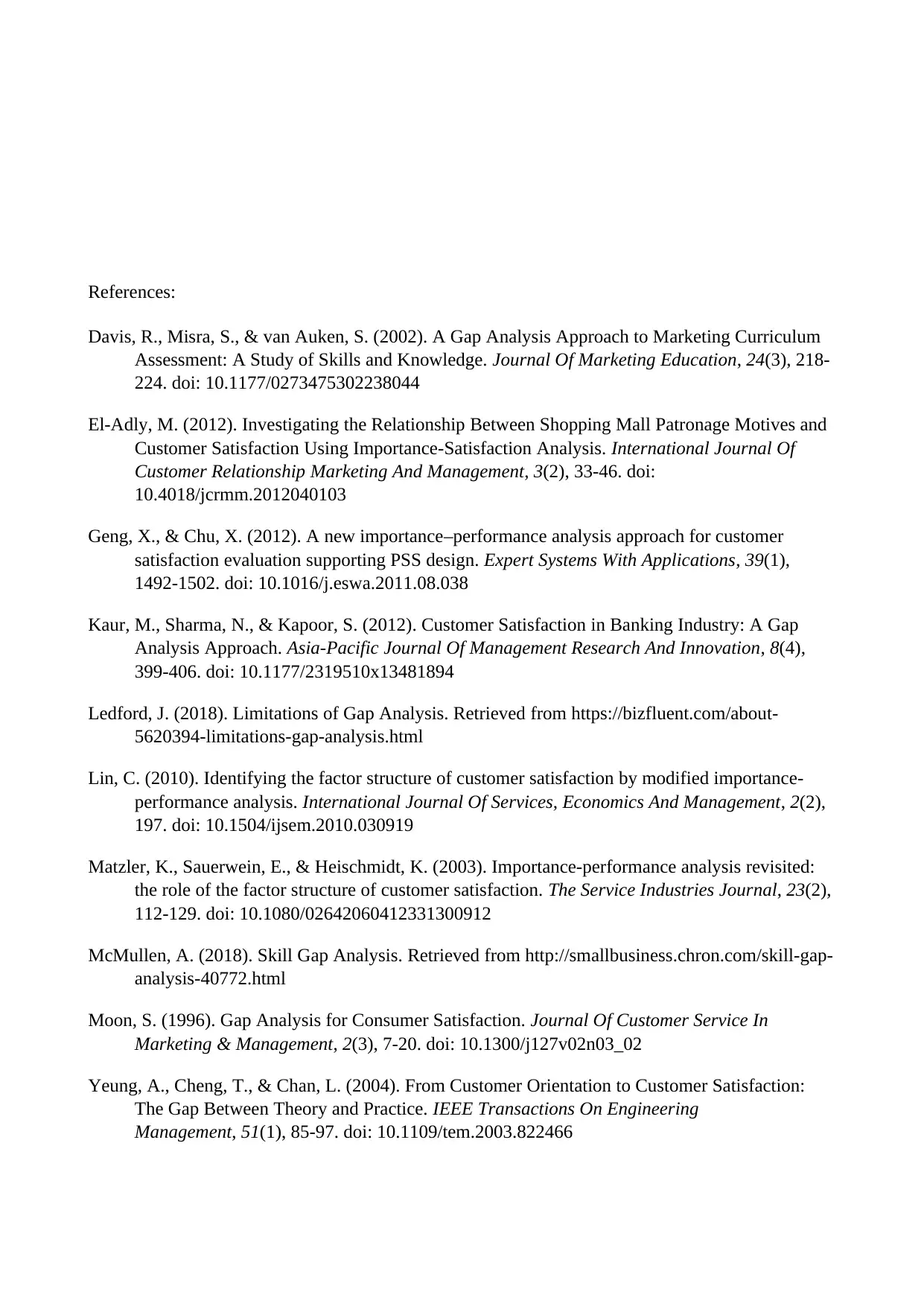
References:
Davis, R., Misra, S., & van Auken, S. (2002). A Gap Analysis Approach to Marketing Curriculum
Assessment: A Study of Skills and Knowledge. Journal Of Marketing Education, 24(3), 218-
224. doi: 10.1177/0273475302238044
El-Adly, M. (2012). Investigating the Relationship Between Shopping Mall Patronage Motives and
Customer Satisfaction Using Importance-Satisfaction Analysis. International Journal Of
Customer Relationship Marketing And Management, 3(2), 33-46. doi:
10.4018/jcrmm.2012040103
Geng, X., & Chu, X. (2012). A new importance–performance analysis approach for customer
satisfaction evaluation supporting PSS design. Expert Systems With Applications, 39(1),
1492-1502. doi: 10.1016/j.eswa.2011.08.038
Kaur, M., Sharma, N., & Kapoor, S. (2012). Customer Satisfaction in Banking Industry: A Gap
Analysis Approach. Asia-Pacific Journal Of Management Research And Innovation, 8(4),
399-406. doi: 10.1177/2319510x13481894
Ledford, J. (2018). Limitations of Gap Analysis. Retrieved from https://bizfluent.com/about-
5620394-limitations-gap-analysis.html
Lin, C. (2010). Identifying the factor structure of customer satisfaction by modified importance-
performance analysis. International Journal Of Services, Economics And Management, 2(2),
197. doi: 10.1504/ijsem.2010.030919
Matzler, K., Sauerwein, E., & Heischmidt, K. (2003). Importance-performance analysis revisited:
the role of the factor structure of customer satisfaction. The Service Industries Journal, 23(2),
112-129. doi: 10.1080/02642060412331300912
McMullen, A. (2018). Skill Gap Analysis. Retrieved from http://smallbusiness.chron.com/skill-gap-
analysis-40772.html
Moon, S. (1996). Gap Analysis for Consumer Satisfaction. Journal Of Customer Service In
Marketing & Management, 2(3), 7-20. doi: 10.1300/j127v02n03_02
Yeung, A., Cheng, T., & Chan, L. (2004). From Customer Orientation to Customer Satisfaction:
The Gap Between Theory and Practice. IEEE Transactions On Engineering
Management, 51(1), 85-97. doi: 10.1109/tem.2003.822466
Davis, R., Misra, S., & van Auken, S. (2002). A Gap Analysis Approach to Marketing Curriculum
Assessment: A Study of Skills and Knowledge. Journal Of Marketing Education, 24(3), 218-
224. doi: 10.1177/0273475302238044
El-Adly, M. (2012). Investigating the Relationship Between Shopping Mall Patronage Motives and
Customer Satisfaction Using Importance-Satisfaction Analysis. International Journal Of
Customer Relationship Marketing And Management, 3(2), 33-46. doi:
10.4018/jcrmm.2012040103
Geng, X., & Chu, X. (2012). A new importance–performance analysis approach for customer
satisfaction evaluation supporting PSS design. Expert Systems With Applications, 39(1),
1492-1502. doi: 10.1016/j.eswa.2011.08.038
Kaur, M., Sharma, N., & Kapoor, S. (2012). Customer Satisfaction in Banking Industry: A Gap
Analysis Approach. Asia-Pacific Journal Of Management Research And Innovation, 8(4),
399-406. doi: 10.1177/2319510x13481894
Ledford, J. (2018). Limitations of Gap Analysis. Retrieved from https://bizfluent.com/about-
5620394-limitations-gap-analysis.html
Lin, C. (2010). Identifying the factor structure of customer satisfaction by modified importance-
performance analysis. International Journal Of Services, Economics And Management, 2(2),
197. doi: 10.1504/ijsem.2010.030919
Matzler, K., Sauerwein, E., & Heischmidt, K. (2003). Importance-performance analysis revisited:
the role of the factor structure of customer satisfaction. The Service Industries Journal, 23(2),
112-129. doi: 10.1080/02642060412331300912
McMullen, A. (2018). Skill Gap Analysis. Retrieved from http://smallbusiness.chron.com/skill-gap-
analysis-40772.html
Moon, S. (1996). Gap Analysis for Consumer Satisfaction. Journal Of Customer Service In
Marketing & Management, 2(3), 7-20. doi: 10.1300/j127v02n03_02
Yeung, A., Cheng, T., & Chan, L. (2004). From Customer Orientation to Customer Satisfaction:
The Gap Between Theory and Practice. IEEE Transactions On Engineering
Management, 51(1), 85-97. doi: 10.1109/tem.2003.822466
⊘ This is a preview!⊘
Do you want full access?
Subscribe today to unlock all pages.
Trusted by 1+ million students worldwide


1 out of 7


Related Documents


Your All-in-One AI-Powered Toolkit for Academic Success.
+13062052269
info@desklib.com
Available 24*7 on WhatsApp / Email
![[object Object]](/_next/static/media/star-bottom.7253800d.svg)
Unlock your academic potential
Copyright © 2020–2026 A2Z Services. All Rights Reserved. Developed and managed by ZUCOL.