Business Research Method Report: Customer Satisfaction Analysis

Verified

Added on  2020/02/23

|6
|1330
|82
Report
AI Summary
This report delves into the realm of business research, with a specific focus on the assimilation theory and its implications for customer satisfaction. The report begins with an introduction to the core concepts, including the origins of assimilation theory from cognitive dissonance and its role in understanding how customers form satisfaction judgments. It then provides a discussion summarizing the theory's progression and the critical findings in the field. The report highlights the significance of expectation disconfirmation and its influence on customer evaluations. Furthermore, the report examines the limitations of different research methods employed, such as quantitative, qualitative, and mixed methods. The report also suggests directions for future research. Overall, the report offers a comprehensive analysis of customer satisfaction by examining the assimilation theory, its underlying principles, and its practical applications in the business world.
Document Page
Running head: BUSINESS RESEARCH METHOD
Business Research Method
Name of the Student
Name of the University
Author note
tabler-icon-diamond-filled.svg

Paraphrase This Document

Need a fresh take? Get an instant paraphrase of this document with our AI Paraphraser
Document Page
1
BUSINESS RESEARCH METHOD
Introduction
The base of satisfaction exists in mankind’s abilities of learning from their previous
experiences. A number of theories have been made use of for understanding the procedure
through which satisfaction judgments is formed by customers. Over the years of research,
authors and researchers have used or many forms of comparison to define and model
satisfaction. Some of the most advanced theoretical approaches include assimilation theory,
negativity theory, contrast theory and assimilation-contrast theory. Among these, the most
commonly discussed is the assimilation theory. The theory was originally extracted from Kurt
Lewin’s theory of cognitive dissonance, which later was developed and refined by Festinger.
Dissonance theory is the basis of assimilation theory (Oliver 2014).
Discussion
Summary of the Theory and Progression in the Field
The dissonance theory sets that the clients of a specific product make some sort of
cognitive correlation between expectations about the product and the apparent product
performance. In the event that there is a disparity amongst expectations and saw product
performance then dissonance or negative disconfirmation emerges. This perspective of the
shopper "post-usage evaluation" was brought into the satisfaction literature as assimilation theory
(Festinger 1962). Consumers have the option of reducing the tension that results from any
discrepancy amongst expectations and product performance in two ways – by distorting the
expectations to make them accord with perceived product performance or raise the satisfaction
level by means of minimization of the relative importance of the disconfirmation experienced. If
the consumers adjusts either their expectations or their perceptions regarding product
Document Page
2
BUSINESS RESEARCH METHOD
performance then the dissatisfaction would not become a result of the post usage evaluation
procedure. This theory has an implication that it is the responsibility of the promotional mix of a
product to substantially direct expectations above product performance for obtaining a better
customer evaluation or observation of the company’s product (Vivek, Beatty and Morgan 2012).
Themes/Findings
According to Wanjiku, Ombui and Iravo (2016), assimilation theory indeed comes from
dissonance theory. Their discussion continues on the assessment of any discrepancy among
expectations and perceived product performance, which leads to the rising of dissonance. The
article also discusses about the weaknesses of the assimilation theory. The approach suggests that
there is a connection between satisfaction and expectation, however, not specifying the way
disconfirmation of an expectation the theory even suggest that customers have that much of
inspiration among them for adjusting either their perceptions or their expectations in regards to
the product performance. Controlling for actual product performance could lead to a constructive
relationship between satisfaction and expectation. It would seem that dissatisfaction can never
happen except the evaluative processes were to start with negative customer expectations. The
main aim of this research is examining the influence of the customer service stratgeies on the
customer satisfaction of the firms. Lankton and McKnight (2012) discusses assimilation theory
in response to the postulation that if it is perceived by individuals that the discrepancy among
expectations and performance is small enough, they would accept the disparity and assimilate
their performance evaluations towards their expectations. Therefore, assimilation reduces the
existing cognitive dissonance amongst expectation and performance perceptions. Assimilation
theory backs the positive association amongst expectations and satisfaction as individuals react
to performance with similar satisfaction levels as their expectations. The major focus of this
Document Page
3
BUSINESS RESEARCH METHOD
article is to explain a lot of customer satisfaction theories in terms of their nature and
development of customer satisfaction from different perspectives. Isac and Rusu (2014) opines
that the assimilation theory assumes that the consumers are interested enough to modify both
their product performance perception and expectations. This article focuses on the influence
expectations, disconfirmation and performance have on customer satisfaction (Velte and
Stawinoga 2016; Shipman 2014).
Study Limitations and its Variance
The three discussed articles are based on three types of research method – quantitative,
qualitative and mixed method. All these research methods have some limitations of their own,
while being included in a study. The first issues that arises in the methodology section is of the
sample size. It is dictated by the type of research problem to be investigated. A too small sample
size would pose difficulty in finding significant relationships from the data. It is not relevant for
qualitative research. Another issue that arises is the lack of available and reliable data, which
limits the scope of the analysis, sample size and finding of trend. Lack of previous literature on
the same topic acts as a barrier to laying foundation for understanding the research problem
being investigated. In some cases it happens that after completion of the interpretation of the
findings it is found that the way the data is gathered inhibited the capability to carry out a
complete analysis of the results. In such cases it is recommended that acknowledgement of the
deficiency and the need for revising the specific method of data collection is provided for future
researchers. Possibly, access denied or limited for access to people, organizations or documents
happen in case of carrying out a research. Bias detected in prior research also acts as a barrier for
proper solution of the hypothesis.
Future Research Directions
tabler-icon-diamond-filled.svg

Paraphrase This Document

Need a fresh take? Get an instant paraphrase of this document with our AI Paraphraser
Document Page
4
BUSINESS RESEARCH METHOD
The articles discussed in previously recommended some solutions for future researchers.
It has been suggested that the survey sample be not skewed towards a specific profile, and more
easily generic conclusions could have drawn if a better representative sample could have been
taken. Suggestions regarding change of areas and counties as also put forward as
recommendation. Recommendations were given that disconfirmation operationalization can be
acquired via different methods.
Conclusion
On summarizing the articles discussed, it can be understood that the base of
comprehending customer satisfaction or dissatisfaction depends on the ability of learning from
past experiences. Customer satisfaction is considered as the first conceptualizations as a singular
variable that represents a sole reaction of customer evaluation, which can both be connected or
not connected to the concepts of pre-evaluation.
Document Page
5
BUSINESS RESEARCH METHOD
References
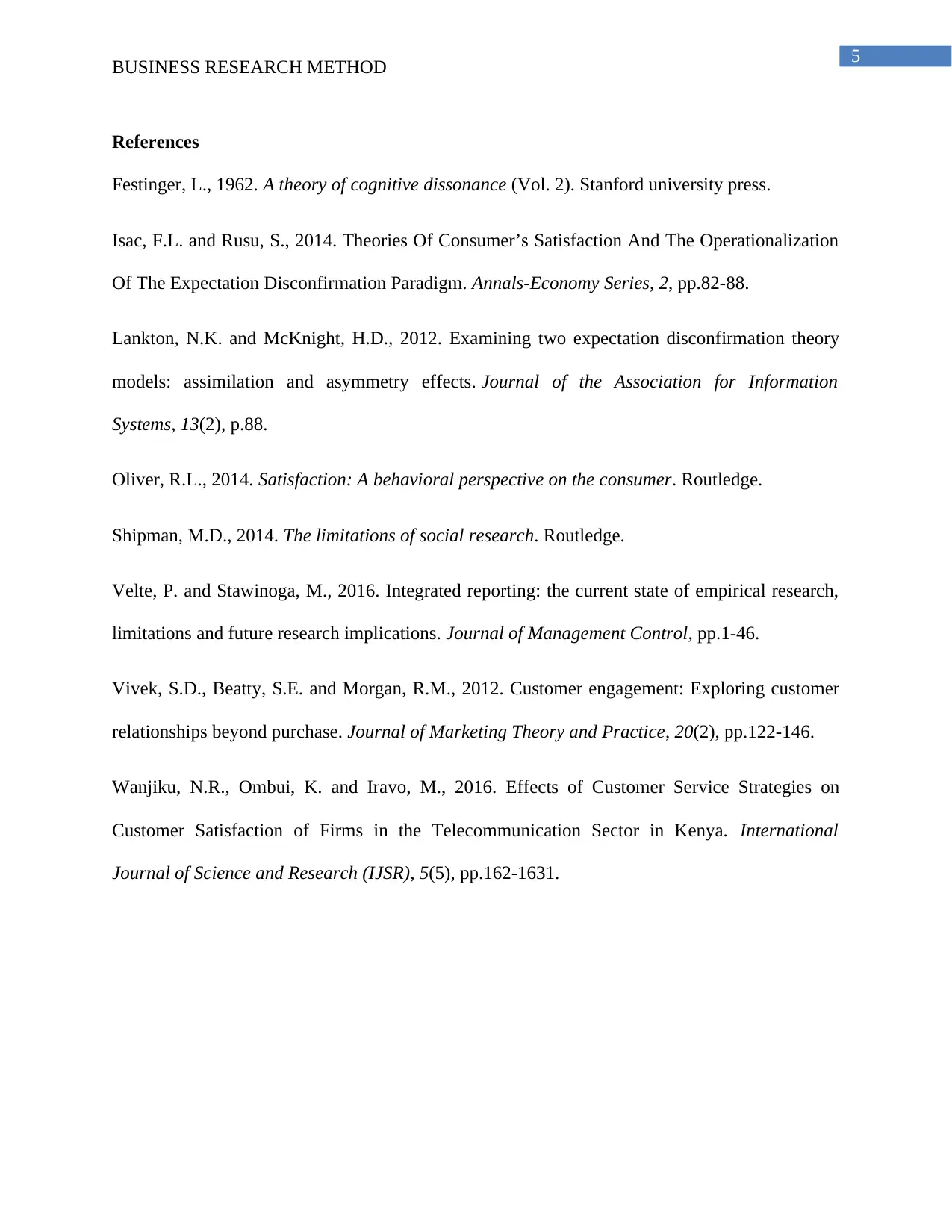
Festinger, L., 1962. A theory of cognitive dissonance (Vol. 2). Stanford university press.
Isac, F.L. and Rusu, S., 2014. Theories Of Consumer’s Satisfaction And The Operationalization
Of The Expectation Disconfirmation Paradigm. Annals-Economy Series, 2, pp.82-88.
Lankton, N.K. and McKnight, H.D., 2012. Examining two expectation disconfirmation theory
models: assimilation and asymmetry effects. Journal of the Association for Information
Systems, 13(2), p.88.
Oliver, R.L., 2014. Satisfaction: A behavioral perspective on the consumer. Routledge.
Shipman, M.D., 2014. The limitations of social research. Routledge.
Velte, P. and Stawinoga, M., 2016. Integrated reporting: the current state of empirical research,
limitations and future research implications. Journal of Management Control, pp.1-46.
Vivek, S.D., Beatty, S.E. and Morgan, R.M., 2012. Customer engagement: Exploring customer
relationships beyond purchase. Journal of Marketing Theory and Practice, 20(2), pp.122-146.
Wanjiku, N.R., Ombui, K. and Iravo, M., 2016. Effects of Customer Service Strategies on
Customer Satisfaction of Firms in the Telecommunication Sector in Kenya. International
Journal of Science and Research (IJSR), 5(5), pp.162-1631.
chevron_up_icon
1 out of 6
circle_padding
hide_on_mobile
zoom_out_icon
[object Object]