CX770031: Convenience Store Customer Service Research Report
VerifiedAdded on 2023/01/23
|10
|2030
|71
Report
AI Summary
This report presents an organizational research design focused on customer service issues within convenience stores, particularly in the context of the New Zealand market. The study identifies key problems such as a lack of understanding of customer needs, inadequate staff knowledge, customer dissatisfaction stemming from various service failures, and long wait times. The research employs both qualitative methods, including individual interviews and observations, and quantitative methods, such as surveys, to gather data from a sample of convenience stores. The analysis includes a 5-Whys analysis to determine root causes, followed by a SWOT analysis to assess strengths, weaknesses, opportunities, and threats. The report suggests several management concepts and tools, such as conceptual models and further SWOT analyses, to address the identified challenges and improve customer service. The report also provides references to support the findings.

Organizational Research Design
Name:
Institution:
Date:
Name:
Institution:
Date:
Paraphrase This Document
Need a fresh take? Get an instant paraphrase of this document with our AI Paraphraser

Introduction
Convenience stores have grown rapidly over the years throughout the whole world and
especially in NZ. This may be largely attributed to the ease of undertaking such businesses .They
are mostly devoid of complex government systems and usually require a small amount of capital
to set up and hence this explains why it is being favored by a majority of people. ( Beck, &
Hopkins,2017). Despite this, convenience stores have encountered a great deal of problems over
the recent years related to customer service. The problems are both internal and external. The
problems have made it difficult for the owners to fully run the businesses and achieve profits or
even break even and have become a major cause of concern.( Chan, & Tan,2016).
First the stores are faced with the issue of not understanding what the customer
wants. Lack of understanding may lead to the owners not having the goods that the customers
need. This is a big problem as failure to have the products in the store could lead to very low
sales and in the worst case no sales at all.
Also there at times in which customer may ask the staff question regarding a certain
product and the staff is unable to give a satisfactory answer. This makes the customer to view the
staff at the store as not having knowledge enough and thus most of them would back out of
purchasing a particular product. (Wu, Huang,Tsai, & Lin. (2017).
Customers at times may have angry tones that may be due to lack of proper attention
being given to them or due to a complaint regarding purchase of a certain product that had
already been done. They may also complain on the general customer service being offered at the
store.
Convenience stores have grown rapidly over the years throughout the whole world and
especially in NZ. This may be largely attributed to the ease of undertaking such businesses .They
are mostly devoid of complex government systems and usually require a small amount of capital
to set up and hence this explains why it is being favored by a majority of people. ( Beck, &
Hopkins,2017). Despite this, convenience stores have encountered a great deal of problems over
the recent years related to customer service. The problems are both internal and external. The
problems have made it difficult for the owners to fully run the businesses and achieve profits or
even break even and have become a major cause of concern.( Chan, & Tan,2016).
First the stores are faced with the issue of not understanding what the customer
wants. Lack of understanding may lead to the owners not having the goods that the customers
need. This is a big problem as failure to have the products in the store could lead to very low
sales and in the worst case no sales at all.
Also there at times in which customer may ask the staff question regarding a certain
product and the staff is unable to give a satisfactory answer. This makes the customer to view the
staff at the store as not having knowledge enough and thus most of them would back out of
purchasing a particular product. (Wu, Huang,Tsai, & Lin. (2017).
Customers at times may have angry tones that may be due to lack of proper attention
being given to them or due to a complaint regarding purchase of a certain product that had
already been done. They may also complain on the general customer service being offered at the
store.

Another major problem facing convenience store is the time spent on attending to a
customer. Most of the customers would prefer a place where they can go in buy what the need,
pay for it and get out as soon as possible. Due to lack of adequate resources the customer may
take a long time in the queue and thus become frustrated. The customer may opt not to come
back and thus the store would lose out on potential revenue.( Blodgett, Bakir, Saklani, Bachheti,
& Bhaskar,2015)
Customer expectations have greatly exceeded over the last years. The expectations are
not constant but keep changing over time.( Chen, 2017). Most of the stores find themselves not
being able to cope with the rate at which the expectations of the customer are changing and thus
find themselves not being able to fulfill the customers’ requirements. Once customers have
notion of your inability, then the sales would drastically reduce as they will prefer to go to
somewhere else.
If the store’s manager can be able to look at these problems and solve them adequately,
they will be able to attract more customers and greatly enhance their revenues.
Research approaches
In the undertaking of this research we have decided to use both qualitative and
quantitative methods in trying to better understand the customer service problems that are facing
many stores.
In using qualitative approach, I decide to go with conducting individual interviews and also
making observations.
customer. Most of the customers would prefer a place where they can go in buy what the need,
pay for it and get out as soon as possible. Due to lack of adequate resources the customer may
take a long time in the queue and thus become frustrated. The customer may opt not to come
back and thus the store would lose out on potential revenue.( Blodgett, Bakir, Saklani, Bachheti,
& Bhaskar,2015)
Customer expectations have greatly exceeded over the last years. The expectations are
not constant but keep changing over time.( Chen, 2017). Most of the stores find themselves not
being able to cope with the rate at which the expectations of the customer are changing and thus
find themselves not being able to fulfill the customers’ requirements. Once customers have
notion of your inability, then the sales would drastically reduce as they will prefer to go to
somewhere else.
If the store’s manager can be able to look at these problems and solve them adequately,
they will be able to attract more customers and greatly enhance their revenues.
Research approaches
In the undertaking of this research we have decided to use both qualitative and
quantitative methods in trying to better understand the customer service problems that are facing
many stores.
In using qualitative approach, I decide to go with conducting individual interviews and also
making observations.
⊘ This is a preview!⊘
Do you want full access?
Subscribe today to unlock all pages.

Trusted by 1+ million students worldwide

Individual interviews are an effective method of gathering information as one is able
to ask the interviewer critical questions regarding the subject topic and get first-hand
information.( Lau, Lam, Cheung, & Leung,2019). The person being interviewed is able to
provide explanations on various things that may not be clear at first and thus one is able to leave
the interview having all the questions answered and satisfied. Observation is also an important
research method as one can be able to critically analyze what is going on by just keeping quiet
and observing. With this method you may be able to notice a lot that goes on during the whole
day unlike the employees who are busy enough to notice some of the mistakes being done.it is a
reliable method as there is no distortion of the information gathered
Quantitative approach usually involves collecting of numerical data. This was done
through surveys which included online, paper survey and telephone interviews. This method was
chosen as it is reliable in the sense that all the data is captured in a particular place and thus there
is no risk of loss of data or distortion of any kind. Also the method is beneficial to the stores as
one can always refer on the data even if it is after some years and still be able to analyze the
customer service that was there at the particular time. (Milner, & Furnham, 2017).
The research system as basically in the following form;
Sampling-the sampling scope was for about 10 convenience stores that are located nearby. My
choice was informed by the performance of these stores over the last few years.
Data collection-I employed interviews, observations and paper survey in coming up with the data
from the stores.
to ask the interviewer critical questions regarding the subject topic and get first-hand
information.( Lau, Lam, Cheung, & Leung,2019). The person being interviewed is able to
provide explanations on various things that may not be clear at first and thus one is able to leave
the interview having all the questions answered and satisfied. Observation is also an important
research method as one can be able to critically analyze what is going on by just keeping quiet
and observing. With this method you may be able to notice a lot that goes on during the whole
day unlike the employees who are busy enough to notice some of the mistakes being done.it is a
reliable method as there is no distortion of the information gathered
Quantitative approach usually involves collecting of numerical data. This was done
through surveys which included online, paper survey and telephone interviews. This method was
chosen as it is reliable in the sense that all the data is captured in a particular place and thus there
is no risk of loss of data or distortion of any kind. Also the method is beneficial to the stores as
one can always refer on the data even if it is after some years and still be able to analyze the
customer service that was there at the particular time. (Milner, & Furnham, 2017).
The research system as basically in the following form;
Sampling-the sampling scope was for about 10 convenience stores that are located nearby. My
choice was informed by the performance of these stores over the last few years.
Data collection-I employed interviews, observations and paper survey in coming up with the data
from the stores.
Paraphrase This Document
Need a fresh take? Get an instant paraphrase of this document with our AI Paraphraser

Data analysis-I analyzed the data based on the major customer challenges that has been facing
the stores of late. I was able to group this into 5 major problems and then went on to record for
each store the kind of problem that they had using the 5whys as mentioned below;
Why? The stores lacked products
Why? They had no wide knowledge of product issues
Why? They lack advanced equipment’s
Why? They are not offering customers attention
Why? They can’t fulfill customer expectations
This was followed by an analysis of the strength and weakness they had and also listed
the areas of improvement that the convenience stores had to work on to avoid these problems in
the near future.
Management concepts theories and tools
There are several management concepts and tools which can e used in relation to the
problems facing the convenience stores.
The management may decide to come up with a conceptual model to critically
analyze the challenges they are facing ( Roy, Lassar, & Shekhar,2016.) A conceptual model is a
representation of all the facts regarding a certain issue. The concept uses ideas in order to come
up with the representation. Once this is done they will be able to identify the requirements that
they need, the ways of executing the various ideas and program that they have and finally the
results that they so wish to achieve.
the stores of late. I was able to group this into 5 major problems and then went on to record for
each store the kind of problem that they had using the 5whys as mentioned below;
Why? The stores lacked products
Why? They had no wide knowledge of product issues
Why? They lack advanced equipment’s
Why? They are not offering customers attention
Why? They can’t fulfill customer expectations
This was followed by an analysis of the strength and weakness they had and also listed
the areas of improvement that the convenience stores had to work on to avoid these problems in
the near future.
Management concepts theories and tools
There are several management concepts and tools which can e used in relation to the
problems facing the convenience stores.
The management may decide to come up with a conceptual model to critically
analyze the challenges they are facing ( Roy, Lassar, & Shekhar,2016.) A conceptual model is a
representation of all the facts regarding a certain issue. The concept uses ideas in order to come
up with the representation. Once this is done they will be able to identify the requirements that
they need, the ways of executing the various ideas and program that they have and finally the
results that they so wish to achieve.

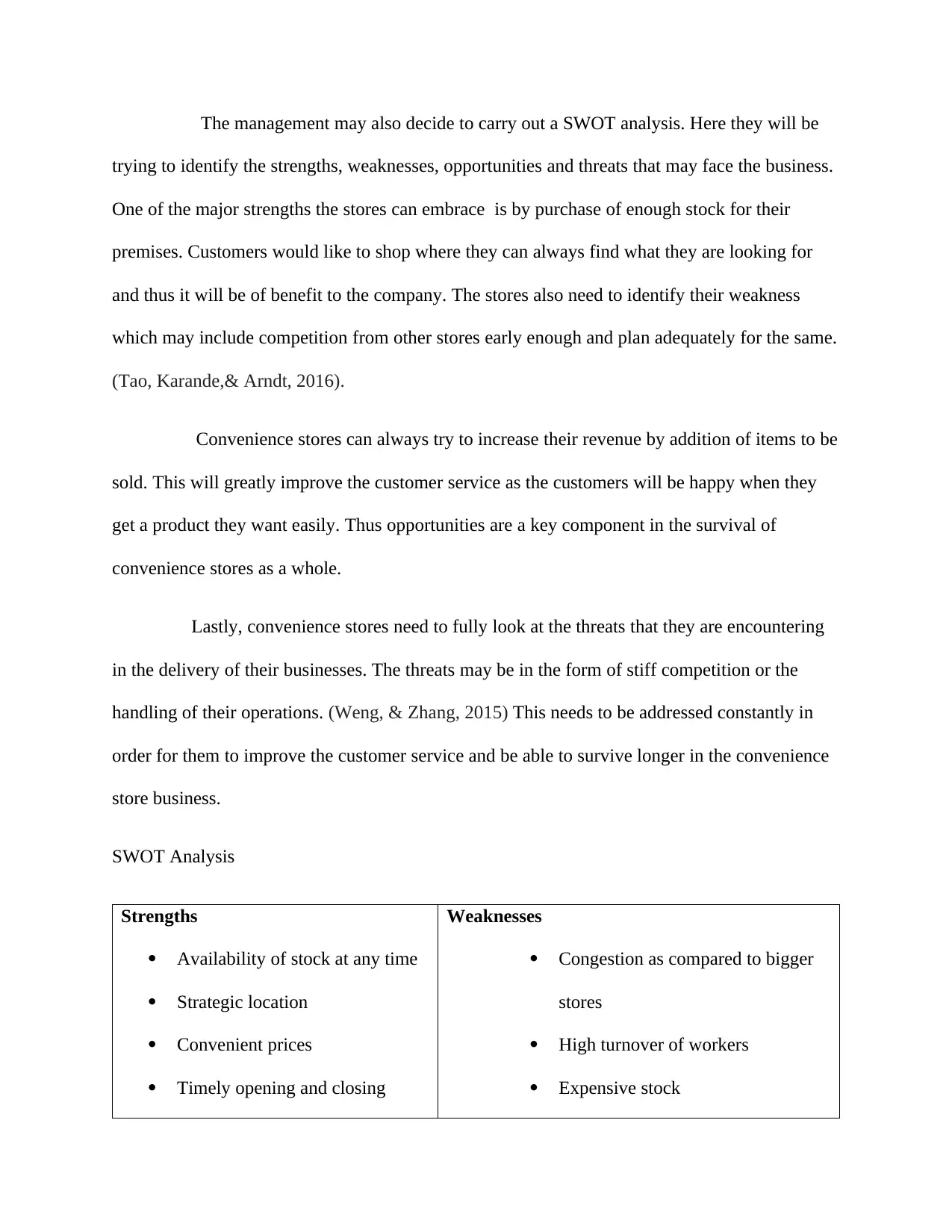
The management may also decide to carry out a SWOT analysis. Here they will be
trying to identify the strengths, weaknesses, opportunities and threats that may face the business.
One of the major strengths the stores can embrace is by purchase of enough stock for their
premises. Customers would like to shop where they can always find what they are looking for
and thus it will be of benefit to the company. The stores also need to identify their weakness
which may include competition from other stores early enough and plan adequately for the same.
(Tao, Karande,& Arndt, 2016).
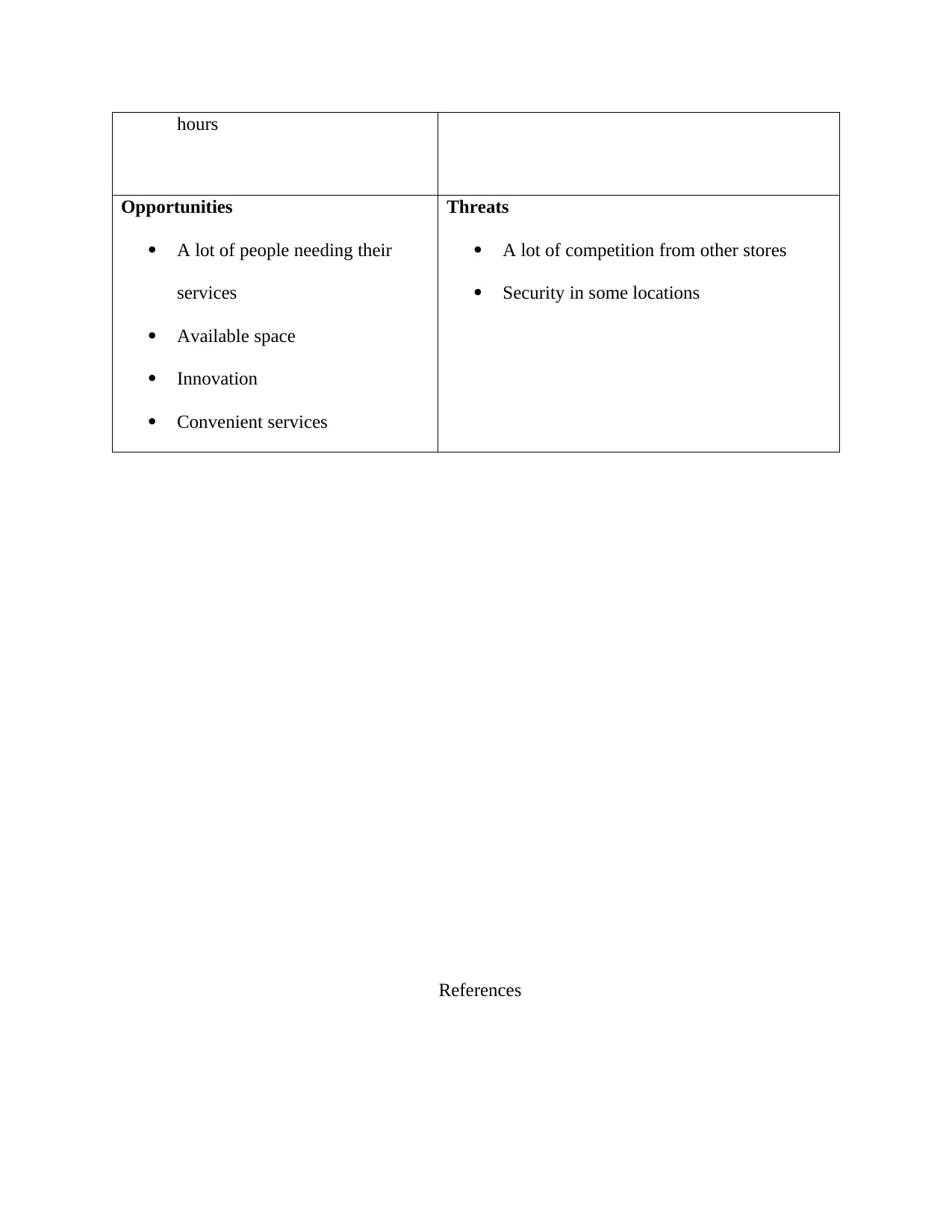
Convenience stores can always try to increase their revenue by addition of items to be
sold. This will greatly improve the customer service as the customers will be happy when they
get a product they want easily. Thus opportunities are a key component in the survival of
convenience stores as a whole.
Lastly, convenience stores need to fully look at the threats that they are encountering
in the delivery of their businesses. The threats may be in the form of stiff competition or the
handling of their operations. (Weng, & Zhang, 2015) This needs to be addressed constantly in
order for them to improve the customer service and be able to survive longer in the convenience
store business.
SWOT Analysis
Strengths
Availability of stock at any time
Strategic location
Convenient prices
Timely opening and closing
Weaknesses
Congestion as compared to bigger
stores
High turnover of workers
Expensive stock
trying to identify the strengths, weaknesses, opportunities and threats that may face the business.
One of the major strengths the stores can embrace is by purchase of enough stock for their
premises. Customers would like to shop where they can always find what they are looking for
and thus it will be of benefit to the company. The stores also need to identify their weakness
which may include competition from other stores early enough and plan adequately for the same.
(Tao, Karande,& Arndt, 2016).
Convenience stores can always try to increase their revenue by addition of items to be
sold. This will greatly improve the customer service as the customers will be happy when they
get a product they want easily. Thus opportunities are a key component in the survival of
convenience stores as a whole.
Lastly, convenience stores need to fully look at the threats that they are encountering
in the delivery of their businesses. The threats may be in the form of stiff competition or the
handling of their operations. (Weng, & Zhang, 2015) This needs to be addressed constantly in
order for them to improve the customer service and be able to survive longer in the convenience
store business.
SWOT Analysis
Strengths
Availability of stock at any time
Strategic location
Convenient prices
Timely opening and closing
Weaknesses
Congestion as compared to bigger
stores
High turnover of workers
Expensive stock
⊘ This is a preview!⊘
Do you want full access?
Subscribe today to unlock all pages.

Trusted by 1+ million students worldwide

hours
Opportunities
A lot of people needing their
services
Available space
Innovation
Convenient services
Threats
A lot of competition from other stores
Security in some locations
References
Opportunities
A lot of people needing their
services
Available space
Innovation
Convenient services
Threats
A lot of competition from other stores
Security in some locations
References
Paraphrase This Document
Need a fresh take? Get an instant paraphrase of this document with our AI Paraphraser

Beck, A., & Hopkins, M. (2017). Scan and rob! Convenience shopping, crime opportunity and
corporate social responsibility in a mobile world. Security journal, 30(4), 1080-1096.
https://link.springer.com/article/10.1057/sj.2016.6
Chan, S. J., & Tan, C. L. (2016). A Model Linking Store Attributes, Service Quality and
Customer Experience: A Study Among Community Pharmacies. International Journal of
Economics & Management, 10(2).
http://www.ijem.upm.edu.my/vol10no2/(7)VOL_10(2)_Chan%20Suzi%20Jack_A%20Model
%20Linking.......pdf
Chen, A. C. (2017). Active and Latent Failures in Customer Services and Opportunities for
Quality Innovation for Convenience Stores. International Journal for Innovation Education and
Research, 5(12), 228-236.
https://ijier.net/index.php/ijier/article/view/894
Blodgett, J. G., Bakir, A., Saklani, A., Bachheti, M., & Bhaskar, S. (2015). CUSTOMER
COMPLAINT BEHAVIOR: AN EXAMINATION OF CULTURAL VS. SITUATIONAL
FACTORS. Journal of Consumer Satisfaction, Dissatisfaction & Complaining Behavior, 28.
https://web.b.ebscohost.com/abstract?
direct=true&profile=ehost&scope=site&authtype=crawler&jrnl=08998620&AN=114467562&h=jYYxM7O
AGlEXWF4cfATMVgAQXWqONcdvZIyN59%2fAT3R491qCcqTHwBZcFb9orE9b2ho1fGF
%2bN3lSqMyoYKKz8w%3d
%3d&crl=c&resultNs=AdminWebAuth&resultLocal=ErrCrlNotAuth&crlhashurl=login.aspx%3fdirect
corporate social responsibility in a mobile world. Security journal, 30(4), 1080-1096.
https://link.springer.com/article/10.1057/sj.2016.6
Chan, S. J., & Tan, C. L. (2016). A Model Linking Store Attributes, Service Quality and
Customer Experience: A Study Among Community Pharmacies. International Journal of
Economics & Management, 10(2).
http://www.ijem.upm.edu.my/vol10no2/(7)VOL_10(2)_Chan%20Suzi%20Jack_A%20Model
%20Linking.......pdf
Chen, A. C. (2017). Active and Latent Failures in Customer Services and Opportunities for
Quality Innovation for Convenience Stores. International Journal for Innovation Education and
Research, 5(12), 228-236.
https://ijier.net/index.php/ijier/article/view/894
Blodgett, J. G., Bakir, A., Saklani, A., Bachheti, M., & Bhaskar, S. (2015). CUSTOMER
COMPLAINT BEHAVIOR: AN EXAMINATION OF CULTURAL VS. SITUATIONAL
FACTORS. Journal of Consumer Satisfaction, Dissatisfaction & Complaining Behavior, 28.
https://web.b.ebscohost.com/abstract?
direct=true&profile=ehost&scope=site&authtype=crawler&jrnl=08998620&AN=114467562&h=jYYxM7O
AGlEXWF4cfATMVgAQXWqONcdvZIyN59%2fAT3R491qCcqTHwBZcFb9orE9b2ho1fGF
%2bN3lSqMyoYKKz8w%3d
%3d&crl=c&resultNs=AdminWebAuth&resultLocal=ErrCrlNotAuth&crlhashurl=login.aspx%3fdirect

%3dtrue%26profile%3dehost%26scope%3dsite%26authtype%3dcrawler%26jrnl%3d08998620%26AN
%3d114467562
Lau, M. M., Lam, A. Y., Cheung, R., & Leung, T. F. (2019, January). Understanding
determinants of customer behavioral intention in using mobile payment at convenience stores.
In Proceedings of the 10th International Conference on E-Education, E-Business, E-
Management and E-Learning (pp. 357-362). ACM.
https://dl.acm.org/citation.cfm?id=3306549
Milner, R., & Furnham, A. (2017). Measuring customer feedback, response and
satisfaction. Psychology, 8(03), 350.
http://file.scirp.org/pdf/PSYCH_2017021414540782.pdf
Roy, S. K., Lassar, W. M., & Shekhar, V. (2016). Convenience and satisfaction: mediation of
fairness and quality. The Service Industries Journal, 36(5-6), 239-260.
https://www.tandfonline.com/doi/abs/10.1080/02642069.2016.1186657
Tao, K., Karande, K., & Arndt, A. D. (2016). How angry customer complaints influence
salesperson commitment to service quality. Journal of Marketing Theory and Practice, 24(3),
265-282.
https://www.tandfonline.com/doi/abs/10.1080/10696679.2016.1170521
Voorhees, C. M., Fombelle, P. W., Gregoire, Y., Bone, S., Gustafsson, A., Sousa, R., &
Walkowiak, T. (2017). Service encounters, experiences and the customer journey: Defining the
field and a call to expand our lens. Journal of Business Research, 79, 269-280.
%3d114467562
Lau, M. M., Lam, A. Y., Cheung, R., & Leung, T. F. (2019, January). Understanding
determinants of customer behavioral intention in using mobile payment at convenience stores.
In Proceedings of the 10th International Conference on E-Education, E-Business, E-
Management and E-Learning (pp. 357-362). ACM.
https://dl.acm.org/citation.cfm?id=3306549
Milner, R., & Furnham, A. (2017). Measuring customer feedback, response and
satisfaction. Psychology, 8(03), 350.
http://file.scirp.org/pdf/PSYCH_2017021414540782.pdf
Roy, S. K., Lassar, W. M., & Shekhar, V. (2016). Convenience and satisfaction: mediation of
fairness and quality. The Service Industries Journal, 36(5-6), 239-260.
https://www.tandfonline.com/doi/abs/10.1080/02642069.2016.1186657
Tao, K., Karande, K., & Arndt, A. D. (2016). How angry customer complaints influence
salesperson commitment to service quality. Journal of Marketing Theory and Practice, 24(3),
265-282.
https://www.tandfonline.com/doi/abs/10.1080/10696679.2016.1170521
Voorhees, C. M., Fombelle, P. W., Gregoire, Y., Bone, S., Gustafsson, A., Sousa, R., &
Walkowiak, T. (2017). Service encounters, experiences and the customer journey: Defining the
field and a call to expand our lens. Journal of Business Research, 79, 269-280.
⊘ This is a preview!⊘
Do you want full access?
Subscribe today to unlock all pages.

Trusted by 1+ million students worldwide

https://www.sciencedirect.com/science/article/pii/S0148296317301364
Weng, X., & Zhang, L. (2015). Analysis of O2O model’s development problems and
trend. Ibusiness, 7(01), 51.
http://citeseerx.ist.psu.edu/viewdoc/download?doi=10.1.1.945.5093&rep=rep1&type=pdf
Weng, X., & Zhang, L. (2015). Analysis of O2O model’s development problems and
trend. Ibusiness, 7(01), 51.
http://citeseerx.ist.psu.edu/viewdoc/download?doi=10.1.1.945.5093&rep=rep1&type=pdf
1 out of 10
Related Documents
Your All-in-One AI-Powered Toolkit for Academic Success.
+13062052269
info@desklib.com
Available 24*7 on WhatsApp / Email
Unlock your academic potential
Copyright © 2020–2025 A2Z Services. All Rights Reserved. Developed and managed by ZUCOL.